By www.CentralBankNews.info Sri Lanka’s central bank held its benchmark repurchase rate steady at 7.50 percent and said inflation is expected to start declining in March and “reach a more favourable level by the end of the year.”
The Central Bank of Sri Lanka, which raised rates by a 50 basis points in 2012, said the decline in inflation should also offset the upward pressure from an expected revision to administered prices.
Sri Lanka’s inflation rate was steady at 9.8 percent in February from January, reflecting the remaining impact of changes to administered prices and disruptions to food supplies.
“Inflation has been at single digits over the past 49 months and the positive outlook for inflation is expected to continue, supported by well contained demand and favourable domestic and global supply conditions,” the central bank said.
But the central bank voiced concern that after its rate cut in December, commercial lending and deposit rates remain high. However, following recent discussions with leading banks, the central bank expects rates to be adjusted and this should “stimulate private sector economic activity towards the growth targets for 2013.”
The central bank raised rates by 75 basis points during 2012 to rein in credit growth but then cut its rate by 25 basis points in December and removed its ceiling on loan growth as inflation was declining.
Credit extended to the private sector continued to ease in January to an annual rate of 15.5 percent from the peak of 35.2 percent last March, “indicating that the relaxation of monetary policy in December 2012 is yet to be reflected in bank lending,” the bank said.
Sri Lanka’s balance of payments has also continued to rise and “comfortable surplus is anticipated in 2013” even if the central bank has bought $US 486 million net this year. The exchange rate has been stable due to increased foreign exchange flows to the government bond market and from tourism and private transfers, the bank said.
Sri Lanka’s Gross Domestic Product expanded by an annual rate of 4.8 percent in the third quarter, down from 6.4 percent in the second. The central bank expects economic growth to reach 7.5 percent this year, above the International Monetary Fund’s forecast of 6.25 percent. In 2011 Sri Lanka’s economy expanded by 8.3 percent.
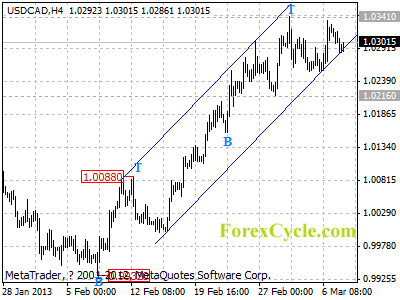
USDCAD failed to break above 1.0341 resistance
USDCAD failed to break above 1.0341 resistance and stays in a trading range between 1.0216 and 1.0341. Key support is at 1.0216, as long as this level holds, the price action in the range could be treated as consolidation of the uptrend from 0.9932, and another rise to 1.0400 is still possible after consolidation. On the downside, a breakdown below 1.0216 will indicate that lengthier consolidation of the longer term uptrend from 0.9815 (Jan 11 low) is underway, then the pair will find support around 1.0150.
Why the Stock Market Boom is on Pause
We had lunch with a couple of old broker pals yesterday. The broad opinion was that we were all worried that the stock market was heading for a fall.
But not the whole stock market, just one bunch of stocks in particular.
Trouble is those bunch of stocks happen to make up a big percentage of the market. We’re talking about dividend stocks.
As one of our lunch pals said, ‘It’s hard to recommend [Commonwealth Bank] when it’s trading near $70.’
However, just because a market or stock hits a new high, it doesn’t mean it will fall straight away. That’s because there’s one key factor you can’t ignore – the Reserve Bank of Australia (RBA).
As long as the RBA keeps interest rates low it will be difficult for investors to sell stocks yielding 5% or 6% in favour of bank deposits paying 3% or 4%.
So how long could this last? This is where we can look to the US for an insight. Here’s a chart of the Dow Jones Industrial Average that this week broke through to an all-time high:

Source: Google Finance
As you can see from the chart, the Dow muddled around in about a 10% trading range for a year…before eventually breaking out higher.
It meant that investors in the US faced the same problem that Aussie investors face now. Do you stick with stocks that may not grow any further, and which pay dividends that may not grow either? Or do you sell and get next to nothing in a low-risk but low paying bank account?
Here’s our advice…
Our Two Favourite Assets for 2013
For the past couple of years we’ve tried to keep things fairly simple.
We told you to buy dividend-paying shares to get better-than-the-bank income. That strategy paid off…although not in the way we expected. We didn’t bank on boring old dividend-payers rocketing up 30% or 40% in just a few months.
We tipped income stocks because we expected them to be stable and offer a stable income.
That’s why at the lunch yesterday there was some caution about the outlook for these types of shares.
But if you’ve followed all my advice you won’t just own dividend shares. By now you should have your assets nicely spread across a few asset classes (eg. Gold, cash, dividend shares, small-caps).
The next trick is to work out where you’ll put your incoming cash flow to work. You’ll need to decide which of those assets you believe will perform best over the coming months.
Until recently, we thought gold was the best bet, but we’re having second thoughts. We’ve even held off on an expected gold purchase. Instead, we’re looking at two other asset classes for the short term – dividend stocks and small-caps stocks.
Small-caps are obvious. The stock market has beaten them to a pulp over the past year, but we’re so convinced that the time is right to buy small-cap stocks that we’ve hired a research analyst (Sam) to help us scour the market for quality (and speculative) small-cap stocks.
You’ll hear from Sam and get to see some of his analysis later in the week.
The other asset class – dividend stocks – may not seem so obvious. That’s especially so if you look at the big run up these stocks have had recently…
Keep a Look Out for ‘Cheaper’ Shares
But if we look at the Dow Jones index as a template for what can happen after a big run, it’s plain to see that the Australian share market could follow the same pattern.
That is, after reaching or getting near a key level (in the Aussie market’s case, 5,000 points), investors will take a break. As we mentioned above, investors find it emotionally hard to buy shares when they’re trading at the top of a trend.
But after stocks have traded at or around a certain level for some time, investors can get used to it. And importantly, they start taking more notice of the fundamentals. They’re looking for an excuse to either buy or sell shares.
The US market suffered this fate for a year. Stocks traded in a range until investors had an excuse to buy and push prices even higher. The catalyst in the US market (aside from money printing) was higher company profits.
Today, it appears that investors feel that this is as much as they’ll pay for stocks based on current earnings and dividend levels. Or that’s how we’re reading the recent spate of volatility.
In short, while we’re still bullish on the stock market, it always makes sense to revisit your investing gameplan. Right now, we wouldn’t be surprised to see stocks wobble either side of 5,000 points for most of the rest of this year.
That should give you plenty of chances to put some of your free cash flow to work by buying dividend stocks as they slip to ‘cheaper’ levels.
Just remember, don’t invest all your cash. You still need a big cash buffer (20% minimum is our tip), but the next ten months could give you the perfect chance to grab stock market volatility by the scruff of the neck and get it to work for you rather than against you.
Cheers,
Kris
Join me on Google+
From the Port Phillip Publishing Library
Special Report: Australia’s Energy Stock BLOWOUT
Daily Reckoning: The Australian Shale Rush Begins
Money Morning: Why the Dow Jones Record High Doesn’t Matter
Pursuit of Happiness: Here’s Why I’m Positive about the Future and Technology
Australian Small-Cap Investigator: Why Invest in Small-Cap Stocks? And Why Now?
Can Kuroda’s New Round of Easy Money Finally Revive Japan’s Economy?
[Kyoto, Japan] – I think I hear the sounds of helicopter engines warming up in Tokyo.
Newly elected 2nd time Prime Minister Shinzo Abe has officially tapped Haruhiko Kuroda as the next head of the Bank of Japan and the financial markets here seem quite pleased.
Since rumours of his nomination surfaced in conjunction with Shinzo Abe’s election campaign last November, the Nikkei has risen nearly 30%. But the Nikkei’s rise is based on little more than hope and ‘Abenomics’ – which is not unlike US markets that have risen with each new infusion of Bernanke Bucks.
Unfortunately, disappointment is the more likely outcome when reality sets in.
It’s not that there is anything wrong with Kuroda-san. He’s aggressive and has a solid track record as president of the Asian Development Bank. Like many here he wants to ease monetary policy even further to stimulate the Japanese economy out of the hole it’s dug for itself over the past 23 years.
I just question what ‘else’ he possibly can do to fix it.
Even More Stimulus for the Japanese Economy
Interest rates, which are a primary monetary policy tool here like they are in the United States and Europe, are already staggeringly low with benchmark 10- year rates at 0.678%, according to the Ministry of Finance’s website. Kuroda can’t take them much lower. Zero is still zero any way you cut it.
Like a long truck backed into a tight alley, he’s got very few options at his disposal.
Speaking of which, Abe made a big deal out of setting higher inflation rates on the campaign trail last year. Not surprisingly, the Bank of Japan acquiesced in a 7-to-2 vote to double the official inflation target to 2% up from 1%.
Considering the bank’s official inflation target for 2014 is 0.9%, and the Japanese economy has been unable to hit even 1% despite 23 long years of trying and 8 to 10 failed stimulus plans (depending on how you count them), this is a big deal made all the more critical on the heels of three straight quarters of economic contraction.
Further, as my colleague Martin Hutchinson recently observed, moving the needle to 2% would require a massive bond purchase scheme of about $1.2 trillion by January 2014, plus another $150 billion per month after that. Bernanke’s madcap plans are presently running $85 billion a month, to put that figure into context.
As Martin points out, ‘that’s nearly twice the size of Ben Bernanke’s stimulus program for the United States, and Japan’s economy is only one-third the size of the US economy.’
Plus, if interest rates actually increase by as little as 2%, the Japanese economy has another problem. The nation will have to spend its entire current budget servicing debt. Its entire budget.
There’s also been talk of Kuroda buying so-called ‘exotics’, like gold, corporate bonds and various ETFs. He is, after all, known for thinking outside the box, but I think he’s unlikely to get the kind of support needed here to pull that off.
Besides, even if he does, there simply isn’t the kind of liquidity he needs in the global market to absorb Japan’s purchases without sending prices haywire.
Kuroda could also decide to purchase foreign currency bonds. However, in doing so he risks the unthinkable – a 1930s style currency war that would sweep through global markets faster than one of Berlusconi’s so-called bunga-bunga parties.
Following a Dangerous Path
I believe, though, that Kuroda will do his best to steer clear of the more radical solutions being proposed even though they do potentially address the biggest thorn in his economic side – deep structural imbalances in everything from demographics to productivity.
For example, Seiko Noda, a Japanese legislator who’s served since 1993 and in several cabinet level positions, recently suggested banning abortions as a means of improving the birth rate and raising a productive workforce.
That might strike you as extreme, but she’s not kidding and she’s not a fringe lunatic. The Japanese have one of the world’s lowest birthrates, and it’s placing serious strains on the financial system at a time when Japan literally can’t afford to have this happen.
As I have noted many times previously in Money Morning, this translates into a decreasing pool of productive, taxpaying workers while simultaneously draining both health care and retirement programs, further decreasing productivity and hampering recovery efforts.
Taro Aso, Japan’s Finance Minister who also serves as Deputy Prime Minister, stands at the other end of the spectrum. He drew fire recently for suggesting that Japanese seniors should hurry up and die.
Callous? You bet, at least to Western ears, but he’s not that far off either, numerically speaking and human costs aside.
Seniors make up more than 25% of Japan’s population and the number of ‘silvers’ is increasing dramatically. Estimates suggest that the number of seniors will outnumber those 15 and younger 4 to 1 in less than 20 years.
For investors, lighten up on Japanese companies, using each rally to move up trailing stops and harvest winners. I don’t believe Kuroda is going to be able to achieve anything markedly different from his predecessors despite lots of big talk and aggressive posturing.
That means somebody is going to be left holding the bag: don’t let it be you.
There is one final thought, albeit a very disturbing one – what’s happening in Japan now is a look into the USA’s in the not-too-distant future.
Our leaders would be wise to study what’s happening here very carefully or risk subjecting the US to the same kind of ‘recovery’ that’s plagued Japan’s economy for the last 23 years.
Keith Fitz-Gerald
Contributing Editor, Money Morning
Publisher’s Note: This is an edited version of an article that originally appeared in Money Morning (USA)
Join Money Morning on Google+
From the Archives…
Gold’s Dark Hour Before Dawn
1-03-2013 – Dr. Alex Cowie
The Primary Colours of Investing
28-02-2013 – Kris Sayce
Revealed: Inside a Share Trader’s Den
27-02-2013 – Murray Dawes
Where to Find Value in this Rising Stock Market
26-02-2013 – Kris Sayce
China Bull Versus China Bear – There Can Only Be One Winner
25-02-2013 – Dr. Alex Cowie
Peru holds rate steady, sees inflation converging to 2%
By www.CentralBankNews.info Peru’s central bank maintained its policy rate at 4.25 percent as inflation recovers from supply-side shocks and economic growth remains close to potential.
The Central Reserve Bank of Peru (BCRP), which has held rates steady since April 2011, said it expects inflation to converge towards 2.0 percent in coming months due to improvements in the supply of foods and productive activity that is close to potential in a generally weak economic environment.
Peru’s headline inflation rate fell to 2.45 percent in February from January’s 2.87 percent, primarily reflecting a decline in food prices, the central bank said.
The underlying annual inflation rate was 3.22 percent in February and inflation excluding food and energy was 2.20 percent, the bank added.
Peru’s Gross Domestic Product expanded by only 0.6 percent in the fourth quarter from the third quarter for an annual rate of 5.9 percent, down from the third quarter’s pace of 6.8 percent.
The BCRP targets annual inflation of 1.0-3.0 percent.
www.CentralBankNews.info
Thursday, February 7, 2013
Peru holds rate steady, sees inflation converging to target
Peru’s central bank kept its policy rate steady at 4.25 percent, saying inflation is expected to converge toward the bank’s 2.0 percent mid-point target in coming months, reflecting improved supply of food and economic activity that is close to its potential during a time of weak global output.
The Central Reserve Bank of Peru (BCRP), which has held rates steady since April 2011, also said the country’s economy had stabilized around its sustainable, long-term level of activity although sectors that depend on external markets remain weak.
Peru’s inflation rate rose to 2.87 percent in January, up from December’s 2.65 percent, still within the central bank’s target range of 1.0-3.0 percent.
Peru’s Gross Domestic Product rose by an annual rate of 6.5 percent in the third quarter of 2012, up from 6.3 percent in the second quarter.
At its previous meeting in January, the central bank also said it expects inflation to converge toward its 2.0 percent target.
The Central Reserve Bank of Peru (BCRP), which has held rates steady since April 2011, also said the country’s economy had stabilized around its sustainable, long-term level of activity although sectors that depend on external markets remain weak.
Peru’s inflation rate rose to 2.87 percent in January, up from December’s 2.65 percent, still within the central bank’s target range of 1.0-3.0 percent.
Peru’s Gross Domestic Product rose by an annual rate of 6.5 percent in the third quarter of 2012, up from 6.3 percent in the second quarter.
At its previous meeting in January, the central bank also said it expects inflation to converge toward its 2.0 percent target.
The central bank has said it expects inflation to merge toward 2 percent this year, and it now seems more worried about the effect of the wobbly global economy on Peru’s swift expansion than about rapidly rising prices.
Peru’s potential growth rate, the maximum rate the economy can expand without provoking excessive inflation, is normally seen around 6 percent or 6.5 percent.
The government has said Peru’s economy probably expanded 6.3 percent in all of 2012. A similar pace is expected this year.
The central bank has described its current monetary stance as slightly tighter than neutral. It has raised bank reserve requirements six times since May to soften the impact of heavy capital inflows on the local currency and to steady a quick credit expansion.
The country is a top exporter of minerals, which drive some 60 percent of its international shipments. Exports have slumped in recent months, and domestic lending, consumption and construction are now fueling the country’s economic expansion.
ECB policy accommodative, gov’s must help confidence
By www.CentralBankNews.info The European Central Bank (ECB), which earlier today held its benchmark refi rate steady, said its accommodative policy stance was supporting economic recovery and it is up to governments to bolster confidence through structural reform and continued fiscal tightening.
ECB President Mario Draghi told a press conference that the ECB’s governing council had discussed a rate cut but “the prevailing consensus was to leave rates unchanged,” raising the prospect that rate cuts will be discussed in future council meetings if the economy remains mired in recession and inflation is below the ECB’s target.
Draghi remained cautiously optimistic that the euro area’s struggling economy should start to recover later this year on the back of stronger global demand, despite a downward revision in economic forecasts by the ECB staff.
The ECB’s latest forecasts calls for average real Gross Domestic Product growth in the 17 nations that share the euro of between -0.9 and -0.1 percent in 2013 and between 0.0 and 2.0 percent in 2014.
In the fourth quarter of 2012, the euro zone GDP shrank by 0.6 percent, the fifth quarterly contraction in a row, for an annual drop of 0.9 percent.
The ECB cut its benchmark refinancing rate by 25 basis points to 0.75 percent in 2012.
Although euro area inflation has declined below the ECB’s target and is expected to remain contained, Draghi only said this would “allow our monetary policy stance to remain accommodative.”
Some economists had speculated that the decline in inflation to under 2.0 percent would allow the ECB to start thinking of cutting rates. The ECB targets inflation of below, but close to 2 percent.
In February the euro area inflation rate fell to 1.8 percent from January’s 2.0 percent and the latest ECB staff forecast calls for inflation of 1.2-2.0 percent this year and between 0.6 and 2.0 percent in 2014.
“In order to support confidence, it is essential for governments to continue implementing structural reforms, to build further on the progress made in fiscal consolidation, and to proceed with financial sector restructuring,” Draghi said, basically saying the ECB has done its part to boost growth and now it is up to governments to do their part.
www.CentralBankNews.info
Adam Hewison’s Financial Market Afternoon Update & Trade Trends
Try MarketClub for 30 Days for just $8.95 – Click Here!
New All-Time Highs on the Dow: Does It Matter?
Watch a (very) informal discussion of the Dow’s new all-time highs between InvestorPlace’s Jeff Reeves and Sizemore Capital’s Charles Sizemore:
SUBSCRIBE to Sizemore Insights via e-mail today.
The post New All-Time Highs on the Dow: Does It Matter? appeared first on Sizemore Insights.
Be Careful: Russia is Back to Stay in the Middle East
By OilPrice.com
Russia is back. President Vladimir Putin wants the world to acknowledge that Russia remains a global power. He is making his stand in Syria.
The Soviet Union acquired the Tardus Naval Port in Syria in 1971 without any real purpose for it. With their ships welcomed in Algeria, Cuba or Vietnam, Tardus was too insignificant to be developed. After the collapse of the Soviet Union, Russia lacked the funds to spend on the base and no reason to invest in it.
The Russian return to the Middle East brought them first to where the Soviet Union had its closest ties. Libya had been a major buyer of arms and many of the military officers had studied in the Soviet Union. Russia was no longer a global power, but it could be used by the Libyans as a counter force to block domination by the United States and Europeans.
When Gaddafi fell, Tardus became Russia’s only presence in the region. That and the discovery of vast gas deposits just offshore have transformed the once insignificant port into a strategic necessity.
Earlier at the United Nations, Russia had failed to realize that Security Council Resolution 1973 that was to implement a new policy of “responsibility to protect” cloaked a hidden agenda. It was to be turned from a no-fly zone into a free-fire zone for NATO. That strategic blunder of not vetoing the resolution led to the destruction of Gaddafi’s regime and cost Russia construction contracts and its investments in Libyan gas and oil to the tune of 10 billion dollars.
That was one more in a series of humiliating defeats; and something that Putin will not allow to happen again while he is president. Since his time as an officer in the KGB, he has seen the Soviet Empire lose half of its population, a quarter of its land mass, and most of its global influence. He has described the collapse of the Soviet Union as a “geopolitical catastrophe.”
In spite of all of the pressure from Washington and elsewhere to have him persuade Bashar Al-Assad to relinquish power, Putin is staying loyal to the isolated regime. He is calculating that Russia can afford to lose among the Arabs what little prestige that it has remaining and gain a major political and economic advantage in Southern Europe and in the Eastern Mediterranean.
What Russia lost through the anti-Al-Assad alliance was the possibility to control the natural gas market across Europe and the means to shape events on the continent. In July 2011, Iran, Iraq, and Syria agreed to build a gas pipeline from the South Pars gas field in Iran to Lebanon and across the Mediterranean to Europe. The pipeline that would have been managed by Gazprom would have carried 110 million cubic meters of gas. About a quarter of the gas would be consumed by the transit countries, leaving seventy or so million cubic meters to be sold to Europe.
Violence in Iraq and the Syrian civil war has ended any hope that the pipeline will be built, but not all hope is lost. One possibility is for Al-Assad to withdraw to the traditional Aliwite coastal enclave to begin the partitioning of Syria into three or more separate zones, Aliwite, Kurdish, and Sunni. Al-Assad’s grandfather in 1936 had asked the French administrators of the Syrian mandate to create a separate Aliwite territory in order to avoid just this type of ethnic violence.
What the French would not do circumstance may force the grandson to accept as his only choice to survive. His one hundred thousand heavily armed troops would be able to defend the enclave.
The four or five million Aliwites, Christians, and Druze would have agricultural land, water, a deep water port and an international airport. Very importantly, they would have the still undeveloped natural gas offshore fields that extend from Israel, Lebanon, and Cyprus. The Aliwite Republic could be energy self-sufficient and even an exporter. Of course, Russia’s Gazprom in which Putin has a vital interest would get a privileged position in the development of the resource.
In an last effort to bring the nearly two year long civil war to an end, Russia’s foreign minister Sergei Lavrov urged Syrian president Bashar al-Assad at the end of December to start talks with the Syrian opposition in line with the agreements for a cease fire that was reached in Geneva on 30 June. The Russians have also extended the invitation to the Syrian opposition National Coalition head, Ahmed Moaz al-Khatib. The National Coalition refuses to negotiate with Al-Assad and Al-Assad will not relinquish power voluntarily.
The hardened positions of both sides leaves little hope for a negotiated settlement; and foreign minister Sergei Lavrov has made it clear that only by an agreement among the Syrians will Russia accept the removal of Al-Assad. Neither do they see a settlement through a battlefield victory which leaves only a partitioning that will allow the civil war to just wind down as all sides are exhausted.
The Russians are troubled by what they see as a growing trend among the Western Powers to remove disapproved administrations in other sovereign countries and a program to isolate Russia. They saw the U.S involvement in the Ukraine and Georgia. There was the separation of Kosovo from Serbia over Russian objections. There was the extending of NATO to the Baltic States after pledging not to expand the organization to Russia’s frontier.
Again, Russia is seeing Washington’s hand in Syria in the conflict with Iran. The United States is directing military operations in Syria with Turkey, Qatar, and Saudi Arabia at a control center in Adana about 60 miles from the Syrian border, which is also home to the American air base in Incirlik. The Program by President Obama to have the CIA acquire heavy weapons at a facility in Benghazi to be sent to Turkey and onward to Syria is the newest challenge that Putin cannot allow to go unanswered. It was the involvement of Ambassador Chris Stevens in the arms trade that may have contributed to his murder; and the Russians are not hesitating to remind the United States and Europeans that their dealings with the various Moslem extremists is a very dangerous game.
The Russians are backing their determination to block another regime change by positioning and manning an advanced air defense system in what is becoming the Middle East casino. Putin is betting that NATO will not risk in Syria the cost that an air operation similar to what was employed over Libya will impose. Just in case Russia’s determination is disregarded and Putin’s bluff is called, Surface to surface Iskander missiles have been positioned along the Jordanian and Turkish frontiers. They are aimed at a base in Jordan operated by the United States to train rebels and at Patriot Missile sites and other military facilities in Turkey.
Putin is certain that he is holding the winning hand in this very high stakes poker game. An offshore naval task force, the presence of Russian air defense forces, an electronic intelligence center in latakia, and the port facilities at Tardus will guarantee the independence of the enclave. As the supplier of sixty percent of Turkey’s natural gas, Moscow does have leverage that Ankara will not be able to ignore; and Ankara well knows that gas is one of Putin’s diplomatic weapons.
When the Turks and U.S see that there is little chance of removing Al-Assad, they will have no option other than to negotiate a settlement with him; and that would involve Russia as the protector and the mediator. That would establish Russia’s revived standing as a Mediterranean power; and Putin could declare confidently that “Russia is back.” After that, the Russians will be free to focus upon their real interests in the region.
And what is Russia’s real interest? Of course, it is oil and gas and the power that control of them can bring.
By. Felix Imonti for Oilprice.com
More Banks Bearish on Gold as Price Flatlines in “Spinning Top” Pattern
London Gold Market Report
from Adrian Ash
BullionVault
Thurs 7 Mar, 07:55 EST
WHOLESALE PRICES to buy gold held around $1580 per ounce on Thursday morning, trading in a tightening range as Asian and European stock markets crept higher after the Dow stock average recorded another all-time high in New York last night.
The Euro and Sterling both rallied this morning against the Dollar after the ECB and Bank of England both left their key interest rates unchanged.
Silver ticked back below $29.00 per ounce as the broader commodity markets also held flat.
“Gold has flatlined for the last 4 sessions,” says Wednesday night’s note from bullion bank Scotia Mocatta, “trading in very narrow ranges with very little difference between the open and close.
“This is referred to as a spinning top in candlesticks.”
“Gold continues to drift within a $1570-85 range,” agrees Moudi Raad at Swiss refinery and finance group MKS.
“On one side we have long term investor liquidation capping the market…while on the other side regional Asian demand continues to support.”
Still holding his hedge fund’s large position in gold-backed ETF trusts, mining shares and bullion derivatives, John Paulson last month posted an 18% decline in his $900 million Gold Fund reports Bloomberg News, quoting a letter to clients.
The fund has now lost 26% so far in 2013. The gold price is down 5.5%.
“For the first time since 2008,” says a new average forecast of $1600 in 2013 from Japanese bank Nomura, “the investment environment for gold is deteriorating.
“Economic recovery, rising interest rates and still benign Western inflation (for now) will likely leave some investors rethinking their cumulative $240bn investment in gold over the past four years.”
Cutting its 2013 average price forecast today to $1530, Australia’s Macquarie Bank says “Without a compelling new driver, weaker investment demand for gold is likely to continue on reduced tail risks, low inflation, and a lower prospect of more QE.”
The Bank of England today failed to expand its Quantitative Easing program, surprising analysts and leaving its purchases of government gilts at £375 billion.
It also left its key interest rate at 0.5%, four years after first taking it to that new all-time low.
“The steep fall in Sterling seen in recent weeks may have made the BoE more cautious,” reckons James Knightley at ING.
Prices to buy gold for UK savers fell as Sterling rose back above $1.50 on the news, dropping 0.5% to £1051.60 per ounce on BullionVault’s live online market.
“I can’t stop thinking that gold is still a good buy here, even though it is losing momentum,” says one London bullion-bank dealer in a note.
“Loose monetary policies are still on, sovereign debts issue are still on, the debasement of currency is the easiest and only way out.”
Ahead of Friday’s much-anticipated US jobless data, new figures today showed a sharp rise in the number of planned lay-offs, rising to a 3-month high of 55,000 in February.
Gold price chart, no delay | Buy gold online
Adrian Ash is head of research at BullionVault, the secure, low-cost gold and silver market for private investors online, where you can buy gold and silver in Zurich, Switzerland for just 0.5% commission.
(c) BullionVault 2013
Please Note: This article is to inform your thinking, not lead it. Only you can decide the best place for your money, and any decision you make will put your money at risk. Information or data included here may have already been overtaken by events – and must be verified elsewhere – should you choose to act on it.
