You’ve Been Warned:This Rally Will End in an Epic Crash

By Chris Hunter

Unless you’ve been living under a rock, you’ll know that last week the Dow passed its nominal high of five years ago.

There has been much pompom waving in the mainstream media. Even
discredited forecasters now feel it’s safe to start regurgitating failed
predictions of stocks going to the moon.

Take economist Kevin Hasset. In 1999, along with James Glassman, he wrote Dow 36,000,
which forecast that the Dow would reach 36,000 points “within three to
five years.” Despite getting it spectacularly wrong in 1999, he was back on Bloomberg last week with the same prediction.

This is a silly distraction. The real question is where would the Dow
be if the Fed were not corralling investors into stocks by wiping out
yields on bonds?

The answer is a lot lower.

Here’s how legendary investor Stan Druckenmiller
put it on CNBC last week: “If you print enough money, everything is
subsidized – bonds, stocks and real estate.” (You can watch the full
interview here.)

Druckenmiller was George Soros’s lead portfolio manager at the
Quantum Fund and the architect of the pound sterling short that “broke
the Bank of England” in 1992. He also has an astounding track record –
averaging 30% returns over 30 years.

And what he sees now is the mother of all market manipulations… and an epic crash… caused by the Fed and other central banks.

Here’s how he put it on CNBC:

I don’t know when it’s going to end.
But my guess is it’s going to end very badly. And it’s going to end very
badly because, again, when you get the biggest price in the world,
interest rates being manipulated, you get a misallocation of resources
and this is going to end in one of two ways: with a malinvestment bust
which we got in 07-08. […] Or it could end with just monetizing the
debt and “off we go” inflation. So that’s a very binary outcome. They’re
both bad.

I am not saying that stocks can’t go higher from here. The Fed is printing $85 million a month and has promised do to so until the official unemployment rate comes down to 6.5%.

What I am saying is that the party is going to end badly. Just like
it did with the housing bust in 2007-08 and the stock market crash in
2008.

Here’s what’s important to understand: Stocks seem like a good deal because the Fed has evaporated yields on bonds. But on an absolute basis, they are not a great value.

The dividend yield on the more widely followed S&P 500 is just 2% – nearly 120% below its historic average. And its price-to-earnings ratio, based on 12-month report earnings, is 17.6 – more than 13% above its historic average.

Here’s the argument, from the introduction to their book, that Hasset
and Glassman used back in 1999 to sucker millions of Americans into a
falling stock market:

[We] will convince you of the single
most important fact about stocks at the dawn of the twenty-first
century: They are cheap. […] If you are worried about missing the
market’s big move upward, you will discover that it is not too late.
Stocks are now in the midst of a one-time-only rise to much higher
ground – to the neighborhood of 36,000 on the Dow Jones industrial
average.

This argument was wrong then. And it is just as wrong now.

You’ve been warned.

Good investing,

Chris

http://www.insideinvestingdaily.com/


Gold Flat in “Uneventful” Market, US Recovery “Could Be Bearish” But “Economists Expect Ongoing Fed Support”

London Gold Market Report
from Ben Traynor
BullionVault
Monday 11 March 2013, 08:30 EST

U.S. DOLLAR gold prices continued to hover around $1580 an ounce Monday morning, in line with last week’s trading, while silver dipped back below $29 an ounce after making slight gains in Asian trading.

Sterling and Euro gold prices were also flat, hovering around £1060 and €1215 an ounce respectively.

“[Last week] was a relatively uneventful week for gold,” says a note from precious metals refiner Heraeus, citing a lack of “impulses to influence the metal”.

European stock markets ticked lower this morning with the exception of the FTSE, following Friday’s announcement by ratings agency Fitch that it has downgraded Italy by one notch to BBB+.

On the currency markets the Euro hovered around $1.30 against the Dollar this morning, after dropping 1.4% Friday following the release of better-than-expected US jobs data and the Italy downgrade news.

Friday’s US nonfarm payroll report showed 236,000 jobs added last month, while the unemployment rate fell from 7.9% to 7.7%.

“Gold prices have built in the view that the US recovery is on a good footing,” says Societe Generale commodity strategist Jeremy Friesen, “and by the end of the year we should see the Fed exiting the stimulus, which should be bearish for gold.”

January’s nonfarms figure however was revised lower to 119,000 jobs, below December’s 196,000 and the lowest figure for number of jobs added since June last year.

“This is the third time since the recession began that hiring has accelerated, only to fizzle out a few months later,” says INTL FCStone metals analyst Ed Meir.

More importantly, while the recent employment gains have been encouraging, overall employment is some three million jobs below the peak reached in January 2008…it is not surprising to see why most economists see the Fed continuing to provide the economy with support.”

The so-called speculative net long position of gold futures and options traders, calculated as the difference between bullish and bearish contracts held by hedge funds and other professional money managers, fell to its lowest reported level since December 2008 in the week ended last Tuesday, according to weekly data published Friday by the Commodity Futures Trading Commission.

Gold exchange traded funds meantime continued to see net outflows last week. The world’s largest, the SPDR Gold Trust (ticker: GLD), saw its holdings drop to their lowest level since October 2011 Friday, at 1239.7 tonnes.

“ETFs remained net sellers, although their aversion to the metal does seem to be easing,” says a note from Standard Bank.

“The week saw 21.9 tonnes liquidated from the holdings [of all ETFs tracked by Standard Bank], significantly lower than the previous week’s 56.7 tonne loss (which was a 12-month record). Total holdings are now at 2567.7 tonnes, down 152.7 tonnes since the beginning of the year.”

“[ETF] holdings remain vulnerable given prices are trading sub $1600,” adds Suki Cooper, precious metals analyst at Barclays.

“[That said,] macro uncertainty continues to linger, and gold’s safe haven appeal could return, particularly given the debt ceiling debate scheduled for May, but should investor interest continue to dwindle, physical demand and official sector appetite are likely set the floor for prices.”

Over in China, the world’s number two gold consumer, industrial production and retail sales both grew at a slower pace than analysts forecast in February, according to official data published over the weekend.

“Fixed asset investments continued to be the key driving factor[ for China’s growth],” says a note from Credit Suisse.

“This is consistent with our view of a narrow-based recovery. So far, there is no evidence that the growth momentum that has been primarily driven by local government investment projects has spilled over to other sectors…without a broader-based improvement of activities, a strong rebound of growth momentum will likely still be missing.”

Producer prices in China fell by more than expected, while by contrast consumer price inflation ticked higher to 3.2%, up from 2.0% a month earlier.

Chinese gold production meantime rose by nearly 25% to just over 30 tonnes in January, according to figures published by the China Gold Association. Data published last week show China’s net gold imports from Hong Kong that month fell to a three-month low below 30 tonnes.

Ben Traynor
BullionVault

Gold value calculator   |   Buy gold online at live prices

Editor of Gold News, the analysis and investment research site from world-leading gold ownership service BullionVault, Ben Traynor was formerly editor of the Fleet Street Letter, the UK’s longest-running investment letter. A Cambridge economics graduate, he is a professional writer and editor with a specialist interest in monetary economics. Ben can be found on Google+

(c) BullionVault 2013

Please Note: This article is to inform your thinking, not lead it. Only you can decide the best place for your money, and any decision you make will put your money at risk. Information or data included here may have already been overtaken by events – and must be verified elsewhere – should you choose to act on it.


Central Bank News Link List – Mar 11, 2013: BOJ nominee vows swift action as orders data disappoints

By www.CentralBankNews.info Here’s today’s Central Bank News link list, click through if you missed the previous link list. The list comprises news about central banks that is not covered by Central Bank News. The list is updated during the day with the latest developments so readers don’t miss any important news.

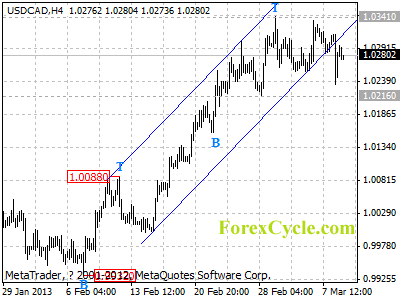
    USDCAD breaks below channel support

    USDCAD breaks below the lower line of the price channel on 4-hour chart, suggesting that lengthier consolidation of the uptrend from 0.9932 is underway. Range trading between 1.0216 and 1.0341 could be expected to continue in a couple of days. Resistance is at 1.0341, a break above this level will indicate that the uptrend has resumed, then further rise to 1.0400 area could be seen. On the downside, a breakdown below 1.0216 support will indicate that the uptrend from 0.9932 had completed at 1.0341 already, then deeper decline to 1.0150 area is possible.

    usdcad

    Forex Signals

    Large COT Currency Speculators continued to bet in favor of US Dollar last week

    By CountingPips.com

    The latest weekly Commitments of Traders (COT) report, released on Friday by the Commodity Futures Trading Commission (CFTC), showed that large futures traders increased their bets sharply in favor of the US dollar once again last week. The bets for American currency have now risen for four straight weeks and are at the highest overall long position since July 17th 2012, according to Reuters.

    Non-commercial large futures traders, including hedge funds and large International Monetary Market speculators, registered an overall US dollar long position of $23.57 billion as of Tuesday March 5th. This was a change from a total long position of $14.39 billion that was registered on Tuesday February 26th, according to the CFTC’s COT data and trader position calculations by Reuters, which calculates the dollar positions against the euro, British pound, Japanese yen, Australian dollar, Canadian dollar and the Swiss franc.


    cot-values


    Individual Currencies Large Speculators Futures Positions:

    The individual currency contracts quoted directly against the US dollar last week saw the euro, British pound sterling, Japanese yen, Swiss franc, Australian dollar, New Zealand dollar, Canadian dollar and the Mexican peso all have a declining number of contracts compared to the previous week.

    Individual Currency Charts:

    EuroFX:

    eur

    EuroFX: Large trader and speculator sentiment for the euro declined last week to drop for a fourth consecutive week. Euro contracts fell to a total net position of -26,116 contracts in the data reported for March 5th following the previous week’s total of -9,394 net contracts on February 26th.

    Euro spec positions are now at their lowest level so far in 2013 and the lowest since December 11th 2012 when positions stood at -31,623 contracts.


    Great Britain Pound:

    gbp

    GBP: British pound sterling spec positions decreased for a seventh consecutive week last week and dropped to their lowest level since November 2011. British pound speculative positions declined to a total of -43,849 net contracts on March 5th following a total of -36,130 net contracts that were reported on February 26th.

    Pound speculator positions have now been in a negative bearish position for four straight weeks and are at the lowest level since November 29th 2011 when positions equaled -46,660 contracts.


    Japanese Yen:

    JPY

    JPY: Japanese yen speculative contracts declined last week to the lowest level in about two months. Japanese yen positions decreased to a total of -73,351 net contracts reported on March 5th following a total of -65,344 net short contracts on February 26th.

    Yen positions are at their lowest point since January 8th when short positions equaled +74,096 contracts.


    Swiss Franc:

    chf

    CHF: Swiss franc speculator positions decreased last week for a third consecutive week and remain at the lowest level since November 2012. Net positions for the Swiss currency futures dropped to a total of -11,450 contracts on March 5th following a total of -8,191 net contracts reported for February 26th.

    CHF positions are on the short side for a third straight week and are at the lowest level since November 20, 2012 when positions totaled -12,488 contracts.


    Canadian Dollar:

    cad

    CAD: Canadian dollar positions decreased sharply lower once again last week to decline for a seventh consecutive week and to the lowest level in over a year. Canadian dollar positions fell to a total of -46,663 contracts as of March 5th following a total of -21,433 net contracts that were reported for February 26th.


    Australian Dollar:

    aud

    AUD: The Australian dollar decreased last week to fall for a sixth consecutive week. Aussie speculative futures positions declined to a total net amount of +7,149 contracts on March 5th after totaling +25,695 contracts as of February 26th.

    Australian dollar contracts are now at their lowest level since June 26, 2012 when positions equaled just -2,159 contracts.


    New Zealand Dollar:

    nzd

    NZD: New Zealand dollar speculator positions decreased last week for a second week after reaching their highest level in over a year on February 19th. NZD contracts fell to a total of +19,044 net long contracts as of March 5th following a total of +20,297 net long contracts on February 26th.

    The New Zealand dollar positions have fallen under the +20,000 contracts threshold for the first time in the last eight weeks.


    Mexican Peso:

    mxn

    MXN: Mexican peso speculative contracts decreased last week to decline for a seventh straight week. Peso positions fell to a total of +93,521 net speculative positions as of March 5th following a total of +104,804 contracts that were reported for February 26th.

    Peso speculative positions have fallen under the +100,000 threshold for the first time since November 27th 2012.


    The Commitment of Traders report is published every Friday by the Commodity Futures Trading Commission (CFTC) and shows futures positions data that was reported as of the previous Tuesday (3 days behind).

    Each currency contract is a quote for that currency directly against the U.S. dollar, a net short amount of contracts means that more speculators are betting that currency to fall against the dollar and a net long position expect that currency to rise versus the dollar.

    (The graphs overlay the forex spot closing price of each Tuesday when COT trader positions are reported for each corresponding spot currency pair.)


    Article by CountingPips.comForex News & Market Analysis


    Sending and Receiving Money With Bitcoin

    By Matt Michaels

    The bitcoin system is one of the first types of crypto-currency which has existed in the market since January 2009. What makes bitcoin different from regular currencies is the fact that bitcoin uses cryptography to monitor and control the creation and transfer of the currency between different parties. Bitcoins are generated over time at a diminishing rate, and the maximum amount of bitcoins in the market at one time is 21 million units. The usage of bitcoin eliminates the need of a third party when it comes to completing online transactions.

    What makes bitcoin different from other online currency systems like Paypal is that the currency is decentralized. This means that no group or organization has a control over it. This is unlike real currency that is monitored by central authorities. Real currency is controlled in terms of the printing and distribution of coins and notes to the public. And compared to other online payment systems, there are little to zero charges to transfer bitcoins. Using bitcoins will be especially useful for businesses which carry out a majority of its transactions online.

    To start using bitcoins, all you need is a bitcoin wallet. Since bitcoin is a virtual currency, you cannot hold it physically, unless you exchange it for goods and services. Your e-wallet is where your bitcoins are kept secure. E-wallets are convenient and easy to use. You can find many bitcoin wallet providers like My Wallet from blockchain.info.

    Your bitcoin wallet can also be accessed via your smartphone. Having a smartphone will enable you to sell and buy bitcoins wherever you are. Apple blocks bitcoin wallets from its App Store. But if you are an Android user, many mobile apps are available for you to transact using bitcoins.

    And if you feel that your bitcoin wallet is unsafe, you will want to have desktop clients to store actual bitcoins onto your laptop or PC. When you start a wallet, remember to save the file on the computer and back up the file. Make multiple backups if you feel insecure. Using bitcoins give users a sense of safety, as they are not relying on other parties like banks to take care of their funds. Most users will prefer to use the original software which has been around since the inception of bitcoins – the Satoshi Client.

    After creating your wallet, you are on the way to selling and buying bitcoins. There are many ways that you can obtain this online currency. The methods include buying it from various sellers, receiving it in the form of product sales, doing actions and fulfilling conditions to obtain free bitcoins and also by mining bitcoins – only for advanced users. Bitcoin is a growing currency and will most definitely be one of the top items in the online world in the near future. For more information about bitcoins and bitcoin wallet, feel free to search the Internet for more information. With the usage of bitcoins, you will be able to earn extra income and you will have an additional way to receive and make virtual payments.

    About the Author

    Are you looking for more information regarding Bitcoin? Visit http://blockchain.info/wallet today!


    Thou Shalt Not Drop Money From Helicopters

    By Bill Bonner, billbonnersdiary.com

    The Dow is still climbing. It poked further into record territory yesterday. Gold did nothing.

    What to make of it? Be cautious, dear reader. This is the most manipulated market in history. It could up higher, much higher. But you can’t trust it.

    Did we finish explaining how the world works?

    Probably not. We either forgot to explain it. Or forgot how it worked…

    We took up the question on a long walk down the beach.

    “You’re not disputing the importance of Aristotelian logic are you,” Elizabeth asked.

    “No. It’s a useful approach to solving problems in a logical and
    rational way. But if you have a neighbor who is making noise late at
    night, you have to use something more than just logical and rational
    thinking. You have to use your brain. Logic will tell you that you need
    to do something to turn the music off.

    “That is a simple problem. You could solve it in several ways. Even a
    robot could solve it. Call the police… break into your neighbor’s
    house and turn it down yourself… or possibly just ask the neighbor
    politely to keep it down.

    “All of those ways might work. Logically, you will select the one
    that involves the least expenditure of energy on your part with the
    most likelihood of success. That could be as simple as taking out a
    shotgun and blasting your neighbor’s electrical box. Or maybe whacking
    the neighbor himself, so the problem goes away forever.

    “Is that a good idea? Logically, the answer is ‘maybe.’ Because you
    don’t know much more about the future. And since you don’t know what
    will happen — no one does — your decision should be based, logically,
    on only what you do know, which is that the noise will go off.

    “But here’s where you have to use your head. We follow rules that
    aren’t necessarily logical but that make civilization possible. ‘Thou
    shalt not shoot up thy neighbor’s junction box’ is not necessarily
    logical. But it is nevertheless a useful guide to noise abatement
    issues.

    “These rules evolved over a long period of time… each one of them
    distilled from the rich juice of mistakes, corrections and experience
    of many generations that came before us. We ignore them at our peril.”

    “But you can perfectly well incorporate the lessons of history in
    your rational analysis,” countered the distaff, and wiser, half of the
    Bonner household. “You don’t have to rely on an illogical “Thou Shalt
    Not.’ You can just think it through.”

    Ben Bernanke’s Pseudo Logic

    We didn’t answer. Most people will think Elizabeth is right. You can
    try to think it through. You see a banana peel on your front step…
    and you can see a lawsuit headed your way. You take the banana peel
    off… and you probably have made for a better future.

    But there are many things that just don’t allow such simple
    analysis. I probably chose a bad example, because on the noisy neighbor
    level you probably can have a reasonable shot at knowing what is going
    on.

    “Thou shalt not drop money from helicopters” is probably a better
    prohibition. It is not logical. We don’t know exactly what outcome it
    will produce. And logically — or at least pseudo-logically — if
    people don’t have enough money, it seems to make sense to give them
    some.

    This became the evolved wisdom of central banking… discovered by
    trial and error over many centuries. Many times central bankers tried
    printing money. Never did it produce anything but misery.

    You could find a similar rule in the stock market: “Buy low. Sell
    high.” It’s a rule, backed by long experience and bitter setbacks. It’s
    illogical, in the sense that you never know what will happen.

    According to the most serious academic work, we never know whether
    prices are going up or down. And when they’re going up, we feel a huge
    emotional tug to get in on the trade. But the rule tells us to do something else.

    Will obeying the rule protect us from losses? We don’t know. But if we could know, we wouldn’t need the rule.

    It’s not that Aristotelian logic isn’t useful. And it’s not that you
    can build a bridge with old wives’ tales. (You can’t.) It’s just that
    each has its own limitations. Don’t try to romance your girlfriend with
    logic. And don’t try to go to the moon on instinct and intuition.

    Regards,

    Bill Bonner

    Bill


    Monetary Policy Week in Review – Mar 9, 2013: Emerging market central banks cut, major banks offer nothing new

    By www.CentralBankNews.info

        Last week 14 central banks took policy decisions with two major emerging market central banks (Mexico and Poland) slashing rates to stimulate economic growth while two of the world’s major developed market central banks (the Bank of England and the European Central Bank) had nothing to offer to shore up confidence.
        The decisions last week illuminate three major global issues: Firstly, the huge public policy challenges facing Europe and its shrinking economy; secondly, the ability of fast-growing emerging markets to cut rates while many advanced economies are running out of ammunition and ideas, and thirdly, the asynchroneous pace of global growth.
        The contrast between the central banks of Mexico and Poland, on one hand, and the European Central Bank and the Bank of England, on the other hand, was stark. Mexico and Poland cut rates by a larger-than-expected 50 basis points while neither the ECB nor the BOE could muster up new initiatives. And in the case of the ECB, it essentially said it was up to politicians to get growth going.
        In addition to Mexico and Poland, the Central Bank of West African States also cut  rates last week for a total of three rate cuts. Eleven central banks held rates steady(Australia, Uganda, Brazil, Canada, Japan, Indonesia, Malaysia, the BOE, the ECB, Peru and Sri Lanka).

        Through the first 10 weeks of the year, 21 percent of 91 decisions taken by the 90 central banks followed by Central Bank News have lead to rate cuts, slightly up from the 20 percent seen after the first nine weeks, showing that global monetary policy rates are still trending downwards.
        But the vast majority of policy decisions – 76 percent – favour unchanged rates, with many central banks, examplified last week by Australia, in a wait-and-see mode to gauge the impact of last year’s rate cuts and whether the global economy has enough momentum to overcome the drag from Europe’s recession and the fiscal cutbacks in the United States.
        Central banks in emerging markets have accounted for almost half (nine) of this year’s 19 rate cuts while developed market central banks have not cut rates once.
        This is largely explained by the fact that the world’s major central banks hit the zero bound four years ago when rates were slashed in response to the Global Financial Crises.  Since then, those banks have been using their balance sheets, or quantitative easing, to stimulate growth and hopes are high for new initiatives in coming months when new governors take up their jobs at the BOE and the BOJ.
        Although Canada and Brazil held rates steady last week, they appear to be on diverging paths.
        Canada, which spent most of last year warning about the need to raise rates, softened its tone further last week. The Bank of Canada initially switched tack in February, saying a tightening of policy was less imminent, and last week it moved further into neutral, saying the current stance was appropriate for the time being.
        In Brazil the shift to a tighter policy stance seems to be under way to pull back inflation, which has been rising for eight months in a row, most recently in February.
        After 10 consecutive rate cuts since August 2011, Banco Central do Brasil adopted a neutral stance last November – saying rates would remain steady for a prolonged period – but dropped this phrase last week, saying it was now monitoring conditions before deciding its next move.
        And although Mexico cut its rate last week, it stressed that this did not herald the start of an easing cycle, signaling that it is still somewhat optimistic about growth prospects.

    LAST WEEK’S (WEEK 10) MONETARY POLICY DECISIONS:

    COUNTRYMSCI    NEW RATE          OLD RATE       1 YEAR AGO
    AUSTRALIADM3.00%3.00%4.25%
    UGANDA12.00%12.00%21.00%
    POLANDEM3.25%3.75%4.50%
    BRAZILEM7.25%7.25%9.75%
    CANADADM1.00%1.00%1.00%
    JAPANDM 0.10%0.10%0.10%
    WEST AFRICAN STATES3.75%4.00%4.25%
    INDONESIAEM5.75%5.75%5.75%
    MALAYSIAEM3.00%3.00%3.00%
    EURO AREADM 0.75%0.75%1.00%
    UNITED KINGDOMDM0.50%0.50%0.50%
    PERUEM4.25%4.25%4.25%
    SRI LANKAFM7.50%7.50%7.50%
    MEXICOEM4.00%4.50%4.50%

         Next week (week 11) features nine scheduled central bank meetings, including two meetings that were rescheduled from last week to next week.  
        Mauritius rescheduled last week’s meeting to give the newly appointed policy committee members time to “take stock of the domestic economic and financial environment and to prepare for the meeting.”Among the eight members of the Bank of Mauritius’ Monetary Policy Committee are Prof. Jeffrey Frankel of Harvard University and Prof. Silvana Tenreyro of the London School of Economics.
        Serbia rescheduled its executive board meeting “owing to obligations of Executive Board members.”
        The other policy meetings next week include Mozambique, South Korea, New Zealand, the Philippines, Switzerland, Latvia and Norway.

    COUNTRYMSCI        MEETING              RATE     1 YEAR AGO
    MAURITIUS11-Mar4.90%4.90%
    MOZAMBIQUE11-Mar9.50%13.75%
    SERBIAFM12-Mar11.759.50%
    NEW ZEALANDDM14-Mar2.50%2.50%
    SOUTH KOREAEM14-Mar2.75%3.25%
    PHILIPPINESEM14-Mar3.50%4.00%
    SWITZERLANDDM14-Mar0.25%0.25%
    LATVIA14-Mar2.50%3.50%
    NORWAYDM14-Mar1.50%1.50%

       
    www.CentralBankNews.info

    Hugo Chavez R.I.P.

    By Bill Bonner, billbonnersdiary.com

    Today, we struggle to hold back tears. Another world leader has bit
    the dust. This time Venezuela’s big chief. Some bleak corner of Hell
    took him in on Tuesday, if not before.

    Chavez was a great entertainer. Real life was too small for him. He
    had to stretch the truth out… bend the real world into a larger, more
    fantastic shape… and puff it up with hot air until it could hold him.

    In real life people go about their business, taking what fortune
    sends their way and doing their best with it. That stage was much too
    restricted for Chavez. He aimed to play a more important role under a
    much bigger proscenium arch. Naturally, he took up politics (the refuge
    of all fantasists) and tried to overthrow the Venezuelan government; he
    landed in jail.

    The authorities let him out after a couple of years. He went right
    back to his mischief. A few years later and he was elected president of
    the country. But even that wasn’t enough. He conspired to twist the
    nation’s constitution to make himself “President for Life,” which, in an
    act of divine mercy toward the Venezuelan people, ended this week.

    Chavez
    was a great showman. He kept TV audiences entertained for hours,
    concocting a larger-than-life fairy tale about how terrible the foreign
    capitalists were and how his “Bolivarian Revolution” was setting things
    straight.

    Alas, his lines were written by hacks; perhaps he wrote them himself.
    It took a real A-list actor to deliver his speeches with a straight
    face. The idea of a 21st Century Socialism, for example, that he claimed
    to have invented himself, was so transparently hollow and self-serving
    that a lesser thespian would have been laughed off stage.

    A Magisterial Presence

    Chavez followed in a long South American tradition of crowd-pleasing
    strongmen. Like Peron, Castro and Melgarejo, he was not only a leader
    the masses could adore, but he was also one they deserved.

    Melgarejo has been largely forgotten. But he was one of the great
    standup guys of Bolivian politics. In 1854, like Chavez, he attempted a
    coup d’etat against the legitimate dictatorship of the time. He was
    captured. He was tried and found guilty. That should have been the end
    of him, but he came out with a convincing argument for clemency: that he
    was drunk at the time and not responsible for his actions.

    President Belzu pardoned Melgarejo. A few years later, just to show
    his gratitude, Melgarejo murdered Belzu. Then came a real tour de force
    of political theatre, illustrating not only Melgarejo’s magisterial
    stage presence, but also the masses’ deep attachment to their leaders.

    A crowd had gathered in front of the presidential palace demanding the return of Belzu. “Viva Belzu,” they chanted.

    Melgarejo appeared on the balcony. He had the dead body brought out and displayed to the crowd.

    “Who lives now?” he asked them.

    “Viva Melgarejo,” they replied.

    Having whacked his rival, Melgarejo soon became perhaps the most
    disastrous leader in the history of South America – a hotly contested
    title. He is said to have signed the Treaty of Ayacucho with Brazil, in
    which he traded millions of acres of Bolivian territory for a
    “magnificent white horse.”

    In 1870, France and Germany went to war. Hearing reports of the
    German assault on Paris, Melgarejo rushed to defend the City of Lights.

    He reputedly could not locate it on a map, but he was fascinated by
    what he had heard of it. So, he told his army to march to Europe. His
    military commanders informed him that they had no means to cross the
    Atlantic Ocean. Melgarejo replied: “Don’t be stupid! We will take a
    shortcut through the brush!”

    Cash and Claptrap

    That was the sort of Bolivarian tradition to which Chavez was heir.

    But Melgarejo was hardly the only legator. Chavez learned from Juan
    Peron too. Argentina had been one of the richest countries in the world,
    in the early 20th century. You can see the residue of it here today –
    broad, tree-lined avenues and beautiful beaux arts, belle époque and
    arts nouveaux private buildings and public monuments. (The Argentines
    were great admirers of the French too!)

    Now, Argentina is way down the list of the world’s richest countries.
    Today, it is No. 54 on the CIA Factbook list – with Trinidad and
    Tobago, Equatorial Guinea and Greece far ahead of it. That, along with
    periodic financial crises, massive strikes, disappearances and pointless
    wars, is the legacy given Argentina by Peron and his Peronist
    successors.

    You’d think the gauchos and the porteños would have had enough of it
    by now. But they still elect Cristina Fernandez de Kirchner, a Peronist
    candidate, just as they voted for Chavez in Venezuela despite an
    economic record worthy of Mariano Melgarejo.

    That’s what makes the masses so attractive to leaders like Chavez:
    They are incredibly stupid. Consumer prices rise even faster in Caracas
    than in Buenos Aires. The power goes out, too. Despite being one of the
    world’s top oil producers,
    supplies are so tight people are urged to take “socialist showers” to
    conserve energy. And the murder rate is among the highest in the world –
    so high that even people from Baltimore are afraid to go there.

    Chavez made their lives more miserable, but the masses still loved
    him. Of course, he paid for their affection. He took $100 million in
    annual oil revenues and spread it around. Realizing that it would go
    further in poor neighborhoods than in rich ones, he built his popular
    support on cash and claptrap.

    And now he is gone. The performances have come to an end. The show’s over.

    “Now he belongs to the ages,” said Secretary of War Edwin M. Stanton
    when Abe Lincoln died. Now Chavez belongs to the ages too… like Peron
    and Melgarejo.

    Good riddance.

    Regards,

    Bill Bonner

    Bill

    billbonnersdiary.com