- Fed to stick to stimulus as Cyprus rekindles global risks (Reuters)
- ECB: Will provide needed liquidity as per existing rules (MNI)
- Ex-ECB Trichet: ‘No element of contagion’ from Cyprus crises (dow jones)
- Cypriot banks on brink in Icelandic flashback (Reuters)
- Cyprus tax on deposits a step back – Australia central bank (Reuters)
- Globally coordinated monetary easing urged (dow jones)
- Hungary central bank research call may signal unconventional future policy (WSJ)
- Singapore 2013 growth tipped at 2.8%: central bank survey (cnbc)
- Serb central bank says 2-week FX swaps to ease liquidity trouble (Bloomberg)
- Tanzania: Central bank keen on liquidity control (allafrica)
- www.CentralBankNews.info
Just Like Cyprus: How the Australian Government Turned on its Citizens
Yes, this is getting old, but this week a new Mediterranean country became the centre of the financial world’s attention.
It’s not even big enough to be one of the PIIGS, which used to make all the headlines.
But Cyprus is important for a whole new reason.
This time around, bank depositors will take a hit in the effort to bail out the banks.
And that’s causing panic across Europe…
What you need to know about this isn’t in the details. They’re a complete mess and keep changing from one hour to the next. One moment all depositors will lose a few percent of their deposits, the next only some will.
What’s really important is the signal this sends. We’re entering into the next stage of the financial crisis. The stage where governments turn on their citizens.
This is exactly in keeping with Kris’ theme in Money Morning. He’s written about this for over four years, including the Australian government’s attempts to take your wealth, like they’re going to do in Cyprus. It’s not just Cyprus, by the way.
In Japan, the government hopes to stimulate the economy by creating inflation. That will have a similar effect on the country’s savers as confiscating a proportion of their deposits would. In Italy, the German bank Commerzbank is expecting a wealth tax to be brought in. France’s ill fated 75% tax may not last, but it shows what’s making popular politics these days.
In Australia, the miners, polluters and ‘super profiteers’ are the target…for now. And on May 31st, the government will raid small superannuation accounts and unused bank accounts.
All around the world, governments are beginning to see their citizens as ATMs to pay for political promises. Whether its entitlements, bank bailouts, wars or insulation schemes. Sure, simply taking people’s deposits is particularly audacious. But you don’t even know if we’re referring to Australia or Cyprus in that sentence. Both are up to the same sort of confiscation.
By the way, if you’re thinking this is just a question of finding the right kind of politicians to solve the problem, you’re going to be disappointed. Remember the ‘there will be no Carbon Tax’ promise? Well, the President of Cyprus was only elected three weeks ago, and promised deposit taxes wouldn’t be part of any plan to bail out the banks. You never know what you’ll get from a politician.
Reuters reports that Cyprus’ President initially stormed out of negotiations with the IMF, EU and ECB when they demanded a tax on depositors’ funds. But he quickly changed his tune when faced with the bankruptcy of Cyprus’ two largest banks by Tuesday, after Monday’s bank holiday.
Now the bank holiday has been extended to Thursday, which really means indefinitely, because the bailout plan wasn’t passed by Cyprus’ parliament.
If we wrote to you about deposit confiscation, bank holidays, bank runs, and all the rest of it a few years ago, would you have laughed it off? Would it have seemed absurd?
Well, suddenly stuffing cash under your mattress seems a whole lot less eccentric. Suddenly, owning physical gold outside the banking system looks smart.
Nickolai Hubble.
The Daily Reckoning Weekend Edition
From the Port Phillip Publishing Library
Special Report: Australia’s Energy Stock BLOWOUT
Daily Reckoning: Cyprus: An Old Fashioned Crisis in Europe
Money Morning: Your Retirement or Your Mortgage?
Pursuit of Happiness: Where Cyprus Got the Idea for its Savings Raid
New Developments on Whether You Can Get Your Mortgage Cancelled
If you’re not familiar with the story on how you could have your mortgage cancelled, why not take a quick peek at the one-minute long movie trailer? You can find it here.
Our recent articles about this opportunity have really thrown the cat amongst the pigeons. People affected by the crisis have sent in their thanks, feedback, criticism and remarkable stories.
One couple that emailed were a victim of the kind of manipulation the video exposes not once, but twice. Both when they got their initial loan and when they refinanced. They only found out because the banks sent them the proof by mistake.
But we’re just getting started. Soon, anyone in Australia will be able to find out if they can get their mortgage cancelled too.
The thing is, we’re not the only ones exposing this mess. Denise Brailey has worked hard in the name of individual wronged borrowers, as well as spearheading the effort to wake up Australians generally.
In her latest email to me she laid out her plans. Her evidence is explosive and cannot be ignored any longer. If you’re interested in the story, why not become a member of her dedicated consumer support association here.
Now, the real question is what will be done about the scandal as it goes mainstream. Will the regulators allow hundreds more borrowers to cancel or reduce their loans? Where would that leave the banks? One subscriber wanted to know what would happen to our housing market:
‘Hi,‘My question is whether this is going to force financial institutions to become honest and cease giving out “easy money” and is this going to impact on getting our housing market more honest? Do you see this as a beginning of the end of our “Fannie Mae” housing market and its leveraged pricing bubble?
‘Regards,
Sarah’
You never know what effects something will have in the financial world. It’s driven by people’s perceptions, and those are very unpredictable. The same piece of news can have drastically different effects on different days.
You might recall American big-wigs like Ben Bernanke assuring the world that sub-prime debt was just a small problem. The rest is history.
Well, we don’t even know how big this problem is yet. That’s part of the fuss Denise Brailey is making. This could be an enormous issue, but nobody knows and nobody in government seems to want to find out.
There’s certainly a chance it will cause a real upset for Australia’s banks and housing market. That’s a big problem because housing and financial shares are two of Australian retirees‘ biggest financial assets.
Speaking of which, Murray has just positioned his subscribers at Slipstream Trader to profit from a struggling Australian financial sector. You can find out more here.
But in the end, cancelling your mortgage is the best way you can go about protecting yourself from any financial debacle in Australia. It’s part of ‘definancialising’ your life. That’s a trend we hope to build on in The Money for Life Letter.
The recommendation in our next monthly issue will have more in common with bears than shares…and it could be just as profitable, and far more enjoyable.
Nickolai Hubble.
The Daily Reckoning Weekend Edition
From the Port Phillip Publishing Library
Special Report: Australia’s Energy Stock BLOWOUT
Daily Reckoning: Cyprus: An Old Fashioned Crisis in Europe
Money Morning: Your Retirement or Your Mortgage?
Pursuit of Happiness: Where Cyprus Got the Idea for its Savings Raid
Why the Cyprus Bailout Could Set Banking Back 300 Years
Even by the standards of the EU bureaucracy, raiding the private deposits of Cyprus’ banks is spectacularly foolish.
For a measly €5.8 billion, the EU has now put the entire Eurozone on edge – not to mention the entire global economy.
It revolves around something as simple as trust. And as a former banker, I can tell you that there’s no substitute for the belief that your deposits are safe and sound.
It’s a thin line, and once it’s been crossed it’s nearly impossible to repair.
Now savers in Spain, Italy and elsewhere in the Eurozone are left to wonder about the safety of their own accounts.
Here’s why savers everywhere should be concerned…
The Problem with the Cyprus ‘Bailout’
Like Ireland and Iceland, Cyprus has a banking sector that’s not only shaky but is far bigger than its overall economy, with deposits of around $90 billion, or five times its GDP.
Unlike most banking systems, more than half of those deposits are in large chunks of over €100,000, the limit of Cyprus’ deposit insurance. Indeed, about $20 billion of Cyprus’ deposits are held by the Russian mafia.
Since Cyprus’ president Nicos Anastasiades didn’t want to shut down the island’s attraction as a money haven and playground for the Russian jet-set, he agreed to a deposit tax of 6.7% on deposits up to €100,000 and 9.9% on deposits above €100,000, to satisfy the EU’s demand of 5.8 billion euros part of the bank bailout.
But like most schemes designed by politicians and EU bureaucrats, this one has huge flaws, including the fact it angered Russian president Vladimir Putin. Even at this level, with much of the money coming from Cyprus’ modestly well-off citizens , Putin described it as ‘unfair, unprofessional and dangerous.’
But the main flaw isn’t about Putin. It has to do with the idea of deposit insurance itself.
Under a separate scheme introduced by the EU after the 2008 financial crash, deposits under €100,000 are insured by the Cyprus government.
Of course, the ‘tax’ on deposits is a supposedly clever way to get around this without the Cyprus government itself defaulting. However, all this little trick does is call into question deposit insurance throughout the EU and, indeed, worldwide.
That’s why this tiny country, with a population of only 800,000 and $17 billion in GDP, has roiled the world markets – it attacked the central principle of deposit insurance.
After all, if governments can just seize deposits by means of a ‘tax’ then deposit insurance is worth absolutely zippo.
Meanwhile in Cyprus, there were a number of alternatives to breaking this underlying bond of trust. The banks have some bond debts outstanding, which certainly should have been written down before the deposits were attacked. In fact, the tax is an attempt to avoid this, and should be resisted on that ground alone.
Instead, because the large deposits are so big, you could raise the required €5.8 million simply by a 15% tax on large deposits – but that would make Putin REALLY angry (he personally may or may not have money in Cyprus, but lots of his friends do).
They could also write down Cypriot government bonds, but because the banking system is relatively so huge the write-off would have to be a big one. To get €5.8 billion it would take more than a 50% write-down.
In the big picture, Cyprus doesn’t matter much, unless EU incompetence and the recalcitrance of its own politicians makes it leave the euro altogether, in which case that currency unit yet again faces the prospect of break-up.
Who Can You Trust?
But in this case, the effect on global deposit insurance systems is much more important.
Deposit insurance was first invented in the United States during the Great Depression as a means to reassure savers about the solvency of banks, a third of which had just gone belly-up. It worked beautifully.
Americans trusted the federal government (at least, they did back then), so once deposit insurance was in place savers came to have complete trust in the banking system.
Unfortunately, that same trust had a very bad effect on the banking system itself.
From leverage ratios of $4-5 of assets to $1 of capital in the 1920s, banks leveraged themselves ad infinitum, having leverage ratios of $10-12 of debt to $1 of capital in the 1970s, and up to $30 of assets to $1 of capital in 2008.
Even today, after de-leveraging, J.P. Morgan Chase, in many ways the most solid of the big banks, had assets of $2,359 billion at the end of 2012 and tangible equity of only $146 billion – or a ratio of 16.2 to 1. As recently as 2010, JPM’s leverage was 19.3 to 1.
At those levels you can see the dangers that kind of leverage presents.
In fact, I counselled the National Bank of Croatia to this effect, when they were designing their deposit insurance system in 1996-97, advising them to have insurance covering only 90% of deposits. Unfortunately the politicians in the Croatian parliament overruled us, so Croatia now has the same damaging 100% insurance as everywhere else.
So the depositor today ends up with the worst of both worlds. He can’t rely on the banks not to go bust, given their current absurd levels of leverage (which are of course encouraged by Ben Bernanke’s money printing). On the other hand, now there’s a question of whether he can rely on deposit insurance either.
If these worries become really serious, it will be devastating for the world economy. Small savers will take their money out of banks and resort to household safes and a shotgun.
If savers no longer have a solid place in which to put their money, we will have undone the financial revolution of the last 300 years, and returned to a world in which Samuel Pepys didn’t trust the local goldsmith, so buried most of his wealth in the back garden. Needless to say, that won’t do much for small business – the entire flow of finance will seize up altogether.
The solution is to do away with deposit insurance, forcing banks that want to attract depositors to hold $1 of capital for every $4-5 of assets, at most.
Eliminating Ben Bernanke and going back to a gold standard will probably be necessary too – even though that’s not likely to happen anytime soon.
But if politicians continue behaving as badly as those who designed the Cyprus bailout, the gold standard will be the only economically viable alternative.
With this ‘bailout’ all the EU has done is open up a Pandora’s Box.
Martin Hutchinson
Contributing Editor, Money Morning
From the Archives…
Can This Indicator Predict The Dow Jones Next Move?
16-03-2013 – Kris Sayce
Seven Situations to Watch in the Pacific Currency War
15-03-2013 – Dan Denning
Stock Market Warning: Next Week Could be a Blood Bath
14-03-2013 – Murray Dawes
REVEALED: One Opportunity to Escape Your Mortgage
13-03-2013 – Nick Hubble
UK Property: How You Can Buy a House For Less Than 250 Grand
12-03-2013 – Dr. Alex Cowie
A New Chapter for Turkey’s Market
In 2012, Turkey was the best performer among the emerging markets we track on our Periodic Table showing a decade of returns. All developing countries rose last year, but stocks in Turkey climbed an astounding 56 percent.

While visiting the country, I was happy to see my explicit knowledge of Turkey’s market growth was supported by my tacit knowledge.
Istanbul has been in the midst of a fantastic transformation from an impoverished population to one of affluence. Popping up among the beautiful Ottoman mosques, Byzantine churches, palaces and bazaars are ultra-contemporary art sculptures, shopping malls and lush landscaping.
This blend of ancient with modern fits well with the young, vibrant and culturally diverse crowd that hangs out in the local cafes, shops and galleries.
A New Era In Turkey
Investment managers like me aren’t the only ones showing increased interest in Turkey’s new-found prosperity. US Secretary of State John Kerry visited Turkey during his first overseas trip as America’s top diplomat.
German Chancellor Angela Merkel, the powerhouse figure of the European Union, was also in Ankara recently to meet with President Abdullah Gul and Prime Minister Recep Tayyip Erdogan. The topic of their discussion is not new, but suggests a ‘new chapter’ for Turkey’s market. These leaders are picking up the conversation started years ago regarding Turkey entering the European Union (EU).
Tim Steinle, portfolio manager of the Eastern European Fund, says that unlike Greece, which fudged its numbers to join the EU, Turkey was held to a higher standard.
But it doggedly pursued its aspiration, and in the process of implementing the European Union accession chapters, such as the Right of Establishment & Freedom to Provide Services, Company Law, Financial Services, Information Society & Media, Statistics, Financial Control, and Science & Research, had modernized its economy, making it competitive with those of Western Europe.
In addition, open trade with the EU allowed it to build a diversified export economy.
Turkey’s admittance to the EU had stalled over Cyprus, but more recently, France and Germany seem to be warming to the idea. Under newly elected President Francois Hollande, France is opening another chapter to the accession, and Angela Merkel’s visit to Turkey is signalling a shift in Berlin’s position on Turkey’s membership.
This wasn’t the only time Turkey reformed its policies. In 2001, the country experienced its own devastating financial crisis, and as a result of that experience (with which the rest of the world can now sympathize), the government adopted tough, but important financial and fiscal reforms.
These reforms helped the country rebound, and its strong banking regulations kept banks well capitalized compared to the US and Europe.
Turkey on the Rise
In the charts below, you can see the result of the government’s determination. From 2010 through 2012, Turkey’s GDP exceeded that of Europe, the Middle East and Africa (EMEA), as well as the rest of the world.
Through 2015, GDP is also expected to be greater than EMEA’s GDP as well as overall world GDP. Simply stated, Turkey ‘remains superior in the region,’ says Wood & Co.

Turkey’s manufacturing sector, in areas such as the automotive industry, white goods that include refrigerators and washing machines, and glass makers, has also been growing in strength.
For nearly two years, Turkey’s purchasing managers’ index (PMI) has been significantly stronger than Europe’s and ‘outstrips global averages,’ says Wood & Co.
Although the PMIs around the world fell rapidly in mid-2011, Turkey’s manufacturing hasn’t fallen below the expansion number of 50 as often, and as significantly, as Europe. According to Wood, Turkey’s PMI also recovered, ‘signalling growth ahead’.

Turkey’s manufacturing PMI number of 53.5 in February was slightly lower than its January figure of 54.0, but manufacturing remains solid and in expansion territory. Businesses are reporting an increase in new orders, new products and new clients and ‘new business from abroad increased at the fastest pace since January 2012,’ says HSBC.
With the country exhibiting positive demographics, strong consumer demand and an open, competitive economy, Turkey is at a figurative, as well as literal, crossroad between Europe and Asia.
The European Energy commissioner Günther Oettinger annoyed Germany when he suggested that the EU needed Turkey more than Turkey needed the EU. ‘I would like to bet that one day in the next decade a German chancellor and his or her counterpart in Paris will have to crawl to Ankara on their knees to beg the Turks, ‘Friends, come to us.”
However, Spiegel Online reports Erdogan hinted that the emerging economy may consider joining the Shanghai Cooperation Organization, which includes countries such as China and Russia, instead. ‘The economic powers of the world are shifting from west to east, and Turkey is one of these growth economies,’ remarked the prime minister.
My visit to Istanbul was thrilling, and I’m equally excited about the continued investment prospects for Turkey as it gains in economic strength.
Frank Holmes
Contributing Writer, Money Morning
From the Archives…
Can This Indicator Predict The Dow Jones Next Move?
16-03-2013 – Kris Sayce
Seven Situations to Watch in the Pacific Currency War
15-03-2013 – Dan Denning
Stock Market Warning: Next Week Could be a Blood Bath
14-03-2013 – Murray Dawes
REVEALED: One Opportunity to Escape Your Mortgage
13-03-2013 – Nick Hubble
UK Property: How You Can Buy a House For Less Than 250 Grand
12-03-2013 – Dr. Alex Cowie
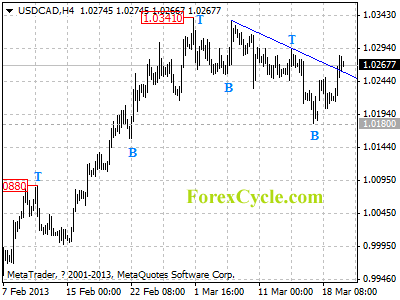
USDCAD breaks above downward trend line
USDCAD breaks above the downward trend line on 4-hour chart, suggesting that the downtrend from 1.0341 had completed at 1.0180 already. Further rise to test 1.0341 previous high resistance would likely be seen, a break above this level will indicate that the longer term uptrend from 0.9815 (Jan 11 low) has resumed, then the following upward movement could bring price to 1.0500 area. Support is at 1.0230, followed by 1.0180, only break below these levels could signal completion of the uptrend from 0.9815.

Nigeria holds rate steady, cut would send wrong signal
By www.CentralBankNews.info Nigeria’s central bank held its monetary policy rate (MPR) steady at 12.0 percent, as expected, with its policy committee rejecting a proposal to cut rates due to slower growth and core inflation because “it could send the wrong signals of a premature termination of an appropriate tight monetary stance” and “signal the preference for a higher inflation rate.
The Central Bank of Nigeria (CBN), which started tightening policy in September 2010 and last raised rates by 275 basis points in October 2011, said rising inflationary pressures in February indicated “factors that could constitute a threat to inflation in the medium term.”
The bank’s monetary policy committee voted by 9:3 to hold rates steady and rejected a proposal to raise rates as there were no major inflationary concerns at this time.
Nigeria’s inflation rate ticked up to 9.5 percent in inflation from 9.0 percent in January, largely reflecting the base effect of the first and second round impact of the removal of fuel subsidy in January 2012 and thus sending a clear signal that there was still a risk of inflation in the near-to-medium term.
The central bank targets inflation of 10 percent but is working to get inflation toward 6 percent.
Taking note of an approximate 5 percent rise in the 2013 federal government budget, which is based on an oil benchmark price of $79, “potentially slows down the pace of fiscal consolidation.”
Nigeria’s Gross Domestic Product rose by an annual rate of 6.99 percent in the fourth quarter, up from 6.48 percent in the third quarter.
For 2012 Nigeria’s real GDP growth eased to 6.58 percent from 7.43 percent in 2011, mainly due to a 0.91 percent contraction in the oil sector. The main driver of growth was thus the non-oil sector, with agriculture contributing with 1.37 percent, wholesale and retail trade with 2.19 percent and services with 2.10 percent, the central bank said.
Growth projections for this year are “relatively robust,” the bank said, noting there are risks of “increased levels of corruption and impunity in the country, insecurity particularly in the northern part of the country, as well as mixed signals from power and petroleum sector reforms.”
The central bank said growth in the domestic capital market, where bond yields have been declining steadily and equity prices were trending upwards, was due to the impact of “huge capital inflows” and quantitative easing, especially in the U.S. and the EU “is already creating a potential new round of asset bubbles globally.”
The principal risk to stability from these inflows can only be addressed through fiscal consolidation and structural reform and without these the economy will not be able to attract the long term capital inflow that can help insulate the economy from the risks of external shocks and capital flow reversals, the central bank said.
The Cyprus Crisis and What It Means For Investors
I’ll give the European Union credit: at least they are creative at finding new ways to upset the world’s capital markets.
Instead of demanding just the usual austerity measures of higher taxes and lower spending—and a potential haircut on speculative creditors such as hedge funds—the EU bailout negotiators insisted over the weekend on extracting a pound of flesh from the customers of Cypriot banks. Savers would see as much as 10% of their checking and savings accounts expropriated to help cover the cost of the bailout, and the levy would apply even to accounts insured by the Cypriot equivalent of the FDIC.
Ouch.
Needless to say, the news didn’t go over well in Cyprus; it led to a small-scale bank run as depositors rushed to get to their cash. It also didn’t go over particularly well in Russia. Cyprus is notorious as a haven for Russian funds of…ahem…questionable origins. Roughly a quarter of all Cypriot bank deposits are owned by Russians.
As I’m writing this, it looked likely that Cyprus’ parliament would shoot down the bailout agreement hammered out between the government and the European Union on the grounds that it wasn’t fair to small local savers who assumed their deposits were protected by government guarantee. (Imagine any democrat or republican approving something like that here; it would be political suicide.) The government is also reluctant to “soak the Russians” out of fear that it will destroy confidence so badly as to end Cyprus’ existence as an offshore financial center. And I can’t say I blame them for not wanting to anger the Russian mafia dons or Russian President Vladimir Putin. That’s not good for your health.
So what happens now?
Good question. My best guess is that the deal is slightly tweaked to allow the Cypriot government to save face but that the bailout goes through and the depositors get hit. Politically, German Chancellor Angela Merkel and French President Francois Hollande cannot ask their taxpayers to come to the rescue of dirty Russian money, nor should they.
If the bailout flops, the options quickly get messy. I don’t see the EU backing down this time and watering down the deal, nor do I see the European Central Bank continuing to provide emergency liquidity. This means that without the bailout, the Cypriot banking system will collapse, and given that the banking system is eight times larger than the economy, there is no way that Cyprus will be able to make its depositors whole. Barring some sort of last-minute emergency loan from Russia (which would presumably come with some pretty wicked strings attached), Cyprus either accepts the EU bailout and goes about its business or it drops the euro, issues a new currency, and then falls into hyperinflationary oblivion.
What does this mean for the Eurozone?
The fear was that seizing bank deposits would set a terrible precedent and lead to bank runs in Spain, Italy and other indebted countries and plunge us back into crisis mode. Once bank depositors are seen as a viable target, you create a slippery slope.
But judging by the market’s reaction, this is a non-event. European stocks took a small hit on the news, though it caused nothing like the turmoil over Greece, Spain and Italy last year. Bond yields in these problem countries spiked up but hardly to levels that would cause alarm.
There are a couple reasons why the bank run didn’t happen…or at least hasn’t happened yet. To start, Spain and Italy already effectively had bank runs last year. Funds have been leaking out of both since the onset of the crisis, and their respective banking systems have been kept solvent by the ECB. But more basically, it’s an open secret that Cyprus is a haven for dirty money (wink wink), and investors see clear differences between their own banking systems and that of Cyprus.
There is also the “Draghi Put,” or the belief that ECB President Mario Draghi will live up to his word to do “whatever it takes” to keep the euro intact. This, more than anything, has been what has stabilized the Eurozone over the past nine months.
And finally, don’t underestimate the effects of “crisis fatigue.” After three years of crisis, these sorts of headlines simply don’t have the ability to move the market like they used to.
Things could still get very ugly very fast in Europe if the feared contagion finally does happen. But for now, it looks as though this too shall pass.
Cyprus may choose to leave the Eurozone before this is over or may well become a Russian client state; anything is possible at this point. But I don’t see any of these outcomes changing the direction of events. The Eurozone will undergo deeper integration. With or without Cyprus, the rest of the Eurozone will sink or swim together.
This makes things a little awkward for non-Eurozone EU members like the UK, Sweden and Demark. But even as the cumbersome, confusing mess it is, the Eurozone will muddle through.
How are we to invest in this environment? I would recommend using any sell-offs to accumulate shares of some of Europe’s finest companies. One in particular I like at current prices is Spanish telecom giant Telefonica (NYSE:$TEF). Telefonica is quietly paying down its debts, and I expect the company to reinstate its dividend within the next 1-2 years. In the meantime, it’s an excellent way to get exposure to the growing markets of Latin America, where it gets more than half its revenues.
SUBSCRIBE to Sizemore Insights via e-mail today.
Disclosures: Sizemore Capital is long TEF.
The post The Cyprus Crisis and What It Means For Investors appeared first on Sizemore Insights.
“Safe Haven Demand” for Gold Seen Amid Fresh Cyprus Chaos, But #1 ETF Shrinks Again
London Gold Market Report
from Adrian Ash
Tues 19 Mar, 09:35 EST
The GOLD PRICE continued to hold above $1600 per ounce in Asian and early London trade on Tuesday, easing back from Monday’s 3-week high as world stock markets struggled again amid fresh uncertainty and rumor over Euro-member Cyprus’ banking crisis.
Silver below $29 per ounce held flat alongside other commodities, while major-government bond prices rose.
Ahead of the US Federal Reserve’s 2-day policy meeting, 10-year Treasury yields edged down to 1.94% per year.
Consumer price inflation was reported at 2.0% on Friday.
“[The Eurozone’s] long-running problems…are not going to be resolved quickly,” said New Zealand’s finance minister Bill English in an interview this morning.
“I think over the next five to seven years, you’re going to see these occasional outbreaks of [Eurozone] anxiety in quite unexpected ways.”
Following Monday’s jump in the gold price, “Whether this will be enough to push prices sustainably higher remains to be seen,” notes the latest Precious Metals Update from German refining group Heraeus.
“In the past, such measures fuelled investors’ uncertainty and gave a boost to bullion demand.”
Monday saw turnover in US gold futures contracts jump 28% from the previous week’s average, but the outstanding number of open contracts was barely changed by session’s end.
The giant SPDR Gold Shares – briefly the world’s biggest exchange-traded trust fund when Dollar gold prices peaked in late-summer 2011 – saw yet another outflow from its holdings, down for the 32nd time this year to a 20-month low beneath 1,220 tonnes.
By value the SPDR Gold ETF slipped beneath $63 billion for the first time since July 2011.
Silver ETF holdings, in contrast, rose to a new all-time record at 19,738 tonnes according to Bloomberg data.
Silver prices again touched $29 per ounce in Asian and early London trade today, before slipping back unchanged from last week’s finish.
“We now see the gold market building a solid base at [$1600 per ounce],” says a London bullion-bank trader in a private note, with “the fundamentals for gold as a ‘safe-haven’ coming back in force.”
“For as long as there is a lack of clarity,” agrees today’s note from Commerzbank, “and especially if the situation should escalate, gold should continue to remain in high demand as a safe haven.”
Cyprus last night declared an emergency 3-day Bank Holiday, giving parliament time to argue and vote on the proposed “bail-in” which would cut bank deposits below €100,000 by 6.75% and by 9.9% above that level.
Nicosia’s finance ministry has now proposed a “zero levy” on savers with less than €20,000, according to the BBC.
After the Kremlin in Moscow said it may call in a €2.5 billion loan to Cyprus in retaliation for the tax hitting Russian savers, energy giant Gazprom this morning denied Greek press reports that it has offered to pay all of Cyprus’s €16bn rescue in return for oil and gas exploration rights.
“Cyprus is shaking…the people are bleeding,” says editorial comment in German tabloid newspaper Bild.
Publicly criticizing the levy on German TV on Saturday, German finance minister Wolfgang Schaeuble had in fact “demanded a 40% depositor tax” according an un-named Cypriot official quoted by Bloomberg.
“The blackmail…peaked at 3.00am on Saturday,” according to local reports, when Germany’s Jorg Asmussen apparently phoned European Central Bank president Mario Draghi, and told him to prepare the ECB for the collapse of two Cypriot banks.
Looking ahead meantime to Wednesday’s updated Budget from the UK’s coalition government, “There is little room to move on fiscal policy,” says FX strategist Simon Derrick at BNY Mellon.
“[So] monetary policy remains the principal tool for providing additional support to the economy.”
“With the economy flatlining,” agrees analysis from HSBC bank – also quoted by CNBC – “the mood music certainly suggests some sort of change [to the monetary policy framework] is on the cards.”
Japan’s central-bank governor Shirakawa last night ended his term and was replaced by so-called “radical inflationist” Kuroda.
The Bank of Japan has already set itself a 2.0% target for annual inflation.
The Japanese Yen has lost almost one-fifth of its value against the Dollar since the new Abe administration took over in November.
Indian gold prices meantime rose Tuesday as the Rupee fell hard – and the Mumbai stock market dropped 1.5% – following an interest-rate cut and news that the ruling coalition government has lost the support of a key member party.
“With the federal elections next year,” Reuters quotes Bank of Baroda economist Rupa Rege Nitsure, “political stability is key for all economic reforms” planned in the world’s No.1 gold consumer nation, now struggling with a large balance of trade deficit.
“[The exit of the Dravida Munnetra Kazhagam party] will surely delay them.”
Gold price chart, no delay | Buy gold online
Adrian Ash is head of research at BullionVault, the secure, low-cost gold and silver market for private investors online, where you can buy gold and silver in Zurich, Switzerland for just 0.5% commission.
(c) BullionVault 2013
Please Note: This article is to inform your thinking, not lead it. Only you can decide the best place for your money, and any decision you make will put your money at risk. Information or data included here may have already been overtaken by events – and must be verified elsewhere – should you choose to act on it.
Final Deal on Cyprus Rescue Package Still Pending and the U.S. Dollar Suspended its Growth
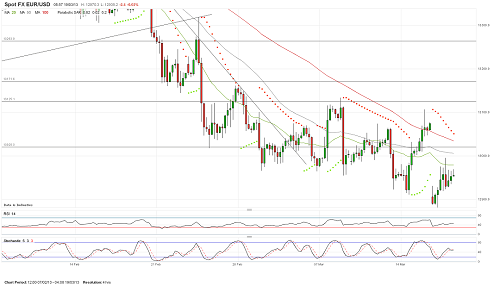
EURUSD
The bulls failed to close the gap, with which the EURUSD pair was opened yesterday. But the bears could not manage to move below 1.2881. There, the euro made an attempt to recover, which was limited by the 1.2996 level, while pullbacks were facing the demand on the approach to 1.2920. Thus, the pair spent the day in a narrow range. It remains under pressure, and testing of the support at 1.2880 still looks likely. Only the pair growth and ability to consolidate above 1.3125 would indicate the end of the downward trend.
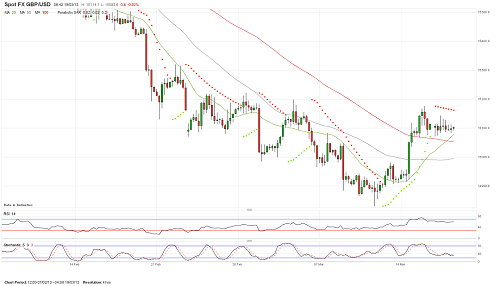
GBPUSD
Against the background of the situation in Cyprus, the British pound has become more attractive in comparison with the euro, allowing the GBPUSD afloat above 1.5074 so far. This time, the pound is to overcome the resistance in the 1.5200-1.5220 proximity and fixe above it. Possible reduction in the GBPUSD will contribute to it, and then the GBPUSD may increase to 1.5300. The loss of the current support would cause the reduction to 1.5000.
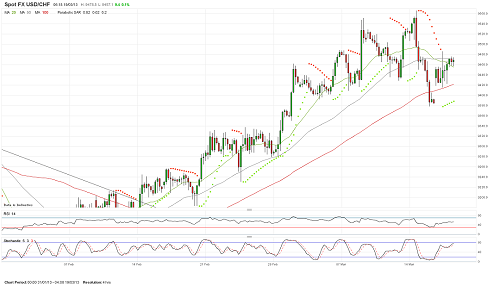
USDCHF
The USDCHF was trading in a range yesterday. There, the support is at 0.9415 and the resistance — near 0.9480. None of these levels has not been passed, though the dollar continues to trade on a positive note, which enabled it to recover after the drop to 0.9378. If the bulls manage to overcome 0.9480, the pair will test the strong resistance at 0.9555 once again. The loss of 0.9378 would weaken the bullish momentum and cause the decrease to 0.9308.
USDJPY
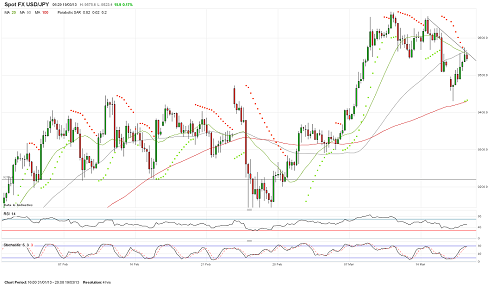
Yesterday, the USDJPY opened the gap and dropped to 94.07, but the downward movement was not developed again, thus the pair returned to 95.60. During the Asian session on Tuesday, the growth continued and the dollar increased to 95.75. Here on the 4 hour chart the 20-day converge together with the 50-day one, which gives hope for the sufficiently strong resistance formation so that the Japanese currency could try to develop its downward correction. The pair’s growth above would deprive the bears of hopes for it.