Beware: Inflation Is Not as Low as You Think

By Bill Bonner

Gold got whacked again — down another $22 yesterday. Stocks fell too. The Dow fell 111 points.

Is it the start of another correction? Or just a hiccup? Stay tuned!

Meanwhile, independent Sen. Bernie Sanders from Vermont is up in
arms. He demands that the White House and the House of Representatives
say no to benefit cuts for Social Security recipients and disabled vets.

He got the Senate to express itself on the issue too. Not
surprisingly, the senators are opposed to any cutbacks that would fall
on their voters’ heads. No senator dared raise his voice against it.

What exactly has been proposed?

Simple enough: more fudge.

Special Numbers

Anyone who has read our Diary for very long knows that the numbers used by the federal government… and by economists, generally… are special numbers.

They look like normal numbers. They use the decimal system. You can
add them. You can subtract and multiply them. But they are imposters…
crooked… bent… perverted. They do not mean the same thing as
stand-up, normal numbers. They may not mean anything at all.

If you look in a basket of apples, you will find a certain number of
them. You might have one. You might have six. But whatever number you
have, it will be an actual, real number. It will accurately describe
what’s in your basket.

But what if the feds tell you the unemployment rate is 7.6%? What if
they tell you that GDP is growing at 2.5% per year? What if they insist
consumer prices are rising at a 2% annual rate?

What do you know? Nothing!

These are public numbers, not private numbers. Like public
information, generally, they are low-quality numbers… with little real
information content… and, often, negative value.

They may have meaning, but it is not the same meaning that you expect
from other numbers. Often, they lead you to believe something that
isn’t true. And you can never trust them.

The Feds’ Latest Scam

What got Sanders worked up was the latest attempt to use these scammy
numbers to lower US deficits. The idea on the table is a plan that
probably originated here in Argentina. It is shifty enough.

The feds propose to change the way they calculate the CPI — a so-called “chained dollar” inflation rate — so that they will get a lower reading and, thereby, send less money to the old folks.

Heck, the number can be almost anything you want! Why not make it convenient for the feds?

On the surface, it appears to be the rarest sort of government initiative
— the kind we can approve of. After all, the feds spend too much.
Cutting back would allow more people to keep more of their money.

But isn’t it cheating the graybeards and the cripples?

Yes, of course. They were promised money that does not belong to
them. As it turns out, they will get less than they expected. But so
what?

The politicians promised to adjust payments to the CPI. As we’ve
discussed at length, the CPI was fudge from the get-go. It already
understates real price increases substantially. According to John
Williams of ShadowStats.com, the real CPI — calculated as the feds did
in the Carter administration — is 9.6%, not 2%.

So they’re already cheating retirees and veterans. Might as well cheat them a little more…

Regards,

Bill Bonner

Bill

To learn more about Bill visit his Google+ page or Bill Bonner’s Diary


Bitcoins and Gold: I Would Short Them Both If I Could

By The Sizemore Letter

It is truly a digital age: gold bugs have gone virtual.

I’m talking about Bitcoin, of course.  I realize that Bitcoin is not gold and has nothing to do with gold; it is a true cyber currency made of nothing but ones and zeros.  But its popularity is driven by the same forces that have caused investors to run to gold over the past decade: fear of inflation and a general mistrust of the global financial system.

Five years from now, I have my doubts as to whether Bitcoin will still be around.  In order to be taken seriously, it has to reach that tipping point where it becomes a viable medium of exchange accepted by mainstream retailers and not merely a pet project for ideological anarcho-libertarians and other assorted malcontents.  It could happen; but I’m not betting on it.  It’s taken more than a decade for Paypal to be accepted at non-internet cash registers, and Paypal is denominated in a recognized currency.  I don’t see retailers spending the money to update their payment systems any time soon, and before they do I would see this little fad fizzling out.

But I digress.  Today, I have no recommendation to short Bitcoin.  As tempting as it is, it’s dangerous to short anything that is in the middle of a parabolic move.  (And, alas, I’m not sure if it’s even possible to short Bitcoin at this time, unless there are derivatives I am unaware of.)

Instead, I recommend shorting Bitcoin’s far older predecessor, the barbarous relic itself: gold.

Gold has been in virtual free far since October.  In that time period, we’ve seen six months of aggressive QE Infinity from the Federal Reserve, an inconclusive Italian election with the potential to plunge Europe back into crisis, a botched Cyprus bailout that threatened to set off a bank run, and the most aggressive monetary stimulus in modern history coming out of Japan.

If none of these developments can spark interest in gold, then it’s hard to see what will.  After a great decade-long run, it appears that the gold bull market has run its course.

Action to take: Short gold.  The easiest route is to short the SPDR Gold Trust (NYSE:$GLD), though if you want to throw a little gasoline on the fire, you can instead buy the Proshares Ultra Short Gold ETF (NYSE:$GLL), a leveraged inverse ETF.

Gold is a volatile commodity, and you should be careful when shorting it.  I recommend something along the lines of a 10% trailing stop.  Within 1-2 years, I expect gold to be trading back in the $1,000-$1,200 range.

Disclaimers: Sizemore Capital currently has no positions in any security mentioned.

The post Bitcoins and Gold: I Would Short Them Both If I Could appeared first on Sizemore Insights.

How to Lock in an 8% Annual Yield as A DIY Venture Capitalist

By Aaron Gentzler

A groundbreaking new business, upstart.com,
built by a group of ex-Google employees, allows you to invest in the
future endeavors of promising college graduates for as little as $100.

Upstart allows you to become a venture capitalist… from your own
home… using just your computer and an Internet connection.

That’s because, as the graduate you back embarks on a career or
starts their own business, you receive a portion of their income for a
set time.

Investing in startup businesses is highly risky. The vast majority
of startups go to zero. If you invest in a startup, chances are good
you’ll lose your money.

But if you invest in a promising college grad, chances are good that
you’ll reap a high return on your investment as they pay your loan
back through a small portion of their future income.

As I’ve written before, the US education system — with its sky-highs costs — is broken and saddles young people with unpayable debt.

Upstart.com gives promising, motivated young grads a forum to
advertise themselves and collect backing from investors — people like you.
And unlike the broken college loan system, Upstart borrowers have to
start paying back their loans only once they start making money.
(Upstart borrowers must pay back a percentage of any income over $30,000
for at least a decade.)

Upstart spends a lot of time ensuring that the grads you invest in
have strong earnings potential in the future. It verifies a student’s
identity, academic record, creditworthiness, work record… and even
test scores… before that student can seek funding. So you don’t have
to worry about vetting whom you are loaning your hard-earned cash to.

Upstart uses what it calls a “pricing engine” to project each
applicant’s future income over the expected lifetime of an Upstart loan
contract. This engine uses data from other graduates with similar
backgrounds and achievements.

Upstart targets an average annual 8% return for investors. This is
certainly tempting, with the yield on the 10-year Treasury note
languishing at 1.8%. But be aware that Upstart does not have a long
track record of returns. So your actual return could be higher or lower
than 8%.

Of course, no investment is risk-free. And Upstart allows you to
start diversifying your income streams outside the stock market —
which carries its own risks.

Even better, Upstart also allows you to use your saved capital to support the idea leaders of tomorrow’s business world.

Let me give you some real-world examples…

Chris S. will graduate from the University of Chicago later this
spring. He’s already started a business called Maroon Collegiate
Sportswear. The company makes high-quality clothing inspired by
university history.

Chris is looking for backers on Upstart.com to build his business and take it to other schools. Chris is graduating from college debt-free and wants to focus his full attention on taking Maroon as far as it can possibly go.

Ian S. from Stanford’s Graduate School of Business recently reached
full funding at Upstart.com for his project to build a health
care-specific application for the new Google Glass device.

And Brodie Y. from the University of Washington recently reached
full funding to launch a startup that he believes could revolutionize
online grocery shopping.

Right now, you need to be an accredited investor to start supporting
grads through Upstart. That means having a net worth of more than $1
million or an income that has exceeded $200,000 for the past two years.
But I expect this to change, as Upstart and other peer-to-peer lending
businesses gain acceptance.

If you are an accredited investor, this could be a great way to pick
up an extra income stream outside the stock and bond markets. If you
are not an accredited investor, keep an eye on developments. My bet is
that in two to three years, this kind of income-generating opportunity
will be open to all.

And when that happens, it will fully replace the broken college loan system young Americans are saddled with today.

Check out upstart.com for full details.

Best regards,

Aaron

P.S. If you are not yet an accredited investor, there are plenty of
other unconventional ways to pick up extra income outside the stock and
bond markets. For instance, you can turn an obscure law signed by
President Ford into three ultra-safe “off market” streams of income. Click here to learn more.

Disclaimer

Article brought to you by Inside Investing Daily. Republish
without charge. Required: Author attribution, links back to original
content or www.insideinvestingdaily.com. Any investment contains risk. Please see our disclaimer.


Is It Time to Sell Your Gold?

By Bill Bonner

Dear readers ask about gold. Is it time to sell? To buy? To forget about it?

Gold fell $25 yesterday; it now stands at $1,575 per ounce. The gold
price could break all the way down to $1,000. But we don’t expect it.
Gold is not in a bubble.

As you have seen, gold is neither overpriced nor underpriced. It buys
about what it should buy. Maybe a little less. Maybe a little more.

How do we know what gold “should” buy?

We don’t, really. But gold is a natural thing. It is pulled from the
earth by people, using the technology and resources available to them.
As their productivity in other areas goes up, so does – generally –
their ability to extract gold from the ground.

If GDP goes up 10%… the quantity of gold usually goes up about the
same amount. If the economy goes into a decline, so does the gold mining
industry… reducing the rate of growth of the gold supply.

For these reasons, the supply of gold is usually more or less in sync
with the supplies of other goods and services. And the exchange rate
between gold and other goods and services is usually stable.

This was also the observation of Roy Jastram, who wrote The Golden Constant in 1977. Jastram looked at 500 years of British history. He found that prices – in terms of gold – were remarkably stable.

And here we see that prices for stocks, too, were also stable… as
long as gold – rather than an economist – stood behind the currency.

Gold Standard vs. Fiat Capital
View Larger Image

You can see for yourself from the above chart of the Dow/gold ratio
going back to 1800. Prices for stocks went haywire in gold terms only
after Congress created the Federal Reserve System in 1913.

Then the world went off the gold standard during World War I. (It was partly the struggle to get back on the gold standard that set off the bubble of the 1920s.)

Then there was another big run-up of stock prices – in terms of gold –
in the 1950s and 1960s… and again in the 1980s and 1990s. The chart
also shows the Dow/gold ratio heading down for the last 13 years… with
no clear sign that it has reached the bottom.

But wait. Hasn’t most of the profit for gold buyers already been made? Tekoa Da Silva from BullMarketThinking.com explains:

In response to that, the Pareto
Principle suggests that 80% of the gains are found in the final 20% of
the bull market. As it currently stands, the Dow/gold ratio is sitting
at roughly 9-to-1. A move to a 5-to-1 ratio would require a
$2,907-per-ounce gold price, a 3-to-1 ratio $4,845 per ounce, and a
2-to-1 ratio would require a stunning $7,268-per-ounce gold price.

A 2-to-1 ratio move from here equates
to a 400% move higher in gold, and of course, a 1-to-1 ratio ($14,500
per ounce) would equate to an over 900% move left remaining in the gold
bull market.

Be Happy

Da Silva does not say so, but the Dow/gold ratio could come down in
another way. Gold does not have to go up in price; stocks could fall. If
the Dow were to slip to 8,000, for example, this would be equivalent to
a 5-to-1 ratio.

When the stock market cracked in 2000… and gold continued to
rise… we thought the two were headed for a historic conjunction.
Perhaps at 2-to-1. Perhaps at 1-to-1. Where would the two meet?

We guess it would happen at about 5,000. Gold would rise to $5,000 per ounce… and the Dow would fall to 5,000.

Or at 2-to-1 – the Dow could fall to only 10,000… while the gold price rose to $5,000 per ounce.

Who knows? But there is no reason to think that things have changed in any fundamental way.

Gold is still real money. It is still brought forth only with much
effort and investment. And the Dow stocks still represent a certain
group of publicly listed, US-domiciled companies from which you can
expect a certain earnings stream. There is no reason to think that the
basic relationship between the Dow stocks and gold has been altered in
any fundamental or everlasting way.

For practically the entire 19th century… many years of the 20th
century… and as recently as the 1980s, the ratio of the Dow to gold
was 1 to 5 or less. Investors paid 5 ounces of gold to buy the Dow and
its earnings.

Will the Dow once again trade for 5 ounces of gold or less? Almost
certainly. And it will probably happen before this historic drop in the
Dow/gold ratio has reached its final bottom.

Hold your gold. Sell your stocks. Floss your teeth. And be happy.

Regards,

Bill Bonner

Bill

To learn more about Bill visit his Google+ page or go to Bill Bonner’s Diary


The Real Reason There Will Be No “Recovery” in America

By Bill Bonner

Nothing much happened on Wall Street yesterday. The Dow rose 56 points. Gold was flat.

From the Daily Mail in London:

US sees highest poverty spike since the 1960s, leaving 50 million Americans poor…

The number of Americans living in
poverty has spiked to levels not seen since the mid-1960s, classing 20%
of the country’s children as poor.

It comes at a time when government
spending cuts of $85 billion have kicked in after feuding Democrats and
Republicans failed to agree on a better plan for addressing the national
deficit.

The cuts will directly affect 50
million Americans living below the poverty income line and reduce their
chances of finding work and a better life.

As President Barack Obama began his
second term in January, nearly 50 million Americans – one in six – were
living below the income line that defines poverty, according to the
bureau. A family of four that earns less than $23,021 a year is listed
as living in poverty.

The newspaper illustrates its bleeding-heart story with a
ridiculous example, taken from the streets of Baltimore. A Mr. Antonio
Hammond abandoned his children for 20 years… and stole copper pipes
and other things to support a full-time drug habit.

“All I wanted to do was to get high,” he told the Daily Mail.

Then Hammond kicked the habit and got a job at $13 per hour. Now he’s
a success story. And if you believe the Daily Mail, cuts to the federal
budget may make it harder for people like Hammond to escape from
poverty.

Seems much more likely to us that cuts to federal spending will help
people like Hammond get back on their own two feet; the feds won’t have
the funds to keep him in poverty.

Baltimore has been fighting poverty for the last 50 years – ever
since President Johnson declared a war on poverty in the 1960s. Spending
has gone up and up, blasting away at poverty with hundreds of billions
of dollars.

But now Baltimore has more poor people than ever – one in four residents is below the poverty line, according to the Daily Mail. And no wonder. When poverty pays, why take up something else?

No Brave New World

We wonder how come there are so many poor people? Wasn’t the Internet supposed to make us all rich?

Even Hammond can now go online and discover the secrets of business
and science. He can know as much about economics as Ben Bernanke. He can
know as much about politics as Nancy Pelosi. He can know as much about
journalism as Tom Friedman.

So how come they get the big bucks and he doesn’t? How come a man who
can know almost everything settles for just $13 per hour? Is that all
omniscience is worth?

Back at the end of the 1990s, we ran into people who thought the
Internet changed everything. With so much information at everyone’s
fingertips, they thought they saw a brave new world coming.

We would all have access to the information we needed to increase
productivity and add wealth. No one would be poor again. All they would
have to do is to go on the Internet to find out how to get rich.

We were suspicious of these claims back then. Information is cheap,
we pointed out. It’s wisdom that is precious, and you don’t get much of
that on the Internet. You have to pay for it… with bitter experience.

In fact, information – unless it is exactly what you need, exactly
when you need it – has negative value. It distracts you. It must be
applied. And stored.

How much good would it have done Napoleon – on his disastrous retreat
from Moscow – to have the plans for a nuclear weapon? Suppose Louis
XVI, mounting the scaffold to the guillotine, had had proof that Sacco
and Vanzetti were innocent! Imagine whispering to Hugo Chavez, as he lay
on his deathbed: “Studies show that people who eat less meat have less
cancer.”

No, dear reader, information is like manure. A little, at the right time, is a good thing. Pile up too much, and it stinks.

Productivity Falls

And now we have proof… that the Internet did not add to the wealth of the US… or apparently anywhere else. From The New Yorker:

For a time, the Labor Department’s
productivity figures appeared to support the idea of an Internet-based
productivity miracle. Between 1996 and 2000, output per hour in the
non-farm business sector – the standard measure of labor productivity –
grew at an annual rate of 2.75%, well above the 1.5% rate that was seen
between 1973 and 1996.

The difference between 1.5% annual
productivity growth and 2.75% growth is enormous. With 2.75% growth
(assuming higher productivity leads to higher wages), it takes about 26
years for living standards to double. With 1.5% growth, it takes a lot
longer – 48 years – for living standards to double…

Since the start of 2005, productivity
growth has fallen all the way back to the levels seen before the Web was
commercialized, and before smart phones were invented.

During the eight years from 2005-2012,
output per hour expanded at an annual rate of just 1.5% – the same as it
grew between 1973 and 1996. More recently, productivity growth has been
lower still. In 2011, output per hour rose by a mere 0.6%, according to
the latest update from the Labor Department, and last year there was
more of the same: an increase of just 0.7%. In the last quarter of 2012,
output per hour actually fell, at an annual rate of 1.9%. Americans got
less productive – or so the figures said…

If the sluggish rates of productivity
growth we’ve seen over the past two years were to persist into the
indefinite future, it would take more than a hundred years for
output-per-person and living standards to double.

How about that? The Internet. A big dud. A time waster, like television, not a wealth booster, like the internal combustion engine.

Regards,

Bill Bonner

Bill

To learn more about Bill visit his Google+ page or Bill Bonner’s Diary
 

What’s Next for the Yen and Japanese Stocks?

By The Sizemore Letter

When it comes to quantitative easing, Fed Chairman Ben Bernanke is playing AA minor league ball at best.  If he ever wants to make the big leagues, he needs to take batting practice with Japan’s new central bank governor, Haruhiko Kuroda.

In addition to the “usual” quantitative easing actions of buying government bonds, the Bank of Japan will be buying 30 billion yen of Japanese real estate investment trusts and a trillion yen of exchange traded funds…annually!

By Forbes estimates, the new expansion in Japan’s monetary base amounts to 10% of Japan’s GDP.  By comparison, Bernanke’s QE Infinity is less than 7% of U.S. GDP.

Not surprisingly, Japanese stocks surged on the news.  We talk about the Fed “propping up” the stock market here (and conspiracy theorists have long accused the “Plunge Protection Team” of manipulating the markets), but  we’ve never had the Fed directly jumping into the stock market like this.

What does this mean for Japanese stocks going forward?  Or the yen?

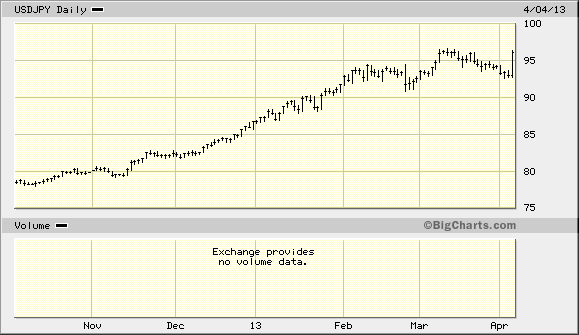
Figure 1: USDJPY

Figure 1: USDJPY

The standard “don’t fight the Fed” advice applies here, at least in the short term.  The Bank of Japan is determined to push the value of the yen down to boost exports and to shake the economy out of its long deflationary funk.  It’s much easier for a central bank to destroy the value of its currency when it is expensive than to prop up its value when it is falling.

So, don’t try to be a hero here by betting against the Bank of Japan.  Remember, George Soros made his legendary “bankrupt the Bank of England” trade by shorting the pound when the BoE was trying to prop it up.  Not even Soros the Great and Powerful could have succeeded in a long bet against a central bank this determined to weaken its currency.

Let’s take a look at how the yen has performed of late (Figure 1). You have to view this graph in reverse; a rising line means a falling yen relative to the dollar. (Think of it like this; back in November, a dollar would have bought you 80 yen; that same dollar today will buy you 96 yen.)

The yen has been in virtual free fall since it became obvious that Prime Minister Shinzo Abe would win last year’s election, though the yen rose sharply for most of March due in large part to the turmoil coming out of Europe.

Perversely, given Japan’s debt load, the yen became a “haven” currency following the unwinding of the carry trade in 2008 (which should put the nail in the coffin of any ideas you might have had about markets being rational).  So, if Europe has another destabilizing wave of volatility, then the yen might enjoy a brief respite.  But overall, the yen’s downward trend will likely continue for a while.

Figure 2: iShares MSCI Japan ETF (NYSE:EWJ)

Figure 2: iShares MSCI Japan ETF (NYSE:EWJ)

What about Japanese equities?

Japanese stocks, measured by the iShares MSCI Japan ETF (NYSE:$EWJ), have been on a tear since mid-November (Figure 2), coinciding with the yen’s decline.  And over the next, say, three to six months, I expect this trend to continue.

But be careful here; Japanese stocks should be viewed as a short-term trade, and most definitely not a long-term investment.  In the not-too-distant future, I expect Japan to bust apart at the seams.  If the Bank of Japan is successful in reigniting inflation, Japanese bond yields will rise.  And when Japan’s financing costs rise, that gargantuan pile of debt (currently 220% of GDP) becomes a lot harder to service.

As I wrote in February, “debt service now accounts for 43% of Japanese government revenues and quarter of all spending.  Furthermore, more than half of all Japanese government spending is financed by new borrowing.   This means that half of every yen borrowed is used to service existing debts.  It’s a debtor’s nightmare that gets worse every year with budget deficits that are consistently higher than 7% of GDP.”

The bond vigilantes will eventually wake up and take note of these sobering statistics, and when they do things are likely to deteriorate very quickly.  Think banana republic levels of hyperinflation followed by outright default.

Amazingly, Japanese yields continue to fall for now.  The 10-year Japanese bond now yields an almost unbelievable 0.45%.  At these levels, shorting Japanese bonds becomes an almost risk-free proposition.

When yields finally begin to rise, get ready for the short opportunity of a lifetime in virtually all Japanese assets.  In the meantime, keep an eye on the 10-year yield.  When it rises above the 1.0-1.5% level, I expect doomsday to follow shortly thereafter.

Disclaimer: Charles Sizemore currently has no positions in any security mentioned.


The post What’s Next for the Yen and Japanese Stocks? appeared first on Sizemore Insights.

Gold’s Fall “Exaggerated”, Another Big Move Down “Will Need to Break Through Big Support Level”

London Gold Market Report
from Ben Traynor
BullionVault
Friday 5 April 2013, 07:30 EST

U.S. DOLLAR gold prices climbed back towards $1556 per ounce Friday morning in London,
the level that was until yesterday’s falls the 2013 low, as stocks and commodities fell ahead of the
release of monthly US jobs data.

Gold in Sterling climbed back above £1020 an ounce, up from a three-month low hit yesterday,
while gold in Euros climbed back above €1200 an ounce, after touching its lowest level since
February.

Silver briefly edged back above $28 an ounce, having fallen to eight-month lows yesterday, while
longer-dated US Treasuries gained.

The latest US Employment Situation report, which includes the nonfarm payrolls figures for the
number of jobs added last month as well as the latest unemployment rate, is due to be released at
08.30 Washington, D.C. time.

A day earlier, gold sank to a 10-month low in Dollar terms Thursday, briefly touching $1540 an
ounce.

“The fact that gold failed to hold the intraday lows in the $1540 area is a bit of a concern for the
bearish trend in the short-term,” say technical analysts at Scotia Mocatta.

“There is a big support level between $1522 and $1532 which will have to be cleared before we see
another large move down in gold.”

The gold price will average $1730 an ounce this year, trading in a range between $1530 and $1850,
according to forecasts published Thursday by metals consultancy Thomson Reuters GFMS.

GFMS added however that an improving economic backdrop “could easily entail the start of a
secular bear market” in 2014. At the launch of its Gold Survey 2013 report, GFMS also noted that
gold exchange traded funds saw outflows of 177 tonnes in the first three months of 2012, equivalent
to 63% of the amount they added over the whole of 2012.

As of Thursday, the volume of gold backing shares in the world’s biggest gold ETF, SPDR Gold
Trust (ticker: GLD), was down more than 10% since the start of the year.

Hedge fund Paulson & Co., which latest available data show held around 5% of the GLD, saw
its Gold Fund fall by 27.9% in the first quarter, the Wall Street Journal reports, with the firm
citing “implied volatility in the gold derivatives market”. The Dollar gold price was down around
4% over the same period.

“The main driver behind gold’s weakness this year has been the focus on global growth and that’s
meant rotation out of defensive assets like gold,” says UBS analyst Joni Teves.

“There’s this weak sentiment and it’s been feeding on itself. Central banks continue to pursue
exceptionally loose monetary policies and create a still supportive environment for gold.”

“Investors are reshuffling commodity investments into equities,” adds Commerzbank analyst Daniel
Briesemann.

“We find it somewhat hard to understand the current underperformance of commodities given that
the market environment is characterized by at least some economic recovery. We think that the drop
is exaggerated.”

Police in Italy on Sunday seized gold bars worth an estimated €4.5 million after stopping a car
trying to cross the border into Switzerland, according to press reports.

Friday marks the 80th anniversary of Executive Order 6102, the confiscation of privately-held
gold by President Roosevelt in 1933.

Ben Traynor
BullionVault

Gold value calculator | Buy gold online at live prices

Editor of Gold News, the analysis and investment research site from world-leading gold ownership
service BullionVault, Ben Traynor was formerly editor of the Fleet Street Letter, the UK’s longest-
running investment letter. A Cambridge economics graduate, he is a professional writer and editor
with a specialist interest in monetary economics. Ben can be found on Google+

(c) BullionVault 2013

Please Note: This article is to inform your thinking, not lead it. Only you can decide the best
place for your money, and any decision you make will put your money at risk. Information or
data included here may have already been overtaken by events – and must be verified elsewhere –
should you choose to act on it.


Barbados to focus on treasury rates instead of deposit rate

By www.CentralBankNews.info
    The Central Bank of Barbados (CBB) is launching a new approach to influencing interest rates by intervening directly in the market for Treasury bills instead of using the minimum deposit rate as a guide to affecting commercial banks’ lending rates and thus economic activity.
    The rationale behind the new policy was unveiled in a CBB working paper from last month  – Central bank intervention and interest rate policy in Barbados – that laid out the limitations of using interest rates to control inflation in a country like Barbados where 80 percent of inflation is imported.
    “It has been the experience in Barbados that monetary policy cannot relieve any pressure that might aggravate imported inflation; for instance, it will not achieve low domestic inflation rates in an environment where international oil and commodity inflation is high,” the paper said.
    Under the new policy, which will begin on April 18, the CBB said it would “from time to time intervene actively in the Treasury Bill market to influence the average rate at which the bills are sold.”
    The coupons on all longer-dated government securities will be priced at an appropriate premium over the Treasury bill rate and the central bank will publish a quarterly yield curve to provide guidance to the market.
    “With the introduction of this policy, the minimum deposit rate will no longer be used for interest rate guidance,” the CBB said.

    However, the banks said it would continue to stipulate a minimum savings rate for the savings accounts of private individuals and non-profit organisations – currently at 2.5 percent – to partially insulate small savers against the erosion of the value of their funds due to inflation.
    Financial institutions will be free to set all other rates, the CBB said.
    In a small, open economy like Barbados, the policy of targeting a deposit rate to guide the local availability of credit was weak because banks, firms and households went abroad to obtain funds.
    “In these circumstances, interest rate policy cannot fulfill its conventional role,” the CBB said in its working paper from last month, adding that changes in interest rates had little or no effect on inflation.
    In addition, domestic interest rates had to be kept in line with international rates to “avoid incentives for destabilizing inflows and outflows of capital,” the bank said, adding there was a longstanding view that keeping rates low to boost investment did not work because there was an incentive for an outflow of funds, “thereby starving the domestic system of investible liquidity.”
    In the future, the CBB will base its interest rate policy on two factors that will help it determine a notional policy rate, with an allowance for an appropriate spread: The trend in international interest rates and whether there is a need for a temporary inflow of finance to boost domestic liquidity.
    The CBB will use the three-month Treasury bill rate as the market-determined benchmark and other government securities would be based on this T-bill rate.
    “Where warranted, the Central Bank’s intervention in the T-bill market would signal to the market the need for interest rate adjustments, if there is a sustained change in the U.S. and domestic interest rate spread or if there is a continuous shortfall in T-bill auctions.
   

    www.CentralBankNews.info

Central Bank News Link List – Apr 5, 2013: BOJ’s Kuroda: monetary onslaught won’t cause asset bubbles

By www.CentralBankNews.info Here’s today’s Central Bank News link list, click through if you missed the previous link list. The list comprises news about central banks that is not covered by Central Bank News. The list is updated during the day with the latest developments so readers don’t miss any important news.

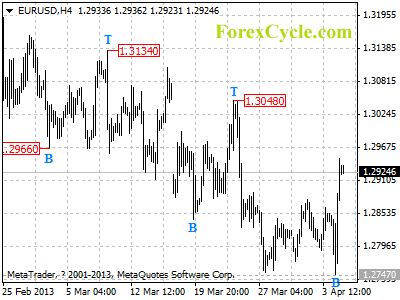
EURUSD bounces strongly from 1.2747

EURUSD bounces strongly from 1.2747, suggesting that a cycle bottom has been formed on 4-hour chart. Further rise to test 1.3000 key resistance would likely be seen, a break above this level will indicate that the downtrend from 1.3711 (Feb 1 high) has completed, then the following upward movement could bring price to 1.4000 zone. On the downside, as long as 1.3000 resistance holds, the rise from 1.2747 would possibly be consolidation of the downtrend, one more fall to 1.2500 area is still possible.

eurusd

Daily Forex Forecast