The Eurozone Desperately Needs a Weaker Euro — and It’ll Get it

By MoneyMorning.com.au

Another weekend, another eurozone crisis. This time it’s Portugal.

The doughty little country has managed to stay below the radar for a surprisingly long period of time. Given that tiny countries — like Cyprus — can still cause tremendous headaches for the eurozone, that’s an achievement.

It’s come about primarily because Portugal has been a ‘good’ eurozone member so far, and taken its austerity medicine with gusto.

But now Portugal’s constitutional court has told the government that it’s taken austerity too far. On Friday night, it threw out plans to cut public sector wages and pensions, sending the government back to the drawing board.

The money will likely be found somewhere. But that’s not the point.

Portugal’s woes point to the next phase of the eurozone crisis — one that even the European Central Bank will find much harder to deal with…

What Portugal’s Court Ruling Means for the Eurozone

Portugal got a bailout deal from the eurozone two years ago. In return, it promised to get its budget back on track.

That hasn’t happened yet. By now, Portugal’s budget deficit (its annual overspend) was supposed to be back below 3%. That deadline has already had to be extended to 2015.

It looks like it’ll have to be extended again. The Portuguese constitutional court has just blown a big hole in this year’s budget. The government had aimed to save about €5bn this year.

The court has said that some of the cuts to state pensions and public sector wages are unfair. So the Portuguese government now has to find other ways to save about €1bn of that €5bn.

This in itself is not a huge problem. Portuguese prime minister Pedro Passos Coelho said he will do ‘everything to avoid a second bail-out’. So services, rather than wages, will be cut.

And Portugal was set to miss the 2015 target anyway. So this apparent lack of co-operation by the court gives Mr Passos Coelho a good excuse to ask for more time. Portugal has enough brownie points with the ‘troika’ (the eurozone bail-out committee) to have earned a sympathetic hearing.

So Why Does Any of This Matter?

Because it’s yet another sign that national politics in the eurozone is starting to seriously undermine regional politics.

Let’s remind ourselves of the basic problem in the eurozone. Germany is the region’s biggest economy. So it’s only natural that it’s going to have a big influence on monetary policy.

The way Germany sees it, all of the countries that have ended up in trouble are in need of reform. And it’s hard to argue with that. Italy, Spain, Portugal, Greece — they could all do with more flexible labour markets, and probably with more efficient tax systems, among other things.

The trouble with structural reform is that it’s painful and uncomfortable. It’s also politically unpopular. So countries will often only do it when their backs are against the wall.

So Germany doesn’t want the European Central Bank (ECB) to use monetary policy to give these southern Mediterranean countries an ‘easy’ way out. That would remove some of the incentive to reform.

(Germany doesn’t really like the idea of money printing in general either, as it’s the country most likely to suffer from inflation as a result of it.)

Again, on one level, it’s hard to argue with this. Why should Germany take the strain of bailing these countries out if they’re just going to go back to their old ways?

But you can see it from the point of view of the Italians and the Portuguese too. At the end of the day, isn’t it up to them — as sovereign nations — to decide if they prefer to run their economies as borderline basket-cases? Particularly if the evidence so far suggests that austerity isn’t really working for them?

It boils down to the problem that has always been at the heart of the euro project. You can’t have currency union without political union. And no one has ever made that clear to the voters in the eurozone. In fact, they deliberately hid that fact because they knew that no one would vote to give up their sovereignty.

But in the heat of the crisis, the true nature of the problem is becoming increasingly clear. Politicians in Portugal and Greece and Italy have been trying to make their countries more ‘euro-worthy’. But amid the pain this is causing, voters and national political bodies are rebelling.

Italy has no government. The Greeks only narrowly voted in a pro-euro party at the election last year. Now the courts have struck a blow against Portugal’s current government. How long will it stay in power?

This All Adds Up to One Thing — a Weaker Euro

The longer this is allowed to continue, the closer that voters will come to the truth of the matter: if they want self-determination, they have to leave the euro. That means that to protect the euro — which is ultimately its job – the ECB has to find a way to make life less painful for voters in the periphery countries.

People are scared of the unknown. And ditching the euro is definitely a leap into the unknown. It would probably be better in the long run for many of these countries. But in the short-term it could mean savings are destroyed and businesses collapse.

What the ECB has to do is to stop voters from getting so desperate that they decide a leap into the unknown is better than what they currently have.

The big problem is the German election in September. Once that’s over, Angela Merkel (assuming she’s still in power) will no longer feel the need to adopt such a hard line on austerity. But until then, she has to act tough, and talk tougher. So the ECB’s options are limited.

However, the ECB’s job is fairly simple. It boils down to keeping the euro weak. And the worse the various crises become, the more excuses it has to act. And assuming the euro is still around come September, I can see quantitative easing being launched as soon as politically possible.

In short, I don’t see the euro being allowed to strengthen far beyond where it is now (about 1.30 against the US dollar) this year. And I can see it eventually becoming much, much weaker.

John Stepek
Contributing Editor, Money Morning

Join Money Morning on Google+

Publisher’s Note: This article first appeared in MoneyWeek

From the Archives…

Only Lunatics Need Apply for This Stock Market Rally
5-04-2013 – Kris Sayce

The Run-on Effect of Aussie Housing on the Australian Stock Market
4-04-2013 – Murray Dawes

Good News in China’s Economy? Put This Date in Your Diary…
3-04-2013 – Dr Alex Cowie

‘Gold Only Rises During the Bad Times’ and other Fairy Tales
2-04-2013 – Dr Alex Cowie

On Gold — Billionaire Investor Eric Sprott Says : ‘I’m in Alex Cowie’s Camp’
1-04-2013 – Dr. Alex Cowie

How to Play the Deep Water Oil Boom

By MoneyMorning.com.au

A good technology company should sell products that pay for themselves. In other words, products should have a rapid payback period for customers.

In the oil drilling equipment business, technology should offer solutions that cut operating costs or enhance production at customers’ projects. Oil companies spend billions on large offshore oil and gas projects.

Typically, the deeper the project, the more money is spent. So any high-tech equipment that can cut costs or boost production can essentially sell itself.

A Clear Oil Company Leader

In the market for highly engineered offshore production equipment, FMC Technologies Inc. (NYSE: FTI) is the clear leader. FMC installed its first ‘full field’ subsea separation, boosting and injection system on Statoil’s Tordis field in the North Sea in 2007.

FMC increased recovery by an extra 35 million barrels of oil and extended the life of the field by 15 years. With a payback of an extra 35 million barrels, this sort of equipment pays for itself.

FMC Technologies Inc.

Deep-water drilling is a growth market, and FMC Technologies is investing heavily to capture a large share of the market. Tore Halvorsen, a senior VP of Subsea Technologies at FMC, recently explained FMC’s long-term vision to Bloomberg News:


‘Instead of all that up and down travel through the ocean, FMC Technologies wants to move those operations to the seafloor… There would be less need for the massive floating production platforms that can cost as much as $1 billion and contain tons of equipment.

‘Operating costs would drop with no need to ferry workers by helicopter to offshore sites, or house and feed them there, Halvorsen said. And the less equipment sitting at the top of the sea, the less vulnerable operations would be to hurricanes sweeping through warm seawaters during the summer.

‘With more equipment located at the seafloor and not tied into platforms, wells could be more widely spaced, draining the reservoir more efficiently, he said. And if processing is done at the seafloor, water would be separated and left behind, minimizing energy consumption and eliminating the problem of ice crystals plugging up pipelines in the cold waters below.’

Furthermore…

James West from Barclays, a leading oil service and equipment analyst, agrees that more offshore production and processing is likely to migrate to the ocean floor:


‘The main drivers of subsea processing include accelerating production, increasing recovery and extending field life, reducing [capital spending] on topside processing equipment and pipelines, improving flowline efficiency, and alleviating topside capacity constraints.’

Byron King, our geologist, recommended FMC four years ago. ‘It’s fair to say that without the equipment that FMC Technologies has invented and provides, the deep waters of the world would still be off-limits to energy exploration,’ Byron wrote. ‘Looking broadly at the subsea equipment business sector, there are only a handful of major vendors with the technical ability to build, supply and service this kind of equipment.’

A Play on a Growth Industry

There is much more potential upside for patient shareholders…

FMC’s equipment has pricing power; you can see it in FMC’s consistent profit margins – even during downturns.

The quality of FMC’s business shows up in its high average return on equity (ROE) over the past decade: 33%. A high ROE allowed FMC to grow revenues rapidly without stressing its balance sheet or increasing its share count.

FMC has a long history of conservative financial policies, and only recently borrowed a reasonable amount of debt to fund its 2012 acquisitions. Acquisitions helped round out FMC’s vision for underwater well processing, and broadened its offerings in the onshore shale drilling market.

FMC’s profit margins were down a bit in 2012, but this can be explained by management’s decision to hire and train its workforce aggressively to fulfil a $5.4 billion (and growing) backlog of orders.

The stock’s valuation is rich, but FMC is the type of company that can ‘grow into’ its valuation. With huge growth potential, FMC is an attractive stock to own – and buy on weakness.

Dan Amoss
Contributing Writer, Money Morning

Join Money Morning on Google+

From the Archives…

Only Lunatics Need Apply for This Stock Market Rally
5-04-2013 – Kris Sayce

The Run-on Effect of Aussie Housing on the Australian Stock Market
4-04-2013 – Murray Dawes

Good News in China’s Economy? Put This Date in Your Diary…
3-04-2013 – Dr Alex Cowie

‘Gold Only Rises During the Bad Times’ and other Fairy Tales
2-04-2013 – Dr Alex Cowie

On Gold — Billionaire Investor Eric Sprott Says : ‘I’m in Alex Cowie’s Camp’
1-04-2013 – Dr. Alex Cowie

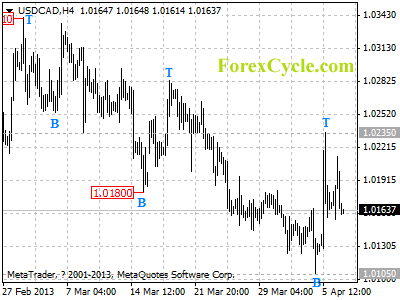
USDCAD had formed a cycle top at 1.0235

USDCAD had formed a cycle top at 1.0235 on 4-hour chart. Range trading between 1.0105 and 1.0235 would likely be seen in a couple of days. As long as 1.0235 resistance holds, the price action in the range could be treated as consolidation of the downtrend from 1.0341, another fall towards 1.0000 could be expected after consolidation, only break above 1.0235 could signal completion of the downtrend.

usdcad

Daily Forex Analysis

Time to leave the Casino (and Buy Gold)

By Bill Bonner

On Friday, the Bank of Japan hit the markets with a zany
announcement. It said it was going to double the country’s monetary
base! From Reuters:

The Bank of Japan unleashed the world’s most intense burst of
monetary stimulus on Thursday, promising to inject about $1.4 trillion
into the economy in less than two years, a radical gamble that sent the
yen reeling and bond yields to record lows.

New Governor Haruhiko Kuroda committed the BoJ to open-ended
asset buying and said the monetary base would nearly double to 270
trillion yen ($2.9 trillion) by the end of 2014, a dose of shock therapy
officials hope will end two decades of stagnation.

The policy was viewed as a radical gamble to boost growth and
lift inflation expectations and is unmatched in scope even by the US
Federal Reserve’s own quantitative easing program.

Will it work? Will it put some life into the Japanese economy?

Nomura Research Institute chief economist and expert on Japan’s “balance sheet recession” Richard Koo says no.

Koo says this kind of monetary stimulus won’t do the trick. Because
businesses and households are still rebuilding their balance sheets and
paying down debt. The Japanese feds may make more money and credit
available, but the real economy won’t take it. Instead, the money will
just pour into the (speculative) stock market.

The yen fell on the announcement. And Japanese stocks shot up. But
the US stock market was unimpressed. The Dow fell 40 points on Friday.

Desperation and Lunacy

What to make of it? The world’s third largest economy. A jolt of
money printing unprecedented in world history. And the Fed, BoE and ECB
all following along.

The BoJ says it just wants to get inflation to 2%. It says it will
buy bonds with fiat money that didn’t exist previously… and keep
buying… until inflation reaches 2%.

Then what? Well, we guess it will stop.

And then what?

Then it will have an economy that has come to expect 70 billion yen
in new money every month. And an economy with a monetary base (the
“stock” from which the “soup” of money supply is made) maybe twice what
it is today.

We don’t know what that will mean for Japan. Will the asset prices collapse again when the money printing stops?

Will the economy pick up… the banks begin to lend again… and consumers go on a spending binge?

Or will investors all over the world dump their yen, eager to get out of the Japanese paper money before inflation levels get out of control?

We don’t know. But neither do the Japanese feds. As Reuters describes it above, it is a “radical gamble.”

People make radical gambles now and then. Businessmen might take a
chance now and then. Gamblers might go for long odds. Lovers might hope
to get lucky.

Traditionally, central banks do not make “radical gambles.” They tend
to eschew gambles of any kind, even of the most respectable and
bourgeois sort.

Central banks are meant to be stolid and boring. Spiders should be
able to weave their webs in front of their vaults and remain unmolested.
Central bankers are not supposed to call press conferences. (They not
supposed to have anything to say in the first place.) And all requests –
whether for bailouts, interviews or lunch – should be answered with an
unyielding “no.”

For a central bank to make a “radical gamble” bespeaks desperation and lunacy.

How this gamble will pay off, we don’t know. We simply note most of
the world’s major central bankers are putting their money on the same
color… and as the wheel spins… we urge dear readers to leave the
casino.

Neither in yen, euros, pounds nor in dollars should we be. For when
the dust finally settles on this wild riot of radical gambles by central
bankers, gold will be the “last man standing.”

Regards,

Bill

To learn more about Bill visit his Google+ page or Bill Bonner’s Diary.


This Is Not a Rally… It’s a Credit Bubble of Epic Proportions

By Chris Hunter

An explosive rise in asset prices always generates concern that a
bubble may be developing and that its bursting might lead to broad and
deep economic distress.

– Fed governor Frederic Mishkin, August 2007

On Friday, the Bank of Japan ushered in a new era of monetary stimulus.

Under new governor Haruhiko Kuroda… and under massive pressure from
new prime minister Shinzo Abe… the BoJ promised a $1.4 trillion debt
monetization program.

This will start next year and will double the country’s monetary base
(currency in the hands of the public plus commercial bank deposits at
the Bank of Japan).

Following the news, the Nikkei 225 ended the session up +1.6%. The
yen fell more than -2% versus the dollar… and -4% versus the euro. And
the yield on the 10-year JGB hit a record low.

We are in unchartered territory regarding monetary easing.
We are living through a giant academic-led monetary experiment – the
largest in history by far – that is being pursued without regard for the
potential for nasty unintended consequences.

The central banks
of the “big three” developed economies – the US, the EU and Japan – are
now committed to doing “whatever it takes” to keep bond yields low.
They have no choice. If yields go higher, stock market gains will
evaporate and rising interest costs on sovereign debt would put huge
pressure on governments. We would see another giant asset bubble deflate
and have no monetary “ammo” in reserve to ease the pain it would cause.

Relative to the size of its economy, the BoJ’s stimulus plan is now
even more intense than the Fed’s. As Japan bond bear Kyle Bass points
out, “The BoJ is now monetizing at a rate around 75% of the Fed on an
economy that is one-third the size of the US.”

What many don’t understand… or don’t want to see… is that in
Japan (and in the US), this stimulus is not reaching “Main Street” by
way of bank lending. Although monetary base is rising, wider measures of
money supply have been flat or are falling.

This means that credit easing ends up exclusively boosting asset
prices (most notably, equities) by way of cheap leverage, margin buying
and “carry trades.”

But the fundamentals are not keeping up… As former Reagan budget advisor David Stockman pointed out in a recent piece in The New York Times, “State-Wrecked: The Corruption of Capital in America”:

Since the S&P 500 first reached its
current level, in March 2000, the mad money printers at the Federal
Reserve have expanded their balance sheet sixfold (to $3.2 trillion from
$500 billion). Yet during that stretch, economic output has grown by an
average of 1.7% a year (the slowest since the Civil War); real business
investment has crawled forward at only 0.8% per year; and the payroll
job count has crept up at a negligible 0.1% annually. Real median family
income growth has dropped 8%, and the number of full-time middle-class
jobs, 6%. The real net worth of the “bottom” 90% has dropped by
one-fourth. The number of food stamp and disability aid recipients has
more than doubled, to 59 million, about one in five Americans.

Of course, Stockman’s views have gone down like a lead balloon in the
corridors of power and in the mainstream media – which abhor his
hard-money views and which cling to a painless Keynesian solution to the
2008 credit collapse.

What should you do in the current environment? Exercise extreme
caution. Try to think independently of the crowd. And remember your
history…

As barometers go, stock markets, under conditions of high levels of
margin borrowing and other forms of leverage, are less than perfect.
Otherwise, the much-feted 1929 rally would not have happened – a full
year after commodity price deflation had set in.

Fast-forward to 2013, and we see that the three best-performing
sectors in the US equity rally are the anti-cyclical and defensive
health care, consumer staples and utilities (with an average
year-to-date gain of 14%). The three worst-performing sectors
are the highly cyclical and growth-sensitive materials, tech and energy
(with an average year-to-date gain of less than 3%).

This is not a rally. It’s a credit bubble of epic proportions.

Disclaimer

Article brought to you by Inside Investing Daily. Republish
without charge. Required: Author attribution, links back to original
content or www.insideinvestingdaily.com. Any investment contains risk. Please see our disclaimer.


Gas Starts Flowing from Israel’s Levant Basin, What Now?

By OilPrice.com

The first gas has started flowing from Israel’s supergiant Tamar gasfield in the Levant Basin. Where it will go will redraw the Mediterranean energy map and the geopolitics that goes along with it.

The Tamar field stakeholders announced on 30 March that the gas had started flowing, raising the value of Texas-based Noble Energy Inc. (NYSE: NBL), which holds a 36% stake, and Israel’s two Delek Group subsidiaries, which each hold a 15.6% stake.

For now, the gas is being pumped to mainland Israel, where it will feed the domestic market, but exports should begin in 2-3 years. What Israel has in mind is the European market, via a hoped-for undersea Mediterranean pipeline to Turkey, which has the infrastructure to get it to Europe.

The competition for this prized market is stiff. In total, the Mediterranean’s Levant Basin has an estimated total of 122 trillion cubic feet of gas and 1.7 billion barrels of oil. Lebanon and Cyprus are eyeing the same market for their own Levant Basin gas resources. Cyprus has found gas in its section of the basin, and Lebanon has announced a tender for exploration off its shoreline.

The Greek Cypriot government believes it is sitting on an amazing 60 trillion cubic feet of gas, but these are early days—these aren’t proven reserves and commercial viability could be years away. In the best-case scenario, production could feasibly begin in five years. Exports are e ven further afield, with some analysts suggesting 2020 as a start date.

Israel has the upper hand right now in terms of development and production, but it lacks the infrastructure without Turkey.

Israel was originally hoping to lay a pipeline that would traverse both Cyprus and Turkey, but there are too many political pitfalls to this plan (whichwould essentially mean a final resolution to the Turkey-Cyprus spat). The ideal would have been a pipeline that connects all the Levant Basin resources—including Lebanon, Israel, Cyprus and Turkey—but this is the stuff of geopolitical dreams.

In the end, it is shaping up that an Israel-Turkey pipeline is not only possible, but coming to fruition. Earlier this month an official apology from the Israeli prime minister to his Turkish counterpart for some high-level grievances was engineered by US President Barack Obama. It was an unprecedented move by Israel and one that illustrates how important this pipeline is for Israel. An apology was really the only thing keeping Turkey from green-lighting this pipeline project without a backlash at home.

This Israel-Turkey pipeline makes Lebanon and Cyprus nervous. It essentially cuts them out of the equation. Politics for now will keep Lebanon from connecting up to any Israeli pipeline, and Turkey won’t have a connector to Cyprus.

Russia’s Gazprom, of course, is not keen to lose its stranglehold on the European market. To that end, it’s jumped in on Tamar itself, obtaining exclusive rights from Israel to develop the field’s liquefied natural gas (LNG). Here’s the plan: Russia is hoping to divert Israeli gas exports to Europe by banking on these resources being turned into LNG for Russian export to Asian markets instead. Russia is willing to invest heavily in a $5 billion floating LNG facil ity to this end. In return it gets exclusive rights to purchase and export Tamar LNG. (Gazprom has signed the deal but it still awaits final approval from Israel).

For Israel, this is a windfall. There is an estimated 425 billion cubic meters (16 trillion cubic feet of gas in its Leviathan field, plus the 250 billion cubic meters in the Tamar field, which is now officially pumping. All this gas is worth about $240 billion on the European market, and Tamar gas alone could boost Israel’s GDP by 1% annually. For now, the Tamar gas will result in a decline in the price of electricity for Israelis by way of reducing the production costs for the state utility.

For Europe, it will mean newfound power to deal with Russia differently like it did with the recent Cypriot bailout package that came along with a harsh lesson for Russian oligarchs who are seeing their Cypriot banks holdings sequestered.

Source: http://oilprice.com/Alternative-Energy/Nuclear-Power/Gas-Starts-Flowing-from-Israels-Levant-Basin-What-Now.html

By. Jen Alic of Oilprice.com


Soros Says Gold’s Safe-Haven Status Is “Destroyed” as Small Speculators Slash Bullish Bets on Futures Market

London Gold Market Report
from Adrian Ash
BullionVault
Mon 8 Apr, 08:00 EST

The GOLD PRICE ticked lower against the US Dollar early Monday, but held onto the bulk
of Friday’s sharp rally at $1577 per ounce as world stock markets rose alongside commodities.

Silver bullion traded at $27.30 per ounce, some 2.5% above last week’s 9-month low, while
both Sterling and the Euro extended their gains versus the US currency, pushing the gold
price below £1030 and €1215 per ounce respectively.

Major-government bond prices eased back, but Portugal’s 10-year borrowing costs nudged up
to 6.40% after a court in Lisbon today rejected a plan to suspend state-salary and pension
payments for one month.

Prime minister Pedro Passos Coelho responded by vowing a new round of spending cuts as
he seeks to meet the terms of 2011’s bailout by Eurozone partners, the International Monetary
Fund and the European Central Bank worth €78 billion.

Head of the IMF Christine Lagarde today called the Bank of Japan’s new $1.4 trillion
program of quantitative easing “a welcome step”.

What one Japanese fund manager calls Tokyo’s “bazooka” has seen the Nikkei stock index
rise 9.9% over the last four sessions.

“[Gold] has disappointed the public,” says currency speculator and hedge-fund manager
George Soros, speaking to the South China Morning Post, “because it is meant to be the
ultimate safe haven.

“But when the Euro was close to collapsing in the last year…gold was destroyed as a safe
haven, proved to be unsafe…Gold is very volatile on a day-to-day basis [with] no trend on a
longer-term basis.”

Daily volatility in the US Dollar gold price has averaged less than 20% over the last 5 years.
The S&P stock-market index shows average volatility of 21%.

Soros called gold “the ultimate bubble” in February 2010. Rising 75% over the following 18
months, its price stands more than 43% higher today.

“There is still strong physical demand with the gold price below $1600,” says the latest
Commodities Quarterly from Standard Bank’s analysts, pointing to their Gold Physical Flow
index, which remains well above both the 2012 and four-year average levels for the year so
far.

Trimming their 2013 average forecast from $1720 per ounce to $1700, “We still view the two
dominant drivers for gold as real interest rates and global liquidity,” the Standard Bank team

go on, noting a near-2% rise in central bank reserves worldwide year on year.

“Our supply and demand forecast implies [a] tight [market] as well as a decline in supply in
the long term.”

Looking at the price charts, however, “Gold is still in a bearish trend,” says Friday’s note
from technical analysts at bullion bank Scotia Mocatta, “with support at the base of the
massive 18-month consolidation pattern, in the $1522 area.

“Should we break through, it will open up a move to the $1300 level.”

Looking at positioning by professional money-managers and speculators in gold
futures, “Much of the downside is already priced in,” reckons a note from Credit Suisse this
morning.

What analysts call the “net long” position of non-industry players in US gold derivatives was
little changed at the equivalent of 415 tonnes in the week-ending last Tuesday, new data from
US commodity futures regulators said late Friday.

That compares with a 5-year average of more than 700 tonnes equivalent, and is 60% smaller
than the peak hit in August 2011.

As a group, so-called “small speculators” – meaning mostly private traders rather than hedge
funds or other managed accounts – now hold fewer than 1.7 bullish contracts for every bet
they hold that the gold price will fall.

That compares to a 5-year average of 2.3 and a peak of 3.9 in September 2012.

Adrian Ash
BullionVault

Gold price chart, no delay | Buy gold online

Adrian Ash is head of research at BullionVault, the secure, low-cost gold and silver market
for private investors online, where you can buy gold and silver in Zurich, Switzerland for just
0.5% commission.

(c) BullionVault 2013

Please Note: This article is to inform your thinking, not lead it. Only you can decide the best
place for your money, and any decision you make will put your money at risk. Information
or data included here may have already been overtaken by events – and must be verified
elsewhere – should you choose to act on it.


A Better Inflation Bet Than Gold…Stock Market Investing

By MoneyMorning.com.au

On 20 June 2012 we told you it was a great time to buy stocks.

We put our neck on the line by suggesting you look at five beaten-down Aussie blue-chips.

Not everyone appreciated our advice. Some said we were mad telling investors to look at those stocks when the financial world was falling apart.

Now, as those stocks have gained 43.7%, 63.9%, 78.2%, 50.4%, and 38.2% respectively, many folks have changed their mind. They now want to read more ideas on how to take advantage of this crazy market.

So we’ve knocked around a few possibilities with our publisher for the best way to get those ideas to you. We think you’ll like it. Stay tuned for more details in the coming days. Until then…

Here’s a novelty: bad news on the US jobs front last Friday saw the US stock market fall. That’s not how it has often worked in recent years.

Much of the time the market has seen bad news as good news. Why? Because investors have figured out that the worse the news, the more likely the US Federal Reserve will print money, which will be good news for stocks.

But the good news/bad news angle can only get you so far. Ask Japanese investors. They’ve seen more than 20 years of money printing and the market is no higher today than it was in 1986:

NIKKEI 25

Source: Yahoo! Finance

That said, the market has surged to trade at a level last seen in 2008. That makes the current level a five-year high. And what was the catalyst for the rally? That’s right, Bank of Japan money printing.

A Surprising Fact About Japanese Stocks

That’s the thing. It’s easy to point to Japan and say money printing doesn’t work. Look at the chart; that’s proof.

However, look at the chart again, especially the past six months. That shows you, regardless of the effectiveness of the policy on the broader economy, the fact is that it can have a positive impact on stock prices.

We’ve seen similar comments about the effectiveness of money printing on the US economy. The unemployment rate is still high, more people than ever are on food stamps, and US public sector debt is at record levels.

It’s all true. We can’t deny it. But the one statistic they forget to quote is the most important one for an investor — the US Dow Jones Industrial Average has gained 120% since the low point in 2009.

That’s almost twice as good as the performance of gold during the same time. The gold price is up 67% since March 2009. And it’s better than silver, which has only gained 102% since then:

US Dow; Gold; Silver

Source: Google Finance

Now, we’re sure that you could cherry-pick some other dates and produce a different result…but it would be just that, cherry picking. And if one thing’s for sure, cherry-picking results in hindsight won’t make you a darn dollar as an investor.

Instead, you need to focus on the future and make your best guess about where the stock market is heading next.

Look at the chart of Japan’s Nikkei 225 index again. Since 4 January 1990, there have been 5,718 trading days. How many of those days have been up days. 1,000? 1,500? Try this…

Of 5,718 trading days, 2,842 days have seen the Nikkei 225 close at a higher price compared to the previous day.

(Don’t take our word for it. Go to Yahoo! Finance and download the daily data for the Nikkei 225, calculate the gain or loss for each day, sort them in ascending order and then count the plus days and minus days. You’ll get the same answer that we did.)

In other words, 49.7% of all trading days on the Japanese market since 1990 (23 years) have resulted in stocks going up. That’s despite the overall market falling 66.9% during that time.

Do you see what we’re getting at?

Still the Best Bet for Long Term Wealth Creation

We’re not saying you should ignore high unemployment, record high food stamp usage, or multi-trillion-dollar debt levels. But we are saying that you shouldn’t allow it to interfere with your ultimate goal…

And that is to make money from what still remains the best short- and long-term way to build wealth — the stock market. You can read about some of those ideas here.

Stock market investing has always been an active investors game, and it still is. If you stay active, watch the market and place your bets at the right time, the stock market can reward you handsomely.

Don’t let the ‘down crowd’ scare you away from the potential riches of the stock market.

Cheers,
Kris

Join me on Google+

From the Port Phillip Publishing Library

Special Report: TORRENT SIGNAL 3

Daily Reckoning: Can the Stock Market Crash Anymore?

Money Morning: Opportunities in the Australian Energy Landscape

Pursuit of Happiness: Why a PlayStation and Mining Technology Have More In Common Than You Think

Australian Small-Cap Investigator:
How to Make Money From Small-Cap Stocks

Japan’s Bold Move of Nothing

By MoneyMorning.com.au

Stop the presses! Japan will make a bold attempt to stop falling prices. Making the yen worthless at a 2%-per-year clip is the promised land, according to the new Bank of Japan (BOJ) governor Haruhiko Kuroda.

‘This is monetary easing in an entirely new dimension,’ Mr. Kuroda said following the bank’s decision. The Nikkei 225 finished 2.2% higher for the day, at 12,634, on Kuroda’s big idea.

The big idea — the ‘entirely new dimension’ — is for the BOJ to ‘aggressively buy longer-term bonds and double its holdings of government bonds in two years.’ In other words, double the amount of money in circulation.

Whoa, now that’s some secret sauce. How come nobody thought that up before?

A Long List of Government Intervention

Hiroko Tabuchi, writing for The New York Times, calls this strategy a ‘dramatic turn in Japanese monetary policy.’ Up until now, the BOJ has engaged in only a ‘halfhearted battle to end deflation — the damaging fall in prices, profits and wages that has weighed on its economic growth.’

Halfhearted? Not hardly. Back in 1989, the Nikkei hit an all-time high of 38,916. The average stock was trading at a price-earnings ratio of 80. The capitalized value of the Tokyo Stock Exchange was over 40% of the entire world’s combined stock market value. Japanese real estate accounted for half the value of all land on Earth.

When that doozy of a bubble popped, the supposedly halfhearted BOJ transformed the world’s healthiest OECD country in 1990 into a country with a public debt of 240% of GDP. Bill Bonner quips, ‘The Japanese tried to cure an alcoholic with heroin. Now they’re addicted to it.’

Japan’s monetary policy aggressively lowered rates to 0.5% between 1991–1995 and has operated a zero interest rate policy virtually ever since.

The Japanese government didn’t just leave matters to the monetary authorities. Between 1992–1995, it tried six stimulus plans totalling 65.5 trillion yen and even cut tax rates in 1994. It tried cutting taxes again in 1998, but government spending was never cut.

In 1998, another stimulus package of 16.7 trillion yen was rolled out, nearly half of which was for public works projects. Later in the same year, another stimulus package was announced, totaling 23.9 trillion yen. The very next year, an 18 trillion yen stimulus was tried, and in October 2000, another stimulus of 11 trillion yen was announced.

During the 1990s, Japan tried 10 fiscal stimulus packages totalling more than 100 trillion yen, and each failed to cure the recession.

In spring 2001, the BOJ switched to a policy of quantitative easing — targeting the growth of the money supply, instead of nominal interest rates — in order to engineer a rebound in demand growth.

The BOJ’s quantitative easing and large increase in liquidity stopped the fall in land prices by 2003. Japan’s central bank held interest rates at zero until early 2007, when it boosted its discount rate back to 0.5% in two steps by midyear. But the BOJ quickly reverted back to its zero interest rate policy.

In August 2008, the Japanese government unveiled an 11.5 trillion yen stimulus. The package, which included 1.8 trillion yen in new spending and nearly 10 trillion yen in government loans and credit guarantees, was in response to news that the Japanese economy the previous month suffered its biggest contraction in seven years and inflation had topped 2% for the first time in a decade.

In December 2009, Reuters reported, ‘The Bank of Japan reinforced its commitment to maintain very low interest rates on Friday and set the scene for a further easing of monetary policy to fight deflation. The bank said that it would not tolerate zero inflation or falling prices.’

In a paper for the International Monetary Fund entitled Bank of Japan’s Monetary Easing Measures: Are They Powerful and Comprehensive?, W. Raphael Lam wrote that the BOJ had ‘expanded its tool kit through a series of monetary easing measures since early 2009.’

The BOJ instituted new asset purchase programs allowing the central bank to purchase corporate bonds, commercial paper, exchange-traded funds (ETFs), and real estate investment trusts (REITs).

According to Lam’s work, the BOJ bought 134.8 trillion yen worth of government and corporate paper between December 2008 and August 2011. Lam described the impact of these purchases as ‘broad-based and comprehensive’, but it failed to impact ‘inflation expectations’.

For more than two decades, the Japanese central bank and government have emptied the Keynesian tool chest looking for anything that would slay the deflation dragon.

Reading the hysterics of the financial press and Japanese central bankers, one would think prices are plunging. Or that borrowers cannot repay loans and the economy is not just at a standstill, but in a tailspin. Tokyo must be one big soup line.

This graphic does not exactly portray a deflationary death spiral. Consumer prices have gone nowhere, give or take, for the past two decades. What’s so bad about that?

What About Japan’s GDP?

Japan’s GDP doesn’t look all that desperate either. Except, of course, that GDP is loaded with government ‘investments’ that wouldn’t survive in a competitive market.

The argument about Japan’s government debt has always been that it is internally financed. However, the government’s ability to finance spending is increasingly constrained by a falling Japanese household savings rate. Japanese private savings has declined from 15–25% in the 1980s and 1990s to under 3%.

That is the rub. Trillions of yen in government debt have been created, and the government is unable to inflate any of it away with its mad printing. More money doesn’t not equal more economic growth.

So far, Japan government bond bears have gone broke reading the same tea leaves we are. However, government funding will become much more difficult with the declining savings rate and aging Japanese starting to cash in their bonds.

Insurance companies and pension funds are also selling their holdings and buying fewer bonds in order to fund the increase in payouts to people eligible for retirement benefits. Institutional investors and retail investors are also increasingly investing in other assets, desperately seeking yield.

For the moment, Japan has a large portfolio of foreign assets of $4 trillion that will provide some breathing room. However, even if net income from foreign assets (interest payments, profits, and dividends) stays constant, Japan’s overall current account may move into deficit as soon as 2015, according to Satyajit Das, writing for EconoMonitor.

These foreign assets will eventually dry up, and Japan will have to go hat in hand to foreign creditors. As it is, Japan spends 25–30% of its tax revenues on interest payments. ‘At borrowing costs of 2.50–3.50% per annum, two-three times current rates,’ Das writes, ‘Japan’s interest payments will be an unsustainable proportion of tax receipts.’

Additionally, Japanese government bonds clog Japanese bank balance sheets. When rates go up, it will be devastating for these banks. An increase in JGB yields would result in immediate mark-to-market large losses on existing holdings and slice critical bank equity positions.

The new guy at the BOJ may claim that he’s doing new things. But he brings to mind Bill Bonner and Addison Wiggin’s gruesome observation in Financial Reckoning Day Fallout. ‘It’s a little like a guy who’s getting good at suicide — if he’s so good at it, you’d think he’d be dead already.’

Japan’s new financial emperor still has no clothes.

Douglas French
Contributing Writer, Money Morning

Join Money Morning on Google+

From the Archives…

Only Lunatics Need Apply for This Stock Market Rally
5-04-2013 – Kris Sayce

The Run-on Effect of Aussie Housing on the Australian Stock Market
4-04-2013 – Murray Dawes

Good News in China’s Economy? Put This Date in Your Diary…
3-04-2013 – Dr Alex Cowie

‘Gold Only Rises During the Bad Times’ and other Fairy Tales
2-04-2013 – Dr Alex Cowie

On Gold — Billionaire Investor Eric Sprott Says : ‘I’m in Alex Cowie’s Camp’
1-04-2013 – Dr. Alex Cowie