Why You Should Buy ‘Dirty, Grimy’ Gold Stocks

By MoneyMorning.com.au

Hello…

Is there anyone out there?

Just checking…talking gold stocks can be a lonely business at the best of times.

And after gold’s biggest tumble in more than thirty years, talking about gold stocks just got a whole lot lonelier…

Here’s how bad it is: the Gold Miners bullish percentage index just crashed to ZERO.

That’s the first time that’s happened in five years. Statistically there is not even a glimmer of love for gold stocks. Gold equities are officially at the point of maximum capitulation.

If that’s not enough to tempt your inner contrarian to rummage for bargains in the dumpsters…then I don’t know what is…

If sifting through dumpsters isn’t really your style, please let me pitch contrarian investing to you from a different angle.

A Reliable Signal

This chart shows how when the gold miners bullish percentage index (red line) crashes as it now has, it reliably predicts major upward moves in the gold stocks.

The Ultimate Contrarian Signal to Buy Gold Stocks…?

I’ve circled in green to show how the low values for the bullish index precede significant rallies in the market vectors gold miners index (GDX), which measures a basket of small, mid, and large-cap gold stocks listed around the world.

But go back to late 2008. You’ll see I’ve put a rectangle to highlight when it last actually got down to zero.

The last time it hit zero, which is where it sits today, it marked a point where gold stocks started their transformation from pariah to the new must-have investor accessory.

This metamorphosis was born in the deepest scepticism, as bull markets always are. From this unlikely start, the market vectors gold miners index (GDX) went on a three-year bender that saw its value TRIPLE.

And of course that’s just the average across a whole selection of stocks. Many individual gold stocks saw far bigger gains than that.

Investing in this stuff takes guts. If you’re looking for a nice, reliable 6% yield … this ain’t the right game for you. This is a play for the battle hardened, high-risk-high-reward investor.

In the recent words of my colleague Dan Denning:

Bring it back to simple big picture fundamentals. And as a stock picking exercise, you can always bring it back to Rick Rule’s basic premise of natural resource investing: you’re either a victim or a contrarian. Victims are attracted by high or rising prices and speculate on them. Contrarians are attracted by dirty grimy things in the gutter that no one else wants and can be bought cheaply.

There’s no denying that today, gold stocks are certainly in the ‘dirty grimy things in the gutter’ category.

I’ve found (through experience) that in terms of after-dinner conversation, gold stocks currently rank alongside hearing about Aunty Mildred’s recent bowel operation.

It’s so tough to find willing listeners, that a major Australian gold conference was just cancelled for the first time in history due to lack of takers.

Now is the Time to Act

Gold stocks are a tough sell all around. But the irony is…this is exactly what makes now the right time to start looking.

Now I’m not saying that gold stocks couldn’t fall further still. But after the last few days of historically wild market action, if we haven’t seen the bottom yet, then we’re as close as dammit to it.

Of course, we first need gold to lead the way. Yesterday, gold guru, Marc Faber said:

I am happy we have a sell-off that will lead to a major low. It could be at $1400, it could be today at $1300, but I think that the bull market in gold is not completed. All I’m saying is that I think we’re going to have a major low in gold in within the next couple of weeks.

It may have happened already. Gold has bounced $50 in the last 24 hours. The traders that shorted gold on Monday will need to cover their trade soon, which could generate a strong rally in itself. Still, I’d expect a few more twists and turns to this story. A bounce is rarely as simple as all that. Volatility is the order of the day.

Gold is understandably getting all the attention, but…

What About Other Precious Metals?

Take palladium for example.

Palladium fell by a comparatively ‘modest’ 10%.

It’s not a precious metal you hear about very often, but is worth putting on your radar as it is facing one of the most fundamentally bullish set ups I’ve ever seen.

The palladium market is small. This table shows the value of palladium’s annual supply is just $35 billion.

Compare that to platinum’s which is ten times bigger, at $294 billion…

Or gold’s which is over three hundred times bigger at $10 trillion.

Palladium: the Metal Version of a Microcap Stock

When the fundamentals stack up for microcap stocks, they’re capable of phenomenal moves as the market charges in to take a slice of the action, driving up the price quickly. You want to get in before that happens!

And palladium is the precious metal version of a microcap. It’s a tiny market, and when investors start looking for exposure, the price could move sharply higher.

It’s not just that it’s a small market. The fundamentals look excellent for palladium. One third of supplies comes from Russian stockpiles – which are about to run out; and a third comes from South Africa – from which supply has flat-lined and no increase is on the cards for years. Meanwhile demand is rising strongly. It’s a rocket waiting to take off.

Mark my words that palladium is a precious metal to keep an eye on. So while commentators focus on gold in the coming weeks, make sure you also keep an eye on the 10% sale going on in palladium!

Dr Alex Cowie
Editor, Diggers & Drillers

Join me on Google+

Ed Note: After the big hit taken by gold and gold stocks in recent days, your instinct is probably to buy gold stocks. There’s nothing wrong with that. But in today’s Money Morning Premium, Kris looks at another hot set of resource stocks that are set to rebound too…click here to upgrade now.

From the Port Phillip Publishing Library

Special Report: TORRENT SIGNAL 3

Daily Reckoning: Trees Don’t Grow Gold

Money Morning: Why this Historic Fall in the Gold Price Equates to a Historic Opportunity

Pursuit of Happiness: The Definition of a Stockbroker…

Diggers and Drillers:
Why You Should Invest in Junior Mining Stocks
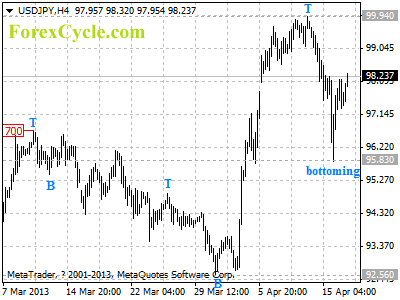
USDJPY may be forming a cycle bottom at 95.83

USDJPY may be forming a cycle bottom at 95.83 on 4-hour chart. Further rise to test 99.94 previous high resistance would likely be seen, a break above this level will indicate that the uptrend from 77.14 (Sep 13, 2012 low) has resumed, then another rise towards 105.00 could be seen. On the downside, as long as 99.94 resistance holds, the consolidation of the uptrend could be expected to continue, and one more fall to 94.00 – 94.50 area to complete the consolidation is still possible.

usdjpy

Daily Forex Analysis

Global Monetary Policy Rates – March 2013: Avg. global policy rate falls to 5.79% as major emerging markets cut

By www.CentralBankNews.info
   Global policy rates fell by a net 425 basis points during March as nine central banks – including four major emerging market central banks – cut rates, pushing the global average policy rate down to 5.79 percent at the end of the first quarter from 5.83 percent after the first two months.
    It was the size of the rate cuts by Mexico, Colombia and Poland – each by 50 basis points – that took observers by surprise, with the central banks attempting to give their economies a jolt to avoid disinflation becoming embedded.
    India was another major emerging market central bank that cut rates in March, though by an expected 25 basis points, as it is still struggling to dampen inflation amid a weakening economy.
    The cumulative 425 basis point cut in policy rates in March was sharply above February’s total  decline of 150 basis points and higher than January’s 342 points, signaling growing concern over the strength of global demand.
   Through March, global policy rates have fallen by 967 basis points, well below a cumulative fall of 2,162 after the first quarter of 2012, illustrating that rates are heading lower this year, though at a slower pace than last year, as many central banks take a wait-and-see approach to gauge the effect of last year’s substantial rate cuts, the depth of Europe’s recession and the impact of U.S. budget cuts.

INTEREST RATE CUTS, YEAR-TO-DATE IN BASIS POINTS, END-MARCH 2013:


COUNTRY
MSCI    CURRENT RATE      YTD CHANGE
BELARUS28.50%-150
KENYAFM9.50%-150
COLOMBIAEM3.25%-100
POLANDEM3.25%-100
VIETNAMFM8.00%-100
GEORGIA4.50%-75
HUNGARYEM5.00%-75
MONGOLIA11.50%-75
INDIAEM7.50%-50
JAMAICA5.75%-50
MEXICOEM4.00%-50
ALBANIA3.75%-25
ANGOLA10.00%-25
AZERBAIJAN4.75%-25
MACEDONIA3.50%-25
W. AFRICAN STATES3.75%-25
BULGARIAFM0.01%-2


    www.CentralBankNews.info

So Paulson…About that Gold Stash…

By The Sizemore Letter

“A billion dollars ain’t what  it used to be.”

Bunker Hunt reportedly said those words in the early 1980s after the Hunt brothers lost a large chunk of their family fortune in their ill-fated cornering of the silver market.  But John Paulson must be thinking the same thing.  After Monday’s 9.3% drop, Paulson has personally lost over $1.5 billion over the past two trading days in his gold investments, not to mention the sums he has lost for his clients.

Ouch.

It's only money...

It’s only money…

As much as I would love to, I can’t gloat because even after the recent bloodletting gold bugs can call scoreboard on me. I initially got bearish on gold in 2010 when it crossed $1,200, believing at the time that the gold bubble has reached the euphoria stage.  Well, it got a lot more euphoric from there, rising another 50% from that point…and I had to eat a lot of crow.

Though probably not as much as Paulson right now.

The recent action should finally lay to rest one of the common misconceptions about gold: that it is a stable store of value.

No asset that has risen in value by a factor of six is “stable.”  Gold is a speculative asset like any other whose price is determined by the whims of the market.  As the more “financialized” gold gets via ETFs and mutual funds, the more it behaves like the rest. Gold is not an antidote to stocks or other “paper” assets. It has now become a paper asset.

While gold may, in theory, have value as an inflation hedge, this matters very little in a world where most industrialized countries have inflation rates under 2%.  But most fundamentally, gold fails my test as an investment because it pays no interest or dividends and has no productive purpose.  It is a shiny metal…and nothing more.

But none of this matters in the short-term.  As any good trader knows, in the short-term the only thing that matters is supply and demand.  And this is why I would steer clear of gold for the time being.

As the Dow hits new highs and the 2008 crisis becomes more of a memory, investors are starting, albeit slowly, to return to the stock market.  This is very bad news for someone like John Paulson, who needs a large pool of greater fools on which to unload his massive gold hoard.

At the risk of picking on John Paulson, he’s really gotten himself into a mess.  By GuruFocus estimates, he owns 22 million shares of the SPDR Gold Trust (NYSE:GLD), holding more than 10% of all traded shares.  He also holds stakes in miners and in physical bullion.  When the size of Paulson’s gold bet became known, the New York Times calculated that Paulson owned more gold than the Australian government.

If you were a hedge fund manager or trader and you thought that there was even a slight possibility that Paulson was going to liquidate, you would rush to the front of the line to sell before he did.

I’m not saying that this is exactly what happened on Friday and Monday.  But a technical explanation like this is far more plausible than the explanation given in the media: slower growth from China.

Chinese growth of three tenths of a percent lower than expected does not “cause” gold to lose over 9% of its value in one day.  But a hedge fund stampede most certainly would.

Gold might enjoy a dead-cat bounce today and in the days ahead.  But given the large investors with enormous positions to unwind, I wouldn’t advise trying to bargain hunt here.

Disclosures: Sizemore Capital has no interest in any security mentioned.

SUBSCRIBE to Sizemore Insights via e-mail today.

Turkey cuts key rates 50 bps, inflation seen contained

By www.CentralBankNews.info     Turkey’s central bank cut its main short-term interest rates by 50 basis points, saying that weak global demand and the outlook for commodity prices should “contain the upward pressures on inflation.”
    The Central Bank of the Republic of Turkey (CBRT) cut its policy rate, the one-week repo rate, to 5.0 percent from 5.50 percent along with the top and bottom rates on its daily interest rate corridor.
   The overnight borrowing rate in the corridor was cut by 50 basis points to 4.0 percent and the overnight lending rate to 7.0 percent.
    The rate on borrowing facilities for primary dealers was also cut by 50 basis points to 6.5 percent.
    The CBRT has been steadily narrowing its interest rate corridor since last September, including a 100 basis point cut in the ceiling rate last month. However, it only cut its main policy rate in December, seeking to balance the need to stimulate declining economic activity without boosting credit growth too much and encouraging the inflow of capital that looks to take advantage of the high yield.
    The CBRT said capital inflows had re-accelerated and credit growth was above the bank’s reference rate so “in order to balance the risks to financial stability, the proper policy would be to keep interest rates low while increasing foreign currency reserves via macroprudential measures.”
    In addition to cutting short-term rates, the bank will further raise its reserve options coefficients, a tool that helps the central bank control banks’ foreign exchange reserves and thus liquidity.

     Turkey’s inflation rate rose to 7.29 percent in March, slightly up from 7.03 percent in February. The CBRT targets annual inflation of 5.0 percent this year, the same as in 2012 when inflation averaged 6.2 percent.
    The central bank said demand was developing in line with expectations, with domestic demand healthy, but exports were lower. The current account deficit had increased in light of a revival in domestic demand but it expects to contain a further widening of the deficit.
    Turkey’s Gross Domestic Product stagnated in the fourth quarter from the third quarter for annual growth of 1.4 percent, down from a 1.6 percent annual rate in the third quarter.

    The Turkish economy is estimated to have expanded by 2.5 percent in 2012, down from 8.5 percent in 2011. The CBRT forecasts 2013 growth of 4 percent or higher.
    In the first four months of this year, the CRBR has cut the overnight lending rate by 200 basis points and the overnight borrowing rate by 100 basis points. The short-term rates have been declining during the last decade from 2002 when the borrowing rate was 57 percent and the lending rate 62 percent.
    In 2012 the CBRT started cutting the overnight lending rate from 12.50 percent while keeping the borrowing rate steady at 5.0 percent.
    Earlier this month, the central bank’s governor, Erdem Basci, held out the hope for “a measured rate cut, ” and a few day’s later Prime Minister Recep Erdogan said interest rates around 6 percent were too high in light of a decline in inflation to around 6 percent from 63 percent in 2002.

   www.CentralBankNews.info

Top 3 Technical Tools Part 1: Japanese Candlesticks

Top 3 Technical Tools Part 1: Japanese Candlesticks

EWI senior analyst Jeffrey Kennedy shows you how to identify quality trade setups with supporting technical indicators.

By Elliott Wave International

“I always will be an Elliottician, but other technical tools have merit and are indeed worthwhile: they allow me to build a case, build a more confident reason for making a forecast and for taking a trade; making a trading decision.”

-Jeffrey Kennedy

I recently asked Elliott Wave International analyst Jeffrey Kennedy to name his 3 favorite technical tools (besides the Wave Principle). He told me that Japanese candlesticks, RSI, and MACD Indicators are currently his top methods to support trade setups.

In this 3-part series, we will share examples of how to use these 3 tools to “build a case” in the markets you trade. These practical lessons allow you to preview how Jeffrey applies techniques with proven reliability to support his analysis.

We begin this first lesson with a basic candlestick-style price chart.

This is excerpted from Jeffrey Kennedy’s teachings. Follow this link to learn more about Jeffrey Kennedy’s educational trading service, Elliott Wave Junctures.


You may be familiar with an Open-High-Low-Close (OHLC) chart: comprised of vertical lines with small horizontal lines on each side. The top of each vertical line is the high and the bottom is the low. The small horizontal lines on either side represent the open and close for that period.

Here’s an example of a Japanese Candlestick chart:

Japanese candlestick charts employ the same data that OHLC price charts do except that the data is expressed differently. The real body is the range between the open and close, and appears as a small block. Shadows are the lines that extend upward and downward from this block, and represent the highs and lows.

Next, take a look at the chart below.

Two bearish candlestick reversal patterns that Jeffrey finds highly reliable are the Evening Star and the Bearish Engulfing Patterns. This weekly continuation chart for the Canadian Dollar combines a 20-period moving average to show that the trend is down — allowing you to focus on bearish reversal candlestick patterns to spot trading opportunities.

Jeffrey notes that “combining these reversal patterns with moving averages makes them even more dynamic because they focus your attention in the direction of the larger trend.”

Japanese Candlesticks begin our spotlight on Kennedy’s top 3 ancillary tools for trading with the Wave Principle. We’ll share parts two and three via how Kennedy uses RSI and MACD indicators to support his Elliott wave interpretation in coming weeks.


To learn more about these tools
now, access our FREE 10-Lesson Trading Series,
“How to Apply Some of the Most Powerful Technical Methods
to Your Trading.”You will gain access to an archive
of lessons that includes a wealth of information: in-depth
guidance and insight on the Elliott Wave Principle and
other technical approaches. You’ll learn some of the
best technical indicators for analyzing chart patterns,
anticipating price action, and spotting high-confidence
trade setups.

Learn how you can access your free lessons now >>

This article was syndicated by Elliott Wave International and was originally published under the headline Top 3 Technical Tools Part 1: Japanese Candlesticks. EWI is theworld’s largest market forecasting firm. Its staff of full-time analysts led by Chartered Market Technician Robert Prechter provides 24-hour-a-day market analysis to institutional and private investors around the world.


The U.S. Dollar Increases at the End of the Day

The U.S. Dollar Increases at the End of the Day

EURUSD – The EURUSD Supported by Level 1.3021

eurusd16.04.2013

The EURUSD is slowly fluctuating between the 1.3052 and 1.3107 levels, having initially tested the low, and then – the high level. Therefore, yesterday turned out to be a boring and monotonous day. During the U.S. session, speculators somewhat came to life, the pair broke the support and dropped to a more serious support at 1.3021, reinforced by the running 50-day MA. What is important for the pair bulls that this level has attracted buyers, and the pair returned to 1.3081. This proves the continued demand for the EURUSD pair, as well as its potential to develop the upward momentum. The breakthrough of this support would worsen the pair’s outlook.

GBPUSD – The GBPUSD Under Pressure Again

gbpusd16.04.2013

The GBPUSD attempt to increase failed at the level of 1.5385. Having tested this level, the pair dropped to the support at 1.5308 which managed to constrain the bears for some time. But the recovery was limited by the level of 1.5344, and during the U.S. session, the support failed to resist, having caused the rate to drop to 1.5270. During the Asian session, the pound managed to recover to the level of 1.5308 – the resistance level this time, where it is trading at the moment. The drop below 1.5308 weakens the pair bulls’ position, but as long as the GBPUSD is trading above the 100-day MA, running near 1.5240, the pair’ outlook remains positive. The decreases below would lead the pound down the slippery slope.

USDCHF – The USDCHF Fluctuates Within Descending Range

usdchf16.04.2013

Yesterday’s fluctuations in the USDCHF pair were limited by the narrow range again. The pair first dropped to 0.9267, then increased to 0.9327, and then dropped to 0.9288. There is not much pabulum for reflection regarding the future dynamics of the pair. However, the pair moves downwards within the range that could easily be broken in a southerly direction. In this case, it is wise to expect testing of the 92nd figure.

USDJPY – The USDJPY Dropped to 95.80

usdjpy16.04.2013

The USDJPY was gradually slipping lower and lower, then it turned into a landslide movement, in which the pair dropped to 95.80. The pair’s demand remained strong and it returned to the level near 97.70 – the resistance level this time. Though, the bears’ further attempts to continue their downward correction are not ruled out, the 96th figure looks quite attractive for purchases, since the 100-day MA runs near it. The nearest support level can be the level of 96.70.

Provided by IAFT


Gold Loses $1 Trillion of Total Global Value, “Could Fall to $1050”

London Gold Market Report
from Ben Traynor
BullionVault
Tuesday 16 April 2013, 07:00 EST

SPOT MARKET gold prices fell to a fresh two-year low in Tuesday’s Asian trading, dropping to $1322 per ounce, before rallying back above $1386, as stock markets extended yesterday’s losses.

Silver dropped to its lowest level since September 2010 at $22.10 an ounce before it too recovered some ground. Oil was down on the day by lunchtime in London, while copper ticked slightly higher.

Since Friday morning, the value of total above-ground stocks of gold bullion, estimated by metals consultancy Thomson Reuters GFMS at around 174,000 tonnes, has fallen by more than $1 trillion.

Based on PM London Fix prices in Dollars, gold on Monday was down 9% from the Friday afternoon fixing, the biggest one-day drop since February 28 1983, when gold dropped 12% in a day. That in turn was the biggest single day drop since January 1980, when gold fell more than 13% one day after hitting its then all-time high of $850 an ounce.

On a two trading day basis, gold was down almost 11% by Monday afternoon’s fixing, with 1983 again being the last time gold saw steeper two-day drop. By comparison, gold fell more than 18% in the two days following the January 1980 high.

“The aftershock of the previous two trading days will likely continue today with investors caught off guard and now ready to press sell buttons in any renewed weakness,” said one London-based trader this morning.

The CME Group, which runs the Comex exchange in New York on which gold and silver futures are traded, raised its margin requirements Monday, following a similar announcement by the Shanghai Gold Exchange. The gold margin, which determines the amount of collateral that must be posted to cover potential losses, was raised by 19%, while silver margins went up 18%.

“At some stage [the selling] will start to dissipate,” adds David Govett at brokerage Marex Spectron.

“I am sure we will see a rally at some stage this week. But given the current mood, this will no doubt be sold into as soon as it runs out of steam… A major part of this fall has been the snowball effect of people attempting to pick lows and being forced out of positions in quick order. This will discourage any bargain hunting and gold’s only hope rests with physical demand.”

“We continue to see the potential for lower prices,” says Tyler Broda at Nomura.

“The lack of investment demand so far in 2013 has pushed gold out of equilibrium and a price as low as $1050 an ounce is possible should we see significant disinvestment occur. We are now on this path, in our view.”

The world’s largest gold exchange traded fund SPDR Gold Trust (ticker: GLD) continued to see outflows Monday, though at a slower rate than on Friday, with holdings falling by 4.1 tonnes to 1154 tonnes, their lowest level since April 2010.

Since the start of 2013 the GLD has seen the amount of gold held to back its shares fall by nearly 15%.

The GLD’s biggest holder, hedge fund boss John Paulson, has lost around $1 billion of his personal wealth since Friday morning as a result of gold’s price drop, according to news agency Bloomberg.

“While gold can be volatile in the short term and is going through one of its periodic adjustments, we believe the long-term trend of increasing demand for gold in lieu of paper is intact,” says an emailed statement from Paulson & Co. partner John Reade.

“Federal governments have been printing money at an unprecedented rate creating demand for gold as an alternative currency for individual and institutional savers and central banks alike.”

Along with gold and silver, industrial commodity prices fell Monday, while stock markets also traded lower.

“Weaker-than-forecast data releases in China and the US weighed heavily on market sentiment,” says a note from Credit Agricole, “supporting the theory that the global economy is repeating the pattern of first-quarter strength followed by weakness over the remainder of the year.”

Here in the UK, inflation remained steady at 2.8% last month, according to figures published Tuesday, while Eurozone core consumer price inflation ticked higher to 1.5%, up from 1.3% in February.

Economic sentiment in Germany and across the Eurozone as a whole meantime has fallen this month, according to the ZEW survey.

Italy should look to use some of its gold reserves to recapitalize its banking system, Il Sole 24 Ore reports. The report cites proposals to use the gold to back a so-called EuroUnionBond rather than selling it.

Gold market development organization the World Gold Council has argued that governments should consider using gold to back bond issues, and last month commissioned a poll that found 91% of Italian business leaders and 85% of citizens agree that the country’s gold reserves should play a part in economic recovery.

Ben Traynor

BullionVault

Gold value calculator   |   Buy gold online at live prices

Editor of Gold News, the analysis and investment research site from world-leading gold ownership service BullionVault, Ben Traynor was formerly editor of the Fleet Street Letter, the UK’s longest-running investment letter. A Cambridge economics graduate, he is a professional writer and editor with a specialist interest in monetary economics. Ben can be found on Google+

(c) BullionVault 2013

Please Note: This article is to inform your thinking, not lead it. Only you can decide the best place for your money, and any decision you make will put your money at risk. Information or data included here may have already been overtaken by events – and must be verified elsewhere – should you choose to act on it.


Central Bank News Link List – Apr 16, 2013: Developing Asian nations need to halt easing policies

By www.CentralBankNews.info

Here’s today’s Central Bank News link list, click through if you missed the previous link list. The list comprises news about central banks that is not covered by Central Bank News. The list is updated during the day with the latest developments so readers don’t miss any important news.

Sri Lanka holds rate, lower inflation would allow rate cut

By www.CentralBankNews.info     Sri Lanka’s central bank held its benchmark repurchase rate steady at 7.50 percent, as expected, saying a further decline in inflation would allow it to cut rates again.
    The Central Bank of Sri Lanka, which cut rates by 25 basis points in December 2012 after raising them twice earlier in the year, said inflation “fell significantly” as expected in March due to the base effect and lower food prices and inflation should remain at this “benign” level.
   However, a proposed revision to administered prices is likely to exert some upward pressure on price levels, the central bank added.
    In March the headline inflation rate fell to 7.5 percent from an average 9.4 percent for the previous nine months while core inflation eased to 6.8 percent from 7.4 percent in February. Both inflation measures have been in single digits for 50 consecutive months.
    After raising rates in early 2012 to rein in credit growth, the central bank cut rates in December and removed a ceiling on credit growth, and said these measures are “providing reasonable stimulus for a higher economic growth.”
    “At the same time, further depreciation of demand driven inflation on a sustainable basis would provide space for further easing of monetary policy,” the central bank said.
    In 2012 Sri Lanka’s economy expanded by 6.4 percent for average growth of 7.5 percent over the last two years, based on resilient agriculture during adverse weather and sustained industry activity. Although tourism and finance grew rapidly, its growth was moderate due to low external trade.
    The central bank has forecast growth of 7.5 percent this year, down from 2011’s 8.3 percent.
    Credit extended to the private sector rose by an annual 13.3 percent in February and with the public sector relying less on bank financing in coming months, this should help provide the necessary stimulus to strengthen private sector activity, the bank said
     Sri Lanka’s balance of payments, which recorded a surplus of US$ 151 million at the end of 2012, remains in surplus so far this year and is expected to improve further. Gross official reserves have risen to $6.9 billion, enough for 4.5 months of imports.

    www.CentralBankNews.info