Money Weekend’s FutureWatch

By MoneyMorning.com.au

TECHNOLOGY: Use Mind Control Over Your Gadgets

This isn’t science fiction. The kind of technology that delves into the world of mind control is very exciting. It’s not mind control in the sense of Jedi Knight Mind Control though. Well maybe it is. But instead of controlling humans, we’re at the beginning of controlling our devices…with our mind.

2013 is quickly becoming the year of ‘Wearable Tech’. It’s the merging of computer technology and your physical world. Google Glass is the headliner, the one you’re most likely to have heard about. But Google is not the only one working towards putting interactive devices on your noggin.

One company in particular is getting more attention about their exciting new wearable tech product. The company is InteraXon.

InteraXon’s device goes on your head but is different to Google Glass. And we think a little bit cooler.

It’s called the Muse and it’s a headband-like device that fits over your forehead. It uses your brain waves to control your devices. With compatible software you can play games and even train your brain.

Source: InteraXon

But the really promising part about Muse is linking to other devices. Imagine having a coffee machine at home. As you walk through the front door you think to yourself, ‘geez I could go a latte right now.’ By the time you’ve entered the kitchen your latte is sitting under the coffee machine waiting for you.

Or here’s another example. 10 minutes before you go to get in the car on a cold day, you think ‘it’d be nice to get into a car that’s warmed up to 24 degrees.’ And when you jump in the car, it’s a perfect 24 degrees.

That’s the potential capability of the Muse. This isn’t some prototype. It’s a real life working product. You can pre-order it. Rest assured we’re on the waiting list for this one too.

HEALTH: The Debilitating Saturday Morning May be a Thing of the Past

For anyone who’s ever consumed alcohol, it’s more than likely you’ve had a hangover. But fear no more the blinding light, thumping head and obligatory Maccas trips.

A pretty ‘simple’ piece of nanotechnology research has gone a long way to curing one of the worst ailments in human history. The hangover.

Some (possibly drunk) scientists have had enough. Their discovery could be the biggest, well at least the most widely applauded, scientific discovery of all time. They have managed to create a hangover pill.

This isn’t a new type of Berocca. It’s a pill that can be taken immediately and, over a few hours, cuts down the blood alcohol percentage.

Professor Yunfeng Lu, the lead scientist says, ‘The pill acts in a way extremely similar to the way your liver does.’

We guess that when this becomes a commercial reality, countries like the Czech Republic, Ireland and France will take to it pretty quick. Respectively they rank 1st, 4th and 5th in the world when it comes to consumption of alcohol per capita (Australia falls in at 28th).

Two alcohol battling enzymes combine inside a Nano sized pill to make it work. Then the scientists got a bunch of lab mice drunk. After their little party, the scientists administered the pill to the mice. The results were astounding.

Source: csucichemistryblog.blogspot.com

The pill reduced the blood alcohol content of the mice by up to 36.8%. Lu says the pill isn’t quite ready for human testing, yet. But we all know a hangover pill endgame isn’t for drunken mice, it’s for drunken humans.

This may seem trivial. But a fully functioning hangover pill will sell, and sell a lot. So we’ll see which of the big pharma companies adopts this work and takes it to commercialisation because the opportunity in this space is enormous.

ENERGY: Fire Power Your Phone, and Maybe the World.

In the search for renewable energies there are many weird and wonderful inventions. The world is not short of inventors who discover new ways to create power.

And Point Source Power (PSP) is one more company thinking outside the box when it comes to power.

The process of photosynthesis is one area scientists believe is vital to generating renewable power. Plants are one of the most efficient producers of energy in nature. And scientists argue, why can’t we replicate that?

PSP agreed and produced a fuel cell that mirrors the process of photosynthesis to capture energy.

Plants create oxygen and carbon compounds as a result of photosynthesis. PSP’s little fuel cell captures the carbon compounds and oxygen to produce electricity, heat, water and carbon dioxide.

The process is done via what PSP calls votosynthesis.

Although PSP is only a small time player at this stage, they’re onto something. Their current range of devices uses heat from fire and cooktops to charge up their fuel cells. When the fuel cell is charged, it will charge your phone, or provide you with light.

Initially PSP’s products appear to just be handy camping tools. But there’s more to it than that. They actually fit in with the overall push towards global renewable energy. The potential of PSP’s technology is greater than they realise.

There are some areas in the world, particularly third world nations, where stable grid electricity isn’t available. PSP fuel cells (on a larger scale) could be the power source needed to provide electricity to those populations.

The upside is PSP’s technology is relatively cheap to make and quite portable. So hopefully PSP will expand their range to larger, more powerful fuel cells. And who knows, they might just play a larger role in renewable energies.

Sam Volkering
Technology Analyst, Money Weekend

Join Money Morning on Google+

Ed Note: Sam Volkering is assistant editor and analyst for a new breakthrough technology investment service to be launched by Money Morning editor Kris Sayce. The breakthrough technology service will introduce cutting edge investment ideas from the technologies of the future, including medicine, science, energy, mining, and more.

From the Archives…

The Market Rebounds, but We’re Still Not Selling…
26-04-2013 – Kris Sayce

Is This the Last Hurrah for the Australian Dollar?
26-04-2013 – Murray Dawes

Here’s Proof the Silver Bullion Market is Alive and Well
24-04-2013 – Dr. Alex Cowie

Stand By for the Recession Rally in Resource Stocks: Take Two
23-04-2013 – Dr. Alex Cowie

A New Take on Hard Asset Investing
22-04-2013 – Kris Sayce
Look Out for the Chinese Consumer

By MoneyMorning.com.au

‘The market is behaving as if it’s all over for mining,’ laments Diggers & Drillers editor Dr Alex Cowie in his latest issue out this week. He goes on, ‘but nothing could be further from the truth.’

The good doctor probably feels like a lonely voice right now. It’s been a rough ride over the last two years in the mining sector. But you don’t find bargains when the outlook is rosy. So how do you find them? ‘Find the trend whose premise is false,’ says legendary speculator George Soros, ‘and bet against it’.

The premise, in this case, is that the natural resource bull market is all over. But…

Is that a Bet You Want to Take?

Take China’s economy, for example. We’re told that the Chinese economy needs to adjust from an investment-led, manufacturing and export economy to a consumer-based model. Everyone’s positioning for this pivot, whether they think China can or can’t pull it off. In the meantime, commodity producers get the jitters as they price in lower growth.

But what if China is about to become a major inflationary force in the world? Remember, for the last thirty years China has been a deflationary force as its cheap labour brought down manufacturing costs and it exported cheap products all over the world.

Well, analyst Shaun Rein says, get ready for the buying power of the most important group in the world right now: the Chinese consumer. This will put pressure on prices around the world – including commodities. Rein is especially bullish on agricultural commodities as the Chinese middle class grows.

He argues:


‘The Chinese consumer will be the greatest growth story in the world in the next three years…As China continues to urbanize, there still is plenty of room for economic growth. I expect GDP to hover around 8 percent over the next five years.’

Rein should know what he’s talking about. He lives in Shanghai. He’s the founder and managing director of the China Market Research Group. And he’s also a columnist for Forbes and BusinessWeek. His basic position is that the Chinese consumer is in a stronger position than people realise.

And, he argues, Chinese consumer demand is a much bigger percentage of Chinese GDP than most economists calculate.

He might be right. Luxury brand Coach [NYSE: COH] revealed sales like this last month: ‘International sales rose 6 percent to $382 million in the quarter, driven by a 40 percent rise in sales in China.’ China is also Apple’s second largest market after the US.

There’s no question Chinese incomes are rising in real terms and there is strong demand for workers because of the shrinking labour pool. This is the opposite of the United States.

Now, it’s easy to be cynical about Rein, as his consultancy obviously profits from advising companies to target Chinese consumers. But it’s interesting to note that Rein came out in 2010 after Jim Chanos called China ‘Dubai times a 1000′ and said he was wrong. That was a gutsy call, considering the credibility Chanos brings to the table. And to a large degree, it’s Rein that has been proved right so far.

A Bubble in China?

It’s 2013 and this bubble has not burst. Maybe there is no bubble. From Reuters a couple of weeks ago: ‘For all the talk about a real estate bubble in China, apartments are much more affordable in smaller cities throughout China’s interior.’

Jim Chanos probably wouldn’t agree with that. Indeed, only this month he gave a presentation that reiterated what he has been saying for the last five years – China’s real estate (especially commercial sector) is a bubble and will end badly. It’s a credit-driven binge that has resulted in massive over investment in buildings and infrastructure. He says it was bad back then, it’s REALLY bad now. The companies connected with it are in trouble.

Rein disagrees and suggests the two biggest problems in China are actually corruption and pollution, not real estate. That’s an interesting angle.

Who’s right? We don’t know. But we do agree a trend to back over the next decade is rising incomes in Asia. As Alex says in his latest report,


‘There are four billion people in China, India, Indonesia and other ASEAN (Association of South East Asian Nations) members who are rapidly getting richer, and increasing their quality of life from a low base – and that will require commodities. Lots of them.’

We agree. But we don’t expect it to be a smooth ride.

Callum Newman
Editor, Money Weekend

PS. Don’t forget if you want to keep track of the latest things we’re reading and brief commentary on events that happen through the day, check out our Google+ page and Kris Sayce’s as well.

From the Port Phillip Publishing Library

Special Report: TORRENT SIGNAL 3

Daily Reckoning: An Aussie Dollar Crash

Money Morning: Down 24% in Three Months…is it Time to Buy Resource Stocks?

Pursuit of Happiness: What the Government’s Latest Money Grab Means for You

Uganda holds rate, sees stable inflation, positive economy

By www.CentralBankNews.info     Uganda’s central bank held its Central Bank Rate (CBR) steady at 12.0 percent, saying a neutral monetary policy stance was warranted in light of an expected stabilization of core inflation around the central bank’s 5.0 percent target and underlying positive economic momentum.
    The Bank of Uganda (BOU), which slashed its key rate to 12 percent from 23 percent in 2012, said real growth in Gross Domestic Product is projected at 5.3 percent for the financial year 2012/13, which ends June 30, rising to 6-7 percent in 2013/14.
    The BOU’s governor, Emmanuel Tumusiime-Mutebile, said in a statement that the country’s output gap had narrowed and annual growth in monetary aggregates showed signs of recovering. Commercial bank lending had been restrained by the closure of the Land Registry and other structural factors, but he expects growth in lending to accelerate and lending rates to decline further.
    “Nonetheless, there are potential risks of stronger inflationary pressures emanating from both domestic and external factors,” he said, noting global economic uncertainty, upside risks to global commodity prices, and a stronger stimulus to domestic demand from public and private sectors.
    Energy prices are also projected to rise in the near term, he said, adding this would have a one-off impact on prices “but it may also have more persistent second round effects on inflation.”
    Uganda’s headline inflation rate eased slightly to 3.4 percent in April from 4.0 percent while core inflation fell to 5.8 percent from 6.8 percent in March. Annual non-food inflation was stable at 6.8 percent, the central bank said.
    Last month the BOU said core inflation was forecast to remain 1-2 percentage points above the bank’s target for the next few months and then fall back toward the bank’s target later this year. The bank dropped this reference in today’s statement.
    In response to a rise in headline inflation to an all-time high of 30.5 percent in October 2011, the BOU raised rates sharply that year to a high of 23.0 percent. Inflation then plunged over the next 12 months and hit a two-year low of 3.5 percent in February this year and the BOU cut rates by 1100 basis points. The BOU has held rates steady since December last year.

    www.CentralBankNews.info

Central Bank News Link List – May 3, 2013: Bank of Canada’s Ploloz is outsider with financial savvy

By www.CentralBankNews.info

Here’s today’s Central Bank News link list, click through if you missed the previous link list. The list comprises news about central banks that is not covered by Central Bank News. The list is updated during the day with the latest developments so readers don’t miss any important news.

Precious Metals “Rangebound” Ahead of US Nonfarms, India’s Central Bank Proposes New Gold Restrictions

London Gold Market Report
from Ben Traynor
BullionVault
Friday 3 May 2013, 07:30 EDT

WHOLESALE gold prices hovered around $1480 an ounce most of Friday morning, around 1% up on the week, as European stock markets edged higher and the Euro regained some ground against the Dollar ahead of the release of key US jobs data for April, including the latest nonfarm payrolls report.

Silver held its ground above $24 an ounce, also slightly up on the week, while other commodities also ticked higher. US Treasuries were little changed while UK Gilt prices fell.

“Precious metals remain rangebound,” says Standard Bank commodities strategist Walter de Wet.

“The $1450 level continues to attract physical gold buying.”

At its meeting on Thursday, the European Central Bank cut its main policy rate to an all-time low of 0.5%.

Asked at the subsequent press conference whether the ECB sees room to cut the rate it pays on commercial bank deposits with the central bank, currently at zero, ECB president Mario Draghi replied that his institution is “technically ready” for such a move.

“There are several unintended consequences that may stem from this measure,” Darghi added.

“We will address and cope with these consequences if we decide to act. We will look at this with an open mind and we stand ready to act if needed.”

“Draghi has shifted the ECB’s stance on the potential floor for interest rates,” says Marchel Alexandrovich, senior European economist at Jefferies International in London.

“A negative deposit rate is now a more distinct possibility.”

The Euro fell nearly two cents against the Dollar immediately following Draghi’s comments, though by Friday lunchtime had regained around half the drop.

Gold by contrast rose against the Dollar following Draghi’s press conference.

“We suspect that this was because the [Euro’s]weakness was triggered…by the fact that Draghi’s comments, which while bearish on the Euro, were, curiously, a tacit endorsement for gold,” says a note from INTL FCStone metals analyst Ed Meir.

“[Negative deposit rates]would mean that under such a scenario, gold would no longer return nothing (if its prices held steady), but would, in fact, compare favorably to risk-free bank deposits whose holders would not even get their full principle back. We may reading too much into Draghi’s comments, but we see little else to explain Thursday’s disconnect between the weaker Euro and higher gold prices.”

The European Commission meantime cut its 2013 growth forecast for the 17-nation Eurozone Friday, predicting a contraction of 0.4%, down from a -0.3% contraction projected back in February. The economy of the Eurozone as a whole shrank by 0.6% during 2012, according to official GDP figures.

The Eurozone’s unemployment rate rose to 12.1% last month, figures released earlier this week show, the highest rate since the single currency launched in 1999.

“In view of the protracted recession, we must do whatever it takes to overcome the unemployment crisis in Europe,” the European Union’s Economic and Monetary Affairs Commissioner Olli Rehn said Friday.

Over in India, traditionally the world’s biggest gold buying nation, the central bank today proposed new restrictions on gold bullion imports as part of its annual monetary policy statement. The Reserve Bank of India proposes restrictions on banks importing bullion on a consignment basis, allowing them only to import gold to meet the needs of gold jewelry exporters.

“The banks import gold on consignment basis from a miner without investing anything and it remains the property of the miner until the bullion dealers take delivery,” explains Bachhraj Bamalwa, director of the All India Gems & Jewellery Trade Federation.

“If they are not allowed to buy on consignment basis, imports will be restricted and chaos will prevail in the market.”

The RBI says detailed guidelines will be published by the end of this month. Back in January India’s authorities raised the import duty on gold to 6% in an effort to curb inflows that are blamed for exacerbating the country’s current account deficit.

UBS meantime reports its physical flows to India “continue to indicate very strong demand…at least five times the average over the last 12 months.”

Ben Traynor

BullionVault

Gold value calculator   |   Buy gold online at live prices


Editor of Gold News, the analysis and investment research site from world-leading gold ownership service BullionVault, Ben Traynor was formerly editor of the Fleet Street Letter, the UK’s longest-running investment letter. A Cambridge economics graduate, he is a professional writer and editor with a specialist interest in monetary economics. Ben can be found on Google+


(c) BullionVault 2013

Please Note: This article is to inform your thinking, not lead it. Only you can decide the best place for your money, and any decision you make will put your money at risk. Information or data included here may have already been overtaken by events – and must be verified elsewhere – should you choose to act on it.


India cuts rate 25 bps, says little room for further easing

By www.CentralBankNews.info

    India’s central bank cut its policy rate by 25 basis points to 7.25 percent, as expected by most economists, but added there were significant upside risks to inflation so there is little room for further easing of its monetary stance.
    In its policy statement for the financial year 2013/14, which began on April 1, the Reserve Bank of India (RBI) cautioned that recent rate cuts cannot by itself revive economic growth and its moves to stimulate growth need to be supplemented by efforts towards easing supply bottlenecks, improving governance and stepping up public investment along with continuing commitment to fiscal consolidation.
    The RBI has now cut rates three times this year by a total of 75 basis points after cuts of 50 basis points in 2012, and said its policy stance for 2013/14 was guided by its expectation that economic activity will remain subdued in the first half of the current year with a modest pick-up in the second half of the year.
    However, although headline wholesale price inflation eased in March, the RBI said “food price pressures persist and supply constraints are endemic, which could lead to a generalization of inflation and strains on the balance of payments.”
    “Monetary policy will also have to remain alert to the risks on account of the CAD (Current Account Deficit) and its financing, which could warrant a swift reversal of the policy stance,” the RBI said, adding: “Overall, the balance of risks stemming from the Reserve Bank’s assessment of the growth-inflation dynamic yields little space for further monetary easing.”

    India’s main inflation gauge, the wholesale price index, rose 5.96 percent in March, down from 6.84 percent in February, continuing its gradual decline form a recent high of 10 percent in September 2011, and the lowest inflation rate since November 2009.
    However, the RBI said upside risks to near-term inflation were significant due to “sectoral demand supply imbalances,” corrections to administered prices and pressures from minimum support price increases so “monetary policy cannot afford to lower its guard against the possibility of resurgence of inflation pressures.”

    India’s economic growth slowed to a decade low of 5 percent in the 2012/13 financial year. In the fourth quarter of the 2012 calendar year – the equivalent of the third quarter of the fiscal year – Gross Domestic Product expanded by 1.3 percent for annual growth of 4.5 percent, down from 5.3 percent in the third quarter, and well below growth rates of over 9 percent in early 2010.
    In addition to the cut in the repo rate, the RBI said the reverse repo rate, which is set with a spread of 100 basis points below the repo rate, would be adjusted to 6.25 percent while the marginal standing facility rate, with is set 100 basis points above the repo rate, would be set at 8.25 percent.
    The Bank Rate would be set at 8.25 percent while the cash reserve ratio (CRR), which some economists had expected could be cut, was retained at 4.0 percent. The  CRR  – the proportion of deposits that banks have to keep in cash at the RBI – was cut by 25 bps in January to its current level.
    The drop in inflation in March had boosted hopes for a rate cut along with statements by the RBI’s chief economic advisor,  Raghuram Rajan, who said there was scope for interest rate cut as inflation has come down and there is a need to push growth.
     In its review of macroeconomic and monetary developments in 2012/13, which ended March 30,
the RBI had already said the room to cut interest rates further was very limited in light of “headline inflation remaining above the threshold and consumer price inflation remaining high.”
    The review, which was released yesterday as a backdrop to the RBI’s rate-setting meeting, also said headline inflation was likely to remain range-bound in 2013/14 with some moderation in the first half due to subdued pricing power by producers and falling global commodity prices before rising in the second half due to base effects.
    The RBI’s own survey of forecasters shows growth recovering in 2013/14 to 6.0 percent from 5.0 percent in 2012/13 and average WPI inflation easing to 6.5 percent from 7.3 percent.
    India’s current account deficit is “by far the biggest risk to the economy” the RBI said.
    The current account deficit is likely to ease in the fourth quarter of the 2012/13 financial year due to lower imports and a pick up in exports after a record high of 6.7 percent of GDP in the third quarter.  For the full year, the deficit is expected to be around 5.0 percent of GDP, “twice the sustainable level,” the RBI said in its economic review.
    India is one of the few countries worldwide to suffer from inflationary pressure during the current phase of weak economic growth. In 2012 inflation slowed markedly across much of Asia, except for India , Indonesia, and to a lesser extent Thailand, according to the International Monetary Fund’s latest regional outlook.
     The IMF forecasts India’s inflation to be the second highest in Asia this year, only surpassed by Mongolia. Even Vietnam, which has been struggling with inflation, is forecast to cut inflation this year to 8.8 percent from 2012’s 9.1 percent.
    Measured by consumer prices, India’s inflation rate is expected to average 10.8 percent this year, up from 9.3 percent in 2012, and then hit 10.7 percent in 2014.
     “Inflation is expected to remain generally within central banks’ explicit or implicit comfort zones, with the notable exception of India,” the IMF said.
 
    www.CentralBankNews.info

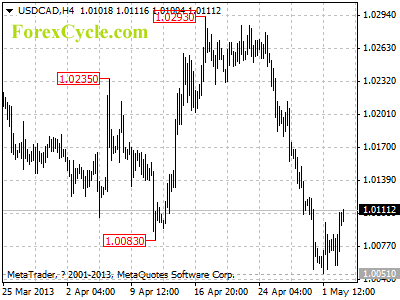
USDCAD remains in downtrend from 1.0293

USDCAD remains in downtrend from 1.0293, the rise from 1.0051 is likely consolidation of the downtrend. Resistance is at 1.0145, as long as this level holds, another fall could be expected after consolidation, and a breakdown below 1.0051 could signal resumption of the downtrend. On the upside, a break above 1.0145 will suggest that the downtrend had completed at 1.0051 already, then the following upward movement could bring price back to 1.0250 area.

usdcad

Forex Signals

Down 24% in Three Months…is it Time to Buy Resource Stocks?

By MoneyMorning.com.au

It’s like late 2008 all over again for the resource sector…it’s bloody marvellous!

You couldn’t describe too many resource investors as ‘excited’ today. But this guy certainly is. He’s a Melbourne-based boutique fund manager who’s made a ‘buck or two’ in mining over the decades.

So why is he excited?

You make the real money by buying low, when something looks putrid…and selling high, when it becomes the new market darling.

And, right now…resource stocks are looking, well…pretty putrid.

Last time the mining sector was as putrid as this, a very simple method let us find stocks that then gained as much as 2,000% as the mining sector bounced back.

So I agree with my excitable friend: the opportunity of buying cheap stocks, and finding another 2,000% gain, is ‘bloody marvellous’ indeed…

So what is it that makes a stock stand out from the crowd, including the one that gained 2,000% in the aftermath of the GFC chaos?

In investing, you can make it complex…or you can keep it simple. I try and keep it simple. The tool I use is – cash.

Let Me Explain…

The ASX’s small resource companies live and die by their cash balance. Some have enough to survive for a few years, but many only have enough to survive a few months.

Cash is the ‘fuel’ in their tank.

So when the mining sector turned back up in 2009, the ones with the most fuel in their tank could put their foot to the floor.

Their cash-strapped peers wasted valuable time trying to raise money from a shell-shocked and nervous market.

This is why many of the best-performing, small-cap resource shares in 2009 were also the ones with the best cash balances.

That’s it really, nothing too exotic!

When we played this move in 2009, the top five cashed-up stocks were an obscure and eclectic mix. Nevertheless, on average they had gained 60% just a few months later.

One of the stocks on the cashed-up list was little known; an oil and gas  company  called Buru Energy (ASX: BRU) which had funny ideas about something called ‘shale gas’…at the time few had heard of shale, Buru was off the radar, and the stock traded for just 18c.

But just 2.5 years on, shale was the buzzword, and Buru was trading at $3.78…a 2,000% gain in price.

When the mining sector is down like this, you can let it depress you OR you can look for the kind of smashed-up, cashed-up stocks that investors made a fortune on, after buying the last time the market was this cheap.

And here’s the good bit…

Today’s Market Looks Perfect for the Same Strategy

Why? Because mining stocks are so cheap, they are back to GFC valuations again. All boats have gone down with the tide: regardless of how good the project, management, jurisdiction, or cash balance may be…

Mining — the Ultimate Boom and Bust Industry

Source: Bigcharts

When mining stocks bounce back, it will be those with the right stuff – and the cash – that will hit the ground running.

This all assumes that mining stocks will bounce back, of course, which is something I wrote to you about on Wednesday.

I find it hard to see how mining stocks are back to GFC valuations, and even harder to see how mining stocks can stay at these valuations for long. A sharp recovery seems inevitable to me.

It may take a month or two, or maybe longer, no one really knows. The point is that if you take time to get set now, there’s a good chance the market could be finishing off a strong rally in two to three years time.

So now is the time to sift through the bargain bins, looking for the rare gem hidden amongst the garbage.

It’s also the time to check balance sheets, and see who’s out of cash, and who’s not. The March quarterlies are all out now, so I’ll scan them to see how things stand.

The Biggest Question is: What to Invest in?

The Australian resource sector is like a supermarket. It’s one of the world’s premier exchanges for mining stocks, and it’s very diverse.

You can invest in stocks to get you exposure to less known precious metals like palladium, niche minerals like diamonds, obscure commodities like vanadium and antimony, long-forgotten uranium, and thorium.

There’s mining service companies, which are all trading at deep discounts. Then there are companies looking into mining technology. With costs rising, any tech that can give producers an edge over their competitors will be highly valuable.

That’s not to overlook the usual candidates like base metals (copper, nickel, tin etc), bulks (iron ore, metallurgical coal and so on), and energy (conventional/unconventional oil and gas, as well as coal), which are all very, very cheap too.

But if I had to pull out a few favourites, the agriculture story looks like it’s going to come back, so think about mined fertilisers like potash and phosphate. In the strategic minerals space, I also think the graphite story still has a long way to run, thanks to the incredible developments in graphite.

And uranium looks like it may finally have its day in the sun too. The megawatts to megatons program expires at the end of the year, so there should be a big gap in supply in early 2014.

I could go on (and on) but I’ll save that for next week’s Money Morning.

But the bottom line is this: if you’re nervous about how high the banks and yields stocks have soared…take a minute to look at the fantastic opportunities opening up for the brave and the patient in resources.

Dr Alex Cowie
Editor, Diggers & Drillers

Join me on Google+

Ed Note: Most investors think that the gold, copper or iron ore in the ground is a resource company’s biggest asset. But it’s not. It’s something much more important than that. In today’s Money Morning Premium, Kris explains why access to this ‘rare’ asset can make or break a company. Click here to upgrade now.

From the Port Phillip Publishing Library

Special Report: TORRENT SIGNAL 3

Daily Reckoning: An Aussie Dollar Crash

Money Morning: Gold’s in an Uptrend, but for How Long?

Pursuit of Happiness: What the Government’s Latest Money Grab Means for You

Diggers and Drillers:
Why You Should Invest in Junior Mining Stocks

The Next Wall Street Financial Scandal Has Arrived

By MoneyMorning.com.au

Well, it looks like the major financial institutions can’t learn a lesson. They’re neck deep in yet another financial scandal of global proportions.

U.S. and international securities regulators investigating manipulation of LIBOR, the world’s most important set of benchmark interest rates, have uncovered another price-rigging scheme, this one in the $379 trillion market for interest rate swaps.

$379 Trillion, not Billion. Trillion.

The Commodity Futures Trading Commission (CFTC) has already issued subpoenas to Wall Street’s biggest banks and is interviewing a dozen former and current brokers from the Jersey City, NJ, offices of ICAP Plc.

For investors in the big banks, new revelations may put an end to the upward push to the groups’ stock prices, whose earnings of late have been helped by reductions in reserves meant as a cushion against future asset hits and litigation expenses.

Blackbeard’s Legacy

According to a former broker from London-based ICAP’s Jersey City swap desk, nicknamed ‘Treasure Island’ for the huge commissions and pay packages traders there are accustomed to, brokers routinely manipulated prices on behalf of bank clients to benefit bank trading desks.

On the other side of the banks’ trades are tens of thousands of counterparties who may have lost hundreds of billions of dollars as a result of having to pay more interest, or may have received less interest, on swaps whose prices were manipulated.

ICAP, formerly Intercapital Brokers, initially hit regulators’ radar as part of the LIBOR scandal.

According to the July 7th, 2012 print edition of the Economist,

‘Court documents filed by Canada’s Competition Bureau have also aired allegations by traders at one unnamed bank, which has applied for immunity, that it had tried to influence some LIBOR rates in cooperation with some employees of Citigroup, Deutsche Bank, HSBC, ICAP, JPMorgan Chase and RBS.’

Far from being in a shady corner in the world of derivatives, interest rate swaps are a mainstream financing tool used by tens of thousands of corporate treasurers worldwide.

Interest rate swap prices are used to set the value of over $550 billion of commercial real estate collateralized bonds and are used to calculate pension annuity values and benefits.

Big Banks in Big Trouble, Again?

Mega-banks primarily facilitate interest rate swaps by initially taking the other side of customers’ trades and are responsible for establishing pricing of these instruments in conjunction with a handful of brokers.

Similarly to how LIBOR is calculated, the ISDAFIX, the benchmark series of rates used to price interest rate swaps for U.S. dollar denominated swaps, is convened by a ‘panel’ of banks.

The panel, according to the International Swaps and Derivatives Association consists of: Bank of America Corp., Barclays, BNP Paribas SA, Citigroup Inc., Credit Suisse AG, Deutsche Bank AG, Goldman Sachs Group Inc., HSBC Holdings Plc, JPMorgan Chase & Co., Mizuho Financial Group Inc., Morgan Stanley, Nomura Holdings Inc., Royal Bank of Scotland, UBS and Wells Fargo & Co.

The banks submit their quotes for a range of maturities to ICAP through a secure screen connection. ICAP then forwards those data points to Thompson Reuters, who calculates the actual swap rates. Rates are then disseminated to over 6,000 viewers.

An Easy Con in an Era of Regulation

Manipulation of rate pricing is easy. ICAP posts rates, supposedly based on transactions and bid and offer quotes it receives and enters manually into what’s known as the 19901 screen (named for the Reuters screen page number).

Banks don’t have to submit their own rates as part of the panel; they can use the suggested rates ICAP posts. Or they submit their own rates to ICAP to be forwarded to Thompson Reuters who calculates the final numbers.

ICAP sits in the middle, entering by-hand prices and rates from the transactions that occur through their brokerage desk, which average a staggering $1.4 trillion a day.

Not only can banks ask ICAP brokers to post whatever quote benefits the bank’s internal trading book, whether it’s to affect a positive mark-to-market closing price for accounting and profit and loss (bonus) calculations, or manipulate an entry price on a new trade with a counterparty, they allegedly ask ICAP brokers to delay entry of actual transactions until after ISDAFIX rates are disseminated.

The delay can easily create a beneficial entry price on a trade that would otherwise be priced based on fresh data. Manipulation of prices and rates has huge profit and loss and mark-to-market implications in terms of capital reserve ratios and other bank balance sheet metrics.

Of course, these allegations have yet to become indictments, and nothing may come out of any of this but a few little fines and some slapped wrists. And if the past is actually prologue, we can rest assured that no criminal charges will ever be tossed into the casino, since none ever are.

After all, the tumbling dice always favor the house, and we know whose house it is.

Shah Gilani
Contributing Editor, Money Morning

Join Money Morning on Google+

From the Archives…

The Market Rebounds, but We’re Still Not Selling…
26-04-2013 – Kris Sayce

Is This the Last Hurrah for the Australian Dollar?
25-04-2013 – Murray Dawes

Here’s Proof the Silver Bullion Market is Alive and Well
24-04-2013 – Dr. Alex Cowie

Stand By for the Recession Rally in Resource Stocks: Take Two
23-04-2013 – Dr. Alex Cowie

A New Take on Hard Asset Investing
22-04-2013 – Kris Sayce

(Video) Top 3 Technical Tools Part 3: MACD

Enhance your trading confidence with a 2-minute lesson on how to combine Moving Average Convergence Divergence with other technical tools.

By Elliott Wave International

“Guessing or going by gut instinct won’t work over the long run. If you don’t have a defined trading methodology, then you don’t have a way to know what constitutes a buy or sell signal. Moreover, you can’t even consistently correctly identify the trend.”

-Jeffrey Kennedy

Jeffrey Kennedy is an accomplished teacher and a Senior Analyst here at EWI. Yet he often says that the Wave Principle alone is not a trading methodology. It does not tell you how much trading capital you can afford to risk, or specific guidance about which entry or exit levels are best suited for your trading style or where to set your protective stop.

Kennedy also says that along with risk management and emotional discipline, the right technical tools are a vitally important part of supporting your wave count.

To enhance trading confidence, Jeffrey’s 3 favorite technical tools are Japanese candlesticks, RSI, and MACD. (read Part 1 on Japanese Candlesticks and Part 2 on RSI ). Today’s lesson shows you how MACD can help identify trading opportunities with an example from USDCAD.

This 2-minute video and overview of MACD are adapted from Jeffrey’s Elliott Wave Junctures educational service (which empowers subscribers with information on nearly every aspect of trading. Try it risk-free for 30-days >> ).


Moving average convergence divergence (MACD) is a momentum indicator developed by Gerald Appel. It consists of two exponential moving averages, the MACD line and Signal line. The difference between these two lines yields an additional indicator, MACD Histogram.

Since these studies evaluate momentum, they work optimally in trending markets. When combined with reversal candlestick patterns, MACD and MACD Histogram can increase confidence in these patterns as well as continuation of the larger trend.

MACD divergence occurs when prices move one way and MACD moves the other. Bearish divergence forms when prices make new highs and MACD does not. Conversely, new price lows without lower MACD readings is bullish divergence. These conditions aid traders in identifying potential changes in momentum and trend.

MACD is constructed using two lines referred to as the MACD line and the Signal line.

When the MACD line appears to penetrate the Signal line, but fails to do so, a hook forms. The significance of a hook is that it coincides with countertrend price moves.

MACD is excellent technical tool provided you know how to use it and what to look for.


Learn the Best Technical Indicators for Successful TradingThis free report from Elliott Wave International will teach you how to incorporate technical indicators into your analysis to improve your trading decisions.You’ll learn which technical indicators are best for analyzing chart patterns, which are best for anticipating price action, and which are best for spotting high-confidence trade setups. You’ll also learn how technical indicators can be used to complement Elliott wave and other technical methods.

Get your technical indicators report now >>

This article was syndicated by Elliott Wave International and was originally published under the headline (Video) Top 3 Technical Tools Part 3: MACD. EWI is the world’s largest market forecasting firm. Its staff of full-time analysts led by Chartered Market Technician Robert Prechter provides 24-hour-a-day market analysis to institutional and private investors around the world.