ETF Selling “Key Downside Risk” as Gold “Struggles in Sideways Resistance Range”

London Gold Market Report
from Ben Traynor
BullionVault
Tuesday 7 May 2013, 07:00 EDT

WHOLESALE gold market prices fell to $1460 an ounce Tuesday morning, around ten Dollars lower than where it closed last week, as the FTSE in London ticked higher following yesterday’s UK bank holiday.

Other European stock markets also edged higher, while the Euro gained against the Dollar immediately following the release of better-than-expected German factory orders data.

Silver meantime fell below $23.70 an ounce, nearly 2% down on the week so far, while other industrial commodities also ticked lower.

“Gold is struggling against the important resistance range at $1469 [an ounce] and $1504.33,” says technical analysts at UBS.

“Support is at last week’s low of $1440.57, a break below this would pave the way to test $1424.63 and even$ 1405.02, the 38% and 50% retracements of the April-May recovery, respectively.”

“Our view is more sideways consolidation before another test to the downside,” agree technical analysts at bullion bank Scotia Mocatta, who also cite support at $1440.

On the New York Comex, the number of bearish short gold futures contracts held by smaller private traders, classified by the Commodity Futures Trading Commission as ‘Nonreportable’, exceeded the number of bullish long futures they held last Tuesday, according to weekly data published by the CFTC Friday. It is the first time this category of trader has been reported as holding more short than long contracts since February 2001.

So called Managed Money meantime – a category that includes hedge funds and other professional money managers – held slightly fewer short contracts than a week earlier, although at 65,224 contracts the aggregate short gold position of fund managers remains elevated compared to recent years.

Gold exchange traded funds saw their twelfth straight week of outflows last week, implying ongoing selling of their shares by investors, according to data from Bloomberg. The largest gold ETF, SPDR Gold Trust (ticker: GLD), saw its total gold holdings fall to a 44-month low of 1062.3 tonnes, compared to more than 1350 tonnes at the start of the year.

“We continue to believe exchange-traded product outflows remain a key downside risk [for the gold price] in the near term,” says Suki Cooper, precious metals strategist at Barclays Capital.

The Gold Fund run by hedge fund Paulson & Co., the GLD’s biggest stakeholder, ended April down 27%, Bloomberg reports, citing “two people familiar with the matter”. As well as GLD shares the fund also specializes in investing in gold mining equities.

“We expect the physical [bullion] demand to support the [gold] market,” say analysts at banking group ANZ.

“[But that] could prove difficult to maintain in the face of rallying equity markets,ETF outflows and speculative financial shorts… additionally, global inflation concerns that could support gold are benign. We expect to see a pick-up in prices through the second half of 2013, where gold should trade in the mid-high $1500 an ounce area.”

ANZ today cut its 2013 average gold price forecast to $1573 an ounce, forecasting an average price next year of $1648 an ounce.

“To suggest the gold price makes a lot of upside from here requires either a global crisis or a re-emergence of inflation,” said Gary Dugan, private bank Coutts’ chief investment officer for Asia and the Middle East, in an interview quoted by Bloomberg today.

Coutts now holds between 1% and 2% of its clients’ money in gold, down from 6-7% as recently as September, he said.

Gold imports to mainland China through Hong Kong more than doubled in March, net of exports, according to latest data from the Census & Statistics Bureau cited by Reuters.

The surge came as part of China’s 26% rise in first-quarter gold consumption, reported today by the China Gold Association.

Over in the West meantime, April’s gold price drop was met with increased demand for physical gold bullion from self-directed individual investors, according the Gold Investor Index from online precious metals exchange BullionVault, which hit a 16-month high at 58.6 last month.

Ben Traynor

BullionVault

Gold value calculator   |   Buy gold online at live prices


Editor of Gold News, the analysis and investment research site from world-leading gold ownership service BullionVault, Ben Traynor was formerly editor of the Fleet Street Letter, the UK’s longest-running investment letter. A Cambridge economics graduate, he is a professional writer and editor with a specialist interest in monetary economics. Ben can be found on Google+


(c) BullionVault 2013

Please Note: This article is to inform your thinking, not lead it. Only you can decide the best place for your money, and any decision you make will put your money at risk. Information or data included here may have already been overtaken by events – and must be verified elsewhere – should you choose to act on it.


How to Trade Gold, Silver & Precious Metal Miners

By Chris Vermeulen

How to trade Gold and other precious metals related investments is not that complex. But you must be willing to wait for price to provide low risk entry points before getting involved. Precious metals are like any other investment in respect to trading and investing in them. There are times when you should be long, times to be in cash and times to be short (benefit from falling prices).

Since 2011 when gold and silver started another major bull market correction the best position has been to move to cash or sell/write options against your positions to protect your investment until the next trend resumes.

If you take a look at the chart below of gold you will notice that in 2008 we had a similar breakdown in price which purged the market of investors who where long gold. And if you compare the last two breakdowns they look very much the same. If price holds true then much higher prices are likely to unfold at the end of 2013.

The key here is for the price to move and hold above the major resistance line. If it can do that then we are looking at a possible breakout to $2600 – $3500 gold. With that being said gold and silver may just be starting a bear market. Depending what the price of gold does when my resistance level is touched, my outlook may change from bullish to bearish.

Also with last weeks economic numbers getting better in the USA I do have concerns that gold may be starting a bear market but we will not know for several more months yet.

LongTermWeeklyGold


How to Trade Gold Daily Technical Chart:

Major technical damage has been done to the chart of gold. This can be seen as bullish or bearish price action but until price and volume pattern unfolds which puts the odds on the bullish or bearish side I remain neutral.

LongTermGold


How to Trade Silver Daily Technical Chart:

Silver is in the same position as gold. The question is if this is a shakeout or breakdown…

LongTermSilver


How to Trade Gold Mining Stocks Monthly Chart:

Gold mining stocks broke down a couple months ago and continue to sell off. If precious metals continue to move lower then mining stocks will continue their journey down. The chart below made in February and it has in most part played out as expected. While I do not try to pick bottoms (catch falling knives) I do like to watch for them so I am prepared for a new position when the time and chart become bullish.

LongTermMiners


How to Trade Gold, Silver and Mining Stocks Conclusion:

In short, precious metals continue to be in a down trend. While they look to be trying to bottom it is important to remember that the largest moves take place in the last 10% of a trend. So we may be close to a bottom but there could be sharply lower prices yet.

The time will come when another major buy or short signal forms and when it does we will be getting involved. The exciting part is that it could be just around the corner. If you want to keep current and take advantage of the next major move be sure to join me free newsletter here: http://www.GoldAndOilGuy.com/

Chris Vermeulen


Central Bank News Link List – May 7, 2013: Coeure says ECB may assess banks’ balance sheets to spur lending

By www.CentralBankNews.info Here’s today’s Central Bank News’ link list, click through if you missed the previous link list. The list comprises news about central banks that is not covered by Central Bank News. The list is updated during the day with the latest developments so readers don’t miss any important news.

Eurozone Retail Sales Drop Again

By HY Markets Forex Blog

According to the European Union statistics agency Eurostat the volume of sales have dropped 0.1% after a 0.2 drop in February. The retail across the eurozone has dropped for the second time in March.

Reports show a worse than expected 24% drops which has got economist worried about the eurozone economic growth.

The European Commission forecast last week showed that euro-area growth would possibly shrink by 0.4%.

The Eurostat data reports that Spain saw the biggest fall with their retails, which came down to 10.5% compared to last year.

Eurostat shows that there was all spending on items such as clothed and electronics n the 17- nation euro bloc.

The unemployment rate is expected to hit an average of 12.2 later this year according to analysts.

Consumers show concerns for the European Central Bank which lowered benchmark interest rate to a record low of 0.5 last week.

Countries of the eurozone are expected to ease up and come together to ease up on austerity measures, fears and precise budget cut hindering growth

France’s finance minister Pierre Moscovici said on Monday that the dogma of austerity was over.

He told French radio that a more “responsible attitude” to austerity budget cuts was now in place

The euro-area services PMI rose to 47 in April to 46.4 in March. Improving on the initial estimate of 46.6.

The post Eurozone Retail Sales Drop Again appeared first on | HY Markets Official blog.

Article provided by HY Markets Forex Blog

Visa and MasterCard: Don’t Chase Them Higher

By The Sizemore Letter

Credit card giants MasterCard (NYSE:$MA) and Visa (NYSE:$V) both crushed earnings estimates this past week, and both are sitting near new all-time highs.

Not bad, considering the line of work they are in.  Given that the global economy has been tepid at best lately and that unemployment remains stubbornly high, you might not expect companies that depend on consumers opening their wallets to perform well.

But by focuses narrowly on the consumer angle, you miss the proverbial forest for the trees. MasterCard and Visa—along with American Express (NYSE: $AXP) and, to a lesser extent, Discover (NYSE:$DFS)—are some of the prime beneficiaries of two of the most powerful macro trends of the past 20 years:

  1. The   transition to a global cashless society
  2. The rise of the emerging market consumer

The first point should be obvious.  Even in the United States, where credit and debit cards are ubiquitous, roughly 40% of all transactions are conducted with cash or paper checks.  Not all transactions will ever be captured with credit and debit cards, of course, but with internet commerce growing relative to “bricks and mortar,” you can bet that the percentage will grow.

Demographics also play a role here.  Older consumers who might never have embraced plastic are a shrinking segment of the population, whereas anyone under the age of 50 grew up with credit cards and anyone under 30 learned how to swipe a credit card before they could walk.

I exaggerate…but not all that much.

Card usage is also working its way down the economic ladder.  Consumers without access to traditional credit or banking services are embracing prepaid cards branded with the Visa and MasterCard logos, and both companies are experimenting with ways to let consumers pay at retail cash registers using their mobile phones. Even American Express, which has traditionally focused on a more patrician business clientele, has partnered with Wal-Mart (NYSE:$WMT) in promoting its Bluebird prepaid cards (see “Is Amex Going Slumming?”).

This is a long way of saying that even if overall consumer spending growth is tepid, growth in electronic payments has plenty of room to grow.

The second point is the one I find the most promising, however.  Credit and debit card usage is soaring in virtually all major emerging markets as incomes rise and consumers join the ranks of the global middle class.  Rising incomes and growing financial sophistication can only mean a higher percentage of transactions move from cash to plastic. Both Visa and MasterCard stand to benefit from this trend, though Visa has the better presence globally.  Visa expects to get more than half of its revenues from overseas by 2015, and the overwhelming amount of this will come from emerging markets.

So what’s the downside?

As I see it, there are two.  The first is competition from other mobile payment solutions such as eBay’s (Nasdaq:$EBAY) Paypal and Square.

It gets a little muddy here, however.  Paypal is a payment mechanism in of itself, but it is also a facilitator for payment with a traditional credit card. Up until this point, the mobile revolution has been nothing but beneficial for the traditional credit card companies. The card readers for Square and Paypal Here turn any Apple (Nasdaq:$AAPL) iPhone or Google (Nasdaq:$GOOG) Android device into a mobile point-of-sale terminal.  Even an ice cream man or hot dog street vendor can take payment by card now.

But this is also a fast-changing area, and there is a possibility that Visa and MasterCard can see themselves getting pushed out as unnecessary middlemen.  On my recent visit to Home Depot (NYSE:$HD), the cash registers gave me the option to pay with Paypal. Today, this is a novelty.  But in five years, will it be the norm?

Maybe, maybe not.  But given the rate of change in this space, I am reluctant to pay too high a premium for the stocks in this sector.  The growth is impressive and the profit margins are so high as to be absurd.  But as with any investment, you don’t want to overpay.

And this brings me to the second downside.  Both MasterCard and Visa sport valuations that are reminiscent of the 1990s tech bubble.  Visa trades for an absurd 50 times trailing earnings and 21 times expected 2014 earnings.  MasterCard, at 25 times trailing earnings and 18 times forward earnings, almost looks reasonable by comparison.  Almost.

As much as I like both companies, I’m not comfortable paying these prices.  For now, I’d recommend you pass on Visa and MasterCard.

In the card sphere, American Express would appear to be the best bargain.  Unlike Visa and MasterCard, Amex actually accepts credit risk, but I am ok with that.  In an improving economy, that is not such a bad thing. Amex trades for 13 times expected earnings and pays a 1.2% dividend.

Disclosures: Sizemore Capital is long WMT.

SUBSCRIBE to Sizemore Insights via e-mail today.

HY MARKETS TRADING COMPETITION BEGINS!

By HY Markets Forex Blog

Yesterday saw the beginning of the latest HY Markets Trading Competition in association with www.investing.com where there is up to $70,000 in cash prizes available.

The competition format follows a similar theme to the HY Markets Trading Championship that was held in September 2012 where traders used a demo account to make the most profit.  The standard of trading was incredible seeing a number of winners accumulate over times the weekly trading balance. 

This time round clients with MT4 accounts will use their own funds in order to make the most profit to win BIG cash prizes on offer for leading traders.

Traders can trade all capital markets products such as forex, metals, oil, gas and indices during the competition.  Click here for further details.

Competition entrants will be placed into 3 groups determined by the traders existing account balance.

Platinum           $10,001 and above
Gold                      $5,001 to $10,000
Silver                   $1,000 to $5,000.

Each category will have cash prizes for the top 3 traders at the end of the month:

PLATINUM CATEGORY
MONTHLY CHAMPION                                  $10,000 + Cup + Certificate
MONTHLY 1st RUNNER UP                          $5,000 + Cup + Certificate
MONTHLY 2nd RUNNER UP                        $3,000 + Cup + Certificate

GOLD CATEGORY
MONTHLY CHAMPION                                  $5,000 + Cup + certificate
MONTHLY 1st RUNNER UP                          $2,500 + Cup + certificate
MONTHLY 2nd RUNNER UP                        $1,000 + Cup + certificate

SILVER CATEGORY
MONTHLY CHAMPION                                  $2,500 + Cup + certificate
MONTHLY 1st RUNNER UP                          $1,300 + Cup + certificate
MONTHLY 2nd RUNNER UP                        $650 + Cup + certificate

So what are you waiting for?  Get involved today!

Click here for the terms and conditions.


The post HY MARKETS TRADING COMPETITION BEGINS! appeared first on | HY Markets Official blog.

Article provided by HY Markets Forex Blog

10 Shocking Earnings Season Trends (Part 1)

By WallStreetDaily.com

While most investors continue to track every jot and tittle of the market to see if we hit yet another record high, a more important situation is still unfolding.

What could that possibly be?

Oh, just a little something called earnings!

Remember, stock prices ultimately follow earnings, and we’re still in the midst of the first-quarter earnings reporting season.

Most analysts predicted that results would be terrible this go-round. On average, they expected S&P 500 companies to report a 0.7% contraction in profits.

With roughly 80% of companies’ reports on the books, though, S&P 500 earnings actually grew by 3.2% in the first quarter. The strength is broad based, too, as nine out of 10 sectors have reported stronger earnings relative to last year.

Talk about a swing and a miss by analysts!

What an embarrassment. However, there are several surprises contained within the reports.

Take note and invest accordingly…

~Surprise #1: A Bullish Earnings “Beat Rate”

A month ago, I told you to focus on the earnings “beat rate” (i.e. – the percentage of companies that reported better-than-expected earnings). As I said at the time, “Any reading above 58.7%, which is the low since this bull market began, should pave the way for higher stock prices.”

Well, 59% of companies have beaten earnings expectations, according to Bespoke Investment Group.

If we focus on just S&P 500 companies, that number rises to 72%, which tops the average beat rate for the past four quarters of 70%.

In the end, the current beat rate might not be overly bullish. But any bullish reading still points to higher stock prices.

I’m not the only one embracing this optimistic outlook, either.

On Monday, Berkshire Hathaway’s (BRK.A) Warren Buffett and Microsoft’s (MSFT) Bill Gates took to the airwaves of CNBC, declaring that stocks are a better bargain than bonds now.

~Surprise #2: So Much for the Weak Consumer

Tall tales abound about how American consumers are still cutting back on spending.

But they’re not. At least, not nearly as much as analysts expected.

Case in point: The consumer discretionary sector boasts the best earnings beat rate this quarter, at 64.3%.

Financial stocks represent another surprising bastion of strength, with 60.4% of companies reporting better-than-expected earnings. (More on that in a moment.)

~Surprise #3: Reversal of Tech Fortunes

As I mentioned before, nine out of 10 sectors in the S&P 500 have reported stronger earnings compared to last year.

Of course, that now begs the question: Which sector is the lone laggard?

Believe it or not, it’s technology. The sector has the lowest earnings growth rate so far of -3%.

If that wasn’t shocking enough, Apple (AAPL) is weighing the sector down the most, with an 18% earnings slide. While former laggard, Microsoft, is propping the sector up with a 20% profit jump.

Talk about a reversal of tech fortunes!

Add it all up, and the tech sector weakness means that we need to be pickier when choosing investments in the space. Speaking of which, I’ll be sharing a handful of top tech investment opportunities with readers of Tech & Innovation Daily this week. For free! So make sure you’re signed up to receive them.

~Surprise #4: Bank on Banking

Back in March, I wrote: “The banks got us into the financial crisis. So it stands to reason that they need to lead us out, too. That recovery is undeniably underway.”

Fast forward to today, and forget simply “underway.” The recovery is now gaining steam.

Case in point: The crown for the highest earnings growth rate this quarter belongs to the financial sector. On average, financial companies grew earnings by 11.5%. That’s more than triple the market average.

No surprise, the biggest contributor to the earnings growth is Bank of America (BAC).

Even if we remove it from the results, though, the financial sector would still be in the top three – with an earnings growth rate of 7.4%, according to FactSet.

On the heels of such strength, we should keep banking on bank stocks.

~Surprise #5: A Little Help From Housing

I’m a broken record when it comes to the residential real estate recovery. So I figured you’d enjoy hearing different “artists” singing the same “tune.”

Straight from the earnings reports (emphasis mine)…

  • E. I. du Pont de Nemours and Company (DD): “Operating earnings and margins are expected to improve sequentially from the first quarter to the rest of the year due to our productivity actions, the U.S. housing market rebound, and improving demand in industrial and public sector markets.”
  • United Technologies Corp. (UTX): “The housing and commercial construction markets are improving, Americans are investing in their homes again, and our North American Residential HVAC orders were up 11% versus last year.”

Clearly, the housing recovery is gaining momentum. What’s more, it’s not isolated to the most obvious beneficiaries (i.e. – homebuilders).

It’s spreading to multiple industries, which means it’s high time to load up on overlooked real estate-related investments. (Hint: Back in February, I shared five such investments with you here.)

Stay tuned for tomorrow when I plan to share five more shocking earnings season trends and their investment implications.

Ahead of the tape,

Louis Basenese

Article By WallStreetDaily.com

Original Article: 10 Shocking Earnings Season Trends (Part 1)

Australia cuts rate to boost growth, says FX rate still high

By www.CentralBankNews.info     Australia’s central bank’ cut its benchmark cash rate by 25 basis points to 2.75 percent as lower-than-expected inflation had given it scope to cut rates to “encourage sustainable growth in the economy.”
    The Reserve Bank of Australia (RBA), which embarked on an easing cycle in October 2011 and last cut its rate in November 2012, said economic growth had been a little below trend in the second half of last year and this appears to have continued into 2013 with employment growing slower than the labor force so the jobless rate had increased slightly.
    “The exchange rate, on the other hand, has been little changed at historically high level over the past 18 months, which is unusual given the decline in export prices and interest rates during that time,” the RBA said, adding demand for credit was currently “relatively subdued.”


Australian Dollar on the defensive vs US Dollar, Euro, Japanese Yen prior to RBA decision

By CountingPips.com

The Australian dollar has been on the decline today in Forex trading action ahead of Tuesday’s Reserve Bank of Australia (RBA) policy meeting and interest rate decision. The Aussie has fallen against the US dollar, Japanese yen and the European common currency in foreign exchange trading as data published today showed that Australian retail sales unexpectedly contracted in March by 0.4 percent.

Bloomberg data, based on overnight-index swap rates, shows a 53% chance of an interest rate reduction on Tuesday while large money traders, including possibly George Soros, are rumored to be betting on a rate cut.

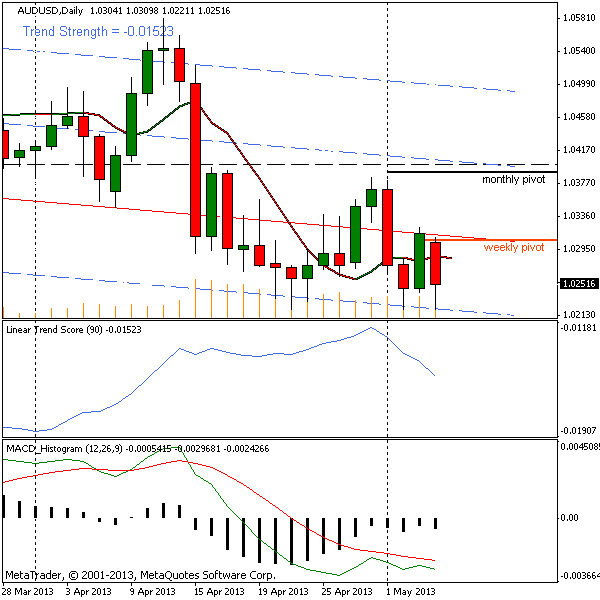
The AUD/USD in trading today declined and ended the day near the 1.0251 exchange rate level at the New York close of business. This was a decline of approximately 50 pips on the day. The Australian dollar, meanwhile, showed more modest declines against the Japanese yen and the euro today of approximately 25 pips and 30 pips, respectively.


AUDUSD forex chart
AUDUSD


AUD/USD Support & Resistance Levels:

The AUD/USD currency pair trades right near the 1.0250 exchange level at the current time with a downside support level coming into play at 1.0220. This level has provided support numerous times since February while a close below this level would be the lowest close since the beginning of March. Lower downside targets would bring 1.0200 and then 1.0165 to 1.0150 which would be bringing the pair to the lowest levels of 2013.

Upside targets may be capped at the 1.0300 major resistance level that has been an obstacle in the past and features the weekly pivot point very close by. If the pair can get by that obstacle the 1.0325 to 1.0350 resistance will likely come into play.


AUD/USD Changes & Ranges: Past 6 Weeks

DatePct ChangeTrue Range
2013.03.31-0.3510.0142
2013.04.071.3060.0234
2013.04.14-2.1440.0255
2013.04.21-0.0240.0118
2013.04.280.3540.0163
*2013.05.05-0.5640.0089

* current week so far


Pivots and Trends Data:

Weekly Pivot Point: 1.0295
Monthly Pivot Point: 1.0390


Linear Regression Indicator Trend / Strength Data:

30-day current trend is BEARISH / Trend strength of -230.4 pips
60-day current trend is BULLISH / Trend strength of 52.9 pips
90-day current trend is BEARISH / Trend strength of -36.1 pips
180-day current trend is BEARISH / Trend strength of -49.7 pips
365-day current trend is BULLISH / Trend strength of 239.6 pips


Article by CountingPips Forex Blog, News & Analysis


New Wyoming Lithium Deposit could Meet all U.S. Demand

By OilPrice.com

The U.S. currently imports more than 80% of the lithium it uses, with the silvery metal winding up in batteries from cell phones to electric cars.

According to a United States Geological Survey publication on lithium, “The only commercially active lithium mine in the United States was a brine ope ration in Nevada. The mine’s production capacity was expanded in 2012, and a new lithium hydroxide plant opened in North Carolina. Two companies produced a large array of downstream lithium compounds in the United States from domestic or South American lithium carbonate, lithium chloride, and lithium hydroxide. A U.S. recycling company produced a small quantity of lithium carbonate from solutions recovered during the recycling of lithium ion batteries.”

The bad news?

Last year virtually all of the major brine and mineral-based lithium producers increased their prices, which in turn has spurred prospecting. In the U.S. exploration has been largely centered in Nevada, but the growing worldwide market for lithium has also spurred exploration in Argentina, Australia, Bolivia and Canada.

And now, the good news.

University of Wyoming researchers found the lithium while studying the idea of storing carbon dioxide under ground in the Rock Springs Uplift, a geologic formation in southwest Wyoming. University of Wyoming Carbon Management Institute director Ron Surdam stated that the lithium was found in underground brine. Surdam estimated the located deposit at roughly 228,000 tons in a 25-square-mile area. Extrapolating the data, Surdam said as the uplift covered roughly 2,000 square miles, there could be up to 18 million tons of lithium there, worth up to roughly $500 billion at current market prices.

As a yardstick, the lithium reserves at Silver Peak, Nevada, the largest domestic producer of lithium total 118,000 tons in a 20-square-mile area. The University of Wyoming stated that in a best-case scenario, the Rock Springs Uplift’s 18 million tons of potential lithium reserves is equivalent to roughly 720 years of current global lithium production. UW researchers suggest that the lithium mining could be part of a carbon dioxide sequestration operation, since the lithium-bearing brine must be pumped to the surface from the underground rock formation to extract the lithium, creating space to store the CO2 in its place. Surdam highlighted the economic advantages to the combined lithium-CO2 storage operation, commenting, “You get paid to put the carbon in the subsurface and that’ll pay for the wells to remove the lithium.”

Carbon Management Institute senior hydrogeologist Scott Quillinan said, “Due to their high salinity, brines from the CO2 storage reservoirs would have to be pumped to the surface and treated – often an expensive process. Recovering and marketing lithium from the brines would produce significant revenue to offset the cost of brine production, treatment and CO2 storage operations .”

Several fortunate factors converge to make the lithium- CO2 storage reservoir concept more than merely feasible. While lithium production from brines requires sodium carbonate (soda ash), transporting soda ash to lithium production facilities is often a significant expense the Rock Springs Uplift CO2 storage site is located 20-30 miles of the world’s largest industrial soda ash supplies, so costs of soda ash delivery would be minor. While magnesium must be removed from brines before they can be used for lithium recovery, the Rock Springs Uplift reservoirs contain much less magnesium than brines at existing, currently profitable lithium mining operations. While brines must be heated and pressurized before lithium can be extracted, the Rock Springs Uplift brines lie so far underground, they are already at a higher pressure and temperature than brines at existing lithium operations, allowing any potential operators largely eliminate the step, furt her lessening costs. Finally, the treated water resulting from the recovery process could benefit local communities, agriculture and industry.

It will be interesting to see if any investment entities step up to the plate on this.

Source: http://oilprice.com/Energy/Energy-General/New-Wyoming-Lithium-Deposit-could-Meet-all-U.S.-Demand.html

By. John C.K. Daly of Oilprice.com