By www.CentralBankNews.info Egypt’s central bank held its benchmark overnight deposit rate steady at 9.75 percent to give its recent rate hike time to take effect, but warned that inflationary pressures may build and the bank’s Monetary Policy Committee will not hesitate to raise rates to ensure price stability.
The Central Bank of Egypt (CBE), which raised its key lending rates by 25 basis points in April, said slow economic growth had checked the upside risks to inflation and a rebound in international food prices was not likely, but there is a “possible build-up of upward pressures on inflation going forward” due to local supply bottlenecks and distortions in distribution channels.
Egypt’s headline inflation rate rose by a monthly 1.47 percent in April to an annual rate of 8.11 percent, up from 7.59 percent in March, while core inflation rose to 7.437 percent from 7.03 percent. Higher prices are due to broad-based increases in food and non-food prices.
Egypt’s Gross Domestic Product expanded by a real 2.4 percent in the first half of the 2012/13 financial year, which ends June 30, following a “similarly feeble growth rate” of 2.2 percent in 2011/12, the bank said.
A “nascent” economic recovery was based on better construction and tourism activity, but manufacturing remains weak, investment low and the current political transformation is still weighing on consumption and investment decisions, the CBE said.
The central bank considers its current rates to be “appropriate given the lagged transmission of the previous rate hike across the economy combined with the mixed balance of risks surrounding the inflation and GDP outlooks at this juncture,” the bank said adding that it “will not hesitate to adjust the key CBE rates to ensure price stability over the medium-term.”
In April, when the CBE changed rates for the first time since November 2011, the central bank said it would not hesitate to adjust rates to ensure price stability.
Central Bank News Link List – May 9, 2013: G-7 to confirm economic policy cooperation for global growth
By www.CentralBankNews.info Here’s today’s Central Bank News’ link list, click through if you missed the previous link list. The list comprises news about central banks that is not covered by Central Bank News. The list is updated during the day with the latest developments so readers don’t miss any important news.
- G-7 to confirm economic policy cooperation for global growth (Kyodo)
- Thai finmin calls meeting on baht as feud with c.bank continues (Reuters)
- China inflation data shows central bank policy dilemma (Reuters)
- Bank of Korea monetary policy history (Bloomberg)
- Hungary will not use reservers to root out forex loans: Malolcsy (Reuters)
- SARB to cut interest rate? (iafrica)
- Markets approve (Thai) central bank ‘tookit’ (MarketWatch)
- Mexico rate decisions to weigh policy stance in other countries (Bloomberg)
- ECB says rate cut is consistent with low inflation in euro area (Bloomberg)
- Rwanda central bank may keep rates unchanged: governor (Bloomberg)
- www.CentralBankNews.info
Korea cuts rate 25 bps, sees considerable global risks
By www.CentralBankNews.info South Korea’s central bank cut its base rate by 25 basis points to 2.50 percent, saying downside risks to global growth remain “considerable” while domestic growth remains weak with the negative output gap likely to continue for a considerable time.
The Bank of Korea (BOK), which surprised many by holding its rate steady last month, said it would closely monitor the effect of its rate cut and the government’s 17.3 trillion won supplementary budget to keep inflation within its target over the medium term.
Last month the BOK’s Monetary Policy Committee also said there were downside risks to the global economy but this month it used stronger language by describing these risks as considerable.
At its meeting in April, the BOK decided by a narrow 4-3 vote to hold rates steady despite government pressure. It is the BOK’s first rate cut this year after two cuts in 2012, when the base rate was cut by 50 basis points.
The BOK said moderate economic recovery in the US was continuing but the sluggishness of the euro area’s economy has deepened and “the trends of improvement in economic indicators in emerging market countries such as China have been weaker than initially anticipated.”
“The Committee expects the global economy to continue its modest recovery going forward, but judges that the downside risks to growth remain considerable due chiefly to uncertainties related to for instance the sluggishness of economic activity in the euro area and to the implementations of fiscal consolidation in major countries,” the BOK said.
Korea’s Gross Domestic Product expanded by a stronger-than-expected 0.9 percent in the first quarter from the fourth quarter’s 0.3 percent, the highest growth rate in two years, signs interpreted by some observers that last year’s rate cuts were starting to pay off.
But the BOK said growth remains weak, and although exports are recovering, the pace is modest and domestic demand is alternating between improvement and worsening.
“Going forward, there is no change to the Committee’s forecast that the domestic economy will show a negative output gap for a considerable time, due mostly to the slow recovery of the global economy, to the influence of the Japanese yen weakening, and to the geopolitical risk in Korea,” the bank said.
South Korea’s economy expanded by 2.0 percent in 2012, down from 2011’s 3.6 percent, and the BOK now expects 2013 growth of 2.6 percent, slightly higher than the government’s 2.3 percent forecast.
Korea’s inflation rate fell to 1.2 percent in April from 1.3 percent the prior month, well below the BOK’s 2.5-3.5 percent range for the 2013-2015 period. Core inflation also eased to 1.4 percent from 1.5 percent in March.
The BOK expects inflation to remain low for the time being.
www.CentralBankNews.info
Gold “Still Bearish” as Western Buying “Cools”, But Indian Festival Demand Seen Matching ETF Outflows
London Gold Market Report
from Adrian Ash
BullionVault
Thurs 9 May, 07:50 EST
SPOT GOLD PRICES slipped back below $1470 per ounce Thursday morning in London, drifting as world stock markets failed to follow Wall Street higher, where equities yesterday hit new all-time highs.
Silver held above $24.00 per ounce, just shy of last week’s finish, as commodities slipped overall.
A rise in Sterling after the Bank of England held its monetary policy unchanged drove gold prices down to £942 per ounce for UK investors.
Government bond prices meantime rose everywhere except Australia and New Zealand, where strong new jobs data saw both currencies jump together with interest rates.
Spain today raised €4.5 billion ($6.5bn) in new debt at sharply lower interest rates from its last bond auction in April.
Neighboring Portugal has “already been able to totally finance our needs for this year” the finance minister said earlier this week, adding that Lisbon is now aiming to start pre-financing its 2014 needs and plan an exit from the €78bn bail-out it received from the European Union and IMF in 2011.
“The downtrend in [gold’s Relative Strength Index] is bearish,” says the latest technical comment from bullion bank Scotia Mocatta, “as it indicates that gold is becoming overbought at progressively lower levels, and becoming oversold at progressively lower levels.”
Even so, “Gold still has some room to move higher before making its next leg down,” Scotia’s note adds.
In terms of private-investor demand, “The pace of buying has cooled,” says another broker, pointing to “the frenzied pace” following the 30-year record price crash of mid-April.
“We suspect that those sitting on the fence and waiting for cheaper prices may yet have another shot at getting back in.”
Amongst the exchange-traded trust funds favored by money managers buying gold, the giant SPDR Gold Trust shed another 6 tonnes on Wednesday, taking the quantity of bullion held to back its shares to the lowest level since March 2009 at 1051 tonnes.
“Indian physical demand is strong,” says James Steel at London market-maker HSBC, “and the combined response by consumers and retail investors to the plunge in prices since mid-April is absorbing a portion of the liquidation in the gold-exchange traded funds.”
“No end in sight for precious metals appetite across the globe,” agrees Swiss refining and finance group MKS, “especially out of China and India” – the world’s No. 2 and No.1 consumer markets respectively.
“The question is who will win the battle between the unprecedented physical demand, and the unrelenting ETF supply.”
Importers are rushing to beat new gold restrictions proposed by India’s central bank, according to Rajesh Khosla, managing director at MMTC-PAMP India, in New Delhi.
“Supported by strong physical demand from India and China,” says Mumbai-based brokerage Emkay, “gold prices in India can be supported by physical demand ahead of Akshay Tritiya” – the spring festival celebrated this year on May 13 and traditionally an auspicious day on some Hindu calendars for buying gold.
Indian jewelers are buying gold at up to $12 an ounce over benchmark London prices, Livemint quotes Bachhraj Bamalwa, a director of the All India Gems & Jewellery Trade Federation.
That compares with $2 an ounce before mid-April’s slump in global gold prices.
With gold gifts now in demand for the Indian wedding season – which runs until July –”Should you buy gold [for your own portfolio] this Akshaya Tritiya?” asks Jayant Manglik, president of retail distribution at Indian brokerage Religare Capital, writing for MoneyControl.
“The unambiguous answer is yes. Having gold in the portfolio increases diversification & security while reducing risk & volatility. It is liquid in any country in the world and is virtually physically indestructible.
“The right mix would have between 10 to 15% of your investible surplus.”
On the supply side, meantime, the world’s largest gold miner corporation – Barrick Gold – has restructured a deal with the Dominican Republic to share more of the revenues from its giant Pueblo Viejo project with the government.
Barrick cut half-a-billion Dollars of new exploration spending from its 2013 plans following April’s price crash.
Gold mining output from South Africa – formerly the world’s #1 producer nation, but now in 6th place after production halved since 2000 – fell again in March, new data showed today, down a further 6.2% from a year earlier to the lowest levels in nine decades.
Gold price chart, no delay | Buy gold online
Adrian Ash is head of research at BullionVault, the secure, low-cost gold and silver market for private investors online, where you can buy gold and silver in Zurich, Switzerland for just 0.5% commission.
(c) BullionVault 2013
Please Note: This article is to inform your thinking, not lead it. Only you can decide the best place for your money, and any decision you make will put your money at risk. Information or data included here may have already been overtaken by events – and must be verified elsewhere – should you choose to act on it.
Toyota’s Profit Highest In Years
The world’s largest car makers have doubled their profit to a net income of 3.13.9bn yen ($3.2bn) from 121bn yen, marking its highest in six years. Toyota has gained a profit of 1.37tn yen from 962bn this year.
Exporters such as Toyota may benefit from Japan’s plans to weaken the yen which has helped the car makers boost their sales.
A weak yen help boost the value of foreign income and helps with the competitive Japanese companies overseas.
Tokyo based analyst “Issei Takahashi said “Adjusting the price of cars or suddenly adding incentives to gain volume sales would have a negative impact on their brand image in the long term, so that’s not a part of Toyota’s basic strategy,”
Toyota’s global market share topped the industry with approximately 12% in 2012 for 3.4 % of the European market.
The amount of exports from Japan accounted for about 44 percent of Toyota’s output between January to March which makes the weaker yen a bigger profit for the company.
The world’s biggest carmakers have believed to have recovered after the tsunami and earthquake which disrupted most of the supply chains and production.
Toyota has managed to recover the sale figures in most of the Asian markets and the US.
The post Toyota’s Profit Highest In Years appeared first on | HY Markets Official blog.
Article provided by HY Markets Forex Blog
Bank of England maintains QE target, bank rate
By www.CentralBankNews.info The Bank of England (BOE) held its official bank rate steady at 0.5 percent and its target for asset purchases financed through bank reserves at 375 billion pounds, as widely expected.
The BOE has held its bank rate steady since March 2009, when it also started purchasing assets – known as quantitative easing – to hold down long-term interest rates. The target for asset purchases has been raised several times since then, most recently by 50 billion pounds in July 2012.
The outgoing BOE governor, Mervyn King, and two other members of the bank’s nine-member Monetary Policy Committee were defeated in their attempts in March and February to boost the size of asset purchases by 25 billion.
The details of today’s meeting will first be released on May 22 while the bank will publish its inflation outlook on May 15.
The United Kingdom avoided slipping back into its third recession since the global financial crises as first quarter Gross Domestic Product rose by a quarterly 0.3 percent after contracting by 0.3 percent in the fourth quarter of 2012. On an annual basis, first quarter GDP rose 0.6 percent.
Following the stronger-than-expected first quarter growth, economist had not expected the BOE to expand its asset purchases further.
The BOE, along with the UK Treasury, also recently extended its Funding for Lending Scheme (FLS) by another year until January 2015. The scheme aims to encourage banks to lend to small businesses and the bank is hopeful this should encourage stronger growth.
Inflation continues to remain above the BOE’s 2 percent target. In March inflation was steady at 2.8 percent and last time it was below 2 percent was in December 2009.
The BOE has acknowledged that inflation has remained “stubbornly above” target and expects it to rise further and remain above target for the next two years.
Under its new remit, which was revised in March, the BOE was given more flexibility to disregard a temporary rise in inflation and use unconventional policy instruments to boost growth as long as inflation is trending toward target.
The BOE was also given the freedom to use forward guidance and specific economic thresholds as a tool to affect consumers and markets expectations. The BOE will deliver an assessment of the use of such thresholds in August, the month after Mark Carney, currently Bank of Canada governor, takes over from King who is retiring.
Euro Traded Flat Against US Dollar
Europe’s currency traded flat against the US dollar at $1.3149. Markets are focused on the long term Spanish bond auction.
Euros have risen after positive outputs by the Germans with hopes euro growth might be leaning towards the economical growth. With the current conditions, there is a possibility EUR/USD might remain at its range bound.
German production was up 1.2% in march combined with Tuesday‘s unexpected March factory orders which indicates the Germans still have a solid and stable economy.
The U.S Dollar lost 0.24% against the Japanese yen at ¥98.75 while Sterling traded 0.08% higher against euro, buying at £0.8459. Investors are mainly focused on the bank rate from the Bank of England.
Reports show that crude stockpiles have risen by 230,000 to 395.5 million barrels. Analyst’s reports weaker dollar might be helping the market which would improve the economy and increase the demands
Spain is expected to hold a long term government bond auction on Thursday by 8:30am GMT.
Madrid is trying to sell a 3 year bond with a fixed coupon of 3.3%, with bond maturities in 2016, 2018 and 2026.
The post Euro Traded Flat Against US Dollar appeared first on | HY Markets Official blog.
Article provided by HY Markets Forex Blog
Malaysia holds rate on steady growth, modest inflation
By www.CentralBankNews.info Malaysia’s central bank held its benchmark Overnight Policy Rate (OPR) rate steady at 3.0 percent, as expected, saying this stance was appropriate in light of steady domestic growth and inflation that is expected to continue rise modestly.
The Central Bank of Malaysia, which has held rates steady since June 2011, said domestic supply and costs are expected to push prices higher, but “given the modest global growth prospects, pressures from global commodity prices are likely to be contained.”
At its previous meeting in March, the bank’s Monetary Policy Committee made the same observation about the outlook for inflation.
Malaysia’s inflation rate rose slightly to 1.6 percent in March from February.
Domestic demand is continuing to support Malaysia’s economy and investment activity and consumption have remained firm and the bank expects this to continue.
The central bank forecasts growth of 5-6 percent in 2013 compared with 5.6 percent in 2012 and 5.1 percent in 2011.
The central bank described the momentum in global growth as “modest” and the recovery uneven and there are still downside risks as growth in advanced countries is constrained by fiscal consolidation, while domestic demand continues to support growth in Asia.
“Despite the improvements in international financial market conditions, markets remain vulnerable to setbacks and changes in sentiment,” Malaysia’s central bank said.
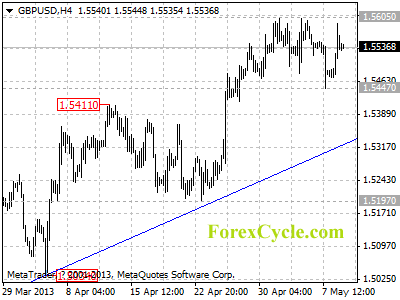
GBPUSD is in uptrend from 1.4831
GBPUSD is in uptrend from 1.4831 (Mar 12 low), the fall from 1.5605 is treated as consolidation of the uptrend. Initial support is at 1.5447, and the key support is located at the upward trend line from 1.4831 to 1.5034. As long as the trend line support holds, the uptrend could be expected to resume, and one more rise to 1.5800 is still possible after consolidation. Resistance is at 1.5605, a break above this level could signal resumption of the uptrend.
Can Australian Stocks Defy Gravity if The Australian Dollar Falls
Over the past two weeks I’ve said that the Australian dollar was looking vulnerable to a near term sell-off. I pointed out that the last major line of support is around US$1.015.
After the interest rate cut on Tuesday we saw the Aussie sell-off sharply to, you guessed it, $US1.015.
Now things start to get interesting for the Aussie. In the last two and a half years every time this level has been broken the Australian dollar has sold off in a straight line to between US$0.94-$0.985.
I don’t think this time will be any different. The Aussie has been in a tight range between US$1.015 and US$1.06 for ten months now. The coke bottle has been shaking up for a long time in other words. Once the support level gives way you’ll see the Aussie hit parity in a matter of days…
The reason why I’ve spent so much time talking about the Australian dollar lately is because the short term charts are now lining up quite nicely with the very long term charts. There is a line of dominoes set up that if pushed could cascade into a steeper fall than anyone expects.
To show you what I mean, have a look at the monthly chart of the Aussie going back to 1991:
Australian Dollar Monthly Chart

I use the 10-month/35 month moving averages to give an idea of the very long term trends. You can see that it has been amazingly accurate at sticking with multi-year trends.
We’ve only seen two instances in the last 20 years where the 10-month moving average has crossed under the 35 month moving average in the Aussie. The first one in mid-1997 was at the very beginning of a five-year bear market in the Australian dollar.
The second time was during the crash in the Aussie in 2008. It moved so fast and viciously at that time that the signal showed up fairly late.
The Australian Dollar on the Edge
We’re now on the edge of receiving the third very long term signal in over twenty years.
The other interesting technical development over the long term is the symmetrical triangle that has formed for the past couple of years (the dashed lines in the chart). A failure below the lows of that triangle around US$0.98 could spell trouble.
Yet another thing that I want to point out is the major high in 2008 of US$0.985 (The solid blue line). I think that level is a very large line in the sand for the Australian dollar.
It has held above that level for the majority of the time since late 2010. A lot of long positions have been placed above that level and I think we’ll see some serious liquidation if it starts trending below US$0.985 for any length of time.
On a monthly chart I would see a failure below the 2008 high as a ‘false break’ of the high, even though it has taken three years to play itself out. Or you could look at it as a double top formation.
Fundamentally we know that the Aussie should be trading a lot lower than here if it wasn’t for the influx of money from offshore hunting some yield and escaping their own devaluing currencies.
That theme is incredibly powerful and there is no indication that the major central banks around the world are about to stop printing. For that reason I would be surprised to see a sharp collapse in the Aussie like the one we saw in 2008.
But I really wouldn’t be surprised to see the Aussie heading towards the low US$0.90′s over the coming six to twelve months, especially if we see a continued deterioration in the economic data worldwide.
US Macro Data Keeling Over


Source: ZeroHedge
As you can see from the chart above the US economic figures released over the past couple of months have been deteriorating sharply. Whether this is just a short term slowdown or something more sinister is still unknown.
On the same theme, it looks like George Soros has once again done his homework and started picking on the Aussie dollar at exactly the right time. The rumours of his entry into a short trade on the Australian dollar could be enough of a catalyst to get the ball rolling, and the interest rate cut has added fuel to the fire.
I think we will see the US$1.015 level give way within the next week or so, and then the dominoes could really start to fall.
It’s still an open question whether this development will be bullish or bearish for Australian stocks. There are sectors of the economy that have struggled under the weight of the strong Aussie dollar and we could see them breathe a sigh of relief if it stumbles.
The heavily beaten up resource stocks would be in that category as well as any companies in import competing businesses or with large revenues offshore.
But on the other side of the coin we may see some offshore money pulled out of Australian stocks if the currency starts to head south at a rate of knots.
As I’ve said many times in the past, there is a very high correlation between the Aussie/Yen and our stock market due to the influence of the carry trade and the high levels of Japanese cash now looking for a home outside of their own weakening currency.
If the Aussie/Yen plummets then it would be hard for Australian stocks to defy gravity.
Murray Dawes
Editor, Slipstream Trader
PS. Rumour has it that George Soros cleaned up by punting on the Aussie dollar this week. True or not, it should have you thinking about how to protect your investments if the Aussie dollar falls…especially if you own shares in companies that will suffer from a lower Aussie dollar. In today’s Money Morning Premium, Kris looks at a neat ASX-listed investment that could fit the bill. Click here to upgrade now.
From the Port Phillip Publishing Library
Special Report: TORRENT SIGNAL 3
Daily Reckoning: How the Dow is Just Wall Street’s Marketing Tool
Money Morning: Build Wealth Fast through the Resource Sector
Pursuit of Happiness: The Government’s Idea of Wealth Creation
