And the Masters of the Universe Say…

By The Sizemore Letter

In my last article, I noted that “Big Money” managers was wildly bullish on U.S. stocks—74% were bullish and only 7% were bearish.

But what about those legendary masters of the universe—the global macro hedge fund managers who, if their reputations are to be believed, hold the fates of companies and even entire countries in the palms of their hands?

At last week’s Ira Sohn Investment Conference, we got to hear the latest investment themes from some of the biggest names in the business, including Bill Ackman, Jim Chanos, Stanley Druckenmiller, and David Einhorn, among others.

Some of these “smart money” guys haven’t been looking too smart of late.  Ackman has taken enormous losses in JC Penney (NYSE:JCP); at one point, his losses on the investment were over $500 million.  He also appears to be on the wrong side of a very large short position in Herbalife (NYSE:HLF).

This year Ackman is recommending Procter & Gamble (NYSE:PG), even though it is sitting near 52-week highs and is trading at a substantial premium to the broader market…after a long run in which consumer staples have outperformed.  Ackman is agitating for management change.  We’ll see how Ackman’s recommendation plays out, but I wouldn’t expect market-beating returns here.

Most of the speakers focused their comments on individual stocks, but there were some “big picture” themes worth noting as well.  Kyle Bass of Hayman Capital reiterated his bearish call on Japan, saying that “the beginning of the end has begun.”  I agree with Bass’ view on Japan and recently called it “the short opportunity of a lifetime” here on the Trading Deck.  I can’t say I agree with Bass in his bullish defense of gold, however.

Stanley Druckenmiller, a legendary investor and a former top trader under George Soros, had perhaps the most interesting macro perspective.  Druckenmiller argued that the commodity supercycle—the massive decade-long bull market enjoyed by most commodities—is over.  The primary culprit?  A slowdown in commodity demand from China.

I would take Druckenmiller seriously here.  This is a man who enjoyed a 30-year run without losing money and who is one of the best managers alive today.  Druckenmiller sees the slowdown in China—coming at a time when commodity production is being ramped up globally—resulting in a supply glut and sharply lower prices.  This is good news for companies with large raw materials costs and for countries that import large volumes of commodities, but it is very bad news for Brazil, South Africa and Australia, among other resource-rich countries.

Still, you might want to take the words of all of these masters of the universe with a grain of salt the size of their egos.  88% of hedge fund managers underperformed the S&P 500 last year.

Disclosures: Sizemore Capital has no positions in any security mentioned.   This article first appeared on MarketWatch.

SUBSCRIBE to Sizemore Insights via e-mail today.

The Deflating of the Apple Bubble, the Decline of Sony, and More on Straight Talk Money

By The Sizemore Letter

Listen to Charles Sizemore, Peggy Tuck and Mike Robertson talk about the deflating of the Apple ($AAPL) bubble, the rise and fall of Japanese electronics giant Sony (NYSE:SNE)–the company that should have been Apple, Japan and “Abenomics” and more on Straight Talk Money Radio.

SUBSCRIBE to Sizemore Insights via e-mail today.

ETFs, “Doom and Gloom,” and More on Straight Talk Money

By The Sizemore Letter

Listen to Charles Sizemore, Peggy Tuck and Mike Robertson give their thoughts on ETF investing, “doom and gloom” forecasters, and Samsung ($SSNLF) vs. Apple ($AAPLin the smartphone wars on Straight Talk Money radio.

SUBSCRIBE to Sizemore Insights via e-mail today.
We’re Still Not Selling the Aussie Stock Market…

By MoneyMorning.com.au

George Soros or not, the Aussie dollar has been the talk of the financial markets this week.

This morning the Aussie dollar is trading around USD$0.99.

That’s it. It’s all over. The Aussie dollar and the Aussie miracle economy have finally gotten their come-uppance after four years of bravado.

Not so fast.

We can’t tell for sure. But before the bears get too excited, we offer one note of caution – a strong currency and strong stock market don’t always go hand-in-hand…

The story now is that because the Aussie dollar has hit the skids, we can expect the Aussie stock market to follow suit.

And maybe it will. Yesterday it fell by 26 points. We’ll admit that like anyone else all we can do is take an educated guess on what will happen in the future. But like anyone else’s guess we’ve got just as much chance of being right as being wrong.

So far, we reckon we’ve got the broad trend just about right. The market has gone up…then down…then up…then down…then up.

Yet, despite the hoopla the Aussie market is still near its highest point since mid-2008. That was just before the world economy plunged into a black hole as banks failed and the bailout culture began.

Australia’s Not Selling, But Are We Buying?

Not only that, but it’s also worth remembering that one of the best performing global markets over the past year has been the US market…which also had one of the weakest currencies.

Then there’s the Japanese market, which has soared 66% since November as the Japanese yen has fallen into the toilet.

Yes, we understand those market moves are arguably more about monetary policy than the fundamental health of the respective economies or the stock market.

But given the state of the Australian federal budget, which will be in deficit for at least another four years (notice how the projected return to surplus is forecast for after the 2016 election), and the Reserve Bank of Australia’s willingness to follow international rates lower, can you really rule out another stock surge?

Granted, we’re not about to bet the family silver on a 50% or 66% stock rally.

But stocks are still only just below the recent high point. And they’re still in the sideways trading range we expect to see continue for the rest of the year. That means we’re in no hurry to sell stocks here.

In fact, with the market holding at the top of the range, we’re re-considering our stance of not buying the market at this level.

As we say, we could be wrong and stocks could go into free-fall. But if you’ve balanced your savings across a number of asset classes (as we’ve long advised, and a strategy my old pal Dan Denning has written about here), even if stocks fall it shouldn’t leave you with a big hole in your pocket.

But by the same token, pulling out of the market now without any evidence that stocks are set to plummet could see you miss out on further gains.

So how should you play it?

Dividend Stocks are for Keeps

Well, that’s easy. As far as we’re concerned, your dividend stocks should be ‘keepers’. There’s no need to sell them (although there’s no harm in taking a little bit of profit). So you can put the dividend stocks to one side.

As for what you should buy. If you can find a good dividend stock that hasn’t had a good run, or one where you expect it to increase dividends, then perhaps looking at scaling in. That is, if you normally invest $5,000 in a stock, just buy one-third that amount to start with.

If stocks fall, then you can buy another third, say at a point 5% below your initial entry price. And then invest the final third when the stock appears to have some clear direction.

Of course, if it looks like the stock and the market is heading down the toilet then you shouldn’t buy the extra amounts, and maybe you’d consider selling what you’ve bought.

On the other hand, if the stock rises then at least you’ve picked up some of the gains and you get to buy more stock in a rising market.

You can use that same ‘scaling in’ strategy for blue-chip or small-cap growth stocks too.

When Things Look Bad, Stocks Are Cheap

Look, it’s a tough market to predict. We certainly don’t want to give you the false impression that everything’s fine, because it isn’t. But you should also remember that the situation has been much, much worse in the US, Europe, and Japan, yet they’ve seen some of their best moves in years.

Investors who sold out too soon or refused to buy into the rally are doubtless kicking themselves. Don’t let that happen to you.

If you remain an active investor, understand the risks of investing, and invest responsibly, there’s no reason why you can’t make money on the Aussie market while still protecting your investments if things go sour.

Cheers,
Kris

Join me on Google+

PS: If you believe the papers you’ll think a falling Aussie dollar is a disaster for savers and investors. But what you seldom read is a way to protect your investments or even profit from it. In today’s Money Morning Premium, Kris shows one of many simple ways to protect your wealth from a falling dollar. Click here to upgrade now.

From the Port Phillip Publishing Library

Special Report: IT’S A TRAP

Daily Reckoning: Down the Warped Path of Regular Deficits

Money Morning: How the Aussie Dollar is Running Out of Friends, Fast

Pursuit of Happiness: What Drives Entrepreneur’s and Inventors

Australian Small-Cap Investigator:
How to Make Money From Small-Cap Stocks

The Foundations for the Great Lie We Have Built Our Lives Upon

By MoneyMorning.com.au

The fall of the Berlin Wall was a public declaration that the communist experiment had failed.

The utopian concept of equality in an unequal world was flawed from the start. However, the resolve of the State to alter the laws of human nature meant sceptics had to wait 70 years to be proved correct.

The Soviet experiment taught us major trends in large economies can take decades to reveal the truth.

Nixon’s closure of the ‘gold window’ in 1971 was another key moment in economic history. Free from the remaining shackle of financial responsibility, governments began an experiment to create wealth out of thin air.

When Nixon abolished the gold standard he said:

…if you are among the overwhelming majority of Americans who buy American-made products in America, your dollar will be worth just as much tomorrow as it is today.

The American public bought this propaganda hook, line and sinker.

The following chart shows the cumulative effect of inflation in the US since 1913 (the founding year of the US Federal Reserve):


Source: www.inflationdata.com

From 1913 to 1970, the gold standard kept inflation’relatively’ in check. After 1971, free from the gold standard ‘ball and chain’, it’s a completely different story.

Nixon Released the Inflation Genie

So much for a 1971 dollar being ‘worth as much tomorrow as it is today‘.

The prosperity we’ve enjoyed over the past 42 years has been a fraud. Inflated dollar values don’t necessarily mean we’re richer, it just means we need more inflated dollars to maintain our standard of living.

Given that this is the only economic model the vast majority of people have grown up with, we don’t know any better. The establishment has trained people to think modest inflation and constant growth is the sign of a healthy economy – hardly anyone ever questions this belief.

Yet common sense tells us trees do not grow to the sky forever. The earth has a finite amount of resources to feed, clothe and house a certain amount of people. At some point (and some argue we are already there), for the sustainability of the planet, we must reverse this growth.

This notion is completely at odds with the political and corporate talk of growth, growth and more growth.

North Korea spreads its state propaganda to its citizens and we in the ‘informed West’ mock their gullibility. Yet the West faces State run propaganda too – bogus inflation rates; doctored unemployment figures; manufactured GDP stats; Budget figures that don’t reveal the true state of affairs, and so on.

Mainstream media accepts all this at face value. The masses wrongly believe government and its central bank henchmen have things under control. Mission accomplished.

Maintaining the illusion of growth (the only system we’ve ever known) is vital to these Wizards of Oz. They’ll do and say anything to achieve this outcome. The more desperate things become, the more desperate their actions become (indefinite and unlimited money printing is pretty desperate).

The US share market (as measured by the Dow Jones & S&P 500) has reached record highs. But it’s on the back of zero bound interest rates and legally counterfeited dollars.

But most in the mainstream ignore these facts. The US Fed, their cheerleading economists and the investment industry use the market’s phony record as proof of a US economic recovery.

If you believe the rhetoric, a new bull market awaits us. But the only bull that waits is more policymaker spin.

To reduce the chances of ‘static’ (or truth) ruining the message, Chairman Ben Bernanke – according to Bloomberg on 20 March 2013 – is…

‘…tightening his control of Federal Reserve communications to ensure investors hear his pro-stimulus message over the cacophony of more hawkish views from regional bank presidents.

(Bold emphasis is mine.)

Bernanke is taking charge of the Fed’s propaganda machine to make sure any dissenting voices are no more than a whisper in the wind.

The Bear Market Trap

So, how do we sort through the public misinformation to get the private knowledge to protect our investment capital?

Mark Twain famously said, ‘History doesn’t repeat, but it does rhyme.‘ Patterns of past behavior give an insight into what the future may have in store.

The following chart is the Dow Jones Index from 1900 to Nov 2011. The chart clearly shows that in the very long term (60+ years) the market does indeed go up…

The boxed areas are the times when the market ‘catches its breath’ before getting the energy to go higher. These periods are known as ‘Secular Bear Markets’ – they typically last 15 to 20 years.

The thing to remember about secular bear markets is they deliver far more pain then they do returns.

If your investment timeframe is 20 to 30 years, you can’t afford to walk into a secular bear market trap.

The task of the current secular bear market is to unwind the excesses of the greatest credit bubble in history. This is how systems work – they breath in and they breath out.

The Ruling Class is wildly trying to thwart the natural processes of markets and economies. History shows printed money has never achieved this aim.

Who do you believe – history or the spin-doctors (with their own history of deception)? Choose carefully; your investment capital depends on it.

Vern Gowdie
Contributing Editor, Money Morning

Join Money Morning on Google+

From the Archives…

Why Small-Cap Resource Stocks Beat Blue Chips Hands Down
10-05-2013 – Dr Alex Cowie

Can Australian Stocks Defy Gravity if The Australian Dollar Falls?
9-05-2013 – Murray Dawes

Build Wealth Fast through the Resource Sector
8-05-2013 – Dr Alex Cowie

36% Potential Upside for Australian Stocks Over the Next Two Years
7-05-2013 – Kris Sayce

The Key to Becoming a Successful Investor
6-05-2013 – Kris Sayce

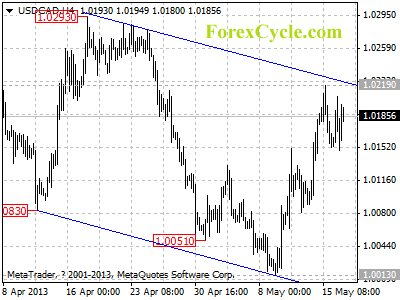
USDCAD is facing channel resistance

USDCAD is facing the resistance of the upper line of the price channel on 4-hour chart, a clear break above the channel resistance will indicate that the downtrend from 1.0341 (Mar 1 high) had completed at 1.0013 already, then the following upward movement could bring price to 1.0500 area. On the downside, as long as the channel resistance holds, the price action from 1.0083 is treated as consolidation of the downtrend from 1.0341, another fall towards 0.9500 could be expected after consolidation. Support is at 1.0145, a breakdown below this level could signal completion of the short term uptrend from 1.0013.

usdcad

Forex Signals

Central Bank News Link List – May 16, 2013: IMF: Central bank bond buying improved economic conditions

By www.CentralBankNews.info

Here’s today’s Central Bank News’ link list, click through if you missed the previous link list. The list comprises news about central banks that is not covered by Central Bank News. The list is updated during the day with the latest developments so readers don’t miss any important news.

Latvia keeps rate steady, warns of lower growth

By www.CentralBankNews.info     Latvia’s central bank left its benchmark refinancing rate steady at 2.5 percent along with its reserve requirements, saying there were no risks to price stability but the risks of lower economic growth has risen and economic policy should take this into account.
    The Bank of Latvia also continued to prepare for Latvia’s adoption of the euro on Jan. 1, 2014 by keeping its payments system open for business on Dec. 30 to ensure that all payments, including credit card payments, would be settled before the switch to the single currency.
     Latvia’s consumer prices fell by 0.4 percent in April, down from inflation of 0.2 percent in March, continuing the declining trend since May 2011 when the inflation rate hit 4.8 percent.
    “Sustained low inflation rates persist in Latvia and the economic growth rate posts no risks to price stability in the medium term” the bank said.

    Latvia’s inflation rate is below that of the euro zone’s 1.2 percent and its growth rate much stronger, but the central bank warned that in “the last few months, however, the risk of the economic growth in 2013 moderating in comparison with the previous forecasts has increased,” adding:
    “Such possibility should be taken into account when planning the economic policy for the near future.”
    Latvia’s Gross Domestic Product rose by 1.2 percent in the first quarter of 2013 for annual growth of 3.1 percent, down from a rate of 5.1 percent in the fourth quarter.
    In comparison, the euro zone’s economy contracted for the sixth quarter in a row, down by 0.2 percent in the first quarter from the fourth quarter, for an annual decline of 1.0 percent.
    The Bank of Latvia has forecast 2013 growth of 3.6 percent, down from 5.6 percent in 2012.
    As part of preparations for joining the single currency next year, Latvia already joined TARGET2, the euro zone’s payments system, in 2007. In TARGET2 more than 1,000 European financial institutions perform real-time payment settlements in euro. Since 2008 the Bank of Latvia’s electronic clearing system (EKS) has also been able to handle retail payments in euros.

    www.CentralBankNews.info

Surge in Retail Gold Demand “Outweighed by ETF Selling” as Far East Premiums Hit New Highs

London Gold Market Report
from Adrian Ash
BullionVault
Thurs 16 May, 08:10 EST

GLOBAL GOLD prices fell further at the start of London trade on Thursday, hitting new 1-month lows beneath $1370 per ounce but leaving gold bars traded in East Asia at record-high premiums.

“[Western] investors appear to be tired of gold as a safe haven,” says Mitsubishi analyst Jonathan Butler, quoted by Reuters, because “they anticipate the end of loose monetary policies, possibly by the end of this year or maybe early next year.”

With US consumer price inflation data due just before today’s Wall Street opening, five members of the US Federal Reserve were scheduled to make separate speeches at various events later on Thursday.

Four of them are voting members on the Fed’s policy-setting committee.

“There also seems to be a return of risk appetite” amongst Western money managers, says Mitsubishi’s Butler.

European stock markets today held flat after rising 12% in the last month.

The gold price in US Dollars extended Wednesday’s drop to fall briefly beneath a one-month low of $1370 per ounce – a level first hit in October 2010.

Gold priced in Sterling fell closer to £900 per ounce, a level seen on only 4 trading days since May 2011.

“New highs in the US equity markets and plummeting bond yields,” says Edward Meir at INTL FC Stone, “particularly in Europe, spurred the exodus away from gold and into financial assets on Wednesday.

The silver price, “which has been looking particularly poorly on the charts lately,” says Meir, “is now within striking distance of its mid-April lows of $22 an ounce” – the lowest level since Oct. 2010.

“Rampant equity markets continue to attract investor funds away from gold,” agrees a note from Japanese trading house Mitsui’s New York team.

“The yellow metal looks to be heading for another look towards last month’s lows beneath $1350.”

In contrast to Western money managers, Chinese investors “[have been] discouraged by the weak domestic stock market,” says the latest Gold Demand Trends from market-development group the World Gold Council, “[and so] increasingly relied on gold to fulfil their investment needs.”

Analyzing global data from the first 3 months of this year (which included the Chinese Lunar New Year holidays), the World Gold Council says China’s total gold demand again outpaced demand from India – still the world’s #1 in 2012 – by rising 20% from the same period in 2012 to a new quarterly record of 294 tonnes.

Indian demand rose 27% to 256 tonnes. So-called “retail” demand worldwide – meaning jewelry, small gold bars and coin – rose 11.5% by weight compared to Jan-Mar. 2012, with US gold jewelry sales rising 6%.

That was the first rise in US gold jewelry demand year-on-year since autumn 2005.

Opposing the rise in retail gold demand, says the World Gold Council, “[was] a well-documented decline in gold E.T.F. holdings…which outweighed the [global] growth in bar and coin demand.”

In total, exchange-traded gold trust funds shed more than 175 tonnes during the first quarter.

The giant New York-listed SPDR Gold Trust (ticker: GLD) has shed a further 175 tonnes in the 6 weeks since, losing metal again on Wednesday to reach its smallest holdings since March 2009.

New regulatory filings for March 31st yesterday showed speculator George Soros’s flagship hedge fund cut its position in the GLD by a further 12% during the first quarter.

Paulson & Co., the largest single investor in the GLD, maintained its position in the trust, which now holds 1047 tonnes of large gold bars in HSBC’s specialist bank vault in East London.

Meantime in Asia, “Japan is clearly back from stagnation,” reckons Citigroup economist Naoki Iizuka in Tokyo, commenting to Bloomberg today on new data showing a surprise 3.5% annualized rise in GDP during the first quarter.

The Japanese stock market took a pause Thursday from hitting new 5-year highs.

Premiums for 1 kilogram gold bars in Hong Kong and Singapore meantime rose to newly unprecedented levels above the bullion market’s benchmark London price, according to private reports.

The excess demanded above 400-ounce London wholesale prices for kilobars (31 ounces) of 0.9999 fineness today reached $5 per ounce, up from last week’s strong $3 level as demand held firm.

Adrian Ash

BullionVault

Gold price chart, no delay | Buy gold online


Adrian Ash is head of research at BullionVault, the secure, low-cost gold and silver market for private investors online, where you can buy gold and silver in Zurich, Switzerland for just 0.5% commission.


(c) BullionVault 2013

Please Note: This article is to inform your thinking, not lead it. Only you can decide the best place for your money, and any decision you make will put your money at risk. Information or data included here may have already been overtaken by events – and must be verified elsewhere – should you choose to act on it.


Turkey cuts rates 50 bps, raises FX reserve requirement

By www.CentralBankNews.info      Turkey’s central bank cut its benchmark, short-term interest rates by 50 basis points, as expected, but also raised its reserve requirements for foreign currency deposits by the same amount in a move designed to stimulate the economy yet deter capital inflows than could threaten financial stability.
     The Central Bank of the Republic of Turkey (CBRT) cut its benchmark, one-week repo rate to 4.5 percent from 5.0 percent and shifted its interest corridor further down by cutting the overnight borrowing rate, the ceiling in the corridor, to 3.5 percent and the lending rate, the corridor’s floor, to 6.5 percent from 7 percent.
   “Capital inflows remain strong and credit growth hovers above the reference rate,” the central bank’s monetary policy committee said in a statement, adding:
     “The Committee indicated that, in order to balance the risks on financial stability, the proper policy would be to keep interest rates low while increasing foreign currency reserves via macroprudential measures.”
    Other short-term rates that were cut by the CBRT include the rate on borrowing by primary dealers via repo transactions, which was reduced to 6.0 percent from 6.5 percent and the lending rate on the late liquidity window was cut to 9.5 percent from 10 percent while the borrowing rate remained at zero.