Palantir’s Software is so Good its First Client Was the CIA

By MoneyMorning.com.au

[Ed note: The following article first appeared in the 26 April Australian Small-Cap Investigator weekly update.]

Technology has a huge impact on how we fight terrorism and crimes against humanity. The high-tech gear used to catch the Boston Bombers demonstrated this.

You see bad guys have technology whiz-kids too. More than you’d like to know. So the real war is making sure the right side stays ahead of the technological curve.

It might sound a bit strange, but the heroes of our world are the computer engineers and coders. These people that create, innovate and invent to give the good guys the upper hand.

And there’s one company with an army of engineers and coders that’s at the forefront of this fight.

Because for this company war isn’t fought on battlefronts. The real war is in computer networks, data streams, and mountains of information.

To have the best information you need to be the best at making sense of it. In today’s world with huge amounts of data, it’s getting hard to gather clear and precise information.

Too much data slows the process of governments and corporations, as they simply can’t make sense of it all.

Think about it for a second. Consider the data you create on a daily basis. Your smartphone, email, TV, car and computer all generate data every second.

Cisco Systems [NASDAQ: CSCO] estimates by 2017 there will be over 11.17 Exabytes of mobile data traffic per month. That’s about 2.8 Billion DVD’s of data per month. That’s just the mobile data.

The problem is how to make sense of it all. It’s crucial to use data to make good decisions. This is important for billion dollar businesses, police, health organisations and telecommunication providers.

So as the flow of data continues to increase, it becomes increasingly difficult to spot trends and patterns to help good decision-making. But, if you can see through the information where others can’t, you hold an advantage.

And to hold any advantage over a competitor means you control the game.

To get this advantage, companies need to know how. And as most lack the ability and systems, they ask, ‘Is there someone to do it for us?’

The same goes governments. They could have all the data in the world, but if they don’t know what to look for or can’t see it, then it is useless.

To analyse and read the information almost becomes more important than the data itself.

Of course where there’s a need, there’s a Silicon Valley company to meet it.

A company has created software that is like no other that’s come before it. They’re world leading in information analysis. And governments and big business are climbing over each other to use their software.

Palantir’s Software is Like a Virtual Crystal Ball

Or as they see it, the ‘seeing-stones’ out of J.R.R Tolkien’s Lord of The Rings.

Having a self-confessed ‘limited-social life as a teenager,‘ the founder of this company named it Palantir. (Google, ‘Palantir – Lord of The Rings’ if you haven’t read the books.)

Palantir sprung from an idea by Dr. Alex Karp, a Stanford graduate with a PHD in Social Philosophy. His idea, to create software that can ‘make sense of massive amounts of disparate data.

Teaming up with his friend (and PayPal founder) Peter Theil, they started Palantir.

Palantir’s first client was the US Central Intelligence Agency (CIA). They now provide their software to a range of industries. Financial, Medical, Government and Not-For-Profit.

Palantir software represents the intersection of data, technology and human expertise. Our data fusion platforms sit above traditional data systems and enable people to ask the questions they need answered in a language they understand.‘ – Palantir

Here’s a list of the work Palantir has done over the last few years;

  • The hunt for terrorist groups in Iraq. Palantir’s software found patterns and connections amid Iraqi fighters and suicide bombers. They called this The Sinjar Records. Until this work, the US had never properly understood the networks and funding of these groups. It was groundbreaking information for the US.
  • Uncovering a cyber-spying network that hacked the Dalai Lama. An unnamed country received an email from China asking them to stop an event for the Dalai Lama. The shocking part was the event was not public knowledge. Only the country and the Dalai Lama knew of the details. Palantir’s software identified that the Dalai Lama’s networks were hacked, along with 1600 others.
  • The world’s first Human-Trafficking Database. Palantir have joined with Google [NASDAQ: GOOG] and Salesforce [NYSE: CRM] to fight the multi-billion dollar criminal world of human-trafficking. They will record data from emergency calls and evidence found by Police. Using real-time trends and patterns Police can respond swiftly when these criminals surface.

For now Palantir is private, but rumours are circulating they might float in 2013. Valuations of Palantir range from $4 Billion to $7 Billion. With numbers like that, it’s a tempting suggestion.

But Palantir isn’t just about making money. They’re a company trying to change the world. A view held by a number of Silicon Valley companies.

Palantir is another example of a Silicon Valley success story. Dr Karp has a theory on why Silicon Valley companies seem to achieve greater success:

What makes a software product work is the ability to build a business around a compelling idea. And while this seems obvious in America and especially in Silicon Valley, in almost every other place if you want to build a business people say, ‘well how are you going to make money tomorrow?’ In Silicon Valley we build businesses around an idea. And then figure out how to make money.

So keep a close eye on Palantir. They are a piece of the puzzle that’s driving the technological revolution we’re in.

Sam Volkering
Technology Analyst, Money Morning

Join Money Morning on Google+

From the Archives…

The Day Japan and China Shook the Aussie Market

24-05-2013 – Kris Sayce

Why the Only Thing That Matters in the Markets is Japan
23-05-2013 – Murray Dawes

When Soros Buys Gold Stocks, You Better Take Note…
22-05-2013 – Dr Alex Cowie

Look for Small-Cap Resource Stocks with Plenty of Cash
21-05-2013 – Dr Alex Cowie

Why Bank Stocks have Outperformed Resource Stocks…
20-05-2013 – Kris Sayce
GBPUSD remains in downtrend from 1.5605

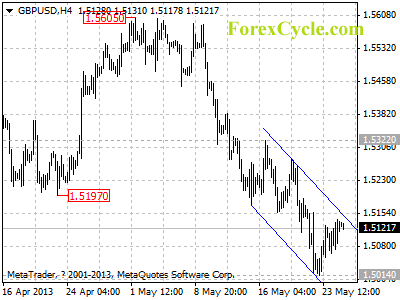
GBPUSD remains in downtrend from 1.5605, the rise from 1.5014 is treated as consolidation of the downtrend. Resistance is at the upper line of the price channel on 4-hour chart, as long as the channel resistance holds, the downtrend could be expected to resume, and another fall to 1.4900 area is still possible after consolidation. On the upside, a clear break above the channel resistance will indicate that the downward movement from 1.5605 had completed at 1.5014 already, then the following upward movement could bring price back to 1.5400 – 1.5500 area.

Forex Analysis

Monetary Policy Week in Review – May 25, 2013: One bank raises, 4 hold as markets take fright over QE tapering

By www.CentralBankNews.info
    This week five central banks took policy decisions with one bank, Ghana, raising rates while the other four (Nigeria, Japan, South Africa and Trinidad & Tobago) maintained rates as global stock markets reacted strongly to the prospect of the Federal Reserve winding down its quantitative easing.
    While Federal Reserve Chairman Ben Bernanke didn’t really say anything new to a U.S. senate committee about the timing or conditions for a withdrawal of the extraordinary stimulus, his remarks followed a spate of warnings about the growing risks of quantitative easing and the challenges facing major central banks when they enter unchartered waters and start to normalize monetary policy
    The previous week the general manager of the Bank for International Settlements (BIS) and a paper from the International Monetary Fund highlighted the risks of a prolonged period of ultra-easy monetary policy.
    Then this week the governor of South Korea’s central bank pointed to the risks from the U.S exiting quantitative easing, Canada’s banking regulator said low rates were raising the risks for banks and Canada’s finance minister warned that too much capital was “sloshing around the world” which tends to create asset bubbles, as witnessed in 2007.
    If anyone needed proof that quantitative easing is boosting shares as an asset class, it was delivered by Thursday’s 7.3 percent plunge on the Tokyo stock market in reaction to weak Chinese data and Bernanke’s comments. Ever since it became clear that Japan’s government was pushing the Bank of Japan to loosen its policy further, the stock market has been on a tear.
    But illustrating the bind that policy makers find themselves in, Federal Reserve Bank of St. Louis President James Bullard called on the European Central Bank to look to Japan and also take aggressive action, including quantitative easing, to avoid Japan’s fate of 15 years of deflation and weak economic growth.
 
    This week’s policy decisions from five central banks were largely as expected with the BOJ affirming its ambitious target for asset purchases and playing down the economic impact of the recent rise in bond yields.
    The South African Reserve Bank (SARB) once again painted a bleak picture of the country’s economic prospects but held rates steady given the upside risks to inflation from wage rounds and the fall in the rand.
    The lack of rate cuts this week was in stark contrast to a flurry of rate cuts in recent weeks in response to softer global growth, lower commodity prices and thus inflationary pressures, and the BOJ’s aggressive monetary easing that has lead to a plunge in the value of the yen and fears of capital inflows in other countries.
    Since April 1, central banks have cut policy rates 20 times for a total rate reduction of 945 basis points, almost twice the number of rate cuts in the first quarter of this year. The BOJ announced its “new phase of monetary easing” on April 4.

    Through the first 21 weeks of this year, 24 percent of 200 policy decisions by the 90 central banks followed by Central Bank News have lead to rate cuts, slightly down from 25 percent after the previous week.
    This week’s rate rise by Ghana pushed up the cumulative decline this year in global policy rates by 100 basis points to 2,151 basis points.
    It also raised the Global Monetary Policy Rate (GMPR), the average policy rate of 90 central banks, to 5.65 percent from 5.64 percent last week, but this is still well below 6.2 percent at the end of 2012.
    Most central banks keep their rates on hold from week-to-week with 72 percent of all policy decisions so far this year favouring steady rates, slightly up from 71 percent at the end of the previous week.

LAST WEEK’S (WEEK 21) MONETARY POLICY DECISIONS:

COUNTRYMSCI    NEW RATE          OLD RATE       1 YEAR AGO
NIGERIAFM12.00%12.00%12.00%
GHANA16.00%15.00%14.50%
JAPANDM0%0%0.10%
SOUTH AFRICAEM5.00%5.00%5.50%
TRINIDAD & TOBAGO2.75%2.75%3.00%

    NEXT WEEK (week 22) features nine scheduled central bank policy meetings, including Israel, Hungary, Thailand, Canada, Brazil, Fiji, Moldova, Angola and Colombia.

COUNTRYMSCI             DATE              RATE       1 YEAR AGO
ISRAELDM27-May1.50%2.50%
HUNGARYEM28-May4.75%7.00%
THAILANDEM 29-May2.75%3.00%
CANADADM 29-May1.00%1.00%
BRAZILEM 29-May7.50%8.50%
FIJI30-May0.50%0.50%
MOLDOVA30-May3.50%8.00%
ANGOLA31-May10.00%10.25%
COLOMBIAEM31-May3.25%5.25%

    www.CentralBankNews.info

Forex Weekend Update: USD Speculator bets rose to $41 Billion Last Week

Speculators boosted USD bets to $41 Billion Last Week


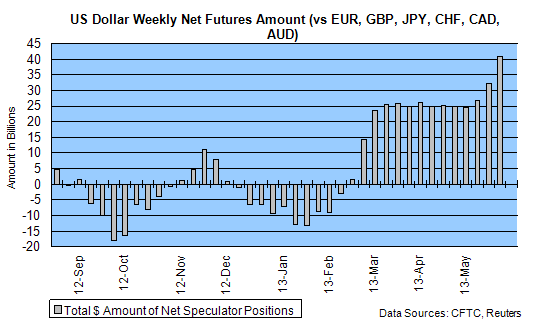
The weekly Commitments of Traders (COT) report, released on Friday by the Commodity Futures Trading Commission (CFTC), showed that large futures traders sharply extended their total bullish bets of the US dollar again last week. Total US dollar long positions have risen for three consecutive weeks and are now at the highest level since 2008 when Reuters started calculating total amount of positions, according to Reuters.

Non-commercial large futures traders, including hedge funds and large International Monetary Market speculators, increased their overall US dollar long positions to a total of $41.0 billion as of Tuesday May 21st. This was a rise from the total long position of $32.27 billion registered on May 14th, according to position calculations by Reuters that derives this total by the amount of US dollar positions against the combined positions of euro, British pound, Japanese yen, Australian dollar, Canadian dollar and the Swiss franc.

See the full COT report & charts here…


Technical Outlook: US Dollar strength slowed last week

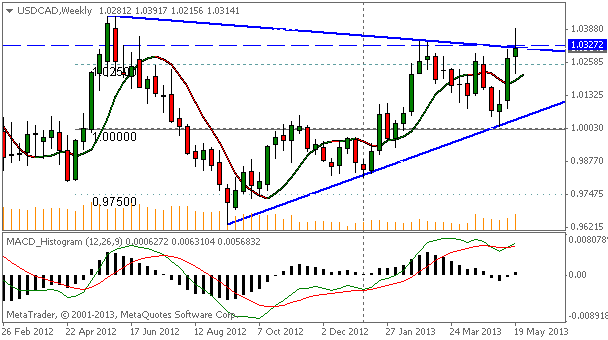
The US dollar’s strength cooled off a bit in the forex markets last week after two straight weeks of gains. The dollar continued its rise against the Australian dollar, British pound sterling and the Canadian dollar while falling against the euro, Japanese yen and the Swiss franc. The New Zealand dollar was virtually unchanged against the USD.

Looking ahead to the upcoming week, we have a shortened week as we start with a Monday holiday in both the US and the UK.

See the full Technical Currency Pairs post and charts here…


Next Week’s Economic Events Highlights:

Monday, May 27th

USA Holiday

UK Holiday

Tuesday, May 28th

United States — consumer confidence
euro zone — German retail sales
China — leading index
Switzerland — trade balance

Wednesday, May 29

Japan — BOJ speech
euro zone — German employment data
euro zone — German consumer price index
Canada — Bank of Canada interest rate decision

Thursday, May 30

United States — GDP first quarter
United States — personal consumption
United States — weekly jobless claims
United States — pending home sales
Japan — national consumer price index
Switzerland — GDP report

Friday, May 31

China — manufacturing PMI
euro zone — consumer price index
Canada — GDP report
United States — personal consumption expenditure
United States — University of Michigan confidence survey

See our full economic calendar for more events.


Big Dividends From Across the Pond

By Investment U

[embed_weekily_video]

Barron’s ran an article last week about three of the grandfathers of the tech industry: Cisco Systems (Nasdaq: CSCO), Intel (Nasdaq: INTC) and Microsoft (Nasdaq: MSFT). Investors are making big bets that these old timers will evolve into effective data and services companies.

Cisco was the clear pick over the other two. Even though Microsoft and Intel have done well for the past year – up 21% and 10%, respectively – Cisco has blown away their numbers and has delivered 11 consecutive quarters of meeting or beating estimates.

It has doubled its dividend yield and has reset its growth expectations – both moves have been very well received by investors.

Cisco’s lack of competition from its chief competitors has allowed the company to increase its market share and, despite the run-up in price this year, the stock has a forward P/E of just 11.5.

The CEO said in the Barron’s article that the Street was wrong to bet against the company. When things get tough, he said, Cisco is the best.

This could be a rare opportunity to get onboard a tech play that is not a small or mid cap, offers the stability of a large established company, has increasing earnings and revenues and is trending upward.

The evolution of the big, old, tech companies is something you have to be a part of. Take a look at Cisco.

Across the Pond for Big Dividends

For the past 15 years, regulators in the European Union who control pricing for Internet and wireless have focused on competition instead of pricing.

The result has been very inexpensive service, over 50 providers, and very little investment in wireless, Internet technology or infrastructure. Europe, as you can imagine, is well behind the United States in implementation of 4G and fiber optics.

All that is about to change, and four big names – France Telecom (NYSE: FTE), Telecom Italia (NYSE: TI), Telefonica (NYSE: TEF) and Deutsche Telekom (OTC: DTEGY) – will be the winners.

Currently, smaller providers rent space on the networks of the four big providers. But regulators, in an effort to spur infrastructure investment, are about to raise those rents and allow the majors to raise their rates, too.

Neelie Kroes, the EU’s digital commissioner, also wants a single telecom market for the whole EU, which should allow for cheaper service between countries and encourage consolidation. Essentially, the EU system will end up being more like the American system, with two major providers.

The big four could see market values run up from 20% to 75%, but the big winner will be Deutsche Telekom.

The company already has a supportive regulatory environment that will allow it to thrive no matter what the EU does. It has won concessions from regulators for rate increases with inexpensive improvements to its system. It also owns 75% of T-Mobile, sports a 5.4% dividend and, despite a big move this year, has a P/E of just 13.

Telefonica and Telecom Italia have debt and dividend issues, and France Telecom is essentially a jobs and revenue provider, not a for-profit enterprise.

It looks like Deutsche could be the dominant player and the one to watch.

The “Slap in the Face” Award: The College Rip-off

This week, our award goes to all the new college grads out there, who have been scammed by the incredibly high cost of colleges and universities.

The average grad is $30,000 to $40,000 in debt and paid three times as much for their education as it cost just 25 years ago.

In the words of my father to my mother, where the heck is all the money going? This is nuts!

Private colleges in 1983 cost $11,000 a year in today’s money. Today they are $29,000.

Even state schools, which were a bargain when I was in school in the early ‘70s, are four times as expensive in today’s dollars. They average as much a year now as a four-year degree cost in 1983.

And these numbers do not include the extras: room, board, spending money, books, beer, transportation… you know the drill.

The result is 17% of student loans are 90 days late, or more. And 44% haven’t made the first payment.

This might be the biggest rip-off in our history. Where the heck is all the money going? This is truly a big slap in the next generation’s face.

Article By Investment U

Original Article: Big Dividends From Across the Pond

The Renaming of a Generation

By MoneyMorning.com.au

Those born between 1946 and 1961 had their birth certificate stamped ‘Baby Boomer’. The inscription on their death certificate will read ‘Retiree Buster’.

Boomers (of which I am one) have had a relatively charmed life – carefree youth; low cost tertiary education; fuel was cheap; abundant employment opportunities – the future was rosy. The world was the boomers’ oyster.

We were too busy acquiring ‘things’ to realise our collective ‘wants and desires’ were reshaping the global economy. Conspicuous consumption (funded by never-ending credit) became an art form. Luxury brands -retail, motor vehicles, restaurants, housing – blossomed.

Our standard of living is a world away from the one our frugal parents grew up in. Moderation was not in our vocabulary. Therein lay the seeds of the trouble that awaits the indulgent boomers. ‘Austerity and boomers’ are as compatible as ‘salt and ice cream’.

The first wave of boomers has started to retire. The transition from taxpayer to tax receiver has begun, and will gather momentum over the next twenty years.

The predicted longevity of the boomer generations is bad news for tomorrow’s workforce.

The three major issues arising from this demographic shift are:

  1. How do (seriously indebted) western governments fund mounting health and welfare costs without overburdening Gen X,Y & Z?
  2. How does the global economy survive without boomer credit fuelled consumption?
  3. How do boomers avoid outliving their capital?

In 1910, the Commonwealth Government entered into a social contract with the citizens of Australia. The age pension was payable to females over 60 and males over 65. Lower life expectancies meant honouring this contract was a modest impost on the taxpayers of the day.

The pyramid structure of society allowed the base to easily support the apex.

Pyramid (Ponzi) structures only survive if the base keeps expanding. Social security is the ultimate Ponzi scheme. Unless the ruling class makes the tough decisions necessary to re-weight this scheme, boomers are going to be the victims of its collapse

The solution to the problem is relatively straightforward – pay more taxes or pay fewer entitlements. A workforce needs to be incentivised. Higher taxes (like those proposed by French President Hollande) cripple incentive. The ‘best and brightest’ take flight to a more tax friendly country. Only so much ‘blood’ can be extracted from the workers.

The sensible resolution is to ‘cut your coat according to your cloth’. Entitlements need to be pared to a level that can be funded from a fair tax regime. This means the social contract entered into a century ago is obsolete.

Making this call is a political death warrant – baby boomer voters would make sure of that.

The answer to issue 1 is that Governments cannot whip future taxpayers to death to fund promises made over a century ago. If something can’t continue, then it won’t. In the absence of a brave politician, it is safe to say the welfare system will implode sometime within the next decade or two.

The Great Credit Contraction is the answer to issue 2. The global economy, so heavily weighted to consumption, cannot continue without consumers willingly living beyond their means. Governments desperate for boom time tax revenues have instructed central bankers to ‘stimulate’ demand. Zero-bound interest rates, unlimited QE, Everest sized public debt piles and never-ending budget deficits are all designed to ‘grow’ an economy.

Economic ‘growth’ as measured by GDP is a falsehood. Deduct government (federal, state and local) deficit spending (future taxpayer liability) and GDP would be massively in the red. The underlying economy is shrinking. The complete disregard for economic fundamentals is one thing. However, the burden being placed on the wallets of future taxpayers is obscene. It is a desperate attempt to hold together the remaining vestiges of the boomers’ spending spree.

The central bankers actions have lead to the greatest level of malinvestment in history.

The current market euphoria is the last hurrah of the boom time era. This artificially inflated asset bubble is destined for the same fate as all preceding bubbles.

The answer to issue 3 depends on whether boomers recognize in time how vulnerable their paper profits are to the claws of the worst bear market since The Great Depression.

Our role, indeed responsibility, is to manage risk and reward over the long term. At present the share market is being driven by central banker momentum – this is a high risk and very low reward strategy.

A retirement strategy based on:

  1. The age pension and health care entitlements continuing unchanged
  2. The global economy resuming ‘credit bubble’ growth rates

            and

  1. Markets delivering above average returns to fund a comfortable standard of living

is a high stakes game of Russian Roulette with your future.

The few boomers who survive the coming Secular Bear mauling will not only survive, they will prosper. Your Gen Y & Z children will thank you profusely for your foresight.

‘Retiree Buster ‘ or ‘Retiree Boomer’ – choose your title before the Secular BearMarket selects it for you.

Vern Gowdie
Contributing Editor, Money Weekend

Join Money Morning on Google+

From the Archives…

The Foundations for the Great Lie We Have Built Our Lives Upon
17-05-2013 – Vern Gowdie

How the Aussie Dollar is Running Out of Friends, Fast
16-05-2013 – Murray Dawes

STOP PRESS…Resource Stocks Pay Dividends Too
15-05-2013 – Dr Alex Cowie

‘Best Week in Four Years’: Resource Stocks are Starting to Move…
14-05-2013 – Dr Alex Cowie

Why You Won’t See Me on ABC or CNBC Discussing Financial Markets…
13-05-2013 – Kris Sayce

Money Weekend’s FutureWatch: 25 May 2013

By MoneyMorning.com.au

Health: New Brain Tech to Keep Athletes Safe

Companies that use technology to make people safer are good for the world. And one industry where safety is paramount is professional sports.

In general most people love some kind of sport. For some it’s football. And when watching a gladiatorial game of football there’s not much better than a bone crunching tackle or high flying display of athleticism.

But sometimes the repercussion of players putting their bodies on the line is severe. It frequently has short term effect on their health. But the long term effects are now also starting to be recognised.

One of the serious long term effects contact sports have on players is mental illness. This is a direct result of Sports Brain Injuries (SBI). Multiple concussions over a prolonged period are a main cause of long term mental illness in ex-players.

In the NFL (American Football) ground-breaking research is underway into the effect of multiple concussions on players over time. The NFL has admitted there is an overly high risk of concussion and long term mental illness in their game. This reached boiling point early April with over 4,000 past players suing the NFL for their part in allegedly hiding the consequences of concussion injuries.

For one pioneering company technology is the answer to preventing SBI. Their aim is to ensure the protection and safety of all contact sports players.

The company is called X2 Biosystems. Their field of expertise, SBI analysis of athletes. X2 has two main technologies, the xGuard and xPatch. The xGuard is a mouthguard and the xPatch is an adhesive sensor placed behind the ear. Both contain lots of sensors, microchips, gyroscopes and accelerometers.


Source: X2 Biosystems

During the course of a game, players will make contact with each other. As impact occurs it triggers the sensors in X2′s devices. This creates a large range of data which the doctor will use to diagnose a concussion.

It’s a much clearer data driven approach to diagnosing on field concussions, rather than some of the more subjective testing that occurs today.

We wouldn’t be surprised if every major football code across the world ended up using X2′s devices with players.

Next season the NFL will use X2′s devices across the league. And it will be only a matter of time before AFL teams here in Australia start to look at this tech and roll it out across all levels of competition.

ENERGY: Tesla’s Arrow is Avisio’s Reality

Nikola Tesla was a wizard of his time. He was an early pioneer of electricity and invention. He’s widely recognised for his great showmanship and mind blowing inventions.

One of his more ‘out-there’ inventions was his version of an electric car. But it’s a mysterious story. The tale is Tesla took a Pierce-Arrow car, removed the gasoline engine and put in his own ‘black box’ electric engine.

This is where it gets really interesting. Tesla’s electric engine needed no charging. It simply used free electrical energy to power the vehicle and make it run. It created its own power as it moved.

Allegedly the car reached a speed of 90 mph and Tesla drove it over 50 miles without incident. No one has ever seen the vehicle since, nor found any further record of its existence. The mysterious nature of its construction and the secrecy Tesla had over it means no one is really even sure if Tesla’s invention was even real.

However we’re not in 1931 anymore. And there is a genius engineer named Ismael Avisio who has devised a modern version of Tesla’s electric car. This breakthrough has given some legitimacy to Tesla’s genius over 80 years ago.

Avisio’s car has an electric motor that generates more energy than it uses. The car is equipped with an antenna that catches energy signals from invisible radiofrequency. Using this radiofrequency it generates power for the car.

And this isn’t another snake oil tale. The Philippine Department of Energy has independently validated Avisio’s technology.

In short, Avisio has made an electric car that never needs charging, and in theory will never run out of charge. It’s the most cutting edge breakthrough since Tesla’s Arrow.

TECHNOLOGY: If You Make TV Remotes for a Living, Find a New Job

It’d be remiss of us not to mention the serious heat that’s building between two of the biggest tech giants, Microsoft and Sony.

It’s a genuine battle for control of your living room. No doubt Apple will saunter into this battle later this year, but for now the two key devices are the Xbox One, and the PlayStation 4.

Some might suggest these are just the two new gaming consoles from Microsoft and Sony. But they’d be wrong. Sure you can play games on the new devices, but that’s not the target here.

The holy grail for these companies is having full control of your TV; what you watch, how you watch it and the user experience of it all.

That’s why the newly launched Xbox One is being touted as the all-in-one entertainment experience.


Source: xbox.com

Say goodbye to your remote control. With Xbox One you simply talk to it and use hand movements to control the box. The whole entertainment experience literally has you as the control.

Want to start it up? Say, ‘Xbox on.’ Not only does it start up, it recognises your voice and opens to a home page with your own preferences.

Want to watch a TV channel? Say ‘Watch MTV.’ And instantaneously the box will switch to MTV. Want to see what’s on later in the day? Just ask to see the guide. Want to play a game? Just ask. It’s as seamless and interactive experience as we’ve ever seen with a media hub.

One step further is the full integration of Skype (now it makes sense why Microsoft bought Skype for $8.5 billion). So if you want to watch a footy game with your mates around the world, no problem. Skype them in and you can sledge each other in real time.

Sony is yet to release the PlayStation 4, but will do so in about 3 weeks. Microsoft has set the bar extremely high, so we wait in anticipation as to how Sony’s going to top this. Microsoft has significantly more to lose, with the Xbox platform making up over 20% of total revenue. And they’ve certainly done their best to make sure this One’s a winner.

Sam Volkering

Join Money Morning on Google+

Technology Analyst, Money Weekend

Ed Note: Sam Volkering is assistant editor and analyst for a new breakthrough technology investment service to be launched by Money Morning editor Kris Sayce. The breakthrough technology service will introduce cutting edge investment ideas from the technologies of the future, including medicine, science, energy, mining, and more.

From the Archives…

The Foundations for the Great Lie We Have Built Our Lives Upon
17-05-2013 – Vern Gowdie

How the Aussie Dollar is Running Out of Friends, Fast
16-05-2013 – Murray Dawes

STOP PRESS…Resource Stocks Pay Dividends Too
15-05-2013 – Dr Alex Cowie

‘Best Week in Four Years’: Resource Stocks are Starting to Move…
14-05-2013 – Dr Alex Cowie

Why You Won’t See Me on ABC or CNBC Discussing Financial Markets…
13-05-2013 – Kris Sayce

Gambit in Japan Equals Market Blitz

By MoneyMorning.com.au

Zugzwang describes a dilemma when any move you make puts you in a weaker position. It’s a German word but the idea is taken from the game of chess.

In chess, there’s no random element. There are eight ranks and eight files with pieces that obey fixed laws. Not so in markets today, where central bank intervention is so heavy we doubt any one price is where it should be.

Investors probably feel a whole lotta zugzwang right now. If you can’t trust any price signals, which asset do you trust? Doesn’t any move feel like you’re opening up a weak flank?

This is especially true for the country that dominated discussion in our Albert Park headquarters this week: Japan.

So it’s the task of today’s Money Weekend is to explore what it means for Aussie investors….

It’s All About Japan

In case you’ve missed it, the Japanese stock market has been on a tear for about six months.
It’s up around 75% in a year – that’s a pretty astounding run for a major index. This has all been under the watch of Shinzo Abe in his second innings as Japan’s PM. Check him out below.

Can you imagine it? All Abe has really done is stick a puppet in the central bank and told him to run the printing press to the tune of $75 billion every month. 

Hence the Japanese yen has collapsed 25% against the US dollar. 

Granted, one argument for this is it might help Japan’s struggling exporters. As far as we can tell all it’s done is drive up the cost of Japan’s essential imports. You know, things like food and fuel.

Check this out from the Financial Times:

‘Japan’s trade deficit widened in April as the boost to exporters from a weaker yen was outweighed by rising prices for imports. Preliminary figures from the finance ministry on Wednesday showed that Japan posted a deficit of Y879bn ($8.6bn) in its trade balance last month, almost 70 per cent wider than a year earlier, as rising shipments of cars and iron and steel products were offset by much higher bills for fuel, food, clothing and semiconductors.’

That’s a real bummer for your average salaryman in Tokyo. Net result of currency depreciation: a rising cost of living and lower quality of life.

But, as mentioned, one thing the Japanese money printing has done is light the fire under the Japanese stock market, as you can see in the chart below (the black line) alongside the Australian market (red line). 


Source: StockCharts

This matters for Australian investors because both stock markets are moving so close together. A chart like this backs up Kris Sayce’s argument over at ASI that the fundamentals under stocks (the economy, earnings) matter less than the ‘torrent’  of central bank money flooding into the market and driving up asset prices.  

You’ll notice on the chart that the Japanese stock market dropped like a stone on Thursday. It was a pretty savage break. In the end it was 7.5% down. Murray Dawes over at Slipstream Trader says he’s never seen a market move like that on the day.

But does this signal anything more than a correction?

We don’t know.

If you asked Murray he’d suggest the Japanese markets – currency, stock and bond – are the three most important markets to watch right now. They also happen to be some of the biggest in the world.

That’s why Murray expects Japanese fireworks to play out in Australia fairly soon. He sees the risk to the downside. But traders like him have the flexibility to move in and out, both long and short, taking advantage of the volatility .

Mispriced Market Mayhem

The orthodox bear position would be to say the central bank has inflated Japanese stocks. But you could say that about American stocks too, and they’ve rallied and held up since 2009. Why can’t Japan’s stock market motor along for a similar period of time? Who knows how long all this can go on?

Fiscally, Japan is the second largest external creditor in the world. It also happens to have a monstrous internal debt. Presumably those scales can balance for a while longer. 

Share markets as a rule of thumb don’t like rising interest rates. One thing we know for sure iscentral banks will do everything to keep interest rates at an artificially low level.
This makes stocks look more attractive. They look even more attractive when you consider that central banks have made it clear they prefer the ‘wealth effect’ of higher stock prices. In fact, you could make a case that they have removed the equity risk premium from the market with an implied backstop.

This makes stocks look more attractive. They look even more attractive when you consider that central banks have made it clear they prefer the ‘wealth effect’ of higher stock prices. In fact, you could make a case that they have removed the equity risk premium from the market with an implied backstop. 

Does this make the long term case for stocks as less risky than in a pure free market? You could certainly argue it – until the bubble bursts.

Since we have no way of knowing when that day of infamy could come, sitting on the sidelines as currencies depreciate, or holding only a pile of gold, doesn’t sound a great wealth building strategy either. 

We agree with the note Kris sent us: ‘If you want any chance of making money from this craziness you have to take part in it, but protect yourself knowing it could end at any moment.

Callum Newman+
Editor, Money Weekend


Join Money Morning on Google+

PS. Don’t forget if you want to keep track of the latest things we’re reading and brief commentary on events that happen through the day, check out our Google+ page and Kris Sayce’s as well.

From the Port Phillip Publishing Library

Special Report: How to Buy Better Stocks

Daily Reckoning: More Background Noise From Ben Bernanke

Money Morning: The Day Japan and China Shook the Aussie Market

Pursuit of Happiness: Fight the Tax Man, Invest in Dividend Paying Stocks

Trinidad & Tobago holds rate, growth weak, inflation down

By www.CentralBankNews.info    The Central Bank of Trinidad and Tobago held its benchmark repo rate steady at 2.75 percent, saying its accommodative policy stance was appropriate in light of contained price pressures and economic growth that remains weaker than expected.
    The central bank, which cut rates by 25 basis points in 2012, said private sector credit growth remained subdued but the financial system was highly liquid and it “stands ready to employ additional measures in the coming months to contain excessive build-ups in financial system liquidity.”
    In response to the large build-up of liquidity – commercial banks’ daily excess reserves at the central bank averaged $6.5 billion during May 1-21, up from $5.3 billion in April – the central bank facilitated the issue of a $1 billion liquidity absorption bond. With the proceeds sterilized, excess reserves fell to $5.8 billion on May 21 from over $7 billion earlier in the month.
    In addition, the central bank sold foreign currency, removing $637 million from the system and rolled over a $1 billion fixed deposit held by commercial banks at the central bank.
    “Nevertheless, with liquidity still at elevated levels, there was no activity on the inter-bank market and banks did not access the central bank’s repo facility,” the bank said.
    Given the high levels of liquidity, treasury rates have remained depressed and banks lowered their lending rates early this year to encourage credit demand.
    Headline inflation rose by 1.5 percent in April from March, but on an annual basis, the inflation rate fell to 5.5 percent from 6.9 percent.
    For the first time since October 2011, food price inflation slowed to single digits, reaching 9.4 percent in April, down from 26.2 percent in April 2012 and 15.0 percent in April 2011.
    “The recent slowdown in headline inflation and the continued stability in core inflation suggest that general price pressures are contained, although food price pressures may increase in coming months with the advent of the rainy season,” the central bank said, adding that “economic growth is still not as strong as expected, underlined by the further contraction in business credit.
    On an annual basis private sector credit granted by the financial system grew by 2.0 percent in March, down marginally from 2.1 percent in February while business lending contracted for the fourth consecutive month, down by 2.4 percent year-on-year in March.
    Trinidad & Tobago’s Gross Domestic Product contracted by an annual 0.39 percent in the fourth quarter of 2012 and earlier this month the central bank said in its monetary policy report that it was still forecasting 2.5 percent growth this year, up from 0.2 percent in 2012, based on a rebound in natural gas production.

    www.CentralBankNews.info

Chinese and German Manufacturing Now Both Contracting

Chinese-and -GermanA recession for the global economy is becoming an increasingly likely scenario.

The Chinese economy, the second-biggest in the world, witnessed a contraction in manufacturing in May. The HSBC Flash China Manufacturing Purchasing Managers’ Index (PMI) registered 49.6 for May, declining from 50.4 in April. (Source: Markit, May 23, 2013.) Any number below 50 represents contraction in the manufacturing sector.

 The Chinese economy exports a significant amount of what it produces to the global economy. Contraction in Chinese manufacturing shows exports are falling—the global demand for goods is falling.

Similarly, Germany’s Flash Manufacturing PMI showed continuous contraction in the manufacturing sector. The index stood at 49.0 in May. (Source: Markit, May 23, 2013.) The German economy is important to observe, because it’s the largest economy in the eurozone and an economic slowdown in the nation can send the common currency region into another downward spiral, again affecting the global economy.

Looking at other key indicators, they are pointing to an economic slowdown ahead in the global economy. Consider the copper market. Demand for copper is suggesting activity in the global economy is sluggish, even deteriorating.

Copper prices are down more than 10% since the beginning of 2013, and stockpiles of the brown metal, tracked by the London Metals Exchange (LME), are up a staggering 95% this year! (Source: Bloomberg, May 23, 2013.)

Other industrial metal prices, such as aluminum, lead, nickel, and zinc, are in decline as well.

How can the U.S. economy possibly improve when the global economy is in trouble?

The U.S. is highly affected by any shift in demand in the global economy.

After the financial crisis of 2008, U.S.-based companies were able to show growth because of robust demand in the global economy. Some say the growth in the global economy pulled the U.S. out of recession in 2008.

Now, the economic indicators clearly point to diminishing global demand. Will U.S.-based multinational companies be able to show profit growth under the scenario of global manufacturing contraction? Of course not! (Someone tell stock market investors!)

During the first-quarter earnings reporting season, some of the biggest big-cap companies in the key American stock indices displayed concerns regarding the crisis in the eurozone. I expect more companies to start blaming the economic slowdown in the global economy as they report lower second-quarter corporate earnings.

Michael’s Personal Notes:

As I have been writing in these pages, economic growth in the U.S. economy won’t happen by printing more paper money—it’s a short-term fix that creates more long-term problems.

According to data compiled by Bloomberg, 2,267 non-financial constituents of the Russell 3000 index saw their cash holdings increase by 13% to $1.73 trillion in the first quarter of 2013 compared to the same period a year earlier. (Source: Bloomberg, May 23, 2013.)

As the cash hoard continues, business spending declined 21% in the first quarter compared to the last quarter of 2012. This was the biggest decline since the financial crisis of 2008.

To top this off, business executives in the U.S. economy are worried about troubles in the global economy, and they don’t have a very optimistic view on conditions here at home. A CEO Confidence Survey conducted by the Conference Board suggests only 29% of executives believe conditions in their industries have improved in the first quarter; going forward, only 32% expect the U.S. economy to improve in the next six months. (Source: Conference Board, April 25, 2013.)

Looking at all of this, how can you not question the effectiveness of quantitative easing in the U.S. economy? The problem at hand is businesses shying away from spending in the U.S. economy and hoarding cash. To my standards, quantitative easing is failing at making businesses more confident about spending as it was promised.

Dear reader, for economic growth to take place in the U.S. economy, businesses must be willing to spend and make investments; we are seeing the opposite of that. This isn’t rocket science; once businesses start to spend and make investments, we will see recovery in the jobs market and economic growth will eventually follow.

The U.S. economy is at a vulnerable stage. I am paying extra attention to business spending because troubles from outside the U.S. economy are brewing quickly, and as a result, multinational businesses may make further cutbacks on their spending.

Where the Market Stands; Where It’s Headed:

We are putting the finishing touches on “A Dire Warning for Stock Market Investors,” a forecast we will present in video format. Please see your e-mail inbox tomorrow for this presentation. It’s important you watch it to see where the stock market is really headed next.

What He Said:

“As for the stock market, it continues along its merry way oblivious to what is happening to homebuyers’ wealth. (Since 2005 I have been writing about how the real estate bust would be bigger than the boom.) In 1927, the real estate market crashed and the stock market, even back then, carried along its merry way for two more years until it eventually crashed. History has a way of repeating itself.” Michael Lombardi in Profit Confidential, November 21, 2007. This was a dire prediction that came true.

Article by profitconfidential.com