The Secret Behind 12% of Ohio’s Oil Production

By Investment U

A Forbes 2011 cover story described him as “America’s Most Reckless Billionaire.” Conversely, former Houston mayor Bill White spoke of him as being “at the forefront of those heroes” of America’s natural gas exploration companies.

During his tenure, his company bought land in the nation’s largest shale gas plays. But this controversial CEO was hot on one shale gas play in particular. When he spoke of it, he compared it to the Eagle Ford in Texas and the Bakken in North Dakota.

“It’s the biggest thing to hit [this state] since the plow,” he said of the play a couple of years ago.

At the time, his company had leases on 1.3 million acres in this shale play. He claimed the stake held $20 billion of hydrocarbons. And projections showed the shale play held as much as $500 billion worth of oil.

Regardless of his stormy reign as CEO of Chesapeake Energy Corporation (NYSE:CHK), Aubrey McClendon made some great calls regarding natural gas.

But I’m not here to talk about Chesapeake. I’m here to introduce you to the proverbial sweet spot of this shale play. Few folks have any idea what’s going on… or how lucrative this opportunity could be.

The Secret Is Out

Texas is usually the first state an investor thinks of when it comes to oil production. But these days it’s all about shale plays in Ohio. It’s the region’s Utica formation that McClendon was so excited about.
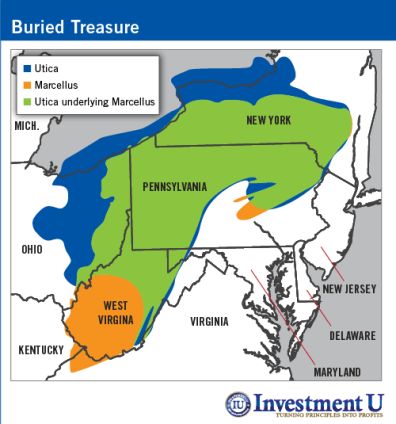
The Utica lies directly under the Marcellus formation throughout much of its region. But it comes closest to the surface in eastern Ohio.

After several years of secretive test drilling, the reality of the Utica is finally surfacing. In an article in Bloomberg, Argus Research analyst Philip Weiss had this to say about early Utica drilling data: “The results were somewhat disappointing. It’s not as good as we thought it was going to be.”

The acreage-buying boom has turned into an acreage-selling boom.

Wood Mackenzie analyst Jonathan Garrett has also studied the Utica. In the same Bloomberg article, he added his comments on the Utica: “People started to realize that, you know what, maybe the oil window of the play is not all it’s cracked up to be.”

The big problem isn’t that the Utica doesn’t contain the hydrocarbon riches once envisioned. In many cases, the rock formation is too dense. In other areas, there are insufficient underground pressures to allow the oil to flow.

Still, 11 companies are actively drilling in the Utica Shale.

What do they know that the analysts mentioned in the Bloomberg article don’t? A lot more than they’re willing to admit.

Take a look at the map below…
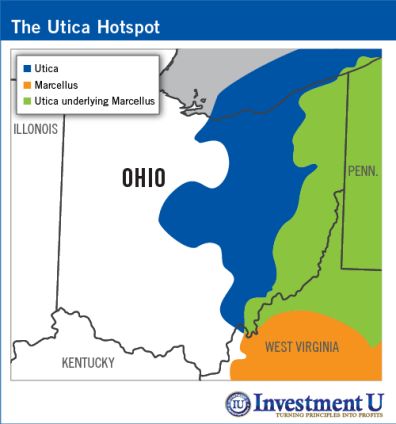
The area where the Utica begins to emerge from under the Marcellus formation represents the liquids-rich sweet spot of the Utica. That’s where most of the drilling took place in 2012. According to the Ohio Department of Natural Resources (ODNR), there were 87 producing wells drilled in the Utica Shale last year.

Hitting the Sweet Spot

Those wells produced 636,000 barrels of oil and 12.8 billion cubic feet of natural gas. And not one of the wells was in production for the entire year.

Of the 87 wells drilled, 76 produced oil and 63 are in commercial production.

But here is the figure that is turning heads…

Those 63 horizontal wells accounted for 12% of all the oil produced in Ohio in 2012. That’s a huge amount of oil from just 63 wells, especially considering the state has more than 60,000 conventional (vertical) operating oil wells.

Clearly, something big is going on in the Utica.

The numbers are fresh, which makes investing in the Utica formation riskier than buying into proven shale plays. But that’s what makes the opportunity so exciting. We’re witnessing the birth of what could be a huge moneymaker.

If this hotspot continues to pump out big numbers… somebody is going to get rich.

Good investing,
Dave

Article By Investment U

Original Article: The Secret Behind 12% of Ohio’s Oil Production

West African States keeps rate, growth trending up

By www.CentralBankNews.info     The Central Bank of West African States (BCEAO) held its benchmark marginal lending rate steady at 3.75 percent, saying inflation remains moderate and economic growth is continuing its upward trend toward this year’s target of 6.5 percent in the eight-nation West African Monetary Union (WAMU).
    The central bank’s monetary policy committee, which met in Dakar on June 3, said in a statement that inflation eased to 2.3 percent at the end of April from 2.8 percent end-December due to a sharp drop in the price of local food and a small rise in petroleum product prices.
    “The medium-term outlook remains consistent with the objective of price stability in the EU. At the 24-month horizon, the inflation rate would be at 2.5% yoy,” the central bank said.
   Interest rates in the money market have also eased, with the weighted average call rate on liquidity offers for one-week down to 2.81 percent in April from 3.07 percent in December.
    Economic growth last year was better than expected, the central bank said, with Gross Domestic Product volume expanding by 6.4 percent due to higher public investment, with spillover effects on private investment, and dynamic activity in the extraction industry.
    To strengthen growth, the central bank urged members of the union to increase investment in agriculture and basic infrastructure along with maintaining economic stability.
    At its previous meeting in March, when BCEAO cut its rate by 25 basis points, the central bank also forecast growth of 6.5 percent this year.
    In April, BCEAO Governor Tiemoko Meyliet Kone told Reuters that he expected growth of 7 percent in 2014.
    Growth has strengthened due to a recovery in the Ivory Coast and strong commodities demand from emerging economies such as China and India, help the currency bloc shrug off effects of the slowdown in Europe.
    BCEAO comprises the central banks of Benin, Burkina Faso, Ivory Coast, Mali, Niger, Senegal, Togo and Guinea-Bissau.

    www.CentralBankNews.info

The Worst Is Yet to Come

By Investment U

For months, I’ve forecasted that interest rates would rise and, consequently, bond prices would fall. Now it’s happening…

In May, the Barclay’s U.S. Aggregate Bond Index – one of the most widely watched benchmarks for the fixed-income market – fell 1.62%. But many investors fared far worse.

For instance, the $292.9 billion Pimco Total Return Fund, the world’s largest bond fund, fell 2%. And many leveraged fixed-income funds got hammered.

Take the Nuveen Insured Municipal Opportunity Fund (NYSE: NIO), for instance. This leveraged tax-free bond fund is an excellent vehicle in a rising bond market. The majority of its holdings are AAA-rated and insured… yet this is the last sort of thing you want to hold in a bond market rout.

From a high of over $16 just four months ago, the fund has plunged to just over $14, a 13% drop. And that’s just with a tiny jump in interest rates. Wait until rates start moving up in earnest.

That’s when things will really get interesting.

“Expert” Opinions

The bond market reversal took many so-called experts by surprise. Bill Gross, the manager of the Pimco Total Return Fund, is still heavily invested in Treasurys, which are highly sensitive to rising rates.

Another pundit on the wrong side of the bond market is Nobel laureate and New York Times columnist Paul Krugman, who has made a career of atrocious calls. (You need only go back and read his books over the last two decades.)

If you need a reason to believe interest rates are headed higher, just listen to Krugman’s smug assurance that it won’t happen.

After all, this is the same man who believes a) the federal government is far too frugal (I’m not kidding) and b) demanded in 2009 that Uncle Sam nationalize the money-center banks. Not only was it unnecessary, his plan would have wiped out shareholders entirely.

Fed’s Folly

So why should you expect interest rates to rise and bond markets to sell off further?

It’s not because the dollar is weak. Indeed, the dollar is in an uptrend and rose 2.5% in the last month.

And it’s not due to inflation. Wages are stagnant. Commodity prices are falling. And traditional inflation hedges like gold and Treasury Inflation-Protected Securities are dropping.

No, it’s much simpler than that.

It’s because Bernanke & Co. have been not only following a zero-interest-rate policy on the short end, but holding longer-term interest rates down with a massive bond buying program meant to stimulate the economy, revive the housing market and strengthen the banks.

The Fed has not said when it will end its quantitative easing program. But the market has gotten a whiff that it’s a matter of time, which was enough to send fixed-income investors to the exits.

What should you do as an investor?

Reduce your investment-grade bond holdings to just 10% of your asset allocation. Stick with short-term, high-grade corporate bonds, low-cost, short-term fixed-income funds, and defined-maturity ETFs.

The 30+-year bull market in bonds is over. And the worst is yet to come…

Good investing,

Alex

Article By Investment U

Original Article: The Worst Is Yet to Come

What’s Next for the Chinese Renminbi…and What Does it Mean for Investors

By The Sizemore Letter

If you are to believe U.S. politicians and talk radio hosts, China’s renminbi is managed by a sinister cabal of James Bond villains who intentionally suppress the value of the currency to give their manufacturers an advantage and to hollow-out U.S. manufacturing.

 US Dollar – Chinese Renminbi Exchange Rate

While that view of China’s ruling Communist Party isn’t completely fantastical, the truth is a little more complicated. When China’s leaders decided in the 1980s that “to get rich is glorious,” they decided that a weak currency was a convenient way to make that happen.  From a value of 1.50 yuan per dollar in 1980, the renminbi fell to nearly 9 yuan per dollar before China instituted a peg at 8.27.  The renminbi was pegged at that level from 1997 until 2005, when—pressured by the United States and other trading partners—China opted for a managed float that would allow for a gradual rise.

The precise rules that control the float have changed multiple times as China has become more lenient, and currently the price of the renminbi is allowed to fluctuate within a daily 1% band against a basket of major world currencies.

(Note: I’m often asked why China’s currency has two names: the renminbi and the yuan.  “Renminbi” is the currency’s official name.  “Yuan” is a unit of renminbi.  The price you see quoted in a Chinese store would be, say, 5 yuan.  You would never see a price quoted as 5 renminbi.  This is not too different than the British pound sterling.  “Pound sterling” is the currency’s name, but prices in the UK are quoted in pounds, not sterling.)

As a country with a massive export economy and the largest current account surplus in the world—$214 billion as of 2012—China’s currency should naturally appreciate in value due to market forces (all else equal, a large trade surplus leads to a rising currency as it, in effect, involves selling the currency of the importing country to buy the currency of the exporting country).

And indeed, the renminbi has been gaining on the dollar since it was de-pegged.

Not entirely coincidentally, China has also become less competitive as a manufacturer.  In fact, just this week one of China’s leading shoemakers moved part of its manufacturing base to Africa to take advantage of the lower costs!

The rising value of China’s currency is certainly part of the reason for China’s loss of competitiveness.  A bigger issue—and one for which there is no easy solution—is the rising cost of Chinese labor, which is growing at a double-digit clip.

China’s manufacturing model assumes an inexhaustible supply of cheap migrant labor from the countryside.  But after 30 years of growth—and over 30 years of the One Child Policy—the pool of labor is simply no longer there to exploit.  This means that China will have to invest more in capital in order to boost competitiveness…or simply massively devalue its currency again.

There is a big problem with that second option.  China’s leaders are already worried about inflation, and they are reluctant to do anything that will fan those flames.  And China’s middle classes—which become more assertive every day—are less likely to tolerate high inflation or higher prices for imported goods.

If the Chinese Communist Party wants to keep its grip on power, it has to keep its restive masses happy.  And this means that any devaluation of the renminbi will be gradual, if it happens at all.

What does any of this mean for investors?

If you are going to invest in China, invest in companies that benefit from rising living standards among Chinese workers.  Go for consumer goods and services rather than industrial companies and exporters.

China Mobile ($CHL) is a fine example. China Mobile is the largest mobile phone operator in the world by subscribers, and as Chinese consumers trade up from feature phones to smart phones, the company is well positioned to benefit.  It also trades for just 10 times earnings and yields 4% in dividends.

China will eventually “blow up,” as its aging demographics and persistent asset bubbles virtually guarantee a Japanese-style malaise.  But in the meantime, there is still money to be made investing in the Chinese consumer.

Sizemore Capital is long CHL. This article first appeared on InvestorPlace.

SUBSCRIBE to Sizemore Insights via e-mail today.


Poland says weak euro area could dent growth further

By www.CentralBankNews.info     Poland’s central bank cut its reference rate for the second month in a row due to weaker than expected economic growth, a stronger than expected decline in inflation and continued uncertainty over the scale and timing of the expected economic recovery in the euro area that could adversely affect economic activity in Poland.
    The National Bank of Poland (NBP), which has cut rates by 150 basis points this year, did not give a specific guidance for future decisions, but said easier monetary policy since November 2012 “supports economic recovery and limits the risk of inflation running below the NBP target in the medium term.”
    Earlier today the NBP cut its benchmark reference rate by 25 basis points to 2.75 percent.
    Poland’s inflation rate fell again in April to 0.8 percent from 1.0 percent in March due to lower growth in energy prices, including fuel, markedly lower than the NBP’s target of 2.5 percent within a one percentage point range.
    “At the same time, low level of core inflation, as well as a stronger decline in producer prices, confirm persistently low demand and cost pressure in the economy,” the central bank said, adding that households’ expectation of inflation has also declined further.

    Economic growth in Poland was weaker than expected in the first quarter of 2013 and the NBP said April data and business climate indicators “show that weak economic growth continued at the beginning of Q2.”
    In the first quarter, Poland’s Gross Domestic Product rose by an annual 0.5 percent, down from 0.7 percent in the fourth quarter, due to lower exports and a persistent decline in domestic demand that was driven by falling investment, the central bank said.
    Lower demand has lead to higher unemployment and April data also point to continued decline in employment, which is supporting low wage growth, along with low growth in loans to households and businesses, the NBP said.
    “Weak global activity growth, and the previous fall in commodity prices, has supported further decline in inflation in many countries,” the central bank said, adding that “despite signs of some improvement, recent data on business conditions in the euro area point to persistently negative trends in that economy at the beginning of Q2.”
    Poland’s economy slowed to 1.9 percent growth in 2012, from 4.5 percent in 2011, and the central bank has forecast growth of 1.3 percent this year.
     The central bank started cutting rates in November 2012 – a move that was criticized as being too late to cushion the impact from recession in the euro area – reducing the reference rate by 150 basis points from 4.75 percent to to 3.25 percent.
    The central bank then froze rates in April to review the impact of its easing but as the economy continued to slow down, the NBP started cutting rates again in May.

    www.CentralBankNews.info 

Central Bank News Link List – Jun 5, 2013: EU says Latvia ready for euro but ECB warns of risks

By www.CentralBankNews.info Here’s today’s Central Bank News’ link list, click through if you missed the previous link list. The list comprises news about central banks that is not covered by Central Bank News. The list is updated during the day with the latest developments so readers don’t miss any important news.

Poland cuts rate another 25 bps as inflation falls further

By www.CentralBankNews.info     Poland’s central bank cut its policy rates by a further 25 basis points, increasing this year’s rate cuts to a total of 150 basis points, and said it would explain its decision at a press conference later today.
     The National Bank of Poland’s (NBP) benchmark reference rate will be cut to 2.75 percent, the lombard rate to 4.25 percent, the deposit rate to 1.25 percent and the rediscount rate to 3.0 percent, the NBP said in a statement.
     In May, when the NBP also cut by 25 basis points, the central bank’s monetary policy council said future policy decisions would depend on new data and the likelihood of inflation remaining “markedly below” the central bank’s target.
    Poland’s inflation rate fell to 0.8 percent in April from 1.0 percent in March, continuing the steady decline seen since June 2011 when it hit 5.0 percent.  
    The NBP targets inflation of 1.5 to 3.5 percent with a 2.5 percent midpoint. Minutes from the May meeting showed that most members of the 10-member policy council believe inflation will remain below the central bank’s latest forecast for this year of 1.6 percent and some council members believe this justifies further monetary easing.

    Poland’s Gross Domestic Product expanded by an annual 0.5 percent in the first quarter, down from 0.7 percent in the fourth quarter. Growth in 2012 slowed to 1.9 percent from 2011’s 4.5 percent and the central bank has forecast growth slowing to 1.3 percent this year.
    As growth slowed last year, the NBP started cutting rates in November – a move that was widely criticized as being too late to counter the recession in the euro area.
   After cutting rates by 150 basis points, the central bank froze rates in April to evaluate the impact of its cuts and then started easing its policy again in May.

   www.CentralBankNews.info

EUR/USD: Euro weak after German PMI

By HY Markets Forex Blog

Euro remained unchanged at $1.3082 against the US dollar. According to the reports from the Markit Economics, Germany’s services PMI slipped by minor 49.7 in the month of May from the previous rate 49.6 in the month of April.

Euro slipped 0.20% against the Japanese yen at 130.53 yen.

France PMI remained the same as the previous record of 44.3 in May, while Italy’s PMI worsened to 46.5 in May and Spain’s final services PMI increased to 47.3 points, compared to previous record of 44.4 in April. Germany is expected to see some improvement and pick up by an approximate 47.5.

Spain’s final manufacturing PMI increased to 48.1 in May, from previous record of 44.7, while Italy’s final manufacturing PMI edged up from previous record of 45.8 to 47.3 and the French manufacturing PMI improved and rose to 44.4.

Euro zone area as a whole manufacturing activity increased to an unexpected 48.3 in May.

European Central Bank’s President Mario Draghi stated on Sunday that the monetary union was at a much steady condition.


“The economic situation in the euro area remains challenging but there are a few signs of a possible stabilization, and our baseline scenario continues to be one of a very gradual recovery starting in the latter part of this year,” he said.


The post EUR/USD: Euro weak after German PMI appeared first on | HY Markets Official blog.

Article provided by HY Markets Forex Blog

Shares in Asia declines after Abe unveils new policies

By HY Markets Forex Blog

Shares in Asia dropped on Wednesday as stocks declined, after the Prime Minister Shinzo Abe revealed new policies and long-term growth prospects to boost the growth of the economy. From the stock market and energy market to agriculture, tax breaks, foreign investment and capital.

Tokyo’s Nikkei 225 slipped 2.45% to 13,202.38, while Topix slipped 1.91% to 1,103.98, both as of 5:21am GMT.

The Hang Seng dropped 1.02% to 22,057.77, while China’s Shanghai Composite slipped 0.16% to 2,268.05 and South Korea’s Kospi index slipped by 1% .

Hong Kong’s property company, Henderson Land had the biggest lost in shares of 12.91%, while Aia Group slipped by 2.82%.

The new strategies from the Japanese prime minister are still uncertain about the effect of the monetary stimulus on the risk assets.

“Now is the time that Japan becomes the driving force of the global economy,” Prime Minister Shinzo Abe stated.

“The goal of Abenomics is to spread the fruit of the growth in the real economy to hard workers, not a shortsighted money game,” Abe added.

The Chinese stocks declined at the early hours of the trade, while investors and the markets continue to raise concerns and worries regarding the possibility that the U.S Federal Reserve (Fed) would ease off on the plan of bond purchases.

Fed Bank of Kansas City President Esther George stated that the central bank should slow the bond-buying program, so did the San Francisco President John Williams, as she also mentions an adjustment and slowdown in bond purchases later this summer.

Analysts at Deutsche Bank and Goldman Sachs Group predicted that the Fed could begin to reduce its stimulus program later this summer.

The post Shares in Asia declines after Abe unveils new policies appeared first on | HY Markets Official blog.

Article provided by HY Markets Forex Blog

The Incredible World of Graphene

By MoneyMorning.com.au

If graphene is new to you, the best way to describe it is that it’s a totally new, man-made material that will turn the world on its head.

Although graphene is about as high-tech as it comes, it also sits in my camp as it’s derived from graphite, a commodity mined in a very small number of locations globally.

What makes graphene so exciting?

Well for one thing, graphene conducts electricity better than anything, including copper, silver or gold. It has been used to make microprocessors that are orders of magnitude faster than silicon based ones. Because it’s also not rigid, it can be used to make large hi-definition screens that can be folded away in your pocket.

Graphene is also stronger than anything else known to man. A sheet just one molecule thick is totally invisible, yet strong enough to support the weight of a newborn baby.

And a sheet the width of Gladwrap could support an elephant wearing stilettos! (So they say anyway…I look forward to seeing the photographic evidence…)

I can’t help thinking that if it’s that strong, it’s just a matter of time before the world of competitive sailing adopts graphene to construct ultra-lightweight, unbreakable sails.

Another property of graphene is that it can be engineered at a microscopic scale: nanotubes to make microscopic robots and so on. The applications are endless. As you can imagine, scientists are queuing up to research the possibilities everywhere, and immense grants are being thrown at the research.

So every week a new discovery comes along. Recently it was for using graphene as a water filter to cheaply and easily desalinate water. Apparently it can be done for 10% of the cost of current tech.

Then this week we heard that graphene can make light camera sensors so sensitive, that they make the one in your digital camera look like it’s from the Stone Age.

The graphene camera will be more than a thousand times more sensitive to light than current tech. So there will be no more underexposed shots in dark environments.

But it goes well beyond that. Think about high-resolution satellite imagery or space telescopes, as graphene sensors can pick up electromagnetic radiation well outside the spectrum of visible light too.

Even though most of these potential applications are at R&D stage, it’s inevitable that between them they will generate a commercial level of demand for the source of graphene. This is mined graphite.

At the moment the traditional use for graphite is constructing steel-making equipment. Not so exciting admittedly, but steady work.

The current growth area for demand is in lithium ion batteries, which is driving a 25% annual growth in demand.

But it’s just a matter of time before the graphene researchers hit on something that will add significantly to global graphite demand.

When they do, they’ll find supply is already tight. A major gap in the market is predicted in three years. Demand could be 50% bigger than current supply.

And that’s assuming current supply is steady. The reality is that most supply comes from China, where not only are mines running low and being shut down, but it’s getting more expensive and harder to export.

There are a few graphite stocks on the Aussie market, but only one stands out. Twelve months ago, I tipped a graphite explorer to leverage this situation. At the time it was early, but it looked like the exploration project had potential.

Then their first drill results were off the charts. Fast forward to today, and they have just announced their deposit contains more graphite than all other known deposits combined. The stock is up 115% since I tipped it, and has much further to go.

They are in a great position to meet market needs for decades ahead. And that also means that any breakthroughs in graphene research won’t face supply issues either. 

When technology and the resource sector cross paths to create something entirely new, there can be a big investment opportunity in it. Fracking technology and shale gas is a good recent example.

Dr Alex Cowie
Editor, Diggers & Drillers

Join me on Google+

From the Port Phillip Publishing Library

Special Report: How to Buy Better Stocks

Daily Reckoning: Big Trouble in the Australian Economy… Everybody Relax

Money Morning: After the Correction: Gold Stocks Set for the Biggest Gains

Pursuit of Happiness: Australian Housing: Neither a Bull nor a Bear