Germany to Pull Back on ECB’s “Whatever It Takes” Position?

By Profit Confidential

I can’t stress this enough: troubles in the eurozone are far from over.

First and most important, the strongest nations in the eurozone are experiencing an economic slowdown now too. As I have written before, France and Germany are seeing diminishing demand.

Finland, one of the financially strongest nations in the eurozone, fell into a recession in the first quarter of this year. Why? Exports from Finland are declining due to economic slowdown in the eurozone area, unemployment is increasing, and the government has introduced spending cuts. (Source: Wall Street Journal, June 5, 2013.)

The European Central Bank (ECB) expects the eurozone economy to shrink by 0.6% this year, lower than its previous estimate of 0.5%. In the first quarter of 2013, the eurozone experienced its sixth consecutive economic slowdown. (Source: Associated Press, June 6, 2013.)

Regardless of what you hear or don’t hear in the popular media, don’t believe for a second that the economic slowdown in the eurozone is going away anytime soon. The region is struggling with extreme levels of unemployment—the highest ever just recorded in April.

Some countries in the eurozone such as Ireland, Greece, and Portugal have now reached debt-to-income ratios (what the government spends compared to what the government brings in) above 300%. (Source: The Guardian, June 9, 2013.)

We have heard the head of the ECB say that the central bank will do “whatever it takes” to save the eurozone. But Germany is challenging this notion. The President of Germany’s central bank is expected to testify in front of the court and say it is illegal to bail out bankrupt eurozone countries; it puts no limit on the country’s spending and it’s essentially a way to give loans to governments of other countries. (Source: BBC News, June 11, 2013.)

You need to keep in mind that Germany was at the forefront when it was trying to help the eurozone after the debt crisis hit, sending the eurozone into a downward spiral; if Germany backs away from this “whatever it takes” stance, the outcome will not be good.

The eurozone’s economic slowdown is very important to observe, because it affects us here at home—in the profits of American companies and their stock prices.

What He Said:

“A Stock Market’s Obituary: It is with great sadness that we announce the passing of the Dow Jones Industrial Average. After a strong and courageous battle, the Dow Jones fell victim to a credit crisis and finally succumbed on Friday, October 3, 2008, when it fell decisively below the mid-point between its 2002 low and its 2007 high.” Michael Lombardi in Profit Confidential, October 6, 2008. From October 6, 2008 to November 27, 2008, the Dow Jones Industrial Average experienced one of its biggest two-month losses in history.

Article by profitconfidential.com

Number of S&P 500 Companies Reporting Negative Guidance a Red Flag

By Profit Confidential

 Food Stamp Usage RisingStandard & Poor’s, the credit rating agency, believes the likelihood of the U.S. credit rating being downgraded in the near term is less than 33% (one in three) and it has decided to keep its credit rating on the U.S. economy at AA+, slightly lower than the best investment grade. (Source: Standards & Poor’s, June 10, 2013.)

This may be good news to the politicians who continue to believe there is an economic recovery in the U.S. economy, but it’s not enough to convince me.

In March, 47.7 million Americans, or 23.1 million households, were on some form of food stamps in the U.S. economy. (Source: United States Department of Agriculture, June 7, 2013.) This is more than 15% of the U.S. population.

And instead of people moving away from the government’s help, as would be the case during economic growth and a recovery, dependence on the government is actually increasing. Food stamp use in the U.S. economy was lower at 44.5 million in March of 2011.

Economic growth in the U.S. economy means job creation and consumers increasing spending—we have the exact opposite today.

After 2009, we had a sense of economic growth in the U.S. economy as demand in the global economy meant many multinational American companies were able to sell their goods for a profit outside the U.S. But as the global economy struggles now, it’s a different story.

For the second quarter of 2013, 116 companies in the S&P 500 have provided corporate earnings guidance; 93 of them have provided negative guidance. The ratio of companies providing negative guidance compared to companies providing positive guidance has hit the highest level since the first quarter of 2001! (Source: Thomson Reuters Alpha Now, June 10, 2013.)

Going back to Standard & Poor’s keeping the U.S. economy’s credit rating unchanged…it doesn’t mean much. We are far away from economic growth, and the troubles in the global economy continue to be a major hurdle.

American companies have plenty of cash on hand; but because they hold a very gloomy view of the U.S. economy, they are shying away from spending their money. So instead of our economy recovering on its own, we have money printing and government spending trying to help our situation—both of which failed miserably for the Japanese economy.

Michael’s Personal Notes:

I can’t stress this enough: troubles in the eurozone are far from over.

First and most important, the strongest nations in the eurozone are experiencing an economic slowdown now too. As I have written before, France and Germany are seeing diminishing demand.

Finland, one of the financially strongest nations in the eurozone, fell into a recession in the first quarter of this year. Why? Exports from Finland are declining due to economic slowdown in the eurozone area, unemployment is increasing, and the government has introduced spending cuts. (Source: Wall Street Journal, June 5, 2013.)

The European Central Bank (ECB) expects the eurozone economy to shrink by 0.6% this year, lower than its previous estimate of 0.5%. In the first quarter of 2013, the eurozone experienced its sixth consecutive economic slowdown. (Source: Associated Press, June 6, 2013.)

Regardless of what you hear or don’t hear in the popular media, don’t believe for a second that the economic slowdown in the eurozone is going away anytime soon. The region is struggling with extreme levels of unemployment—the highest ever just recorded in April.

Some countries in the eurozone such as Ireland, Greece, and Portugal have now reached debt-to-income ratios (what the government spends compared to what the government brings in) above 300%. (Source: The Guardian, June 9, 2013.)

We have heard the head of the ECB say that the central bank will do “whatever it takes” to save the eurozone. But Germany is challenging this notion. The President of Germany’s central bank is expected to testify in front of the court and say it is illegal to bail out bankrupt eurozone countries; it puts no limit on the country’s spending and it’s essentially a way to give loans to governments of other countries. (Source: BBC News, June 11, 2013.)

You need to keep in mind that Germany was at the forefront when it was trying to help the eurozone after the debt crisis hit, sending the eurozone into a downward spiral; if Germany backs away from this “whatever it takes” stance, the outcome will not be good.

The eurozone’s economic slowdown is very important to observe, because it affects us here at home—in the profits of American companies and their stock prices.

What He Said:

“A Stock Market’s Obituary: It is with great sadness that we announce the passing of the Dow Jones Industrial Average. After a strong and courageous battle, the Dow Jones fell victim to a credit crisis and finally succumbed on Friday, October 3, 2008, when it fell decisively below the mid-point between its 2002 low and its 2007 high.” Michael Lombardi in Profit Confidential, October 6, 2008. From October 6, 2008 to November 27, 2008, the Dow Jones Industrial Average experienced one of its biggest two-month losses in history.

Article by profitconfidential.com

Europe stock market opens negative

By HY Markets Forex Blog

On Thursday, the European stock market opened at a negative territory, following ongoing concerns regarding the Federal Reserve possibility to cut down the monthly bond-buying program sooner than expected. In addition, the World Bank recently lowered their expected growth forecast for the euro-zone for the year.

Germany’s DAX dropped to 1.49 percent to 8,021.80, while the European Euro Stoxx 50 opened at a low 1.02 percent at 2,639.30 at 7:01am GMT .France’s CAC 40 dropped 1.21 percent to3, 748.30 and the UK’s FTSE 100 dropped 1025% to 6,221.30.

On Thursday, The World Bank released a report saying, the global economy will grow by 2.2% this year, down from the last year’s rate of 2.3%.

“Hard data so far this year points to a global economy that is slowly getting back on its feet. However, the recovery remains hesitant and uneven,” the bank stated.

The gross domestic product for euro zone has indicated it has decreased by 0.6 percent this year, while the US economy is showing signs of boosting by 2% this year, according to the bank.

Developing countries is predicated to expand by 5.1 this year, while China’s growth forecast was cut to 7.7% from 8.4%. The World Bank forecast a 1.4% increase this year.

Italy is due to hold auctions of treasury bonds for 2016 and 2028 with coupons of 2.25 percent and 4.75 percent respectively, while in Rome, the government is aiming to meet its 5 million euro target.

The post Europe stock market opens negative appeared first on | HY Markets Official blog.

Article provided by HY Markets Forex Blog

World Bank reduces forecast on China’s growth rate

By HY Markets Forex Blog

The World Bank’s predictions on China’s growth have been reversed along with warnings of possible slower and a stable growth rate is approaching over the coming months.

The World Bank  has changed their forecast of China’s growth of 8.4 percent growth, down to  7.7 percent in 2013. The world’s second-largest economy  ,have reduced  as policymakers and looking to re-balance the growth level ,according to world bank.

The fall in the demand of the Chinese exports, have raise concerns from US and Europe as to if China could maintain its high growth rate. Especially due to the fact China has relied on exports and investments to improve the economy over the past years.

The bank said that the stimulus measures of infrastructure projects would assist in increasing China’s growth level, according to reports released last December. The reports were released after Beijing approved $150bn worth of infrastructure projects.

However, according to the latest reports released, concerns have been raised regarding China’s investments growth level.

“The main risk related to China remains the possibility that high investment rates prove unsustainable, provoking a disorderly unwinding and sharp economic slowdown,” it stated in the report.

The report continuous stating “should investments prove unprofitable, the servicing of existing loans could become problematic – potentially sparking a sharp uptick in non-performing loans that could require state intervention.”

The World Bank said the global growth is still low in high income countries, especially in Europe.


The post World Bank reduces forecast on China’s growth rate appeared first on | HY Markets Official blog.

Article provided by HY Markets Forex Blog

Chart Reveals the Best (Contrarian) Buying Opportunity in 30 years

By WallStreetDaily.com

Get ready to stretch your contrarian muscles.

As you know, I’ve been on the hunt for undervalued investments in what’s becoming a slightly overvalued world.

And I just found such an opportunity.

It’s historic, too, since it could be another 30 years (or more) before we get an opportunity to buy this cheaply again. But pulling the trigger is going to require some serious intestinal fortitude.

So let’s see if you’ve got what it takes. (FYI – Warren Buffett does.)

Dumpster Diving in the Eurozone

Lingering financial turmoil. Social unrest. And an economic rebound that seems a long, long way off.

That (still) pretty much sums up the conditions in Europe.

Yet now could be one of the best times – ever – to start scooping up the companies that are largely responsible for the region’s debt crisis: banks.

I know. The thought probably repulses you. However, as Daniel Hemmant at BNP Paribas Investment Partners recently told CNBC, European bank stocks haven’t been this cheap in 30 years.

He’s not exaggerating, either.

Since 1987 (when the first episode of “The Simpsons” aired), the average price-to-book (P/B) ratio for European bank stocks has clocked in at 1.87.

Today, they’re trading at an average P/B ratio of 0.78 – a staggering 58% discount to the long-term average. That’s based on the STOXX Europe 600 Banks Index, which is a diversified mix of 46 of Europe’s banks, including most of the largest ones.

What’s more, these bank stocks aren’t simply dirt cheap in relation to their historical valuations. They’re cheap relative to other popular investments right now, too. Namely, U.S. bank stocks, Chinese stocks and Japanese stocks.

Take a look:

Now, as far as investing, we have two ways to capitalize on the bargains…

We can either scoop up individual banks that are trading at even steeper discounts than the average – like Barclays (BCS), Credit Suisse Group AG (CS), or Deutsche Bank AG (DB).

Or we can opt for a more diversified approach…

Specifically, buying a low-cost exchange-traded fund with significant exposure (more than 50%) to European banks – like the iShares MSCI Europe Financials ETF (EUFN).

Follow Buffett, Not the Crowd

In the end, if investing is all about buying on the cheap, it doesn’t get much better than this. So what are investors waiting for?

Well, most want conditions to improve dramatically in Europe before they put any hard-earned capital on the line. Essentially, they’re waiting for an “all clear” signal before buying. But that’s a costly mistake.

Just like we witnessed with residential real estate investments, the profits start piling up when conditions move from bad to “less bad.” And by the time conditions get back to normal, it’s too late.

Or as Hemmant says, “Usually the right time to buy cyclical stocks is at the bottom [of the] cycle… It’s never a comfortable thing to do.”

He’s right. Being a contrarian is never comfortable. But it is profitable.

And the current opportunity in European banks won’t be an exception.

“We are somewhere around the bottom of the cycle [for European banks],” says Hemmant. I concur.

And that means it’s time to step up and buy – or be sorry we didn’t later on.

Still scared? Maybe this will help you overcome any anxiety related to buying European stocks…

Warren Buffett’s doing it! And if it’s good enough for him, it should be good enough for us, right?

He recently told CNBC that he’s been buying “some European stocks and companies in the past year.”

What’s more, he echoed the same sentiments I’m sharing today, saying, “We bought stocks when the United States was in trouble, in 2008… It wasn’t because the news was good; it was because the prices were good. And if you believe that Europe is going to be around, which it certainly is… then you actually look at troubles as possibly being an opportunity to buy.”

Agreed!

Bottom line: The news coming out of European banks isn’t good. Yet. But the prices are. So hurry up and buy, before it’s too late.

Ahead of the tape,

Louis Basenese

The post Chart Reveals the Best (Contrarian) Buying Opportunity in 30 years appeared first on  | Wall Street Daily.

Article By WallStreetDaily.com

Original Article: Chart Reveals the Best (Contrarian) Buying Opportunity in 30 years

The Technology Revolution Begins in Four Days…

By MoneyMorning.com.au

It’s Thursday.

On Thursday’s you expect to read Slipstream Trader Murray Dawes’ top technical analysis (he picked the recent market sell-off like a peach).

So you may be surprised to see me (Kris Sayce) here manning the stall. If you’ve tuned in just to read Murray, don’t panic. Murray will give you his latest key analysis on the markets below.

But before you scroll down, I want to make sure you’re aware of an important development. Because this could be the most important issue of Money Morning I’ve published all year…

By now you probably know that I’ve spent the last six months working on a special project. That included pitching an idea to my publisher and the executive team here in Australia.

It was a tough pitch. After all, I was asking my publisher to spend a lot of money supporting this idea – including hiring a new full time technology analyst.

Anyway, it worked. And the culmination of those six months of effort will come to a head on Monday 17 June with the official launch of Revolutionary Tech Investor.

Revolutionary Tech Investor is a ground-breaking service in Australia…there’s nothing else like it. So, what is it?

Perhaps I can best explain by putting it in context…

Despite what you read every day in the mainstream press about banker bailouts, government debt crises, and central bank money printing, the world is on the cusp of a revolutionary moment in history

I don’t use the word revolutionary lightly. I agree with futurist Ray Kurzweil, who says the 21st century will see more advances in technology than the world has seen in the last 20,000 years.

It will be a world where killer diseases such as heart disease and cancer could become a thing of the past as scientists use high-tech cell treatments to rebuild damaged organs.

It will be a world where electric cars generate more energy than they use. (Sound impossible? It’s not. One prototype has already achieved this.)

And it will be a world where space travel becomes as commonplace as a trip from Melbourne to the Gold Coast or Sydney to Wollongong.

To put this in perspective, you can take the Industrial Revolution and the Internet Revolution, roll them into one and it will still only be a fraction of the technological change you’ll witness over the next 20 years of your life.

To show you what I mean in more detail, last week I sat down with our new technology analyst, Sam Volkering, to discuss the key events and innovations that will herald the beginning of what I call the Molecular Revolution.

We recorded this conversation, and tomorrow you’ll receive part one of this three-part video series. Each video is 10-minutes long.

  • In part one you’ll learn about the advances in artificial intelligence (AI) and immersive technology. If you don’t know what that is, you will (and understand its importance) after you’ve watched the video.
  • In part two you’ll hear Sam talk about the results of his DNA analysis, including the measures he can take to combat his newly-discovered heightened risk of atrial fibrillation.
  • In part three, Sam explains why commercial space travel is no longer science fiction. In fact, holiday trips to the Moon and Mars could happen well within your lifetime.

I’m really excited about this project. It’s truly like nothing else we’ve ever published. If like me you’re sick of reading about central bankers and government bailouts, and you’d rather read about technology and biotechnology breakthroughs, Revolutionary Tech Investor will be a refreshing change.

It will be a banker-free zone. Think about it. What’s more important to your future? Federal Reserve chairman Dr Ben S Bernanke, or some of the amazing revolutionary technologies I’ve hinted at here?

Anyway, you’ll see what I mean soon. Until then, enjoy the rest of today’s Money Morning, and look out for the first of the three-part series in your inbox starting from tomorrow…

Cheers,
Kris

Join me on Google+

Six Revolutionary Technology Trends for the Next 20 Years
6-06-2013 – Sam Volkering

The Incredible World of Graphene
5-06-2013 – Dr Alex Cowie

After the Correction: Gold Stocks Set for the Biggest Gains
4-06-2013 – Dr Alex Cowie

The Single Best Way to Build Wealth: Invest in Business…
3-06-2013 – Kris Sayce

The NSA May Know Your Hat Size, but They Can’t Take Your 3D Printer

By MoneyMorning.com.au

The dominant technology story on everyone’s screen this week has been cyber security and the PRISM scandal. There’s a high chance any data you’ve put online, including email, video, and Facebook posts, has gone through a filter and been analysed by government spy agencies.

This has come glaringly to light thanks to a young chap, Edward Snowden. Edward leaked to the world that the US National Security Agency (NSA) had been monitoring and looking at data from some of the biggest technology companies in the US.

These technology companies include Microsoft, Google, Facebook, Yahoo and Apple.

Now interestingly enough every one of these tech giants has denied being a willing volunteer. Apparently they didn’t freely hand over their databases and customer information to the NSA…hmmm.

NSA: Bigger Stories Are Behind the Headlines

Maybe they’re telling the truth. It’s certainly not the first and won’t be the last time government agencies have sequestered information without due process.

So although the world is up in arms about this complete invasion of privacy and the audacity of the NSA to use and abuse data, what impact has it had on everyone?

Do you now wake up in the morning fearful the email you sent last night with the Grumpy Cat Meme will land you in Guantanamo Bay? I doubt it.

And that’s where the doom and gloom pumped out by media outlets gets confused with the actual impact it has on people.

On a side note, considering the NSA is an almighty powerful government spy agency, you’d think they’d be capable of whacking together a slightly more compelling PowerPoint Presentation.

I’m more concerned they don’t have the skills to create an innovative PowerPoint than the fact they can monitor my Twitter account.

Imagine if the lead analyst on the PRISM project presented that PowerPoint to a Venture Capitalist to pitch the program. The VC’s would have laughed the analyst out of the room!

But NSA and bad PowerPoint’s aside there really isn’t any significant impact on how you live your life day to day. And to be honest, the NSA doesn’t care how many times you watch Gangnam Style on YouTube. And so what if it now knows your shoe size, waist size or hat size because you order clothes online?

Look, I’m not condoning what is going on, and there should be greater transparency as to where our online data goes. But really, there’s much better things to be concerned with in the tech world.

Here’s a perfect example. In the office the one thing that’s rocked our world this week has been the arrival our 3D Printer, the UP Mini.

Now we’ve talked about 3D printing and we’ve seen videos online and no doubt you’ve heard about it too. But what we weren’t prepared for was how mind blowing it really is when it’s happening right in front of you.

Overnight we went from publishers to manufacturers. It was like a goose had laid a golden egg in the office. There were literally 20 people huddled around this printer no bigger than a PC in awe of what was happening right before their eyes.

3D Printed Blue Police Telephone Box


Click to enlarge

Take note; do not underestimate the power of being able to make something from nothing. We’re so pumped by the impact this will have on the world we’ve become unofficial 3D printer groupies.

Today we’re going to print off something very simple. A garden trowel. Now I know that might sound trivial. But think about it like this. It will cost us about 50 cents to make. Why is this important? Because I could go down to Bunnings and pick up the same strength garden trowel, but it would cost me $2.99.

Of course you won’t make up the value of the printer in garden trowels. But the beautiful thing about being able to make things is you can make anything you want, and the opportunities are astounding.

It’s a Technology Revolution Across All Industry

NASA is researching the ability to 3D print in space, doctors are 3D printing life saving devices for people, and scientists are 3D printing food from readily available ingredients. It is truly revolutionary.

The point we’re making here is you will often hear about great tech achievements and sometimes see things on video. But until you experience them first hand like we are, you don’t quite grasp how revolutionary it really is.

3D printing is just one thing that has got us so excited about the potential of new technology to change the world.

It’s not just the world-changing impact these technologies will have, but the revolutionary investment opportunities they also bring. So as these new tech opportunities continue to come we’re making sure you’re the first to know about them through our new tech investment service…Revolutionary Tech Investor.

As Kris mentioned at the top of today’s letter, we’ll send you more details about Revolutionary Tech Investor, including the results of my DNA analysis, soon. Look out for the special emails in your inbox.

Sam Volkering
Technology Analyst

Join me on Google+

From the Port Phillip Publishing Library

Special Report: Buy These Four Yen Dive Stocks Now

Daily Reckoning: The Architecture of Oppression

Money Morning: Zero G for the Australian Dollar is a Shot in the Arm for Miners

Pursuit of Happiness: Government Spies: I Warned of This Trend More Than a Year Ago…

The Secret to Technical Market Analysis

By MoneyMorning.com.au

Kris asked me to spend some time today explaining the way I analyse markets. I’m sure it could become quite confusing if you haven’t had much experience in analysing charts.

The fact is that the underlying principals are actually quite easy to grasp, but they have taken me many years to develop – over 20 years in fact.

The structure of price action can appear mind-bogglingly complex at times. Trying to make sense of the ups and downs is very difficult unless you have a bit of an understanding of a few underlying principles.

I’ll take you through those principles today…

Here’s How to Analyse the Share Market

The first principle of market behaviour that I look at is that false breaks occur far more often than real break outs. A lot of amateur traders spend their time trying to capture break outs and invariably get whipped out of their positions when prices don’t keep going in the desired direction.

Another principle is that traders place their stop losses outside the extremity of the current range. Other traders like to gun for these stop losses so you will end up seeing what I call a ‘widening distribution’ as prices oscillate from one edge of a range to the other, having false breaks of the range.

This lures in traders who are searching to capture breakouts and also stops out any traders who had their ‘stoppies’ placed in the most obvious spot.

Before the market is ready to start trending again you’ll often see between three to seven false breaks of either edge of the range. Obviously as the number of false breaks increase the probability that the current false break could turn into a larger move outside of the range increases.

Another important point to make is that uptrends will begin from a false break of the bottom of the range and vice versa. The best risk/reward spots to join a trend is buying false breaks of the bottom of a range in an uptrend and selling false breaks of the top of the range in a downtrend.

The final point I’ll make is that the point of control which is the middle of the initial range should be seen as a gravitational point around which the rest of the price action oscillates. It will often act as support and resistance, but when it can’t hold a move there is a very high probability that prices will continue in a straight line to the other side of the range.

I use the above principles on widening distributions and then overlay my trending indicators to build up a picture of the current state of the market.

So, What Indicators Do I Use in my Analysis?

My trending indicators are the 10, 35 and 200 day moving averages. I use an exponential 10 day and a simple 35 day and 200 day moving average.

A short term trend is defined by prices being above or below the 10 day moving average. The intermediate trend is when the 10 day moving average is above or below the 35 day moving average and the long term trend is when the 35 day moving average is above or below the 200 day moving average (I also use the 10 week/35 week moving average crossover for this purpose).

It’s the combination between all of these factors that describes the state of the market.

Now that I have outlined some of the basic principles let’s have a look at a live example and make a concrete prediction about what is coming next.

Hang Seng Weekly Chart


Click to enlarge

The above chart is a weekly chart of the Hang Seng, which is the Hong Kong stock market index. If you think the Hang Seng is an obscure chart to pick, it isn’t. Most of the major global indices are easy to trade if you use CFDs. That means it’s just as easy to trade the Hang Seng, the S&P500 or the FTSE 100 as it is to trade the ASX 200 index.

This chart goes back to mid-2009. The initial range which all of the calculations are made off is between about 19,400 and 23,100 and was completed by early 2010. In other words all of the price action that has taken place since then can be understood from this initial range.

The point of control sits at 21,300. (Where we are right now! More on that later.) You can see how the price action has developed over the past few years in relation to what I told you at the start of the article.

We have seen two major false breaks of either edge of the range with the reversal in both false breaks occurring about 0.618 (Fibonacci) outside of the initial range. Prices either found resistance or support at the point of control (February 2012, April 2013) but when the POC was breached we saw a quick move to the other side of the range (early 2010, mid-2011, mid-2012).

The blue line in the chart is the 10 week moving average and the red line is the 35 week moving average. As I said above I use the 10/35 week crossover as a long term trend indicator.

The long term trend has shifted to down only three times in the past four years (the black circles in the chart) and on two out of three occasions we saw a sharp decline with one of them being the beginning of a 30% fall (early 2011).

The Hang Seng is about to send the fourth long term downtrend signal and is busting down through the point of control on a weekly chart.

When you add up the principles above it seems pretty clear that there is a high risk we are about to see the Hang Seng fall all the way to the bottom of the range at 19,400. That would be a 9% fall from here. A weekly close above the 10 week moving average would negate that view in the short term.

I hope I have gone some way towards removing any confusion when I write my articles about the state of the market and where I see the opportunities. Combining my trending indicators with my theories about distributions can be a powerful way to stay in tune with the market.

But if you’re still a little unsure of how it works, don’t worry. Remember, I study charts every day, and have done for the past 20 years. It can take time to identify key patterns that appear in stock and index charts.

Murray Dawes
Editor, Slipstream Trader

Join me on Google Plus

From the Archives…

Bernankenstein’s Financial Monster
7-06-2013 – Vern Gowdie

Six Revolutionary Technology Trends for the Next 20 Years
6-06-2013 – Sam Volkering

The Incredible World of Graphene
5-06-2013 – Dr Alex Cowie

After the Correction: Gold Stocks Set for the Biggest Gains
4-06-2013 – Dr Alex Cowie

The Single Best Way to Build Wealth: Invest in Business…
3-06-2013 – Kris Sayce

Korea holds rate, to watch impact of May cut on inflation

By www.CentralBankNews.info     South Korea’s central bank held its base rate steady at 2.50 percent, as widely expected, saying it would keep a close eye on the impact of last month’s rate cut, changes in external factors and government policies to keep inflation within the bank’s target.
    The Bank of Korea (BOK), which cut rates by 25 basis points last month, said it expects the global economy to sustain its modest recovery but there are still downside risks to growth from “the uncertainties related for instance to the possibility of an earlier-than-expected tapering off of US quantitative easing policy and to the implementation of fiscal consolidation in major countries.”
    The BOK’s description of risks to global growth this month is slightly less pessimistic than in May when it described the risks as “considerable.”
    Economic growth in Korea continues to remain weak though exports have improved and construction investment has risen, the BOK said, adding that it has not changed its forecast for the domestic economy to show a negative output gap for a considerable time, mainly due to the slow recovery of the global economy.
    South Korea’s Gross Domestic Product expanded by 0.8 percent in the first quarter from the fourth, for annual growth of 1.5 percent. The BOK has forecast 2013 growth of 2.6 percent, up from 2012’s 2.0 percent.
    Korea’s headline inflation rate eased to 1.0 percent in May, down from 1.2 percent the previous month, and continuing a declining trend since mid-2011.  The drop was mainly due to lower prices for agricultural and petroleum products and core inflation, which excludes those items, rose to 1.6 percent from 1.4 percent.
    The central bank forecasts that inflation will remain low, repeating its phrase from May. The BOK targets inflation of 2.5-3.5 percent.
    The BOK noted that domestic financial markets had declined due to the possibility of an earlier-than-expected tapering of U.S. quantitative easing and that long-term interest rates had risen while the Korean won had depreciated “to a considerable extent.”
    The won has risen over 10 percent against the Japanese yen this year, putting Korea’s exporters at a disadvantage against Japanese competitors. Korea’s government has drawn up a 17.3 trillion won supplementary budget to boost economic activity.
   
   www.CentralBankNews.info

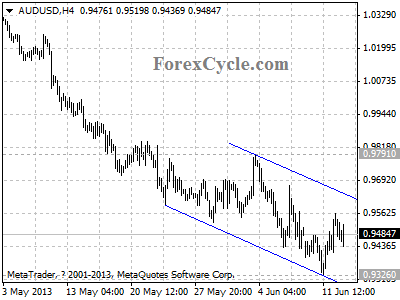
AUDUSD remains in downtrend from 1.0582

AUDUSD remains in downtrend from 1.0582 (Apr 11 high), the bounce from 0.9326 is likely consolidation of the downtrend. Key resistance is located at the upper line of the price channel on 4-hour chart, as long as the channel resistance holds, the downtrend could be expected to resume, and another fall towards 0.9000 is still possible after consolidation. On the upside, a clear break above the channel resistance will indicate that the downtrend from 1.0582 had completed at 0.9326 already, then the following upward movement could bring price back to 1.0700 zone.

audusd

Daily Forex Forecast