Aussie dollar declines as RBA likely to cut

By HY Markets Forex Blog

The Australian dollar extended its biggest fall among major counterparts after the Reserve Bank released its minutes from June’s meeting which indicated the currency may weaken in future.

The local currency slid by 0.30% to $0.9509 as of 6:13am GMT, at the same time it dropped 0.39% to A$ 1.4035 against the euro currency.

The Australian dollar declined against 16 major counterparts after the minutes from the Reserve Bank’s June’s meeting indicated policy makers may ease borrowing costs further.

“The inflation outlook as currently assessed might provide some scope for further easing, should that be required to support demand”, the RBA minutes noted. The minutes continued “The exchange rate had also depreciated noticeably, though it remained at a high level considering the decline in export prices that had taken place over the past year and a half.”

The Reserve Bank of Australia kept its cash rate at 2.75%, after been lowered by 25 points at the bank’s previous meeting last month. The bank predicts that the policymakers will lower the cash rate by another 25 points to an all-time low of 2.5%.

As the Chairman of the Federal Reserve said last month, the Fed may consider decrease its purchases of $85 billion in bonds every month if there are signs of improvement in the economy.

The post Aussie dollar declines as RBA likely to cut appeared first on | HY Markets Official blog.

Article provided by HY Markets Forex Blog

Gold in Euros, Sterling Hits 2-Year Low with Bullion “Under Pressure” ahead of Fed Decision

London Gold Market Report
from Ben Traynor
BullionVault
Wednesday 19 June 2013, 07:00 EDT

WHOLESALE gold bullion prices hovered just below $1370 an ounce for most of Wednesday morning’s London trading, after a “surprise” drop the day earlier, with stocks and commodities also broadly flat this morning ahead of the US Federal Reserve policy announcement later today.

 Silver meantime traded around $21.70 an ounce, 1.8% down on where it started the week, as US Treasury bond prices dipped.

 On the currency markets the Euro and the Pound continued to trade near four-month highs against the Dollar, close to $1.34 and $1.56 respectively.

 A day earlier, gold in Dollars hit a one-month low at $1361 an ounce, a level first passed on the way up in September 2010 and more than 2% down on where it started the week. Euro and Sterling gold prices both hit fresh two year lows at €1016 an ounce and £871 an ounce respectively.

 “[Tuesday’s move] was in thin volume and caught the market slightly by surprise, exaggerating the move somewhat,” says David Govett, head of precious metals at broker Marex Spectron.

 “There was no particular driver for it, just a weary market being taken advantage of.”

 “Gold remains under pressure in the run-up to today’s Fed meeting,” says this morning’s commodities note from Commerzbank.

 As well as announcing its latest monetary policy decision, the Fed will also publish its policymakers’ latest economic projects later today. This will be followed by a statement and press conference.

 European stock markets were little-changed on the day by Wednesday lunchtime in London, a day after US stock markets posted gains. Since the start of 2013, the S&P 500 is up nearly 16%, on course for its best first half of a year since 1997.

 “The recent strength in stocks is attributable to investor expectations that although the Fed may start to signal that it is ready to start its ‘tapering’ policy [of slowing the pace of quantitative easing asset purchases]…stocks may still benefit, since interest rates, although rising, will still remain fairly uncompetitive,” says a note from INTL FCStone metals analyst Ed Meir.

 “Of course, if the Fed says that the economy remains too weak to be abandoned and decides to stand pat, these calculations will change and we could see a rather sharp correction in stock prices with a corresponding rebound in both bonds and gold.”

 “Why would they possibly rush to a taper now?” asks UBS economist Drew Matus.

 “Unemployment is still nowhere near what they consider to be the natural rate, and the inflation number is too low.”

 US consumer price inflation rose to 1.4% last month, figures published yesterday show, up from a 53-year low of 1.1% in April. The official unemployment rate meantime ticked higher to 7.6% in May. The Fed has previously said it sees exceptionally low interest rates as appropriate while the unemployment rate remains above 6.5%.

 “Should the [Fed] not come any closer to giving greater clarification on the asset-buying program,” adds HSBC chief commodities analyst James Steel, “then the gold market could rally and investors who have been shorting gold in anticipation of a Fed move away from QE may have to cover…this could prompt a challenge of the $1400 an ounce level.”

 “US interest rates will rise over time and only the volatility of this move is in question,” says Standard Bank currency strategist Steve Barrow.

 “This normalization period will see bouts of volatility however well the Fed flags its intentions. The global economy and its financial markets have gorged themselves on the Fed’s monetary largesse for many years; draining the punchbowl is bound to spark some fear and panic however the Fed does it.”

Outgoing Bank of England governor Mervyn King meantime was one of three Monetary Policy Committee members who voted for more QE at the MPC’s monthly policy meeting earlier this month, with six members voting against, minutes published Wednesday show.

Ben Traynor

BullionVault

Gold value calculator   |   Buy gold online at live prices


Editor of Gold News, the analysis and investment research site from world-leading gold ownership service BullionVault, Ben Traynor was formerly editor of the Fleet Street Letter, the UK’s longest-running investment letter. A Cambridge economics graduate, he is a professional writer and editor with a specialist interest in monetary economics. Ben can be found on Google+


(c) BullionVault 2013

Please Note: This article is to inform your thinking, not lead it. Only you can decide the best place for your money, and any decision you make will put your money at risk. Information or data included here may have already been overtaken by events – and must be verified elsewhere – should you choose to act on it.


European shares opens higher with Fed’s conclusion in focus

By HY Markets Forex Blog

The European shares opened in a positive territory on Wednesday, while investors awaits final conclusion from the Federal Reserve’s two-day meeting. The Federal Reserve’s policy statement may hint when the central bank will narrow its $85 billion monthly asset-purchasing program.

European Euro Stoxx 50 rose 0.16% to 2,705.15 as of 7.01am GMT. While futures for the French CAC 40 were up 0.10% to 3,864.49 at the same time .Germany’s DAX futures increased 0.21% to 8,246.57 and the UK FTSE 100 futures gained 0.29% to 6,375.50 as of the same time.

Over $2 trillion has been wiped out from the global stocks since May 22, when Fed Chairman Ben S. Bernanke hinted the central bank could slowdown its monthly asset-purchasing program if the economy growth picked up.

“Although we don’t expect the Fed to decide to scale back its asset purchases today, we do think the prospect of an eventual tapering will continue to dampen capital inflows into emerging-market equities in particular, as it undermines investors’ appetite for risk,” chief markets economist John Higgins wrote in a note to clients.

Spain’s trade balance is expected to record a sum of 300 million euros in April, compared to previous month record of 600 million euros.

In the Asian market, the Japanese stock increased after a strong trade data indicated exports increased 10.1% in May, the most since 2010, while the Korean and Chinese stocks were weak before the outcome of the Federal Reserve meeting.

The Chinese Shanghai Composite lost 0.78% to 2,140.28 as of 6:09am GMT, while the Hang Seng fell 0.55% to 21,108 at the same time. The Topix index rose 1.1%, while the MSCI Asia Pacific index advanced by 0.4%.


The post European shares opens higher with Fed’s conclusion in focus appeared first on | HY Markets Official blog.

Article provided by HY Markets Forex Blog

Gold near four-week low before Fed meeting conclusion

By HY Markets Forex Blog

The precious metal  traded slight lower during the Asian trading hours on Wednesday , holding close to a $1,360 mark , while  investors awaits the conclusion from  the Federal Open Market Committee  (FOMC )  meeting ,later today  .

The gold futures for August traded on the Comex division of the New York Mercantile Exchange fell to a low 0.13% to $1,365.10 per ounce as of 5:26am GMT ,at the same time the silver futures for July were 0.70% lower to $21.525 per ounce.

Investors are focused on the Federal Reserve (Fed) plans on when the central bank may begin to reduce its monthly stimulus with the recovering economy.

“Gold remains under pressure amid uncertainty about the Fed’s asset-purchase program,” Mumbai-based Kotak Commodity Services Ltd. said today in a report. “Any sign of curtailment in asset purchases will be negative for gold; however it has been factored in to some extent.”

Holdings from the SPDR Gold Trust, the largest gold-backed exchange-traded fund, lowered 1,001.96 tonnes on Tuesday. Holdings lowered to its lowest level since March 2011.

Investors cut down their holdings in the exchange-traded funds last week for the 17th week, while assets went down to more than 11 tons.

Physical demand from two of the world’s largest gold consumers, India and China, has reached peak levels when gold prices fell in April. Demand in India lowered after the government of India imposed a 2% import tax on gold.


The post Gold near four-week low before Fed meeting conclusion appeared first on | HY Markets Official blog.

Article provided by HY Markets Forex Blog

The Last Line of Defense for This $1-Trillion Industry

By WallStreetDaily.com

When I come across a new investment opportunity that’s so compelling… so unabashedly brilliant… so inherently profitable… I simply must share it with as many readers as possible.

On such merits, be sure to take a close look at the subject of today’s discussion.

I published this story to the Tech & Innovation Daily website last week, and the response from readers was overwhelmingly positive.

I’m confident you’ll feel the same…

Click here to continue reading…

The post The Last Line of Defense for This $1-Trillion Industry appeared first on  | Wall Street Daily.

Article By WallStreetDaily.com

Original Article: The Last Line of Defense for This $1-Trillion Industry

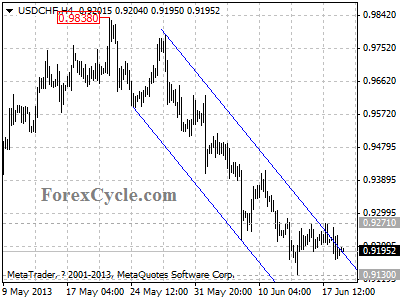
USDCHF pulls back from 0.9271

Being contained by the resistance of the upper line of the price channel on 4-hour chart, USDCHF pulls back from 0.9271, suggesting that the pair remains in downtrend from 0.9838, and the rise from 0.9130 could be treated as consolidation of the downtrend. Further decline to test 0.9130 previous low support could be expected, a breakdown below this level will signal resumption of the downtrend, then next target would be at 0.9000 area. Key resistance is at 0.9271, only break above this level could indicate that the downtrend from 0.9838 had completed at 0.9130 already, then the following upward movement could bring price back to 0.9400 zone.

usdchf

Daily Forex Analysis

Beware The Federal Reserve’s Deadly Game of Poker

By MoneyMorning.com.au

There are three rules that I live by: never get less than twelve hours sleep, never get involved with a woman with a tattoo of a dagger on her body, and never play cards with a guy who has the same first name as a city.

Solid advice there from ‘Coach Finstock’ in that highbrow movie classic Teenwolf.

But, sorry Coach, we must persist with ‘playing cards with a guy who has the same first name as a city’.

You see, for five years now, I’ve been playing cards against ‘Washington Ben’ – though you may know him as Ben Bernanke, the Chairman of the Federal Reserve. ‘Washington Ben’ has been king of the casino, running the whole show – and sometimes in our favour. Anyone in the markets has had no choice but to play him.

He’s made damn sure many years of ‘poker nights’ with the boys turned out as useful as my formal financial qualifications. Because bluffs, double bluffs, and forced tells regarding the Fed’s next move have the power to bulldoze fundamentals and turn all global markets on a dime.

And the bulldozer is at a crossroads. Never have I seen the markets more anxious than they are today, waiting, and furtively twitching, in readiness for 4.30am AEST on Thursday morning.

This is when ‘Washington Ben’ delivers a press conference where he’s set to play his most important hand in years…

After starting quantitative easing almost half a decade ago in October 2008, Washington Ben has recently tested the water with talk about ‘tapering’ the current $85 billion in monthly asset purchases.

That’s all. He hasn’t said it’s definite.

And he hasn’t said ‘stop’ either, just ‘taper’.

The online dictionary defines ‘taper’ as ‘making gradually smaller at one end’. So this could imply dropping QE from $85 billion to $80 billion per month for all we know.

But even just a suggestion of a possible and gradual reduction in QE has sent markets worldwide into a hissy fit. If Washington Ben wanted to know how dependent the casino was on his QE, well now it’s clear as day that it’s totally addicted.

As soon as he mumbled the word taper, money flew out of emerging markets, pulling down their stock markets as it left. The Emerging Markets ETF, which covers stocks in the BRIC countries (Brazil, Russia, India and China) along with South Korea, Taiwan and South Africa, crashed 12% in a few weeks.

But the big market moves also hit the US Federal Reserve where it hurts too. Bond yields have spiked. The 10-year bond yield for example has jumped from 1.6% to 2.2% in the blink of an eye. That doesn’t sound like much I know, but it’s a serious move and takes the yield to a twelve month high.

What Will the US Federal Reserve Do?

The last thing the Federal Reserve wants is for yields to suddenly spike. Their whole recovery thesis is about low rates encouraging borrowing. Rising rates would knock the insipid US recovery on the head pretty fast; there would be no natural economic growth to seamlessly transition to as QE finished.

Frankly I don’t envy Washington Ben. There’s no way to gently wind down QE without the market throwing its teddy out of the pram, in the same way that there’s no way of nicely asking our dear Prime Minister to quietly move on and seek alternative employment.

So for what it’s worth, odds are Washington Ben will back-peddle on the tapering talk for now. The US economy is just too weak, and the Fed knows it.

At the end of last year their stated target for unemployment was 6.5%. At last count, the actual figure jumped from 7.5% to 7.6% as more job hunters came back into the market. So on the unemployment front alone (which has been Washington Ben’s main focus) the Fed has a reason to stop using the word ‘taper’.

The other focus is inflation. The low official inflation rate gives the Fed scope to keep QE going. The headline rate is 1.4%, when their informal target is 2%.

The inflation measure the Fed bang on about more is the ‘Personal Consumption Expenditures Index’. This is now down to just 1.1%. If they believe their own data, then domestic inflation gives them no reason to take their foot off the gas today.

I’d say there is good reason for Washington Ben and his cronies to keep juicing the casino for time being, but who knows what they’ll do. It’s not all up to Ben of course. It’s voted on by twelve people. Eight of them are pro-QE, and the rest are anti-QE or neutral. The vote should be a foregone conclusion.

But what happens behind closed doors isn’t half as important to the market as what Washington Ben says at the press conference afterwards. That matters more because sound-bites travel faster than the official minutes which the Fed won’t release for three weeks.

We can only hope that he articulates the Fed’s plans better than at last month’s press conference when he mixed his messages and left the market as confused as a goat on Astroturf.

So leading up to Thursday morning, expect a bumpy ride. Traders have been jumping at imaginary bogeymen in recent days. An article in the Financial Times on Monday suggesting tapering was enough to send the markets plunging.

Last week it was a story in the Wall Street Journal from a journo (with rumoured close ties to the Fed) who said tapering was off, sending the markets soaring. It’s a total farce.

Rumblings from the China Bears Grows Louder

That’s not the only reason to expect a bumpy ride on Thursday. The Bank of England has a press conference soon after, and just before lunch the monthly Purchasing Managers Index for China (HSBC flash) comes out. China in particular has the scope to hit our market if the news is bad.

My mate and colleague Greg Canavan, of Sound Money Sound Investments, has been banging the China-bear drum again recently. His view of the market was pretty chilling when we had a chat the other day.

It’s not all about China, but his overall view of global markets is that they’re about to crash. Look out for Greg’s new video on the subject tomorrow.

Maybe a negative, or plain unrevealing, press conference from Washington Ben tomorrow could be the trigger for what Greg sees coming?

After all, you got to know when to hold ‘em, and know when to fold ‘em…

Dr Alex Cowie
Editor, Diggers & Drillers

Join me on Google+

From the Port Phillip Publishing Library

Special Report: The Sixth Revolution Has Just Begun

Daily Reckoning: The Pressure is Building in China’s Economy

Money Morning: Why Thursday Could Be a Key Day for Silver…

Pursuit of Happiness: Calming a Property Market Storm

Diggers and Drillers:
Why You Should Invest in Junior Mining Stocks Now

Thirteen Drivers of Silver in Today’s Financial World

By MoneyMorning.com.au

Silver has been in a bear market for some time now, being down a deep 27% this year and a whopping 55% from the peak it reached in 2011.

Needless to say, this has been discomforting to the growing number of silver investors in the Western world. (To meet booming demand, silver coin production has surged at the world’s mints and global holdings in exchange-traded products remain near a record high exceeding 600 million ounces.)

With the [US] dollar recovering strength this year and an improving [US] stock market, you may ask ‘Should I continue to hold an investment in silver?’

Obviously, each person needs to make his or her own financial decisions. In my view, the answer remains yes and below I list the 13 main drivers I believe will drive the silver price higher in the years ahead.

1. Silver, a hybrid precious/industrial metal, is a commodity play on global technological advancement. Silver was once highly dependent on the film photography industry, which collapsed into insignificance with the rise of the digital camera, a major reason for the metal’s weak price in the 1990s.

Today silver’s industrial demand is driven by brazing alloys and solders, growing electronic demand (smart phones, tablets, plasma panels and increasingly by new applications like silk-screened circuit paths and radio frequency ID tags) photovoltaics (solar panels) and new medical applications: silver is both biocidal and highly conductive.

2. Silver moves with gold. Though the metal exhibits more price volatility than gold as an investment asset, silver has been correlated more closely with gold than with anything else for two generations. Despite sometimes violent market swings, silver has kept pace with gold and has even outperformed it over much of the past decade. This is a return to normality, in my opinion, as the sister metals moved in tandem for thousands of years, notwithstanding the historical interruption between the 1870s and the 1930s, caused by adoptions of the Gold Standard.

3. As an investment metal, silver is more precious, less industrial. Silver is significantly more correlated with gold than with industrial metals, like copper, which means that the market regards it as more of a safe-haven precious metal than an economically sensitive industrial one. This was seen during the 2008 crisis: though silver declined, it outperformed collapsing stock markets and commodities by a wide margin. The exception was gold, which rose in that year.

4. Silver is rarer than gold in the investment world today. Total aboveground silver in all forms is worth approximately $800 billion, about one-tenth the value of the world’s gold.

Although there are 5 times more ounces of silver in the world, because gold is more than 50 times more expensive than its sister metal per ounce, the silver market is effectively much smaller. Silver is becoming rarer each year due to annual unrecoverable loss of tons of silver in industrial activities. Throughout history, tens of billions of ounces of silver have been used up in industrial production. Compare this fact with gold, the vast majority of which remains with us today.

5. Silver is a premier real asset for inflationary times. Sister metals gold and silver often outperform other real assets during periods of significant monetary expansion (they each surged over 2,000 percent in the 1970s) because they have a relatively small fixed supply, are nonperishable, liquid (as investments), easily storable, and historically recognized as alternatives to government-issued cash.

Over the last decade, a time of dramatic monetary experimentation, silver has outperformed all real assets (real estate, commodities – even gold) by a wide margin, not to mention the stock and bond markets. It also surged during the inflationary 1960s and 1970s. However, all real assets (houses, commodities, precious metals) have investment trade-offs, and silver’s risks are important to consider.

6. Government today is silver’s friend: Amidst global fiscal excess, unprecedented and extreme use of monetary tools is the only major policy our leaders have. To help the economy recover from the 2008 economic downturn, the worst since the Great Depression, global leaders assumed more debt than ever to reignite the economy (with credit).

With bloated balance sheets, expansionary fiscal policy options at present are limited and increased central bank money-printing, which is already being used around the world as a major policy tool, will be vital when the next recession arrives.

7. Large investment fund ownership of silver is in its infancy. Although the metal has been one of the winning investments of this new century, pension funds, insurance companies, and other large institutions managing tens of trillions in assets have largely ignored silver as a viable investment. Gold very recently was reincorporated into the financial system as the viable, respected financial asset it once was. In the scramble for scarce global real assets, institutional investors are likely to begin considering the investment merits of silver, which is highly correlated with gold.

8. The gold-silver ratio, a 3,000-year-old exchange rate, is out of historical balance. While gold is 8 times scarcer than silver (in terms of total ounces produced annually), its price is more than 50 times higher than silver’s. For 3,000 years in which the exchange rate could be observed, gold was 9 to 16 times more expensive, making today’s level historically extreme.

Now that many of the factors distorting the ratio have disappeared, it seems logical that the market exchange rate between the two should begin to approximate the difference in scarcity of each metal, which points to silver being significantly undervalued.

9. Like gold, silver is an ‘anti-bond’ and ‘non-stock’ – meaning it’s one of the few investment vehicles allowing a person to completely remove wealth from the financial system. Traditional financial assets represent claims on other entities.

To preserve their value, bonds require that a government or company make interest and principal payments; stocks require dividend payments and/or that management deliver on earnings expectations; derivatives of many kinds can require financial faith at multiple levels; and ultimately, the financial system itself relies on trust that world economic leaders will keep markets functioning properly by meeting their ever-expanding financial commitments.

Gold and silver, inert metals recognized for thousands of years as stores of wealth whose nature cannot be altered by human error, have value outside the financial system.

10. Growing global scarcity of safe assets that are not someone else’s liability. According to the International Monetary Fund, of the world’s potentially safe investment assets, 89 percent are bonds of some kind – that is to say, someone else’s debt. For those believing that ultimate financial safety should not involve lending money to a company or government (buying a bond), there is only gold, the other 11 percent. But given the scarcity of gold and other real assets that are not economically sensitive (as real estate and major commodities are), silver is increasingly being regarded as a viable alternative to gold, which it was for most of human civilization.

11. Anyone anywhere can buy silver. Silver is an investment that can be made in any country by virtually any person – even in countries where there is no stock exchange, where even apple, the fruit, is hard to find. An ounce of gold, presently worth in excess of $1,350, is an investment unreachable to most people in the world, and represents a difficult financial decision even for middle class families in the United States.

A $20 silver coin is something that can be bought by a great many people almost on a whim, a minor investment decision that chips away at globally scarce supply. If expectations for future inflation begin to rise – a concept that virtually any working adult understands – silver’s well-known positive sensitivity to higher prices in the economy and its very accessibility could make it an important asset for many.

12. The 1980s and 1990s bear market for precious metals had powerful drivers that no longer exist. In the 80′s the world’s two richest families conspired to manipulate silver and inadvertently caused a crash – along with plenty of metal-fearing fallout. This was surely a singular moment in history.

Also contributing to an overall headwind for the metals, central banks dumped an average 10 million ounces of gold for each of 20 years ending in 2008. This likely-unrepeatable event pushed gold from being close to 50 percent of global central bank reserves in 1980 to an all-time low of 14 percent in 2012.

Heavily weighted in dollar, euro, and yen reserves and fixed income securities, a number of central banks are diversifying back into gold. The 1990′s saw increased pressure on silver prices due to the collapse of film photography, the largest source of demand for the metal. But film photography is in silver’s past, a very small part of demand today, and investment demand has become the key driver.

13. Silver is an important investment asset in Asia, where demand has remained strong over thousands of years. Throughout Asia, but mostly in populous India and China silver, like gold, is a key investment asset worn and stored as a wealth instrument by a great many people.

Every year, generally late in the summer and into the fall, the silver and gold markets are deeply influenced by a major financial event–the Indian wedding season, which draws a substantial portion of the world’s precious metals as part of an enduring millennial tradition.

Silver’s Bottom in Sight?

In spite of present market conditions, this list helps us focus on the essential drivers of silver for the years ahead that distinguish the metal from other investment options.

Silver has the highest price sensitivity to inflation of any commodity or sector in the stock market, by far – and it most certainly outperforms bonds when the price level is rising in the economy.

If you believe – as I do – that the world’s monetary authorities will never allow deflation to take hold and that the odds of inflation climbing to some degree in the years ahead are significant, it makes sense to own some silver to diversify your investment portfolio. (The right percentage to hold is something you should carefully consider with an investment advisor.)

Timing any investment correctly is always a challenge, but silver’s price has fallen by half in the last two years and is beginning to show tentative signs of bottoming. Perhaps the worst has passed for silver.

Shayne McGuire
Contributing Writer, Money Morning

Join Money Morning on Google+

Ed Note: Shayne McGuire is a Managing Director and Head of Global Research at Teacher Retirement System of Texas, one of the world’s largest pension funds. He also manages the GBI Gold Fund.

From the Archives…

Don’t Make Investing a Chore… Invest in an Innovative Business
14-06-2013 – Kris Sayce

The Technology Revolution Begins in Four Days…
13-06-2013 – Kris Sayce

Zero G for the Australian Dollar is a Shot in the Arm for Miners
12-06-2013 – Dr Alex Cowie

There’s More to Technology Than Facebook and Spying
11-06-2013 – Sam Volkering

Four Great Australian Technological Achievements
10-06-2013 – Sam Volkering

Seven Australian Companies to Survive a Metals Market Correction

Source: Kevin Michael Grace of The Metals Report (6/18/13)

http://www.theaureport.com/pub/na/15380

Australian mining companies have been hard hit by falling commodities prices and rising costs. But Petra Capital Analyst Andrew Richards believes his country’s resource sector has turned a corner. In this interview with The Metals Report, Richards says that costs are falling and China’s need for Australian metals will continue to grow. He also names companies that are well positioned to flourish in the near future.

The Metals Report: Australian mining Newcrest Mining Ltd. (NM:TSX; NCM:ASX) has announced huge layoffs and capital expenditure cutbacks. Does this signify a crisis in the space?

Andrew Richards: “Crisis” is certainly a strong word, but there is definitely a correction occurring in the market. Gold and iron ore in particular have come off their peaks. What we are seeing in Australia is a lot of cost-cutting across the board. That’s probably something that needed to happen because labor costs had risen significantly over the last few years due to competition for personnel. The big companies, such as BHP Billiton Ltd. (BHP:NYSE; BHPLF:OTCPK) and Rio Tinto Plc (RIO:NYSE; RIO:ASX; RIO:LSE; RTPPF:OTCPK), have said that Australia has become relatively uncompetitive because of very high labor and engineering costs.

With the fall in some of the commodity prices, companies have had to lay off people where they can and put a stop to some of the planned growth projects. Newcrest was an example of that. Companies are now focusing on cash flow rather than just growth. They want to maintain or improve margins where they can. But I will say I think Australian costs have peaked and are already on their way down.

TMR: Australian mining billionaire Gina Rinehart last month accused Prime Minister Julia Gillard of treating the mining industry like an ATM. How much of a threat to the industry is the Labour government’s mining tax?

AR: The mining tax, at this stage, affects only iron ore and coal. And companies need to make a profit of at least $75 million ($75M) before that tax kicks in. It certainly has an impact on big companies, such as Fortescue Metals Group Ltd. (FMG:ASX), BHP and Rio Tinto. Having said that, the government had estimated significantly higher revenues from the tax than it has received. Maybe that’s a reflection of the pullback in commodity prices, particularly iron ore.

Moving forward, there is an election in Australia in September, and the polls are saying that the current government will lose. The incoming government, should they win, has said publicly that they would remove this tax. So we’ll wait and see what happens in September.

TMR: Let’s talk about some of the companies you cover. Alkane Resources Ltd. (ANLKY:OTCQX; ALK:ASX) has zirconium, niobium and gold. What are the challenges of managing a company that has such diversified resources?

AR: Alkane’s Dubbo zirconium-niobium project is certainly unique. With these sorts of projects, you have to make sure you have a flowsheet that works and is proven. Alkane has had a pilot plant operating for over four years now, so it has actually proven that flowsheet and sent product off to customers. It has signed an offtake agreement with a significant Japanese company, Shin-Etsu Chemical Co. Ltd. (SHE:Fkft). Obviously, there are always risks as you scale up from the pilot plant to the major plant, but I think the company has mitigated them as much as possible. The key now is getting Dubbo funded.

TMR: In April, Alkane came out with a revised feasibility study for Dubbo with a capex of $996M. How is this new feasibility study better than the previous one?

AR: Alkane did reduce the capex by around $70M. It made some improvements with the water recycling, which means that it could reduce the size of the evaporation ponds required. That was quite positive. Also, it slightly improved the costs, and the company has some improvements coming through on recoveries, which could help on the revenue side.

TMR: How does Alkane intend to raise this nearly $1 billion ($1B)? How important are offtakes and cash flow from its Tomingley gold project in this regard?

AR: Tomingley will produce 50,000-60,000 ounces (50–60 Koz) annually starting early next year. It’s a nice little cash flow generator: At current gold prices, the project should generate about $20–25M/year. Alkane may well look to do some hedging should the gold price find support and have a bit of a run up over the next three to six months.

The plan with Dubbo is to sell up to 15% at the project level for anywhere from $150–200M. I mentioned Shin-Etsu, which has signed a memorandum of understanding (MOU), and there is strong interest from other companies in Asia and North America. The company is also talking to government agencies, which could provide cheap debt, up to $400M at low interest rates. So that adds up to around $550–600M. Alkane has appointed Credit Suisse and Sumitomo Corp. (8053:TKY; SSUMF:OTCPK) of Japan to help facilitate the project selldown and negotiate government debt. All together, that could mean $800M in funding. The balance would be equity, and Alkane is targeting a maximum of $200M. The first thing we’ll see will be the selldown, hopefully by the end of this year.

TMR: How crucial have offtakes become to companies involved in setting up nonprecious minerals projects?

AR: They are important; there’s no doubt about it. I think there is a window open over the next four to five years for companies such as Alkane to lock in long-term offtakes. Shin-Etsu is a major player in the rare earth element industry. It has a separation plant in Japan, and it will be treating the concentrate that Alkane produces. The market will be looking to see these MOUs convert into offtake agreements over the next six to 12 months.

TMR: How confident are you that Alkane is a winner going forward?

AR: I think it is in a great position. I’m confident that it will get the funding for Dubbo and deliver on what it has said it is going to do. Dubbo’s economics are very attractive. The $1B capex should be paid back within five years. Dubbo’s current reserve equates to a mine life of over 30 years, and the resources equate to over 70 years. And it will be providing not just light rare earths but a majority of heavy rare earths, which are in short supply, as well as the zirconium and niobium. It is certainly far more advanced than a number of other competing projects globally.

TMR: Let’s talk about Crusader Resources Ltd. (CAS:ASX). It has the Posse iron ore project and the Borborema gold project in Brazil. Posse just went into production. How does this affect Borborema?

AR: Posse is a small iron ore project. It started producing at 300,000 tonnes per annum (Ktpa) and recently just got the environmental approval to expand to 1 million tonnes per annum (Mtpa). What distinguishes Posse is its cash costs. It is targeting $12/tonne, which is bottom quartile globally. Current iron ore prices are around $110/tonne. It will be selling high-grade ore for anywhere between $75–100/tonne. So the margins are quite good. That will start generating some good cash flow: at current production rates, probably at least $1M/month. At the expanded rate of production, it could be three times that.

Posse provides cash flow to Crusader, which can then be used to move Borborema forward. Crusader is currently doing a bankable feasibility on Borborema. We’re talking about production of about $100 Koz/year at cash costs of around $750 an ounce ($750/oz).

TMR: Is that all in?

AR: All-in cash costs are probably more like $950/oz, so it’s still attractive at current prices. We won’t get the final numbers until probably later this year, so these are my estimates. It has 1.6 Moz in reserves and 2.4 Moz in resources. It is open-pit, and the costs should be low because of the cheap labor and power available in Brazil.

TMR: Where do you see iron ore prices going?

AR: What I’ve read from some of the larger brokers is that prices are close to the bottom right now. We’ll wait and see. Commentators say that stockpiles in China are falling, and there is a real possibility they could look to restock in the second half of 2013, which might help support prices.

TMR: Alara Resources Ltd. (AUQ:ASX) has the Khnaiguiyah zinc-copper project in Saudi Arabia and the Washihi-Mullaq-Al Ajal and Daris copper-gold projects in Oman. Is the Gulf Region particularly mining friendly?

AR: It is. Saudi Arabia, obviously, has a long history with oil and gas. However, it is now looking to develop its mining industry to create employment and a more diverse economy. We’ve seen some companies move into Saudi Arabia in the last five to six years. Citadel Resources Group had a copper-gold project that Equinox Minerals Ltd. bought, which was then bought by Barrick Gold Corp. (ABX:TSX; ABX:NYSE). There is another zinc-copper project to the south called Al-Masane, and there are some government-owned gold projects. Saudi Arabia is a good place for investment. Corporate tax for 100% foreign-owned entities is only 20%. There are no royalties. Diesel is just $0.08/liter.

Oman has a longer mining history. It is copper rich and has a copper smelter on the coast. Fuel is only slightly more expensive there than it is in Saudi Arabia but is still very cheap.

TMR: What are the highlights of the Khnaiguiyah feasibility study released in April?

AR: The feasibility study showed a 13-year mine life, production of 80 Ktpa zinc and about 6 Ktpa copper. Cash costs are attractive at $0.46/pound ($0.46/lb) zinc. That’s after copper credits in the first seven to eight years. Life-of-mine cash costs are $0.50/lb. So at current prices of around $0.85/lb, it looks good. Longer term, I think it should be quite exciting, as most groups forecast that zinc will be in a deficit within two to three years because of some large mines shutting down. That could be very good timing for Alara with first production targeted to begin by late 2015.

The capex is $257M. The Khnaiguiyah project has access to the Saudi Industrial Development Fund, which has billions of dollars and can provide up to 75% of the capex. The application process to this fund is underway, and the company is targeting completion of that by the end of this year. So Alara is in a much better position to get its project funded than some of the other juniors.

TMR: What do you think about the copper-gold assays that Alara has been getting at Washihi?

AR: They’re very good. It has been getting big, thick intersections of 70–80 meters (70–80m) and over 100m of over 1% copper plus gold, at reasonably shallow depths as well. It looks like it could be an open-pit operation with quite a modest strip ratio. More important, the deposit is still open along strike and also at depth. The current resource is around 9 million tonnes (Mt), and I think that will be upgraded in the next couple of months. I think Washihi will start off small, but Alara could get it up and running within two years, so the company could have two projects running by late 2015.

TMR: How would you rank Alkane, Crusader and Alara?

AR: All three offer significant upside. Crusader has just started generating cash flow, which is attractive to investors in the current market. Alkane is not far behind, with its gold project starting up early next year. And Alara has its low-cost zinc project in Saudi Arabia and upside from its copper project in Oman.

TMR: Briefly, are there any other Australian mining projects (not necessarily ones that you cover) that you think are particularly noteworthy?

AR: In this market, everyone is looking at projects that have low costs and can make money throughout the cycle. In gold, Regis Resources Ltd. (RRL:ASX) is one that stands out. It certainly has low costs and an appealing growth profile. In copper, PanAust Ltd. (PNA:ASX) and Sandfire Resources NL (SFR:ASX)are certainly making very healthy margins. In iron ore, BC Iron Ltd. (BCI:ASX) has been a standout. It has been one of the best performers of the past few years with very healthy margins at current prices.

TMR: How much does the economy of Australia depend on Chinese industrial expansion?

AR: Australia is quite dependent on China because we are still a commodity country, and China now consumes around 40% of metal production across the board. It’s a big consumer of our iron ore and coal. There is concern at the moment that China is slowing, but with growth figures of 7–7.5%/year, it still looks pretty healthy. And, of course, China’s base is a lot bigger than it was even a few years ago.

TMR: How do you stand on the debate over the so-called commodity supercycle? Do you think we can expect it to last for a while longer?

AR: Yes, I do not think that the cycle is over. Our view remains that China still has a lot of growth ahead of it, and it looks like the U.S. is starting to pick up as well. Hopefully, we’ll start to see that come through in the next six to 12 months. Europe still has its issues, but if the U.S. and China continue to grow, then the outlook is pretty positive.

TMR: Do you think that the Australian economy’s best days are ahead of it?

AR: Good question. Australia has done well for quite some time. A number of mining companies said that our resource market has become uncompetitive, but we’re starting to see improvements. Also, the Australian dollar had been very strong for a couple of years now, but it’s now back down to around $0.94 to the U.S. dollar. A weaker currency really positively impacts revenue in the Australian resources industry because commodities are priced in U.S. dollars. And Australia remains a very attractive place for investment given its low geopolitical risk. Looking ahead, there is a lot to be positive about, and I expect better times from the second half of 2013 onward.

I think that investors just have to be a bit more selective. There are a number of projects that are high cost and will struggle, but there are also plenty of attractive projects, including the ones I’ve mentioned, that will make good money throughout the cycle. And when the cycle picks up again, these projects will do extremely well.

TMR: Andrew, thanks so much for your insights.

AR: A pleasure, Kevin.

Andrew Richards is a rated analyst in gold and base metals with Petra Capital of Australia. He is a geologist and has worked for such major miners as Newcrest Mining and Western Mining. He has over 15 years experience as an analyst, including for such leading firms as Merrill Lynch and Shaw Stockbroking.

Want to read more Metals Report interviews like this? Sign up for our free e-newsletter, and you’ll learn when new articles have been published. To see a list of recent interviews with industry analysts and commentators, visit our Metals Report <href=”#interviews” target=”_blank”>homepage.

DISCLOSURE:

1) Kevin Michael Grace conducted this interview for The Metals Report and provides services to The Metals Report as an independent contractor. He or his family own shares of the following companies mentioned in this interview: None.

2) The following companies mentioned in the interview are sponsors of The Metals Report: Alkane Resources Ltd. Streetwise Reports does not accept stock in exchange for its services or as sponsorship payment.

3) Andrew Richards: I or my family own shares of the following companies mentioned in this interview: Alkane Resources, Crusader Resources and Alara Resources. Petra Capital has previously raised capital with the following companies mentioned in this interview: Alkane Resources, Crusader Resources and Alara Resources. I was not paid by Streetwise Reports for participating in this interview. Comments and opinions expressed are my own comments and opinions. I had the opportunity to review the interview for accuracy as of the date of the interview and am responsible for the content of the interview.

4) Interviews are edited for clarity. Streetwise Reports does not make editorial comments or change experts’ statements without their consent.

5) The interview does not constitute investment advice. Each reader is encouraged to consult with his or her individual financial professional and any action a reader takes as a result of information presented here is his or her own responsibility. By opening this page, each reader accepts and agrees to Streetwise Reports’ terms of use and full legal disclaimer.

6) From time to time, Streetwise Reports LLC and its directors, officers, employees or members of their families, as well as persons interviewed for articles and interviews on the site, may have a long or short position in securities mentioned and may make purchases and/or sales of those securities in the open market or otherwise.

Streetwise – The Energy Report is Copyright © 2013 by Streetwise Reports LLC. All rights are reserved. Streetwise Reports LLC hereby grants an unrestricted license to use or disseminate this copyrighted material (i) only in whole (and always including this disclaimer), but (ii) never in part.

Streetwise Reports LLC does not guarantee the accuracy or thoroughness of the information reported.

Streetwise Reports LLC receives a fee from companies that are listed on the home page in the In This Issue section. Their sponsor pages may be considered advertising for the purposes of 18 U.S.C. 1734.

Participating companies provide the logos used in The Energy Report. These logos are trademarks and are the property of the individual companies.

101 Second St., Suite 110

Petaluma, CA 94952

Tel.: (707) 981-8204

Fax: (707) 981-8998

Email: [email protected]
 

Botswana cuts rate 50 bps in non-inflationary stimulus

By www.CentralBankNews.info     Botswana’s central bank cut its Bank Rate by 50 basis points to 8.50 percent, saying the economy is growing below potential and unemployment is high and this “provides an opportunity for non-inflationary stimulus to the economy.”
    The Bank of Botswana, which also cut its rate by 50 basis points in April, said the inflation outlook  suggests that a “more accommodative monetary policy stance is consistent with the achievement of the bank’s 3-6 percent inflation objective in the medium term.”
    Inflation eased to 6.1 percent in May from 7.2 percent in April with weak domestic demand contributing to the positive inflation outlook. In the short term, inflation is expected to be close to the upper end of the bank’s target range, but it should converge to the range in the second half of 2013.
    “The lower global growth, subdued demand and stable commodity prices have contributed to moderate inflationary pressures,” the bank said, adding persistent capacity underutilisation and high unemployment rates in major economies is restraining global inflation.
    Domestic output rose 3.7 percent in the year to December 2012 and expansion is expected to remain below potential in the medium term and thus not inflationary, the central bank said.
   
    www.CentralBankNews.info