Central Bank News Link List – Jun 24, 2013: China’s central bank reiterates prudent monetary policy

By www.CentralBankNews.info Here’s today’s Central Bank News’ link list, click through if you missed the previous link list. The list comprises news about central banks that is not covered by Central Bank News. The list is updated during the day with the latest developments so readers don’t miss any important news.

Why The ‘Asia-Zone’ Crisis Makes Australian Stocks a Buy…

By MoneyMorning.com.au

It has been one crisis after another over the past five years.

The US debt crisis…the Eurozone crisis…the credit crisis…the subprime crisis, and so on.

But perhaps now the crisis has come closer to home. Five years ago people once more dubbed Australia the ‘Lucky Country’ due to the closeness to China.

China – many thought – was Australia’s saviour. Forget about the ‘Old Country’ and those dunderheads in America. The action is in Asia.

Remember, we’re lucky. We’ll benefit from the 50-year boom in commodities.

How quickly things change…

Now, don’t get us wrong. We’re not saying that China won’t be the world’s most powerful nation within the next 50 years. That’s entirely possible – probable even.

What we’re saying is that economic growth doesn’t advance in a straight line without problems.

You only have to look at the economic growth of the United States in the 19th and 20th centuries. They suffered countless recessions, depressions and panics on the way from colonial backwater to the world’s most powerful nation that at one point made up 50% of global GDP.

And so knowing that problems do arise from time to time, you have to be prepared to deal with it.

That’s Not a Stock Market Bubble

And the best way to deal with it is in the Australian stock market right now.

With the big rally from the middle of last year through to July, many investors, commentators and analysts think the Australian market is in bubble territory.

And with the recent 500 point drop on the S&P/ASX 200 index, many of the same people think the Australian market could fall further.

But they couldn’t be more wrong.

The Australian market closed last Friday at 4,738 points. That’s 17.6% above the May 2012 low point. Although that may be a bigger percentage gain than the long-term average annual gain for Australian stocks, it’s far from being a bubble-sized gain.

But let’s go back further, to March 2009. The main index has gained 50.7% since the low point following the 2008 financial meltdown.

Is that a bubble? No, not really.

It’s an average annual gain of 12.7%. Sure, it’s a good return, but it’s hardly bubble territory. And if you look at the chart you’ll actually see that since 2010, the Australian market has been mostly flat.

In fact, if you started investing in 2010 the only gains you’ll have made would be from dividends. We don’t know about you, but to us that hardly looks like Tulip, South Sea or Dot-Com bubble type gains:


Source: Google Finance

But that’s not all. Even though the main index is up 17% over the past year, one group of stocks has gone through the wringer over the past two years.

Market Bubbles Don’t Look Like This

Last week our old pal, Diggers & Drillers editor Dr Alex Cowie, showed us a research report from Canadian-based broker Canaccord.

The research included analysis on 139 Australian resource stocks. These stocks covered the full range. They include gold, copper, iron ore, nickel, rare earth, oil and gas.

You don’t need a Harvard degree to know it has been a tough time for resource stocks. But what’s even more amazing is that according to the Canaccord research, of the stocks analysed the average fall from the top of the resource cycle to the bottom is 78.1%.

The poor performance of resource stocks is a major reason why the Australian market has performed so poorly compared to US and European markets.

But that’s not the only reason.

For most of the past five years the financial markets have focused attention on the multiple US and European debt and currency crises.

But now the focus is on the Asian time zones (notwithstanding the US Federal Reserve’s money printing woes). There are now serious worries that the Chinese economy is slowing fast.

Add to that the issue about Japan’s enormous debt position. Suddenly, being close to Asia is more of a risk than a benefit.

You could say we’re now in an ‘Asia-Zone’ crisis.

And yet, this isn’t new news. Greg Canavan has warned about China’s structural problems for the past two years. And here in Money Morning, Murray Dawes has told you to keep an eye on Japanese bond yields for the past couple of months.

So to our mind stock prices already have much of the downside risk baked in. The market knows China has over-stimulated its economy, and it knows Japan has a huge debt problem.

Beaten Down Value in Australian Resource Stocks

While we can’t guarantee stocks will soar from here, we can say there are many more potentially profit-making opportunities on the ASX than most in the mainstream would have you believe.

The numbers from Canaccord show that. After leaving resource stocks alone for most of the past year, we’ve tipped resource stocks in two of the past three issues of Australian Small-Cap Investigator.

And as someone who’s constantly on the lookout for value in a beaten down market, it’s hard to look past Australian resource stocks right now.

In short, while others see the past few weeks of volatility as a reason to ditch stocks, we take the other side.

If you’re looking for a chance to buy what is still hands down the best way to build wealth – the stock market – this is a great time to think about shifting more of your asset allocation from cash into stocks.

Cheers,
Kris

Join me on Google+

From the Port Phillip Publishing Library

Special Report: The Sixth Revolution Has Just Begun

Daily Reckoning: How to Play ‘Spot the Stock Market Bubble’

Money Morning: Money Weekend’s Technology FutureWatch 22 June 2013

Pursuit of Happiness: Calming a Property Market Storm

Australian Small-Cap Investigator:
How to Make Big Money from Small-Cap Stocks

Are You Keeping Yourself from Getting Rich?

By MoneyMorning.com.au

I believe people are a product of their environment, and that the most successful investors embody five key ‘traits’ for lack of a better term.

So here they are…the five traits I believe will help boost your profits and keep the bears at bay.

Get Out of Your Comfort Zone

Every investor falls into a comfort zone sooner or later, whether it’s because they ‘know’ their investments or become overly familiar with certain methodologies. Sometimes this works for them, but the majority of the time it works against them for one simple reason…the markets change over time.

Really successful investors will deliberately go outside their comfort zones. They’re the ones who have stacks of magazines and books all over their homes. They read voraciously and make it a point to engage others around them in a never-ending process to learn more about the world.

Dr. Mark Mobius, Executive Chairman of Templeton Emerging Markets Group, is perhaps the ultimate example of what I am talking about. Overseeing research in 18 global emerging markets offices, he’s always on the go and commands an almost encyclopaedic knowledge of the investing landscape.

He revels in change because it’s synonymous with opportunity.

Persistence

Average investors tend to try something once then move on. If it works, great. They’re a genius. But if it doesn’t, something must be wrong with the method or the recommendation or the source. They simply move on.

But successful investors follow up diligently and assume personal responsibility for their efforts. If an investment doesn’t work out the way they plan, they’ll be back. They never assume that a single shot is enough…not in life and not when it comes to their money.

Case in point…many investors are surprised to learn that professionals don’t think twice about taking 3, 4 or even 5 swings at the same investment before they settle into a position they like.

Take Jim Rogers, for example. He is one of the most successful investors on the planet and one of the most persistent, prescient thinkers I’ve ever met. When he latches onto something, it’s rare he’ll let go.

Yet, he’s also the first to tell you that he doesn’t know everything and doesn’t hide from trades that he’s messed up over the years.

In fact, Rogers frequently notes during interviews in a very self-deprecating manner that ‘he hopes he’s smart enough’ to buy or sell at some point a reporter has picked out for him.

More often than not, he is.

Healthy Scepticism

If you’re like me, you get all sorts of junk mail every day touting everything from the newest six-headed singing bass I can’t live without to the miracle hair cure discovered by some company I’ve never heard of.

What makes adverts so great is the ‘copy’. That’s the term for the language used to evoke a response which usually involves taking out your wallet and forking over a bunch of money. It’s a finely tuned science.

Here’s the thing…the better you are at reading it, the easier it gets to sort out opportunities, especially when it comes to reading about new companies in new industries.

To do it right, you need a healthy sense of scepticism. My grandmother, Mimi, had a finely tuned radar and saw to it that I developed one too. You’ve heard me reference her before in Money Morning as the voice of investing reason.

Mimi and I would play a game to see just how outrageous we could be whenever we learned about a new company that interested us. First, we’d review the analyst reports and company data. Then, we’d pretend to be the company’s marketing staff and make up outrageous claims.

Our goal was to understand the transition from what’s plausible to what’s possible. When we got a match…we knew we had an investment worth consideration.

Make Decisions that Benefit Others

All too often the modern media perpetuates the image of ‘lone wolves’ when it comes to making money. That may work for a little while, but in reality, the most successful investors are those who understand their own limitations and seek help to overcome them, especially when doing so benefits others.

Sir Richard Branson of Virgin is a great example of what I am talking about. Always on the go, he’s just as likely to ask you about what you do for fun as he is to engage you on the finer points of environmental management and leaving the world a better place for those who follow us in the future.

I know because that’s exactly what we discussed over dinner in London years ago when we wound up seated next to each other by happenstance at Nobu (which by the way is one of my favourite places to eat).

Sir Richard, and others like him, will often connect the dots later, knowing that the cascade is a lot bigger down the line…when the results start rolling in. But thinking about others is always the beginning of the line.

Freedom to Fail

Our society is hopelessly wedded to the notion of high-powered people climbing the ladder of success without a stumble. Consequently, we like to believe that the legendary investors of our time are infallible.

Yet, if you look at who’s made it and who hasn’t, it becomes very clear that those who freely talk about their failures along the way are the truly successful ones.

Love him or hate him, George Soros is a great example.

He’s quick to recognise when he’s wrong and has famously acknowledged on several occasions that he’s survived because he’s capable of recognising his mistakes.

Most investors can’t. They’re too focused on being ‘right’ when being profitable is the higher priority, at least when it comes to long term success.

Keith Fitz-Gerald
Contributing Editor, Money Morning

Publisher’s Note: This is edited version of an article that first appeared here.

Join Money Morning on Google+

From the Archives…

The 12 Most Important Rules Every Investor Must Know
21-06-2013 – Vern Gowdie

The US Economy Butterfly Effect
20-06-2013 – Murray Dawes

Beware The Federal Reserve’s Deadly Game of Poker
19-06-2013 – Dr Alex Cowie

Why Thursday Could Be a Key Day for Silver…
18-06-2013 – Dr Alex Cowie

The Single Biggest Mistake a Technology Investor Can Make
17-06-2013 – Sam Volkering

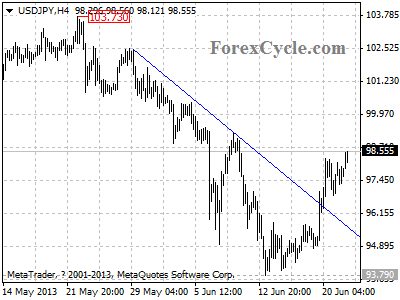
USDJPY’s upward movement extends to 98.56

USDJPY’s upward movement from 93.79 extends to as high as 98.56. Further rise would likely be seen, and next target would be at 100.00 area. However, the rise from 93.79 would possibly be correction of the downtrend from 103.73, another fall is still possible after correction. Support is now at 96.80, a breakdown below this level will indicate that the upward movement from 93.79 has completed, then the following downward move could bring price back towards 85.00.

usdjpy

Forex Signals

Forex Weekly Update & Outlook: Specs bet on Euro, Bernanke gives USD boost

Large Currency Speculators decreased US Dollar bets last week. Euro bets turn bullish

cot-values


The weekly Commitments of Traders (COT) report, released on Friday by the Commodity Futures Trading Commission (CFTC), showed that large futures traders and speculators sharply scaled back their total bullish bets of the US dollar last week. This is the third straight weekly decrease for US dollar bets after USD long positions reached their highest level on record (Reuters data) on May 28th.

Non-commercial large futures traders, including hedge funds and large International Monetary Market speculators,slashed their overall US dollar long positions to a total of $14.55 billion as of Tuesday June 18th. This was a decrease from a total long position of $28.28 Billion registered on June 11th, according to position calculations by Reuters that derives this total by the amount of US dollar positions against the combined positions of euro, British pound, Japanese yen, Australian dollar, Canadian dollar and the Swiss franc.

See Full COT Report and Charts Here…


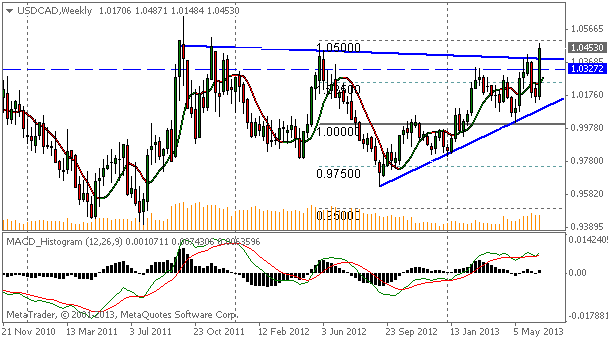
US Dollar surged last week vs major currencies on Fed Outlook

usdcad-w6-23


The US dollar surged against the other major currencies in forex trading action last week as Federal Reserve Chairman Ben Bernanke’s comments and outlook rocked the financial markets. Mr. Bernanke said the US Fed bond-buying program could possibly be scaled back in 2013 and likely to wrap up in 2014 if growth, employment and inflation data all continue to improve. The end of this program is seen as US dollar positive and helped the US dollar gain ground against all the other major currencies last week.

Looking forward to this week, the question will be whether last week’s US dollar strength will extend into this week and, perhaps, beyond.

See Full Post and Commentary Here…


This Week’s Economic Calendar highlights:

Tuesday, June 25

United States — durable goods report
United States — consumer confidence report
United States — new home sales

Wednesday, June 26

United Kingdom — Bank of England financial report
United States — GDP report
United States — personal consumption expenditure
New Zealand — trade balance

Thursday, June 27

Euro zone — Germany employment report
Japan — national consumer price index
United Kingdom — GDP report
euro zone — consumer confidence
United States — weekly jobless claims
United States — pending home sales

Friday, June 28

Euro zone — Germany consumer price index
Canada — GDP report
United States — University of Michigan survey


Central banks face tough exit decisions – BIS’s Caruana

By www.CentralBankNews.info

    Major central banks will decide how and when to exit from extraordinary easy monetary policy with much less certainty that they probably will like but they cannot afford to wait for irrefutable evidence, said Jaime Caruana, general manager of the Bank for International Settlements (BIS).
    Speaking to the annual meeting of Basel-based BIS, Caruana said nobody really knows “how central banks will exit, or what they will exit into.”
    BIS, known as the central bankers’ bank, is owned by 60 central banks and monetary authorities, including the U.S. Federal Reserve and the Bank of Japan. About 80 central bank governors and deputies listened to Caruana’s speech. 
    After five years of very low interest rates and massive asset purchases, major central banks will need to draw on all their communication skills to make the exit from such policy as smooth as possible.
   The expanded range of tools that central banks have crafted and used since the global financial crises – such as forward policy guidance, lending schemes, bond purchases – give central banks more flexibility and they will certainty need to use that, Caruana said.
    “And they will have to take decisions with much less certainty than they would probably like – waiting for irrefutable evidence may complicate exit and prove costly,” Caruana said. “The bigger the scale and scope of their interventions, the more difficult it will be to reduce them.”

    Since the beginning of the global financial crises almost six years ago, central bank balance sheets have doubled from $10 trillion to more than $20 trillion while governments have continued to pile up debt, which has risen by $23 trillion since 2007, Caruana said.
    Without such a forceful response, the global financial system could have collapsed, bringing the world economy down with it. But the recovery has been halting, fragile and uneven. Further rounds of policy easing has only lead to continued growth in private credit, weaker lending standards, record equity prices and record low long-term yields.
    

BIS: Central banks should return to roots, focus on rates

By www.CentralBankNews.info    Central banks should stop influencing overall financial conditions and return to their traditional role of controlling short-term rates now that the global financial crises is receding, the Bank for International Settlements (BIS) said.
    In response to extreme pressure on financial markets during the height of the crises, central banks in advanced economies expanded their operations and influence on markets; accepting a wider range of collateral, engaging in large-scale asset purchases and creating special lending schemes.
    But the BIS, known as the central bank to the world’s central banks, said such tools were most suitable for exceptional circumstances and central banks should now return to influencing short-term policy rates only as a way to affect monetary conditions.
    While it acknowledged that it would be tempting for central banks to hold on to their wider range of tools, BIS said there were three reasons to return to a narrower their focus.
    Firstly, central banks’ control over long-term bond yields is limited compared with short-term rates. Long-term bond yields are mainly driven by a governments’ fiscal policies and balance sheet and affected by its debt management operations.
    Secondly, “central bank balance sheet measures can easily blur the distinction between monetary and fiscal policies,” and thirdly, BIS said the expansion in most central banks’ balance sheets in recent years puts their own financial strength at risk.
    Higher bond yields, for example, can lead to losses on central banks’ holdings of bonds while changes in exchange rates expose central banks – such as those in Asia or the Swiss National Bank with large foreign exchange holdings – to potential losses.
    “All this raises tricky issues concerning coordination with the government and operational autonomy,” BIS said. “For these reasons, such tools are best considered suitable for exceptional circumstances only.”
    Since late 2007, central banks’ total assets have roughly doubled to over $20.5 trillion, up from $18 trillion last year, accounting for just over 30 percent of global Gross Domestic Product (GDP), double the ratio of a decade ago.
    In the wake of the crises, many central banks in Asia added to their foreign exchange holdings as they resisted upward pressure on their currencies. Following the Asian financial crises in the late 1990s, central banks in that region started accumulating foreign exchange reserves to avoid a repeat.
    While the rate of accumulation has slowed in recent years, BIS said foreign reserve holdings in Asian economies amounted to $5 trillion at the end of 2012 – about half of the world’s total stock of foreign reserves, with total central bank assets topping 40 percent of their GDP.
    Asian central banks are not the only ones to have boosted their foreign exchange reserves. The Swiss National Bank, which intervened to impose an upper limit on the franc’s exchange rate in September 2011, raised its foreign reserves to some $470 billion by the end of 2012, or 85 percent of Swiss GDP.
    While narrowing their operational focus, BIS said central banks should expand their overall strategy by integrating financial stability into the conduct of monetary policy.
    Prior to the crises, monetary policy frameworks were primarily focused on price stability and independent central bank decision-making.
    And while the crises didn’t discredit this focus, BIS said was clear that an environment of low inflation didn’t’ prevent the build-up of financial imbalances that “ushered in the most severe crises since the Great Depression.”
    Given the tendency of economies to generate long-lasting booms followed by busts, BIS said this “suggests that there are gains from integrating financial stability considerations more systematically into the conduct of monetary policy.”
    While regulatory measures, such as higher capital requirements for banks and regulation of the shadow banking system, will help reduce risks, BIS said some parts of the financial system will be difficult to regulate and macroprudential measures may lose some of their effectiveness over time due to regulatory arbitrage.
    Monetary policy will therefore continue to play a key role as “the policy rate represents the universal price of leverage in a given currency that cannot be bypassed so easily,” BIS said.
    That said, there are “serious analytical challenges” to integrate financial stability into monetary policy as the current macroeconomic models largely ignore the possibility of financial booms and busts.
   Work is underway in many central banks to tackle this challenge and Norway’s central bank recently amended its policy model to capture the notion that interest rates that are too low for long can create distortions over time.
   BIS was hopeful that these analytical efforts would also lead to a more symmetrical monetary policy.
   Over the last 15 years, central banks have responded to every financial crises by slashing policy rates but subsequently only raising them “hesitantly and gradually,” culminating in the current era with rates that are essentially zero.
    “A more symmetrical approach would mean tightening more strongly in booms and easing less aggressively, and less persistently, in busts,” BIS said.
    Another hope of the BIS is that central banks in the future will better appreciate the “global monetary spillovers in the increasingly globalized world” and put more weight on the global side effects and feedbacks from their policy decisions.
    Not only did low interest rates in advanced economies increase global vulnerabilities in the run-up to the financial crises, but they were transmitted and amplified worldwide as emerging markets intervened to counter upward pressure on their currencies and struggled with capital flow pressures.
    “The recent build-up of financial imbalances in a number of emerging market and small advanced economies indicates that this mechanism may be at work again,” warned BIS.

    www.CentralBankNews.info

BIS: higher interest rates may stress financial system

By www.CentralBankNews.info     A sharp rise in interest rates from major central banks’ exit from extraordinary accommodative policy could raise the risk of stress in the financial system as banks hold large portfolios of long-dated fixed income assets that will fall in value, warned the Bank for International Settlements (BIS).
    In its annual report, published as financial market shudder from the Federal Reserve’s decision to start cutting back on asset purchases later this year, BIS warned of the challenges facing central banks in striking the right balance between a premature exit and the risks from delaying an exit further.
    “These considerations highlight the possibility that disruptive market dynamics could even materialize as soon as central banks signal that an exit is imminent,” said Swiss-based BIS, as if it had been looking into a crystal ball at last week’s plunge in global bond and stock markets.
    The annual report went to the printers on June 14, the week before the Federal Reserve on June 19 laid out its timetable for pulling back from quantitative easing, underlining the uncanny ability of BIS to spot and anticipate financial events.
    In its 2006 annual report – a full 12 months before the first signs of a global liquidity shortages – it warned of “financial market turmoil or a long period of relatively slower global growth” from the unwinding of financial imbalances.  And in 2008, a few months before the bankruptcy of Lehman Bros., BIS predicted a “more protracted global downturn that the consensus view seems to expect.”
     While central banks have more tools at their disposal, are more transparent and experienced in managing expectations that in 1994 – when a tightening of U.S. monetary policy lead to turbulence in global bond markets – BIS said the situation now is much more complex with the exit requiring “a sequencing of both interest rate increases and the unwinding of balance sheet policies.”
    Central banks’ will be exiting at a time of very high levels of debt with much issued at record low levels, raising the risk of public and government anger over higher interest payments and losses.
    A rise in U.S. Treasury yields by 300 basis points, for example, would result in losses to holders of those securities that exceed $1 trillion, or almost 8 percent of U.S. GDP.  While yields are not likely to jump that much overnight, BIS noted that yields in 1994 rose some 200 basis points during one year in a number of countries, illustrating that “a big upward move can happen relatively fast.”
    Central banks’ communications skills will be severely tested during the exits from easy policy, putting a premium on careful, advance preparation at the same time that central banks have to shore up their anti-inflation credentials.
    “Retaining the flexibility and wherewithal to exit is critical to avoid being overtaken by markets,” BIS said.
    Despite progress in slashing deficits, gross government debt in most advanced governments has continued to rise. This year it is projected to reach some 110 percent of Gross Domestic Product in the United States, the United Kingdom and France, some 230 percent in Japan and close to 90 percent in Germany.
    In most large and advanced economies, the total debt of households, non-financial corporations and governments has risen by $33 trillion from 2007 to 2012, with debt ratios in a number of emerging economies rising even faster.
    In addition to slashing policy rates to effectively zero to avoid a total financial collapse, central banks also embarked on large-scale asset purchases to aid the economic recovery.
    Since late 2007 central banks’ total assets worldwide have roughly doubled to over $20.5 trillion, or just over 30 percent of global Gross Domestic Product. Among the emerging Asian countries, central banks’ assets correspond to over 40 percent of GDP as banks boosted their foreign currency reserves.
    “Open questions remain about how well markets will react to a change in course of monetary policy, not least as central banks have taken on such a large role in key  markets,” said BIS.
    In some markets central banks are effectively seen as the marginal buyer of longer-term bonds while in others they have provided a liquidity backstop and “in effect become core intermediaries in interbank markets.”
    Financial institutions will face the challenge of managing this interest rate risk and efforts by regulators’ to stress-test for the impact of higher yields take on added importance along with banks’ and investors’ ability to hedge risks.
    “That said, there may be limits to investors’ ability to hedge effectively if the transition to higher returns turns out to be particularly abrupt and bumpy,” BIS warned.
     Emerging market economies and small advanced economies will also feel the draft from the exiting by major central banks – witness the outflow of capital from emerging markets since early May – possibly leading to volatile capital flows and exchange rates and financial stability.
    Apart from the major financial repercussions of the exit, central bankers will face political pressure as households, companies and governments object to the rise in interest rates, making the exit even harder.
    “For instance, it is easy to imagine tensions arising between central banks trying to exit and debt management offices seeking to keep servicing costs low,” BIS said.
    Central banks’ own finances may also come under strain, “possibly even undermining the institutions’ financial independence. The public’s tolerance for central bank losses may be quite low.”
 
    www.CentralBankNews.info


BIS urges reforms as easy monetary policy nears end

By www.CentralBankNews.info     With five years of ultra-easy monetary policy slowly coming to an end, politicians need to make up for lost time and speed up needed reforms of labor and product markets so societies can more easily adjust and return to economic growth, the Bank for International Settlements (BIS) said.
    Despite years of rock-bottom interest rates and massive asset purchases, global economic growth remains lackluster, unemployment high, public finances unsustainable and many households and firms are still struggling to restore financial balances. Total debt has continued to rise.
    With the risks and side effects of easy monetary policy growing and the benefits dwindling, central banks – first and foremost the U.S. Federal Reserve – are now starting to look towards the exit. Easy monetary policy has helped overcome the global financial crises and nursed economies back to recovery, but time provided by central banks for households and firms to repair balance sheets and governments to restore fiscal health has largely been squandered.
    “The time has not been well used,” the respected BIS wrote in its latest annual report.
    “Continued low interest rates and unconventional policies have made it easy for the private sector to postpone deleveraging, easy for the government to finance deficits and easy for the authorities to delay needed reforms in the real economy and in the financial sector.”
    As illustrated by the Federal Reserve’s decision last week to wind up quantitative easing later this year, overburdened central banks have reached a crossroad. Delaying the inevitable exit from very easy monetary policies just makes the exit more challenging.
    “Alas, central banks cannot do more without compounding the risks they have already created,” said Swiss-based BIS, known as the central bankers’ bank.
    Continuing with loose monetary policy, will only tend to encourage aggressive risk-taking, the build-up of financial imbalances and distorted prices. In addition, low rates in advanced economies have spilled over to emerging economies, pushing up exchange rates and creating credit and property booms.
    Instead of retarding needed changes in societies with near-zero interest rates and further purchases of government debt, BIS said central banks must return to their traditional focus and thereby encourage policy makers to change.
    “After all, cheap money makes it easier to borrow than to save, easier to spend than to tax, easier to remain the same than to change,” said BIS.
    Sluggish economic growth is not only causing hardship for millions of people, but also explains why central banks have continued to loosen policy over the last year and why “even more radical ideas have been entertained” BIS said, referring to nominal GDP targeting or monetization of fiscal deficits.
    Unlike previous years, when BIS rarely ventured into specific public policy recommendations, the world’s oldest financial institution is not holding back in highlighting the reforms that it believes most economies need to tackle to return to strong and sustainable growth.
    Continued financial reform and repair of the finances of households, firms and governments is necessary but not enough.
    “Authorities need to hasten labor and product market reforms so that economic resources can shift more easily to high-productivity sectors,” Stephen Cecchetti told journalists as he completes his five-year term at the BIS as economic adviser.
    BIS pointed out that long-run economic growth and labor productivity has been trending downward in most advanced economies well before the financial crises in 2007, suggesting that part of the slowdown may be due to other factors.
    “From that point of view, the crises aggravated the slowdown, but it was not the only cause,” BIS said.
    Slower investment in information technology, for example, accompanied a drop in U.S. productivity and the U.S. employment rate peaked around 2000 and has been steadily falling since then for reasons that are still being debated.
    Another point raised by BIS is that in the countries at the center of the financial bust, the sustainable growth path was likely overstated as financial booms tend to conceal structural misallocations of resources – construction, finance and real estate – and imbalances are first revealed when things go bust. Using previous growth rates as a benchmark is therefore not only inappropriate, but it also leads to widespread disappointment with current growth.
    In order to improve growth, those past misallocations have to be put right, BIS said.
    In some countries, workers and capital will need to shift away from industries that over-expanded during the boom to other sectors. In other countries, such as Italy that did not see a housing boom, productivity must rise.
    In the long run, economic growth comes from new goods and services, and innovative ways of producing and delivering them.
    “Regulations that obstruct innovation and change will therefore slow growth,” said BIS, adding that hindering a reallocation of capital and workers across sectors “puts the brakes on the economic engine of creative destruction.”
    As such reforms typically produces winners and losers, policy makers only tend to act when their hand is forced, said BIS, noting those countries that have endured the most intense market pressure in recent years have pushed through such reforms.

As Demand in the Global Economy Weakens, American Multi-Nationals to Feel the Pain

By Profit Confidential

The so-called “powerhouse” of the global economy, China is witnessing an economic slowdown like never before—the repercussions of which will be felt here in North America.

The HSBC Flash China Manufacturing Purchasing Managers’ Index (PMI) continued its slide in June, registering 48.3—a nine-month low—compared to 49.2 in May. (Source: Markit, June 20, 2013.) Any number below 50 suggests contraction in the manufacturing sector.

China is a leading indicator of the global economy, because it exports a significant portion of its products worldwide. If manufacturing in China declines, it suggests the economic hubs of the global economy aren’t really buying much.

Similarly, Germany, the fourth-biggest economy in the global economy, is also facing dismal economic conditions. The country’s Flash Manufacturing PMI declined to a two-month low in June, standing at 48.7 compared to 49.4 in May. (Source Markit, June 20, 2013.)

And Russia seems to be headed towards an economic slowdown as well. The International Monetary Fund (IMF) has slashed its growth forecasts for the country. The IMF expects the Russian economy to grow only 2.5% in 2013, and 3.25% in 2014. I think the IMF is way off with both estimates—we see growth coming in much lower for Russia this year and next.

As an economic slowdown in the global economy emerges, we are seeing U.S.-based companies report weak demand. Caterpillar Inc. (NYSE/CAT), the big construction and mining company, reports that in the last three months ending in May, its total machine retail sales in the global economy fell seven percent from the same period a year ago. Caterpillar’s retail machine sales declined in every region of the global economy except for Latin America! (Source: Bloomberg, June 20, 2013.)

Caterpillar’s retail sales declining in the global economy may just be the beginning of what may become the norm for second-quarter earnings results for other large American multinational companies—weak revenue.

My opinion hasn’t changed; the global economy is treading in dangerous waters. Very few in the media are covering this story. It’s a global economy: if China, the eurozone, Japan and other big economies are all facing soft demand from their consumers and businesses, big American companies operating in these countries will eventually feel the pain as well. That pain will eventually make its way to the stock prices of those companies.

What He Said:

“Why Google stock will go higher: Most investors in Google, surprisingly, are retail investors. And that’s why the stock can go higher—because only 20% of the stock is owned by institutions. If the institutions jump in and buy Google, the stock will certainly move higher.” Michael Lombardi in Profit Confidential, June 2, 2005. Michael recommended Google Inc. (NASDAQ/GOOG) as a buy on June 2, 2005, when the stock was trading at $288.00. On November 5, 2007, when Google reached US$700.00 per share, Michael advised his readers to sell their Google stock and to put the proceeds into gold-related investments. Coincidently, gold bullion was also trading at about $700.00 per ounce in November 2007. Michael’s message was to trade each $700.00 share of Google into $700.00 of gold, because he saw gold as a much better investment.

Article by profitconfidential.com