The Two Things That are Keeping the S&P 500 Artificially High

By Profit Confidential

The Two Things That are Keeping the S&P 500 Artificially HighIn the first quarter of 2013, companies on the S&P 500 repurchased $97.8 billion worth of their own shares.

That represents an increase of 4.3% from the previous quarter (fourth quarter of 2012), and a 17.2% hike from the same period a year ago. Over the trailing 12 months, the S&P 500 companies have repurchased almost $400 billion worth of their own shares. (Source: FactSet, June 27, 2013.)

Some of the big-cap companies on the S&P 500 are buying back a significant number of shares. Consider Oracle Corporation (NASDAQ/ORCL), for example. The software giant on the S&P 500 has repurchased $10.65 billion worth of shares in the trailing 12-month period. That amount is the sixth-highest among the S&P 500 companies.

Other companies are doing it, too. AT&T Inc. (NYSE/T), a big-cap telecommunication company on the S&P 500, has repurchased its own shares amounting to $5.9 billion in the first quarter.

Big-cap companies that have been on the index since the fourth quarter of 2004 have been reducing their number of shares outstanding for seven straight quarters. In the first quarter, their shares outstanding declined 1.1% year-over-year.

This shouldn’t be surprising to my Profit Confidential readers; I have been talking about this issue in these pages for some time.  By reducing the number of shares a company has outstanding, corporate earnings per share automatically increase.

For example, say a company has 10,000 shares outstanding and has corporate earnings of $100.00, or $0.01 per share. If the company buys back 2,000 shares and its profits remain at $100.00, per-share earnings will rise 25% to $0.0125. This is nothing but financial engineering, and investors should be careful about its effects on corporate earnings.

In hindsight, as the key stock indices like the S&P 500 continue to rally, corporate earnings estimates for the second quarter are sliding lower.

At the end of March, analysts expected corporate earnings growth for the S&P 500 companies to be 4.2%. For the week ended June 28, the corporate earnings growth rate for the S&P 500 companies declined to 0.8%. (Source: FactSet, June 28, 2013.)

Here’s what I am also watching: cash and short-term investment accounts on the financial statement of the S&P 500 companies increased by $30.1 billion in the first quarter, amassing to $1.29 trillion. The first quarter of this year was the fourth in a row in which the S&P 500 companies increased their cash positions. (Source: FactSet, June 27, 2013.)

Combining these two phenomena—the S&P 500 companies buying back their own shares and increasing cash on their balance sheets—I see two implications.

First, those companies might repurchase more shares and make investors believe their corporate earnings are actually better than they appear.

And second, it shows me that companies on the key stock indices are not spending. They are not investing in projects that create jobs and eventually drive the U.S. economy toward economic growth. The struggles in the jobs market we have seen since the financial crisis might just continue.

While companies are artificially pumping up their stock prices, it might be prudent to avoid the S&P 500 until things settle down and stock prices are more in line with valuations.

Article by profitconfidential.com

The One Stock that Always Seems to Keep on Rising

By Profit Confidential

The One Stock that Always Seems to Keep on RisingThere are lots of benchmark stocks, but NIKE, Inc. (NKE) is an incredibly important one in retail.

It’s actually quite surprising that such a mature brand can continue to do as well as it does. Not only is the company succeeding operationally, but it continues to be an excellent stock market investment.

The company’s earnings results in the first quarter of this year were very good, and there’s been some worry that second-quarter numbers would be soft, commensurate with all the economic data we have been getting.

But that was not the case as the company’s second-quarter earnings were excellent.

Earnings season is always the most important time of year, and it certainly helps to divert investor attention from all the worries in the world. There’s been a real focus on what the Federal Reserve is going to do with quantitative easing. As odd as this may be, the stock market went up on weaker economic data in the hopes that quantitative easing would continue through to 2014.

NIKE said that its fiscal fourth-quarter sales grew seven percent to $6.7 billion, or nine percent on a currency-neutral basis.

The company experienced growth in all geographic regions except for Western Europe and China. Sales were stronger for running, basketball, and men’s and women’s training shoes, offsetting slightly weaker sales in sportswear, action sports, and soccer.

Earnings grew an impressive 25% to $696 million. With a two-percent reduction in average common shares outstanding, diluted earnings per share grew 27% to $0.76. This is an excellent performance from such a mature brand.

NIKE’s stock chart is featured below:

Nike Inc Chart

Chart courtesy of www.StockCharts.com

NIKE has proven to be a solid equity market investment. According to the company’s history, it’s never down for long.

Similar to the company’s first quarter, the standout in NIKE’s latest earnings report was its strength in the North American market. Footwear, representing about half of the company’s total sales in the North American market, grew seven percent, while apparel sales grew 22%, and equipment grew 24%.

Also noteworthy was the company’s huge increase in its cash balance, growing 44% to $3.34 billion over the comparable quarter.

The company has been steadily increasing its annual dividends over the last five years. The huge increase in NIKE’s cash balance suggests another quarterly increase is likely this year.

NIKE has now doubled in value on the stock market since 2010, not including its dividends. The company’s long-term stock market performance is exemplary and history suggests that an investment in NIKE may be a worthwhile long-term endeavor.

While no business can provide absolute consistency in both revenue and earnings growth, NIKE has been able to execute its business plan with remarkable effect. (See “How Five Hundred Bucks and a Handshake Created a Colossal Stock Market Winner.”)

The company experienced a slow period between 1997 and 2004, but all stocks go through cyclical enthusiasm from Wall Street, even while business conditions continue to grow.

I always follow NIKE as a benchmark on consumer confidence. The company is fully priced on the stock market, but it always is.

Article by profitconfidential.com

The Signs You Should Look for Before Getting into Equities Again

By Profit Confidential

The Signs You Should Look for Before Getting into Equities AgainIn spite of all the doom and gloom reactions that immediately followed the Federal Reserve’s recent decision to announce a possible scaling back of the central bank’s bond-buying program by the year’s end, the stock market rallied for three straight days with triple-digit gains by the Dow Jones Industrial Average in each.

As I have said, the Fed will only ease off on the throttle if they think the economic recovery is on target, if the jobs market improves, and if inflation doesn’t become an issue.

The soft gross domestic product (GDP) growth of 1.8% in the first quarter was actually a relief for the stock market. Estimates had called for GDP growth of 2.4%, so it was a major underperformance.

Now I know it’s only one quarter, but the renewed buying interest that followed in the stock market suggests to me that traders are now hoping for slowing in the U.S. economy, so the easy money can continue and the stock market can keep moving higher.

I’m not convinced stocks are set for anther sizzling run-up on the charts. Trading will continue to be driven by the daily headlines, which add to the volatility.

The focus will shift to jobs in a few days and depending on what we see, the stock market will trade off that. I sense that the market is probably secretly seeking a flat number and for the unemployment rate to hold steady or rise.

Traders know that a move in the unemployment rate to 7.2% would make the Fed begin to look at tapering its bond purchases.

And don’t forget there’s also the potential negative impact from the stalling in China and continued distress in the eurozone, which will impact the demand for American goods.

The growth in the global economy is also being slashed down to 2.0% this year and 2.6% in 2014, according to Madhur Jha, the chief economist at HSBC. Jha feels the slowing in China and the possible cutting of the Fed’s bond-buying program will affect growth. (Source: Barnato, K., “HSBC Cuts Global Growth Forecasts, Sees Major Slowdown in Emerging Markets,” CNBC, June 28, 2013.)

While I feel the best gains in the stock market are behind us, I still believe there will be opportunities to make money on market weakness—the bigger the drop, the better the opportunity.

If the global and U.S. economies continue to show lackluster results, we could be seeing a few more years of stimulus from the global central banks and further opportunities in the stock market.

S&P 500 Percent of Stocks Chart

Chart courtesy of www.StockCharts.com

Over the next few weeks, the key will be to see how the stock market behaves and whether the bargain hunters start to surface.

I would rather just take a seat and wait for more selling before jumping in. There will be opportunities to make money on the market swings to be sure.

Article by profitconfidential.com

Why I Remain Bullish on Gold Even While Negativity Surges

By Profit Confidential

Why I Remain Bullish on Gold Even While Negativity SurgesGold bullion prices are taking a hard hit. Headlines are blaring with negativity, and bears continue to say the precious metal is useless. Dear reader, they may have done a good job driving the gold bullion prices lower, but they haven’t changed my opinion on gold one bit. I continue to believe that gold bullion has a shining future ahead.

Regardless of the gold bullion prices declining on the paper market, I see demand for the precious metal increasing. It’s giving the average investor another buying opportunity just like they had back in 2008.

Look at the chart below and pay close attention to the circled area. In 2008, gold bullion prices went from above $1,000 an ounce in early 2008, to below $700.00 by end of the year. If I recall correctly, the sentiment from many notable economists was very similar to what we’re hearing today.

Gold-Spot Price Chart

Chart courtesy of www.StockCharts.com

But smart investors are buying.

The demand for gold bullion at the U.S. Mint is higher than what it was in 2011, when the precious metal prices were at their peak. So far this year, until June 27, the U.S. Mint has sold 619,000 ounces of gold bullion in coins. This figure is almost 7.5% higher than the same period in 2011, when the Mint sold 576, 000 ounces in gold bullion coins. (Source: U.S. Mint web site, last accessed June 27, 2013.)

Demand from gold bullion–consuming nations like India is robust in spite of the Indian government imposing higher import taxes and its central bank telling Indian banks not to sell gold bullion coins.

The premium paid on the precious metal by Indian consumers doubled on Wednesday, June 26 as suppliers could not meet the demand. Harshad Ajmera, proprietor of wholesaler JJ Gold House in Kolkata, said, “We are unable to supply, though there is demand … we give deliveries after two to three days.” (Source: “Gold premiums jump as physical demand outstrips supply,” Reuters, June 26, 2013.)

On top of this, I see more central banks buying gold bullion than selling. According to data from the International Monetary Fund (IMF), central banks from Russia and Kazakhstan bought the precious metal for the seventh straight month in April. Central banks from nations like Turkey, Belarus, Azerbaijan, and even Greece joined Russia and Kazakhstan on their buying spree that month as well. (Source: Bloomberg, May 27, 2013.)

You need to keep in mind that central banks were net sellers of gold bullion not too long ago, and now they are buying.

So how low can the precious metal’s prices actually go with all the negativity?

It is certainly tough to be a gold bull these days, but what I know is that the greatest opportunities come in times of greatest uncertainty. Currently, gold bullion prices have come under scrutiny and even some of the most well-known gold bullion bugs are turning against the precious metal.

But I believe they’re wrong. While it can still go lower in the short term, the long-term trend still holds.

Michael’s Personal Notes:

A report from the National Institute of Retirement Security (NIRS) found that American households have a shortfall of anywhere between $6.8 trillion to $14.0 trillion when it comes to their retirement savings.

Looking at their assets only in their retirement accounts, 92% of working households in the U.S. economy don’t have enough savings to meet their retirement target. (Source: “The Retirement Savings Crisis: Is It Worse Than We Think?,” National Institute of Retirement Security, June 2013.)

Sadly, that’s just one part of the problem. The report also pointed out that as many as 38 million working-age households in the U.S. economy don’t have any retirement savings. In addition, for all working households, the median retirement savings is just $3,000. For those who are near their retirement, their median retirement savings are just $12,000.

About 67% of working households between the ages of 55 and 64 and with a minimum of one person involved in the jobs market earning income have saved less than the amount of one annual income. (Source: Ibid.)

How will this phenomenon impact the U.S. economy? The effects of a major shortfall in retirement savings can be many, but one of its main victims may just be the already struggling jobs market.

What we already know from the most recent jobs market report is there are almost 12 million unemployed Americans. Most of those who were lucky enough to find a job are working low-wage jobs, like those in the retail sector, or are working part-time.

According to the U.S. Department of Labor, in 2012, there were 284,000 college graduates who were working for minimum wage in the jobs market—a figure that has doubled since 2007, and has increased 70% from 10 years ago. (Source: Wall Street Journal, March 30, 2013.)

As the report cites, there is a significant number of Americans without sufficient savings who are closing in on retirement age. It’s likely that they will stay in the jobs market longer, because they don’t really have any other option.

The jobs market will feel a ripple effect as those who are already looking for work or those who are looking to enter the workforce find fewer openings.

Consider the college graduates working for minimum wage in the jobs market. If they have student debt, they will have troubles paying it off—which will lead to a higher delinquency rate on the already $1.0-trillion student debt load.

And those with lesser skills in the jobs market will have even more difficulties finding work compared to what they see now.

Dear reader, food stamp usage in the U.S. economy is at a dangerous level; and I can see it going even higher as more Americans are unable to find work due to those staying in the jobs market longer rather than retiring.

As we have learned, and similar to Japan’s mishap, printing more paper money helps the stock market and big banks—not the little guy. About two-thirds of U.S. gross domestic product (GDP) is dependent on consumer spending. If consumers are not spending, we have no GDP growth. If consumers pull back on spending, we have negative GDP growth. That’s why I’ve slowly been preparing my readers for another recession. And no stock market I know has ever risen during a recession.

What He Said:

“Many of today’s consumers have purchased properties with very little down payment. They’ve been enticed by nothing-down, interest-only, second and third mortgages. Bottom line: The lower interest rate environment sucked consumers into the housing market big-time. And that will eventually cause us all problems.” Michael Lombardi in Profit Confidential, June 22, 2005. Michael started warning about the crisis coming in the U.S. real estate market right at the peak of the boom, now widely believed to be 2005.

Article by profitconfidential.com

Number One Reason American Students Can’t Find Jobs

By Profit Confidential

A report from the National Institute of Retirement Security (NIRS) found that American households have a shortfall of anywhere between $6.8 trillion to $14.0 trillion when it comes to their retirement savings.

Looking at their assets only in their retirement accounts, 92% of working households in the U.S. economy don’t have enough savings to meet their retirement target. (Source: “The Retirement Savings Crisis: Is It Worse Than We Think?,” National Institute of Retirement Security, June 2013.)

Sadly, that’s just one part of the problem. The report also pointed out that as many as 38 million working-age households in the U.S. economy don’t have any retirement savings. In addition, for all working households, the median retirement savings is just $3,000. For those who are near their retirement, their median retirement savings are just $12,000.

About 67% of working households between the ages of 55 and 64 and with a minimum of one person involved in the jobs market earning income have saved less than the amount of one annual income. (Source: Ibid.)

How will this phenomenon impact the U.S. economy? The effects of a major shortfall in retirement savings can be many, but one of its main victims may just be the already struggling jobs market.

What we already know from the most recent jobs market report is there are almost 12 million unemployed Americans. Most of those who were lucky enough to find a job are working low-wage jobs, like those in the retail sector, or are working part-time.

According to the U.S. Department of Labor, in 2012, there were 284,000 college graduates who were working for minimum wage in the jobs market—a figure that has doubled since 2007, and has increased 70% from 10 years ago. (Source: Wall Street Journal, March 30, 2013.)

As the report cites, there is a significant number of Americans without sufficient savings who are closing in on retirement age. It’s likely that they will stay in the jobs market longer, because they don’t really have any other option.

The jobs market will feel a ripple effect as those who are already looking for work or those who are looking to enter the workforce find fewer openings.

Consider the college graduates working for minimum wage in the jobs market. If they have student debt, they will have troubles paying it off—which will lead to a higher delinquency rate on the already $1.0-trillion student debt load.

And those with lesser skills in the jobs market will have even more difficulties finding work compared to what they see now.

Dear reader, food stamp usage in the U.S. economy is at a dangerous level; and I can see it going even higher as more Americans are unable to find work due to those staying in the jobs market longer rather than retiring.

As we have learned, and similar to Japan’s mishap, printing more paper money helps the stock market and big banks—not the little guy. About two-thirds of U.S. gross domestic product (GDP) is dependent on consumer spending. If consumers are not spending, we have no GDP growth. If consumers pull back on spending, we have negative GDP growth. That’s why I’ve slowly been preparing my readers for another recession. And no stock market I know has ever risen during a recession.

What He Said:

“Many of today’s consumers have purchased properties with very little down payment. They’ve been enticed by nothing-down, interest-only, second and third mortgages. Bottom line: The lower interest rate environment sucked consumers into the housing market big-time. And that will eventually cause us all problems.” Michael Lombardi in Profit Confidential, June 22, 2005. Michael started warning about the crisis coming in the U.S. real estate market right at the peak of the boom, now widely believed to be 2005.

Article by profitconfidential.com

Looking for Safety? People Have to Eat and That’s Why I Love This Food Company

By Profit Confidential

Looking for Safety? People Have to Eat and That's Why I Love This Food CompanyIt’s impossible to get more basic or old economy than Chef Boyardee.

The brand is owned by ConAgra Foods, Inc. (CAG), which is one of North America’s largest packaged-food enterprises. The company’s brands are found in 97% of American households, and it has a large commercial foods segment.

ConAgra just reported a very good quarter, especially considering how mature and competitive the food business is. Frankly, the company’s sales and earnings were quite impressive.

Total revenues for the 13 weeks ended May 26, 2013 grew to $4.59 billion, up 33.7% over the comparable quarter. The company’s consumer foods division grew 7.3% to 2.3 billion, while commercial foods grew 3.5% to $1.33 billion. The rest of the revenue gain came from the acquisition of Ralcorp Holdings, Inc., which added $962 million to revenues and $108 million in operating earnings.

In its fiscal fourth quarter of 2013, ConAgra’s earnings were a solid $192 million, compared to a loss of $86.2 million in the same quarter last year.

For its full fiscal year (ended May 26, 2013), ConAgra’s total sales grew 15.9% to $15.5 billion. Earnings grew an impressive 65.4% to $774 million.

The company’s cash balance also grew significantly to $184 million, and shareholders’ equity jumped to $5.4 billion, up from $4.5 billion.

ConAgra’s 20-year stock chart is featured below:

Conagra Inc Chart

Chart courtesy of www.StockCharts.com

The company’s share price recently crossed below its 50-day simple moving average, but as the above chart illustrates, the shares have clearly broken out after a long consolidation.

Currently yielding three percent on the stock market, this position looks to be fully priced with a price-to-earnings ratio of around 29.

But what the Street likes about the company’s return to profitability was its solid forecast for the future.

This fiscal year, the company expects its adjusted earnings per share (for comparability purposes) to be $2.40, representing 11% comparable growth.

Management cited a strong earnings contribution from its Ralcorp acquisition and continued growth in its consumer foods division as reasons for the solid forecast.

The company expects some $300 million in annual pre-tax cost synergies from the Ralcorp business by the end of fiscal 2017.

Because of this, annual adjusted diluted earnings per share between fiscal 2015 and 2017 are targeted at a minimum of 10%.

The company forecasts annual adjusted earnings-per-share growth of between seven and nine percent for the long term, with annual sales growth expected to be between three and four percent.

This is an improvement over ConAgra’s previous expectations, and while the earnings forecast might not seem that robust, they are very solid for such a large and mature enterprise. Institutional investors want certainty, and that’s exactly what ConAgra delivered in its latest quarter. They bid the shares significantly on the company’s earnings results.

The numbers so far are modest, but generally holding up much like in the first quarter. There have been some earnings surprises, both up and down. (See “Stock Market Fake-Out: Where Is the Retrenchment?”)

Big investors are still nibbling away at positions, and as earnings season gets into full swing, this will be the biggest trading catalyst.

From my perspective, the stock market remains a big hold. Interest rates are going up as they should be. They’ve been held down for far too long. Large-cap balance sheets remain excellent.

Article by profitconfidential.com

If I Was Told I Could Only Buy One Stock, This Would Be the One

By Profit Confidential

If I Was Told I Could Only Buy One Stock, This Would Be the OneSomeone asked me the other day to recommend a diversified exchange-traded fund (ETF).

I thought about it and really couldn’t think of one. There are some good diversified ETFs out there, but why only limit yourself to an ETF and not a stock?

Now as many of you know, I focus primarily on small-cap stocks (read “Small-Cap Stocks the Place to Be—If Economic Growth Is Real”) and contrarian plays. Seldom do I venture into the big-cap stocks and blue chips, but that’s not to say these are not important to the overall success of a diversified portfolio.

So when I was asked the original ETF question, I was initially thinking of what diversified ETF I could recommend—but I quickly realized that the best answer was not an ETF.

I suggested General Electric Company (NYSE/GE), a company that is well diversified across many industries and geographical areas around the world.

First established in 1892 and with over 305,000 employees worldwide, General Electric (GE) is widely known as a huge company. When you think corporate America, you think GE.

GE has long been known as a “widow” stock, something that you buy and leave in your holdings for decades until retirement and then live off the strong dividends.

GE builds products and solutions for anyone from consumers to commercial enterprises. Providing kitchen appliances, aviation engines and systems, medical imaging solutions, healthcare products, advanced power systems, and energy management, the company has interests in many areas.

But the best thing about GE is that it’s strong in all of its areas and is a world-class company.

Just take a look at the price chart of GE from 1964 to today. It has been an impressive and steady ride overall; though there have been some hurdles since 2000.

General Electric Company Chart

Chart courtesy of www.StockCharts.com

In 2012, GE reported revenues of $147 billion and earned over $13.6 billion in profits.

At first glance, the growth may not look that great, with revenues estimated by Thomson Financial to grow at a rate of just 0.2% this year and 2.0% in 2014; but for GE, it’s all about long-term performance.

While you can certainly get a lot more growth from the technology companies, you have to question whether they will still be around in 50 years.

I know GE will be here for another 50 years, and that’s why, in my opinion, the company makes perfect sense as a comparable to a diversified ETF.

Article by profitconfidential.com

Review: Intermarket Analysis and Investing

By The Sizemore Letter


“Recognizing that the stock market is a difficult game to play and admitting that investing in securities is an art, we can only preface this book by saying, ‘Good luck.’”

So writes Michael E.S. Gayed in the forward to Intermarket Analysis and Investing, originally published in 1990 and republished in 2013.

Outside of politics, few areas of life are in greater need of fresh thinking than the investment profession.    Like students of political ideologies or religious cults, investors often fall into dogmatic camps.  There are chartists, who view stock patterns as if they are prophetic views of the future.  There are value investors who view the utterances of Warren Buffett and Benjamin graham like divine revelations.  There are trend followers…and contrarians who actively bet against the prevailing trend.

There is a dedicated core of followers for virtually any investing style you can imagine (and plenty that you can’t).  But the problem with rigid schools of thought is that what works in one market does not necessarily work in another.

This is the basis of Gayed’s book.  Rather than lean too heavily on one particular method, with all of its inherent flaws, Gayed attempted to meld the various schools of thought into a unified process.  He’s not the first analyst to do so, and he certainly wasn’t the last.  But his attempt is one of the most comprehensive I’ve seen, and it was made over 20 years ago.

Investment books tend to have a somewhat finite shelf life.   Stories and anecdotes can look somewhat dated with the passing of time.  But as with Graham and Dodd’s Security Analysis, first published during the pits of the Great Depression, there is value in studying historical anecdotes and in reading a contemporary account of the times.  History tends to get “scrubbed” with the passing of time, which makes learning its lessons more abstract and difficult.  Gayed’s book fits a particular time period—the late 1980s and very early 1990s—making it an effective time capsule of the era immediately preceding the Internet Revolution.

One of the aspects I most respect about Gayed’s work is that he is intellectually honest.  Investing isn’t easy, and no “how to” book is a guarantee of success.   You will make mistakes along the way, but those mistakes make you a better investor if you make analyzing them part of your process.

And this is really the key word: process.  All 484 pages of the book can essentially be boiled down to one critical point: you must have a rigorous investment process in place.  The process can take different forms, but a regular assessment of the results should be a key part of it.  Process brings order from the chaos and prevents your investment decisions from being “a random walk of trial and error.”  And if it is failing to deliver results, “perhaps the whole process should be examined to uncover where things went wrong.”

Well said, Mr. Gayed.

Gayed addresses the strengths and weaknesses of each of the major schools of investing thought.  For example, of fundamental analysis he writes that it is “more reliable than any other approach…tangible and logical.”  But also acknowledging its shortcomings, he notes that “fundamentals tend to lag behind the price action.  The discounting mechanism of the market often senses evolving financial problems before the company actually discloses them.”

Similarly, Gayed notes that quantitative market timing approaches are “most helpful in allowing investors to buy or sell a security at the most opportune price.”  But they can also let you “get carried away in a frenzy of speculation and overtrading, eventually becoming a gambler.”  And remember, Gayed wrote this in the days before discounted internet trading and algorithmic bots!

I liked Gayed’s comments on contrarian investing because I see some of my own psychological shortcomings in his words.  While betting against the crowd at key moments can by wildly profitable, “The crowd is not wrong at all market junctures… The only correct application of the contrarian approach occurs when market psychology reaches unanimity in either direction.  Beware of being a contrarian all the time, since this attitude violates the well-established norms of trend following.”

Given my experience of working with Harry Dent for the better part of a decade, I found Gayed’s comments on demographics to be particularly interesting.  Dent made several bold predictions that proved to be correct and became a very successful New York Times bestselling author in the early 1990s by using demographics as a forecasting tool.  I still consider his first bestseller—1993’s The Great Boom Ahead—to be his best.

Dent is widely considered to be the first analyst to effectively use demographics in the investment process.  But Gayed appears to have independently reached many of the same conclusions at around the same time:

All industry groups are affected in varying degrees by demographics.  Beginning in the 1970s, the economy has felt the impact of the baby boomers—those born between 1945 and 1960… The influence of demographics is likely to continue into the first quarter of the next century as the baby boomers grow older.  There might be increased demand for such services as health care, banking, investments, insurance, nursing homes, leisure, travel, etc… Demographics should be factored into the overall investment strategy.

This could have been written today, but Gayed wrote it in 1990.  The prescience is impressive.

Gayed saves some of his best insights for last in the section on intermarket relationships.  The capital markets are a complex organism.  “Market links are interrelated, and they tend to feed on each other… The commodities market, for example, influences the trend of interest rates, which affect the bond market.  This, in turn, impacts securities prices.”

In this era of central bank intervention, it’s important to remember not to view each segment of the market in isolation.  Intermarket analysis is complicated…and messy…and you won’t always put the pieces together.  But it should be part of the thought process that goes into your asset allocation.  Gayed notes that an astute investor would have seen that the accelerating inflation of the 1970s would have been great for commodities but terrible for bonds.  But when the Fed’s high interest rates in the 1980s halted inflation, the high real interest rates in place set the stage for a long-term bull market in bonds…which in turn led to a long-term bull market in stocks.

I would add that more recently, investors with a deeper understanding of intermarket dynamics would have known that the Fed’s explosive growth in its balance sheet would not be inflationary given the debt deflation going on in the private sector. First order thinking would tell you to expect inflation.  Second order thinking would tell you to expect flat or even falling prices.

Oh, and remember “TED spreads”?  These are the spreads between Treasury bills and Eurodollar rates that become front-page news during the 2008 meltdown when the capital markets ceased to function.  Few people had ever heard of TED spreads prior to 2008.  Gayed was writing about them in 1990.

I recommend you pick up a copy of Intermarket Analysis.  Gayed’s magnum opus is an exhaustive collection of investment insights that he has done a remarkable job of funneling into a cohesive framework for analysis.   The sheer scope of material covered would put most MBA programs to shame.

SUBSCRIBE to Sizemore Insights via e-mail today.

Currencies Stuck in Narrow Ranges

EURUSD – The EURUSD Trading Between 1.3014 and 1.3071

The EURUSD has failed to advance in any of the directions, and now it is consolidating in a narrow range limited by 1.3014 and 1.3071. The pair on the 4 hour timeframe left the oversold zone due to the consolidation phase, thus it has no technical “barriers” to resume its reduction, at the same time the Parabolic SAR is still above the price chart. Nevertheless, the longer the single currency remains above 1.3020 support area, the more likely the basis formation at this level becomes followed along with the following resistance breakdown and the increase towards the 32nd figure.

It goes without saying, it is not necessary to rush into long positions until the pair forms the basis, since it is premature to talk about the end of the downtrend.


eurusd02.07.2013


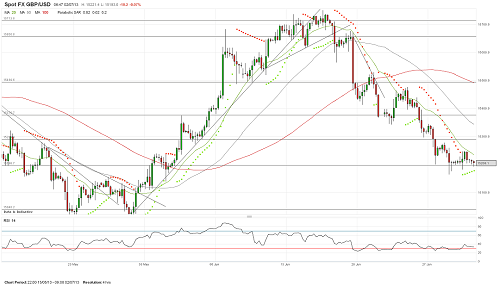
GBPUSD – The GBPUSD Trying to Hold Above 1.5200

The GBPUSD dropped below the 52nd figure, but after testing 1.5183 it increased to the level of 1.5247, which became the yesterday’s high. The bulls failed to breakthrough higher, and the pound returned to the 52nd figure. The pair also failed to develop a downward trend, consequently it spent the whole day in a narrow range yesterday. The pair remains under pressure, which also put by the risks of breakdown of the support with a further decrease towards the 51st figure. However, the inability to overcome the support would cause the basis formation, as well as the increase to the resistance at 1.5290.


gbpusd02.07.2013


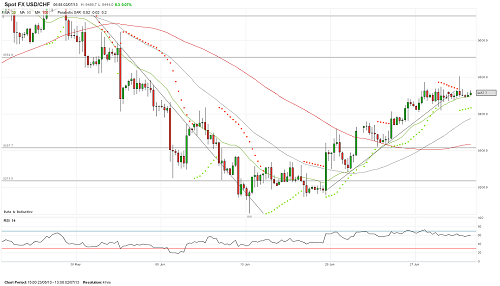
USDCHF – Downside Risks to the USDCHF Increase

The USDCHF was drifted near the support at 0.9440. At one point, the pair bulls made their mind to test the strength of the 95th figure. Having verified it, the dollar returned to its initial position. The longer the bulls manage to overcome 0.9500, the higher the risks of the renewed pair’s decrease are. The next support is located at the 94th figure, where the 50 day MA is running.


usdchf02.07.2013


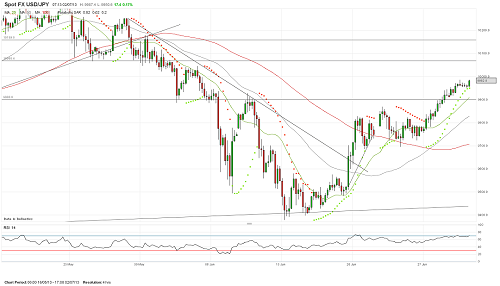
USDJPY – The USDJPY Slowly but Surely Increasing

The USDJPY dynamics has also left much to be desired, though the bulls clearly feel confident in their further actions and are still focused on the 100th figure. The pair’s increase is limited by the 99.86 level so far, but the Parabolic SAR is still below the price chart and moving averages are pointing upwards, consequently the likelihood of the level’s breakdown is very high. It is wise to remember about the upcoming publication of the U.S. macroeconomic statistics – it might completely change the situation.


usdjpy02.07.2013

provided by IAFT


Gold Analysts Turn Bullish as Price Regains 40% of June Slump

London Gold Market Report
from Adrian Ash
BullionVault
Tuesday, 2 July 08:10 EST

The PRICE of GOLD rose in Asia and jumped at the start of London trade Tuesday, hitting $1267 per ounce to recover 40% of last month’s crash before easing back.

Prices for silver bullion also rose, but lagged gold’s rate of gain, before slipping back below last week’s finish at $19.69 per ounce.

European stock markets meantime fell, as did the Euro – down 0.5¢ against the Dollar – after Eurozone and IMF officials said Greece has just three days to prove its commitment to fresh budget cuts.

 Prices to buy gold with Euros touched €970 per ounce, a near 1-week high more than 7% above last week’s 34-month low.

 “We expect gold to trade with a positive bias going ahead,” says a technical analysis of the gold chart from Sharekhan, India’s second largest stock broker.

 “The crucial support is placed at $1180,” says Sharekhan, “which is the low it touched” at the end of June.

 “Friday’s multi-year low of $1180 looks like a bad quarter-end liquidation memory,” agrees Canadian bank and London bullion market-maker ScotiaMocatta.

 On a technical analysis, “[Monday’s] higher close confirms Friday’s bullish hammer reversal warning on the daily chart,” says Scotia.

Last week’s record-large number of bearish contracts held by speculative traders in US gold futures also “leaves gold open to a more sustained short covering” as they scramble to close their positions at rising prices, says fellow London market-maker HSBC.

“[This Thursday’s] 4th of July holidays in the US also make it likely the gold markets will be relatively thin,” HSBC adds. “This could all contribute to a rally.”

After advising clients to sell gold in January, “At this time we believe gold and gold miners represent good risk/reward,” says Carter Worth, managing director and chief market technician at Oppenheimer Asset Management Inc., which currently runs some $9 billion in client money.

“Indeed, the recent extreme weakness is judged to be the reciprocal…of the extreme strength witnessed in the summer of 2011. The ‘despair’ relating to gold now is as palpable as ‘euphoria’ then.”

Urging “immediate action” on Monday, investment and bullion bank J.P.Morgan told clients to “go overweight” on commodities – a call last made in October 2010 – because “consumers are likely already starting to act on the 20%+ swoon” in natural resources prices.

“Price-driven involuntary production cuts in crude oil, copper, and gold” should also help buoy prices, says J.P.Morgan.

Bank of America agrees, noting today that “Around one-third of the gold mining industry does not cover ‘all-in’ cash production costs.”

But while “in the long term [mining problems] will provide big support,” says $2.2 billion fund manager Charlie Morris at HSBC Global Asset Management in London, “in the short term it won’t really make any difference at all.

“I’m still bullish [on gold prices] long term, but I just think we’ve got a big nasty bear market in the meantime.”

“Even if gold were to bottom off its current lows,” adds a note from brokers Jefferies Bache, “we believe gold equities face further downside.

 “Gold mining is a very challenging and high risk business.”

Looking at the classical commodity-price cycle, falling prices to buy gold mean “New mines will be put on hold, old mines closed, some permanently, exploration will dwindle,” writes Lawrie Williams at MineWeb.

“Global gold production will fall, shortages will develop and then prices will be ultimately forced up dramatically…Such is the cyclical nature of the global mining sector.”

Western households choosing to buy investment gold in June again outnumbered sellers, according to BullionVault‘s latest Gold Investor Index, and also by the same proportion as in May.

Over in Asia today, gold demand was “strong” amongst wholesale dealers said traders on Tuesday morning. But the pace of purchasing “is not on the scale we saw in April,” Bloomberg quotes Citics Futures Co. analyst Huang Fulong.

“The recent short-covering rally [in US gold futures] is expected to continue,” says Huang, “before the US holiday and payrolls data later this week.”

After Thursday’s Independence Day holiday, Friday will bring US jobs data for June.

Adrian Ash

BullionVault

Gold price chart, no delay | Buy gold online


Adrian Ash is head of research at BullionVault, the secure, low-cost gold and silver market for private investors online, where you can buy gold and silver in Zurich, Switzerland for just 0.5% commission.


(c) BullionVault 2013

Please Note: This article is to inform your thinking, not lead it. Only you can decide the best place for your money, and any decision you make will put your money at risk. Information or data included here may have already been overtaken by events – and must be verified elsewhere – should you choose to act on it.