Three Stocks for a Recovering Europe

By The Sizemore Letter

It’s getting harder to find bargains in the stock market these days.  American stocks aren’t expensive, per se, but they’re not exactly a bargain either.

The S&P 500 trades for 17 times earnings, which is slightly above the long-term average.  If you’re aggressively buying U.S. stocks at these levels, you’re either expecting earnings growth to pick up speed in the coming quarters…or you’re looking to sell to a greater fool.

Yet across the Pond, there are some noteworthy values to be found.  Five years of on-again / off-again crisis have turned investors away from Old Europe and have created some real bargains for those of us willing to look.

I’ll start with Norwegian oil and gas giant Statoil ($STO).  I’ve had my eyes on Statoil for years—and recommended it in the March 2013 issue of the Sizemore Investment Letter—because of its unique strategic position.

You see, Statoil is the second-largest natural gas producer in Europe after Russia’s Gazprom.  Russia’s tendency to use its gas supplies as a geopolitical weapon has incentivized Europe to look elsewhere, and Statoil has been a major beneficiary.  Add to this Europe’s commitment to use less carbon-intensive energy sources as part of its environmental commitments, and you have the makings of an excellent macro backdrop.

Statoil is cheap to the point of being hard to believe.  It trades for 8 times forward earnings and 0.65 times sales.  With Europe in and out of recession, Wall Street just can’t get comfortable with owning a European energy stock.

Their loss.  Statoil pays 4% in dividends and has a long record of raising its dividend every year.  We can buy it and milk the dividend indefinitely while we’re waiting for its value to be realized.

Next on the list is Daimler ($DDAIF), my recommendation in InvestorPlace’s 10 Stocks for 2013 contest.  As this is going to press, Daimler was sitting pretty in first place with a 10-point lead over Mylan ($MYL) in the second spot.

Yet despite Daimler strong performance this year, the stock is still shockingly cheap.  Daimler—the premier global luxury automaker—trades for just 8 times earnings.  That represents a 45% discount to the broader German market, by Bloomberg estimates.

Daimler also trades for just 0.49 times sales and sports a 4% dividend…and nearly a third of its market cap is in cash.  Investors have been unwilling to pay up for the stock due to Europe’s economic malaise and due to fears of a hard Chinese landing.  Yet Daimler shares my view that the worst is already behind us in Europe and that the continent is (at least slowly) making a recovery.

Even after its recent run-up, Daimler is still a buy.

Finally, no list of European blue chips would be complete without beer giant Heineken ($HEINY).

Beer sales are actually pretty weak in Europe, and it’s not just due to the economy.  It’s demographics.  Heineken’s core beer-guzzling Baby Boomer clientele is drinking less as it ages, and it’s not being replaced by younger Europeans.  Like their American counterparts, younger Europeans tend to prefer vodka-based cocktails.

Let me let you in on a little secret: I don’t care.

Not in the slightest.  So long as Heineken’s European sales more or less stay steady and avoid rapid shrinkage, Heineken is still an excellent long-term growth stock for its presence in emerging markets and particularly Africa.

Africa is the last real frontier market, and Heineken already gets about a quarter of its profits from the continent.  As African living standards and incomes continue to rise, Heineken is in a unique position to benefit.

I consider Heineken one of those select few stocks that I would be comfortable buying and holding forever, or at least for the foreseeable future.  And today, you can buy it for less than 10 times earnings and 1.5 times sales.  As a point of reference, Anheuser-Busch InBev ($BUD) trades for 20 times earnings and 3.5 times sales…and the iconic maker of Bud Light and Stella Artois doesn’t have anything close to Heineken’s opportunities in Africa.

Disclosures: Sizemore Capital is long STO, DDAIF and HEINY.  This article first appeared on InvestorPlace.

SUBSCRIBE to Sizemore Insights via e-mail today.

Gold Traders “Wait and See” Ahead of “Key Risk” in Fed Decision & Jobs Data

London Gold Market Report
from Adrian Ash
BullionVault
Monday, 29 July 08:45 EST

WHOLESALE GOLD prices reversed an overnight drop of $10 per ounce to trade above $1335 lunchtime Monday in London, gaining in what dealers called “very quiet” trade.

 Silver also rallied from an earlier drop, adding 1.9% to trade above $20.10 per ounce.

Japanese stock markets fell hard as the Yen rose on the currency markets.

Commodities, European equities and major government bond prices held flat, with economists forecasting “no change” in either US Fed policy or the key language around reducing QE bond purchases in Wednesday’s monthly announcement.

 “We expect the FOMC meeting and the US payrolls report will be the highlights this week,” says a note from commodity and investment analysts at Germany’s Deutsche Bank.

 “A soft employment report would amplify the more dovish sentiment on [QE] tapering and sustain the cautious rebound in gold prices.”

 “Gold has made a terrific recovery,” Bloomberg quotes $3 billion fund manager Donald Selkin at National Securities Corp. in New York, “but there’s not too much to the upside for now.

 “People are going to wait and see what the Fed is going to do.”

 Gold investment positions in exchange-traded funds “have continued to trickle lower,” notes Barclays in London, pointing to the 23% drop from end-2012’s record levels.

 The giant SPDR Gold Trust shed another 5 tonnes last week, taking the bullion needed to back its shareholders’ investment to new four-and-a-half year lows below 928 tonnes.

 Should gold slip back below $1300 per ounce, warns Barclays, “an additional 160 tonnes [of gold ETF positions] become loss-making.”

 New gold ETFs traded for the first time in China today both slipped 1% in value as prices dropped.

 Together, the Huaan and Guotai gold ETFs fell well over two-thirds short of their sponsors’ investment targets, raising less than $261 million between them.

 Ahead of the coming US Fed and jobs data decision, hedge funds and other professional speculators raised their “net long” position on US gold futures to a 6-week high of nearly 180 tonnes in the week-ending last Tuesday, new data from US regulator the CFTC showed Friday.

 Private investors, however – the so-called “unreportable” category of speculative gold futures traders – meantime cut their net long position almost to zero, with bearish bets very nearly equal to bullish contracts.

 That position peaked at 195 tonnes equivalent in October 2012, just as gold prices began their descent from $1800 per ounce.

 “Short positioning had become quite extreme,” says a note from Swiss investment bank and London gold market-maker UBS. So there has been “some scaling back, especially ahead of key risk events this week.

 “Anticipation of the FOMC meeting on Wednesday and nonfarm payrolls on Friday is likely to deter large position-taking and result in more subdued market activity in the next few days.”

 Over in India – currently world No.1 for gold demand, but set to be eclipsed by China this year – prices for gold rose sharply on Monday as what local dealers called a “massive shortage” of metal due to government import restrictions bit harder.

 Indian premiums over and above international benchmarks hit up to $30 per ounce, Reuters reports, quoting Bachhraj Bamalwa of the All India Gems & Jewellery Trade Federation.

Adrian Ash

BullionVault

Gold price chart, no delay | Buy gold online


Adrian Ash is head of research at BullionVault, the secure, low-cost gold and silver market for private investors online, where you can buy gold and silver in Zurich, Switzerland for just 0.5% commission.


(c) BullionVault 2013

Please Note: This article is to inform your thinking, not lead it. Only you can decide the best place for your money, and any decision you make will put your money at risk. Information or data included here may have already been overtaken by events – and must be verified elsewhere – should you choose to act on it.


Central Bank News Link List – Jul 29, 2013: Central banks to keep steady hands on the tiller

By www.CentralBankNews.info Here’s today’s Central Bank News’ link list, click through if you missed the previous link list. The list comprises news about central banks that is not covered by Central Bank News. The list is updated during the day with the latest developments so readers don’t miss any important news.

Europe shares climbs ahead of Fed meeting

By HY Markets Forex Blog

Markets in Europe started the trading week green, as major central banks in the US, UK and Europe will maintain the current monthly monetary stimulus measures as they meet later during the week.

The European Euro Stoxx 50 opened the market gaining 0.39% to 2,752.73, while the German DAX advanced 0.54% to 8,289.3. In France, the country’s CAC 40 index edged up 0.41% higher at 3,985.27, while the UK’s FTSE 100 edged down 0.01% to 6,538.80.

The European Central Bank (ECB) is expected to announce their rates decision on Thursday, as to whether to proceed with refinancing rate or minimum bid rate.

However, investors and analysts are expecting the benchmark rate to remain at its current rate 0.50% and unchanged.

The Federal Reserve’s (Fed) upcoming meeting remains the main focus for investors, as they look forward to the two-day meeting for possible hints on how long the central bank may continue its monthly stimulus program.

Earlier this month, the Federal Reserve (Fed) chairman Ben Bernanke said that it’s still early to decide when to start cutting down the central bank’s bond-buying program and the bank still need more proof that the economy is strong and stable.

The US non-farm payroll reports is expected to be released on Friday, which is expected to show an increase in US employment by an additional 192,000 jobs in month of July, while the rate of unemployment is predicted to show a slight fall from 7.6 to 7.5.

In Italy, the business confidence is predicted to improve from previous month’s record of 90.2 to 91 points for the month of July.

The post Europe shares climbs ahead of Fed meeting appeared first on | HY Markets Official blog.

Article provided by HY Markets Forex Blog

Shares in Asia falls as Yen strengthens

By HY Markets Forex Blog

Asian stocks were seen falling for the fourth day, as yen strengthened and lenders dropped, while the Chinese government attempt to boost growth failed.

The benchmark Nikkei 225 index dropped 2.44% lower to 13,785.63 points as of 1:44am GMT, while the broader Topix fell by 2.86% to 1,135.67 points at the same time.

Hong Kong’s Hang Seng dived 0.94% lower to 21,762.01 points as of 1:48am GMT, while the Chinese mainland Shanghai composite dropped 1:28% as of 2:03am GMT and the Korean benchmark Kospi index declined 0.05% to 1,909.90 points  as of 1.41am GMT.

The New Zealand benchmark NZX 50 index fell 0.13% as of 1:40am GMT, while in Australia; the S&P/ASX 200 index advanced 0.09% higher to 5,046.30 points.

Among the Japanese exporters that dropped were the Tokyo vehicle manufacturers Toyota Motor Corp  , as they  declined 3.3%  , while the Japanese yen was seen trading close to a one-month low to the U.S dollar . Toshiba fell by more than 5%, while JFE Holdings edged lower by 6%.

Japan’s biggest trading lender Mitsubishi UFJ Financial Group, declined 3.5%, extending its two month high weekly declines.

The Japanese yen was seen trading at ¥97.63 as at 2:08am GMT, as it continues to rally.

On Friday, the Finance Minster of China Lou Jiwei said that the Chinese government will increase efforts to increase the economy growth and the government will go through “a lot of difficulties and challenges” in achieving the goal.

Governor of the People’s Bank of China Zhou Xiaochuan said that China would continue to maintain a cautious monetary policy.

The post Shares in Asia falls as Yen strengthens appeared first on | HY Markets Official blog.

Article provided by HY Markets Forex Blog

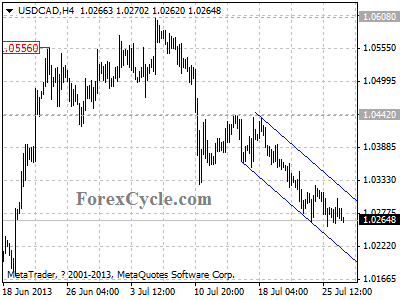
USDCAD stays within a downward price channel

USDCAD stays within a downward price channel on 4-hour chart, and remains in downtrend from 1.0442. Resistance is at the upper line of the channel, as long as the channel resistance holds, the downtrend could be expected to continue, and next target would be at 1.0200 area. However, a clear break above the channel resistance will indicate that consolidation of the longer term downtrend from 1.0608 is underway, then further rally to 1.0360 area could be seen.

usdcad

Provided by ForexCycle.com

This Stock Market Rally Hasn’t Run Out of Puff Yet…

By MoneyMorning.com.au

You may notice that sometimes we’re glib and dismissive of what goes on in the financial markets.

That isn’t because it’s not important. But rather there’s so much waffle flying around that we prefer you just ignore it.

A great example right now is the current battle over who will take over from Dr Ben S Bernanke as chairman of the US Federal Reserve. Will it be Janet Yellen? Or perhaps Larry Summers? Or maybe Bozo the Clown?

Let’s get one thing straight: no one becomes chairman of the Fed with an agenda to rock the apple cart. So in the list of priorities that you should focus on, the race to lead the Fed should be somewhere near the bottom.

On the other hand, finding a way to earn up to $257,948 tax free should be right at the top of your priority list…

Who doesn’t want to earn tax-free dollars?

Our colleague, Vern Gowdie, editor of the soon-to-launch Gowdie Family Wealth, reveals all in the essay below.

However, before you can get to the stage that Vern talks about – the enjoying your retirement stage – there’s the small matter of building your wealth first.

In short, the easy bit is spending and enjoying what you’ve earned, the hard bit is getting to that point.

Be Cautious But Not Over-Cautious

As you should know by now, your editor is a big advocate of the stock market’s wealth creation power.

But it’s fair to say that stocks have gotten a raw deal in recent years. If you ask most people, they’ll tell you the stock market is the biggest wealth destroyer going around.

Of course, that’s not really true. It’s just that they probably dabbled in the market and lost some money, or they heard of someone doing the same.

It doesn’t help the stock market’s cause (especially in Australia) when something like the 2008 stock market crash gets front page headlines, while at the same time house prices in Melbourne and Sydney barely budged an inch.

No wonder folks thought they were better off investing in houses rather than dabbling in the stock market.

That’s a shame. Because we bet they missed the rally from 2009. And we’re sure they missed the rally that started around the middle of last year. In both cases, the returns from stocks have been far better than any return from housing.

However, you shouldn’t ridicule the folks who refuse to give the stock market a go. Instead, you should use their caution as a reminder to never get in over your head…

We Don’t See Stocks Falling 20% from Here

Some investors get impatient when the market piles on big returns in a few months or even weeks. Having missed out on the initial rally because they were too scared, they see a quick 10% gain and panic-buy.

They become worried that if they miss out on this move they’ll never get another chance to buy stocks this cheap.

And look, that’s possible. Our view is that in the next five years at least, you won’t get the chance to buy blue-chip stocks at the 2009 low. That opportunity has gone, so forget about it – for now anyway.

In fact, if we’re right about the direction this market is heading, odds are you won’t get the chance to buy stocks at the 2012 low either. The Australian market would have to fall 20% from here, and quite frankly we don’t see that happening.

But we also know the stock market is risky. And if there’s one thing we’ve learned since getting into the markets nearly 20 years ago: that’s never to buy just because others are buying.

Besides, although it’s a great time to buy stocks, we still think it’s too risky to have much more than 40% of your total wealth in the stock market (that’s blue-chip income and growth and small-cap stocks combined).

We say that because we know that in the long run, a lot of the bearish analysts are right about the macro-economic view of the market. If we thought they were wrong, we’d tell you to put all your money in stocks.

But even so, we don’t know how long it will take for those predictions to come true. It could happen next week, next year, or 50 years from now. We don’t know about you, but we’re just not prepared to miss out on big gains waiting for something that may not happen for years.

Can US Stock Earnings Keep Improving?

Right now more news is lining up on the positive side rather than the negative side. As Bloomberg reported last week, ‘Of the 237 S&P 500 companies that have posted quarterly results, 74 per cent have exceeded analysts’ profit estimates.

That’s important. It tells you even the Wall Street moneymen have under-estimated the earnings power of US stocks. Now, that doesn’t inevitably mean stocks will rise. Stocks will only climb further if investors and analysts believe companies can keep growing profits.

If analysts think this is the end of the run, then stocks could tread water or even fall.

Personally, we don’t buy that idea yet. Low interest rates will continue to boost stocks for the foreseeable future. Plus, the end of political indecision in Australia with the federal election and in the US with a new Fed chairman could act as another boost for stocks.

We know. It seems ridiculous that anyone would base an investment decision on who becomes PM or central bank chairman, but it’s a fact of life…it happens.

As always, take note of these extra-curricular activities, but don’t let them rule how you invest, or worse, stop you from investing.

Cheers,
Kris+

Join Money Morning on Google+

From the Port Phillip Publishing Library

Special Report: The Sixth Revolution

Daily Reckoning: Living in a Keynesian Fictional Paradise

Money Morning: Money Weekend’s Technology FutureWatch 27 July 2013

Pursuit of Happiness: Foreign Family in Taxpayer Rort…Or Royal Celebration?

Australian Small-Cap Investigator:
How to Make Big Money from Small-Cap Stocks

How to Earn Up to $257,948 Tax Free

By MoneyMorning.com.au

Of course I am minimising my tax. And if anybody in this country doesn’t minimise their tax, they want their heads read, because as a government, I can tell you you’re not spending it that well that we should be donating extra!Kerry Packer, comments to the House of Representatives Select Committee on Print Media, 1991

If the big fella thought the Government wasn’t spending your taxes too well in 1991, he would be horrified with the waste taking place today.

Politicians splash around billions of taxpayer dollars on quick fixes. This and the interest costs only add to the mounting federal debt.

If you’re fed up with your taxes going to waste, fortunately for retirees, there is a way to earn up to $257,948 (after July 1, 2014) without having to pay tax. That means you get to keep more of your hard-earned dollars.

Don’t Ignore This Asset Class

Superannuation – in spite of the constant meddling by cash strapped governments – is still the most tax effective method of saving and generating a retirement income in Australia.

But the very thing that makes super attractive – tax savings – is the reason many people think it’s complex.

The government wants to encourage people to save and build a nest egg to reduce reliance on the welfare system. In theory it’s a worthy aim.

Unfortunately the old rule of what the ‘Government giveth, the Government can taketh away’ applies to super. That’s especially so when they’re in search of some much-needed dollars.

The constant fiddling with the contribution rules (to minimise the amount claimed as a tax deduction) and withdrawal taxes, leaves most people scratching their heads on whether super is really that super after all.

But with the huge potential tax break on offer, you shouldn’t ignore it. So if you’re near retirement or you’ve retired let’s start with the basics. (Even if you’re not near retirement, take note so you can plan in advance.)

Obviously the best tax to pay is no tax. Here is where super comes into its own – especially if you’re 60 or older.

When you switch a super account from accumulation (savings mode) to pension phase, the earnings within the fund are currently TAX FREE.

From 1 July 2014 investment earnings in account-based (formerly known as allocated) pensions will be tax-free up to $100,000 a year for each member. Any earnings over $100,000 per member will attract a 15% tax.

In the world of financial theory, a couple with equal account balances (after 1 July 2014) can earn up to $200,000 per annum TAX FREE.

(NOTE: During the 2013/14 financial year there is no limit on the tax free income earned within an account based pension.)

In reality, individuals often have different super account balances – however there are strategies of withdrawal and re-contribution that members can use to even up the balances between two people. But we won’t get into that today.

In principle, super is a great vehicle for retirement income. But depending on your age there are rules around the tax treatment of earnings, accessibility to lump sum and contribution eligibility.

Now, before you rush out to put in place a strategy to keep the taxman’s hands off your funds, check with your accountant or financial planner on how the rules apply to you.

How to Keep the Tax Man Away From Your Wealth

So back to our hypothetical case of the boomer retiree couple.

Assuming they are over 65, we know they can earn up to $100k each in their account-based pension.

That means for tax purposes their account-based pension payment doesn’t register on the taxman’s radar. In effect they have a completely clean slate for income tax reporting requirements.

In addition to their tax-free super income they can also earn other sources of income that have concessions for income tax purposes. This is courtesy of Senior Australians & Pensioners Tax Offset (SAPTO) rules.

Members can earn (from employment, interest, dividends, rents, royalties etc.) a further $28,974 each. Thanks to the SAPTO, they won’t pay tax on those earnings. That’s another $57,948 TAX FREE for the retiree couple.

If the members are over 60, but under 65, they can earn up to $20,542 each before paying any tax. That’s thanks to the Low Income Tax Offset – LITO.

There you have it – up to $257,948 per annum without the taxman getting a sniff of your money.

If you’re a single retiree over 65, the number is $132,279 TAX FREE ($100,000 tax free from the account based pension and $32,279 due to SAPTO).

If you do the math, with say a 5% return, our hypothetical couple could have just over $5 million invested and not pay a cent in tax (for a single retiree it’s $2.6 million).

Now, 98% of retirees don’t have this much retirement capital. So it goes to show how much scope there is for pending retirees and current retirees (based on certain age criteria) to minimise their personal tax to zip, zero, nothing.

But will this tax regime last? Who knows? Governments around the world are looking under every rock for a dollar.

However there is a big retiree and pending retiree demographic. Politicians of all stripes will tread carefully before inflicting more tax pain…or you’d think so anyway.

My personal view is there are a few more years before the loss of boomer tax revenue starts to really bite on the budget’s bottom line.

So each year you can legally avoid making a donation to Canberra is a good year.

You may as well make the most of these tax laws until Gen X&Y takes over the Treasury reins.

The big fella would be very proud of you.

Vern Gowdie
Editor, Gowdie Family Wealth

Join Money Morning on Google+

Ed Note: Vern Gowdie has been involved in financial planning in Australia since 1986. In 1999, Personal Investor magazine ranked Vern as one of Australia’s Top 50 financial planners. His previous firm, Gowdie Financial Planning, was recognized in 2004, 2005, 2006 & 2007, by Independent Financial Adviser (IFA) magazine as one of the top 5 financial planning firms in Australia. He is currently working with Port Phillip Publishing on the creation of a Family Wealth financial strategy for the challenging years ahead.

From the Archives…

Is This the Spark to Send Australian Property Crashing?
26-07-2013 – Kris Sayce

Why it’s Deflation…Not Inflation, that’s Heading Our Way
25-07-2013 – Vern Gowdie

Why You Must Avoid This Big Investing Mistake…
24-07-2013 – Kris Sayce

The Dark Side of Technology: Part 2
23-07-2013 – Sam Volkering

The Dark Side of Technology: Part 1
22-07-2013 – Sam Volkering

6 Key Oil & Gas Discoveries of 2013 – Who’s Worth Owning

By OilPrice.com

The pace of oil and gas exploration is frightening, and discoveries are weekly, if not daily, with volumes investors would only have dreamt of a decade ago. With each new discovery, it becomes difficult to keep track of the playing field, and even more difficult to rank the potential. There are also a lot of juniors popping up on the scene now, exploring, finding and developing with the intent to lure the bigger players to buy them out. So we’ll make it easy for you here, with our list of 6 key oil and gas discoveries so far this year, followed by a short list of the companies we think have the best potential—and they’re not necessarily the ones who have made the biggest discoveries.
Last year, it was all about East and West Africa, with game-changing finds in Kenya, Mozambique, Angola, Ghana and Ivory Coast that have sent explorers on a feeding frenzy looking for analog plays in the region and finding plenty. This year, so far, we like the discovery revival in the Gulf of Mexico and handful of new sub-salt and pre-salt plays.

6 Key Discoveries of 2013

Shenandoah-2/Gulf of Mexico

In mid-June, Anadarko Petroleum (APC) announced a major new discovery in this deep-water play: more than 500 million barrels of crude oil in the Shenandoah-2 well. This find is important: the implications are massive and this means we could be looking at a major oil rush in the Lower Tertiary trend. (Anadarko shareholders should be thrilled). And it wasn’t easy (or cheap): Anadarko drilled through some six miles of rock in water at a depth of 5,800 feet.

The Lower Tertiary trend and its sub-regions could hold up to 15 billion barrels of oil. What this discovery means is that the US oil boom is far from over, and the Gulf of Mexico Lower Tertiary trend is still surprising us. Anadarko’s find solidifies a trend that began with ExxonMobil’s 2010 discovery of the Hadrian field (700 million barrels); Royal Dutch Shell’s discovery of the Appomattox field (500 million barrels); Chevron’s discovery of the Moccasin field (200 million barrels); and BP discovery of the Mad Dog field (est. 4 billion BOE).

Coronado Prospect/Gulf of Mexico

In May, Chevron Corp (CVX) announced a new discovery at its Coronado prospect in the Gulf of Mexico, at the Walker Ridge Block 98-1 well. The well is some 190 miles off the coast of Louisiana in the Lower Tertiary sub-salt trend, in water of around 6,127 feet, but it’s been drilled to a depth of 31,866 feet! (One of the deepest wells ever drilled and probably cost at least $250 million, though we don’t know for sure). The scale of the reserves is still under appraisal for commercial viability, and Chevron currently holds a 40 percent working interest in the prospect. Other owners of the Coronado prospect are ConocoPhillips ( COP ) with a 35 percent stake, a subsidiary of Anadarko Petroleum Corp. ( APC ) with a 15 percent stake, and Venari Offshore LLC with a 10 percent stake.

Harpoon Discovery/Newfoundland

In mid-June, Norway’s Statoil announced it was evaluating a new discovery of high-quality oil off the coast of Newfoundland, about 500 kilometers northeast of St. John’s. The Harpoon discovery is under some 1,100 meters of water. While we don’t know the extent of the Harpoon discovery just yet, what we like is that it is only 10 kilometers from the earlier Mizzen discovery, which is estimated to hold between 100 million and 200 million barrels of oil. Statoil owns a 65% stake in Harpoon (the rest is owned by Husky).

Offshore Cote d’Ivoire

In late April, France’s Total SA announced a major discovery in the deep waters off the western coast of Cote d’Ivoire, encountering 91 feet of net oil pay while drilling in Block CI-100 in about 7,400 feet of water. It was the first block Total drilled. What is significant about this discovery is not the net feet of pay, but the fact that it confirms an extension of reserves in the Tano basin, home to the giant Jubilee field in neighboring Ghana. The Jubilee field is one of the richest oil fields in Africa with potential reserves eclipsing 1.8 billion barrels. This is the second major find in Cote d’Ivoire recently; last year Tullow Oil—which is also exploring in Ghana, made an offshore discovery here as well.


Gullfaks, North Sea

In April, Statoil said it could be sitting on 40-150 million recoverable BOE in the North Sea in its Gullfaks license, where it is still working to confirm its findings. Gullfaks is in the North Sea’s Shetland Group/Lista Formation. The Gullfaks finds are younger, shallower deposits than its primary areas. Gullfaks has three permanent installations that have so far produced over 2.4 billion barrels of oil and over 56 billion cubic meters of gas. Statoil is the operator of the license, with a 70% interest, along with Petoro (30%). The Gullfaks discovery follows two other recent massive discoveries in the North Sea: Johan Sverdrup and King Lear.

Santos Basin/Libra, Brazil

In May, Petrobras doubled the estimate for its Libra field to 12-15 billion barrels. This makes it Brazil’s largest ever discovery. Brazilian officials say it could easily produce a million barrels of oil per day once it is fully developed—that’s TWICE the output of OPEC-member Ecuador. Production could begin in five years, with plans for up to 12-18 production vessels permanently anchored on the field, each of them pumping up to 30,000 barrels per day. For state-run Petrobras, which owns the field, it means more expenditures and more debt (and it’s already drowning). The answer: Petrobras is taking the show on the road, preparing to offer foreign investors up to a 30% stake in this amazing prospect. (The Libra auction will take place in October, and 70% of the field will be up for grabs).

WHAT’S WORTH OWNING

Genel Energy (LON:GENL)


We can’t get enough of Anglo-Turkish Genel, which is advancing like a hurricane in Kurdistan (discovery after discovery and amazing drilling success), and also faring nicely in Africa. Shares in the company have advanced almost 50% over the past year on success in Kurdistan, and now it’s about to hit the roof as its crude oil pipeline nears completion and is slated to start pumping crude to Turkey by the end of September. There is a short window of opportunity here to get in while this is still a bit undervalued. (And there are a number of undervalued stocks operating out of Kurdistan).

Genel is the largest producer in Iraqi Kurdistan, and its holdings are impressive. We’re talking about 7 production-sharing contracts with some nice geological diversity. Its largest producing fields in Kurdistan are Taq Taq and Tawke, which have an estimated gross proven and probable reserves of 1.4 billion barrels of oil and gross proven, and probable reserves of 1.9 billion barrels. By 2014, Genel is aiming for a production capacity of 140,000 net bopd.

Anadarko Petroleum (APC)


Anadarko has great onshore assets in the US Gulf of Mexico and diverse offshore, deep-water assets off the coasts of Algeria, Ghana, Mozambique, Brazil, China, Indonesia and New Zealand, with proven oil and gas reserves at about 2,560 million BOE as of end 2012. We’re looking at liquids-natural gas ratio of 46%-54%. For 2012, Anadarko saw a 10% increase in overall production. This year, Anadarko plans to spend some $5.5 billion developing its onshore US assets alone, and about $1 billion on its overseas plays. So we expect another nice increase in production for 2013. The company will shift its key activities a bit to account for low natural gas prices, so we’ll see more focus and money spent on the Gulf of Mexico and less at the Marcellus shale, for instance. Anadarko is trading at $86.10 per share with a total market cap of more than $43.1 billion.

In the second week of June, shares of Anadarko rose 3.7% on the news of a major new discovery in the deep waters of the Gulf of Mexico (Shenandoah-2, mentioned above).

Noble Energy Inc (NYSE:NBL)

When you think about the Levant Basin these days, you think about Houston-based Noble Energy. In late May, Noble announced a new discovery in the Mediterranean Sea, just 20 miles northeast of its Tamar field in its Karish well after drilling to a total depth of 15,783 feet. The well encountered 184 feet of net natural gas pay, and Noble thinks it potentially holds up to 2 trillion cubic feet of natural gas. This brings its estimated combined resources in the Levant Basin—including the Tamar and Leviathan fields—up to 38 trillion cubic feet of natural gas. Noble is definitely on a roll in the Levant Basin, and this latest discovery is its 7th so far in the eastern Mediterranean.

Back in the US, it’s more good news for Noble. In mid-June, Noble confirmed that its second Gunflint appraisal well in the deep waters of the Gulf of Mexico had an estimated gross resource of 65-90 million bbl of oil equivalent. This means Noble’s plans for a subsea tieback development at Gunflint are a green light for this year. Production is targeted for the end of 2015 at both Noble’s Gunflint and Big Bend deep-water discoveries in the Gulf of Mexico.

Oryx (OXC)

Sorry, but it’s got to be Kurdistan—again, but this time Oryx, a company we’ve written about before but you may not have heard of. If you haven’t you’re missing out. About a month ago, Oryx—the upstream division of AOG–offered up 17% of its shares (16,700,000 common shares) on the Toronto Stock Exchange for C$15 per share) with gross proceeds of $250 million. The proceeds will allow Oryx to complete its exploration and appraisal plans through mid-next year, and they expect some serious results over the next 12 months.

Oryx is the brainchild of Swiss billionaire Jean Claude Gandur, who made his grand entrance onto the oil and gas scene in 2008 with the sale of Addax Petroleum to China’s Sinopec for $7.2 billion. Since then, he’s been out of the fossil fuels game—so Oryx is his re-entry ticket. Gandur owns 77% of Oryx through AOG.

Oryx is exploring in west Africa and Iraqi Kurdistan, but it’s the Kurdistan assets we really like. Gandur is an excellent diplomat who can navigate power brokers, which will make or break a junior company in this territory. Oryx isn’t making any money yet, but it will, and that’s why we think now is the time to get in on this. It could very easily go the way of Addax, which was making about $300 million annually in net income when it was sold to Sinopec. Gandur has dumped $700 million into Oryx, which has been busy buying up licenses and drilling wells. It’s sitting quite nicely in Kurdistan right now with a 100% focus on oil and 143 billion bbls of proven oil reserves.

By. OilPrice.com Premium Analysts


This report is part of Oilprice.com’s premium publication Oil & Energy Insider . Oil & Energy Insider gives subscribers an information advantage when investing, trading or doing business in the energy sectors. Successful investors, hedge funds and senior executives, have access to high level intelligence and power in ways that you, as an individual investor, are locked out of (the game is and never has been fair.) Let us help you level the playing field by using our network of traders, intelligence assets and high level partnerships to ensure you are making the right investment decisions.


To find out more on how you can get a legal inside advantage in the energy markets please take a moment to visit: http://oilprice.com/premium
 

Keep an Eye on Gold

By Investment U

Barron’s reported this week that the Trading Commission’s weekly “Commitments of Traders” report – essentially commercial shorts on gold by gold miners, which has been the single-most accurate measure of gold’s price movement – is more bullish now than when gold was $300 an ounce. The highest bullish indication in 11 years!

Despite having dropped like a rock for most of 2013, demand for gold is exploding and it is giving off signs of another move up.

There has been a big increase in demand in Asia for physical gold. Edmund Moy, chief strategist at Morgan Gold, said in a recent MarketWatch article that lower gold prices have spurred a huge shift of physical gold from the U.S. to Asia, China especially.

And, according to Mark O’Byrne, of Gold Core, there was a 55% drop in gold inventories in one week in July at Brinks, one of the Comex’s storage companies.

Gold inventories are being exported to China at a rising rate, gold coins are at premiums, and there is a huge premium on the Shanghai Gold Exchange as well as record deliveries.

In the first six months of 2013 the Shanghai Exchange supplied 1,098 metric tons of gold as compared to 1,139 tons all of last year. O’Byrne says the market has not yet recognized the significance of this demand shift.

All of this gold has to be going somewhere!

And, this increased demand is coming at a time when the world’s largest producers of gold are announcing production cutbacks.

Based on China’s and India’s increasing demand, and lower worldwide production, O’Byrne is looking for a new bull market in the yellow metal by the end of the summer.

If I have learned anything about gold over the last 30 years, it is that it makes absolutely no sense… it sometimes appears to trade opposite the dollar, but that changes too… and it runs when everyone is looking somewhere else.

Watch gold!

The EU Is Climbing Back

Next up, speaking of bottoming and moving up, Barron’s says the EU is looking much healthier. They reported this week that economic indicators are signaling improving conditions.

Their purchasing managers index hit a 16-month high with marked improvements in Ireland, Spain, France, Italy and the Netherlands.

Business confidence improved in Germany in May and consumer confidence in Italy hit its highest level in a year.

Germany, the U.K. and Ireland are expected to see the strongest gains in 2014. Ireland, according to Barron’s, could see a 2.2% growth spurt in 2014. And Italy, Spain and Portugal, the weakest of the Union, could also exit the recession in 2014.

Nigel Bolton, the CIO and head of EU Equities at BlackRock in London, said the EU is particularly attractive, and fund flows into EU equities have risen for three consecutive weeks.

Analysts expect consumer-driven and hotel stocks to perform well in the next 12 months, and, on a P/E basis, EU stocks as a whole are cheaper than both U.S. and Japanese equities.

The unaddressed internal problems in France and Italy – the second- and third-largest economies in the EU – will still be a drag on the recovery. But ECB Chairman Mario Drahgi’s pledge to do whatever is necessary to defend the euro will go a long way to prevent any sovereign debt crisis, which has been the biggest impediment to a solution to the five-year dip.

The ECB umbrella appears to be working and that means opportunity for the contrarian-minded.

The EU!

The “Slap in the Face” Award: Radio Silence

This one will kill you.

The U.S. Marshal Service has a problem.

The Marshals are responsible for protecting judges, who put very dangerous people in jail – and these people have very dangerous friends who aren’t in jail yet. And they are also responsible for protecting people in the witness protection program, all of whom are on death lists of our less-admired citizens.

It seems the way these sheriffs communicate very sensitive, life-and-death messages within their agency is by encrypted radios. Encrypted means even if you can monitor their frequencies the transmission comes across garbled and unintelligible, so they are secure.

Well, it seems about 2,000 of these super-secret radios are missing. But wait: The higher-ups in the agency say they aren’t missing, not really, it’s just that no one knows where they are. That’s according to a recent Journal segment.

They may have been lost or given to other law enforcement agencies, but they aren’t missing. It’s just a case of poor recordkeeping, not missing radios.

Well, that sounds good except for the fact that one of these not-missing radios recently showed up for sale on eBay.

And, it seems after the Journal started requesting information under the Freedom of Information Act about this story, there was a directive within the U.S. Marshals to answer the requests by phone only, not email – and let’s hope not on the encrypted radios.

Article By Investment U

Original Article: Keep an Eye on Gold