Europe shares drops: Fed decision expected

By HY Markets Forex Blog

The European stock market traded flat at market open on Wednesday as investors focus on the outcome of the Federal Reserve’s two-day meeting, with possible hints on when the central bank would begin to scale back its bond-buying program.

Futures of the European Euro Stoxx 50 dropped to 0.09% lower at 2,758.50, while the German DAX futures declined 0.21% at 8,260.80. The French CAC 40 futures were seen 0.14% lower, as the UK FTSE futures fell 0.10% to 6,529.30.

A statement from the two-day policy meeting is expected to be released by the Federal Reserve (Fed) later this afternoon.

The US growth data and private job reports are also expected to be released later this afternoon. The report is expected to show a growth of 1% in the US economy and an 180,000 addition of new jobs in the month of July in the private job reports.

The expected US non-farm payroll report is expected to show an increase of jobs in the month of July by 185,000, while the unemployment rate is expected to show a slight drop from previous record of 7.6% to 7.5%.

In Germany, the Federal statistical office reported the retails sales had an unexpected fall in the month of June, as sales dropped 1.5% on a monthly basis. While the German unemployment data for July is expected to remain unchanged after unemployment dropped by an adjusted 12,000 in the month of June.

Italy’s Consumer price index (CPI) preliminary report for the month of July , is expected to be released as well , with expectations of an increase in prices by 0.3% on a monthly basis and edged up by 1.4% on a yearly basis .

Spain’s retail sales dropped 4.7% in the month of June on a yearly basis after a 4.6% drop in the month of May.

The post Europe shares drops: Fed decision expected appeared first on | HY Markets Official blog.

Article provided by HY Markets Forex Blog

Gold declines ahead of Fed meeting

By HY Markets Forex Blog

Gold Futures were seen trading low on Tuesday as investors focus on the two-day Federal Reserve (fed) meeting, where they could get a possible hint as to when the central bank intends to start scaling back on its stimulus program.

The yellow metal futures fell 0.46% lower, trading at $1,323.40 an ounce, while the silver futures were down 1.36% at $19.595 an ounce at the time of writing.

Gold correlates inversely with the US dollar and dropped after trading flat as the European trading hours began. The US dollar index has had a slight advance due to investor’s assumptions ahead of the Federal Reserve meeting.

The US dollar index slightly strengthened against some of its major counterparts, adding 0.06% to 81.710 at the time of writing. The US dollar index remains low compared to the near three-year high of 84.75 as of the beginning of the month of July.

Holdings in the largest gold-backed exchange-traded fund SPDR Gold Trust remained unchanged at 927.35 tonnes on Monday. Volume of the holdings dropped just under 1,000 in the month of June.

With worries regarding the Fed’s decision on scaling back the monetary stimulus program, the yellow metal dropped by more than 20% this year. Gold futures reached a three-year low in the month of June.

Prices of the yellow metal reached a five-week high of $1,347.69 an ounce on July 23rd & July 24th.

The post Gold declines ahead of Fed meeting appeared first on | HY Markets Official blog.

Article provided by HY Markets Forex Blog

Central Bank News Link List – Jul 31, 2013: India seeks new central bank governor as Subbarao’s term ends

By www.CentralBankNews.info

Here’s today’s Central Bank News’ link list, click through if you missed the previous link list. The list comprises news about central banks that is not covered by Central Bank News. The list is updated during the day with the latest developments so readers don’t miss any important news.

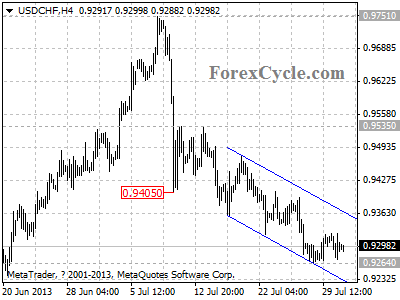
USDCHF stays within a downward price channel

USDCHF stays within a downward price channel on 4-hour chart, and remains in downtrend from 0.9535, the rise from 0.9264 is likely consolidation of the downtrend. Resistance is located at the upper line of the channel. As long as the channel resistance holds, the downtrend could be expected to resume, and another fall to 0.9200 area is still possible. On the other side, a clear break above the channel resistance will indicate that lengthier consolidation of the longer term downtrend from 0.9751 is underway, then further rally to 0.9450 area could be seen.

usdchf

Provided by ForexCycle.com

The News Gets Worse, So We’re Buying Resource Stocks…

By MoneyMorning.com.au

If you own resource stocks, you don’t need us to tell you it has been a torrid two years.

The gold price is 30% below the 2011 peak, and the S&P/ASX 300 Metals & Mining index has lost a whopping 40.6% since April 2011.

And with headlines in the press talking about the ‘Economy at a turning point’ and ‘Mining sentiment in free fall’, only a lunatic would even consider looking at mining stocks today.

That’s where we come in. This is exactly why we’ve just tipped three mining stocks in the past six weeks.

As a contrarian investor, those are exactly the headlines to give us confidence that a rebound in resource stocks is on the way…

But not everyone agrees with our view.

You can probably imagine that we’ve received plenty of mail from readers who think your editor is a traitor because we’re not calling for the market to crash.

The gist is they aren’t happy with our view that the Australian share market is heading towards a record high of 7,000 points in 2015.

These readers say we don’t understand that the world economy is stuffed and that we’re foolish for buying stocks when a crash is imminent.

All we say to those folks is that they don’t understand investing. The stock market doesn’t care what any one individual thinks. The market merely reflects the views of the investors who transact on any given day.

And right now, our view is that market sentiment is changing and resource stocks will be one of the best opportunities through the rest of this year…

No Wonder Resource Stocks Have Fallen So Much

We’ll give you an example. If we had stuck our head in the sand and kept saying ‘the market is crashing’, Australian Small-Cap Investigator subscribers wouldn’t have backed the small-cap uranium stock we tipped last month.

That would have been a shame because it’s up 42.9% in just a few weeks.

And if we had been too scared to back two metals stocks just two weeks ago, Australian Small-Cap Investigator subscribers would have missed out on gains so far of 8.6% and 4.3%.

Not to mention the 121.9% gain on a specialist medical stock we tipped last September. That was before stocks began their yield-chasing rally. Folks called us mad back then, and they call us mad today.

But that’s fine. We’re thick-skinned.

After all, we see it as our role to give you our best useful, actionable investment advice. Right now, our best investment advice is to buy resource stocks.

We’ll admit that flies in the face of conventional wisdom. Take these charts from yesterday’s Australian:

Source: The Australian

In 2012 all mining companies surveyed by Newport Consulting were either increasing or maintaining capital spending on mining projects.

One quarter of those firms were ‘significantly increasing’ capital investment.

Roll forward to 2013 and things have changed. Now 86% of firms are either reducing or not increasing capital spending. That’s bad news for the resource sector…very bad news.

And it’s not the only report to paint a bad picture of the resource sector. Take this from the Age:

The mining investment boom is winding down sharply, with the next few months set to be a turning point for the Australian economy, a report by a leading business advisory group has found.

The value of planned projects, those under consideration or possible, fell 14.3 per cent, or $68.3 billion, from the last quarter, said Deloitte Access Economics in its Investment Monitor June-quarter report, published on Tuesday.

With that news, it makes sense that resource stocks have fallen so much. But let’s look at it another way. Let’s say you knew nothing about investing and someone asked your opinion on what effect that news would have on mining stocks.

Our guess is you’d say, ‘Sell.’

And that would be a fair answer. But what would you now say when we showed you this chart:

S&P/ASX 300 Metals & Mining Index


Source: Google Finance

We bet there’s a better than 50% chance that you would say, ‘Buy.’ At the very least you’d stop and think about it.

Have the Markets Already Priced In the Bad News?

After all, isn’t the object of investing to buy low and sell high? And if you agree that markets are forward-looking, anticipating future good or bad news, isn’t it fair to say that resource stocks began pricing in this week’s bad news two years ago?

Of course, we don’t know that for certain. We thought the mining rout had ended about three months ago. We got that wrong. And we could be wrong this time too.

But we don’t think so. If you’re a speculator or a contrarian investor you should always look out for opportunities to buck the market trend…and get in on a turning market before the rest of the crowd gets the same idea.

We won’t kid you, it’s a risky move. And it’s not for everyone. If you’re the type of investor who prefers surer things then you should probably wait until it’s clear that mining stocks are trending higher.

And that’s fine. It just means that if we’re right, you could miss out on some of the biggest gains if this is the resource rebound we’ve been waiting for.

Cheers,
Kris+

From the Port Phillip Publishing Library

Special Report: The Sixth Revolution

Daily Reckoning: Australian Property: Crazy Bullish or Just Crazy?

Money Morning: Why You Should Be ‘Hands On’ When Investing Your Money

Pursuit of Happiness: Save Now to Avoid the Government’s Retirement ‘Labour Camps’

Australian Small-Cap Investigator:
How to Make Big Money from Small-Cap Stocks

That Squeeze You Feel is The Great Credit Contraction (Part 1)

By MoneyMorning.com.au

Sir Isaac Newton’s third Law of Motion states:

When one body exerts a force on a second body, the second body simultaneously exerts a force equal in magnitude and opposite in direction to that of the first body.

This law of physics has been widely interpreted as ‘for every action there is an equal and opposite reaction’.

Newton’s laws of motion have been in existence since 1687. Therefore it’s reasonable to assume they’ve passed the test of time and are in the irrefutable category.

The law of gravity is also irrefutable. Sadly poor old Sir Isaac Newton forgot this one when he invested in the early 18th century South Sea Bubble.

Reports suggest Sir Isaac lost a £20,000 (£268 million in today’s money) fortune in the bursting of the South Sea Company share bubble. Reflecting on the catastrophic loss, he remarked, ‘I can calculate the movement of the stars, but not the madness of men.

Newton was obviously a seriously smart man but the ‘need for greed’ overrode rational thinking. Therein lies the lesson for those of us who have much lesser IQ’s. Don’t think you’re smarter than the market and don’t let greed blind your objectivity.

Newton could easily apply his theory and personal lessons to the economic malaise we find ourselves in today.

  1. For every action there is a reaction
  2. What goes up must come down
  3. Smart people do dumb things

From 1980 to 2007, the western world (not just an isolated country) went through a credit expansion unmatched in the history of money.

Questions That Need Answering

The Great Credit Expansion of 1980 to 2007 lifted all boats. Share markets posted 1,500% returns; property values increased ten-fold (based on Melbourne median house prices); GDP rose; government revenues increased; household incomes rose; the financial sector ballooned.

When you hear economic commentators saying ‘we are waiting for a return to normal conditions’, they must truly believe the 1980 to 2007 period was ‘normal’.

If that’s true, then in 2040 the All Ords index will be 75,000 points (15x current level) and the average home in Melbourne will be worth over $5 million (10x current median value). That’s possible, but it’s not certain.

In some ways 27 years is a long time – for instance, a jail term or a marriage (in some quarters these are one and the same). However, in the context of life on earth 27 years is a blink of the eye.

The first Industrial Revolution in northern England began around 1750. The second Industrial Revolution (coming mostly from the US) started around 1870.

For the tens of thousands of years that preceded these dates, the global economy made glacial progress. In the pre-Industrial Revolution days, some estimates say it took up to 300 years for living standards to double.

Mechanisation and electricity were major game changers. Better sanitation led to longer life expectancies; electrical appliances allowed women to leave household chores and enter the workforce; and machinery enabled more food production, leading to population growth.

Was the 1980 to 2007 period simply the ‘cherry’ on a productivity cake that was 250 years in the baking?

For those looking for a return to ‘normal’ here are some questions to ponder:

  1. Will the workforce get another productivity boost from women entering it?
  2. Can the world’s resources support a global population rising at the rate of the past century?
  3. Will we see another baby boomer generation or are families opting for fewer children?
  4. If life expectancies continue rising, where will governments find the resources for healthcare and welfare?
  5. Do governments have the capacity to increase public debt from current levels?
  6. If robotics is in our future, what will this do to unemployment levels in the unskilled and semi-skilled workforce?
  7. Each generation has wanted to educate their children to a higher standard. What happens when all youth have tertiary qualifications (and the debt to go with it)? Where to after university?

Perhaps we’ve seen the best of times as far as global growth is concerned – peaking with the baby boomers’ three decade long credit binge.

I concede there may be something in our future that turns all this on its head. Another Industrial Revolution type event that is such a game changer it enables the world to power ahead.

But even if there is, you can measure in decades the lead-time for the benefits of these rare and momentous events to eventuate.

According to historians it took well over thirty years for the economy to register the impact of the Industrial Revolution. Even with technology beginning in the 1980′s it’s only recently we’ve witnessed its impact on global commerce.

So unless the next big thing happens soon, all the pointers suggest global growth has run into severe headwinds. Nearly three hundred years of continuous growth may have reached an end.

This is where the equal and opposite theory kicks in.

The laws of physics tell us contraction follows expansion.

My belief is history will record the GFC as the official start of The Great Credit Contraction.

The bell rang on credit fuelled consumption and investment in 2008. In the five years since the GFC, the private sector hasn’t strayed from its chosen path of debt reduction and/or saving.

Any GDP ‘growth’ in the past five years has been quantitative, not qualitative. The Botox of government deficits has masked the ugliness of the underlying economic numbers. The US Government runs an annual budget deficit over $1 trillion (money they don’t have by the way). This is 7% of their $15 trillion economy.

Take out the printed $1 trillion and the numbers look awfully saggy. The injection of $1 trillion is quantity NOT quality.

The Great Credit Contraction is a far more powerful force than a handful of central banks. It’s the collective decision making of hundreds of millions of people to not only change their consumption habits but also how they fund their reduced consumption.

How the Economic Landscape is Changing

A recent Boston Consulting Group survey on consumer habits prompted the following headline: ‘Retailers now facing jaded consumers’. The article went on to say: ‘Australian retailers are facing critical challenges as more and more people spurn commercialism and choose to save for retirement, research shows.

There are two things at play here that could worsen this already dire prognosis:

  1. Each year, as wave after wave of baby boomers reach retirement, consumption numbers could soften further.
  1. Another GFC-like (or worse) downturn (which on balance is a 50/50 bet) would make consumers even more cautious – worsening the already soft consumer numbers.

These altered spending habits aren’t unique to Australia. This is a global trend. Charles Gave of GK Research recently produced the following chart on US job creation – full-time and part-time employment – since 1976.

Since the Tech Bubble peaked in 2000, full-time employment has gone down and part-time employment has gone up.

Note the big peaks in US full-time employment came during the 1980 to 2000 US share market boom. That’s when the S&P 500 increased from 100 points to 1,500 points, and spread around the paper wealth. But as soon as the music stopped, the trend changed.

Guess what? Do you think part-time employees earn as much as full-time workers? Not on your nelly. This next chart tracks the net losses of full-time vs part-time (red line) and the decline in income levels (black and dotted lines).

While the headlines shout about an increase in US employment (again this is quantitative) the reality (qualitative) is different. More lower-paid employees don’t build the foundation for economic recovery.

And with statistics worse than the Great Depression, Southern Europe is an unemployment wasteland.

The Great Credit Contraction is altering the employment and remuneration landscape.

The central bankers are looking for consumer revival, when in reality it’s all about consumer survival at present.

That leads us to the second theory – what goes up must come down.

We’ll continue that tomorrow…

Vern Gowdie
Editor, Gowdie Family Wealth

Join Money Morning on Google+

From the Archives…

Is This the Spark to Send Australian Property Crashing?
26-07-2013 – Kris Sayce

Why it’s Deflation…Not Inflation, that’s Heading Our Way
25-07-2013 – Vern Gowdie

Why You Must Avoid This Big Investing Mistake…
24-07-2013 – Kris Sayce

The Dark Side of Technology: Part 2
23-07-2013 – Sam Volkering

The Dark Side of Technology: Part 1
22-07-2013 – Sam Volkering

Obama Gives Hope to the Middle Class

Article by Investazor.com

President Obama expressed his satisfaction regarding the evolution of the American economy and highlighted the importance of the wellness of the middle class in order to have the economy running at optimal parameters. Also, the creation of jobs represents the main concern, giving the fact that creating jobs is the nucleus of the American economy. If Americans work hard, every field of the economy will run smoothly. In order to rich this point, reforms are needed and consumers need to understand and accept further changes in this regard.

As the spotlight is the unemployment rate problem, further measures are considered: a revolution of the manufacturing industry, a new tax credit, plans for rebuilding the infrastructure, simplifying of the tax code , simplifying the procedures for investments and starting small businesses, large investments in renewable energy (wind and solar energy), rising the minimum wage.

On the other side of the planet, the interest rate of Australia is likely to be lowered again, the second time this year, as the latest inflation data doesn’t look disturbing (currently 2.4%, dropping from 2.5% in the second quarter of the year). The governor of RBA believes that there is still room for this move and further depreciation of the currency is not a surprise. The consumption still needs to be stimulated and the consumers need to trust their economy enough to start investing in more risky assets. As a measure of fighting the decreasing trend that the Australian economy is following lately, especially because its main exporter China is slowing as well, the Central Bank is willing to boost employment by residential constructions. Today, the building approvals were reported down to -6.9% a considerable drop that seems to darken the overall picture.

The post Obama Gives Hope to the Middle Class appeared first on investazor.com.

Jocelyn August: Top Five Catalysts for Small-Cap Energy Equities

Source: Brian Sylvester of The Energy Report (7/30/13)

http://www.theenergyreport.com/pub/na/15483

Catalysts are a little like earthquakes: They shake things up. These announcements of drill results, production starts and resource estimates can influence stock prices, sometimes for the better, sometimes for the worse. In this interview with The Energy Report, Jocelyn August, senior analyst and product manager for Sagient Research’s CatalystTracker, explains which catalysts have the biggest effect on small- and large-cap companies and identifies upcoming events that could move the needle in the oil and gas and uranium spaces.

The Energy Report: Compared to oil and gas, do you think uranium is the best place to be among the small-cap energy commodities?

Jocelyn August: Not necessarily. Oil and gas is also an interesting space, particularly the small caps. Just in the last six months, there have been a lot of catalysts in that area. The large institutional investors are investing a lot in oil and gas and not in uranium.

TER: What are the most important catalysts for larger companies?

JA: Generally, earnings announcements, drill results, production decisions and go/no-go decisions. Anadarko Petroleum Corp. (APC:NYSE) and the Tweneboa-Enyenra-Ntomme (TEN) cluster is a good example. A production decision there will help it a lot. Another good example is Noble Energy Inc. (NBL:NYSE) and its Leviathan project in Israel. Announcements about that are big movers simply because of the project’s size.

TER: What are some patterns among large, private institutions investing in energy equities?

JA: During H1/13, private institutions invested in oil and gas and in alternative energy. There’s not much investment in the uranium space.

TER: What are the top catalysts for small-cap energy equities?

JA: Drill results, with about a 9.6% average stock movement, are number one. The second is the announcement of further drilling on a currently producing site; those announcements move companies about 8.8% on average. For smaller companies, the announcement that drilling is beginning brings 8% on average. Production starts are number four. They’re 7.5% for the small companies, but they generally don’t move the stock much for the larger energy stocks because they’re already baked into the stock price. Third, we notice that large movements occur around announcements of investments by a strategic partner or investment bank. That creates an average stock price change of about 8.5%. The last one is an earnings announcement, which moves prices almost 6% on average.

TER: Is the percentage of movement similar for small- and large-cap energy equities?

JA: Generally, the larger a company is, the less it will move. Percentagewise, stock prices move a lot more for those under $500 million ($500M) than for those over $500M. And the ones over $5 billion ($5B) won’t move very much.

TER: It will cost almost $60B to clean up the site of the Fukushima Daiichi nuclear disaster. Do you think news of that will push uranium equities prices even lower?

JA: Japan’s election of a new prime minister, who is a known proponent of nuclear energy and has plans to accelerate the startup of currently offline nuclear reactors, is positive news for the uranium industry. The amount of money it will take to clean up the Fukushima site is a negative, but we’ve had a shortage in the uranium supply, and there’s a rising demand for it. Weighing those factors, I think uranium is poised for an upswing. But companies that can keep their costs lower will be able to operate in all types of market environments.

TER: Do you see any catalysts in the uranium space beyond the election of the Japanese prime minister?

JA: In terms of specific companies, Uranium Energy Corp. (UEC:NYSE.MKT) has the Goliad project in Texas, which it expects to bring on-line soon, probably in August.

TER: That will add roughly 30 thousand pounds to its annual production?

JA: Yes, and its cash costs are estimated to be at $18/pound, which is good.

Lost Creek in Wyoming, which is Ur-Energy Inc.’s (URE:TSX; URG:NYSE.MKT) project, is expected to come on-line soon and to add 1 million pounds per year at its peak. The operation underwent its pre-operation inspection in June as required by the Nuclear Regulatory Commission.

TER: What small-cap oil companies have near-term catalysts?

JA: Ivanhoe Energy Inc. (IE:TSX; IVAN:NASDAQ) and its Tamarack oil sands project. A permit approval decision and field-testing results should happen within the current quarter.

TER: Ivanhoe recently put out a release saying that one of the First Nations in that area, the Mikisew Cree First Nation, wouldn’t object to the project’s development. Is an announcement like that a significant catalyst or just a nonfactor?

JA: It’s definitely a factor. We generally add that information to our coverage of the specific permitting catalyst. This project has been delayed significantly; the original date range was H2/12. Now it has successfully negotiated letters of nonobjection from four of the seven stakeholders who previously filed statements of concern, and it’s trying to resolve the final three statements of concern.

TER: Ivanhoe’s Tamarack is a heavy oil play north of Fort McMurray in Alberta, Canada, but a lot of investors have gotten out of the heavy oil sands plays. Would a catalyst for Ivanhoe have had more impact a few years ago than now?

JA: A couple of years ago, when the price of oil was higher, it would have had a larger impact. Investors have gotten out of the heavy oil plays because it costs more to get that heavy oil out of the ground than to get some of the lighter oil out.

TER: Would the approval of the Keystone XL pipeline be a big catalyst for Canadian energy plays?

JA: Obviously, you need some way to distribute the oil. Having more distribution options and another way to get the oil from Canada to the United States will help companies lower their costs.

TER: What small-cap gas names have some near-term catalysts?

JA: FX Energy Inc. (FXEN:NASDAQ) can have large-moving catalysts, whether positive or negative. FX had a positive catalyst in May. Good news on production tests at the Tuchola-3K well put it up almost 19%. A negative catalyst in July, some test results for Plawce, sent the stock down 15.5%. There were basically noncommercial levels of gas.

We’re looking for more drill-test results in the Fences area, where these are located, including those for the Lisewo-2 and Szymanowice-1 wells. We’re also looking for results this quarter from a couple of its wells in Poland.

TER: What other companies in the energy space with either near- or medium-term catalysts would you like to share with us?

JA: We have a couple of catalysts for projects in the North Sea. We have one for Endeavour International Corp. (END:NYSE.MKT) for the West Rochelle project. Its partners are Nexen Inc. (NXY:TSX; NXY:NYSE) and Premier Oil Plc (PMO:LSE). It had some problems with the Rochelle project; a big storm in February did some major damage to the first well, which was the East Rochelle well. Now, it’s working on West Rochelle. We expect a production-start catalyst this quarter for West Rochelle.

We expect Sterling Resources Ltd. (SLG:TSX.V) to have a production start for phase two of its Breagh gas project, also in the North Sea, in August.

TER: What other tips regarding catalysts for energy companies do you have for investors?

JA: You should continue to watch uranium and keep an eye on what’s going on with it in Japan and the United States. Keep an eye on the reactors in Japan and the projects coming on-line in the United States.

TER: You mentioned Anadarko and Noble Energy as being big companies with near-term catalysts. Any others?

JA: We’re obviously still looking for information on Davy Jones, which is a project of McMoRan Exploration Co. (MMR:NYSE) and Energy XXI (EXXI:NASDAQ). It’s in ultradeep water in the Gulf of Mexico. We’re waiting for some flow-test results, which could happen as close as August, definitely by the end of the year.

TER: Would that be a production decision?

JA: It’s more a testing-result decision. It was so close to production and then had that blowout last year. At this point, we’re looking for information as to whether it can proceed. The flow-test results will be a deciding factor. It’s an interesting project because no other companies have tried to go that deep in the Gulf of Mexico; it has pretty big implications for that type of drilling.

TER: Leave us with one great piece of insight into this space.

JA: If you’re interested in long-term investment opportunities and long-term growth, look at some of the larger-cap companies because their share prices aren’t as volatile. But if you want to make more money in the short term or pursue short-term opportunities, some of the smaller-cap companies are doing good things and have upcoming opportunities for making money on short-term catalysts.

Jocelyn August is currently the senior analyst and product manager for CatalystTracker, a proprietary research product focused on identifying and analyzing the future events that will materially impact publicly traded companies. In her five years at Sagient, she has developed expertise in the highly event-driven medical device and diagnostic sector. In addition, she spearheaded the development of a new Natural Resource Industry product within the CatalystTracker product line with the publication of the “Catalyst Impact Study: Natural Resources Sector.” Outside of Sagient, August was named the director of communications for the San Diego Professional Chapter of MBA Women International. August received a master of business administration from the Rady School of Management at University of California, San Diego, and graduated cum laude from the University of California, San Diego, with a bachelor of arts degree in sociology.

Want to read more Energy Report interviews like this? Sign up for our free e-newsletter, and you’ll learn when new articles have been published. To see a list of recent interviews with industry analysts and commentators, visit our Interviews page.

DISCLOSURE:

1) Brian Sylvester conducted this interview for The Energy Report and provides services to The Energy Report as an independent contractor. He or his family own shares of the following companies mentioned in this interview: None.

2) The following companies mentioned in the interview are sponsors of The Energy Report: FX Energy Inc. and Energy XXI. Streetwise Reports does not accept stock in exchange for its services or as sponsorship payment.

3) Jocelyn August: I or my family own shares of the following companies mentioned in this interview: None. I personally am or my family is paid by the following companies mentioned in this interview: None. My company has a financial relationship with the following companies mentioned in this interview: None. I was not paid by Streetwise Reports for participating in this interview. Comments and opinions expressed are my own comments and opinions. I had the opportunity to review the interview for accuracy as of the date of the interview and am responsible for the content of the interview.

4) Interviews are edited for clarity. Streetwise Reports does not make editorial comments or change experts’ statements without their consent.

5) The interview does not constitute investment advice. Each reader is encouraged to consult with his or her individual financial professional and any action a reader takes as a result of information presented here is his or her own responsibility. By opening this page, each reader accepts and agrees to Streetwise Reports’ terms of use and full legal disclaimer.

6) From time to time, Streetwise Reports LLC and its directors, officers, employees or members of their families, as well as persons interviewed for articles and interviews on the site, may have a long or short position in securities mentioned and may make purchases and/or sales of those securities in the open market or otherwise.

Streetwise – The Energy Report is Copyright © 2013 by Streetwise Reports LLC. All rights are reserved. Streetwise Reports LLC hereby grants an unrestricted license to use or disseminate this copyrighted material (i) only in whole (and always including this disclaimer), but (ii) never in part.

Streetwise Reports LLC does not guarantee the accuracy or thoroughness of the information reported.

Streetwise Reports LLC receives a fee from companies that are listed on the home page in the In This Issue section. Their sponsor pages may be considered advertising for the purposes of 18 U.S.C. 1734.

Participating companies provide the logos used in The Energy Report. These logos are trademarks and are the property of the individual companies.

101 Second St., Suite 110

Petaluma, CA 94952

Tel.: (707) 981-8204

Fax: (707) 981-8998

Email: [email protected]
 

How we bought right and sold right for 9-15% gains AMBA

By ActiveTradingPartners.com

How we bought right and sold right for 9-15% gains AMBA

At our ATP trading service, we look for entries on pullbacks in strong stocks.  We also look for the opportune times to sell and take our profits out of the market, which is what the purpose of swing trading is after all.

With AMBA, we alerted our traders to buy only from 16.50-17.10 ranges on July 8th.  Over the next 48 hours the stock dipped right into those exact ranges, bottomed at 16.50, and then shot higher.

On July 18th we sent an alert to sell 1/2 the position at $19.24 per share for 13-16% gains depending on entry point.

We held 1/2 long in case it broke higher, but 6 days later on July 24th we alerted to liquidate the remainder at 18.60 ranges for 9-10% gains on the back 1/2 of the position.

Our net gains were in the 12-13% total return ranges on this swing.

We can now see on July 29th, just 5 days after our last sell alert that the stock broke down and dropped into the mid 17′s…once again affirming our sell timing was spot on to lock in the gains.

Join us for Position Trading where we hold anywhere from days to multiple weeks depending on various positions. We update them every day and provide entry and exit points and real time Text and Email alerts (Stocks and ETF’s)

www.activetradingpartners.com

729 amba


Why Economics at the Most Basic Level Dictates Gold Prices Will Rise

By Profit Confidential

gold pricesTo predict future prices of any good or service, Economics 101 dictates that we must measure the demand and supply of the good or service in question. Today, I’m applying those time-proven measures to the state of gold bullion.

On the demand side, we continue to hear about the increased demand for gold bullion from China. The managing director of investment for the World Gold Council (WGC), Marcus Grubb, said late last week, “China will probably be the world’s biggest gold consumer this year for the first time on an annual basis… That will be driven by both jewellery and investment demand. Jewellery will be the biggest overall demand segment, but investment will grow fastest.” (Source: Harvey, J., “UPDATE 1-Chinese gold demand could hit 1,000 T this year-WGC,” Reuters, July 25, 2013.)

The WGC expects demand for gold bullion in China to be between 950 and 1,000 tonnes in 2013.

Similarly, the demand for the precious metal in India is robust, regardless of the efforts by the government and central bank to curb this demand. A new way of bringing gold into the Indian economy is emerging: smuggling. In the second quarter of this year, 270 million rupees (India’s currency) worth of gold bullion was seized from smugglers—an increase of more than tenfold from a year ago. (Source: Wall Street Journal, July 25, 2013.)

Sure, it’s a minute amount compared to the overall consumption of gold bullion in the Indian economy. Nonetheless, it should be noted as an indicator of precious metal demand. According to India’s anti-smuggling department of the Central Board of Excise and Customs, the number of cases of gold bullion smuggling increased to 205 from just 21 in the same period a year ago.

On the supply side, as gold prices have fallen, gold miners have cut back on their spending on exploration for more gold bullion.

Mining giants like the Agnico-Eagle Mines Limited (NYSE/AEM, TSX/AEM) have started to slash their exploration spending. In its second-quarter earnings, Agnico-Eagle reported its budget for exploration this year has been reduced by 22% to $72.0 million; going forward, in 2014, this budget will be cut further to about $50.0 million—significantly lower than the company’s historical spend level of $100 million annually. (Source: Agnico-Eagle Mines Limited, July 24, 2013.)

Other gold mining giants are making similar moves, cutting back on their exploration spending.

Dear reader, the demand for gold bullion is clearly increasing, while the prospects of supply are declining. Hence, the rules of economics at the most basic level would suggest the price of gold bullion will increase.

Outside of old-fashioned economics, we are seeing too much negativity towards gold bullion. And when investor negativity towards any investment is so great, the price of the investment usually goes in the opposite way.

I remain bullish on gold bullion. I don’t see any reason to be even slightly bearish at these low prices.

Article by profitconfidential.com