The Bank of England announced a major policy shift on Wednesday, as new head Mark Carney provided clear guidance on when it can be expected to raise Britain’s record-low interest rate. Canadian national Carney, speaking at his first policy press conference…
Ex-IMF chief economist to head India central bank
India on Tuesday named a former International Monetary Fund chief economist as its new central bank governor as it grapples with a plunging currency and the slowest growth in a decade. Raghuram Rajan, famed for predicting the 2008 global financial crisis…
Central Bank News Link List – Aug 7, 2013: Fed’s Pianalto prepared for QE retreat if job gains continue
By www.CentralBankNews.info Here’s today’s Central Bank News’ link list, click through if you missed the previous link list. The list comprises news about central banks that is not covered by Central Bank News. The list is updated during the day with the latest developments so readers don’t miss any important news.
- Fed’s Pianalto prepared for QE retreat if job gains continue (Reuters)
- China yuan ends near record high; interest rates attractive (WSJ)
- Bank of Mexico cuts 2013 economic growth outlook to 2%-3% (Dow Jones)
- Key events loom in US as Fed ponders taper timing this fall (MNI)
- Brazil’s Mantega: Growth recovering, inflation tame (Dow Jones)
- www.CentralBankNews.info
Reaction to the Bank of England’s News
Article by Investazor.com
Considering the stagnation that characterized United Kingdom last year, this year we cannot expect miracles to happen. Thereby, the recovery is expected to be slow, with the inflation staying around the values of 3% (CPI inflation rose at 2.9% in June).
Even if the outlook for the U.K.’s economy becomes increasingly positive from one quarter to another, the wounds left by the under target productivity which in turn caused a decrease in demand and also the inflation above target, determines the economists to be realistic and to give time to the economy in order to recover. Here comes the BoE, saying that is ready to intervene so as to make the economy get up and run again at the fastness registered before 2005. Maintaining its focus on price stability, BoE engaged to keep the highly stimulative monetary policy at the current pace for the next 3 years and to maintain the forward guidance as well, with a stable interest rate at the value of 0.5% until the unemployment rate drops to 7% (currently at 7.8%). Proving caution and responsability, BOE affirmed that is liable to intervene and change any of the above mentioned measures in case the inflation’s value will remain 0.5% above the 2% target for next 2 years and if the actual monetary policy will prove to seriously affect the financial stability or price stability.
Assuming that this context is being maintained, United Kingdom will get back to growth, perspective that boosted the investors’ confidence to buy the British pound today, as it was the top mover. The fact that Governor Mark Carney decided to clearly express the BoE’s plans for the future recovery has inspired even more confidence that this growth will really happen. In fact, is extremely important not to neglect the overall image of the Euro zone economy since it is really significant how it handles the current situation which affects all the member states.
The post Reaction to the Bank of England’s News appeared first on investazor.com.
Jordan cuts rate 25 bps on demand for dinar assets
By www.CentralBankNews.info Jordan’s central bank lowered its benchmark re-discount rate by 25 basis points to 4.75 percent, along with its other policy rates, due to improving economic fundamentals “and a boost in the demand for Jordanian dinar denominated assets.”
The Central Bank of Jordan (CBJ), which last changed its benchmark rate in February 2012 when it raised it by 50 basis points to curb inflation, said the aim of the rate cut was to “promote the expansion of private credit and growth-led investments.”
With effect from today, the CBJ said the rate on its overnight repurchase agreements would be 4.50 percent, the rate on the weekly repurchase agreement 4.0 percent and the rate on the overnight deposit window facility 3.75 percent.
The rate on the overnight window deposit was raised in December last year by 75 basis points to improve the attractiveness of dinar-denominated assets and national savings. The CBJ said then that it was retaining the rates on other instruments to make sure the banking system would provide sufficient financing for economic activities and thus spur economic growth.
“The CBJ continues to monitor economic and financial developments locally and internationally, and stands ready to act proactively to sustain monetary stability, and to promote an attractive investment environment,” the bank said.
Unlike many emerging and frontier market currencies, the Jordanian dinar has been relatively stable in recent months and has risen only slightly since the beginning of the year. It was trading at 0.708 to the U.S. dollar today, up from 0.709 in early January.
Jordan’s Gross Domestic Product expanded by an annual 2.6 percent in the first quarter form 2.2 percent in the fourth quarter while the unemployment rate eased to 12.6 percent in the second quarter from 12.8 percent in the first quarter.
The inflation rate rose to 7.1 percent in May from 6.01 percent in April.
Review of Trading: The Best of the Best
By The Sizemore Letter
There is a common problem among many trading and investing books. They “have limited value to their intended audiences.” Or, to be more direct about it, “They suck.”
So says professional trader and popular financial blogger Brian Lund in the introduction to his new book Trading: The Best of the Best. By and large, I am inclined to agree.
Profitable trading and investing can be more art than science, and there is no formula or “how to” checklist that can be published in a book and executed by the reader with any guarantee of success. Far too much depends on the unique skills, intuition and temperament of the practitioner; what works for one trader will often not work for another.
In financial writing, there is also a problem of authenticity. As Lund explains, “most trading books are written by authors who don’t trade, have limited trading experience, or haven’t traded in many years. Most of these authors make their money by writing about trading, giving seminars about trading, or selling systems on how to trade; basically anything but actually trading itself.”
It is as the old adage says: those who can do; those who can’t teach. And even in cases where a writer accurately tells a story—such as in a biography of a famous trader or in an account of a successful trade—there is usually a lack of relatability to the average investor. It’s entertaining to read about John Paulson’s multi-billion-dollar score in betting against the subprime market in 2007. But few investors—and even professional traders, for that matter—have access to the credit default swaps that made Paulson’s bet possible.
Keeping all of this in mind, Brian Lund has produced a very different kind of investing book. It’s not a “how to” book, and it is certainly not a top-down diatribe of received wisdom from a demigod trading guru. Instead, it is a democratic, bottom-up collection of practical trading tips crowdsourced from the blogs and StockTwits and Twitter feeds of real traders with real money on the line.
You won’t agree with every tip in the book; I certainly don’t. But there is a wealth of knowledge here freely shared by practitioners who—like you and me—learn more about trading and investing every day through their successes and failures.
Here are a few nuggets I particularly liked:
When I sit at my desk and trade it involves 80% controlling the psychological aspect of trading and 20% using discipline to stick with the trade. That makes for a trade that is a 100%, or A+, setup.
– Zachary A. Musso (@Zmoose12)No one makes money in the markets all the time. If you strive for consistent trading results you need to find the appropriate method and timeframe that matches your personality. I believe that a strong understanding of market structure and risk management should be at the core of every participants approach.
– Brian Shannon (@Alphatrends)In golf, it helps to look at a putt from both sides of the hole. Do the same thing when you trade. If you are bullish on a stock try and wrap your head around the bear case before you make a trade (and vice versa for a short)…you may see something you didn’t notice the first time.
– Tom Morton (@TheEquitiesRoom)10 times out of 10, Traders who carry BIG losses wish they had respected their “ORIGINAL” stop. So, respect the ORIGINAL STOP LOSS, ALWAYS!
– Trader Stewie (@traderstewie) [Note: So many of my own mistakes could have been avoided by following Trader Stewie’s advice…CLS]Get good at getting out quick for a small loss. This practice of losing small, and often, is what will give you confidence when trades do not go your way. Taking small loses properly is where you as a trader score. Internalize: ‘Every small loss gets me closer to a big win.
– David Aferiat (@TradeIdeas)When you’re trading high growth high momentum names on an intermediate to position trading time frame, it’s often the story that matters much more than the underlying fundamentals. Understanding what stage in the cycle of the story you’re at is extremely important to managing risk.
– Leigh Drogen (@ldrogen)There are no prizes awarded for trading frequency. Don’t feel just because you’re staring at the charts, you’ve got to be in a trade – you don’t
– Anne-Marie Baynard (@AnneMarieTrades)Don’t cry over “spilled beer”: If a trade does not go as planned, forget it and go on to the next one. Never play the “coulda-woulda-shoulda” game…. Don’t trade just for the sake of trading: Let the good trades come to you. Do not over-trade. Do not “revenge trade”.
– Brandon Hayward (@VexTrades)Get some exercise. So many people under-estimate the positive impact working up a sweat can have – not just on your physical health which is kind of obvious, but also on your mental health. My running shoes are one of my best trading secrets.
– Jessica Peletier (@RogueTraderette)
I recommend you pick up a copy of Trading: The Best of the Best and jot down the tips you find particularly helpful. Put them on Post-It notes and stick them to the bottom of your monitor or somewhere where you can’t help but look at them. It will make you a better and more disciplined trader or investor. And I also recommend you follow Brian Lund on StockTwits or Twitter. Brian’s posts are usually funny, always irreverent, and generally quite insightful.
SUBSCRIBE to Sizemore Insights via e-mail today.
Is Hewlett Packard on the Edge of a 20% Fall?
Article by Investazor.com
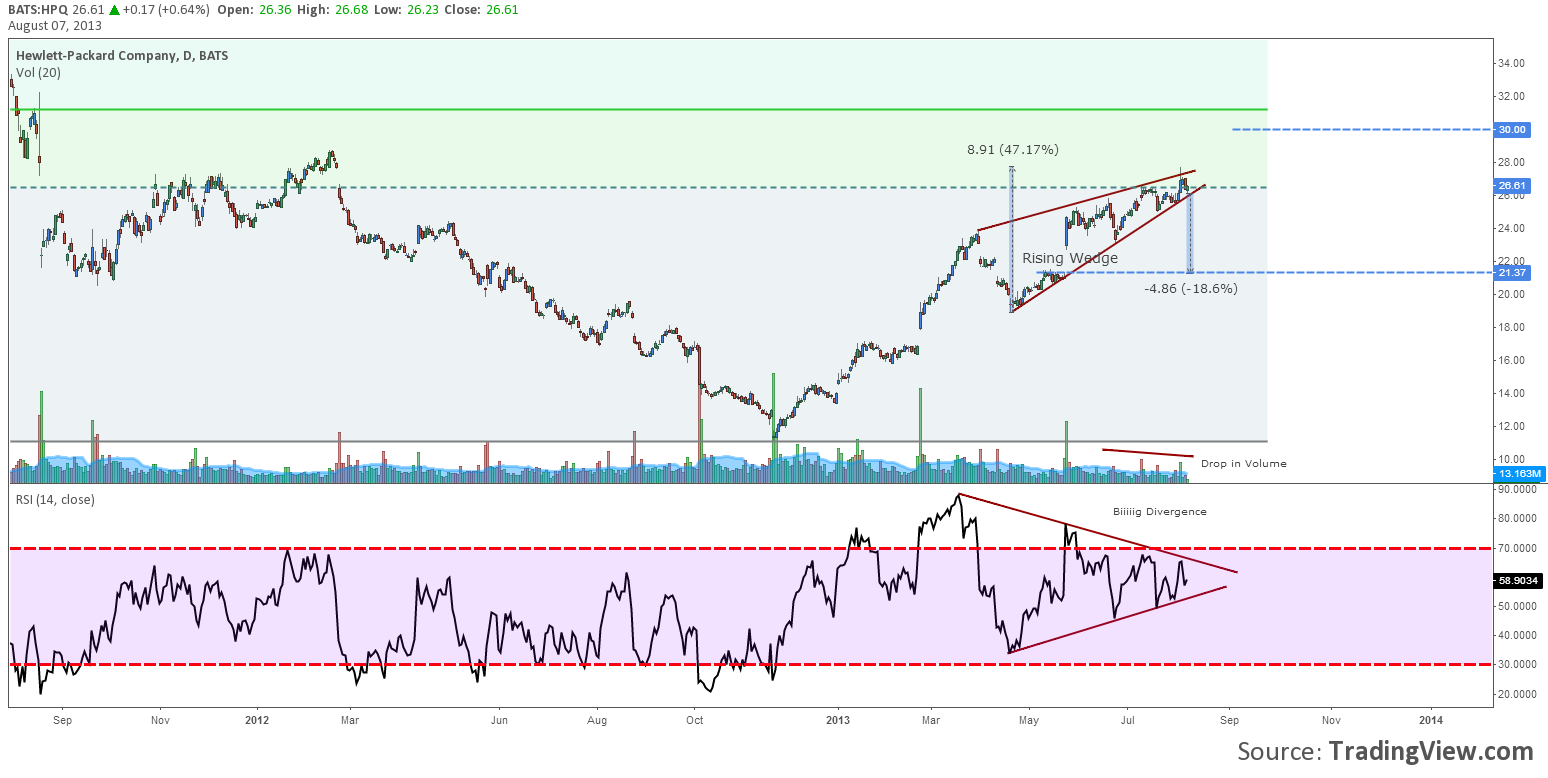
Chart: HPQ, Daily
The answer for this question is in my opinion, yes!
Hewlett Packard (HPQ) has reported earnings above expectations of 0.87$ per share but the price continued to rise at a moderate pace. Starting with the April low the shares gained over 45%, rising almost 9 bucks.
The power of the bulls dropped with each higher high. And this can be seen in the chart, because it has drawn a Rising Wedge. The pattern was accompanied by a fall in the trading volume which also shows that investors are less interested in this stock. With some effort the price managed to retreat 38.2(26.50$), Fibonacci retrace, from the main down trend started at 51$ per share in April 2010.
Adding the fact that on the 14 days RSI we can see not only a negative divergence created, but also a symmetrical triangle I would say that we just need a price action confirmation before a 20% drop back to 21$ per share. If on a daily time frame there will be a close under the lower line of the pattern the fall could be imminent.
All the facts are indicating a drop, but do not rush in taking a decision right now. Wait for a breakout and a close under the lower line and you can act. Short selling the stock could be a choice, but if you prefer you could use options to limit your risk in case of a false breakout.
The post Is Hewlett Packard on the Edge of a 20% Fall? appeared first on investazor.com.
Gold volume thinning amidst uncertainty of the Fed’s tapering
The U.S. Comex gold futures (COMEX:GCU13) fell for six consecutive days and ended at $1,282.60 on Tuesday. During Asia Wednesday morning, the gold futures fell a further 0.40%. The prices have already dropped over 2% this week while they went up 7.…
A world where everything is hackable
It’s been a weird couple of weeks for the Internet of Things. As we connect everything to everything else, we inadvertently create a huge attack surface for hackers, and we’re starting to see the chinks in the armor. Let’s say you fancy a fast…
BOE sets 7% jobless rate as threshold for policy change
By www.CentralBankNews.info
The Bank of England (BOE) intends to maintain its Bank Rate at the current level of 0.5 percent and is ready to purchase further assets at least until the U.K. unemployment rate falls to a threshold of 7.0 percent, the bank said as it adopted a form of forward guidance that sets out the conditions that may lead to a change in monetary policy.
But the BOE is also aware of the major challenges it faces with the UK’s high inflation and low growth rates, and introduced two inflation conditions and a financial stability condition that would “knock out” the unemployment threshold.
Under the inflation conditions, consumer prices should remain below 2.5 percent in 1-1/2 to 2 years ahead and medium-term inflation expectations should remain anchored. Under the financial stability condition, the BOE’s newly-created Financial Policy Committee must not consider the monetary policy stance a “significant threat to financial stability.”
“The knock-outs would not necessarily trigger an increase in Bank Rate – they would instead be a prompt for the MPC to reconsider the appropriate stance of policy,” Mark Carney, the new BOE governor said in his first policy initiative since moving from the Bank of Canada to the UK last month.
“But until the unemployment threshold is reached the MPC intends not to reduce the stock of asset purchases from the current 375 billion pounds,” Carney added.
The two inflation knockouts were included by the BOE’s policy-making body, the Monetary Policy Committee, to ensure that the forward guidance – known as a state-contingent guidance – is consistent with the BOE’s primary objective of price stability, currently defined as inflation of 2.0 percent.
The financial stability knockout was included because the BOE, following the global financial crises, has been given responsibility for ensuring financial stability, with its Financial Policy Committee (FPC) created as an independent body within the BOE.
Forward guidance gives the BOE another tool in its strategy to help the U.K. economy recover from the financial crises along with its low bank rate – at 0.5 percent since March 2009 – asset purchases and the Funding for Lending Scheme.
“It is important to stress that forward guidance does not mean the MPC is promising to keep interest rates low for a particular period of time. The path of Bank Rate and asset purchases will, as always, depend on economic conditions,” Carney said.
The UK’s unemployment rate is currently at 7.8 percent, practically unchanged for the last 10 months, and Carney stressed that the BOE’s bank rate would not automatically be increased when unemployment at some point drop to 7.0 percent, nor is that a target for unemployment.
“So 7% is merely a ‘way station’ at which the MPC will reassess the state of the economy, the progress of the economic recovery, and, in that context, the appropriate stance of monetary policy,” he said.
In its latest inflation report, the BOE forecast that the unemployment rate would only drop to 7.3 percent at the end of the 3-year forecast period