Which is the position of St. Louis Fed’s Bullard?

Article by Investazor.com

Everybody is speaking about the tapering of the Quantitative Easing program, but nobody has any concrete and reliable piece of information. If we are to consider the macroeconomic indicators that describe the U.S.’s economy, it is difficult to take any position. The data is mixed. On one hand, the labour market seems to be giving real signs of improvement, on the other hand, we cannot trust only one set of data. An information that can be trusted is the FOMC Member Bullard’s speech. It looks like between the FOMC members, the only measure which was discussed so far, about the tapering of the QE3, is the starting of discussions about possible plans for reducing the pace of asset purchases. Another thing that we know for sure, is that no final decision will be taken unless the end of the year will meet the same positive results that were met at the end of the first half of 2013. In the best case scenario, the September’s meeting might bring a set of pans, which will be implemented next year, according to the economic conditions.

The main findings of the Bullard’s speech are the following:

– Any decision concerning the Quantitative Easing program is separated from any decision concerning the policy rate;

– There are discussions on whether or not a wider range of labour market indicators need to be taken into consideration, decreasing the importance given to the present key indicators ( the unemployment rate and payroll employment growth);

– FOMC will have to decide if, in taking any tapering decision, it is important to consider the weak evolution of the GDP (starting with the beginning of 2013) or is better having sight of the future evolution, which is expected to be improved, and to trust this presumption?

– The size of the Fed’s balance sheet might pose questions about the most appropriate moment of tapering;

– The inflation is low. In such an environment, the FOMC might remove the policy accommodation;

The post Which is the position of St. Louis Fed’s Bullard? appeared first on investazor.com.

Price of Cotton is signaling a Reversal

Article by Investazor.com

Did you miss a commodity analysis? We have watched the price of cotton for some time now to give us a bullish signal.

cotton-is-signaling-a-bullish-reversal-14.08.2013

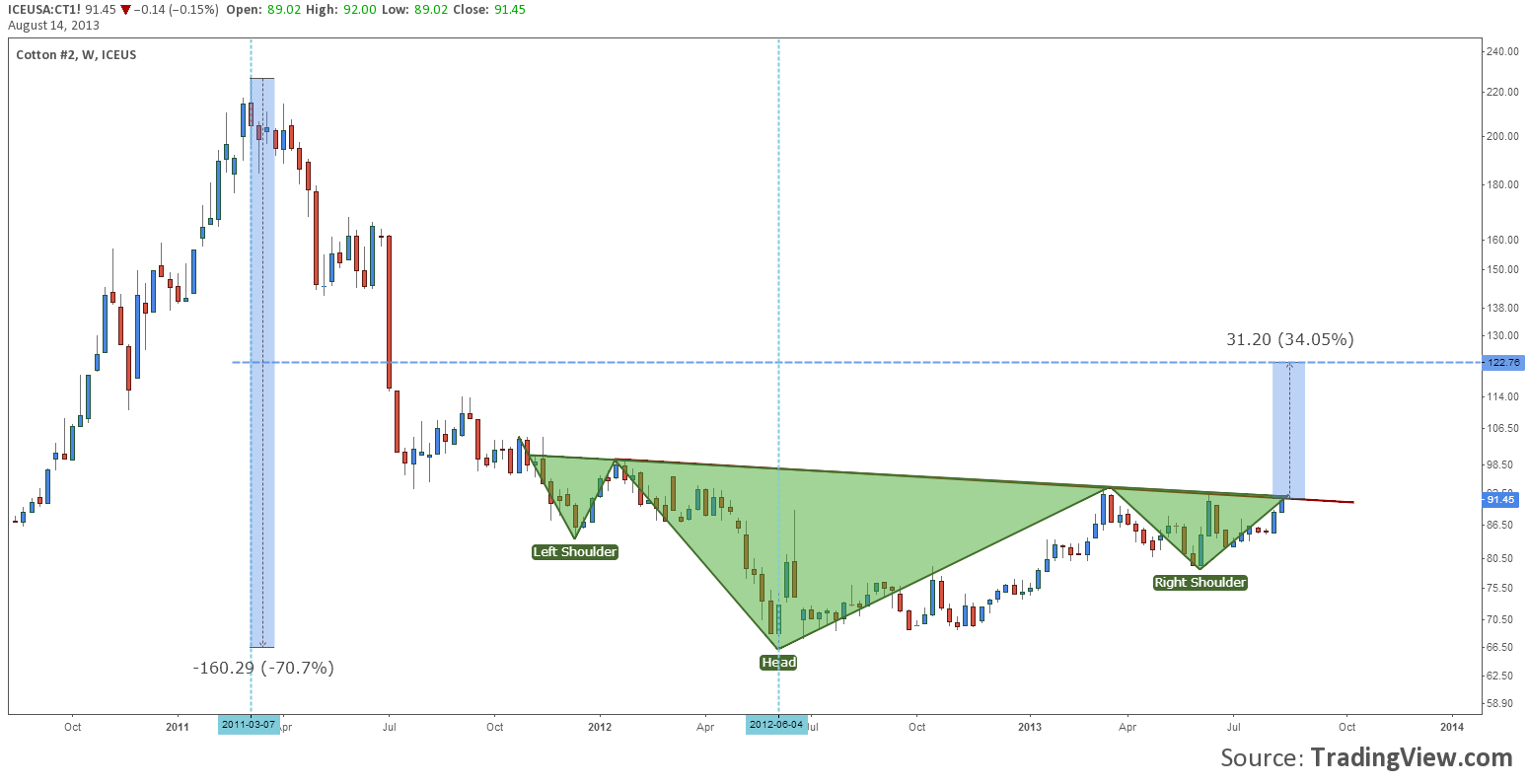
Chart: Cotton, Weekly

In March 2011 the price of cotton reached a historical high, at 227.00, after a low production and high worldwide demand. As usually the history repeated itself. Producers saw the potential in planting cotton and they started to plant record at record levels, resulting in a production that overwhelmed the demand.

In June 2012 the price got to a low of 66.10, dropping more than 70% from the all-time highs. But from 1st of January 2012 the price of cotton started to draw a Head and Shoulders Inverted, a pattern which could be actually build in an accumulation area. The base of the area is situated around 92.00.

At this point the demand for cotton seems to have increase. A big part of the worldwide production is held by China, so the prices might get to higher levels in the near future. If this week, or next 2 weeks will close above 92.00 we will have a confirmed a reversal price pattern. In this situation the target for the Inverted Head and Shoulders sits at 122.76, meaning a 34.00% rally from the current levels.

If anyone would like to profit from a possible rally of the price of cotton there are some possibilities. Investing in futures on the CME or on CFDs would be one of the solutions, while the second would be buying a LEAP call option with 95 – 100 strike.

The post Price of Cotton is signaling a Reversal appeared first on investazor.com.

Georgia cuts rate for 5th time, inflation to remain too low

By www.CentralBankNews.info     Georgia’s central bank cut its rate by another 25 basis points to 3.75 percent, the central bank’s fifth rate cut this year, as inflation is forecast to remain below the bank’s target level in the medium term.
    The National Bank of Georgia (NBG) said prices continued to decline in July due to a seasonal decrease in fruit and vegetable prices, along with the impact of a base effect, and inflation is first forecast to approach the bank’s target range in the second half of 2014.
    Georgia’s consumer prices dropped by 0.2 percent in July, consolidating the deflationary trend in the last 18 months. The central bank targets inflation of 6 percent.
    The central bank started its easing cycle in July 2011 and has cut rates by 425 basis points since then. This year it has cut rates by 150 basis points.
    Preliminary estimates suggest that Georgia’s economy expanded by 1.8 percent in the second quarter and the bank said economic activity is projected to “somewhat improve in the second half of the year, due to, inter alia, expected fiscal activity, thus reducing deflationary pressures.”
    In the first quarter, Georgia’s Gross Domestic Product expanded by an annual 2.4 percent, down from 2.8 percent in the previous quarter and 7.5 percent in the third quarter of 2012.

    www.CentralBankNews.info

Botswana cuts rate for 3rd time this year to boost growth

By www.CentralBankNews.info
    Botswana’s central bank cut its Bank Rate by another 50 basis points to 8.00 percent, its third rate cut this year, saying below-trend economic activity and high unemployment “provides scope for monetary stimulus to spur stronger output growth.”
    The Bank of Botswana, which has cut rates by 150 basis points this year, said weak domestic demand and benign external inflationary pressures contribute to the positive outlook for inflation in the medium term but this positive outlook could be negatively affected by large increases in administered prices and government levies along with higher international food prices.
    “It is anticipated that non-mining GDP will remain below potential in the medium term and will not be inflationary,” the central bank said.
    In the first quarter, Botswana’s Gross Domestic Product contracted by 2.2 percent from the fourth quarter for annual growth of 3.2 percent, down from 4.1 percent. Botswana’s non-mining GDP expanded while the mining sector shrunk.
    Botswana’s inflation rate fell to 5.8 percent in June from 6.1 percent in May, within the central bank’s target range of 3-6 percent.

    www.CentralBankNews.info

Central Bank News Link List – Aug 14, 2013: BOE dissent and robust jobs data fuel interest rate doubts

By www.CentralBankNews.info Here’s today’s Central Bank News’ link list, click through if you missed the previous link list. The list comprises news about central banks that is not covered by Central Bank News. The list is updated during the day with the latest developments so readers don’t miss any important news.

Google Tells Court You Cannot Expect Privacy When Sending Messages to Gmail

Google Tells Court You Cannot Expect Privacy When Sending Messages to Gmail; People Who Care About Privacy Should Not Use Service, Consumer Watchdog Says (via PR Newswire)

SANTA MONICA, Calif., Aug. 12, 2013 /PRNewswire-USNewswire/ — In a stunning admission contained in a brief filed recently in federal court, lawyers for Google said people should not expect privacy when they send messages to a Gmail account. Consumer…

Continue reading “Google Tells Court You Cannot Expect Privacy When Sending Messages to Gmail”

Solar Survivor Up 400%… and Still on Fire

By WallStreetDaily.com

Recent estimates show that datacenters worldwide inhale a total of 30 billion watts annually, the equivalent of 30 nuclear power plants.

No surprise, Greenpeace and vocal environmentalists have (and are) reacting with gasps loud enough to shake up entire industries, and make grown CEOs cry.

As a result, the so-called “dirty companies” have poured billions upon billions of dollars into making their data centers squeaky clean.

But there’s still plenty of scrubbing to do.

Pike Research estimates that more than $45 billion will be spent on energy-efficient datacenter technology by 2016. Indeed, companies are flocking to all corners of alternative energy, including hog waste.

Today, though, I want to talk specifically about solar, and how the most recent efforts of Apple (AAPL) and Verizon (VZ) bode very well for one company in particular, despite what anyone else says.

At the Core of Apple’s Solar Needs

A month ago, Apple announced plans to build (yet another) solar panel farm next to a datacenter in Reno, Nevada.

In addition to providing power to Apple’s datacenter, the 137-acre solar array – called Ft. Churchill – will generate approximately 43.5 million kilowatt hours of clean energy for Sierra Pacific’s power grid.

Apple’s North Carolina datacenter, the largest of its kind in the nation, is powered by two solar farms that generate 42 million kilowatt hours of clean, renewable energy annually for the 100-acre, 20-megawatt (MW) facility.

Finally, Apple has been very hush-hush about two other 338,000-square-foot datacenters in the works in Prineville, Oregon (down the road from Facebook’s (FB)). Like the others, it’s expected to be powered by clean energy, including solar.

And the company that Apple chose for these projects is San Jose-based SunPower (SPWR). And Apple isn’t the only company that’s turning to SunPower…

Hooking Up With Verizon, Too

Verizon also signed a multi-year agreement with SunPower for its $100-million solar and fuel cell energy project that will help power 19 of its facilities in seven states across the country.

The rooftop- and ground-mounted solar photovoltaic systems – as well as solar parking canopies – will be installed at Verizon facilities in California, Maryland, Massachusetts, New Jersey, Arizona and North Carolina. The project encompasses corporate offices, call centers, datacenters and central offices.

When the project is completed, Verizon hopes to generate more than 70 million kilowatt hours of its own green energy annually, while eliminating more than 10,000 metric tons of carbon dioxide. That’s enough to offset the annual carbon emissions from more than one million gallons of gas. (Verizon’s goal is to cut carbon emissions in half by 2020.)

SunPower… Up 400% and Climbing

I counted 77 solar companies listed on Greentechmedia.com that were either acquired, went bankrupt, or simply closed down since 2009.

So the solar market is definitely shrinking. But the industry growth has been phenomenal…

Over the past three months, solar companies have outperformed the S&P 500 – 85% to 5%.

Granted, SunPower sold off nearly 14% after the company released its second-quarter earnings. Revenue came up $4 million shy of the expected $580 million, and investors weren’t happy with the lack of guidance for 2014.

However, all the other numbers were rock solid. SPWR reported a GAAP gross margin of 18.7% and earnings per share of $0.15, both well ahead of the company’s own estimates. Plus, SunPower made a profit of $0.45 per share, crushing Wall Street’s estimate of $0.11.

All of this came after the stock had already shot up 400% the previous six months, from $6.30 a share to $23.76. And there’s still plenty of wiggle room in the short and long term, as current projections have the stock hitting as high as $80.

Keep an eye on any news concerning approval of a recently disclosed $370-million, 162-MW project in Chile. A positive development here could send shares blasting higher in short order.

Ahead of the tape,

Karen Canella

The post Solar Survivor Up 400%… and Still on Fire appeared first on  | Wall Street Daily.

Article By WallStreetDaily.com

Original Article: Solar Survivor Up 400%… and Still on Fire
Global Monetary Policy Rates – July: Average policy rate steady for 3rd month in row as 4 banks raise rates

By www.CentralBankNews.info

    Global monetary policy in July was characterized by tightening by several major emerging market central banks as they responded to a fall in their currencies and a likely build up in inflationary pressures following the U.S. Federal Reserve’s plan to reduce asset purchases later this year.
    The rise in policy rates by Indonesia, Brazil Zambia and Bulgaria and other tightening measures by Turkey and India is unlikely to signal an immediate reversal of this year’s trend toward lower policy rates as global economic growth is still weak and inflation low, allowing for further rate cuts.
    However, it is clear that this year’s trend toward lower rates is slowing as global economic prospects look to be improving.  Europe, the global economy’s Achilles heel in recent years, appears to be turning the corner, the U.S. economy is continuing its slow but steady expansion, Japan may finally be putting two decades of stagnation behind it and China’s slowdown may be bottoming out.
    For the third month in a row the Global Monetary Policy Rate (GMPR) – the average policy rate of the 90 central banks followed by Central Bank News – was steady at 5.65 percent in July, the same as in June and May.
    This compares with a GMPR of 5.77 percent in April, 5.85 percent in January and a 2012 average policy rate of 6.2 percent.
    The initial effect of the outflow of capital from major emerging markets, which followed a reassessment of global risks, was to take rate cuts off the agenda for several emerging market central banks, especially those like India and Turkey that are struggling with current account deficits and weakening economic growth.
    Brazil, Indonesia and Zambia were already heading down the path of tightening so currency depreciation just added fuel to the fire. Brazil had already raised rates in April and May, Indonesia was expected to tighten due to inflationary pressures from a long-awaiting government move to scrap fuel subsidies, and Zambia had already raised rates in June to contain inflation.
     The four rate increases in July by Indonesia, Brazil, Zambia and Bulgaria totaled 126 basis points. This compares with rate cuts of 190 basis points by six central banks, the lowest number of monthly rate cuts so far this year. 
    In total, global policy rates were cut by a net 64 basis points in July, sharply below cuts of 476 points in June or 749 points in April, the highest in any month this year. The central banks that cut rates in July included Hungary, Poland, Albania, Latvia, Tajikistan and Romania.
    Other signs pointing to a coming trend reversal came from New Zealand’s central bank which surprisingly adopted a tightening bias, putting it on course to become the first developed market central bank to raise rates since early 2011.
   
                                        GLOBAL MONETARY POLICY RATES (GMPR) 
                                  (Changes in July 2013 and year-to-date, in basis points)

COUNTRYMSCI               JULY               YTD
RATE CUTS:
BELARUS-650
SIERRA LEONE-500
MONGOLIA-275
KENYAFM-250
VIETNAMFM-200
HUNGARYEM-25-175
POLANDEM-25-175
GEORGIA-125
BOTSWANA-100
COLOMBIAEM-100
MOLDOVA-100
TURKEYEM-100
UGANDA-100
INDIAEM-75
ALBANIA-25-50
ISRAELDM-50
JAMAICA-50
LATVIA-50-50
MEXICOEM-50
MOZAMBIQUE-50
PAKISTANFM-50
RWANDA-50
SRI LANKAFM-50
UKRAINEFM-50
TAJIKISTAN-40-40
ANGOLA-25
AUSTRALIADM-25
AZERBAIJAN-25
EURO AREADM-25
MACEDONIA-25
MAURITIUSFM-25
ROMANIAFM-25-25
SERBIAFM-25
SOUTH KOREAEM-25
THAILANDEM-25
WEST AFRICAN STATES-25
BULGARIAFM1-1
SUM:190-3741
RATE INCREASES:
TUNISIAFM25
EGYPTEM50
ZAMBIA2550
INDONESIAEM5075
GHANA100
BRAZILEM50125
GAMBIA600
SUM:1261025
NET CHANGE:-64-2716

Now it’s not even close – Elon Musk is more important to society than Steve Jobs ever was

Now it’s not even close – Elon Musk is more important to society than Steve Jobs ever was (via Pando Daily)

By Hamish McKenzie On August 12, 2013At South By Southwest in March, Google[x]’s “Captain of Moonshots” told an audience that Elon Musk is a “national treasure.” Musk’s brilliance doesn’t come from being the world’s smartest man, said…

Continue reading “Now it’s not even close – Elon Musk is more important to society than Steve Jobs ever was”