Central Bank News Link List – Sep 16, 2013: Summers withdraws from Fed chair consideration

By www.CentralBankNews.info Here’s today’s Central Bank News’ link list, click through if you missed the previous link list. The list comprises news about central banks that is not covered by Central Bank News. The list is updated during the day with the latest developments so readers don’t miss any important news.

Microsoft Takes Risks by Buying Nokia

Article by Investazor.com

Lately the world was witness to a lot of excitement coming from the technology sector which is changing at a rapid pace. After we have become accustomed whit Yahoo’s impressive purchaces, Google acquired Motorola as a hardware partner and now Microsoft is buying Nokia’s devices and services devision, patent licences, design patents and a lot of employees (32000), all for $7.18 billion. As the Windows Phones’ market is dominated by Nokia, Microsoft may have made a smart decision. Giving the troubing performance of both Nokia and Microsoft in the mobile phones’ industry, the two giants joining their forces may lead to an improved performance in the forseeable future.

In a realistic scenario, both companies are expected to underperform for a while, fact reflected by the decline in the price of shares during the last period. If Nokia is hoping for reinvention and Microsoft is planning to increase its profits in the mobile-device market, starting with the first quarter of 2014 when the process of the acquisition will be completed, we may witness even more bold initiatives coming from the old allies (as they had a partnership in 2010). For now, Nokia is considered a less attractive business which doesn’t appeal investors anymore, being left in Microsoft’s hands (which also is betting on a highly riscant card game).

The post Microsoft Takes Risks by Buying Nokia appeared first on investazor.com.

The Next Big Winner

By Investment U

The industrial sector has lagged an otherwise hot market, but many strategists are looking to it as the next market mover. Improving confidence and an expectation of improving economic growth through the end of this year could make this sector the next big winner.

Industrials have been lackluster to say the least, held back by slowing in the emerging markets and a recession in the EU, but analysts are looking for 11% earnings growth in that sector next year. With improving economic projections for 2014, this slow poke of the market looks to be the best place for the second half of 2013 and 2014.

Despite improving economic numbers this year, industrials have only run up a fraction of other sectors like small companies, consumer discretionary and financials.

Barron’s recently ran a screen of 61 industrial stocks from the S&P 500 looking for companies that have not followed the broad market up and those that would get a boost by improving economic conditions. The names that jumped out were Caterpillar (NYSE: CAT), Textron (NYSE: TXT) and GE (NYSE: GE).

Analysts have put a target of $110 on CAT, based on earnings estimates improving from $7.25 per share to $8.17 in 2014.

Textron has been held back by weak sales from its private jet division, Cessna, but that is expected to turn around next year. Analysts are looking for as much as a 50% increase in earnings, driven by the aging of the existing jet fleet, which means the number of used aircraft is decreasing and the demand for new ones has to increase.

Look for Textron to move to the $45 area from its present $28.

GE is trading only at a forward P/E of 12.7 and is shrinking its financial arm, which should earn a higher multiple from the market. As its industrial margins improve we could see this one move from its current $23 to about $30.

In fact, conditions are right for all three of these to move up as much as 30% in 2014.

They have been the laggards to date, but keep your eye on the industrials.

Lenovo Is Moving Up

In only eight years, Lenovo has gone from a small PC maker to the No. 1 PC maker in the world. And now it is after the smartphone business.

It is already the No. 2 smartphone manufacturer in China, ahead of Apple and right behind Samsung. It currently has only 7% of the world market for smartphones and tablets, but that’s twice the market share HP has. And it is expected to launch its first U.S. smartphone in 2014.

But Lenovo’s real strength is in the emerging markets: 42% of its sales and profits come from China. So, this one is also a long-term play on China’s growth.

Lenovo expects to sell 50 million smartphones and 11 million tablets this year, all made in its own facility. It produced 11.4 million phones in the first quarter of this year, triple the number from the same period last year. Its full year sales for smartphones in 2013 are expected to be in the 50 million range, with 10 million tablets.

Its current manufacturing facility is capable of producing as many 100 million phones a year.

Despite a shrinking worldwide market for PC’s, Lenovo is expected to see 19% earnings growth or, a $1.40 per share on its U.S. ADR, as its sales shift to their higher-margin products.

2015 earnings growth is also expected to be in the 19% area. And analysts put the stock in the $25 range from its current price of $20.

The company isn’t the top dog in the phone and tablet business – not yet anyway. But based on its growth in just eight short years, and its improving position in China, this is one to definitely have on your bogey board.

The “Slap in the Face” Award

This week it goes to the group in this country who has shown the greatest increase in illegal drug use since 2002.

You better sit down. You won’t believe this.

The group that has seen the biggest increase in illegal drug use, not medical marijuana by the way, illegal drugs, heroine, coke, etc., is people between the ages of 50 and 55. And, the number of users in this group has doubled since 2002.

Hold on, it gets better.

That group has only doubled in size. There is an even bigger winner. The age group between 55 and 59 has shown a triple in the number of people using illegal drugs.

What is this? A return to the late ’60s, maybe a second childhood?

Are you kidding me? Woodstock was a long, long time ago, guys!

Life can be difficult, but come on! Drugs at our age? You need more help forgetting where you parked your cars?

Maybe it’s time for the return of the three-martini lunch. It has to better than heroin and coke.

Article By Investment U

Original Article: The Next Big Winner
Basic Ichimoku Trading System

Article by Investazor.com

This system can be put in the trend following category. It uses Ichimoku Kinko Hyo, a trend based indicator and a Stochastic that gives the buy and sell signals.

Because this system uses Ichimoku as the trend following indicator it would be recommended for the traders to apply this strategy on higher time frames, like 30 minutes, 1 hour and up to a month. The best part of the system is that it can be used on every type of instruments (from the most liquid – forex- to stocks and commodities that are not that liquid).

Let us talk now a bit about these two indicators. The Ichimoku Kinko Hyo it used with its default settings, because it usually gives the best signals with them. The Stochastic Oscillator can be adjusted, but we chose to leave it also at the default settings as it proved to work very well on higher time frames.

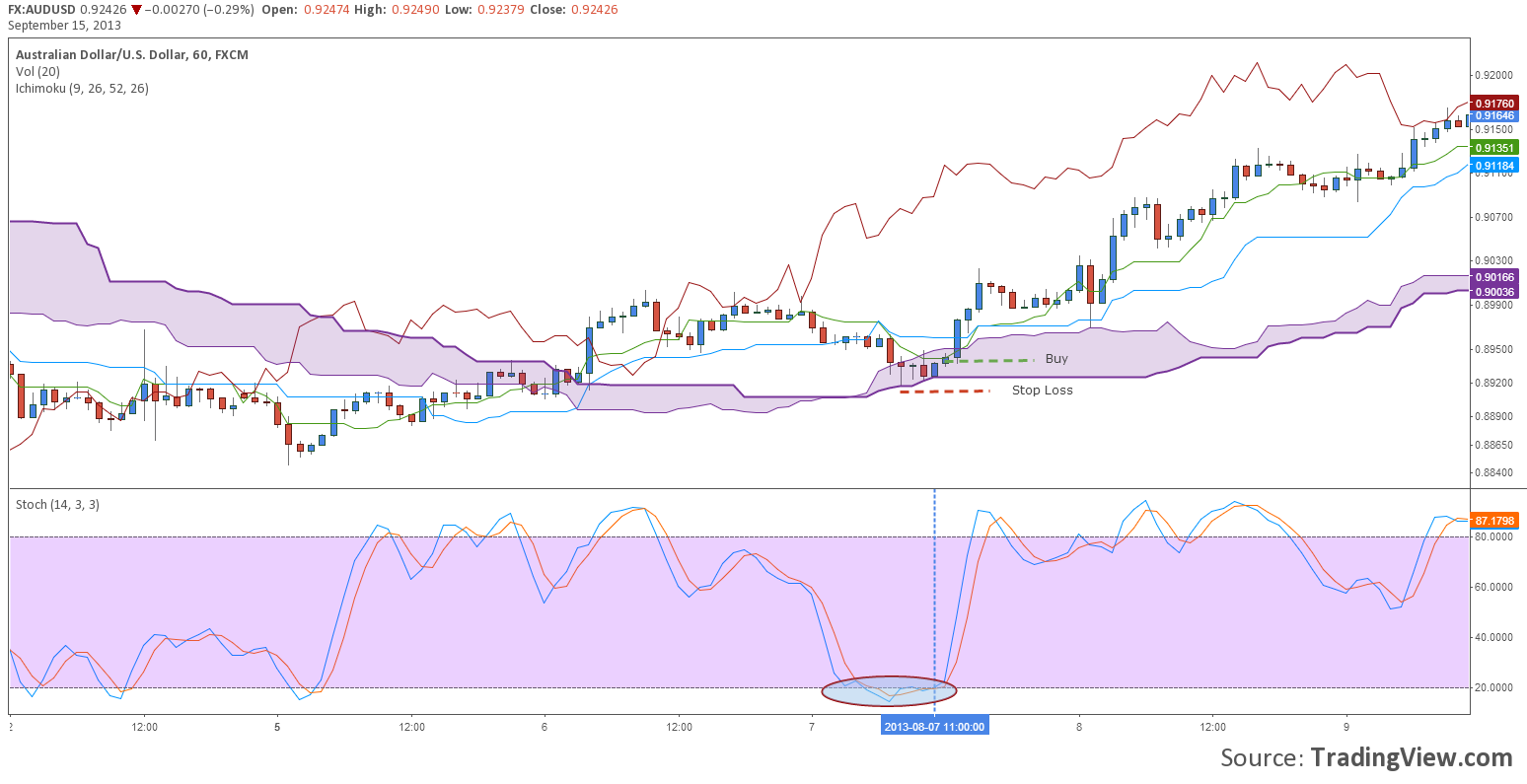
First step in using this strategy is to look for a trend. As long as the Ichimoku Cloud is under the current price, the trend is up; on the other hand if the Cloud is above the current price the trend is on a down slope.

Second step would be to follow the price action. When the price enters the Cloud, look for an oversold on the Stochastic.

basic-ichimoku-trading-system-resize-15.09.2013

Chart: AUDUSD, H1

As you can see in the example bellow, the price is above the cloud after a breakout. When it has retraced the Stochastic went under the 20 level. The trigger is the comeback of the oscillator above the 20 level.  Buy after the close of the candle that got the Stochastic back and set the Stop Loss under the latest low. If the Stop Loss will be set under the cloud, then the probability for it to be hit is even lower.

In what concerns the profit levels, there could be several of them. One Take Profit level could be the latest high, another could be set taking into consideration the money management and the most distant could be another intersection of the price with the Ichimoku Cloud.

This trading strategy can be used also in downtrends. The trader should wait for the price to be under the Ichimoku Cloud and the Stochastic to signal selling points inside the cloud. Pay attention to the sideways moves because this system could offer low probability trades.

The post Basic Ichimoku Trading System appeared first on investazor.com.

Weakest Economic Recovery on Record Means the Rich Get Richer, the Poor Get Poorer in America

By Profit Confidential

economic growthAccording to a study by economists at the University of California, Berkeley, the Paris School of Economics, and Oxford University, the income gap in the U.S. economy in 2012 was similar to what it was in 1920s! (Source: Associated Press, September 10, 2013.)

In 2012, the income of the top one percent of earners increased by almost 20%; for the bottom 99%, their income only increased by one percent.

But that’s not all…

The top 10% of all the income earners in the U.S. economy had more than 48% of all the net earnings in 2012. Going back further, since the Great Recession’s end in June of 2009, 95% of all increases in net earnings in the U.S. economy have gone to the top one percent.

Dear reader, this is not economic growth, it’s just a classic example of the rich getting richer and the poor getting poorer. When a country experiences real economic growth, you will see a steady rise in all incomes.

As I stated earlier, in 2012, almost 50% of all the net earnings went to the top 10%, meaning only 50% went to the bottom 90%. Will this increase consumer spending in the U.S. economy? Of course not. The top 10% can only buy so much and the economy can only go so far on that. For economic growth to happen, you need the middle class to be spending.

What we are witnessing today is the slowest post-recession recovery most living economists have ever experienced. If you take out the rally in stock prices since 2009, there has been no real economic growth.

Auto sales have risen, but auto loans have gone through the roof. (See “Scary Story on the Booming Auto Sales No One Is Talking About.”)

Housing has come back somewhat, but rising interest rates have resulted in a big decline in mortgage applications (the collapsing homebuilder stocks are telling us there’s a problem with the housing recovery).

Retailers from the low end of the market to mid-market are complaining that sales are not growing—their stock prices, a leading indicator, are again trending downward. Retailers are not seeing economic growth in this country.

And the unemployment picture in the U.S. economy remains a problem for economic growth. Add in people who have given up looking for work and those who want full-time jobs but are only able to find part-time work, and the unemployment rate sits at almost 14%—and it’s been there or higher for years now! How can you have economic growth with the unemployment level so high?

As I have written before, the U.S. is headed in the same direction as Europe, where there are only the rich and poor—the middle class no longer exists. You won’t hear politicians talking about this depressing trend, but it’s the doomed road that America is on, and it’s not leading to economic growth.

Article by profitconfidential.com

Why the Street Is So Bullish on This Junior Oil Producer

By Profit Confidential

oil stocksWith all the things going on in the world, it’s a good time to be in the oil business. Bakken oil stocks are almost all high-valuation; but the marketplace knows this, and it’s getting what it’s paying for—there’s big growth among many of these producers.

Everything is relative in the stock market. Valuations among junior oil producers with growing production (on strong oil prices) aren’t comparable to other businesses or industry sectors.

Triangle Petroleum Corporation (TPLM) recently shot way up on the stock market after reporting exceptional growth in production and its financials. This company is developing the Bakken Shale and Three Forks formations in the Williston Basin of North Dakota and Montana.

The stock’s actually been flat over the last two years. Part of the reason for this is that the company has had to sell a number of new shares in order to finance its business plan.

Triangle Petroleum recently reported fiscal 2014 second-quarter (ended July 31, 2013) revenues of $50.4 million, compared to $10.3 million a year ago.

Operating income was an impressive $13.0 million compared to a loss of $1.3 million. Net income was $6.8 million, or $0.12 per diluted share, compared to a net loss of $1.2 million, or $0.02 per diluted share.

The company finished the quarter with 57 million diluted shares outstanding, compared to 44.3 million shares last year.

The tough call in junior oil stocks isn’t knowing which companies are the big growth stories; it’s knowing the spot price of oil, because that’s always what energy stocks trade off. And naturally, you can’t predict the spot price of oil just like you can’t predict the extraneous factors that are part of its pricing mechanism. Costs or profitability come as a secondary concern.

So the oil business remains very much a speculative business even with proven operators and good growth stories. Just like precious metals mining, the junior energy business is a risk-capital, venture industry. (See “My Favorite Bakken Oil Play.”)

Which is why companies like Triangle Petroleum can be so volatile, trying to make things happen while going to the stock market for new financing. The growth in this specific case is coming by diluting existing shareholders.

It is a good time for this company, however, because the business is becoming profitable. I always like the period when an enterprise transitions from losses to earnings—it really is a milestone for any business and for shareholders, as well.

Oil is vulnerable to geopolitical events, obviously, and it also trades off U.S. and Chinese economic data. At just under $110.00 a barrel, the business case for higher-cost producers becomes attractive.

The Bakken oil boom continues, and Street estimates for Triangle Petroleum are going up.

Article by profitconfidential.com

These Exciting Possible IPOs Should Be on Your Radar

By Profit Confidential

IPOIn the late 90s, the anticipation of an initial public offering (IPO) was the hottest thing on Wall Street for traders. Get in on the pre-IPO allotment, and chances are you would make tons of money. I still recall the frenzy that surfaced after an IPO, especially from technology stocks.

Fast-forward a decade, and the market anticipation for IPOs is not as frenzy-like. Now traders are more careful to buy into IPOs after their initial debut.

The key to success in investing in IPOs today is patience. Even if an IPO skyrockets after its debut, it is often prudent to wait for a pullback or for the lock-in period to expire before buying, as this is when the initial investors, such as funds and institutions, can sell their shares in the stock market.

A great example of a former IPO star that opened at a high price but subsequently faltered was Internet stock Groupon, Inc. (NASDAQ/GRPN); the stock traded above $30.00 on its November 4, 2011 debut, but fell to as low as $2.60 a year later on November 12, 2012. I looked at the stock as a decent risk-to-reward play, and now the stock has been sizzling on the charts, up 332% from its November 2012 low. (Read “Why There’s No Stopping the Internet Sector.”)

Another example of a highly anticipated Internet IPO was Facebook, Inc. (NASDAQ/FB), which traded as high as $45.00 on its debut on May 18, 2012, and subsequently plummeted to $18.80 on October 19, 2012. But with over one billion subscribers, I considered Facebook to have excellent potential—if the company could monetize its user base, which it’s currently doing with its mobile advertising sales. The stock is now up over 130%, to its initial level when it first went public.

From these two examples, and there are many more, it’s obvious that the key to successful investing in IPOs is patience. These hyped-up stocks were talked up because they have promise and are not fad stocks.

While the IPO pipeline has numerous interesting stocks, the most anticipated are the technology stocks.

Here are some interesting initial public offerings that could debut this year or in 2014. You might want to keep an eye on these.

Airbnb, Inc.

Airbnb is an online service that allows users to list and rent home-based accommodations instead of hotels.

Dropbox, Inc.

Dropbox is a service that many of you are probably familiar with and use. The online service allows you to store your files in their cloud and access them from anywhere in the world on any device.

Square, Inc.

Square is a mobile payments service for merchants who may be on the road or for small businesses that are just starting out. Having seen the service in action at an arts fair, I can say it’s quite interesting. The merchant simply plugs a square adaptor into a smartphone, the credit card is swiped in the adaptor for approval, and voila!—the transaction is done. The California-based company has already made its way into Canada and recently announced its expansion into Japan.

Article by profitconfidential.com

What to Expect from the Forex Market Next Week 16 – 20 September

Article by Investazor.com

Another week has past and some very interesting readings were published. Wednesday Great Britain has published some very good data from the labor market. Its Claimant Count Change has fallen 32.6K and the Unemployment Rate dropped unexpectedly at 7.7%. The next day Australia reported a rise in its Unemployment Rate of 0.1% and RBNZ’s governor said that it expected a rise in the inflation rate in 2014 and they might have to raise the interest rate. Thursday it was also published the Unemployment Claims for USA at a value of 292K, but it might have been a problem with their computerized systems and this number could be revised next week.

The economic calendar for next week looks like this:

DateCurrencyForecastPrevious
MonSep 16NZDWestpac Consumer Sentiment116.6
GBPRightmove HPI m/m-1.80%
JPYBank Holiday
EURItalian Trade Balance4.13B3.62B
EURCPI y/y1.30%1.30%
EURCore CPI y/y1.10%1.10%
CADForeign Securities Purchases-2.23B-15.41B
USDEmpire State Manufacturing Index9.28.2
USDCapacity Utilization Rate77.80%77.60%
USDIndustrial Production m/m0.50%0.00%
TueSep 17GBPBOE Quarterly Bulletin
AUDMonetary Policy Meeting Minutes
AUDNew Motor Vehicle Sales m/m-3.50%
CNYCB Leading Index m/m1.40%
CNYForeign Direct Investment ytd/y7.10%
NZDREINZ HPI m/m-0.50%
EURCurrent Account18.3B16.9B
GBPCPI y/y2.70%2.80%
GBPPPI Input m/m0.30%1.10%
GBPRPI y/y3.20%3.10%
GBPCore CPI y/y2.10%2.00%
GBPHPI y/y3.40%3.10%
GBPPPI Output m/m0.20%0.20%
EURGerman ZEW Economic Sentiment45.342
EURZEW Economic Sentiment47.244
EURTrade Balance15.3B14.9B
USDTreasury Sec Lew Speaks
CADManufacturing Sales m/m0.60%-0.50%
USDCore CPI m/m0.10%0.20%
USDCPI m/m0.20%0.20%
USDTIC Long-Term Purchases-45.3B-66.9B
USDNAHB Housing Market Index5959
WedSep 18NZDCurrent Account-1.87B-0.66B
AUDCB Leading Index m/m-0.20%
AUDMI Leading Index m/m0.00%
AUDRBA Assist Gov Edey Speaks
GBPMPC Asset Purchase Facility Votes0-0-90-0-9
GBPMPC Official Bank Rate Votes0-0-90-0-9
CHFZEW Economic Expectations7.2
USDBuilding Permits0.95M0.95M
USDHousing Starts0.93M0.90M
USDCrude Oil Inventories-0.2M
CADBOC Gov Poloz Speaks
USDFOMC Economic Projections
USDFOMC Statement
USDFederal Funds Rate<0.25%<0.25%
USDFOMC Press Conference
ThuSep 19NZDGDP q/q0.20%0.30%
JPYTrade Balance-0.81T-0.94T
CNYBank Holiday
AUDRBA Bulletin
JPYBOJ Gov Kuroda Speaks
JPYAll Industries Activity m/m0.30%-0.60%
CHFSECO Economic Forecasts
CHFTrade Balance2.74B2.49B
CHFLibor Rate<0.25%<0.25%
CHFSNB Monetary Policy Assessment
GBPRetail Sales m/m0.50%1.10%
GBPCBI Industrial Order Expectations20
CADWholesale Sales m/m1.60%-2.80%
USDUnemployment Claims323K292K
USDCurrent Account-96B-106B
USDExisting Home Sales5.27M5.39M
USDPhilly Fed Manufacturing Index10.59.3
USDCB Leading Index m/m0.60%0.60%
USDNatural Gas Storage65B
FriSep 20NZDVisitor Arrivals m/m1.30%
CNYBank Holiday
NZDCredit Card Spending y/y4.70%
JPYBOJ Gov Kuroda Speaks
GBPPublic Sector Net Borrowing11.9B-1.6B
CADCore CPI m/m0.10%0.00%
CADCPI m/m0.10%0.10%
EURConsumer Confidence-14-16
USDFOMC Member George Speaks
USDFOMC Member Tarullo Speaks
USDFOMC Member Bullard Speaks

As you can see in the table, Tuesday there will be posted the CPI for Great Britain, the German ZEW Economic Sentiment and the Core CPI for the United States. Wednesday the event of the day and maybe the most important of the week is the FOMC Press Conference. The markets are waiting for details regarding the Quantitative Easing program. Thursday Great Britain will publish its Retail Sales and from USA there will be the Unemployment Claims, Existing Home Sales and Philly Fed Manufacturing index. On Friday Kuroda will have a speech and Canada will report its CPI.

The post What to Expect from the Forex Market Next Week 16 – 20 September appeared first on investazor.com.