Gold “Fierce” If Fed Surprises, Investment Banks Urge “Sell” as Traders “Spooked”

London Gold Market Report
from Adrian Ash
BullionVault
Weds 18 Sept 08:25 EST

The WHOLESALE price of gold fell below $1300 for the first time in 6 weeks Wednesday morning in Asia, as traders in all markets awaited today’s US Fed announcement on QE tapering.

 Regaining that level in London – a record high when first reached 3 years ago next week – gold still held 7% beneath the start of September.

 The US Dollar held flat meantime, as did US Treasury bonds.

 World stock markets ticked up with commodities. Silver rallied 20c from an overnight low at $21.37 per ounce.

 “Any surprise [on Fed tapering] could push gold prices fiercely in either direction,” says a commodity trading desk’s note.

 Longer-term, “Tapering really removes the upside case for gold,” reckons UBS commodity analyst Daniel Morgan in Sydney, speaking to Bloomberg.

 “I don’t see any big reasons to be bullish on gold in the short term.”

 Going further, analysts at Societe Generale today say that “Rate hikes will follow tapering, markets are too complacent,” in a new cross-asset strategy report.

 Recommending 7 key trades, “Switch out of emerging markets and associated commodities,” the French investment bank and London bullion market maker says.

 “Sell gold now,” SocGen’s report adds, pointing both to Fed tapering and “lower sovereign risk from the Eurozone.”

 Shorter-term ahead of today’s US Fed policy statement, “A large part of the market is already short in anticipation of [tapering], says David Govett at brokers Marex.

 “[So] if no taper is announced, gold will shoot straight back up as all the shorts run for cover,” Govett believes, forced to close their bearish bets at rising prices.

 Surveys and economists’ comments today put the consensus expectation for QE tapering at $10-15 billion, cut from the current level of $85bn per month.

 “If this [proves] the case gold is unlikely to come under further pressure,” writes Eugen Weinberg’s team at Commerzbank.

 “Of greater importance will be the way Bernanke steers the market’s expectations of future monetary policy measures [in his 14:30 ET press conference].”

 But “we tend to believe,” counters a note from London market-maker HSBC, “that the bulk of gold declines based on tapering are already largely factored into current prices.”

 After an initial knee-jerk drop, “[only] a heavier tapering program on a more limited timetable could lead to a second-round of sales,” its precious metals analysts say.

 UK policy makers at the Bank of England voted 9-0 this month to keep their quantitative easing unchanged, minutes from the Sept. meeting showed Wednesday morning.

As recently as last month, some members of the committee had seen a “compelling” case for extending the current £375 billion in QE – now used to buy one-third of all UK government debt in issue.

 “As monetary conditions normalise,” reckons Kevin Gardiner, Barclays’ chief investment officer for Europe, “[gold] investment demand is expected to weaken while physical demand growth from India will likely remain soft.”

 World No.1 gold consumer India yesterday saw import duty on gold jewelry raised to 15%, giving domestic manufacturers a price advantage as gold bullion duty stayed at 10%.

 “[Such] bearish news articles doing the rounds have precious metal investors spooked,” says analyst Moudi Raad at refining and finance group MKS in Geneva.

 Looking at the broader natural resources market, however, “Commodities continue to provide diversification versus stocks and bonds,” says a new article from portfolio managers Nicholas Johnson and Greg Sharenow at Pimco, the $2 trillion California-based bond and asset management firm.

“[Commodities] are also one of the most potent ways to hedge against unexpected changes in inflation.”

Adrian Ash

BullionVault

Gold price chart, no delay | Buy gold online


Adrian Ash is head of research at BullionVault, the secure, low-cost gold and silver market for private investors online, where you can fully allocated bullion already vaulted in your choice of London, New York, Singapore, Toronto or Zurich for just 0.5% commission.


(c) BullionVault 2013

Please Note: This article is to inform your thinking, not lead it. Only you can decide the best place for your money, and any decision you make will put your money at risk. Information or data included here may have already been overtaken by events – and must be verified elsewhere – should you choose to act on it.


Crude Prices: WTI Ends Three-Day Fall On US Stockpiles Data

By HY Markets Forex Blog

Prices for the West Texas Intermediate crude was seen in green on Wednesday, driven by the upbeat data of the US stockpiles data that are expected to drop in more than a year.  Traders are looking forward to the conclusion of the US Federal Reserve two-day meeting, later today, as analysts are expecting the scaling-back of the US stimulus program to hurt the crude prices.

WTI October deliveries rose 0.73% higher at $106.21 a barrel at the time of writing on New York’s Nymex, while the European benchmark crude Brent fell 0.16% lower to $108.02 a barrel after dropping to its lowest in over a month in the previous session.

WTI Crude hit its third monthly advance in August, assisted by the global supply worries from the oil-rich Middle East region. Syria was on the edge of a military intervention from the US, threatening the oil-rich Middle Eastern region.

Crude Prices- Eased Tension

The United Nations Security Council started its official talks on Tuesday to discuss about destroying Syria’s chemical weapons. The recent calming news has eased the heated oil markets, putting an end to the US plans for a military intervention against Syria.

The oil-rich country Libya, a member of the Organization of Petroleum Exporting Countries (OPEC) and one of the largest oil reserves in Africa, resumed at its Zawiya and Mellitah terminals on Tuesday. Production picked up from El Feel and Sharara, adding an additional 400,000 barrels a day (bpd), the state’s National Oil Company announced.

Crude Prices – Stockpile estimates

The US crude stockpiles dropped by 252,000 barrels last week, according to the non-public data compiled by the American Petroleum Institute (API).

Supplies in the largest oil-storage hub in Oklahoma, dropped by 889,000 barrels, according to reports from the American Petroleum Institute (API).

The US stockpiles is expected to have contracted another 1 million barrels over the last week to 359 million barrels.

Gasoline stockpiles are predicted to show a 500,000-barrel rise last week, while the distillate inventories is expected to show a fall of 167,000 barrels, according to analysts.


Visit www.hymarkets.com  today and find out more on how you can how you can trade Energy products with only $50.

The post Crude Prices: WTI Ends Three-Day Fall On US Stockpiles Data appeared first on | HY Markets Official blog.

Article provided by HY Markets Forex Blog

Asian Stocks Mixed Ahead of Fed Meeting Conclusion

By HY Markets Forex Blog

Asian Stocks  were seen trading mixed on Wednesday, as investors waits for the decision from the Federal Reserve’s (Fed) two-day meeting ending today. Analysts are expecting the Fed to announce when they would begin to scale-back on its stimulus program.

Meanwhile, the Japanese indices advanced, as it was driven by the upbeat data seen in the US indices from the previous session, as investors waits for the conclusion  of the Fed Open Market Committee(FOMC) from its two-day meeting ending toady.

Majority of investors are expecting the Fed to begin tapering its $85 billion monthly bond-buying program as soon as this month, while some analysts are predicting that the Fed policymakers would postpone their decision until December due to the mixed results released in the recent weeks.

Earlier in May, Fed Chairman Ben Bernanke hinted that the central bank could begin to scale-back on its US stimulus program as soon as this year, which has lead to investors worrying over the possible risk of tapering.


Asian Stocks – Japan

The Japanese benchmark Nikkei 225 advanced 1.35% higher to 14,505.36 points, after reaching an eight-week high of 14,578.34 points earlier in the day.

The US dollar was seen rising slightly higher against the Japanese yen, edged up 0.08% at ¥99.22.

Electronics manufacturers, Tokyo Electron, saw the biggest gain as it rose 5.5%, while Taisei Corporation, declined 1.8%.

Kawasaki Heavy Industries, gained close to a six-year high, rising 4.4% higher. While Kansai electric dropped 1.4% after stopping units from its two power plants. Sharp Corporation edged up 1.9% higher, following its board meeting announcement, where the board members are  expected to discuss a public offering of shares and a capital alliance to improve its balance sheet.

Tokyo’s broader Topix index advanced 1.05% higher to 1,194.65 points, driven by the region’s upbeat data.

Asian Stocks – China

In China, the country’s session saw slight gains, with Hong Kong’s Hang Seng gaining 0.05% to 23,191 points at the time of writing, while the mainland biggest Shanghai Composite advanced 0.29& higher to 2,192.05 points.

China’s housing index rose to 8.3% in August from previous reading of 7.5% in July, the National Bureau of Statistics of China confirmed.

Cheung Kong Holdings, real-estate developer gained 2.2% higher, while it rival China Resources lost 2.4%.


Visit www.hymarkets.com   for updates,news and more information on how you can start trading with the award-winning broker today with only $50 .

The post Asian Stocks Mixed Ahead of Fed Meeting Conclusion appeared first on | HY Markets Official blog.

Article provided by HY Markets Forex Blog

Elliott Wave Forecast: US Bonds Could Turn Into A Correction

I hate to say this again, but major pairs on the FX market place still have a very unclear price action and no direction at all on the intra-day basis. It’s probably “calm before the storm” ahead of highly anticipated FOMC press conference of the last few years, when Bernanke could announce tapering.  Statement will be out at 18:00GMT and press conference will be scheduled 30 minutes later. So until then we may not see a lot of price action today. However, when any changes regarding the monetary policy will be announced then expect a huge impact on USD pairs, particularly USDJPY which has a strong relationship with US yields.  US bonds will move strongly today, and will be interesting to see in which direction they will go if they will start tapering. Keep in mind that markets usually reacts the opposite than you would normally expect. During the QE period, interestingly, bonds were falling/yields rising so if they will lower QE now then this could cause the opposite reaction; higher US bonds in this particular example. That is what we called “buy the rumor sell the news” scenario.

Somehow, I would not be surprised by higher US bonds and reason is the following count on 30year US bond daily chart where I see five waves down in wave III with ending diagonal at the bottom that is pointing for higher prices. A daily close above 132.20 wave 4) extreme would be a bullish signal. If this count would prove correct then US yields will fall which will cause a bearish trend on USDJPY!! For now nothing is confirmed, especially not ahead of FOMC when anything is possible. Bonds could also continue lower if monetary policy remains unchanged, that’s why we need a close above 132.20 to confirm any larger reversal.

30Year US Bonds daily

US Bonds

Written by www.ew-forecast.com | Try EW-Forecast.com’s Services Free For 7 Days at http://www.ew-forecast.com/service


Taper This! Three Real Reasons We Should Care About Today’s Fed Meeting

By WallStreetDaily.com

Here comes the Fed!

We’re mere hours away from receiving a decision on the most overhyped debate in recent memory:

“To taper or not to taper…”

Who does Bernanke think he is anyway, William Shakespeare?

Puh-lease!

The next policy announcement from the U.S. Federal Reserve’s Open Market Committee is due at 2 PM EST, followed by a live media briefing with Chairman Ben Bernanke at 2:30 PM.

But come on, people!

The Fed isn’t cutting off the sauce cold turkey. We’re talking about tapering, here – perhaps as little as $5 billion per month and no more than $20 billion per month.

So the Fed will still be propping up the market to the tune of $65 billion to $80 billion per month.

The end result? The taper obsession gripping the market is complete nonsense.

Or as Bob Doll, Chief Equity Strategist at Nuveen Asset Management, says, “Eventually, we’ll forget all about it.”

Indeed! Heck, it’s not even the most important announcement to come out of the Fed today.

So what is?

~ Fed Focus #1: It’s All About Economic Guidance

When Fed officials provide their policy update this afternoon, we’ll also get their first forecasts for economic growth for 2016.

The party line for many economists (and the Fed) has long been that the U.S. economy will accelerate in the second half of this year.

Yet that’s becoming harder to accept at face value given the following:

  • Hiring recently tapered off. The economy only added 169,000 jobs in August.
  • Consumers cut back on spending, with retail sales increasing a measly 0.2% last month.
  • And confidence appears to be waning. The preliminary reading of the University of Michigan/Thomson Reuters Consumer Sentiment Index for September fell to its lowest level in five months, at 76.8.

Stephen Stanley of Pierpont Securities insists that “the languid August results underscore the big picture point that I have been hammering away at for a while: The vaunted second-half acceleration in the economy ain’t happening.”

Will the Fed read the data the same way? If so, it could have profound policy implications. Namely, it would warrant the Fed stimulating the economy even longer by keeping interest rates at historically low levels.

Bottom line: Any perceived economic weakness by the Fed should show up in future guidance. The Fed currently expects GDP growth of 3% to 3.5% for 2014 – and 2.9% to 3.6% for 2015.

~ Fed Focus #2: Deciphering the Real Unemployment Situation

Since the Fed launched QE3, the unemployment rate has dropped from 8.1% to 7.3%. If it falls to 6.5%, by the Fed’s own admission, it’s going to look to (finally) increase interest rates.

However, as I’ve noted before, the drop in unemployment is a total crock. It’s been caused by more and more Americans dropping out of the workforce – not joining it.

Bottom line: Thanks to the sad labor participation rate, look for the Fed to lower its 6.5% threshold. Otherwise, it runs the risk of investors thinking the labor market is strong – and that an interest rate hike is coming sooner rather than later. And that would be downright irresponsible, given the data.

~ Fed Focus #3: Revisiting Inflation Limits

The Fed has conceded that persistently low inflation could be problematic. And that’s precisely what we’ve got.

Case in point: In April, inflation checked in at a shockingly low level of 0.9%, year-over-year. It’s now only hovering around 1.2%. And that’s well below the Fed’s stated inflation target of 2%.

Bottom line: Expectations for inflation are key for determining when to raise interest rates. So look for the Fed to dial in its guidance to also include a lower bound for inflation.

JP Morgan (JPM) suggested a level of 1.5%, below which the Fed won’t look to raise interest rates, either. We’ll soon find out if the Fed agrees, or if it has another target in mind.

The True Fed Dilemma

A Fed taper is a foregone conclusion. It’s coming within months. However, the more significant event – an interest rate hike – remains a moving target. Just ask traders.

Based on the most recent futures prices, there’s a 55% probability of the first rate hike occurring in December 2014, and a 68% probability for it occurring in January 2015. Compare that to a few days ago when the majority of traders expected the first increase to come in October 2014.

Bottom line: The true Fed dilemma is when to raise interest rates. And that decision hinges on expectations for the economy, inflation and the ever-fragile employment market. So forget about the taper. Instead, pay attention to the Fed’s announcements on these three critical issues this afternoon.

Ahead of the tape,

Louis Basenese

The post Taper This! Three Real Reasons We Should Care About Today’s Fed Meeting appeared first on Wall Street Daily.

Article By WallStreetDaily.com

Original Article: Taper This! Three Real Reasons We Should Care About Today’s Fed Meeting

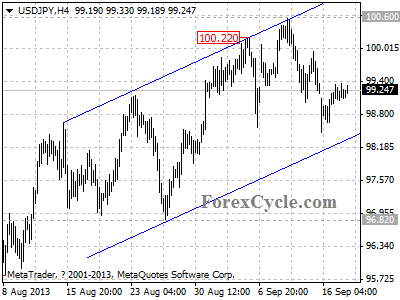
USDJPY stays in a upward price channel

USDJPY stays in a upward price channel on 4-hour chart, and remains in uptrend from 95.81, the fall from 100.60 could be treated as consolidation of the uptrend. As long as the channel support holds, the uptrend could be expected to resume, and one more rise to 101.50 area is still possible after consolidation. On the downside, a clear break below the channel support will indicate that the uptrend from 95.81 had completed at 100.60 already, then the following downward movement could bring price back to 95.00 zone.

usdjpy

Provided by ForexCycle.com

Judge the Stock Market by What it Does Not What it Says…

By MoneyMorning.com.au

Your editor likes a rising stock market as much as the next man.

But we won’t be suckered into believing bogus reasons for a stock rally.

That’s especially so when the reasons don’t pass the smell test.

You’ll have read the news that the supposed front-runner for the job of US Federal Reserve chairman, Larry Summers, pulled out of the race at the weekend.

The stock market met this news with delight. Apparently – we’re told – Mr Summers would have put an end to the whole money-printing thing and set the US Federal Reserve on an entirely new course. But now, with Summers out of the way, the path is clear for the current deputy chairman, Janet Yellen.

She loves money printing, hence the market’s overjoyed response to her assuming the lead in the race to win the Federal Reserve chair.

It all sounds very believable. But if you do believe it, we’re afraid you need your head examined, because it’s 100% hogwash…

An important thing to remember about markets is that they’re always looking for reasons and excuses to move in one direction or the other.

Sometimes it’s a verifiable and justifiable reason. Other times it’s just the best excuse for the stock market going up that anyone can think of.

It’s why one day you may see the market rise because ‘lower oil prices will help cut the cost of doing business.’

And the next day you may also see the market rise because ‘higher oil prices show a pick up in demand from a recovering economy.’

To some degree it’s a glass half full or half empty moment. The same goes with the Summers withdraw.

The ‘Committee to Save the World’

Let’s look at two key pieces of evidence to prove why the story is junk, and also to prove that whoever takes over the top job, the result will be the same…that is, more of the same…more money printing and a maintenance of low interest rates.

Below is a one-month chart of the US S&P 500:


Source: Google Finance

For that period, including the period from the end of August through to last Friday, the market assumed Larry Summers was the front-runner to lead the Federal Reserve.

So disturbed was the market by this prospect that stocks climbed 3.5% in just two weeks. Do you really believe stocks would have behaved this way if big investors thought the assumptive Fed chairman would pull the monetary rug from under the market?

No, of course not.

But what of the price spike on Monday with the news of Summers’ withdrawal? Well, it was a 0.57% gain…let’s not get too over-excited. As we often say, the market is always looking for an excuse to do something; this is one such example.

But it’s not the only proof that Summers would have happily put his finger down hard on the print button. Perhaps you remember this relatively famous TIME magazine cover from 1998:

That’s Larry on the right, at the time he was Deputy Secretary of the Treasury. The US Federal Reserve chairman of the time, Alan Greenspan, is in the middle, and then US Treasury Secretary Robert Rubin is on the left.

You can see from the headline they were dubbed the ‘Committee to Save the World’. There were responsible for saving the world from the 1998 Asian Financial Crisis.

Battle: Grey Hair

What point are we trying to make?

The point is you shouldn’t be fooled by the idea that out there somewhere there is some rational policymaker or bureaucrat who is determined to stop the madness of money printing and low interest rates.

That just won’t happen. How many more times can we say this? Interest rates are going nowhere.

You’re not dubbed part of the ‘Committee to Save the World’ if you turn up, say the party’s over and then proceed to pull the plug, causing the whole thing to collapse.

So no, don’t fall for the spin. Don’t for a moment think the US Fed was within a sniff of getting a chairman with a plan to stop printing money. That’s not how things work.

The market was just looking for an excuse to go up. It got one…and so it went up. Financial markets can be incredibly hard to interpret sometimes. Other times they can be incredibly easy.

Stock prices are rising and falling for some very dubious reasons at the moment. We like to see prices rise or fall based on company earnings and technological breakthroughs.

We’re not so excited when the reason for rising stocks is whether the market prefers a grey-haired lady to a grey-haired man.

So just be aware that when the market is this fickle, rising on little more than hot air, it won’t take much more than a cold draught to knock it back down again.

This is why, despite our belief that stock prices are heading higher,  we want you to be careful. This is why we don’t recommend a big exposure to stocks. Keep adding to your portfolio gradually but with stocks this high, do be prepared for a possible short-term dip.

Cheers,
Kris+

Join The Daily Reckoning on Google+

Special Report: Are You Waiting for a Real Estate Crash That Isn’t Going to Come? 

Cyber Security at the SIBOS Conference

By MoneyMorning.com.au

The big theme of the day today was cyber security. Along with the fear of potentially losing their livelihood to the likes of Google and Amazon, the other thing to keep bankers up at night is cybercrime.

And it comes in a variety of forms. There are the attacks you hear about in the media on a weekly basis. Distributed Denial of Service (DDoS) attacks are one kind. DDoS attacks are what the papers like to call ‘the end of the internet’. But it’s really just a flooding of data to a website or network to basically jam it up.

And then there are Hacktivists. We’ll get on to Hacktivists shortly. But they’re all about ‘taking down the man’, so to speak.

And interestingly the number one type of cyber security concern the chief technology officers had was internal threats and rogue employees.

That’s right, the Syrian Electronic Army can bombard major banks all they like. Anonymous or LulzSec can go to town on a bank’s core systems. But the biggest worry boards around the world have is from their very own employees.

Of course the kinds of boards most worried about internal threats are indeed from the banks. So let me ask you this…

Do you think the number one cyber security worry Google, Facebook or Twitter has is an internal rogue employees?

I doubt it. It seems internal threat is at epidemic proportions in the big banks of the world. Here’s what Nigel Hayward, CIO at J.P. Morgan had to say about it,

You’ve got to take a multi-faceted approach.

At J.P. Morgan you cannot plug in a USB device.

Employees and contractors have patterns and you can track those patterns.

Track patterns? Can’t plug in a USB device? Wow, sounds like the big bank is a really fun place to work.

Oh and in case you were unaware, J.P. Morgan reaped $5.77 billion in banking fees in 2012. And the average (yes, average) pay for Managing Directors in J.P’s Mergers Advisory arm was $1.7 million.

With 258,000 employees across the business, I’m pretty sure not everyone is sharing in the wealth there. It’s no wonder they have a rogue employee crisis. I’d go rogue too with that kind of inequality within the one organisation.

The More You Make The More They’ll Hack

The bigger they are the bigger a target that sits on their head. The annual security spend of these big banks runs into the hundreds of millions of dollars. And the price is going up.

J.P. is planning to increase cyber security spend by over 10% next year. And an audience poll had 52% of the crowd planning on spending over 10% more on cyber security too.

Beware of The Pimply Faced Teenager

You could almost smell the fear permeate through the audience when the term ‘Hacktivist’ was brought up.

I could imagine the reaction if a pimply 15 year old walked in the room with ‘Beats’ headphones hanging round his neck and an Alienware laptop by his side. I think the whole room would have evacuated.

There was one thing in particular the crowd didn’t understand when it came to Hacktivists. It’s the premise they operate without monetary motivation. This was beyond many of the bankers in the room. I could hear internal monologues throughout the room…’Without monetary motivation? Is that possible?’

A cyber criminal will typically steal data to sell in order to make money (i.e. Romanian ATM scammers). Hacktivists are motivated by other means. It’s really not that hard to understand.

It could be political motivation. It could just be because they can. It could even be because they’ve had a bad day.

Regardless of the reason, the Hacktivist operates with a unique set of ideological beliefs. Often they contradict the very existence of everything a bank stands for. And as such, a bank becomes a target.

Whether the banks like it or not they’re fighting an uphill battle. Whether it’s internal or external, cyber security is high on the agenda now.

And the best way to combat this threat is obviously to throw money at it. Now they’re starting to bring on board external companies to help manage their issues.

All Out Cyber Warfare

It’s an environment of all out cyber warfare right now. It’s not just geo-political issues. China spying on America and vice versa isn’t the real cyber warfare underway. It’s the daily attacks and ambushes of networks across the global financial system that we should be most worried about.

Dave Gray, author of The Connected Company calls it ‘network centric warfare‘. He says, ‘The small and agile organization that understands networks has an advantage unless the incumbents can organize themselves.

What he means is it’s the ones who get how a network works that will hold the gun to the head of those that don’t. So the young, tech savvy computer scientists and engineers that want to make an impact in the world will enter the market in two forms.

One, as legitimate start-up companies dedicated to shake the system up. Or they’ll take the path following ideology that favours hacktivists and troublemakers.

Either way it’s a new era of digital warfare. There are battles everywhere. State vs. state, hacktivist vs. banks, hacktivist vs. state…maybe soon enough state vs. bank?

I’ve said before that we can’t predict the future, but after the sessions and discussion from today we’re getting a clearer view of what’s likely to happen.

The trend is of increasing cyber security attacks. They’re not stopping, they’re on a parabolic curve upwards. Spending on defence is increasing, and the ‘generals’ are getting worried.

It feels like a crescendo to all out warfare. The feeling I got from today is it’s not a matter of if it will happen, just a matter of when.

Sam Volkering+
Technology Analyst, Revolutionary Tech Investor

Ed note: You can follow Sam at SIBOS on his Google+ page here… 

Join Money Morning on Google+

Bill Powers: Give Up the Shale Gas Fantasy and Profit When the Bubble Bursts

Source: Zig Lambo of The Energy Report (9/17/13)

http://www.theenergyreport.com/pub/na/bill-powers-give-up-the-shale-gas-fantasy-and-profit-when-the-bubble-bursts

The numbers don’t lie—but politicians and industry bigwigs do. While pundits still wax poetic about an era of American energy independence, Bill Powers, author of the book “Cold, Hungry and in the Dark: Exploding the Natural Gas Supply Myth,” sees productivity plummeting in almost every major shale play. In this interview with The Energy Report, Powers tells us to forget about LNG exports and a manufacturing boom and get positioned for a bust. How? Invest in energy equities. Powers names his favorites for maximum returns when the bubble bursts.
The Energy Report: Your last interview in May stimulated more discussion on how much natural gas supply we actually have in North America. Have there been any significant developments since then to support your views on the long-term supply picture?

Bill Powers: More data points have come in supporting my views and making it very clear that the Fayetteville and Haynesville shales are now in decline and the Barnett had a very steep, 17% decline in H1/13 on a year-over-year (YOY) basis. It is now producing about 4.6 billion cubic feet a day (Bcf/day), which is substantially down from its peak of near 6 Bcf/day. The facts are starting to show that declines for the older shale plays such as the Barnett, Haynesville, Fayetteville and Woodford are very serious. More important, once production growth from the Marcellus slows down, it will no longer be able to offset declining production from shale plays as well as conventional, offshore, CBM and tight sands production, which are all in terminal decline.

TER: Have companies been overproducing?

BP: There are still about 40 rigs running in the Haynesville. That’s dry gas with no associated liquids. Virtually every one of those wells will be uneconomic at under $6 per thousand cubic feet ($6/Mcf) and probably closer to $7/Mcf. About 80% of production will come within the first two years for most Haynesville wells, so current gas prices have an outsized influence on an individual well’s economics. There are still a number of companies out there willfully drilling uneconomic wells, which boggles my mind. These companies are continuing to drill to keep their production from collapsing entirely.

Last year, Chesapeake Corp. (CHK:NYSE) wrote down 4.6 trillion cubic feet (4.6 Tcf) of proven reserves from its Barnett and Haynesville shale wells. At the end of 2012, Southwestern Energy Co. (SWN:NYSE) wrote down the proven reserves of its Fayetteville Shale assets from 5 Tcf to 3 Tcf. Other companies, such as BHP Billiton Ltd. (BHP:NYSE; BHPLF:OTCPK) and BP Plc (BP:NYSE; BP:LSE), took huge write-downs. BG Group Plc (BRGYY:OTCQX; BG:LSE) also took a big write-down due to poor performance of its Haynesville wells. The list goes on and on. These reserves were supposed to have a 90% confidence level of being producible and generating a 10% rate of return using existing technology.

The low price of gas alone isn’t causing these write-downs. A lot of it has to do with the poor performance of these wells. There’s been a lot of evidence put forward by myself, Art Berman, who wrote the forward to my book, and David Hughes, that the shale industry has overbooked its reserves by approximately 100%. The write-downs of the last few years have largely proven this out. More importantly, if shale operators are writing down reserves at the rate we’ve seen, this also speaks volumes about the total recoverability of all shale gas in the United States.

The two really bright spots right now are the Marcellus and the Eagle Ford. There have been thousands of wells drilled through the Marcellus over the years for both the Oriskany, directly underneath the Marcellus, and the Trenton Black River Trend, also below the Marcellus. Operators have had the advantage of using a very good cheat sheet to know where to drill first for the best wells. Additionally, all the knowledge operators gained in developing other shale plays has greatly accelerated the ramp-up in Marcellus production. For example, operators began drilling horizontal wells early in the lifecycle of the Marcellus due to experience gained in the Barnett, Fayetteville and Haynesville. The strong growth in the play has really been the only thing that has kept gas production even close to flat this year in the U.S. As I discussed earlier, it will not be long before future shale wells will not be able to replace production from older wells.

The decline will become more evident once the aerial extent of the Marcellus fields becomes more clear. This is starting to happen in southwestern Pennsylvania, where Range Resources Corp. (RRC:NYSE), one of the most aggressive producers in the region, is now saying in its investor presentation that it and other operators have defined the outer limits of some fields. Once you run out of the high-quality, liquids-rich drilling locations in Washington County (southwestern PA), you will get a very large fall-off in productivity.

TER: Why all the production overestimates regarding U.S. shale reserves?

BP: Many of the people promoting the 100-year myth were doing it for either financial or political reasons. Let’s look at why the U.S. government promoted the myth. The government has the idea that if the U.S. were to become an LNG exporter through the rapid development of shale, we would lessen the importance of Russia on the world’s stage. Ernest Moniz, who’s the head of the Department of Energy, is a big advocate of exporting LNG. He recently granted the fourth LNG export license to Dominion Cove Point LNG (D:NYSE) to open an export facility in Cove Point, Maryland.

Industry mainly wanted the ability to sell acreage to latecomers. Chesapeake Energy championed this model by generating a lot of excitement after making a discovery and then selling out a significant chunk of that acreage to a latecomer, who would almost always overpay. This strategy was actually discussed by the former CEO, Aubrey McClendon, in an October 2008 conference call. Industry needed money to develop its own acreage and also to generate higher stock prices so they could acquire other assets or companies more cheaply. David Hughes has talked about how it would require $42 billion ($42B) to keep gas production flat in the U.S., while shale operators only generate around $32–33B dollars a year in revenue, and probably closer to only $8–9B in cash flow. They are far outspending their cash flow to drill additional wells.

Looking at academia’s role, there was a case where Penn State put forward a very optimistic report that was paid for by the industry and that payment was not disclosed. After a community group discovered this, the dean of the Earth Sciences Department redacted the report and reissued it with numerous changes and proper disclosure as to the source of the funding. The report discussed the economic impact on Pennsylvania from the Marcellus and made some very optimistic projections.

Unlike a lot of people who make statements about the amount of gas that’s out there and provide little or no empirical evidence to support their claims, I have almost 600 footnotes in my book that explain exactly where my estimates of future shale gas recoveries come from.

Other promoters of the 100-year supply myth include people such as T. Boone Pickens, who has a very self-interested agenda to get natural gas vehicles onto the road. Pickens, who said on CNBC in 2011 that the U.S. will recover 4,000 Tcf and has never provided any support for this statement, promoted this patriotic idea that we should convert our vehicle fleet to natural gas rather than buying oil from the “enemy.” Pickens has been known to refer to certain oil-exporting nations as the “enemy.”

However, Pickens almost never discusses the fact that he is one of the largest owners of Clean Energy Fuels Corp. (CLNE:NASDAQ), a company that is one of the biggest providers of natural gas refueling stations and that stands to benefit significantly from the growth of natural gas vehicle adoption. The legislation that T. Boone Pickens is advocating for in the Pickens Plan, which includes large tax credits and grants to the natural gas vehicle (NGV) and NGV refueling industry, would benefit him uniquely because he owns approximately 18.1 million (18.1M) shares of Clean Energy Fuels stock. Pickens’ shares are currently valued at around $230M. There are very few people, and you can count them on one hand, who want to discuss the reality of shale gas, which my book does.

In addition, the Securities and Exchange Commission (SEC), after heavy lobbying, changed its rules in 2010 to allow for a significant increase in proven undeveloped reserves to be booked, so the SEC was also complicit in the perpetuation of the shale gas myth. Without this change in how shale gas reserves were booked in 2010, most shale operators would have been forced to take large write-downs rather than booking increases in reserves. I believe this rule change by the SEC grossly distorts the value of a company’s reserves since it allowed for a large increase in the booking of proven undeveloped reserves.

TER: What other economic consequences do you see if and when your views become reality?

BP: I think it will be similar to the housing crisis, where a handful of people saw it coming and profited from it. There was significant evidence that housing prices were unsustainable, but most people were surprised when the housing bubble popped. People from Alan Greenspan to Ben Bernanke and others had a lot of information about the economy and how unsustainable house prices were, but did not want to talk about it publicly. There’s a saying that “the impossible can become the inevitable in the blink of an eye.” I think this will happen with natural gas. For example, in the first week of December 2000, gas prices went from around $4/Mcf to over $10/Mcf in only a few trading sessions. This was due to falling production, lower storage levels and a cold spell that set in across much of the United States. This price spike was the first of numerous spikes during the last decade.

In the late 1990s, Enron and other companies like Calpine Corp. (CPN:NYSE) built dozens of natural gas-fired power plants on the belief that the price stability between 1984 and 1999 would continue for several more decades. The build-out of gas-fired power plants was led by large demand increases from the electricity generation industry at a time of falling production. Few remember that U.S. gas production fell from 2002 to 2007.

Shale gas is a finite resource. When prices start to escalate, unfortunately, the situation will be even worse than the spikes we had in the early part of the 21st century, and even more so than the 1970s. From 2000–2010, we were able to increase our imports of LNG, and in the 1970s we built dozens of nuclear-fired power plants and hundreds of coal-fired power plants to reduce demand for natural gas. Now we are seeing the nuclear industry in decline, with five plants shutting down this year out of 104 plants, and many more closing in the next two to three years. Dozens of coal-fired power plants will be shutting down before mercury emissions laws take effect in 2015 and few new plants are likely to be built given the stringent emissions standards.

Even worse, for the first time in the industry’s history, world LNG trade shrank last year. We are seeing record-high global prices for LNG with no sign that this is going to slow down or reverse. When the U.S. is forced to go back out and try to secure cargos to import LNG, the prices we will be forced to pay are going to be much higher. The current price of LNG in Chile, Brazil and Argentina is $14–15 per million British thermal units ($14–15/MMBtu). In Japan and Korea it’s been over $16/MMBtu. Even Mexico is currently importing LNG at $16/MMBtu due to demand outstripping supply and lack of pipeline capacity to connect to U.S. markets. The U.S. is going to be forced to pay much higher prices when it will not be able to meet its own domestic needs, as shale gas rolls over and Canadian imports decline as the country begins exporting LNG to Asia via British Columbia.

TER: If we don’t have excess gas supply, will that lead to a bust in the planned LNG export terminal business?

BP: Barring a major new shale gas discovery in the very near future, the future of U.S. LNG exports will have to do with how much domestic demand falls off. A lot of these terminals will probably get built only to lie dormant when the government declares force majeure and cancels overseas contracts. Politicians will look at their constituents and see all sorts of suffering, from higher electricity bills to higher food prices to higher home heating bills, and say they are going to pull the export licenses from all these LNG plants. As I say in my book, “Overseas customers do not vote.”

TER: To address your earlier analogy to the housing bust, what are some actual investments investors may want to consider to for profit opportunity in the event of a shale gas crisis?

BP: Right now I think there are some great ideas out there. Three of my favorite Canadian companies are Bellatrix Exploration Ltd. (BXE:TSX), Advantage Oil and Gas Ltd. (AAV:NYSE; AAV:TSX) andArsenal Energy Inc. (AEI:TSX)—I’m a director with Arsenal and the company just had some very good news. My favorite company in the United States would be Denbury Resources Inc. (DNR:NYSE), which is very active in CO2 flooding in the Gulf Coast as well as in the Rocky Mountain region.

Advantage has a great Montney play at Glacier, where it has built out its infrastructure. However, the company is not overproducing its fields at a time of low Canadian gas prices. I think management’s done a great job and as gas prices rise, the company has tremendous leverage.

Bellatrix is a significant producer that will have room to grow. It has great Cardium acreage and is very leveraged to the Duvernay Shale. The company has significant upside from here.

Arsenal Energy trades at a very low multiple of valuation on any metric and has enjoyed very strong results in North Dakota as well as in central Alberta. It’s 75% oil. Again, I am a director and shareholder.

In the United States, Denbury has a very large inventory of projects it continues to develop and is far and away the industry leader at tertiary oil recovery. It gets Louisiana Light pricing for its oil and generates very significant cash flow, even at substantially lower prices. There’s almost no exploration risk for the company given that it is reestablishing production via CO2 flooding from previously depleted fields.

TER: What should investors be doing now to benefit from or protect themselves from what you believe lies ahead?

BP: I think that energy equities will provide some of the best returns available anywhere over the next 10 years, similar to what we saw in the 1970s. Shortly after the U.S. eliminated convertibility of the U.S. dollar into gold in 1971, which I consider a default, we saw massive inflation. Oil and gas and precious metals and equities related to these two sectors were among the very few investments that paid off in that era. The returns in those investment classes were fantastic, whereas just about everything else, from government bonds to general equities to tech stocks, got destroyed. I think we’re heading toward a similar period. Even though natural gas has been one of the only commodities left behind by the flood of liquidity over the last five years, it is also one of the most volatile commodities. I am looking for a period of serious outperformance by natural gas over the next decade.

TER: Care to take a shot on where you think gas prices may end up in the next few years?

BP: The U.S. is heading toward world gas prices. To recap, this means double-digit prices within the next three to five years for a number of reasons. First, in addition to lower U.S. production, our imports from Canada are going to be diverted toward Asia through LNG exports. Canadian production continues to fall, and 2013 will mark the 12th year since it peaked. Canada will be unable to export to both the U.S. and Asia due to lower production and record domestic consumption. Second, the U.S. is now far more reliant on natural gas to generate electricity than it was in the 1970s. The U.S. got out of that gas crisis by building nuclear and coal-fired power plants, not through increased gas production. Last, this time it’s going to be very difficult to destroy demand because we are starting to see manufacturing come back to the U.S. and coal and nuclear plants are closing.

TER: Thanks for joining us today and updating us on your thinking.

BP: Thank you. I greatly enjoyed our interview.

Bill Powers is an independent analyst, private investor and author of the book “Cold, Hungry and in the Dark: Exploding the Natural Gas Supply Myth.” Powers is the former editor of Powers Energy Investor, Canadian Energy Viewpoint and U.S. Energy Investor. He has published investment research on the oil and gas industry since 2002 and sits on the board of directors of Calgary-based Arsenal Energy. An active investor for over 25 years, Powers has devoted the last 15 years to studying and analyzing the energy sector, driven by his desire to uncover superior investment opportunities. You can follow Powers on Twitter at @billpowers1970 or visit www.bill-powers.com.

Want to read more Energy Report interviews like this? Sign up for our free e-newsletter, and you’ll learn when new articles have been published. To see a list of recent interviews with industry analysts and commentators, visit our Interviews page.

DISCLOSURE:

1) Zig Lambo conducted this interview for The Energy Report and provides services to The Energy Report as an independent contractor. He or his family own shares of the following companies mentioned in this interview: None.

2) The following companies mentioned in the interview are sponsors of The Energy Report: None. Streetwise Reports does not accept stock in exchange for its services or as sponsorship payment.

3) Bill Powers: I or my family own shares of the following companies mentioned in this interview: Arsenal Energy. I personally am or my family is paid by the following companies mentioned in this interview: None. My company has a financial relationship with the following companies mentioned in this interview: None. I was not paid by Streetwise Reports for participating in this interview. Comments and opinions expressed are my own comments and opinions. I had the opportunity to review the interview for accuracy as of the date of the interview and am responsible for the content of the interview.

4) Interviews are edited for clarity. Streetwise Reports does not make editorial comments or change experts’ statements without their consent.

5) The interview does not constitute investment advice. Each reader is encouraged to consult with his or her individual financial professional and any action a reader takes as a result of information presented here is his or her own responsibility. By opening this page, each reader accepts and agrees to Streetwise Reports’ terms of use and full legal disclaimer.

6) From time to time, Streetwise Reports LLC and its directors, officers, employees or members of their families, as well as persons interviewed for articles and interviews on the site, may have a long or short position in securities mentioned and may make purchases and/or sales of those securities in the open market or otherwise.

Streetwise – The Energy Report is Copyright © 2013 by Streetwise Reports LLC. All rights are reserved. Streetwise Reports LLC hereby grants an unrestricted license to use or disseminate this copyrighted material (i) only in whole (and always including this disclaimer), but (ii) never in part.

Streetwise Reports LLC does not guarantee the accuracy or thoroughness of the information reported.

Streetwise Reports LLC receives a fee from companies that are listed on the home page in the In This Issue section. Their sponsor pages may be considered advertising for the purposes of 18 U.S.C. 1734.

Participating companies provide the logos used in The Energy Report. These logos are trademarks and are the property of the individual companies.

101 Second St., Suite 110

Petaluma, CA 94952

Tel.: (707) 981-8204

Fax: (707) 981-8998

Email: [email protected]


Tomorrow FOMC Will Decide QE3′s Fate

Article by Investazor.com

Tomorrow is the much awaited day, when chairman Ben Bernanke will expose his decision concerning the evolution of the third Quantitative Easing program that has been implementent for one year, so far. Everybody’s eyes will be on Fed’s chairman and for sure the makets will be highly sensitive to each word delivered. The big question is: will the QE3 be reduced now? Or later this year? Most of the investors, and also most of the surveys conducted by Reuters and Bloomberg are pointing towards a contraction of $10 billion that will be announced tomorrow, but the amount may vary between $5 and $25 billion. Tomorrow are expeted forecasts about the American economy for 2016 and it will be interested to follow the way they will treat the fact that in January 2014 Ben Bernanke will no long lead the Federal Banks of the United States. Janet Yellen is the favourite so far, but we have to be carreful to any possible surprises. Even is economist believe that Yellen’s approach will be almost the same as the one of Bernanke and another chairman will make radical changes, we cannot expect this scenario to happen. Giving the size and importance of the QE, no matter the chairman, decisions will be taken in the best interest of the american economy. Thus, tapering will happen gradually and further changes will be made according to data coming from the labour and housing sectors, in particular. Anyhow, the difficult part of the process of strengthening the economy just now is coming, and the next chairman will have to be able to control the situation in a proper way.

Both gold an silver’s futures droped in anticipation of the decision that is coming tomorrow, investors preffering to wait. As it concerns the price of gold, it is expected to further decline until the end of this year. Same for the emerging markets, which are already feeling the efects of the “absence of QE” due to the considerable decrease of inflows of money.


The post Tomorrow FOMC Will Decide QE3′s Fate appeared first on investazor.com.