How to Reduce Your Forex Trading Risk with Options Hedging

Article by Investazor.com

The Forex market has got a pretty bad reputation during the past several years. In my opinion this has happened because of the less transparent brokerage houses (saying it short scammers) and because the traders that get into this train believe that it is a short journey to becoming rich.

To become profitable on the Forex market you need first to study it. Learn what are the factors that move the market, how the price is made, find yourself a strategy, get some discipline and start practicing with a risk as low as possible. It can become a full time job, but if you think you will get yourself rich after a day, a week or even a year with risking too much and no discipline, you will find yourself thrown out of a running train.

Traders should try to risk as less as possible and leave the market to run in their favor as much as possible. It is easier said than done, because while trading with real money emotions like fear and greed tend to appear. When the trader is surrounded by these emotions he tends to do stupid things. We will tell you in the next paragraphs a method that will help you reduce your risk while trading on the Forex market, but no one can show you how to manage your emotions, and for this you need to practice, practice and practice.

A good strategy to diminish the risk on the trades made on FX is to buy different types of options on the same instrument. You could ask: why buy and sell on the same type of instrument? Well, it would be pretty difficult to get out of that hedge with a profit on a way or another.

A trader can use different types of options depending on the strategy that he uses and especially on the time that he expects to keep the trade opened. Let’s take some simple examples:

If a trader uses a scalping strategy and he would at some point try to catch a bigger move on a very short time interval (best example would be what happened yesterday, 18 September 2013, on the FOMC meeting), he could use a very fast binary option on the other direction. This way if the price would not go in his direction could catch a profit on the option evolution.

Let’s say that the strategy used is not a very short term strategy, is rather a system that offers signals for trades that could last up to several days. In this case the trader could use European Digital options (Above/Bellow a specific level or Inside/Outside a range) and set up an expiry date for the option close to the day that he estimates he will close the trade.

If the trader is a position trader then he would need to hedge his trades on a longer term. In this case it is recommended to be used the Vanilla type options (Call/Put options). This way he will be able to win if the trade would go against his direction.

One important aspect that should always be taken into consideration is the money management. The premium paid for the option should be less than the potential profit made on trading, let’s say the CFD. The payout for the option should be equal or bigger than the stop loss set on the CFD.

The post How to Reduce Your Forex Trading Risk with Options Hedging appeared first on investazor.com.

Egypt cuts rate by 50 bps for second month in a row

By www.CentralBankNews.info     Egypt’s central bank cut its benchmark overnight deposit rate by another 50 basis points to 8.75 percent, its second rate cut in two months.
    The Central Bank of Egypt (CBE) also cut the overnight lending rate by 50 basis points to 9.75 percent, the rate on its main operations to 9.25 percent and the discount rate to 9.25 percent. The CBE did not immediately issue an explanation for its policy decision.
    The CBE last cut its rate in August, reversing a rate rise in March due to inflationary pressures. The CBE has now cut rates by a net 50 basis points this year.
    In August the central bank said the downside risks to growth were outweighing the upside risks to inflation. Egypt’s economy has been hit hard by political unrest.
    Egypt’s inflation rate eased to 9.74 percent in August from 10.28 percent in July while its economy expanded by an annual 2.2 percent in the first quarter, the same as in the fourth quarter.

    www.CentralBankNews.info


South Africa holds rate, vows to control inflation

By www.CentralBankNews.info     South Africa’s central bank kept its benchmark repurchase rate steady at 5.0 percent, as expected, but warned of upside risks to inflation and said it would “not hesitate to take appropriate action in order to maintain the integrity of the inflation targeting framework and to anchor inflation expectations at a lower level” if the outlook deteriorates significantly.
    The South African Reserve Bank (SARB), which has held rates steady since July last year, said a sustained breach of the central bank’s inflation target was not forecast and given the global uncertainties and downside risks to growth, its policy rate was maintained.
    South Africa’s inflation rate rose to 6.4 percent in August from 6.3 percent in July, above the bank’s 3-6 percent inflation target and though SARB Governor Gill Marcus expects inflation to moderate in the fourth quarter, she admitted the trajectory was “uncomfortably close to the upper end of the target.”
    The 2013 inflation forecast is unchanged at an average 5.9 percent but for 2014 the forecast has been raised to 5.8 percent from 5.5 percent and the 2015 forecast has been raised to 5.4 percent from 5.2 percent. In the third and fourth quarters of this year, inflation is expected to average 5.3 percent.
    “The current breach of the inflation target is still expected to be temporary, and the peak was possibly reached in August,” Marcus said, adding that the deterioration in the forecast was mainly due to changes in assumptions related to the exchange rate and petrol prices.
    Recent wage agreements have been above the inflation rate, contributing to the upside risks, but at the same time there are no demand side pressures in the economy, consumption is subdued with consumers under pressure with persistently high debt and little new employment creation.
    The Federal Reserve’s decision to delay tapering of quantitative easing has provided a temporary reprieve to the pressure on the South African rand, however, “the continued uncertainty relating to the timing of the inevitable slowdown in bond purchases and its data dependent nature, imply that emerging market currencies, including the rand, are likely to experience a protracted period of volatility,” Marcus said.
   “In the short run these developments may have moderated the risk to inflation from the exchange rate, but medium to longer term risks remain, which will be assesses on an ongoing basis,” she added.
    Like many other emerging market currencies, the rand weakened sharply in May but has appreciated since late August and rose in response to the Fed’s surprise decision on Wednesday to delay a  reduction in asset purchases.
    But since the start of the year, the rand has still depreciated by almost 13 percent against the U.S. dollar, trading at 9.685 earlier today.
    “The risks to the inflation outlook from the exchange rate remain elevated and dependent on its future trend,” Marcus said, with a sustained depreciation posing a significant risk to inflation.
    The rand is also under pressure from the current account deficit, which widened to 6.5 percent of Gross Domestic Product in the second quarter.
    The outlook for South Africa’s economic growth remains unchanged since the SARB’s last meeting in July with quarter-on-quarter growth in the second quarter below the bank’s estimate of potential output of around 3.5 percent, resulting in a widening of the output gap.
    SARB still expects 2013 growth to average 2.0 percent, 3.3 percent in 2014 and 3.6 percent in 2015.
   
    www.CentralBankNews.info

Exclusive Invitation: 5 Free Days of Commodities Trading Opportunities

Exclusive Invitation: Free “5-5-5” Event for Commodity Traders

You’re invited to a free trading event, hosted by our friends at Elliott Wave International. Now through Tuesday, September 24, watch 5 videos by EWI Senior Commodities Analyst Jeffrey Kennedy. Each video will bring you a new, imminent trade setup as well as a lesson from Jeffrey on how to find new trades of your own. This is where education meets opportunity! Join EWI’s free commodity trading event now >>

Dear Trader,

You may remember that in late 2012, corn was trading near record highs. Mainstream experts said the rally would keep going. Instead, corn went into a precipitous decline to 33-month lows.

Coffee prices have taken a similar path this year. Since January, coffee has been in a free fall to the lowest levels in four years.

One of the few bright spots for commodity bulls has been cotton — which in August suddenly exploded upwards to its highest level in one year.

What is standing in the way of a FULL-BLOWN commodities sector comeback?

The rumored end to the Fed’s stimulus program later this month, say the pundits.

Well, here’s your chance to get a different perspective.

From September 18-24, EWI’s Senior Commodities Analyst and Trading Instructor, Jeffrey Kennedy will show you 5 online videos, each with 1 new, immediate commodity market trade set-up (market conditions permitting).

What’s more, you will see how he goes about finding new trades.

To participate, all you need is to take 30 seconds now to reserve your FREE virtual seat.

Join EWI’s free “5-5-5” Trading Event now >>


About the Publisher, Elliott Wave International
Founded in 1979 by Robert R. Prechter Jr., Elliott Wave International (EWI) is the world’s largest market forecasting firm. Its staff of full-time analysts provides 24-hour-a-day market analysis to institutional and private investors around the world.


Brent Cook: Do NI 43-101s Provide a False Sense of Security?

Source: Karen Roche of The Gold Report (9/18/13)

http://www.theaureport.com/pub/na/brent-cook-do-ni-43-101s-provide-a-false-sense-of-security

Many mining companies find themselves in a high-grading dilemma, according to Brent Cook, publisher of Exploration Insights. As companies deplete higher grade reserves, they have to acquire new deposits. But unless you are a geologist, don’t look to NI 43-101s to always give you reliable information about the quality of a resource. They often don’t provide the data needed to make intelligent decisions, says Cook in this interview with The Gold Report. Cook is interested in investing only in world-class deposits and shares some of the names on his list.

The Gold Report: Brent, in your August newsletter, you rant about high grading. For our readers who are not familiar with that practice, can you give us a brief explanation?

Brent Cook: Most mine plans or mine reserves are laid out using an economic cutoff grade based on a specific gold price and specific production cost assumptions. Using an example of 0.5 grams/ton (0.5 g/t) as a cutoff grade, any rock pulled out of the mine under 0.5 g/t is waste; you lose money mining it. That’s the difference between waste and ore. With ore, you make money. With waste, you lose money.

Say a company based its cutoff grades on a gold price of $1,500/ounce ($1,500/oz). When the price drops below that level, some of the rock that used to be ore becomes waste. To fix that problem, a company goes to its mine plan and selectively mines the higher grade portions of the deposit. That makes perfect sense and the company needs to do that. But down the road, the grade of the material that was meant to be mined but was instead left in the ground is likely to be too low to be mined economically, barring significantly higher metal prices.

The net result is that, unless gold prices go way up, a company’s stated reserves will decrease with the lower gold price assumption. The total number of ounces in the reserve will decline because the grade of the remaining rock, the rock that was left behind during the high grading of the deposit, was marginal to begin with and is now probably uneconomic.

TGR: If the reserves go down, there would be a corresponding decrease in the value of the company. Is there anything wrong with management keeping a company viable, even if the share price has to go down a bit?

BC: There’s nothing wrong with that, and it is what management has to do. But it means the ounces the company was going to mine in the future go away. Its business has shrunk. The company has to find more ounces to replace what was lost by high grading a deposit. And again, I want to emphasize this is all gold-price and production-cost dependent.

TGR: Are companies high grading just to prove out a project, to position it for sale?

BC: No. Companies like Newmont Mining Corp. (NEM:NYSE), Barrick Gold Corp. (ABX:TSX; ABX:NYSE) and IAMGOLD Corp. (IMG:TSX; IAG:NYSE) are high grading. Most active mines have the ability to adjust the mine plan to current price conditions, unless they are marginal and uniformly low grade to begin with. When the gold price changes or operating costs go up, the whole mine plan changes. What was probably scheduled future production may no longer be economic. That’s the problem.

TGR: Is that good news for advanced explorers and near-term producers?

BC: It depends on the quality of what the junior companies own. As a whole, the major mining companies are producing about 80 million ounces gold (80 Moz)/year. My expectation is that, at some point in the near future, they will be in desperate need of new economic deposits because they don’t have the reserves to keep production at the same level. This is particularly true of companies with deposits that are marginal at, say $1,400/oz gold. Those companies are high grading out of necessity now and more than likely sterilizing significant portions of their deposits.

This loss of quality reserves is leading to an ideal setup for speculators in the junior mining industry who are identifying and buying those few deposits that make money at lower gold prices. I’m convinced that once mining companies come out of their foxholes, they will want to acquire the few high-grade, high-margin deposits held by juniors.

This is an opportune time for us in the junior end of the business, even though it doesn’t feel like it.

TGR: What will motivate mining companies to get out of their foxholes, as you say?

BC: I think it will be the realization that they lack the high-margin reserves needed to keep making money. They weren’t ready for the shock of gold dropping from $1,800 to $1,200/oz. In response, they cut exploration and development dramatically and have started high grading.

All of that will bite them, because without new deposits, without new reserves, they don’t have a business. As I have reiterated many times in Exploration Insights, one day the board of directors will turn to company management and say; “All right, bring on the new high-margin deposits. We are running out of ore.” At that point management will have to explain that it fired all the geologists, shut down exploration, curtailed development and ain’t got nuthin’ new. There is only one solution: Go out and buy a good deposit.

TGR: At what gold price can lower grade mines become profitable? Do we need a $1,500/oz gold price to stop the high grading?

BC: It depends on the individual deposit. Previously, the gold industry talked a lot about cash costs—what it costs on a cash basis to produce an ounce of gold. However, cash costs don’t include all of the other costs that go into keeping a mine going: general and administrative expenses, taxes, exploration and development costs, and sustaining capital costs.

Now companies are switching to reporting all-in sustaining costs, which includes just about everything it takes to produce that ounce of gold. Depending on the company, all-in costs are between $1,300 and $1,500/oz, even $1,700/oz. You can see the problem. Companies can cut costs by laying people off, stopping exploration and development, but that kills their business. It goes back to the need for high-margin deposits.

If readers of The Gold Report contact us, I’ll send a newsletter detailing sustaining costs and cash costs, what it really costs to mine an ounce of gold. Just select the “Contact Us” tab atwww.explorationinsights.com and request the gold cost letter.

TGR: You’ve told us that before people start investing in exploration and speculative companies, they need to know what a company is looking for. That includes understanding the test results and being able to compare them to expectations. One way to do that is through NI 43-101 reports, but you believe that NI 43-101s provide a false sense of security. How do investors know what information to use?

BC: That’s a really good question, and there’s no single answer. The NI 43-101 reports are predominately intended to provide sufficient disclosure for an educated investor to make an informed investment decision. It’s a regulatory document that describes what you can and can’t say. But here’s some interesting results from a review of 50 NI 43-101 reports by the Ontario Securities Commission: Eighty percent had some sort of error; 40% had a serious error or were missing information that should have been included.

What it comes down to is that a lot of companies are not giving us the data we need to make intelligent decisions, be it detailed cross-sections, or detailed information on how costs were calculated. That needs to be addressed because all of us in the mining sector need to have confidence in a report’s conclusion based on the backing data.

In my opinion, too many resource estimates do not adequately address geological and structural controls to mineralization. Computer jockeys who are really good at plugging numbers into spreadsheets are coming up with results that do not honor the basic geology. That gives people a false sense of security that because the resource is in a spreadsheet with lots of fancy math it has to be legitimate. One needs to be careful.

TGR: What additional data would help investors make intelligent decisions?

BC: Too few NI 43-101s provide the cross-sections to prove where the company draws the line between ore and waste—what the criteria are and how these decisions were arrived at.

Admittedly, a lot of this is subjective and bear in mind the resource estimator is extrapolating the resource from very limited data that, volume-wise, represents less than 1% of the rock. For instance, I could look at 100 drill holes and come up with a different resource than somebody else. It’s tough to know who’s right or wrong and that is just the nature of the beast.

TGR: How does someone who’s not an expert make more informed decisions, short of becoming a geologist?

BC: It isn’t easy. Ultimately you do have to rely on the NI 43-101s: Is the documentation there and correct? Who did the documentation and who paid to have it done? Many reports are just sales documents and all too often an engineering firm will assign a less exciting job to its “B” team.

Essentially, you have to rely on an expert. That could be a newsletter writer, an analyst, a relative in the industry or your brokerage firm. You need the advice of someone who knows the industry.

TGR: I like the way you concluded one of your recent rants, “High-quality, high-margin metal deposits are going to become increasingly valuable as current operations are depleted and production begins to decline. This eventuality makes our jobs relatively straightforward. Own the best deposits and discoveries and hope like hell some government doesn’t steal them.” Which companies have the best deposits?

BC: There are two aspects to answering that question: The first is owning the best deposits. The second is identifying them early on and buying at the right price. There are projects that are great deposits, but are over- or fully valued now.

For example, Reservoir Minerals Inc. (RMC:TSX.V), which has a joint venture with Freeport-McMoRan Copper & Gold Inc. (FCX:NYSE) in Serbia, drilled the best copper-gold drill hole I’ve seen in decades. We recognized the potential because we understood the geologic setting and we knew what Freeport was doing. We bought Reservoir at just under $1. It’s now around $4/share. It remains a great deposit, and Freeport will, hopefully, eventually buy it out.

TGR: How much additional upside is there if the copper or gold price begins to rally?

BC: I would say a fair bit. If copper or gold rallies, anyone with a deposit stands a chance of going up. We saw that in late August when the rising tide took most companies up, good or bad.

The advantages with Timok, the Reservoir-Freeport deposit, are how rich the grade is and that it’s part of a much larger system. Freeport is spending what it will take to bring Timok to a bankable feasibility study. It’s in a known mining district and is adjacent to a smelter that can take this sort of ore. It has everything going for it.

TGR: Are there examples when you didn’t get in at the right time that could be educational for our readers?

BC: Unfortunately, yes. Midas Gold Corp. (MAX:TSX) has a great deposit in Idaho. It’s has 6.5–7 Moz gold at a good grade and will show good margins. You get a bonus kicker of some antimony production. We bought at $3.50/share in 2010 when it came out of the shoot, gold was flying and markets heading up. Since then, it has collapsed along with everything else. We bought again at $0.70 and it’s gone back up some. Our timing was wrong, but knowing that it was still a very good deposit, we averaged down and are working our way back up.

TGR: Is that an example of a project that needs a major to get out of the foxhole?

BC: I think so. The company will issue a prefeasibility study and resource update in early 2014. The study is paralleling the permitting process and assuming both turn out positive I think a major takes a run at Midas. The project is in an old mining camp that is a bit of an environmental disaster right now; old tailings, river through a pit and such. The plan, at the end of the mine life, is to fix up the whole area so the salmon can get back upstream and leave mountain meadows full of happy butterflies.

TGR: What is the timing on the permit?

BC: I think final permits are at least two years away.

TGR: What other companies are you following?

BC: I’ve owned Virginia Mines Inc. (VGQ:TSX) or its predecessor for 12 years. The company sold Éléonore, a very high-grade deposit, to Goldcorp Inc. (G:TSX; GG:NYSE), which is putting it into production. Virginia retained a 2.5–3.5% royalty on Éléonore. The mine will produce on the order of 600,000 ounces (600 Koz)/year. That royalty—probably the best royalty held by a company that’s not a major mining company—rolls straight back to Virginia.

If you’re positive on the gold price, this is the safest bet possible. Virginia is also moving forward on a number of other projects. Plus, Virginia’s CEO, André Gaumond, is the most sincere, hardworking and honest guy around.

TGR: According to Eric Lemieux of Laurentian Bank Securities, Virginia Mines has signed a strategic alliance with Altius Minerals Corp. (ALS:TSX.V). How might that help the junior miner?

BC: The two companies follow very similar business models. Both are now royalty companies that generate ideas and bring other companies in to spend the money. Virginia is in Quebec; Altius has assets in Labrador and Newfoundland. There is terrain in between that they will work on together.

Altius own 32 million (32M) shares of Alderon Iron Ore Corp. (ADV:TSX; AXX:NYSE.MKT), the owner of one of the best iron ore deposits ready for development in the Western Hemisphere, in Labrador.

TGR: What is the upside for royalty companies that go beyond precious metals?

BC: Altius owns a piece of production in the Kami iron ore mine that could generate $32M/year to Altius, depending on iron ore prices, at no cost to Altius. It also owns a royalty on the Voisey’s Bay nickel deposit, which generates between $4–6M a year.

TGR: In our May interview, you mentioned Alderon in the context of diversifying across metals. Is that the focus of this particular play or is this a buyout scenario?

BC: I think Alderon will bring in another partner, probably a Chinese or a Korean group, to develop the iron deposit. This is a world-class deposit and I want to own world-class deposits.

Earlier this year, when I was nervous of the gold price, I diversified into other metals but only into best-in-class deposits. We bought Fission Uranium Corp. (FCU:TSX.V) once it made its discovery in the Athabasca Basin, which could turn into a world-class deposit. The advantage is that it’s relatively shallow for the Athabasca Basin, so mining costs are going to be low, as the mine will be open pit. That is a big advantage. The deposit is still growing.

TGR: Is that still your strategy, to diversify out of gold?

BC: To some degree. World-class, high-margin deposits will always be valuable. If we can recognize them very early on, we’ll be OK in the long run.

TGR: Any other updates since our last interview?

BC: I visited Lydian International Ltd. (LYD:TSX) in Armenia in 2010, just as it started drilling, and bought it then. This is a large, near surface, oxidized, high-sulphidation gold deposit, which means it’s a cheap mine to run. Unfortunately, last month, the Armenian government passed regulations making it harder for Lydian to use cyanide to extract the gold.

TGR: Is it unusual for a government to come in and restrict the use of cyanide?

BC: Particularly in this case. The only way cyanide could possibly enter a drainage tunnel that supposedly poses the problem from Lydian’s planned heap-leach pads would be if you reverse the law of gravity and water started to flow uphill. Last time I checked, and you can ask the people in Colorado, water still ran downhill.

Lydian was one of five gold deposits out of 100 that we considered good enough to talk about when we reviewed it in Exploration Insights.

TGR: What were your criteria for selecting those five?

BC: It is all about margin. We found five that we felt offered the potential to be high margin and large enough to interest a major.

TGR: Have those five names stayed the same or have you made changes?

BC: We bought a sixth, an Australian company called Papillon Resources Inc. (PIR:ASX), which is developing a resource in Mali. Our timing was right this time. We bought it at $0.60/share, and it’s almost doubled.

TGR: What makes it a great deposit?

BC: It’s open pittable, there’s good continuity in grade and it’s high grade. It’s about 2.2 g/t. It’s going to make a lot of money.

TGR: Do you follow any companies in Colombia?

BC: Atico Mining Corp. (ATY:TSX.V; ATCMF:OTCBB) has a small but high-grade deposit in Colombia called El Roble. The people behind Atico are solid miners. These are the people who put together Fortuna Silver Mines Inc. (FSM:NYSE; FVI:TSX; FVI:BVL; F4S:FSE). I think Atico can make money on El Roble and use it as a jumping-off point to acquire other deposits in that part of the world and make more money. I also keep a close eye on Miranda Gold Corp. (MAD:TSX.V), which is technically competent and follows a joint-venture exploration model.

TGR: Are you looking at any other new metals or projects?

BC: I looking at something every day. Nothing has come across the radar screen lately that really excites me and hasn’t been discussed in my letter.

TGR: Here’s hoping you find some excitement soon. Brent, I appreciate your time and your insights.

Brent Cook brings more than 30 years of experience to his role as a geologist, consultant and investment adviser. His knowledge spans all areas of the mining business, from the conceptual stage through detailed technical and financial modeling related to mine development and production. Brent’s weekly Exploration Insights newsletter focuses on early discovery, high-reward opportunities, primarily among junior mining and exploration companies.

Want to read more exclusive Gold Report interviews like this? Sign up for our free e-newsletter, and you’ll learn when new articles have been published. To see a list of recent interviews with industry analysts and commentators, visit our Exclusive Interviews page.

DISCLOSURE:

1) Karen Roche conducted this interview for The Gold Report and provides services to The Gold Reportas an employee. She or her family own shares of the following companies mentioned in this interview: None.

2) The following companies mentioned in the interview are sponsors of The Gold Report: Virginia Mines Inc., Goldcorp Inc., Lydian International Ltd., Atico Mining Corp. and Fortuna Silver Mines Inc. Fission Uranium Corp. is a sponsor of The Energy Report. Streetwise Reports does not accept stock in exchange for its services or as sponsorship payment.

3) Brent Cook: I or my family own shares of the following companies mentioned in this interview: Reservoir Minerals Inc., Midas Gold Corp., Virginia Mines Inc., Altius Minerals Corp., Alderon Iron Ore Corp., Fission Uranium Corp. and Papillon Resources Ltd. I personally am or my family is paid by the following companies mentioned in this interview: None. My company has a financial relationship with the following companies mentioned in this interview: None. I was not paid by Streetwise Reports for participating in this interview. Comments and opinions expressed are my own comments and opinions. I had the opportunity to review the interview for accuracy as of the date of the interview and am responsible for the content of the interview.

4) Interviews are edited for clarity. Streetwise Reports does not make editorial comments or change experts’ statements without their consent.

5) The interview does not constitute investment advice. Each reader is encouraged to consult with his or her individual financial professional and any action a reader takes as a result of information presented here is his or her own responsibility. By opening this page, each reader accepts and agrees to Streetwise Reports’ terms of use and full legal disclaimer.

6) From time to time, Streetwise Reports LLC and its directors, officers, employees or members of their families, as well as persons interviewed for articles and interviews on the site, may have a long or short position in securities mentioned and may make purchases and/or sales of those securities in the open market or otherwise.

Streetwise – The Gold Report is Copyright © 2013 by Streetwise Reports LLC. All rights are reserved. Streetwise Reports LLC hereby grants an unrestricted license to use or disseminate this copyrighted material (i) only in whole (and always including this disclaimer), but (ii) never in part.

Streetwise Reports LLC does not guarantee the accuracy or thoroughness of the information reported.

Streetwise Reports LLC receives a fee from companies that are listed on the home page in the In This Issue section. Their sponsor pages may be considered advertising for the purposes of 18 U.S.C. 1734.

Participating companies provide the logos used in The Gold Report. These logos are trademarks and are the property of the individual companies.

101 Second St., Suite 110

Petaluma, CA 94952

Tel.: (707) 981-8999

Fax: (707) 981-8998

Email: [email protected]


The Prime Event of the Weekend: Elections in Germany

Article by Investazor.com

Sunday, 22nd of September, will be held the elections for the position of Federal Chancellor of the Federal Republic of Germany, known as the head of government, the third most important person in the state which also has the most responsibility of all the first mentioned.  Since 2005, this position was managed by Angela Merkel who now is ending her second mandate. The current Chancellor of Germany is leading the CDU/CSU (Christian Democratic Union/ Christian Social Union) grouping knows as the Union.

The main opponent of Angela Merkel is Peer Steinbrück, the Social Democratic challenger. Even if he is known as an expert in finance with potential for this position, statistics say that Angela Merkel is the favourite. Peer Steinbrück’s proposals were to raise taxes for rich people and ensure that women are fairly treated in the labour market, targeting an improvement in the percentage of women working. With respect to his potential party ally, he is rather choosing the Greens than the party of Angela Merkel.

Concerning the main challenges that the two candidates were confronted with, we heard questions about how additional funds for Greece will be obtain and which are the next steps needed in order to make progress in the banking union process, as it is one of the top priorities of the leaders of the European Union.  Also, there were raised questions about situations as the worrying unemployment rate in the Euro zone, the fragile situation of the economy of Spain, the way that Portugal will face the terms imposed by the bailout and the situation of Slovenia which is struggling not to become a country which need additional aid. Why are we mentioning these facts? Because Germany is known as the engine of the Euro zone and it has the decision-making power concerning the matters related to the European continent.

Expectations are indicating that Angela Merkel will begin a third mandate and will continue to lead the country for the next 4 years as it did so far. Considering that Germany maintained its position as the second largest exporter in the world and the biggest economy in Europe, Angela Merkel is considered to be the most appropriate person to lead Germany in the following years. The future promises to be tough, as the Euro zone needs to completely overcome the financial crisis and strength its economy.

The post The Prime Event of the Weekend: Elections in Germany appeared first on investazor.com.

‘QE Unlimited’ Sparks ‘Risk-On Party’ as Dollar Sinks, Precious Metals Jump

London Gold Market Report
from Adrian Ash
BullionVault
Thurs 19 Sept 08:35 EST

WORLD stock markets, foreign currencies and commodities extended yesterday’s jump versus the US Dollar in Asia and London on Thursday morning, with gold regaining the $1370 level it leapt to after the Federal Reserve voted not to trim its quantitative easing program.

Defying the expectations built since April, the Fed gave financial markets what one FX strategist called “a massive green light for a risk-on party.”

 Silver hit a new 5-week low shortly before the US central bank’s announcement. It stood 9.5% higher barely an hour later.

 “We are in QE unlimited,” said money-manager and Gloom, Boom & Doom publisher Marc Faber, speaking to Bloomberg last night and stating that “I always buy gold…I view it as an insurance policy. I think responsible citizens should own gold.

 “The Fed don’t know anything else to do [but print]. They’ve boxed themselves into a corner.”

 Discussing the next likely chair of the US central bank, “Janet Yellen will make Mr.Bernanke look like a hawk,” Faber said.

 The US stock market yesterday surged to new all-time highs.

 Gold prices gained 6.4% from their earlier low, and silver enjoyed its biggest one-day jump since June 2012.

 Bond prices rose to push 10-year Treasury yields to a 3-week low, falling at the fastest pace since 2011.

 “The [failure to taper] put markets in celebratory mood,” says Commerzbank’s daily precious metals note, adding that “the development of ETF holdings over the next few days will give us a clearer picture here.

 Because on Wednesday, says the bank, “gold ETFs again saw slight outflows.”

 Investors in all markets “turned to the buy side with a vengeance,” says Edward Meir for brokers INTL FCStone.

 But “although the Fed decision is a potential game changer and may give gold a new lease on life,” Meir adds, “we would be looking for higher volumes and increased ETF buying to lend further credibility to Wednesday’s gain.”

 “I cannot get overly excited about gold up here,” agrees Marex Spectron’s David Govett.

 “This rally was as much about short covering as it was about fresh buying. Fundamentally nothing has changed. At some point the Fed will taper.”

 Silver’s 7.1% rise from Wednesday to Thursday’s London Fix was the 78th largest move in 45 years.

 Gold began rising before Wednesday’s statement, adding $20 of the $83 per ounce it would gain by this morning’s peak in late Asian trade.

 Gold rose less quickly for non-US investors, however, as the Euro and Sterling both hit their best levels since midwinter on the FX market.

 The Dollar also fell in a straight line against emerging-market currencies previously dented by taper expectations, losing 3% against the Indian Rupee, Brazilian Real and Turkish Lira.

 “We think it’s very important that emerging markets grow and are prosperous,” said chief US central banker Ben Bernanke on Wednesday.

 “We play close attention to what’s happening in those countries. It affects the United States. [But] what we’re trying to do with our monetary policy…is to create a stronger US economy.”

 Meantime in India – the world’s largest consumer market for gold – industry group the Bombay Bullion Association said it unanimously backs nationalist BJP candidate Narendra Modi as prime minister in the 2014 election.

“The bullion traders in this country are desperately looking for a change in the Indian political system,” said BBA president Mohit Kamboj.

 “Narendra Modi is the right choice,” he added, repeating how gold and politics in India were seen interacting earlier this week by BBA colleague Mukesh Mehta.

 “We wish BJP to come to power and run this country.”

 Ruling Congress Party economic affairs secretary Arvind Mayaram today said the government’s aggressive anti-gold import rules had cut inflows “drastically”.

 “Because of the measures we have taken we expect imports of only 750 tonnes [in 2013],” he said – a drop of 11% from fiscal-year 2012.

Adrian Ash

BullionVault

Gold price chart, no delay | Buy gold online


Adrian Ash is head of research at BullionVault, the secure, low-cost gold and silver market for private investors online, where you can fully allocated bullion already vaulted in your choice of London, New York, Singapore, Toronto or Zurich for just 0.5% commission.


(c) BullionVault 2013

Please Note: This article is to inform your thinking, not lead it. Only you can decide the best place for your money, and any decision you make will put your money at risk. Information or data included here may have already been overtaken by events – and must be verified elsewhere – should you choose to act on it.


Switzerland maintains franc cap, rate target, growth higher

By www.CentralBankNews.info     Switzerland’s central bank maintained its ceiling on the Swiss franc’s exchange rate and its interest rate target, saying it is still “ready to enforce minimum exchange rate, if necessary, by buying foreign currency in unlimited quantities, and to take further measures, as required.”
    The Swiss National Bank (SNB), which imposed an upper limit on the franc’s exchange rate to the euro in September 2011, said the Swiss franc was still high and despite reduced tensions on financial markets, the minimum exchange rate “remains essential.”
    “It prevents an undesired tightening of monetary conditions were the upward pressure on the Swiss franc to intensify once again,” the SNB said, adding the target for the 3-month Libor rate would remain at zero to 0.25 percent, the level it has been at since April 2009.
    The Swiss franc was quoted at 1.23 to the euro earlier today, below the SNB’s 1.20 upper limit that has been defended by intervention in foreign exchange markets, boosting the bank’s holdings.
    The cap on the franc/euro exchange rate was imposed by the SNB two years ago when investors feared a breakup of the euro zone and sought safe haven in the Swiss currency, boosting its value and making Swiss exports uncompetitive worldwide.

     The SNB said the outlook for inflation had hardly changed since its previous policy meeting in June though higher oil prices and a slightly more positive assessment of the economic situation had pushed up the forecasts.
    The SNB now forecasts inflation of minus 0.2 percent for 2013, up from the June forecast of minus 0.3 percent, and 0.3 percent for 2014, up from a previous forecast of 0.2 percent. The 2015 forecast remains unchanged at 0.7 percent.
    Headline inflation has been negative in Switzerland for the last 23 months with prices unchanged at zero percent in August and July.
    The SNB said the global economy had continued to recover slowly in recent months with growth in Germany and France stronger than expected but in contrast economic activity in emerging economies has been sluggish.
    “The risk of less favourable global economic developments has decreased somewhat compared to the last quarter,” the SNB said, adding that structural problems persist in Europe and this could cause new tensions on the markets.
    Economic growth in Switzerland had exceeded expectations in the second quarter and the SNB revised upwards its 2013 growth forecast to 1.5-2.0 percent from a previous 1.0-1.5 percent.
    The Swiss Gross Domestic Product expanded by 0.5 percent in the second quarter from the first for annual growth of 2.5 percent, up from 1.2 percent.
    Imbalances on the Swiss mortgage and real estate markets may still increase though the central bank said there were signs of an easing with price growth in some segments slowing.
    “Nevertheless, mortgage lending is still climbing more rapidly than GDP. Additionally, starting at a high level, real estate prices increased further,” the SNB said.

    www.CentralBankNews.info

Norway holds rate, sees same until mid-2014, then higher

By www.CentralBankNews.info     Norway’s central bank held its policy rate steady at 1.5 percent, as expected, and said it would maintain this rate until next summer when it expects to begin raising rates.
    Norges Bank (NB), which last cut its rate in March 2012, said it had kept rates unchanged because inflation had been higher than projected, economic growth lower than expected, the krone currency had depreciated and interest rates abroad are low because inflation prospects have been low.
    The forecast of a steady rate until the summer of 2014 is in contrast to the central bank’s previous statement from June when it signaled that it was likely to cut rates in the coming year as inflation was taking longer to rise than expected and growth was weaker than expected.
    But there are now signs of rising growth in many advanced economies, including the euro area where activity has stopped declining.
    “Growth has picked up and interest rate expectations have increased in many advanced countries,” the central bank’s deputy governor, Jan Qvigstad said, adding that output and employment prospects in Norway had weakened slightly but capacity utilisation was expected to remain close to normal while inflation is forecast to be just below the bank’s 2.5 percent target in coming years.
    “The analyses imply a key policy rate at today’s level in the period to summer 2014, followed by a gradual increase to a more normal level,” Qvigstad said.
    Norway’s headline inflation rate rose to 3.2 percent in August from 3.0 percent in July and Norges Bank estimated underlying inflation between 2.0 and 2.5 percent and projected inflation of around 2.25 percent towards the end of the forecast period, slightly higher than in its previous forecast from June.
    Although the central bank signaled in June that it may cut rates this year, economist had already forecast that the bank would move away from cutting rates at today’s meeting due to the higher-than-expected inflation and depreciation of the krone currency.
    The central bank also delayed the start of imposing a countercyclical buffer on banks.
    In March the bank’s board had decided that banks should start to build up an extra cushion of capital reserves that they could draw on during bad economic times, and the central bank was expected to issue specific advice this month on the level of such a buffer.
    “Several years of rising house prices and lending have increased the risk that financial imbalances may trigger or amplify an economic downturn in Norway. House price inflation has slowed but household debt continues to rise faster than income,” the central bank said.
    However, the bank also acknowledged that banks are already facing the cost of higher capital ratios and a countercyclical buffer will add further costs.
    “Norges Bank expects that the regulation relating to the countercyclical capital buffer will be finalised in the course of the autumn, so that the Bank can give concrete advice in December,” Qvigstad said.

    www.CentralBankNews.info
 

EURUSD: Bullish Impulsive Structure

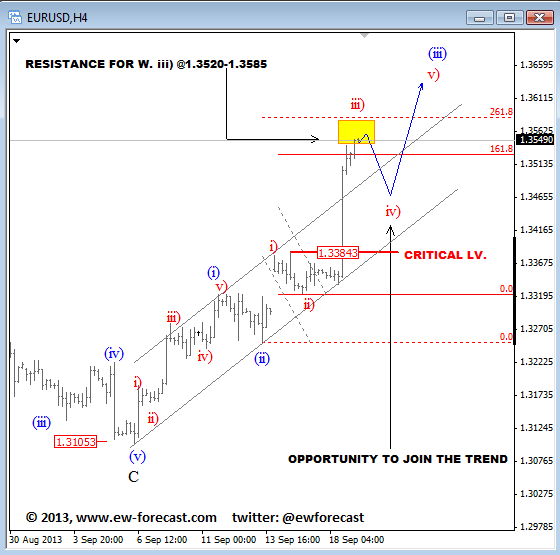
Traders, I am observing a new very interesting bullish count for the EURUSD. I am tracking an impulsive move which has room for much higher levels and reason for this view is very simple; I just want to get involved if those breakouts and current direction (weak USD) is for real. With that said, I will keep an eye on pull-backs; that would be wave iv) that could start unfolding from around 1.3520-1.3585 wave iii) resistance area. If this count is correct, then EURUSD should make a daily close around current levels (1.3500) or higher. Patience!

EURUSD 4h Elliott Wave Analysis

EURUSD 4h Elliott Wave Analysis

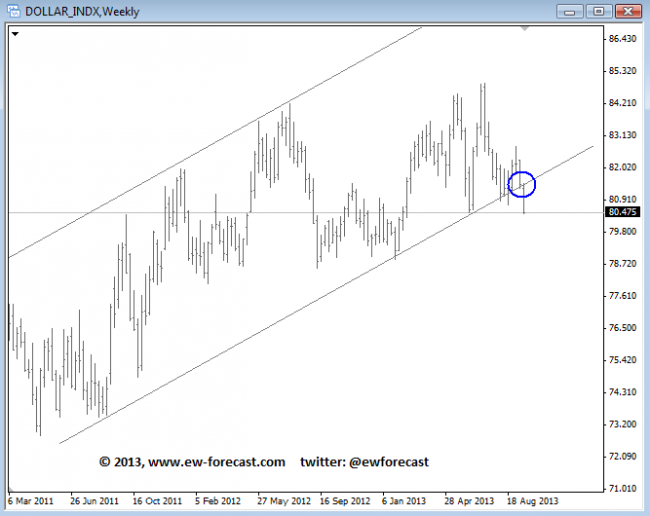
A broken support line on a weekly USD Index chart is the main reason why we favour USD Shorts at the moment.

USD Index Weekly

Written by www.ew-forecast.com

Try EW-Forecast.com’s Services Free For 7 Days at http://www.ew-forecast.com/service