As Expectations for 3Q Earnings Season Fall, What’s the Best Investment Strategy?

By Profit Confidential

Expectations for 3Q Earnings Season Fall, What’s the Best Investment StrategyInvestment risk for the very near-term stock market is going up. There’s been pressure on interest rates, investor sentiment was hit by the lack of tapering to quantitative easing, and finally, the third-quarter earnings outlook is mediocre at best.

Everything related to the stock market has been exceptional this year. While earnings growth was completely and totally lackluster, with several exceptions, the main stock market indices proceeded to rise tremendously based on continued monetary expansion and the fact that there really is nowhere else for investors to go but stocks.

Second-quarter earnings season was unimpressive, and I think it will be the same for the third-quarter reporting season. Financial results very well could be the catalyst for a major market retrenchment in October. I think that all investors need to prepare for such an eventuality. Generally speaking I do think that stocks can continue to rise in 2014; however, corporations will have to provide genuine earnings growth and top-line growth to keep valuations from pushing the envelope.

I would say that, given current earnings and expectations for 2014, the stock market is at least slightly—if not fully—overvalued at present. With the expectation of very modest earnings growth in the third quarter and little in the way of sales growth (especially among large-cap companies), recent stock market strength has been an expansion of valuations only.

This is why I’m so cautious near-term and why October could be a wild ride for share prices.

It is quite likely that market leaders that did well in the first two quarters of this year will continue to do so. These are the Johnson & Johnson’s (JNJ) of the equity market universe—these are the companies that have been well bid by institutional investors. (See “Consistency, Rising Dividends Make This Benchmark A Possible Winner for Savers.”)

The health of large corporations continues to be robust. But if their earnings can’t outperform or sales growth is nonexistent, then the last carrot attracting shareholders is increased dividends.

I think we’re going to get a lot of news related to new share buyback programs and increasing dividends for the simple reason that companies won’t be able to beat consensus earnings in the third quarter.

Or at best, they will produce results similar to the second quarter, when most corporations were not able to beat consensus on both revenues and adjusted earnings.

These are the makings of the next recession in 2014. Rising interest rates, continued lackluster revenue and earnings growth from companies, and mediocrity in other mature economies can certainly tip the GDP scale.

I am therefore very cautious on the near-term outlook for stocks, and I do believe that the marketplace will continue to stick with its existing winners. These are the companies that can deliver on revenue and earnings expectations with rising dividends. It’s a blue-chip market, and in a slow-growth environment, the big brand-name companies are what you want to stick with.

Article by profitconfidential.com

How BlackBerry Could Reemerge as a Viable Company

By Profit Confidential

BlackBerry Could Reemerge as a Viable CompanyThe news broke out right after I wrote the first draft of this commentary on BlackBerry Limited (NASDAQ/BBRY): a surprise takeover bid emerged from Fairfax Financial Holdings Ltd. (TSX/FFH) offering $9.00 per share, or $4.7 billion, for the struggling smartphone maker.

It appears to be the correct timing for BlackBerry. (See “Research In Motion Had Better Be Right.”) And for BlackBerry CEO Thorsten Gerhard Heins, he could get a $20.0-million send-off for selling the company.

This was the situation prior to the takeover announcement to take BlackBerry private:

BlackBerry reported a massive fiscal second-quarter loss of $1.0 billion, highlighted by the write-off of about $930–$960 million of its inventory. The company also announced plans to axe 4,500 jobs, or 40% of its workforce, as my stock analysis indicates.

The inventory adjustment is frightening, based on my stock analysis. It implies the company cannot sell its “Z10” and “Q5/Q10” devices. Again, this isn’t a surprise, as my stock analysis notes that BlackBerry has consistently screwed up in its execution over the past few years to the point that it allowed rivals, such as Apple Inc. (NASDAQ/AAPL) and Samsung Electronics Co. Ltd., to bulldoze over BlackBerry, leaving just a pile of scraps.

BlackBerry said it sold about 3.7 million smartphones in the quarter. Honestly, that number really stinks, based on my stock analysis, especially considering Apple announced it had sold nine million units of its new “iPhone 5” in the first weekend.

The numbers are telling, but this has been the issue for BlackBerry for years, according to my stock analysis. In a never-ending battle to regain its lost luster, my stock analysis suggests that BlackBerry has continued to fight a losing battle, struggling to keep up with a market that already passed it by long ago.

Well, now there’s a “Plan C” for BlackBerry that may be kept, despite the proposed sale, and the irony is that it may work, according to my stock analysis.

What’s the plan? BlackBerry will focus on its corporate base and likely exit the consumer market. While store shelves may still be filled with BlackBerry’s newest product gathering dust, the company still has a decent client base to which it can market its corporate services.

The company also plans to market its fairly popular proprietary messaging system “BlackBerry Messenger,” or “BBM,” for free to iPhone and “Android” users. The hope is that the BBM service will expand to tens of millions of its rival devices and become as popular as Twitter.

The positive about the sale and privatization of BlackBerry is that the company will have time to try to execute its strategy instead of trying to satisfy Wall Street and investors, according to my stock analysis. If Fairfax can turn BlackBerry around, we could see the company listed again in the future.

Article by profitconfidential.com

Why a Turnaround in the Eurozone Won’t Happen: U.S. Companies Beware

By Profit Confidential

 U.S. economyOn Sunday, we saw the results of the election in Germany, the powerhouse of the eurozone. Angela Merkel won again. Her re-election sent a wave of optimism through Europe. I can just hear the chants declaring “the worst is over for the eurozone” starting up again.

Sadly, the reality is completely the opposite. The eurozone is still deep in trouble and an economic slowdown still persists there. My opinion has not changed about the region: the downturn is going to stay for a long period of time.

In July, industrial production in the region declined by 1.5% from the previous month. Compared to the same period a year ago, industrial production in the region was down 2.1%. (Source: Eurostat, September 12, 2013.)

Looking further into the industrial production figures for the eurozone; it’s apparent the economic slowdown is far from over. Capital goods production in the eurozone fell by 2.6% between July and June. Historically, capital goods production can be considered as one early indication of where an economy is headed.

A record unemployed population in the eurozone still remains an issue and further strengthens the argument of the depth of the economic slowdown. Unemployment is not only high in the debt-infested countries in the region; it has also become a problem for even larger countries like France.

Bad bank loans in Spain, the fourth-biggest hub in the region, reached a record high in June, with 11.6% of all bank loans now outstanding considered “bad.” And the biggest lenders in the eurozone country are saying this rate will increase. (Source: Reuters, August 19, 2013.)

With all this, what continues to concern me is the affect of the economic slowdown in the eurozone on U.S.-based companies. In 2010, European sales had accounted for 13.5% of the collective sales of all the S&P 500 companies. Fast-forwarding to 2012, this number declined to 9.7%. (Source: S&P Dow Jones, August 2013.) This means U.S.-based companies are losing revenues from the eurozone, the reason for which is none other than the economic slowdown there.

Where will U.S.-based companies go next to recover their lost revenues from the eurozone? We know the U.S economy is doing poorly, so it will be difficult to increase sales domestically. The Chinese economy is experiencing an economic slowdown as well, so U.S. companies cannot look to China for growth either.

Corporate earnings and revenue growth for U.S. companies do not look good for the current quarter—and they’ve been stagnant all year. Be careful, dear reader, with that rising stock market. The U.S. economy is not an isolated island. American companies trade with other countries. If those countries don’t want to buy, we suffer.

Article by profitconfidential.com

Consistency, Rising Dividends Make This Benchmark a Possible Winner for Savers

By Profit Confidential

Consistency, Rising Dividends Make This BenchmarkFinding consistently growing companies has been and continues to be a tough thing with the world’s developed economies barely growing.

From the investor’s perspective, I think consistency, both in terms of corporate financial growth and stock market performance, is absolutely golden. This is especially the case for investors who aren’t actively trading and are perhaps saving for retirement or are in retirement and want some security with their equity holdings.

One company that I regularly view as an excellent long-term enterprise for savers is PepsiCo, Inc. (PEP). PepsiCo is a drink and snack business that has consistently delivered on management forecasts. The company has a solid track record of increasing dividends over time, and its long-term performance on the stock market has, to date, offered a stable uptrend. The company’s 35-year stock chart is featured below:

Pepsico Inc Chart

Chart courtesy of www.StockCharts.com

PepsiCo has been a stellar performer on the stock market since the beginning of the year. Like a number of other blue chips that delivered on their promises (Johnson & Johnson [JNJ], for example), the company provided the Street with exactly what it was looking for. (See “This Star Pharma Company Delivers the Goods Once Again.”)

With a current dividend yield just shy of three percent, PepsiCo is a company that a long-term equity investor can build a position in over time and still be able to sleep at night. It’s also an attractive equity investment in which to consider a dividend reinvestment plan. A company that pays rising dividends combined with an investor who reinvests those dividends into new shares compounds wealth. It’s an old-school and simple way to get your money working for you instead of the other way around.

PepsiCo’s largest operating division in terms of revenues is the company’s Americas Beverages business, which includes all North and Latin American beverage sales. This is followed by all beverage and food and snack sales in Europe and South Africa, then its snack and food business in North and Latin America, followed by the rest of the world.

The most profitable operating division in terms of gross dollars is actually the company’s Frito-Lay North America business. In terms of operating profits, PepsiCo’s domestic snack business could actually be considered highly profitable in relation to any mature enterprise.

The company’s Americas Beverages division actually saw a two-percent sales drop in the second quarter of this year, mostly due to volume declines. But even with this slight decline, operating profit in its largest business actually rose five percent to $882 million in the second quarter.

Also notable in the company’s second quarter this year was a huge increase to its cash position, in spite of additional restructuring charges. The company’s cash balance soared to $7.8 billion, up from $6.3 billion in the same quarter last year, including a dividend increase.

One Wall Street firm recently lowered its earnings outlook on PepsiCo for the third quarter, this fiscal year, and next year. But in my view, a missed quarter is an opportunity with this kind of blue chip business.

This is a company that’s worth accumulating when it’s down; and it’s proven over time that it’s never down on the stock market for long.

Article by profitconfidential.com

How the Market’s Letting the Fed Get Away with Its “Wishy Washy” Policies

By Profit Confidential

How the Market’s Letting the Fed Get Away with Its “Wishy Washy” PoliciesAnalysts and investors demand clarity when a company reports or offers up guidance. But when it comes to the Federal Reserve, investors and analysts don’t seem to demand the same level of clarity, even though the central bank has been what I would label “wishy washy” as far as its policies and what it offers up to the market.

The stock market is trading (and it has been for a while) on what the Federal Reserve says about its quantitative easing program, namely its monthly bond-buying strategy.

Yet the Federal Reserve appears to be saying one thing, only to contradict it with the next statement. This type of confusion and uncertainty is not what I want to hear. I want more certainty in order to formalize my trading and investment strategy. The cloudiness offered by the Federal Reserve doesn’t help.

Case in point: at last week’s Federal Open Market Committee (FOMC) meeting, Federal Reserve Chairman Ben Bernanke, to the surprise of nearly everyone both on Wall Street and Main Street, announced that the bank had decided against tapering, despite what I see as moderate growth in the economy. Yes, the country continues to slug along, but with the second-quarter gross domestic product (GDP) growth at 2.5% and with the Federal Reserve estimating the country will continue to expand at a rate above two percent this year and in 2014, the Federal Reserve should have begun to rein in some of its bond buying. Pundits were estimating a $10.0-billion cutback to start.

Well, even that small cut didn’t happen. Bernanke said the economy was still fragile, and the Fed didn’t want to take a chance with the economic recovery, especially with the recent soft jobs market report.

My response is that nothing is perfect and the central bank should have eased off anyway. The Bank of England decided against any new stimulus, and its GDP growth was—and is—worse than that of America.

Bernanke needs to gather up his courage and begin to taper. Instead, he is all over the map. At the May FOMC meeting, the Federal Reserve suggested it would begin to taper this year. Now, the Federal Reserve says GDP is stalling a bit, so the question of when tapering will start is unclear.

For the stock market, the lack of clarity from Bernanke will continue to drive uncertainty going forward, which means trading could continue to be tepid. Will it be October or December when the tapering begins? Or will it begin after Bernanke leaves the Federal Reserve in January? The fact is Bernanke appears to lack the confidence to make a tough decision.

Next up as the head of the Federal Reserve will likely be Bernanke clone Janet Yellen, the current vice-chairman of the central bank. I guess that means more of the same.

If I were you, I would be taking some money off the table should stocks edge higher, as the underlying fundamentals really do not support their current record-high levels.

Article by profitconfidential.com
If the Economy Is Improving, Why Is This Happening?

By Profit Confidential

Economy Is Improving, Why Is This HappeningWhile the media and politicians tell us we’re in an economic recovery…I keep writing about the slowdown we’re heading towards. How can I say that?

First, take out the stock buyback programs, and you’ll see that U.S. companies are seeing their earnings and revenues grow this year at their slowest pace since 2009. (More on that in today’s “Michael’s Personal Notes” column below.)

From a boring (but extremely important) economic point of view:

When a country experiences economic growth, industrial production of electricity and gas utilities pick up as factories and consumers use more electricity and other utilities. This is not happening in the U.S. economy. As a matter of fact, industrial production is contracting!

An index tracking industrial production of electric and gas utilities has declined almost eight percent since this past March. It stood at 103.76 then; in August, it stood at 95.62. (Source: Federal Reserve Bank of St. Louis web site, last accessed September 19, 2013.)

But it doesn’t end there.

Another key indicator of economic growth known as “capacity utilization” shows companies in the U.S. economy are operating below their historical norm. In August, the capacity utilization in the U.S. economy was 77.8%, three full percentage points below the historical average from 1972 to 2012. (Source: Federal Reserve, September 16, 2013.)

And we are seeing layoffs and discharges in the manufacturing sector accelerate in the U.S. economy. In March, there were 83,000 layoffs and discharges in manufacturing. In August, that number rose to 91,000—an increase of almost 10%. (Source: Federal Reserve Bank of St. Louis web site, last accessed September 19, 2013.)

When we look at the underemployment rate in the U.S. (that includes people who have given up looking for work and those who have part-time work but want full-time work), it’s been stubbornly around the 14% mark since 2009!

The fact that money printing in the U.S. economy has gone on for so long now is masking the real health of the economy. The U.S. economy is so weak, the Federal Reserve couldn’t even pull off a minor pullback of its $85.0 billion a month in new paper money printing last week!

I stay pessimistic on the economy. Take the stock market out of the equation (after all, only a very small portion of the U.S. population actually owns stocks) and the economic picture is not pretty! We have the Federal Reserve essentially printing money since 2008 to “help” the economy, but those trillions of dollars in new money have benefited the stock market and big banks the most.

Key economic indicators are issuing warnings of trouble ahead for the U.S. economy—warnings smart investors shouldn’t discount.

Michael’s Personal Notes:

The chart below of the Dow Jones Industrial Average depicts the precise moment when the Federal Reserve made its announcement last Wednesday that it was not planning to taper its quantitative easing at this time.

Dow Jones Industrial Average Chart

Chart courtesy of www.StockCharts.com

This is really troublesome. Key stock indices have become addicted to easy money and any news about more money printing just drives the market higher. This pattern has been going on since the Federal Reserve first promised it would rev up its printing presses back in 2008.

Unfortunately, as this continues, the fundamentals that are supposed to actually drive key stock indices higher—corporate earnings—are under major pressure. We have been seeing companies in key stock indices playing “tricks” to increase their corporate earnings per share (such as buying back their own stock), but these antics can’t go on forever.

Software giant Microsoft Corporation (NASDAQ/MSFT) has announced the company’s board of directors has approved a share buyback program worth $40.0 billion. (Source: Microsoft Corporation Investor Relations, September 17, 2013.)

CBS Corporation (NYSE/CBS) said it has increased the amount of its share buyback program to $6.0 billion. (Source: CBS Corporation Investor Relations, July 25, 2013.)

These two companies are only two of the many big-name companies in key stock indices that are rigorously buying back their shares. Other names, like Juniper Networks, Inc. (NYSE/JNPR) and Time Warner Cable Inc. (NYSE/TWC), are taking a similar approach.

As I have recently written, it’s not just corporate earnings growth that’s the problem—revenue growth is also lacking. Companies in key stock indices enjoyed double-digit (or close to it) earnings growth in 2009, 2010, and 2011, as they recovered from the recession and the credit crisis. But today, take away the stock buyback programs and cost-cutting, and these companies are barely growing earnings or revenues.

As this disparity continues—key stock indices climb higher and corporate earnings growth becomes tricky to achieve—the risk for the stock market only rises. The market knows companies can’t deliver on earnings and revenue growth, hence the dependence on money printing now to drive key stock indices higher. How sad.

When and if the Federal Reserve finally starts to pull back on the quantitative easing, it won’t be a pretty sight.

I remain skeptical of the stock market rally we’ve been experiencing this year—its determination has surprised me. Irrationality takes over sometimes in the stock market and this may just be one of those moments. What I do know is that when reality finally does kick in, and it will, the risk to be in the market will not have been worth it.

What He Said:

“There is no mixed signal about this: Foreclosures in the U.S. will continue to rise, the real estate market will get weaker, and the U.S. economy will get weaker. Smart investors should seriously consider unloading their stocks of consumer-products companies that produce nonessential goods.” Michael Lombardi in Profit Confidential, March 12, 2007. According to the Dow Jones Retail Index, retail stocks fell 42% from the spring of 2007 through November 2008.

Article by profitconfidential.com
Why the Risks So Outweigh the Reward in Today’s Stock Market

By Profit Confidential

The chart below of the Dow Jones Industrial Average depicts the precise moment when the Federal Reserve made its announcement last Wednesday that it was not planning to taper its quantitative easing at this time.

Dow Jones Industrial Average Chart

Chart courtesy of www.StockCharts.com

This is really troublesome. Key stock indices have become addicted to easy money and any news about more money printing just drives the market higher. This pattern has been going on since the Federal Reserve first promised it would rev up its printing presses back in 2008.

Unfortunately, as this continues, the fundamentals that are supposed to actually drive key stock indices higher—corporate earnings—are under major pressure. We have been seeing companies in key stock indices playing “tricks” to increase their corporate earnings per share (such as buying back their own stock), but these antics can’t go on forever.

Software giant Microsoft Corporation (NASDAQ/MSFT) has announced the company’s board of directors has approved a share buyback program worth $40.0 billion. (Source: Microsoft Corporation Investor Relations, September 17, 2013.)

CBS Corporation (NYSE/CBS) said it has increased the amount of its share buyback program to $6.0 billion. (Source: CBS Corporation Investor Relations, July 25, 2013.)

These two companies are only two of the many big-name companies in key stock indices that are rigorously buying back their shares. Other names, like Juniper Networks, Inc. (NYSE/JNPR) and Time Warner Cable Inc. (NYSE/TWC), are taking a similar approach.

As I have recently written, it’s not just corporate earnings growth that’s the problem—revenue growth is also lacking. Companies in key stock indices enjoyed double-digit (or close to it) earnings growth in 2009, 2010, and 2011, as they recovered from the recession and the credit crisis. But today, take away the stock buyback programs and cost-cutting, and these companies are barely growing earnings or revenues.

As this disparity continues—key stock indices climb higher and corporate earnings growth becomes tricky to achieve—the risk for the stock market only rises. The market knows companies can’t deliver on earnings and revenue growth, hence the dependence on money printing now to drive key stock indices higher. How sad.

When and if the Federal Reserve finally starts to pull back on the quantitative easing, it won’t be a pretty sight.

I remain skeptical of the stock market rally we’ve been experiencing this year—its determination has surprised me. Irrationality takes over sometimes in the stock market and this may just be one of those moments. What I do know is that when reality finally does kick in, and it will, the risk to be in the market will not have been worth it.

What He Said:

“There is no mixed signal about this: Foreclosures in the U.S. will continue to rise, the real estate market will get weaker, and the U.S. economy will get weaker. Smart investors should seriously consider unloading their stocks of consumer-products companies that produce nonessential goods.” Michael Lombardi in Profit Confidential, March 12, 2007. According to the Dow Jones Retail Index, retail stocks fell 42% from the spring of 2007 through November 2008.

Article by profitconfidential.com
Three Stocks you should Keep an Eye on for next Month

Article by Investazor.com

Browsing my ‘to watch’ list for some interesting opportunities, I have found three stocks that you might also find interesting.

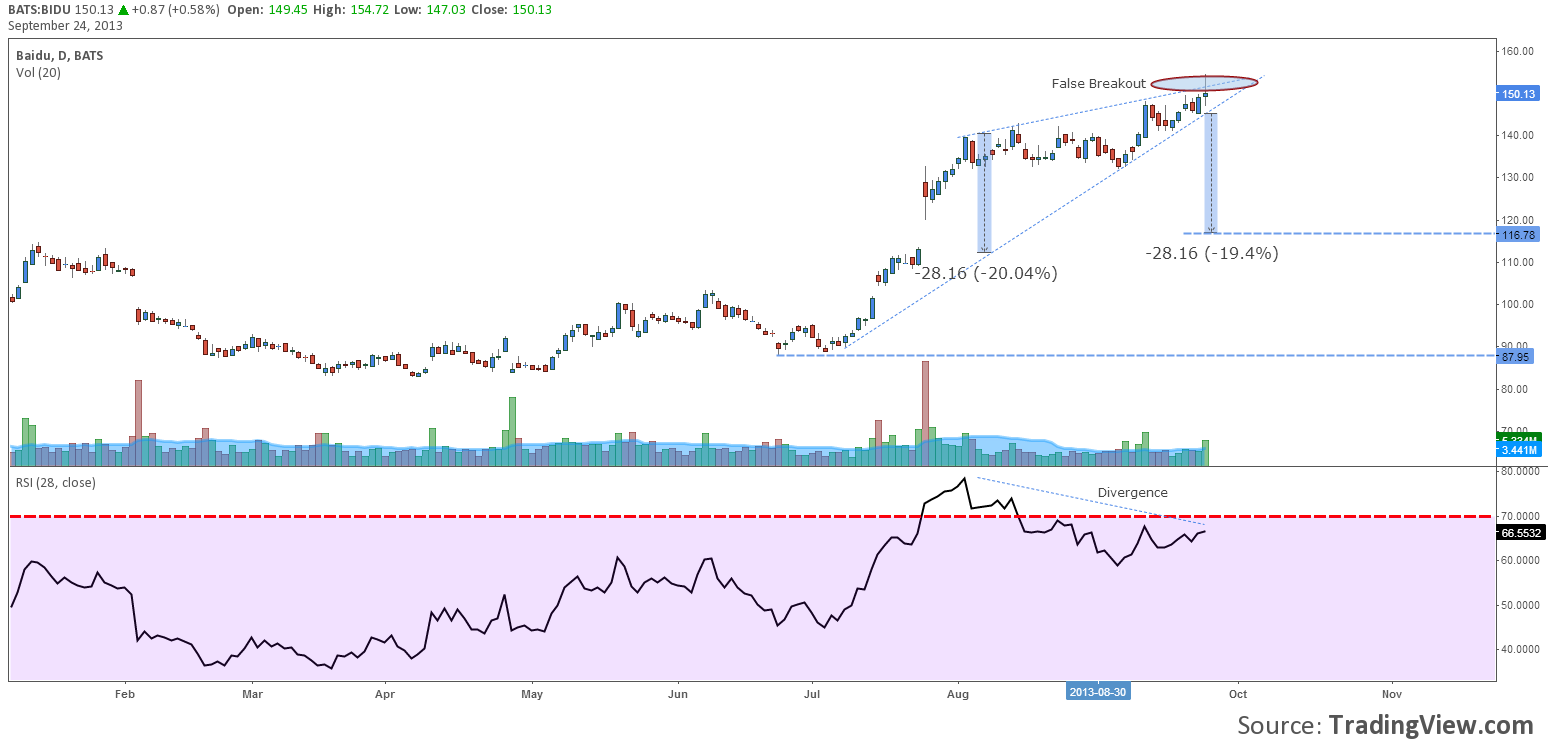
First stock is BIDU (Baidu Inc.). From the first days of July the price of this company started an uptrend and in less than three months it has gained 75%, raising 67$. From the beginning of August the price started to draw a Rising Wedge. Today the price rallied to a new high, above 154$, but dropped pretty fast back to 150$ per share. If the day will close around the current level we can say that the breakout above the upper line was a false one. Taking into consideration also the negative divergence from the 28 days RSI we could say that a drop might occur.

The confirmation will be a drop and a close under the lower line of the pattern. In this case the price target for the Wedge is situated at 116.78 dollars.

baidu-rising-wedge-resize-24.09.2013

Chart: BIDU, Daily

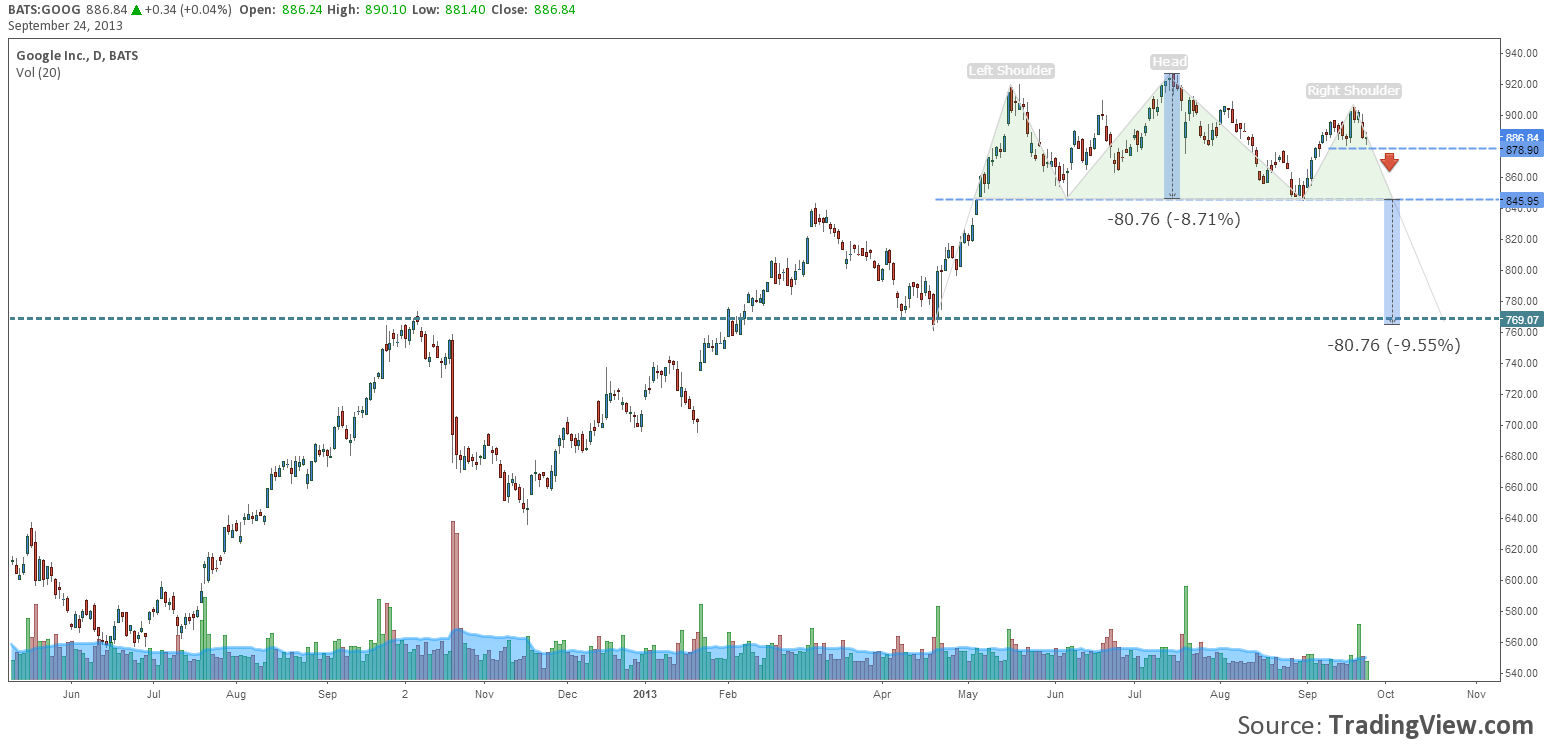
Second in my list is Google Inc. which seems to be in a pretty stable up trend. After 845$ level was breached the price started to consolidate and seem to have drawn a reversal pattern. The Head and Shoulders is not yet complete. The base of the pattern is at 846$ per share, but the second shoulder is not yet finalized.

If the price of the shares will drop under 879$, the local support, then the probability for the shares to complete the H&S will rise. If the price will then fall under the pattern’s base line it might go all the way to 770$ per share.

google-head-and-shoulders-resize-24.09.2013

Chart: GOOG, Daily

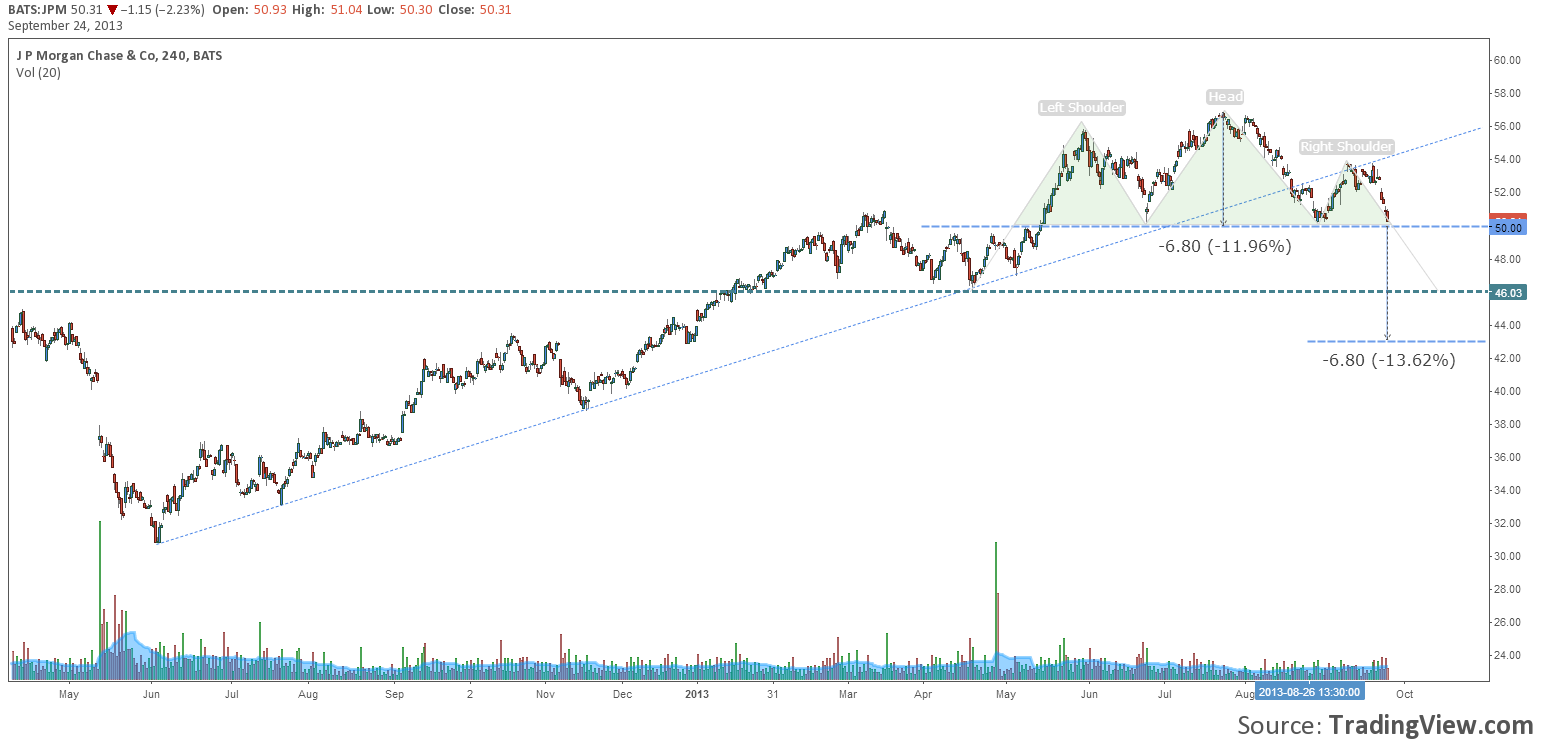
My last, but not least, stock for you is J P Morgan. The chart of this stock it is beautiful from the technical point of view. After the price has broken the uptrend line, came back and retested it, forming this way the right shoulder for the Head and Shoulders pattern. The base line of this pattern is at a round level, 50$. A daily close under this support will confirm the pattern.

The first target for a drop would be the key support level at 46$ per share. The full target of the price pattern sits at 43$ per share, meaning a 14% drop.

jp-morgan-head-and-shoulders-resize-24.09.2013

Chart: JPM, Daily

The charts look incredible and the current signals could be confirmed in the near future. But each trader should take the ideas and personalize them. Use their personal trading style, their own money management and position management to get as much profit out of these setups as they can.

The post Three Stocks you should Keep an Eye on for next Month appeared first on investazor.com.

Morocco holds rate, sees slight upside inflation risks

By www.CentralBankNews.info     Morocco’s central bank held its interest rate steady at 3.0 percent in light of inflationary risks that are “slightly tilted to the upside” though inflation forecasts remain consistent with the bank’s medium-term price stability objective.
    The Bank of Morocco, which has held rates steady since March 2012, said after analyzing the impact of a new index system of certain petroleum products that inflation is broadly in line with the bank’s forecast from June, taking note of projections that show an average inflation rate of 2.2 percent this year, 1.7 percent in 2014, 1.5 percent in the fourth quarter of 2014, and an average of 1.8 percent over the forecast horizon.
    Morocco’s headline inflation rose to 1.9 percent in August from 1.6 percent in July for an average of 2.4 percent in the first half.
    Morocco’s economy expanded by 4.3 percent in the second quarter, down from 4.8 percent in the first and the central bank expects full-year growth of between 4.5 and 5.0 percent.
    The central bank said Morocco’s trade deficit narrowed by 3.1 percent in August due to lower imports and net international reserves rose by 4.3 percent to 150.2 billion dirhams, representing four months and four days of imports of goods and services.

    www.CentralBankNews.info
   

Investing in Healthcare in the ObamaCare Era

By The Sizemore Letter

Last week I explained why I hate ObamaCare.   I won’t get into those details again, but I will explain some of the issues we face as investors.

The biggest issue is simply that of the unknown.  Because ObamaCare–officially called the Patient Protection and Affordable Care Act–has so many moving parts, it’s hard to say what its long-term effects will be on the assorted companies that make up the health care sector.

I’ll start with insurance.  Given that Americans will now be required to buy health insurance, the industry as a whole should expect to see 48 million new customers (i.e. the number of Americans currently without health insurance).  This should be a major boon to insurers like UnitedHealth (UNH), Humana (HUM) and Aetna (AET), right?

Not necessarily.  In fact, American Health Insurance Plans—the industry lobby group—spent $102 million trying to defeat the legislation.

ObamaCare will bring a boost to insurance company revenues. But it will almost certainly come at the expense of margins.  Remember, some of the currently uninsured are people who are effectively uninsurable, or those with preexisting conditions.  These new customers are money losers for the industry.

Muddying the waters more are the provisions regulating the “medical loss ratio.”  Under ObamaCare, insurance companies will have to spend at least 80% of the premiums you pay on actual health care expenditures (as opposed to administrative overhead).  Or flipping the numbers around, the insurance companies would have to limit their overhead to no more than 20% of their premiums received.  Any insurance company that went over these levels would have to pay their customers a rebate.  Currently, many health insurers have numbers closer to 25%-30%.

And because ObamaCare give the federal government unprecedented regulatory control over the industry—and given the politicization of health care—it’s hard to see the insurance companies being allowed to fully benefit from any improvements.  “Excess” profits will result in calls for premium reductions or rebates.

I’m not defending the health insurance industry.  In fact, I dislike these people on a personal level. Give me five minutes alone with  the CEO of any major health insurance company, and I don’t know that I would be able to stop myself from brutally kneecapping them with a tire iron.  My hostility is a product of years of filling out maddening paperwork and spending a small fortune on premiums for lousy coverage.

But I digress.  My point is simply that, over the long term, ObamaCare is not necessarily bullish  for health insurance stocks.

The story is a little less ambiguous with for-profit hospital chains, such as HCA Holdings (HCA) and Tenet Healthcare (THC)—both of which are up big this year.

Reducing the number of uninsured patients eases the strain on the emergency rooms and eliminates a large chunk of the hospital’s bad debts.  It won’t eliminate them, mind you. There will always be some number of people without insurance—such as those who are habitually unemployed and don’t file tax returns—and some low-income patients may have a hard time paying their deductibles and copays.  But it potentially makes a big problem a lot smaller.  Doctors and nurses may find some of the legislation’s micromanagement to be costly and cumbersome, but for the hospital companies themselves ObamaCare is mostly a positive.

The most frustrating aspect for an investor looking to allocate funds to the health sector is that politics and regulatory muddle trump economics and demographic trends.  It’s great to know that the aging of the Baby Boomers will create unprecedented demand for medical services and devices.  But how do you invest accordingly knowing that the profit margins will be taxed and regulated away?

My favorite way to play the sector is via medical office REITs.  Doctors face years of bureaucratic hassle in implementing ObamaCare that may affect their take-home pay.  But they are still going to pay their rent every month.  The rising health needs of the Baby Boomers will create an ongoing need for new medical facilities, and frankly, I’d rather be the landlord than the doctor.

A medical office REIT I particularly like is the Healthcare Trust of America (HTA).   The REIT has a growing portfolio currently consisting of 250 properties with a total purchase price of $2.7 billion.  It also happens to pay a handsome 5.2% dividend which I expect  to see grow in the coming quarters.

One nice aspect of HTA is that it is a young REIT.  The REIT was founded in mid-2006 and only began trading in 2012.  This means that HTA missed most of the run-up in property prices in the mid-2000s and has comparatively few “legacy” properties purchased at inflated priced.

And as an added sweetener, HTA saw a steady stream of insider buying throughout the summer’s “taper tantrum” that saw the prices of many REITs — including HTA — get hammered. Four company officers bought a combined 33,000 shares worth $343,940 in the month of August alone.

Charles Lewis Sizemore, CFA, is the editor of the Sizemore Investment Letter and the chief investment officer of investments firm Sizemore Capital Management. As of this writing, he was long HTA. Click here to learn about his top 5 global investing trends and get your copy of “The Top 5 Million Dollar Trends of 2013.”  This article first appeared on InvestorPlace.

This article first appeared on Sizemore Insights as Investing in Healthcare in the ObamaCare Era

Join the Sizemore Investment Letter – Premium Edition