Immersive Technology and the Problem of Big Data

By MoneyMorning.com.au

It’s a small world we live in. Physically it’s quite large, but metaphorically it’s not.

But way back in the 1900′s the world was epic. It was hard to travel around and communication barely existed outside the written letter.

With that in mind think about what technology was like in the early 1900′s.

TV didn’t exist, radio was new, powered flight was about to be invented and the car was only something for the uber rich.

Imagine what it would be like to go back and speak to someone in 1913. Could you explain to them what technology would be like in 100 years’ time?

A Different World

Try explaining what a mobile phone is considering that the telephone barely didn’t even existed then. That cars which had just been invented will become electric.

What about that contraption the Wright brothers were working on? Well a big version of that will take people across the world in a matter of hours. And then a really big version will one day take people into space.

Try telling someone back then that you can monitor their entire world with tiny sensors. And these sensors will tell us everything. Everything needed to help make day-to-day living easier, safer and more enjoyable.

It’s likely if you tried to explain what today’s world would be like to someone 100 years ago, or even 30 years ago, they would certify you insane.

But insane or not, the constant theme is that amazing developments happen over time. And as the world progresses, governments come and go, and doom and gloom appears and disappears.

Regardless of the ‘economic climate’ the human race still advances.

Sometimes we take for granted the progression of the world. We lose perspective of the long game and focus on the short term mish-mash of drama that dictates the daily papers and news.

Here’s a good example. Aussies went to the polls on 7 September. That’s right, the election. Let me make something clear: this has absolutely no impact on the technological development of the world whatsoever. It has no impact on a cure for cancer, the reality of hypersonic flight or if the internet of things will become a way of life.

Take this as a strong reminder that short term concerns have very little impact to the longer term play.

Problems Equal Profit Opportunity

If you want to build wealth, generational wealth, don’t get bogged down in the day to day nonsense. Instead, look at the trends we’re helping you to identify and then seize the opportunities to take part in it rather than just watch.

One of the trends we’ve talked about since launching Revolutionary Tech Investor is another example of this. You’ve seen us write about it and heard the terms. This includes the Quantified Self Movement and Immersive Technology.

This particular trend is part of your life already and you may not even realise. Bloomberg recently reported on this trend:

‘"It’s smart cities, smart buildings, smart water," said Susan Eustis, president of WinterGreen Research Inc. "It’s enabling a world of things. It’s going to grow unbelievably fast."

‘The market for sensors integrated with processors will reach 2.8 trillion devices in 2019, up from 65 million this year, according to WinterGreen. Some of these sensors could be no larger than a pinhead.’

2.8 trillion devices! Remember there are only 7 billion people in the world. That’s 400 devices per person.

However, big problems exist with so many devices and sensors. But with those problems also comes innovative companies with company-making solutions.

One of these problems is too much data. It’s so excessive it’s near impossible to make sense of it all. The other problem is an even greater risk…cyber security.

Everything you do these days creates data. So it’s important the right protection exists to keep your information safe. That’s why we need cyber security.

And while we go about our day to day business there’s something monumental getting momentum that could tear everything down. It’s the silent war. It’s all-out Cyber Warfare.

Make no mistake about it, as positive as we are about the future, the inherent risk of cyber warfare still exists. We certainly don’t believe it will result in a dystopian future though.

Cyber security is a problem, but one that’s being tackled head on. The digital war is already underway, and there are a few companies on the front line of this battle.

Right now we’re scrutinising these companies as we find, research, analyse and present the best of the best in Revolutionary Tech Investor. Because we know there’s great opportunity for the right company to profit from the threat of cyber warfare.

But cyber warfare aside, the immersive technology trend is real; it’s happening right now.

Sam Volkering+
Technology Analyst, Revolutionary Tech Investor

From the Archives…

Why it’s Time to Reassess Your Stock Strategy
20-09-2013 – Kris Sayce

The Stocks Best Placed to Gain From This Rally…
19-09-2013 – Kris Sayce

Cyber Security at the SIBOS Conference
18-09-2013 – Sam Volkering

Is the Federal Reserve Using the Bank of Japan’s Playbook?
17-09-2013 – Vern Gowdie

Has the US Federal Reserve Created a ‘Fool’s Rally’?
16-09-2013 – Kris Sayce

Why the Next Commodities Boom Could Take Place in a Science Lab

By MoneyMorning.com.au

According to many, the commodities boom is over.

It’s time to sell iron ore.

Sell copper.

Sell gold.

Sell oil.

Sell everything. It’s all over; no one will use a single ounce, pound, tonne or barrel of a commodity ever again.

That’s clearly an over-reaction. There will still be demand for commodities. The question is whether the demand is enough to make investing in resource stocks profitable…

The latest chart of the Reserve Bank of Australia’s Index of Commodity Prices paints a conflicting picture.

Is the boom over? Or is it just a pause before the commodities sector kicks off again?


Source: Reserve Bank of Australia

So which is it? The worst thing we can do in this game is sit on the fence and not give you clear cut advice. In which case, we’ll try our best to give you our thoughts on the state of play for commodities today…

There’s Still Life in the Commodities Market


To give you the short answer, it’s not the end of commodities. So if you think you should sell all your commodity stocks, think again.

The world’s economies will always need to build things and make things. And it’s probable that in one form or another there will always be demand for iron ore, copper and aluminium.

China’s plan to build the world’s tallest building, in pre-fabricated form and in just 90 days, is proof that raw materials are still in demand.

Not to mention all the other grand building plans you see around the world and in Australia. Even though the merit of some of these plans is questionable.

And so with these materials in demand there will always be a need for companies to explore for and produce them.

As you’d expect with the laws of supply and demand, the price will move up and down. That means sometimes it will be good to invest in resource stocks, while other times it won’t.

Although there’s one thing we can almost guarantee. Regardless of the market conditions, if an explorer discovers a brand new resource the stock price will likely take off in a flash. So don’t write off resource stock investing just yet.

In fact, our bet is that now is a perfect time to buy resource stocks while most other investors run scared.

But as important as the big bulk commodities may be, the really exciting ‘commodities’ are anything but bulk. These are the commodities operating at the other end of the spectrum. We’re talking about nano-materials…

Thinner Than a Human Hair, Stronger Than Steel

This is a subject we covered in the latest issue of Revolutionary Tech Investor. It’s the idea of a revolution in the materials used to manufacture large and small goods.

But don’t assume that large goods mean ‘large materials’. Because the reality is that the auto and aerospace are two of the leading industries involved in the development of nano-materials.

So, what are nano-materials? To put it simply, they are materials that you can measure in millionths of a millimetre. A great example is this image of a carbon fibre strand. And although technically speaking carbon fibre isn’t a nano-material, it gives you a clue about how important these materials could become over the next few years:


Source: Carbonfibredesigns.com

The white strand running from top left to bottom right is a human hair. The black strand running from bottom left to top right is a carbon fibre strand.

But despite carbon fibre being just a fraction of the size of a human hair, it’s five times as strong as steel, twice as stiff, and much lighter than steel.

What’s more, it’s resilient to heat and doesn’t expand and contract like steel under extreme temperatures.

This is why the auto and aerospace industries have led the way with innovation into the use of carbon fibre. If they can replace the chassis and body of cars and planes with carbon fibre, not only does it lighten and strengthen the structure, but it improves fuel efficiency too.

But that’s not the only area where nano-materials (or micro-materials in the case of carbon fibre) are set to have a major impact.

Commodities Boom in a Science Lab

As the BBC reports:

The first computer built entirely with carbon nanotubes has been unveiled, opening the door to a new generation of digital devices.

“Cedric” is only a basic prototype but could be developed into a machine which is smaller, faster and more efficient than today’s silicon models.

In short, carbon nanotubes are made from a single sheet of carbon that is one atom thick, and when rolled into a tube provides an incredibly strong structure.

But it’s not just its strength that appeals to scientists. Its conductivity makes it an ideal alternative to silicon in the microchip industry.

In an industry where size is important, the nano-scale size of carbon nanotubes is a key development. The more transistors that can fit on a micro-chip the greater the computing power.

If you’ve heard of Moore’s Law you’ll know that microchip processing power doubles every 18-24 months. Well, if microchip makers can reduce the size of transistors at the atomic level, it stands to reason they can increase the number of transistors and therefore the computing power.

Again, to put this in context, a human hair is about 100 microns (one micron is equal to 1,000 nanometres). The latest silicon chips are about 22 nanometres. The single carbon nanotubes used in ‘Cedric’ are about 1 nanometre.

In other words, a human hair is approximately 100,000 times thicker than a carbon nanotube. That makes carbon nanotubes invisible to the naked eye. But more importantly to the micro processing industry, carbon nanotubes are 22 times thinner than existing silicon chip technology.

In short, when you think about commodities in the future, you need to think more than just iron ore, copper, steel and oil. The future commodities are just as likely to be the product of a science lab in Silicon Valley as they are of a mill or foundry in China’s industrial heartland.

Cheers,
Kris+

Join Money Morning on Google+

Special Report: Are You Waiting for a Real Estate Crash That Isn’t Going to Come?

QE, QE and more QE (Let’s Talk Gold…)

By MoneyMorning.com.au

Today we’ll discuss the prospects for gold and silver.

But first, let’s discuss Richard Nixon.

That is, after he lost the election for governor of California in 1962, he remarked to the assembled news reporters, ‘You won’t have Nixon to kick around anymore.‘ Of course, we all know what happened with Mr. Nixon in later years.

(Heck, speaking of gold, Nixon took the US off the gold standard in 1971. And it was on Nixon’s watch that oil prices quadrupled in 1973. But I digress….)

Nixon’s so-called ‘last press conference’ came to mind as I saw news that former Treasury secretary and presidential economic adviser Larry Summers…umm…’withdrew’ his name from consideration to be the next chairman of the Federal Reserve.

He won’t succeed the current Fed ramrod, Ben Shalom Bernanke. Yes, indeed. Larry Summers withdrew his name. I read it on the internet, so it must be true.

Did Summers walk? Or was he ‘helped’ in making his decision? Or just plain pushed? Whatever happened, I’ll bet Summers thought long and hard about whether or not to plunge into that Fed briar patch with his monetary weed whacker. His designated role would have been that of the central bank ‘fall guy’.

That is, the duty Summers won’t seek is similar to the mission of Paul Volcker back in the late 1970s and early 1980s. Volcker was the Fed head in an era of raging inflation and economic stagnation. Volcker gritted his teeth and raised interest rates to nosebleed levels, which smashed inflation down – and tore the guts out of an already weak economy.

In an alternative universe, today Summers would have had the unpleasant duty of scaling back on Bernanke’s still-raging $85 billion per month program of quantitative easing (QE). Hey, somebody has to fall on that monetary hand grenade sooner or later. But I guess it’ll be later. And the perp will not be Larry Summers.

Keep the QE Flowing

Evidently, big shots within the Obama administration and the Senate noticed that our grand US economy is less robust than they would like. Plus, we have looming budget battles and political dogfights over taxes and spending.

Add in the approaching storm of Obamacare – a job-killing, economy-wrecking tsunami already flooding across the land, from what I can see (long story). So the issue for the Federal Reserve becomes whether to throttle QE just now or let the Fed’s money spigot run.

Politically, it’s risky to scale back on QE. Or to paraphrase that old line about cancer, there are more people living off it than dying from it.

So apparently, policy honchos within the Obama administration told Bernanke to keep the Fed’s signature easy-money programs in place for a while longer. How much longer? Well… through this fall, at least. Then we move into 2014, when the US will hold elections for the entire House and one-third of the Senate. So politically, this is a no-brainer, and QE should last a while longer.

Volcker’s Ghost

Getting back to Larry Summers, I suspect he knows what happened to Paul Volcker back in the 1980s, when the guy battled America’s inflation problem in a post-Vietnam, oil-shocked economy.

In terms of monetary policy, Volcker did what he needed to do. Volcker raised interest rates. He raised them high!

I lived through it. It was good to be a saver or lender, but I also recall that Volcker’s high interest rates sure stung if you were the borrower. Ugh. I once signed up for a 16% rate on a used car loan – a beat-up Dodge Omni, no less! I still cringe at the thought.

In the larger picture, Volcker was much hated in many quarters. In the Midwest at the time, the steel and auto industries were contracting due to rising global competition. (It’s where the term ‘Rust Belt’ originated.)

Volcker’s high interest rates made things worse, leading to more plant and mill closings and attendant layoffs. People rioted in the streets against Volcker and burned him in effigy. As things unfolded, Volcker required personal protection due to death threats.

I’ll add this for perspective, though. Back then, the world was in the depths of the Cold War. The West faced a very real and dangerous nuclear threat from the former Soviet Union, which set the overall political tone. Absent that, I doubt that either President Jimmy Carter or even President Ronald Reagan would have gutted it out with Volcker’s high interest rates, even to halt inflation and save the dollar.

In other words, no matter how bad things were with Volcker’s high interest rates, the politicians could rationalise it all and think it was better than losing out in the Cold War to the evil commies, if not getting nuked. These days, we lack that comforting choice of alternatives.

Thus, Larry Summers ought to breathe sighs of relief at missing out on receiving rivers of unadulterated hatred from entire populations across the now wired-in world, which lacks the former military motivations of the Cold War era. Really, today those flash mobs of ‘Occupy This or That’ can track you down in a heartbeat.

So Summers will avoid the fate of personal vilification and destruction that’s otherwise primed and aimed at whoever takes the dirty job of draining a trillion dollars per year of fake Fed liquidity out of the global economy.

Indeed, global markets were setting up to sell off at merely the hint of Summers at the helm of the Good Ship Fed. And then? No more Summers. Bernanke announced more QE. And the markets firmed up – as did gold prices.

Also, as per the touching custom of Kabuki theater that is modern Washington, DC, President Obama graciously accepted the Summers withdrawal. Heck, Mr. President even offered kind words for Mr. Summers’ many years of national service. Now we can only wonder about what might have been with Summers running the Fed. What might he have accomplished? Scaling back QE? We’ll never know.

Recalling the Happy Golden Bygone Days

Then again… let’s not overly romanticise Larry Summers. It’s not as if he’s a ‘doomed son of heroes’ out of the tale of Ossian, riding toward the steel.

When I think of Larry Summers, I look back to his tenure as president of Harvard, where he left a mixed legacy. For instance, he initiated a long-overdue crackdown on grade inflation – sort of a ‘QE of grades’, if you will. Bravo!

Summers also encouraged several academically challenged Harvard faculty members to seek other opportunities. I won’t mention names, but the matter is not exactly a state secret. Again, bravissimo to Summers!

But then Summers oversaw the loss of $2 billion of Harvard endowment funds due to bad interest rate swaps, a subject on which he’s supposed to be an expert – or at least the smartest guy in the room.

On that last matter, consider that Harvard’s undergraduate tuition is about $50,000 per year, per student. So Summers losing $2 billion is equivalent to burning a year’s take from 40,000 students.

But there are only about 6,000 undergraduate students on campus in any given year. Thus, one could say that Summers broke Harvard’s enrolment bank – zeroed the account – for almost seven entire years of operations. Ouch.

Of course, Harvard continues to function, as one might expect of an enduring institution that dates back to 1636. And the US will likely endure as well – QE or no – considering our resilient national history since 1776.

No matter who runs the Fed, though – and it won’t be Larry Summers – I think we’re in for a rough ride for a while. At least for now, we won’t have Summers to kick around.

What’s the takeaway here? QE, QE and more QE. The Fed is propping up Wall Street, so to speak, while the ‘real’ economy languishes. It’s investable for stock pickers. And buy physical gold. Buy physical silver. Hold oil. The dollar will live through another time of troubles. That’s where this is heading.

That’s all for now. Thanks for reading.

Byron King
Contributing Editor, Money Morning

Ed Note: Larry Summers Won’t Burn in Effigy originally appeared in The Daily Reckoning USA

Join Money Morning on Google+

Do Your Stocks Know Their Place?

By MoneyMorning.com.au

Technology is wonderful.

But it can be mightily cruel too.

We remember the launch of the early BlackBerry [NASDAQ: BBRY] phone models in the late 1990s and early 2000s.

It was so different to everything that went before.

The shape, the screen, what you could do with it.

As we recall, it was more of a data device than a phone because you couldn’t hold it to your mouth and ear to talk. You had to use a handsfree headset.

But now, barely more than a decade after BlackBerry revolutionised the world of mobile communications, the company is about to die.

It’s a worthy reminder to investors that just because something has always ‘been around’ doesn’t mean it will always be around in the future…

As Bloomberg News reported yesterday:

BlackBerry Ltd., once valued at $83 billion, may be stuck with the cheapest valuation ever for a North American technology or telecommunications takeover.

The smartphone maker said yesterday it reached a tentative agreement for a $4.7 billion buyout by a group led by Fairfax Financial Holdings Ltd., its biggest shareholder. Including net cash, the proposal values the Waterloo, Ontario-based company at an 80 percent discount to its book value and just 0.17 times its sales, the cheapest revenue multiple on record among similar-sized North American telecommunications or technology acquisitions…

Technology companies can be like the proverbial Apollo V rocket launch. They can blast off in a flash, delivering investors quick and spectacular gains.

But unless the company continues to innovate, bringing new ideas and technology to the market, the gravitational forces of the free market can quickly see the stock price return to Earth…

‘Wow! This Could Revolutionise the World’

Now, we don’t mean to scare you off technology stocks. As the editor of Revolutionary Tech Investor  that’s the last thing we’d want to do.

Instead, what we want to make clear is that as an investor, technology stocks shouldn’t be an ‘either/or’ proposition. By that we mean you shouldn’t choose between tech stocks or bank stocks, or tech stocks and retail stocks, or tech stocks and industrial stocks.

Generally speaking, tech stocks should be part of your speculative portfolio. So in the same way you’d never choose between a blue-chip banking stock and a tiny mining penny stock, you shouldn’t choose between a blue-chip banking stock and a speculative technology stock – even if that speculative technology stock is a multi-billion-dollar company.

So why is that?

Aside from the obvious, that tech stocks are riskier than banking stocks, you tend to get more accelerated price action with tech stocks. That’s what causes them to shoot up so fast.

Because technology stocks are innovative, investors tend to build all future growth potential into the stock price. When a tech stock unveils a new product or process, investors don’t think ‘Oh that should help businesses achieve a 1% improvement in productivity.’

No, investors think, ‘Wow! That will revolutionise the world.’

And so you get this kind of price action…

Don’t Hold on Too Long

Remember what we said. Tech stocks tend to explode onto the scene. And you shouldn’t confuse a tech stock with a standard blue-chip stock.

Here’s a chart of the BlackBerry share price going back to February 1999:

You’re probably looking at the blue line. If you bought BlackBerry (or Research in Motion as the company was then called) shares in 1999, you could have clocked up more than a 12,000% gain in eight years.

But if you had held on until today, you would have gained just 379%…which still isn’t bad.

But now look at something else. Look at the red line at the bottom of the chart. Compared with BlackBerry the red line barely budges from the bottom of the scale. That’s how it appears anyway. In reality, those shares have gained 177.7% over the same timeframe.

Those are shares of Commonwealth Bank of Australia [ASX: CBA]. Here’s the thing, if you bought and held on to CBA shares over that time you would have picked up $33.47 in dividends. So inclusive of dividends your return would have been a 306.9% gain – not far behind the ‘buy-and-hold’ gain of BlackBerry.

So, what are we saying?

Not a Stock to Buy and Hold

The important message is that you should buy and hold some stocks, but other stocks you shouldn’t.

The comparison between CBA and BlackBerry is a perfect example. It’s why we recommend you hold reliable dividend-payers in your portfolio. This is the part of your portfolio you can afford to buy and then set to one side.

With any luck you’ll never have to do anything with them again…except cash the dividend cheques.

Speculative stocks on the other hand are completely different. We know it’s hindsight investing, but it’s clear BlackBerry wasn’t the type of stock to buy and hold.

And as Sam Volkering pointed out last week with his essay on Apple [NASDAQ: AAPL], odds are that Apple isn’t a stock you want to have lingering around in your portfolio for the long term either.

This is why in Revolutionary Tech Investor we see our tech and biotech stock picks as short-term punts. And the last thing we’d recommend is for investors to see these stocks as an alternative to a reliable dividend-paying stock.

This is super important when it comes to building or rebalancing your portfolio.

Make Sure Your Stocks Know Their Place

You have to know exactly where a stock fits within your portfolio. You can’t have all safe dividend payers because odds are you won’t achieve your investing goals.

But you can’t stack your portfolio with only high-risk growth stocks either, otherwise you’ll find your portfolio crashing and burning all over the place.

The key is to lay the foundations with a handful of quality and reliable dividend stocks, and then supplementing this with a number of volatile speculations to help boost your returns.

Tech stocks are some of the most exciting companies you can invest in. It’s what makes it so enjoyable to write about them every week in Revolutionary Tech Investor. But make sure you understand their role in building your wealth – the goal is to buy, make quick and spectacular gains… and then get the heck out of there.

Cheers,
Kris+

From the Port Phillip Publishing Library

Special Report: Are You Waiting for a Real Estate Crash That Isn’t Going to Come?

Join Money Morning on Google+

You Can Bank on Another Crisis

By MoneyMorning.com.au

The GFC brought into stark contrast just how vital the banking system is to the functioning of an economy.

At the height of the GFC banks did not trust each other. And people did not trust the banks.

Banks viewed each other with suspicion. Letters of credit were no longer accepted on face value. The shipping industry, which relies heavily on letters of credit, ground to a standstill.

Customers lined up outside banks (some with suitcases) to withdraw their savings.

Such was the demand for cash, the Reserve Bank of Australia came close to running out of physical notes.

Modern commerce is a function of faith. When faith in the financial system is lost, chaos follows. 

Banks are the Heart of the Financial System

Money pumps in and money pumps out. The flow of money through the system is as vital to economic health as the flow of blood is to our physical wellbeing. We all know what happens when arteries become blocked or, worse still, when a heart stops pumping.

Governments are only too aware of the need to maintain public faith in the banking sector. Government backed deposit guarantees still remain in force five years after the event – albeit the guarantees are now applied to lower dollar levels.

The first premise of my theory is governments must and will support the banking system in times of crisis. They cannot afford to have the heart stop beating. While nothing is ever certain, the prospect of government not wheeling out the defibrillator is extremely remote.

So I go with the balance of probability and assess that the banking system will be rescued. But who pays and at what cost?

Sayings like ‘safe as a bank’ refer to an era of prudence that is not reflective of modern banking.

Yet, by and large, banks are still viewed as these conservative pillars of society.

This chart from last week shows US credit growth exploding from 1980 onwards.

This graph applies equally to the rest of the western world. Who facilitated and profited (handsomely) from this debt mania? The banks. Fractional banking enabled banks to gear up by a factor of 10x or more. This highly leveraged pillar is what our monetary system rests upon.

The Impact of Shrinking Credit

After 30-years of unbridled debt expansion we have reached the stage where there are too many vested interests prohibiting the stabilisation of banking system.

Firmer foundations would require banks to reduce their gearing – lend less. Think of the ramifications of banks systematically reducing the credit flow throughout society:

  • Government tax revenues (on which all those entitlement promises have been built) would shrink faster than a wool sweater in a dryer.
  • Retail profits would fall and staff would be laid off.
  • The lay-off contagion would affect all business sectors and unemployment would rise. (And how does the government afford all this NewStart while on its Jenny Craig budget diet?)
  • Imagine the reaction from the real estate industry as property prices fall.
  • Bank profits would fall and share prices follow – member balances in superannuation would suffer and cause more pressure on the age pension to fund the shortfall.
  • Last but by no means least in a list that could go on and on, bank executive remuneration would collapse to under the $1m per annum mark. Shock, horror; imagine all those Porsches and North Shore homes that would flood back onto the market.
  • And the domino effect continues right through society.

I think you get the drift on how society is so hooked on the debt. Due to debt dependency, it is virtually impossible for anyone or any institution to voluntarily embark on the stabilisation process.

There have been token attempts at so-called banking reforms. In reality very little has changed. Bankers still get remunerated for taking risks, and not for being conservative.

The banks are even bigger than they were before Lehmann Brothers’ demise.

And the system is totally dependent upon unlimited central bank support. The system, in my opinion, is more unstable than it was in 2008. A cardiac arrest awaits.

Vern Gowdie+
Chairman, Gowdie Family Wealth

Join Money Morning on Google+

A Simple Trick to Get a Six-Fold Boost to Your Share Returns…

By MoneyMorning.com.au

Here’s some good news…or not…from the Financial Times:

The age at which people retire has absolutely no effect on when they die, a joint Australian-Norwegian research project has found.

Actually, we think it’s good news.

Your editor is a glass half-full kinda guy.

The report suggests that whenever you retire, odds are you’ll die at your pre-destined age. In other words, if you’re destined to die at 94, then you’ll die at 94 whether you retire at 55, 65 or 75.

The key then is to do all you can now to save for retirement to make sure that you’ve got enough time left up your sleeve to enjoy yourself.

But how on Earth can you do that without taking unnecessary risks?

There’s a fine balance when it comes to saving for retirement.

Remember, you don’t save money for the sake of saving money. There’s no benefit for you if your only goal is to save as much money as possible.

We know that may sound an odd thing to say, given how we’re always banging on about wasteful governments and how folks go into too much debt these days.

But the reality is that ‘saving’ is just another way of saying ‘delaying consumption’. If you spend all your money today then you’re reducing the amount you can consume in the future.

That’s when folks get into trouble during retirement. They haven’t saved enough, so they don’t have the ability to consume.

Turn a 29.9% Gain into a 188% Gain

Therefore it’s important to save. But, it’s possible to take things too far. Some folks forgo all current spending. They live a subsistence level lifestyle and squirrel every last penny away.

You then tend to hear about them in the papers after they die; ‘We were so surprised that Uncle Jack/Auntie Beryl had $5 million in the bank. They scraped by every day.’

Sorry, but that’s no way to live. It’s one thing to think about the future, it’s another thing to be so frugal that you never get around to enjoying the money you’ve saved.

And now, if as reported in the Financial Times, your time on Earth is somewhat pre-determined regardless of how long you work, it makes even more sense to structure your finances so you can build your savings quickly without impacting negatively on your current lifestyle.

So, how can you do that?

Well, there is one simple technique that’s available to most shareholders of blue-chip stocks, and some small-cap stocks too.

It’s a technique that could help you increase the value of your shares by 188% even if the share price only gains 29.9%. That’s more than a six-fold boost to your returns. Here’s how it works…

Warren Buffett Does This

The simple technique involves getting companies that you invest in to give you more shares for ‘free’. It’s something we’ve recommended to Australian Small-Cap Investigator subscribers, as has Nick Hubble to subscribers of his Money for Life Letter.

You may think that sounds like a tough ask. After all, who wants to give anything of value away for free? But surprisingly, it’s pretty easy.

Some of the biggest Australian stocks, including the big banks, retailers, industrials, and even some of the big mining stocks, offer this ‘free’ share service.

All you need to do is know what to look for. But don’t just take our word for it. World famous investor Warren Buffett says this technique has been one of the biggest influences of Berkshire Hathaway’s [NYSE: BRK/A] growth:

Our net worth has thus increased from $48 million to $157 billion during those four decades and our intrinsic value has grown far more.  No other American corporation has come close to building up its financial strength in this unrelenting way.

The technique in question is dividend reinvestment programs (DRPs).

Big companies such as Commonwealth Bank of Australia [ASX: CBA] and Australia & New Zealand Banking Corporation [ASX: ANZ] offer DRPs to shareholders.

The way it works is simple.

A $15,000 Difference on a $10,000 Stake!

Instead of opting to receive a cash dividend payment from the company, you can choose to receive ‘free’ shares. Of course, the shares aren’t really ‘free’ because you’re paying for the shares using the dividend you otherwise would have received.

But buying shares in this way does have benefits. For instance, some companies will offer the shares at a discount to the prevailing market price. Plus, because the company issues the shares to you directly, you don’t have to pay commission to a broker.

Best of all is the impact taking part in a DRP can have on your investments. The two numbers we’ve circled show the difference in the value of a shareholding with a DRP and without a DRP:

That’s a difference of $15,920.95 over 10 years. And as you can see in the green box, each year the number of DRP shares grows as the value of your shares grow and (hopefully) as the dividend grows.

Of course, we’re making the assumption that this is a company with staying power and that it’s able to grow revenue, profits and dividends over the long term.

But that’s why you do your homework, to make sure you’re investing in the type of company that can hit those goals.

Look at the numbers. This is just with a starting point of $10,050 over 10 years. Now imagine you’ve built up a $100,000 over the first 20 years of your investing life and you can now compound your returns using DRPs over the next 20 or 30 years.

It can have a huge impact on your retirement savings. By compounding your returns through a DRP you could hit your retirement goals much sooner…which means retiring earlier and enjoying more of your life.

And providing you don’t need the income from the dividends now (which most people don’t during the accumulation phase of their savings) it won’t have an impact on your daily lifestyle.

Have Your Investing Cake and Eat It Too

As we see it, DRPs are about as close as you can get in the investing world to having your cake and eating it.

A DRP shouldn’t be the sole reason for investing in a stock. But if you’ve done the research on a stock you like and it happens to offer a DRP, run the numbers. It could be that taking part in the DRP is the single best decision you can make to boost your retirement savings pot.

Cheers,
Kris+

Special Report: Are You Waiting for a Real Estate Crash That Isn’t Going to Come?

Join Money Morning on Google+

Australian Housing Market: Mortgage Lending in the Spotlight

By MoneyMorning.com.au

The Federal Reserve’s surprising decision to keep QE going at its current rate is still front page news. While the US fiddles with monetary policy to meddle with house prices, the Australian government is set to interfere with banks in order to manipulate mortgage lending. If you’ve been reading the Daily Reckoning for a while, you know we are sceptical that government action like this produces the intended outcome.

The problem with the Australian housing market is a simple one. For prices to be at such absurd heights compared to the rest of the world (not to mention common sense), there must be a lack of supply and/or a surplus of demand. We’ve got both.

The central bank keeps interest rates low to spur demand and the government messes about with things like zoning laws to restrict building. If there was a free market in housing, each time house prices rose relative to everything else, more houses would be built and prices would return to affordable levels. As commodity traders in the Chicago trading pits will tell you, ‘The cure for higher prices is higher prices.’ In other words, let the free market do its work.

But the government can’t have that. Housing is just too important, you can’t trust the free market, or some other such nonsense. This type of thinking has been virulent ever since none other than Adam Smith admitted that we need the government to build things like lighthouses. After all, who would build lighthouses if the government didn’t? There’s just no way the free market can provide such goods and services.

Unfortunately for Mr Smith, about three quarters of lighthouses in the UK at the time he wrote were privately funded and built. Over in the US, they often point out that the private sector could never provide certain goods and services – air traffic control, for example. Sure enough, much of ‘socialist’ Europe runs on a private air traffic control system. The examples just go on.

So when it comes to housing, yes the free market could do it all darn well. If it were just left alone, that is. But that’s not going to happen, is it? The good news is, the failures of government are prime opportunities for profiteering because governments fail in predictable ways. So let’s take a look at the latest shenanigans the government has come up with to solve a problem it created.

The Australian Financial Review reports on the meddleomaniacs looking to hamper the free market’s solutions:

Former Reserve Bank of Australia board member Bob Gregory said a property bubble seemed "inevitable" and Melbourne University professor Ross Garnaut said making banks set aside extra capital would be "simple and logical".

The other option being floated is New Zealand’s supposed solution. Over there they limited Loan to Value Ratios, restricting how much you can borrow against a house.

All that’s very nice. Good luck implementing it in a way that bankers can’t get around. For example, bridging loans for a deposit are already common. And if lenders are willing to fudge their client’s income and assetsto get past lending standards, a story which we have been documenting for months, they’re willing to fudge the value of a house.

Here’s our solution. Bring back Hammurabi’s Code. The key part of the code goes a little something like this, ‘If a house collapses, killing the owner, the house builder shall be put to death. If the first born son of the owner dies, the first born son of the builder shall be put to death.’ More modern versions of the same rule include ‘an eye for an eye’, and the politically correct version is ‘do unto others as you would have them do unto you’.

So what’s the mortgage lending version of this? Well, at the very least, if a loan you made goes into default, you should have to return the fees and commissions you made. Can you imagine a world where people are held to account like this? Used car salesmen would be popular and politicians seen as nothing more than an inconvenience.

Bring back Hammurabi!

Nick Hubble+
Editor, The Money for Life Letter

Ed Note: This article first appeared in The Daily Reckoning Australia

Join Money Morning on Google+

CRUDE OIL: Bearish, Sets Up To Weaken Further.

CRUDE OIL: Bearish, Sets Up To Weaken Further.

CRUDE OIL: The commodity continues to weaken, leaving the risk of further downside expected in the new week. Support lies at the 102.00 level followed by the 101.00 level. A violation of here will aim at the 100.00 level and then the 99.00 level, its key psycho level. Its weekly RSI is bearish and pointing lower supporting this view. Resistance is seen at the 104.00 level followed by the 105.50 level where a violation will aim at the 106.50 level. Further out, resistance comes in at the 108.00 level with a cut through targeting the 100.00 level. All in all, Crude Oil remains biased to the downside

Article by http://www.fxtechstrategy.com/


Monetary Policy Week in Review – Sep 23-27, 2013: Israel, Hungary cut, Fed move sparks criticism of communication

By www.CentralBankNews.info
    Last week the central banks of Israel and Hungary cut their policy rates while 10 other banks maintained rates as the U.S. Federal Reserve’s surprise decision to delay tapering its asset purchases reverberated through global markets amid criticism of its communication skills and forward guidance.
    The Bank of Israel, which surprised financial markets by cutting its policy rate for the third time this year, cited the Fed’s decision as a sign of a possible slowdown in advanced economies while the National Bank of Hungary again trimmed its rate, taking advantage of a relief rally and rebound in emerging market currencies.
    Although the Central Bank of Nigeria saw reduced risks of currency instability from the Fed’s decision, both it and Taiwan’s central bank acknowledged that an eventual reduction in asset purchases remains a major risk for the global economy.
    In addition to Nigeria and Taiwan, the central banks of Armenia, Morocco, Georgia, the Czech Republic, Trinidad & Tobago, Colombia, Rwanda and Malawi maintained their policy rates last week.

    The Fed’s surprise decision to postpone tapering may have consequences for the future conduct of monetary policy.
    Although the Fed’s policy-making body, the Federal Open Market Committee (FOMC), never said September would herald the start of winding down asset purchases, there had been enough winks and nods in that direction from governors and Fed bank presidents to convince financial markets.
    The point of forward guidance as an additional communication tool is to help reduce investors’ uncertainty about the path of monetary policy, whether this guidance is open-ended, time-contingent or state-dependent, as in the case of the Fed.
    While no one is arguing the merits of the Fed’s decision to postpone tapering due to lackluster employment growth or the impact of a potential U.S. government shutdown, serious questions are being raised about forward guidance if investors’ expectations turn out to be so wrong, as brutally witnessed on Sept. 18.
    Ever since May, when Federal Reserve Chairman Ben Bernanke first raised the issue of tapering, global financial markets have been volatile as they adjust to a change in the flow of global capital, higher long-term interest rates, a depreciation of emerging market currencies and better economic prospects for advanced economies.
    The process of exiting from extraordinary accommodative monetary policy was always going to be tricky and forward guidance was intended to help central banks keep long-term interest rates low as the economy heals from the scars from the financial crises.
    But instead, long-term rates in most countries have shot up, threatening economic recovery and raising doubts over the efficacy of central bank’s communication via forward guidance, whether this was implemented by the Fed, the European Central Bank or the Bank of England.
    By adding more predictability and transparency to central banks’ policy, forward guidance was supposed to reduce market volatility, not confuse investors and make them even more nervous as they scratch their heads, wondering how they could have misread the Fed.
    So far, much of the criticism directed toward the Fed – even that by its own governors and presidents – has focused on its ability to communicate and not the basic concept of forward guidance.
    But the consequence of the Fed’s deliberate policy of vagueness and uncertainty about winding down quantitative easing may have serious consequences, as witnessed by Richard Fisher, president of the Dallas Fed, who said last week’s decision called into question the credibility of the Fed’s communications.
    Hopefully central banks and the Fed will learn from this error and look back at their notes from this year’s Jackson Hole conference where economists Arvind Krishnamurthy and Annette Vissing-Jorgensen called on the Fed to spell out the exact conditions for winding down quantitative easing to avoid a further damaging rise in long-term interest rates.
    “Since the prices of long maturity assets are much more sensitive to expectations about future policy than short maturity assets, controlling those expectations is of central importance in the transmission mechanism of QE. Therefore, how an exit is communicated to investors matter greatly,” the economists wrote in their paper, “The Ins and Outs of LSAPs.”
   
    Through the first 39 weeks of this year, the global trend toward lower policy rates appears to be bottoming out as emerging markets raise rates to limit the inflationary follow-through from currency depreciation.
    Policy rates have been cut 88 times so far this year, or 23.3 percent of this year’s 377 policy decisions that by the 90 central banks followed by Central Bank News. This is down from 23.6 percent the previous week, 23.9 percent two weeks ago and 25.3 percent after the first half of 2013.
    Meanwhile, the percentage of rate rises is slowing creeping up.
Central banks have raised rates 21 times, or 5.6 percent of this year’s policy decisions, down from 5.8 percent the previous week but unchanged from 5.6 percent two weeks ago and up from 4.7 percent at then end of June.
    Emerging markets account for 43 percent of the 21 rate rises, with Brazil, Indonesia and India accounting for eight of those rate rises.

LAST WEEK’S (WEEK 39) MONETARY POLICY DECISIONS:

COUNTRYMSCI     NEW RATE           OLD RATE         1 YEAR AGO
ISRAELDM1.00%1.25%2.25%
NIGERIAFM12.00%12.00%12.00%
ARMENIA8.50%8.50%8.00%
HUNGARYEM 3.60%3.80%6.50%
MOROCCOEM3.00%3.00%3.00%
GEORGIA3.75%3.75%5.75%
CZECH REPUBLICEM0.05%0.05%0.25%
TAIWANEM1.88%1.88%1.88%
TRINIDAD & TOBAGO2.75%2.75%2.75%
COLOMBIAEM3.25%3.25%4.75%
RWANDA7.00%7.00%7.50%
MALAWI25.00%25.00%21.00%


    This week (week 40)
 eight central banks are scheduled to hold policy meetings, including those from Angola, Romania, Mauritius, Australia, Poland, Iceland, the euro area and Japan.

COUNTRYMSCI            DATE  CURRENT  RATE        1 YEAR AGO
ROMANIAFM30-Sep4.50%5.25%
ANGOLA30-Sep9.75%10.25%
MAURITIUSFM30-Sep4.65%4.90%
AUSTRALIADM1-Oct2.50%3.50%
POLANDEM2-Oct2.50%4.75%
ICELAND2-Oct6.00%5.75%
EURO AREADM2-Oct0.50%0.75%
JAPANDM4-Oct                N/A0.10%

   
     www.CentralBankNews.info

Net Oil Imports… This Should Scare the Hell out of China

By Investment U

America is the strongest nation on Earth, but we depend on foreign energy suppliers. In fact, we import more oil than any other country. This is our crucial weakness as a superpower.

Now, that is changing big-time in ways that are good for America and bad for China. And this change offers you extraordinary investment opportunities.

Here are some information bombshells the U.S. Energy Information Administration recently dropped…

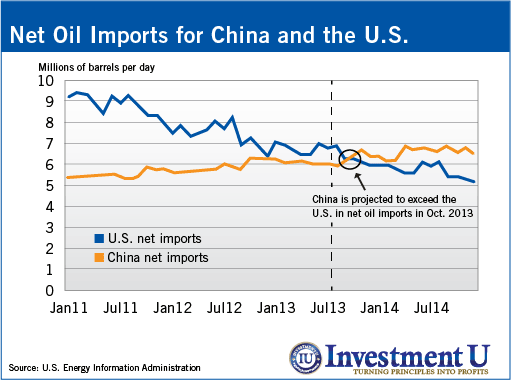
  • In October, China will pass the U.S. to become the world’s biggest net oil importer.
  • China will import 6.45 million barrels of oil a day. At the same time, the U.S. will import 6.23 million barrels of oil a day.
  • On a yearly basis, China’s overseas purchases will surpass the U.S.’s next year. Net Chinese imports will be 6.57 million barrels per day (bpd) next year. That’s higher than the U.S.’s 5.71 million bpd.

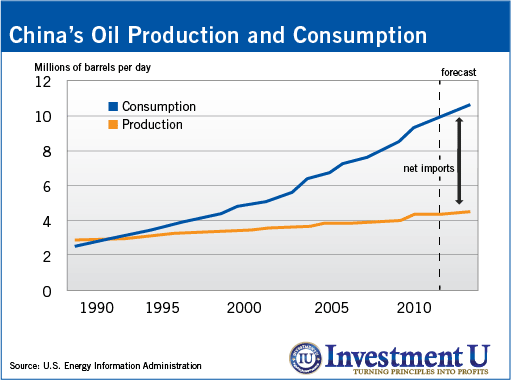
This is happening even though China will use 11 million bpd of oil in October while the U.S. will use 18.6 million.

That’s because new technologies, including fracking and horizontal drilling, are shifting America’s crude oil production into overdrive. U.S. wells pumped out 7.5 million bpd in July.

Add in other liquids, including liquefied natural gas and biofuels, and total U.S. production will rise to 12.4 million bpd by October. China, meanwhile, will produce only 4.57 million bpd.

China’s largest oil fields are mature and production has peaked. Oil explorers in China are focusing on the western interior provinces and offshore fields.

Water injection has raised the oil output of China’s old fields. But fracking has met with mixed success so far. And that leads to the next chart…

You can see this is bad news for China… at least, if China hopes to be an energy-independent superpower.

To be sure, China could come up with new technology. But in the meantime, everybody in China wants to drive like a car-razy American.

  • China’s auto sales rose 10.4% in July alone to 1.24 million units. For the most part, those aren’t replacement cars. They are thirsty new vehicles lining up at China’s gas pumps.
  • China’s use of liquid fuels will grow to more than 11 million bpd in 2014 – up 13% from 2011.
  • And by 2040, the EIA expects China will use 20 million bpd, compared with 19 million bpd for the U.S. That’s more than double what China used in 2010.

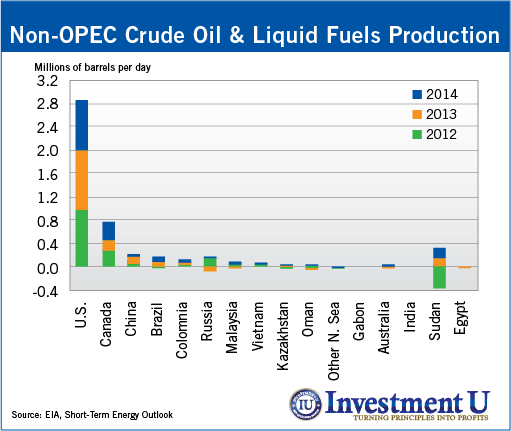
So where is China going to get the oil to fuel all those cars? Well, hang on to your hats for this next chart, showing non-OPEC oil production growth…

As you can see, the U.S. is the big cheese in production growth as well. No one else in the world comes close when you measure new production outside OPEC.

But how about production growth within OPEC? OPEC July output dropped 1.1 million bpd compared to last year. There’s no growth there.

So, when China looks for new sources of oil, it’s probably going to have to come to us.

According to forecasts, the world will use between 1 million and 1.2 million more barrels of oil next year than it did this year.

Longer-term is more of a guesstimate. But everyone agrees the world will use a lot more energy. For example, the EIA says world energy consumption will rise 56% in the next three decades.

The EIA singles out energy demand growth in China and India, as well as legions of thirsty new cars in other developing nations.

Heck, the average person in China consumes about one-ninth the oil an American does. What if everyone in China doubled their energy use?

To be sure, there are all kinds of energy. And there could be new technologies that help wean the Chinese and the rest of us from fossil fuels. But for now, petroleum-based gasoline is still the best way to keep your car on the road.

It looks like China’s oil demand is shifting into overdrive. And Uncle Sam could end up with a lot of power in a rapidly shifting relationship.

How You Can Profit

Here’s one idea that could put money in your pockets. The SPDR S&P Oil & Gas Exploration & Production ETF (NYSE: XOP). The XOP gives investors exposure to plenty of smaller names in the energy space – companies that could do very well as America pumps more oil and natural gas.

There are a number of select companies that will profit significantly from America’s new oil boom. To find out more about them, read my new special report, “How to Profit From America’s Energy Boom and China’s Oil Thirst.”

Good investing,

Sean

Editor’s Note:  Housing starts are up, jobless claims are down – every month we seem to get better and better indications that the U.S. economy is improving. But we all know it isn’t the clowns in Washington or at The Fed that are restoring it. And now we have proof…

Our research has uncovered six companies that are leading a $1.2 trillion project to save America from itself. These companies are more than just great investment opportunities. If their plan works, it could end deficits, bring unemployment down to 4%, send the Dow to 20,000 or higher and even put $8,000 into the pockets of every American.

Who are they? Click here to find out.

Article By Investment U

Original Article: Net Oil Imports… This Should Scare the Hell out of China