U.S. Dollar under pressure

U.S. dollar under pressure

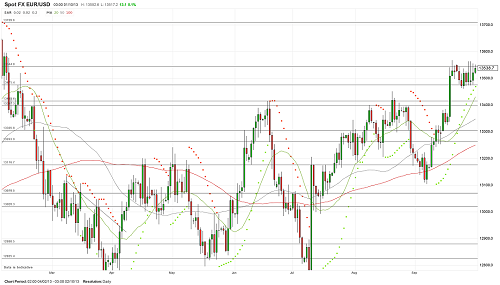
EURUSD Euro / dollar can break the current resistance

Yesterday the EUR / USD rose from 1.3475 support to 1.3555 resistance. Positive against stored pairs, as well as the demand level of 1.3518. Apparently, the bulls for the pair intend to break the resistance. If they succeed, it will be possible to count on the euro into the direction of the 37th figure, which can possibly activate sellers. In turn, the inability of the EURUSD to overcome the level may lead to profit-taking on long positions and, therefore, the depreciation of the pair. In this case, it can not avoid testing the 34th figure.

 eurusd01.10.2013


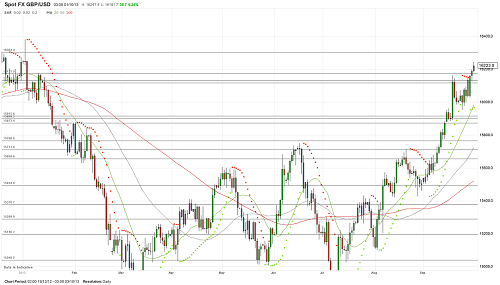
GBPUSD Bullish pound / dollar in force

The uptrend in the pound / dollar remains in force. The pair rebounded yesterday from support at the level of 1.6131 and rose to 1.6202. In the Asian session, the growth continued, and the pound tested the 1.6246 mark. The next target for the pair of bulls looks 63rd figure, but because of overbought conditions, this goal can not be achieved in the short term. The nearest support is on the way to the 61 th figure. A drop below 1.5954 will weaken the bullish momentum. On the upside, 1.6300 is possible to consider the possibility to open a short-term short positions.

 gbpusd01.10.2013


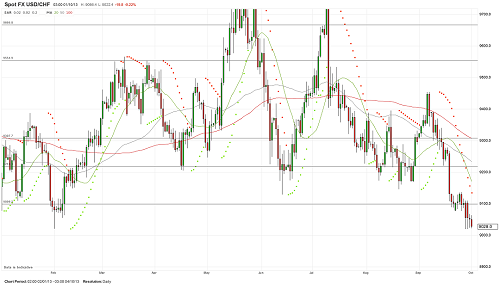
USDCHF bears on the dollar / franc 0.9000 intend to test the lows

Pressure on the dollar / franc remains, therefore, attempts to increase for the pair capped at 0.9068 and support around 0.9000 level attracts buyers. While the bears can not break below 0.9020, it seems that the testing 0.9000 support can not be avoided. Its breakdown will open the way to 0.8930. To weaken the dollar bearish pressure to go back and consolidate above the 91 th figure, but at this stage it looks unlikely.

 usdchf01.10.2013


USDJPY dollar / yen may fall to 97.00

Reduced dollar/yen to 97.50 attracted buying interest, against which the dollar could rise to the level of 98.72. Here sellers again proved, and the pair returned to the 98th figure. Nonetheless, this pair makes it difficult to predict movements in it, but as long as the dollar is trading below 99.00, the pressure on it will be preserved, along with the pressure that will continue and the chances to drop to 97.00. The loss of this support significantly spoil the prospects for the dollar, and a drop below 96.00 would confirm the development of large-scale downward correlation.

usdjpy01.10.2013


provided by IAFT


Daimler and the Best Stocks of 2013

By The Sizemore Letter

With one quarter left to go, the Best Stocks of 2013 contest is settling into a two-horse race. Daimler AG (DDAIF) is in the lead with a 48% year-to-date return including dividends. Rick Pendergraft’s pick Mylan (MYL) is still well within striking distance at 39%. With three months to go, this race is still far too close to call.

Louis Navellier’s Sherwin-Williams (SHW), Jeff Reeves’ Intel (INTC) and Paul La Monica’s Qualcomm (QCOM) round out the top five with year-to-date total returns of 19%, 14% and 10%, respectively. As a point of comparison, the S&P 500 is up 16% year to date and the Dow Industrials 15%. So, taken as a portfolio, the top five are stacking up well.

At #6, Meb Faber’s contrarian recommendation of the Global X Greece ETF (GREK) is showing signs of life after enduring a brutal summer. It’s up by nearly 30% from its July lows and about 6% year to date.

Steve Freehill’s Two Harbors (TWO) and Jon Markman’s Femsa (KOF) both had great starts to the year but took a pounding during the summer “taper tantrum” and are now flat on the year. Greg Harmon’s infrastructure play Great Lakes Dredge & Dock (GLDD) is having a strong September, but the small cap is still recovering from a sharp sell-off in March. And Stephanie Link’s Vale (VALE) , which has had a terrible year along with the rest of the mining sector, is back from the dead. It’s up by a full 26% after hitting a 52-week low in July.

Taken as a single equally-weighted portfolio, the Best Stocks list is up a little over 9% year to date, including dividends.

With Daimler up 48% thus far, it’s fair to ask: is Daimler still a buy?

And to this, I would answer with a resounding “yes.”

Even after its recent run, the stock is still reasonably cheap. It trades for 12 times expected 2013 earnings, 0.5 times sales, and 1.5 times book value. Daimler also pays a market-beating 3.8% in dividends and happens to have nearly a quarter of its market cap in cold, hard cash.

The valuation numbers are roughly in line with General Motors (GM). And given that I consider General Motors attractive at current prices, this makes Daimler’s underpricing all the more apparent. Daimler is a higher-margin luxury automaker with better positioning among the emerging world’s nouveau riche. And while Daimler’s sales have not been completely immune to the effects of slowing global economic growth, Daimler’s customer base is far less sensitive to economic shocks.

Aside from Daimler’s attractive price—which should be catalyst enough—I see two catalysts that should propel Daimler higher.

First, China—Daimler’s most important growth market—appears to have bottomed for now. As I wrote in a recent article, anecdotal data such as property prices, rail volumes and government revenues all point to a Chinese economy that is expanding again. And the shocks to Chinese demand from earlier in the year—such as the crackdown on bribery and conspicuous consumption by public officials—look to have run their course.

Daimler expects to see demand for luxury cars in China rise 15% next year, and last month the company announced plans to invest €2 billion euros increasing its manufacturing capacity in China. In 2014 the company may or may not recoup the ground lost to rivals BMW (BAMXY) and Audi in recent years. But management sees a bright future in China, and I am inclined to agree.

Next is the stabilization of Europe. Yes, we’ve all seen the protests sporadically erupting in Greece, and yes, Silvio Berlusconi is making noise about bringing down the Italian government again. Yet the Eurozone bond market remains calm. Spanish bond yields are near their pre-“taper tantrum” levels of early May, and Italian bond yields are only about 50 basis points their May lows.

I’m not expecting robust growth to return to Europe any time soon. But with investors already largely desensitized to the perpetual Eurozone crisis, I do see stability. And a stable Eurozone should help Daimler on two counts. First, it makes a pop in domestic sales more likely. But more immediately, it means that investors are more likely to award European stocks richer valuations.

Charles Lewis Sizemore, CFA, is the editor of the Sizemore Investment Letter and the chief investment officer of investments firm Sizemore Capital Management. As of this writing, he was long DDAIF and INTC. Click here to learn about his top 5 global investing trends and get your copy of “The Top 5 Million Dollar Trends of 2013.”  This article first appeared on InvestorPlace.

This article first appeared on Sizemore Insights as Daimler and the Best Stocks of 2013

Join the Sizemore Investment Letter – Premium Edition

Eurozone Final Manufacturing PMI In September Drops

By HY Markets Forex Blog

Eurozone’s final Manufacturing Purchasing Managers’ Index (PMI), measuring the eurozone activity level of purchasing managers in the manufacturing sector declined 51.1 points lower in September, meeting analysts estimated of 51.4 in August, Markit Economics confirmed.

“An improvement in euro zone manufacturing business conditions for a third straight month in September sends a reassuring signal that the sector is providing an all-important lift for a region that has been besieged by recession”, Chris Williamson, chief economist at Markit, said on Tuesday.

“Even manufacturers in the region’s ‘periphery’ are reporting better demand for their goods. Orders rose for the fourth month running in Spain and for the third successive month in Italy and Ireland. In the region’s ‘core’, orders likewise rose for a third month running in Germany and the Netherlands and even the recent laggard France saw the first upturn in demand for just over two years” Williamson added.

“Although signaling the best performance for over two years in recent months, the PMI slipped slightly compared with August and remains only just above the 50 ‘no change’ level, indicating that this is still early days in what looks like a fragile recovery.”

Final Manufacturing PMI – German Activity

Germany’s manufacturing sector maintained its expansion in September, while the final manufacturing PMI slightly dropped to 51.1 in September.

“Germany’s manufacturing sector looks to have expanded at a reasonably solid pace through the third quarter of the year, despite growth momentum easing in September. A robust performance from investment goods producers helped sustain manufacturing growth, while the main drag was from weaker consumer goods production,” Tim Moore, senior economist at Markit said.

“Despite output volumes remaining on an upward tilt, manufacturers were cautious about their payroll numbers during September, reflecting relatively subdued demand from emerging markets and a general lack of pressure on operating capacity”, Moore added.

 Italy’s Activity Worsens

The manufacturing sector in Italy worsened in September, as the manufacturing PMI for the country dropped to 50.8 points in September from previous reading of 51.3 in August, Markit Economics said. Analysts had forecasted the reading to come in at 51.1.


“The headline manufacturing PMI slipped from its recent high in August but was nevertheless in expansion territory for a third straight month, implying that the sector has made a positive contribution to GDP in the third quarter. Data suggested that the slowdown in growth in September was mainly attributable to fragility in the domestic economy, with the recent surge in new export orders continuing”, Phil Smith, economist at Markit said.

Activities in the Spanish industrial sector worsened in September, as the manufacturing PMI came in at 50.7 points, down from the previous reading of 50.1 points in the previous month.

“The September manufacturing PMI for Spain confirms the picture of gradual improvement seen in the third quarter of the year, supported again by solid growth of exports. It remains to be seen whether this stabilisation can be translated into a period of expansion or whether the sector will slip back into contraction again,” Andrew Harker, senior economist at Markit stated.

France Activity Picks Up

The business activity in the French manufacturing sector showed a slight boost in September, as the final manufacturing PMI rose 49.8 points higher in September. Slightly higher than the previous reading of 49.7 in August.

“Although French manufacturing output fell again in September, a rise in new orders for the first time in over two years suggests that conditions in the sector are stabilising. Moreover, a sharp fall in stocks of finished goods suggests that production will have to be raised soon if demand continues to hold up,” senior economist at Markit Jack Kennedy said on Tuesday.

“Looking at the data relating to the supply chain, low stock levels at vendors resulted in a marked lengthening of lead times, while input prices showed a renewed rise as the cost of a number of raw materials increased,” he added.


Interested in trading In the European Market?

Visit www.hymarkets.com and find out how you can start trading today with only $50.

The post Eurozone Final Manufacturing PMI In September Drops appeared first on | HY Markets Official blog.

Article provided by HY Markets Forex Blog

European Stocks Mixed After US Government Shutdown

By HY Markets Forex Blog

Major European stocks started the trading session mixed on Tuesday, following the first US government shutdown since 1996.

The US government faced its first shutdown after the government failed to finalize an agreement over the largest economy’s budged spending bill by the deadline given, which was on Monday midnight.

The Euro Stoxx 50 advanced 0.41% higher, opening at 2,900.56, while the German DAX edged up 0.37% higher at 8,626.54 at the open. At the same time the French CAC 40 rose 0.29% at 4,156.87, while the British FTSE 100 declined 0.09% to 6,458 at the open.

A series of Purchasing Managers’ Index (PMI) are expected to be released from Italy, Spain, UK, Germany, France and the eurozone as a whole, between 7:15am GMT and 8:30am GMT.

First US government shutdown

The House Republicans and Senate Democrats tried to reach a temporary agreement for the government budget spending bill before the deadline on Monday midnight, to delay the affordable care act as the US senate aimed for a fresh bill to continue funding the government after Monday.

Over 500,000 federal employees are expected to be out of work without pay, while other government services will be closed for the day.

“You don’t get to extract a ransom for doing your job, for doing what you’re supposed to be doing anyway or just because there’s a law there you don’t like,” Obama said at the White House on Monday. “Time’s running out,” he added.

According to economists, the shutdown could wipe out up to 1.4 percentage points from the fourth-quarter of the US economic growth rate.

Italy’s Turmoil

The ongoing political turmoil in Italy has worsened over the weekend after five ministers from the former Prime Minister Silvio Berlusconi’s party withdrew from the cabinet. Analysts warned that the crises could stir up a new election.

Five Ministers from Berlusconi’s People of Freedom (PDL) party resigned on Saturday, as the party’s leader opposed plans to increase sales tax.


Find out how you can earn extra profit when trading European Stocks Online and open an account with us today! www.hymarkets.com 

The post European Stocks Mixed After US Government Shutdown appeared first on | HY Markets Official blog.

Article provided by HY Markets Forex Blog

Choosing Your Futures Broker: Five Straightforward Measurements

Choosing Your Futures Broker: Five Straightforward Measurements (via Cannon Trading)

Whether you’re planning to open a self-directed futures account, or one where a broker supports the trading of your account – in some large or small way – there are several important factors you should consider when you decide to open an account…

Continue reading “Choosing Your Futures Broker: Five Straightforward Measurements”

The Most Important Chart After the Government Shutdown Ends

By WallStreetDaily.com

Barring a last-minute, epic compromise, the government is closed today. The stock market might be behaving badly as a result, too.

Oh, and apparently Nostradamus predicted this would happen in his fourth quatrain. Thirst and famine are next.

Hey, with this Congress? Who knows!

Of course, most Americans probably won’t even notice the shutdown.

In fact, on Monday morning, the ever-popular Josh Brown of The Reformed Broker blog captured the current zeitgeist of the nation in a single tweet:

“‘Whatever. Wake me up when there’s a Netflix shutdown.’ – America.”

Welcome to the sad state of affairs in America!

We’ve simply grown immune to political brinkmanship. Of course, that won’t prevent the media from trying to scare us into caring about the shutdown. Ignore it.

What should we be focusing on instead? How about the only fundamental metric that’s going to matter once the government shutdown ends?

It’ll soon be dominating the headlines. And rightfully so. Here’s the early scoop – and what it means for our investments…

Get Ready for An Earnings Onslaught

The first government shutdown in 17 years isn’t the only thing yesterday signified. It also marks the end of the third quarter. That means we’re about to get bombarded with third-quarter earnings reports.

And while stock prices have continued to rise in 2013, earnings growth rates are trending in the opposite direction. In the second quarter, S&P 500 companies reported profit growth of 3.8%. Yet estimates heading into this quarter call for only 3.2% growth, according to FactSet data.

That could prove problematic…

After all, stock prices ultimately follow earnings. If earnings growth sputters out, so could the current bull market. Investors simply won’t keep paying up for slower growth. Especially since, at its current forward valuation of 14.4, the S&P 500 is already trading above its five-year (12.9) and 10-year (14.0) averages.

To be fair, earnings growth rates always surge in the early part of a bull market, then level off over time. Given the unprecedented amount of monetary stimulus by the Federal Reserve, though, it’s reasonable to expect that the economy and corporate profits should still be advancing at a healthy clip.

The good news? Despite weak estimates for this quarter, we could be in store for an upside surprise. Here’s why…

Follow the New Leader

Aluminum giant, Alcoa (AA), traditionally kicks off earnings reporting season. But it got booted from the Dow last month. As a result, new Dow component, Nike (NKE), has become the de facto bellwether.

That’s not a bad thing, either, as the shoemaker’s sales boast a 97% correlation with U.S. GDP, according to Businessweek. That’s way better than Alcoa’s correlation of 84.8%.

Put simply, Nike is a far better proxy for the overall health of corporate America, which makes its earnings report last week all the more instructive.

You see, the company reported a 38% increase in net income. Shares surged to an all-time high on the news, too, even though analysts expected weaker growth.

If this trend of better-than-expected earnings growth plays out, there’s no stopping this bull market. If not, well… look out below!

Bottom line: The government shutdown isn’t the biggest threat to our investments right now. It’s earnings. And it’s only a matter of time before investors start focusing on this all-important metric.

Rest assured, we’re already monitoring the reporting activity. And I promise to be in touch with any urgent buying opportunities.

Plus, at this stage of the bull market, we also need to be on the lookout for attractive short-selling candidates (i.e. – companies with rapidly deteriorating earnings).

So stay tuned!

Ahead of the tape,

Louis Basenese

The post The Most Important Chart After the Government Shutdown Ends appeared first on Wall Street Daily.

Article By WallStreetDaily.com

Original Article: The Most Important Chart After the Government Shutdown Ends

GBPUSD: Bullish, Remains on the offensive.

GBPUSD: Bullish, Remains on the offensive. GBPUSD: A second day of rally in the new week leaves GBP targeting further upside. Resistance resides at the 1.6300 level where a violation will pave the way for a run at the 1.6350 level. Further out, resistance resides at the 1.6400 level. A cut through here will turn attention to the 1.6450 level and then the 1.6500 level. Its daily RSI is bullish and pointing higher supporting this view. On the downside, support lies at the 1.6163 level where a breach will target the 1.6100 followed by the 1.6000 level and then the 1.5950 level where a violation will aim at the 1.5900 level. On the whole, GBP remains on offensive mood.

Article by fxtechstrategy.com


Australia holds rate, says lower A$ would assist growth

By www.CentralBankNews.info     Australia’s central bank held its benchmark cash rate steady at 2.5 percent, as expected, saying this was appropriate and the full effects of rate cuts since late 2011 “are still coming through, and will be for a while yet.”
    The Reserve Bank of Australia (RBA), which has cut its cash rates by 2.25 percentage points since November 2011, including cuts of 50 points this year, said the pace of borrowing remains subdued though there have been recent signs of increased demand for finance by households and evidence of a shift in savers’ behavior in response to the declining returns on low-risk assets.
    While the RBA repeated that it would “continue to assess the outlook and adjust policy as needed,” the bank softened its description of the Australian dollar, saying that it is still about 10 percent below its level in April despite a recent rise.
    “A lower level of the currency than seen at present would assist in rebalancing growth in the economy,” the RBA said, no longer describing the exchange rate of the A$ as high, as it has in recent months.
    From January through April, the A$ traded above parity to the U.S. dollar but it started to weaken in early May in response to the RBA’s first rate cut and fell to a year-low of 89 cents to the U.S. dollar on Sept. 1. Since then it has rebounded, trading at 93 cents to the U.S. dollar today.
    Australia’s economy has been hit by lower demand for its raw materials by China and the RBA has been cutting rates to help the economy adjust to lower levels of mining investment.
    The RBA said the economy had been growing a bit below trend in the past year and this was expected to continue. It acknowledged that the unemployment rate had edged higher but there had also been an improvement in household and business sentiment though it was too soon to judge whether this would continue to improve.
    Inflation remains consistent with the RBA’s 2-3 percent target and the central bank expects this to continue over the next one to two years even with the impact of a lower exchange rate as labour costs are moderating.
    In the second quarter, Australia’s headline inflation rate eased to 2.4 percent, down from 2.5 percent in the first quarter, but up from 2.2 percent in the fourth quarter of 2012.
   Australia’s Gross Domestic Product expanded by 0.6 percent in the second quarter from the first for annual growth of 2.6 percent, up from 2.5 percent in the first.

    www.CentralBankNews.info

How Much Attention Should You Pay to The US Debt Ceiling?

By MoneyMorning.com.au

According to a weekend report from Bloomberg News:

A U.S. government shutdown means President Barack Obama will have fewer people to cook meals, do the laundry, clean the floors or change the light bulbs, according to a White House contingency plan…

Of the 90 people who maintain the President’s family living quarters, only 15 would remain to provide “minimum maintenance and support.”

And apparently in the event of a government shut-down, the US president will have to send home three-quarters of his 1,701 permanent staff.

For some reason the market didn’t like that news. Yesterday the Aussie index fell 88 points. The US Dow Jones Industrial Average dropped 128 points.

It was a big fall for the Australian market. But it’s still above 5,200 points, which is a key level as we head towards the end of the year…

But how much attention should you pay to the US debt ceiling?

After all, this isn’t the first time you’ve heard a bunch of shrieking and wailing as the government nears its spending cap.

So our inclination is to ignore the fuss and use the current pull-back as a chance to buy stocks rather than sell stocks.

Of course, like the boy who cried wolf, there’s always the chance that this is the big one. One day investors will become bored with all the nonsense and decide that stocks can’t rise in this environment, and so they won’t pay the current prices.

This is Why Government Money is Doomed

From a philosophical standpoint the market should embrace the idea that the US government is about to shut down (midnight US Eastern time, 2pm AEST).

The less government spends and the less it can inhibit the free market, the more businesses can focus on doing things that really matter – such as innovating, making products and providing services.

This is why, despite the criticism we face from folks who say that we don’t understand the seriousness of the problem, we choose to pay more attention to individual companies and emerging trends rather than whether the US government can afford to pay its bills.

Take the work we’re doing for subscribers of Revolutionary Tech Investor. Technology analyst Sam Volkering has just arrived back in London after spending a week in Dubai at the SIBOS conference.

SIBOS is an annual get-together for the banking industry. They meet and discuss the latest developments – mainly on the technology side – in the financial markets.

While he was in Dubai, Sam met with and talked to some of the people shaping the technological future of money and banking.

But as Sam sees it, as technology moves ahead at a faster speed, the banks will struggle to keep up.

This is another reason why we’re amused by the current fuss over the US debt ceiling. The fact is the whole thing is actually speeding up the demise of government-issued money. Governments have shown that you can’t trust them to look after money, and so at some point the private sector will show them how to do it.

Three charts show how the US government in particular is ‘helping’ with this shift to private money.

First, a chart of the US debt ceiling, which was USD$16.39 trillion at the end of 2012:


Source: Heritage.org

Next is the chart of the US monetary base that shows the extent of inflation and money printing:


Source: Federal Reserve Bank of St Louis

And finally, this chart shows the decline in the purchasing power of the US dollar since 1900:

Would you trust someone who had done that to your money?

The New Way for Money


If you gave a friend a loan and he or she used it as capital to borrow more money from the bank and then made you pay the interest to the bank, would you keep handing over your cash?

One day you’d say enough is enough.

And one day that will happen to the US government and every other government that thinks it can borrow without ever paying back the loans.

But will that day arrive tomorrow? Our bet is that it won’t. Instead, our bet is that you’ll see a continued decline in faith that governments can manage money correctly.

This will happen at the same time as individuals transition towards using non-government forms of money. In a way this is here now with PayPal, iTunes and Amazon.

Soon enough the transition will be complete to the point that you won’t store Aussie dollars or US dollars in a PayPal or iTunes account. Instead you’ll store units of currency issued by these private companies.

But whether that happens next year or next decade, one thing is certain: the private sector will easily adapt to this change – including most of the companies you invest in today.

That’s why for all the bumps in the market we view issues such as the US debt ceiling as an opportunity. Anything that hastens the end of devalued government currencies and heralds the rise of secure and valuable private currencies is a good thing in our book.

Cheers,
Kris+

Join Money Morning on Google+

Special Report: UNAVOIDABLE: Australia’s First Recession in 22 Years

US Interest Rates and the Living Dead

By MoneyMorning.com.au

OK, I admit it. I watch the television series The Walking Dead. If you’re not familiar with this triumph of modern Kultur, it’s a cable TV show about people battling zombies in a post-apocalyptic world.

Basically, The Walking Dead‘s premise is that an exotic disease killed off most of the world’s population, but in the process reactivated the basal sections of their brains. Now the not-entirely-deceased entities prowl the land as zombies. As a counterpoint to these ‘walking dead’ critters, an array of struggling humans battle to survive.

What does this have to do with investing? Glad you asked!

The Walking Dead helps, in perhaps a peculiar way, underpin a new investment thesis. It’s all based on the Fed’s ‘dead money’ philosophy.

While there may be no way of stopping the Federal Reserve’s plague of zombie money from flooding the market, there’s still plenty you can do to ‘arm yourself’ against its deadly advance.

Specifically, you can buy into the idea of holding gold or buying a few undervalued gold companies.

Investing in the Living and the Dead

I recently uncovered a fascinating chart, from Bianco Research LLC, of long-term US interest rates covering 222 years, from 1790-2012.

Pretty cool chart, eh? I could discuss this chart all day. But the take-away here is that since 1790, the average long-term interest rate on US Treasuries has been about 5%. When you look back over all of US history, interest rates have almost never been under 3%, excepting during the total national effort of the Second World War. Keep that 5% in mind!

The Current Historically Low Interest Rates

So what are the current interest rates for US 30-yr bonds? At last check, according to the US Treasury, they’re sitting at just above 3.6% – up over the past five months on the hopes of a Fed taper.

What’s the point? As the chart shows, historical rates for US bonds have averaged about 5% over the past 222 years. Yet right now, according to the US Treasury, short-term bonds yield just a hair above nothing. Medium-term bonds (one-five years) yield way under 1.5%.

We’re a long way below the historical average of 5% money, right? Treasury yields are as dead as doornails. Looking ahead, what if there’s even a slight reversion of Treasury rates to the historical mean? What if these near-dead current interest rates start to rise via the Fed’s promised taper?

Greasing the Treadmill to Nowhere

What do these superlow, historically anomalous Treasury interest rates tell us? On that point, I’m reminded of the words of the great Austrian economist Ludwig von Mises, who wrote that ‘Public opinion always wants easy money, that is, low interest rates.

Well, clearly, we have a government policy of easy money and monetary populism. The US government – and its associated class of media and financial enablers – wants cheap interest rates to mask the true cost of horrific, irresponsible levels of federal borrowing and spending. Low interest rates are just grease for the country’s financialised treadmill to nowhere.

With Treasury bonds continuing to offer historically-low interest rates, it sets a funereal tone for interest rates through the rest of society. Why bother saving? Could it be that American money is ‘cheap’,’ in terms of interest because over the long term, it’s not worth all that much anymore? Do you see the issue?

Back when I took the basic survey economics course at Harvard – Economics 10 – I recall the late Otto Eckstein (who worked for presidents Kennedy and Johnson) saying that cheap money destroys capital. That was just a fundamental point. If you missed that, you failed the course.

In other words, we live in a capital-intensive world. Capital requires savings and investment. Yet low interest rates undermine people’s incentive and ability to save and invest. So low interest rates are – over any prolonged period of time – thoroughly destructive toward capital in many ways.

We could go back to von Mises, who stated, ‘True, governments can reduce the rate of interest in the short run. They can issue additional paper money. They can open the way to credit expansion by the banks. They can thus create an artificial boom and the appearance of prosperity. But such a boom is bound to collapse soon or late, and to bring about a depression.

Soon or late? My bet is soon.

Byron King
Contributing Editor, Money Morning

Join Money Morning on Google+