Global Market Review 18/10/2013

Guest post provided David Wilson of BinaryOptionsDailyReview.com

Dow Jones

US stocks ended mostly higher with the S&P 500 finishing at a record high. Investors’ attention has now switched to corporate earnings now there has been a temporary fix for the fiscal dilemma. So far IBM, which traded down 6.7% and Goldman Sachs, which traded down almost 2.5% are the main Dow constituents to report disappointing earnings. The S&P 500 finished up 11.61 points at 1,733.15. The Dow was at one stage over 140 points easier but rallied and late in the session did break into positive territory before finishing down 2.18 points at 15,371.65.

After hours Google reported earnings that beat estimates and in after hours trading the shares surged 7% to $950.50 on heavy volume.

FTSE

The FTSE extended its winning streak to the sixth straight session helped by well received earnings from SABMiller PLC and British Sky Broadcasting PLC and upbeat economic news in the form of retail sales. The FTSE finished the session up 4.57 points at 6,576.16.

Pre Market Opening

European stocks are expected to open higher this morning boosted by data showing acceleration in China’s economic growth. The Chinese economy grew 7.8% in the third quarter, the fastest pace of growth this year as rising foreign and domestic demand lifted factory production and retail sales. The FTSE is expected to open around 30 points higher, the DAX around 23 points higher and the CAC around 15 points higher.

The Nikkei closed down 24.97 at 14,561.54, the Hang Seng was on track to close higher, it was last seen up 232.51 points at 23,327.39.

The US Department of Labor reported that the number of people filing for initial jobless benefits last week declined by less than expected 15,000 to a seasonally adjusted 358,000, however data is still being affected by computer issues in California. The Philly Fed manufacturing index came in ahead of expectations with a reading of 19.8 against an expected reading of 15.0.

The UK Office for National Statistics said that retail sales in the third quarter grew 1.5% on the second quarter that makes the largest calendar quarter increase since the first quarter of 2008, which was when economic output hit its peak.

Forex, Binary Options News

The Dollar eased against most major currencies as the possibilities grew that the Federal Reserve would continue its bond buying programme well into next year due to the fallout from the debt crisis. After the Dollar rallied yesterday on the news of the deal it soon turned easier as investors focused on the damage to the fragile US economy and the chance that the whole issue could be replayed early next year. The Dollar was sharply lower against the Yen with the USD/JPY dropping 0.88% to ¥97.90. The Euro rose to an eight month high against the Dollar with the EUR/USD advanced 0.99% to $1.3670. Sterling rallied strongly on the back of strong retail sales data with the GBP/USD climbing 1.26% to $1.6149. The Dollar lost ground against the Canadian dollar with the USD/CAD losing 0.35% to CAD$1.0291. The Dollar was easier against the Australian and New Zealand dollars with the AUD/USD ending the session up 0.86% to a four month high of $0.9634 and the NZD/USD climbed 0.93% to a six month high of $0.8503.

Commodity News

Gold prices ended the US day session sharply higher as heavy short covering was prominent as well as some safe-haven buying interest. The sharply lower US Dollar index was also a bullish factor for the precious metals markets. December gold was last up $37.90 at $1,320.80 per ounce. Spot gold was last quoted up $38.50 at $1,321.50. December silver last traded up $0.56 at $21.925 per ounce.

Crude oil futures settled lower and close to the $100 a barrel level following data from a trade group which showed a much bigger-than-expected jump in crude supplies coupled with the possibilities that the government shutdown may have impacted on energy demand. November crude dropped $1.62 to settle at $100.67 per barrel. December Brent crude fell $1.48 to $109.11 per barrel.

Overview

Debt ceiling sorted, budget sorted and US government is back to work everything is rosy, or is it? The deal that was struck is only a temporary fix and the band aid will come off early next year if a permanent solution is not found, meaning we could be back to square one and going through all this again early in the new year. The euphoria in the markets on the news that a deal had been struck soon evaporated when the details were published and the brakes were put on any further headway. It will be an interesting few days in the markets as all the news is digested, expect a fair bit of volatility in the DOW, USD and gold, making for some ideal short term trading opportunities.


EUR/USD Technical Overview before the NFP Release

Article by Investazor.com

The United States Congress got to an agreement on the debt ceiling, avoiding this way a default of the country. Yesterday the government was restarted after a two week partial shutdown. The markets became euphoric and investors started to sell safe havens for riskier assets. The dollar was sold quickly and the selling accelerated when Dagong, a rating company from China, downgraded the United States to A-.

eurusd-technical-overview-before-nfp-resize-18.10.2013

Chart: EURUSD, Daily

EUR/USD rallied yesterday from 1.3515 to 1.3670 in several hours, hitting a new high for the past eight months. The price is very close to February’s high, 13710, and the price action is signaling a reversal. The Rising Wedge drawn during the past weeks might find a new high near this level. From here I expect a short correction, before a break above the resistance.

Next week on Tuesday the Non-Farm Payrolls are scheduled to be published on the economic calendar. If the labor data from United States will disappoint the market, we might see another big fall for the dollar because the Quantitative Easing will most probably continue even after Ben S. Bernanke will leave Federal Reserve.

The post EUR/USD Technical Overview before the NFP Release appeared first on investazor.com.

Friday Charts: Setting the Record Straight on the United States, Europe and Japan

By WallStreetDaily.com

Why use lots of words when pictures will suffice?

That’s our motto on Fridays in the Wall Street Daily Nation.

Once a week, we select a handful of graphics to put important economic and investing news into perspective for you.

This week, I’m dishing on the one thing more painful than the debt ceiling debate, why repetition is important to profitability, and why the fearmongering about the United States being the next Japan needs to stop.

Without further ado, let’s go to the charts!

It Could Have Been Worse

The government is (finally) open again. And that should put an end to the hour-by-hour stock market spasms we endured for the better part of two weeks. Fingers crossed.

Of course, it never hurts to put our most recent trying times into perspective. In this case, it could have been worse.

Despite the uptick in volatility during the shutdown, the average daily percentage move for the S&P 500 Index only increased from +/-0.43% to +/-0.55%, according to Bespoke Investment Group.

That’s a far cry from the volatility we witnessed during the last debt ceiling debate. Back then, the S&P 500 whipsawed, swinging back and forth by an average of 1.92% on any given day.

So rejoice and be glad that this wasn’t as bad as the last time.

Turning Japanese? Not Anymore!

How many times have we heard that the United States was following in Japan’s footsteps? Too many to remember, for sure.

I’ll concede, the similarities were scary: runaway government debt, stubbornly low inflation and, of course, a comatose stock market.

But don’t let anyone dog our great country like that anymore.

As Michael Hartnett, Chief Investment Strategist at Bank of America (BAC), says, “Leveraged areas of the [U.S.] economy appear to be healing more strongly than they did in Japan.” And that’s finally showing up in the stock market.

After mirroring the moves of the Nikkei 225 Index for way too long, the S&P 500 is now officially charting its own course.

Lest you think I’m overly patriotic, here’s a humbling development for U.S. stocks…

European Blue Chips Win Out

After months and months of banging the drum, I know that my wildly contrarian and bullish calls on Europe got tiresome. But please tell me someone listened!

Cheap blue-chip European stocks trounced their American counterparts in the third quarter. By an embarrassing margin, quite frankly.

The SPDR EURO STOXX 50 ETF (FEZ) rallied 16.2%, compared to a mere 2.3% rise for the SPDR Dow Jones Industrial Average ETF (DIA).

Blue-chip European stocks remain the cheaper of the two. They’re about 10% less expensive on a forward price-to-earnings ratio basis – and almost 50% cheaper on a price-to-book ratio basis.

Plus, they’re still not getting much attention. In other words, it’s still a contrarian trade, which points to more profits ahead. So stick with the trade.

That’s it for this week. Before you go, though, let us know what you think of this weekly column – or any of our recent work at Wall Street Daily – by going here.

Ahead of the tape,

Louis Basenese

The post Friday Charts: Setting the Record Straight on the United States, Europe and Japan appeared first on Wall Street Daily.

Article By WallStreetDaily.com

Original Article: Friday Charts: Setting the Record Straight on the United States, Europe and Japan

Chile cuts rate 25 bps, sees slower demand, global growth

By www.CentralBankNews.info     Chile’s central bank cut its policy rate by 25 basis points to 4.75 percent, citing slower global growth, indications that the domestic demand will slow down further and inflation below forecasts.
    The rate cut comes after the Central Bank of Chile’s board considered cutting the rate in the last five meetings but ultimately decided to maintain the rate while awaiting evidence of how the economy was evolving. But the bank had warned in recent months that it may cut its rate if the economy continues to slow down.
    The rate cut came as a surprise to most economists who had expected to central bank to maintain its rate this month but then cut later this year.
    The central bank, which previously cut its rate by 25 basis points in January 2012, did not give any sign of future policy direction, saying “any future changes in the monetary policy rate will depend on the implications of domestic and external macroeconomic conditions on the inflationary outlook.”
    Chile’s inflation eased to 2.0 percent in September from 2.2 percent in August, at the bottom of the bank’s 2-4 percent inflation range, and the central bank said it would continue to conduct monetary policy with flexibility so projected inflation stands at 3.0 percent over the policy horizon.

    Chile, the world’s largest copper exporter, has been feeling the impact of slower global growth for months and the central bank said a weaker medium-term scenario had consolidated, characterized by slower world growth, lower terms of trade for Chile, less favorable financial conditions and the maturing of the global cycle of mining investments.
    Although the U.S. Federal Reserve’s decision to postpone a tapering of asset purchases had led to lower long-term interest rates, the bank said the fiscal agreement reached in the United States was “temporary, so further financial tensions cannot be ruled out.”
     Chile’s Gross Domestic Product grew by 0.5 percent in the second quarter from the first for annual growth of 4.1 percent, down from 4.5 percent.
    The bank said economic activity was in line with its forecast and the growth in final demand had slowed, though not as sharply as forecast.
    “Various indicators anticipate that it will decelerate further,” the bank said.
    While Chile’s exports have been weakening in recent months, domestic demand had remained resilient. In June the central bank cut is 2013 growth forecast to 4-5 percent, down from 2012’s 5.6 percent, and its inflation forecast to 2.6 percent.

    www.CentralBankNews.info

  Chile’s central bank held its policy rate steady at 5.0 percent, as expected, and said that it may adjust policy rates in coming months if the recent trends continue as forecast, the same guidance the bank has given in recent months.

    “Any future changes in the monetary policy rate will depend on the implications of domestic and external macroeconomic conditions on the inflationary outlook,” the Central Bank of Chile said.


The consolidation of the trends outlined in the last Monetary Policy Report could call for adjustments to the monetary policy interest rate in the coming months. 


 “The consolidation of the trends outlines in the last Monetary Policy Report could call for adjustments to the monetary policy interest rate in the coming months,” the central bank said, repeating its statement from July.

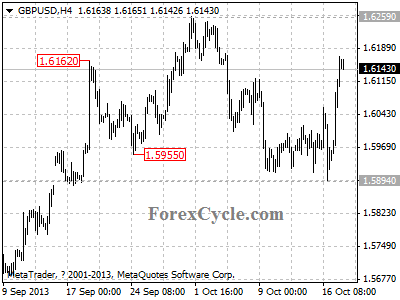
GBPUSD breaks above 1.6060 resistance

GBPUSD breaks above 1.6060 resistance, suggesting that the downtrend from 1.6259 has completed. Further rise to test 1.6259 resistance would likely be seen, a break above this level will signal resumption of the uptrend from 1.4813 (Jul 9 low), then the following upward movement could bring price to 1.6600 zone. Key support is now at 1.5894, only break below this level could indicate that the uptrend from 1.4813 had completed at 1.6259 already, then the following downward movement could bring price to 1.4500 area.

gbpusd

Provided by ForexCycle.com

Why a Higher Aussie Dollar is The Boost Aussie Stocks Are Waiting For

By MoneyMorning.com.au

It seems so long ago.

And yet it wasn’t.

It was only about two months ago that it was falling.

Most people said it would go even lower.

But since then things have turned. And now, maybe there’s a chance it will go higher again.

And if it does it could be the extra boost that Aussie stocks have waited for…

What is the ‘it’ we’re talking about?

It’s the Aussie dollar of course.

The Aussie dollar stayed above or near par with the US dollar from late 2010 through until the end of May this year.

It stayed high not because anyone expressed any particular confidence in the Aussie dollar, but because Australia had higher interest rates than the US.

This allowed investors to take advantage of the carry trade. That means borrowing in a low interest rate currency (US dollar) and then converting the borrowed dollars into a higher interest rate currency (Aussie dollar).

For the big institutional investors this can be almost a risk-free trade…providing economic conditions are stable and predictable. Although it may not have seemed like it at the time, the period from late 2010 to mid-2013 was relatively stable…in a way.

It was stable in that almost everyone knew that the US Federal Reserve would keep printing money. As long as investors kept thinking that, the carry trade would continue.

That all changed this past May…

Death of the Carry Trade

The following chart shows the vicious sell-off in the Australian dollar that started in May and continued through until the end of August:


Source: Google Finance

If you recall, May was around the time when the markets began to get the jitters about a possible end to the US Fed’s money printing.

The argument went that if the Fed stopped printing money it would cause US interest rates to rise, which would result in the US dollar rising against other currencies.

That was the last thing the carry traders wanted to hear. Even the potential for the money printing to end was enough. Carry traders dumped the Aussie dollar in droves in order to return to the perceived ‘safety’ of the US dollar.

The result was the chart you see above.

(Note: Because the carry trade involves borrowing US dollars and buying Aussie dollars, if the Aussie dollar falls traders have to use more Aussie dollars to pay back the US dollar loan.)

The Bull Market Keeps Going

The natural reaction by many was to assume that not only would this exodus from the Aussie dollar see the Aussie dollar fall, but that it would cause stocks to fall too.

This view was right…for a brief time anyway. But around that time we suggested you should take that conventional wisdom with a grain of salt. We argued that a falling Aussie dollar could just as likely be good news for Australian stocks.

It was part of why we said investors shouldn’t sell stocks even though most other folks had panicked and sold. As the following chart shows, we looked pretty dumb at first, until stocks started to turn back up again in June:

Source: Google Finance

The S&P/ASX 200 index is the red line. You can see that after the panic selling stopped in June, the Aussie market rallied around 10% even though the Aussie dollar stayed mostly flat.

But now things have changed again. The market has at last come around to our way of thinking, and it looks like being more good news for Aussie stocks…

Resurrection of the Carry Trade

It would be natural for you to think that if the Australian stock market went up as the Aussie dollar stayed low, then won’t it be bad news for Aussie stocks if the Aussie dollar goes back up again?

The answer is no. Now before you accuse us of being a perma-bull, where we only ever see good news for stocks whatever the prevailing news, let us explain our view.

Our view is that the market has finally gotten it. After months of being duped into thinking the US Fed was about to stop money printing, the market finally realises there is zero chance of that happening.

So that now the market realises there is only one outcome – more money printing, a continuation of low interest rates, and investors buying risky assets.

Whether you agree or disagree with this from a moral or macro-economic view, it doesn’t matter. What matters is what will happen to stock prices. The US Congress has delayed any action on the budget and debt ceiling until next year, and new Fed chairman Dr Janet L Yellen starts in her new job around the same time.

Seeing the instability that the Fed, the US president and the US Congress have created over the past five months, the protagonists will be keen to avoid repeating this mess. As we say, that means more of the same.

And from an Aussie perspective it should mean more good news for stocks as the carry traders regain their confidence and look to benefit from Australia’s relatively high interest rates compared to the US.

The next surge in stock prices may not happen overnight. But last night’s action in the US is a pretty good start. The US S&P 500 index stands at a new record high.

This means Christmas may come early for investors. Look out for the ‘traditional’ Christmas rally. If it kicks off as much as we expect, that should mean the Aussie index hitting our short-term target of 6,000 points by the end of the year.

Cheers,
Kris+

From the Port Phillip Publishing Library

Special Report: UNAVOIDABLE: Australia’s First Recession in 22 Years

Join Money Morning on Google+

Author information

Kris Sayce

Kris Sayce is Editor in Chief of Australia’s biggest circulation daily financial email — Money Morning. (You can subscribe to Money Morning for free here).

Kris is also editor of Australian Small-Cap Investigator, his small-cap stock research service, where he provides detailed analysis on some the brightest, smallest listed companies on the ASX.

If you’re already a subscriber to these publications, or want to follow his financial world view more closely, then we recommend you join Kris on Google+. It’s where he shares investment insight, commentary and ideas that he can’t always fit into his regular Money Morning essays.

The Big Money to be Made in the Aluminium Sector

By MoneyMorning.com.au

Miners and metal suppliers have had a tough year.

Share weakness reflects low commodity pricing, poor global prospects for basic materials and entire investment sectors that are simply out of favour just now. Many investors seem to prefer bonds and tech, if not plain old cash.

So what does the future hold for investors in basic materials? Can we identify any secrets to success? Can we get in ahead of the turning wheels of the business cycle?

In the past two years…aluminium pricing has been shaky on the best of days and weak on most others.

Today, let’s look at a ‘basic’ material supplier that has apparently found the bottom. Shares may be poised for a strong comeback – but beware on that last point, because you might have to wait a while.

The company I’m about to discuss is NOT a ‘buy’ just yet. But it definitely ought to be on your radar screen because of its importance to global industry and as a barometer for market sentiment.

A Very Useful, Versatile Metal

The other day, I listened in on a conference call by Klaus Kleinfeld, CEO of Alcoa (AA.) The aluminium company’s shares trade at $8 – a four-year low – which is far down from the high of $18 about two years back. I followed Alcoa in the portfolio for my newsletter a few years ago, but sold out before the shares drifted into the current doldrums.

I’ve always liked aluminium. It’s a very useful, versatile metal. It’s abundant in the Earth’s crust, but hard to obtain. Indeed, in the olden days, aluminium was so rare and valuable that Napoleon had a set of serving tableware made from it, which he only used when he wanted to impress visiting royalty.

Basically, you manufacture aluminium metal by passing large amounts of electric current through the mineral bauxite. So aluminium is energy intensive, such that it’s like ‘storing’ electricity for future application. Winners in the aluminium biz are usually players with the lowest-cost electricity.

Despite the energy cost factor, the global aluminium business is highly competitive. There are many players and plants scattered across the world, from the Middle East to Russia to Iceland (yes Iceland, based on cheap geothermal energy).

Aluminium prices crashed in the recession of 2008-09, and then rebounded. In the past two years, since about 2011, aluminium pricing has been shaky on the best of days and weak on most others.

Alcoa has survived all through the crummy metals market. In fact, Alcoa just announced surprisingly strong earnings to the upside. Alcoa booked third-quarter net income of $24 million, up from a loss last year of $143 million. A metal play that’s turning a profit? I’m all ears.

According to Alcoa’s Kleinfeld, two things helped improve profitability. Management has focused on restructuring the company away from primarily supplying commodity metal, while also adding value to every molecule of alloy that it ships.

In fact, Alcoa is making its best money downstream this year, with a 22% gain in after-tax operating income for the company’s engineered products and solutions. That is, you can smelt aluminium and cast it into ingots. But in the words of former Alcoa CEO Paul O’Neill (who left the company to become Secretary of the Treasury under President George W. Bush), ‘You can’t put beer in an ingot.

Alcoa is much more than a ‘beer can’ company, however – and don’t discount for a second the advanced tech that goes into making things like aluminium cans.

Part of Alcoa’s secret to success is the continuing stream of ideas that comes out of the company’s well-regarded technical centre, near Pittsburgh. This includes things ranging from super-high-strength alloy for military aircraft to lightweight drill pipe for the oil and gas industry. The technology is simply stunning, when you get into it.

Adding value helps make Alcoa ‘independent of commodity pricing,‘ Kleinfeld said. Thus, the company can ‘win in the market‘ through its organic technical capabilities.

According to Kleinfeld, Alcoa has generated ‘$825 million in productivity gains‘ in 2013, based on management initiatives and willingness to adopt suggestions from employees, vendors, customers and outside consultants. Looking ahead, Alcoa has over 14,000 more ‘productivity-enhancing ideas’ in the pipeline. So internal improvements have every possibility of continuing despite the external market and/or overall economic environment.

Kleinfeld stated, ‘I think all of our businesses have found a way to push back against headwinds‘ – meaning weak commodity pricing and slow global growth. The key idea is to grow productivity, which is ‘part of [the Alcoa] operating process.‘ Plus, this style of internal evolution is deeply ingrained and ‘only limited by the creativity of our employees.

Looking ahead, the aerospace industry is growing over 10% annually, with associated demand for more and higher-quality aluminium alloys. Boeing and Airbus both have a solid backlog of over eight years of commercial airliner production – and that’s if zero new future airline orders come in, which is unlikely.

On the defence side, military procurement is already cut back to the bone. Yes, things could get worse…but actually, not by much. If there’s a turnaround due to the need to rebuild military capacity in the face of new threats, Alcoa is poised to deliver all manner of high-end, high-value products to aircraft and ship builders.

Stunning News From This Sector

Meanwhile, on the ground, the automotive sector uses more and more aluminium. In 2012, for example, the average US car contained about 14 pounds of aluminium. But looking ahead, that number is destined to increase to over 55 pounds by 2015, based on industry designs that are already fixed and contracts that are already signed.

So this is demand that will happen, and the only limit is the end-market for automobiles at the showroom floor.

Looking out even further, the news from the auto sector is stunning. Kleinfeld foresees the average automobile holding 135 pounds of aluminium by 2025. That’s not quite a 10-fold increase in the next decade.

Alcoa has three major expansion projects in progress to meet growing automotive demand. These include a $300 million expansion in Davenport, Iowa; a $257 expansion at Alcoa, Tenn.; and a $380 million project in energy-rich Saudi Arabia, with output destined for the global auto industry.

Another upbeat business sector for aluminium is in commercial buildings and construction. According to Kleinfeld, ‘This is not the same market that it was before the recession.‘ Across the US, Europe and the rest of the world, Alcoa sees building energy requirements increasing. This opens up all manner of new ideas for engineered aluminium products in exterior surfaces, windows, elevators and more.

When you step back and take it all in, Alcoa is operating in the same price-challenged, investment-challenged marketplace as everybody else – gold and silver miners, copper miners, you name it. But Alcoa has focused on what the company can control and done well even during otherwise hard times.

The secret sauce is controlling costs internally and building that aspect of operations deep into company culture. Then there’s adding value to the output.

In the end, for management, it’s all about finding more and more value in the products that the company makes and sells.

That’s all for now. Much more to discuss in the weeks to come. And aren’t you glad that I didn’t digress into some discussion of the government shutdown? As if there’s not enough of that in the news!

Byron King
Contributing Editor, Money Morning

Publisher’s Note: Big Money in the Beer Can Sector originally appeared in The Daily Reckoning USA.

Author information

Byron King

Byron King

How to Find Trading Opportunities in ANY Market

Learn ways to spot trading opportunities using wave analysis and other technical analysis methods

By Elliott Wave International

Senior Analyst Jeffrey Kennedy is the editor of our Elliott Wave Junctures and one of our most popular instructors. Jeffrey’s primary analytical method is the Elliott Wave Principle, but he also uses several other technical tools to supplement his analysis.

In this trading lesson, Jeffrey demonstrates how to determine when an Elliott wave trade setup becomes a trade.

You can apply these methods across any market and timeframe.


Lesson 1: Ready, Aim … Fire: Knowing When to Place a Trade

A very important question you need to answer if you are going to use the Wave Principle to identify high-confidence trade setups is, “When does a wave count become a trade?”

To answer this question, let me draw upon the steps required to fire a firearm:

Step 1 (Ready) — Hold the rifle or pistol still…very still.
Step 2 (Aim) — Focus and align your sights.
Step 3 (Fire) — Pull the trigger without tensing your hand.

If you follow these steps, you should at least hit what you’re aiming at, and, with a little practice, you should hit the target’s bull’s-eye more often than not.

As an Elliottician and a trader, I employ a similar three-step approach to decide when to place a trade. Figure 1 shows a schematic diagram of a five-wave advance followed by a three-wave decline — let’s call it a Zigzag. The picture these waves illustrate is what I call the Ready stage.

In Figure 2, prices are moving upward as indicated by the arrow. At this stage, I begin to aim as I watch price action to see if it will confirm my wave count by moving in the direction determined by my labeling.

Once prices do indeed begin to confirm my wave count, I then determine the price level at which I will pull the trigger and Fire (that is, initiate a trade). And, as you can see in Figure 3, that level is the extreme of wave B.

Why do I wait for the extreme of wave B of a Zigzag to give way before initiating a position? Simple. By waiting, I allow the market time to either prove or disprove my wave count. Moreover, once the extreme of wave B is exceeded, it leaves behind a three-wave decline from the previous extreme.

As you probably know, three-wave moves are corrections, according to the Wave Principle, and as such, are destined to be more than fully retraced once complete. An additional bonus of this approach is that it allows me to easily and confidently determine an initial protective stop, the extreme of wave C.

Remember, all markets have a wave count; however, not all wave counts offer a trading opportunity. So the next time you think you have a wave count, rather than just blindly jumping in, first steady yourself, wait while you aim, and then — if price action does indeed confirm your wave count — pull the trigger.

Also, it is important to note that this is my way of applying the Wave Principle practically, but it’s by no means the only way.


If you are ready for more lessons on how to become a more successful technical trader, get Jeffrey Kennedy’s free report, 6 Lessons to Help You Spot Trading Opportunities in Any Market.

Jeffrey has taught thousands how to improve their trading through his online courses, his international speaking engagements, and in his trader education service Elliott Wave Junctures.

This free report includes 6 different lessons that you can apply to your charts immediately. Learn how to spot and act on trading opportunities in the markets you follow, starting now!

Access Your Free Report Now >>

This article was syndicated by Elliott Wave International and was originally published under the headline How to Find Trading Opportunities in ANY Market. EWI is the world’s largest market forecasting firm. Its staff of full-time analysts led by Chartered Market Technician Robert Prechter provides 24-hour-a-day market analysis to institutional and private investors around the world.


How Edward Guinness’ Alternative Energy Portfolio Climbed 67% in One Year

Source: Tom Armistead of The Energy Report (10/17/13)

http://www.theenergyreport.com/pub/na/how-edward-guinness-alternative-energy-portfolio-climbed-67-in-one-year

Alternative energy is a long-term investment, but returns are already rolling in, says Edward Guinness, co-manager of the Guinness Atkinson Alternative Energy Fund, which is up a whopping 67% year to date. Before you know it, rooftop solar could be as ubiquitous as mobile phones, and developments in wind energy are already creating a compelling value proposition for energy consumers—especially in Europe, where energy prices are high. Learn about the holdings driving growth for Guinness’ fund in this interview with The Energy Report.

The Energy Report: Edward, welcome back to The Energy Report. What are the prospects for alternative energy today?

Edward Guinness: The prospects for alternative energy today are as good as they’ve ever been in the last five or ten years. If you look at the drivers behind the industry, first on my list are scarcity and high prices of fossil fuels. I put second on my list energy security; third, the environment; and fourth, climate change. All these factors remain a priority and a concern. And what has improved over the last five or ten years has been the cost and performance of some of the technologies for installations in the space. So when you look at the cost of wind or solar installations, wind installations on a per-kilowatt-hour basis have fallen by about 35% since 2007. On the solar side, installation costs have fallen by some estimates by about 80% since 2007. So you have seen a dramatic change in the economic potential of the alternative energy industry.

TER: These costs are the costs of materials, installation or the whole package?

EG: I’m thinking about it on a levelized cost-of-electricity basis. That is taking into account the whole package, and looking at it on a per-kilowatt-hour (KWh) basis.

TER: Do costs vary significantly around the world?

EG: “Yes” is the simple answer. For example, there are parts of the world that have much better wind resources. But some countries or regions pay a significantly higher price for electricity, and there the cost hurdle alternative energy needs to overcome in order to be really compelling is much lower.

TER: The prospects for renewable energy are tied to the need to reduce carbon emissions. Are there any technologies that could effectively reduce carbon emissions enough to make coal acceptable as a power-generation fuel?

EG: That’s a difficult question. From our perspective, carbon emissions are linked to two of the drivers for the fund, to the environmental side of things and to concerns about climate change. At what point does coal become acceptable? That’s a really difficult concept to tackle. But what I would say is that there are technologies that work today that I believe can be harnessed to replace fossil fuels over the next 50–100 years without the need for dramatic improvements in the underlying technology. I think we have the potential, particularly in solar, for installations to be considerably higher in 40 or 50 years than people are imagining today.

TER: Are any of the solar stocks in your Top 10 particularly adept at using those technologies?

EG: Absolutely. They’re predominantly the manufacturers of the solar modules that underpin the sector at the moment. They’re also moving into the installation market and developing sites themselves.

We own a number of Chinese service stocks that have really driven the costs down to the point where I feel much more confident that solar is going to perform a lot better than people expect. And the reason is that for a lot of consumers today, solar has got to a point where it provides an economic return without any subsidies, and all that we need to do over the next 40 years is work out how to use it efficiently. This could involve connecting solar to the grid, developing energy storage techniques, working in smaller networks or even just changing the way we consume electricity at home or in the workplace.

TER: There are several advances for solar photovoltaic technology—thin-film technology, the efficiency improvements, wide spread rooftop installations. Which of your Top-10 companies are working in those areas?

EG: I would point you to Trina Solar Ltd. (TSL:NYSE), which is a leading Chinese solar module manufacturer. At the moment the product is polysilicon-based, and I believe will remain that way. I’d look at SunPower Corp. (SPWR-A:NASDAQ; SPWR-B:NASDAQ), which is also polysilicon based. It has more expensive products but it has the highest-efficiency modules on the mass market today. That means its products are the most appropriate for rooftop use.

Another company leading the chart is China Singyes Solar Technologies Holdings Ltd. (CSSXF:OTC ; 750:HK), which is a leading Chinese installer. It buys modules and then deals with permitting and planning and grid connection. It connects the installations, whether they’re rooftop or greenfield, and then typically sells those to a financial investor or an aggregator.

I think the rooftop future potential is going to be a parallel to the mobile-phone industry, where people think maybe we’ll have 5–10% of rooftops covered, and then suddenly people will be saying 15–20%, and then in 40 or 50 years there will be solar electricity-generating material on almost all roofs or buildings. A huge number of buildings are suited to it: housing estates, big-box retail, factories—vast expanses of flat roofs on which panel-based installations work. Longer term, I expect the domestic rooftop market to move toward integrated solar tiles, but I think that’s probably another five or ten years away.

TER: Your Top-10 list is very heavily weighted with wind and solar. What about tidal, hydro, wave energy and geothermal? Are any of these technologies looking promising?

EG: I think some of these, particularly some of the large-scale ocean technologies, have real promise, but they’re a long way away from delivering. Most of them are a long way away from being able to deliver a cost estimate, let alone a competitive cost.

There are tidal installations in place today. There are a limited number of sites internationally where the opportunity is quite large, but we don’t see this as a big game changer internationally. Wave energy could be, but at the moment, the cost is about 10–15 times that of solar and it is still very much at the prototype stage. And these installations operate in one of the world’s most hostile environments: Salt water and moving parts don’t mix. And that’s why a lot of the prototype installations have either not worked or require quite significant maintenance schedules. Right now, there is no listed company for which that is a major part of the business, so I don’t see any investment opportunities there yet.

Geothermal is very interesting. I see opportunities in conventional geothermal, which is where you use either hot water or steam near the surface of the earth to generate electricity directly from a turbine. There are a number of sites around the Ring of Fire in the Pacific or along fault lines in Italy, but the space is geographically constrained. There are a handful of companies, and we hold one, Ormat Technologies Inc. (ORA:NYSE), that is very well positioned. A second technology is hot-rock geothermal, where the energy source is much deeper. It might be 5–10 miles beneath the Earth’s surface. And in a similar way to shale gas, you use fracking techniques to frack the rock and then you pump water down, which then goes through the fractures created in the rock to come back up additional wells, and you extract the heat from much farther down in that way. There are a number of prototype sites and a handful of listed companies with exploration prospects, but they’re highly risky. The benefit is there are a lot more sites globally with the potential for producing long-term, cheap electricity using this method.

We have a couple of hydro holdings, Verbund AG (OEZVY:OTC) and Cia Energética de Minas Gerais (CIG:NYSE). I’m very interested in ground-source heat pumps as a way of reducing energy consumed in the home. We hold one ground-source heat pump company, WaterFurnace Renewable Energy Inc. (WFI:TSX), which should be very well positioned as new housing in the U.S. begins to pick up. We have a smart metering holding, Itron Inc. (ITRI:NASDAQ), and one biofuels holding of a Peruvian biofuel company, Maple Energy Plc (MPLE:LSE), which produces its ethanol from sugar cane. On the battery technology side, I have a lithium mining holding, Canada Lithium Corp. (CLQ:TSX; CLQMF:OTCQX), because I think that the prospects for lithium prices and lithium producers are very attractive.

Another area I think is very interesting is offshore wind. We’re just starting to see large numbers of offshore wind installations go in, and it’s still a reasonably small percentage of the turbine manufacturers’ business models. We have exposure to three of those turbine manufacturers, but it’s an area I’m concerned about, and the cost of offshore wind installations seems to be about double the cost of an onshore wind installation. We are paying a large price for the convenience of not having the intrusion of onshore wind turbines, coupled with the challenge of working in a hostile offshore environment where the operating costs are much higher.

TER: Can you give me a rundown on the wind and solar holdings in your Top-10?

EG: One of my holdings is an inverter manufacturer, SMA Solar Technology AG (S92:XETRA), probably the world’s highest-quality inverter manufacturer. Inverters are the key piece that links solar installations to the electrical grid. I believe the difference in output can be as much as 10% between SMA’s inverters and other firms’ inverters, which makes a huge difference in the economics of a project.

On the wind side I have four different trades going on. First, I hold three wind turbine manufacturers,Vestas Wind Systems A/S (VWS:COP; 0NMKL:LSE), Gamesa Corporación Tecnológica SA (GCTAF:OTC) and Nordex SE (NDX1:GR). They have all done brilliantly this year on the back of improving order books. They’ve restructured and cut costs and they’re now beginning to see the rewards.

I then hold a handful of Chinese wind utilities that are building out Chinese wind farms. They’re benefiting from the fact there’s been a huge price war among the Chinese wind turbine manufacturers. They’re able to build projects that deliver 15%-plus returns. In the last two years, we’ve seen significant investment and improvements to the Chinese grid and progressive changes to wind energy regulation—and that is feeding through to their bottom lines.

I’ve got three holdings in large international wind utilities: Enel Green Power (EGPW:BIT), Acciona SA (0H4K.L:LSE) and EDP Renovaveis SA (EDPR:LSE), all of which have portfolios of wind and other technologies across the world that generate healthy returns. Those three companies are listed in Italy, Spain and Portugal, respectively, and that’s why you’re seeing quite depressed valuations resulting from concerns on the economic situation in those countries. I think the regulatory environment is going to improve in their home markets and, in the medium to long term, the discount for stocks from those countries is likely to diminish.

Another area of the wind space includes smaller wind developers or utilities, where they might be distressed but have managed to get their assets operating and are moving into profitability. The companies there areTheolia SA (THIXY:OTC) and Greentech Energy Systems (0HFD:LSE). We’ve got a great Canadian utility called Boralex Inc. (BLX:TSX) that operates wind assets in Canada and is building out additional wind assets that I think are very attractive prospects.

The last company is a bit of a special case; it’s a small wind utility in the U.K. called Good Energy Group Plc (GOOD:AIM), which also has 35,000 customers. We’ve gotten to know the management, and we understand the company’s business model. I think Good Energy Group has the potential to grow its customer base to 200,000–300,000 over the next two years.

TER: Very impressive. Talk a little bit about Germany, which has been pushing the envelope on solar and wind. Is the party over there for alternative energy?

EG: I think the party is definitely quieting down. I wouldn’t describe it as over. And over the long term I think Germany is in a rather unique and quite attractive position. Its solar industry’s manufacturing side has fallen off quite dramatically, but the much larger part of the solar industry in Germany includes the installers and the owners and operators of assets, and they’re still doing pretty well. You’ve seen the subsidies cut; we think installations this year will be in the 3–4GW level versus 8GW at its peak, but that still makes Germany in the top five on a country basis. The wind industry in Germany continues to be a manufacturer as well as an installer, and I think the technological advantage that companies such as Siemens AG (SI:NYSE), REpower Systems SE (a subsidiary of Suzlon Group [SUZLON:NSE]) and Nordex have built over the last 15 years count for much more on the wind side.

TER: You have said you foresee significant potential for further growth in solar energy. Which companies are most likely to experience the growth that you’re anticipating this year?

EG: I think it’s the leading solar companies. China is not allowing new capacity to be built unless it has significant technological improvement. Top-tier companies like Trina Solar and Yingli Green Energy Holding Co. Ltd. (YGE:NYSE) will be primary beneficiaries of volume growth increases. Last year we had around 30GW of global installations, which was the same as 2011. This year we’re expecting somewhere in the 35–40GW range. And I believe we’ll then move up to the 70-80GW range in the next two or three years on the back of a much broader base of demand than we’ve ever seen historically. I believe SMA Solar will be a direct beneficiary of that. It has a decent market share of global installations. I think it will maintain a good market share and that feeds directly through to its growth as well.

TER: How has the alternative energy fund performed this year?

EG: This year has been a standout year for the fund. We’ve had quite a few tough years since 2008. We’ve been positioned as one of the only pure-play funds in the sector. A number of our peers have moved to invest much more broadly in companies that are tangentially linked to the alternative energy sector, like General Electric Co. (GE:NYSE) and Siemens, where they do a lot more than just alternative energy. We have a much more focused approach where we have to invest in companies that are least 50% in alternative energy. We underperformed on the way down and we’re now hugely outperforming on the way up. We’re up 67% year-to-date and the fund is really capturing the growth and recovery of the alternative energy sector.

TER: How would you advise retail investors in the current market?

EG: I am just a humble fund manager. I try not to advise investors if I can avoid it. I think it’s tricky, but clearly any investor looking at alternative energy needs to think about it as a long-term investment. The risks are clear and the riskiness and volatility of the sector are shown by the volatility of the fund performance. It’s had tough times when we went through the economic crisis after 2008. And you can see how much it snapped back now. I still think there’s a huge opportunity. I feel I’m at the foothills of this recovery and the high-percentage performers this year reflect how far down we’ve gone. I look at my job as trying to climb that mountain.

TER: This has been a delightful talk. Thank you for joining us today.

Edward Guinness joined Guinness Asset Management in 2006. He is co-manager of the Guinness Atkinson Alternative Energy Fund. Previously, he worked for HSBC in corporate finance beginning in 1998; in 2002, he joined Tiedemann Investment Group in merger arbitrage. He graduated from Magdalene College, University of Cambridge, with a Master’s degree in engineering and management studies.

Want to read more Energy Report interviews like this? Sign up for our free e-newsletter, and you’ll learn when new articles have been published. To see a list of recent interviews with industry analysts and commentators, visit our Streetwise Interviews page.

DISCLOSURE:

1) Tom Armistead conducted this interview for The Energy Report and provides services to The Energy Report as an independent contractor. He or his family owns shares of the following companies mentioned in this interview: None.

2) The following companies mentioned in the interview are sponsors of The Energy Report: None. Streetwise Reports does not accept stock in exchange for its services or as sponsorship payment.

3) Edward Guinness: I or my family own shares of the following companies mentioned in this interview: None. I personally am or my family is paid by the following companies mentioned in this interview: None. My company has a financial relationship with the following companies mentioned in this interview: None. I was not paid by Streetwise Reports for participating in this interview. Comments and opinions expressed are my own comments and opinions. I had the opportunity to review the interview for accuracy as of the date of the interview and am responsible for the content of the interview.

4) Interviews are edited for clarity. Streetwise Reports does not make editorial comments or change experts’ statements without their consent.

5) The interview does not constitute investment advice. Each reader is encouraged to consult with his or her individual financial professional and any action a reader takes as a result of information presented here is his or her own responsibility. By opening this page, each reader accepts and agrees to Streetwise Reports’ terms of use and full legal disclaimer.

6) From time to time, Streetwise Reports LLC and its directors, officers, employees or members of their families, as well as persons interviewed for articles and interviews on the site, may have a long or short position in securities mentioned and may make purchases and/or sales of those securities in the open market or otherwise.

Streetwise – The Energy Report is Copyright © 2013 by Streetwise Reports LLC. All rights are reserved. Streetwise Reports LLC hereby grants an unrestricted license to use or disseminate this copyrighted material (i) only in whole (and always including this disclaimer), but (ii) never in part.

Streetwise Reports LLC does not guarantee the accuracy or thoroughness of the information reported.

Streetwise Reports LLC receives a fee from companies that are listed on the home page in the In This Issue section. Their sponsor pages may be considered advertising for the purposes of 18 U.S.C. 1734.

Participating companies provide the logos used in The Energy Report. These logos are trademarks and are the property of the individual companies.

101 Second St., Suite 110

Petaluma, CA 94952

Tel.: (707) 981-8204

Fax: (707) 981-8998

Email: [email protected]


US Debt Deal Sees Gold, Silver Surge, Still Leaves Foreign Creditors “Reviewing Dollar Holdings”

London Gold Market Report
from Adrian Ash
BullionVault
Thurs 17 Oct 08:50 EST

The WHOLESALE price of gold in London leapt at the start of Thursday’s trade, rising $45 per ounce to hit 1-week highs above $1320 after the US Congress reached a short-term deal on the government’s debt limit.

Avoiding the technical default set to hit today, the compromise extends new borrowing to New Year 2014.

 Asian and European shares failed to follow US stocks higher on the news, while the Dollar fell hard and US bond yields also eased back.

Silver rose over 5% this morning to trade above $22 per ounce for the first time in a week.

 “The markets had anticipated a last-minute compromise of this kind,” says a note from German investment bank and bullion dealers Commerzbank.

 “What is more, this also means that the scaling back of Fed bond purchases will be further postponed. A renewed sell-off of precious metals thus failed to materialize.”

 Issued before the debt-limit fix, “Resistance lies between 1301 and 1307,” said Scotiabank’s technical analysis Wednesday night, pointing to gold’s 50% retracement of both its 2008-2011 uptrend and this year’s June-August rally.

 Longer-term, however, “Desire to buy gold as a hedge against the consequences of monetary policy has diminished,” reckons Credit Suisse analyst Tom Kendall, who in February announced the “beginning of the end of the era of gold”.

 “When you’ve got other asset classes, equities in particular, doing so well, then it’s hard to divert investments out of them and into something like gold, which is falling.”

 “A lot of gold,” agrees Robin Bhar at Societe Generale, also speaking to Bloomberg today, “has been held for speculative purposes, investment and a store of value, and that’s less of a reason going forward.

 “If you sell your gold and put your money into equities, other fixed-income assets or real estate, you’re going to show a return. The gold bull market is definitely over.”

 But “although the US has managed to avert a default,” counters Nic Brown’s commodity team at French investment and bullion bank Natixis, “[it] has clearly lost some credibility” with foreign creditors led by China.

 Not only did Washington’s behavior annoy T-bond holders, says Natixis, “a concrete long term solution has once again failed to emerge.”

 As a group, Natixis noted last week, central banks have turned net sellers of goldsince May, cutting 20 tonnes from the 10-year record-high gold reserves. But countries holding US debt “may [now] begin to revisit long term plans to diversify away from the Dollar into other currencies or gold,” it said Thursday.

 Chinese rating agency Dagong today downgraded US government debt from single A to A-minus this morning, regardless of the debt-ceiling deal.

 “A potential Fitch downgrade,” says Citigroup analysis, pointing to the major US ratings agency’s warning over the debt-ceiling deadline on Wednesday, “[would mean] the US will no longer be AAA on average.”

 Losing that status could see US debt forbidden to many central banks worldwide, says Citi.

 The Swiss National Bank, for instance, “insist on investing [only] in high-quality government bonds” with their $430 billion of reserves, one quarter of which s currently in US Dollar assets.

Shortly before the jump in gold, but after the US debt-limit deal, the Indian government revised its import tariff for gold bullion – seen as a key part of this year’s collapse in legal imports to the world’s No.1 consumer – to reflect lower values.

 Cutting the tariff value to $418 per 10 grams from $436, the Central Board of Excise & Customs acted “in line with global rates” according to NDTV, whilst maintaining the 10% duty.

 By the end of Indian dealing on Thursday however, the price of gold had recovered to $425 per 10 grams for London settlement, the international benchmark.

 For Indian consumers, premiums to buy gold over and above London prices have jumped this week to record highs of $100 per ounce amid falling supply and growing demand for autumn festive season.

Adrian Ash

BullionVault

Gold price chart, no delay | Buy gold online


Adrian Ash is head of research at BullionVault, the secure, low-cost gold and silver market for private investors online, where you can fully allocated bullion already vaulted in your choice of London, New York, Singapore, Toronto or Zurich for just 0.5% commission.


(c) BullionVault 2013

Please Note: This article is to inform your thinking, not lead it. Only you can decide the best place for your money, and any decision you make will put your money at risk. Information or data included here may have already been overtaken by events – and must be verified elsewhere – should you choose to act on it.