Price Action of Transportation Stocks Indicates Slowing Economy

By Mitchell Clark, B.Comm. For Profit Confidential

Transportation stocks are now reporting their third-quarter earnings, and it’s important for investors to pay attention to what these leading market indicators have to say.

J.B. Hunt Transportation Services Inc. (JBHT) is one of the largest trucking firms in North America. The company reported a solid third quarter, but earnings came in just slightly below what Wall Street was looking for.

Third-quarter revenues grew 11% to $1.44 billion, which is solid growth for a mature business. Earnings were $89.5 million, or $0.75 per diluted share, compared to $78.2 million, or $0.65 per diluted share. Wall Street was looking for total sales of $1.45 billion, with $0.78 in earnings per share.

The company’s cash position and accounts receivable grew solidly, and so did shareholder’s equity. All in all, it was a good quarter for this trucking firm. If Wall Street consensus was a little too high, then it was. This was still a solid report, and the company’s financial health improved.

In the railroad industry, companies continue to deal with weakening demand for coal, but earnings are holding up on modest revenue growth and higher prices.

Union Pacific Corporation (UNP) reported third-quarter sales of $5.57 billion, growing four percent over the comparable quarter last year. The company’s earnings were $1.15 billion, or $2.48 per diluted share, compared to $1.04 billion, or $2.19 per diluted share.

Third-quarter revenues measured by total revenue carloads were flat. Most of the company’s gain in total revenues came from price increases. Earnings met consensus, while revenues were just a hair below.

So there is growth out there, but it’s modest and not necessarily the result of improving business conditions.

The stock market, as measured by its key stock indices, is taking the news positively, and there is a definite willingness on the part of institutional investors to keep buying if earnings reports don’t disappoint too much.

The Dow Jones Transportation Average is trading right at its all-time record high, and so long as it is, I don’t see the broader market breaking down. This index has been and should continue to be a leading indicator.

CSX Corporation (CSX) slightly boosted its full-year earnings outlook. The Jacksonville, Florida-based railroad saw its share price retrench after reporting, based on several Wall Street downgrades.

Earlier, FedEx Corporation (FDX), a component of the Dow Jones Transportation Average, reported earnings growth of approximately seven percent, with revenues gaining only two percent. (See “Another Earnings Season Suggests Another Quarter of Slow Growth Ahead.”)

This position recently shot up significantly on the stock market after management announced a new 32 million share buyback program. While no time limit was placed on the buyback, this represents just a little more than 10% of the company’s current shares outstanding.

Modest earnings growth on even more modest revenue growth; stronger cash positions with new share buybacks; and some increased dividends: it’s the same metrics as the second quarter. The numbers support current share prices, but so far, the third quarter is looking pretty slow.

So in this slow economic environment, I still favor existing winners—those blue chip stocks that have done well since the beginning of the year. Of course, dividends, in my view, remain the most attractive aspect to the equity market in an environment of very modest top-line growth.


Monetary Policy Week in Review – Oct 14-18, 2013: 4 central banks cut rates in global shadow of US politics

By www.CentralBankNews.info

    Last week four central banks cut their policy rates, warning of volatility in global financial markets due to uncertainty over when the Federal Reserve will start reducing its asset purchases and the prospect of further harrowing budget talks in Washington.
    Five of the seven central banks whose policy committees met last week referred to the U.S. political situation, illustrating how connected the global economy is and thus the worldwide impact of the growing polarization of U.S. politics.
    Both Chile and Sri Lanka’s central banks, which surprisingly cut their rates, were concerned over the prospects for global growth while the last-minute deal in Washington gave Serbia’s central bank room to cut its rates.
    Yet, one of the surprises last week was the remarkable resilience of financial markets to the threat of an unprecedented U.S. default with prices showing that investors were taking the threat seriously yet perceiving the chance of such a default as miniscule.
    One likely explanation is that investors have become desensitized to repeated bouts of political brinkmanship and mismanagement ever since the first failed vote on the three-page Troubled Asset Relief Program (TARP) in September 2008, which led to a 777 point drop in the Dow Jones average, the largest single-day point drop ever.
   A few days later the U.S. Congress passed the bill, creating $700 billion to purchase distressed bank assets, especially mortgage-backed securities.
    The episode emphasized how political risk can never be underestimated and that politicians are capable of doing great damage but in most cases eventually listen to economic reality.
    Brian Barish, president of Denver-based Cambiar Investors, gave financial markets credit for concluding the entire event was a fake emergency: “We weren’t talking about systemic risk. We were talking about stupidity risk,” he told the Wall Street Journal.
    Central banks are clearly nervous that U.S. political dysfunction will return as last week’s deal only reopened the federal government through Jan. 15 and suspended the debt ceiling through Feb. 7.
    The Central Bank of Chile, which surprised markets by cutting its rates, said the Federal Reserve’s decision to postpone tapering had led to lower long-term interest rates but the budget deal in Washington was “temporary so further financial tensions cannot be ruled out.”
    The National Bank of Serbia, which also cut its rate, welcomed the budget deal as it heralded “positive trends in international financial markets.”
   Serbia is an example of those countries that saw their monetary policy decisions influenced earlier this year when it became clear that the Federal Reserve was contemplating winding down quantitative easing. This led to capital outflows, currency depreciation and thus inflationary pressures, limiting the room for the Serbian central bank to cut rates to stimulate economic activity for fear that global investors would withdraw even more capital.
    The other central banks that commented on U.S. politics last week issued their statements prior to the 11th hour budget deal.
    The Bank of Thailand, which maintained its rates, was clearly nervous over the outcome of the talks, saying the impact of the shutdown of the U.S. federal government should be limited but “failure to lift the debt ceiling poses a substantial risk to global financial and economic stability.”
    “The region remained exposed to global market volatility amid uncertainties about the timing of QE tapering and the US fiscal impasse,” the BOT said, referring to Asia.
    The Central Bank of Sri Lanka, which surprised markets by cutting its rates, was clearly concerned over the global economy, saying the, “the heightened uncertainty arising from the delay in announcing tapering of the quantitative easing (QE) by the US Federal Reserve, coupled with the current political impasse experienced by the United States, resulting in a government shutdown and inability to increase the debt ceiling has also increased market volatility.”
    Singapore’s central bank, the Monetary Authority of Singapore, was restrained in its comments, merely saying that “some volatility in growth rates is likely” in light of the uncertainties that currently characterize the international environment.
    The other two central banks that met last week omitted any comments on U.S. politics, with the Bank of Russia focused on anchoring domestic inflation expectations while the Bank of Mozambique cut rates for the third time this year due to on-target inflation.
    Last week’s four rate cuts reinforced this year’s trend toward lower rates with policy rates through the first 42 weeks of this reduced 94 times, or 23.4 percent of this year’s 402 policy decisions by the 90 central banks covered by Central Bank News.
    This percentage is up from 22.8 percent the previous week but down from 25.3 percent after the first half of 2013, as the trend toward lower rates has begun to weaken in recent months as central banks in several emerging markets raised rates in response to inflationary pressures, in many cases fueled by currency depreciation.
    Policy rates worldwide have been raised 22 times or 5.5 percent of this year’s policy decisions, down from 5.6 percent the previous week but up from 4.7 percent at the end of the first half.
LAST WEEK’S (WEEK 42) MONETARY POLICY DECISIONS:

COUNTRYMSCI     NEW RATE           OLD RATE         1 YEAR AGO
RUSSIAEM5.50%5.50%8.25%
SINGAPORE                 N/A                 N/A                   N/A
SRI LANKAFM6.50%7.00%7.50%
THAILANDEM2.50%2.50%2.75%
MOZAMBIQUE8.25%8.75%10.50%
SERBIAFM10.50%11.00%10.75%
CHILEEM4.75%5.00%5.00%
    This week (week 43) seven central banks are scheduled to hold policy meetings, including Namibia, Turkey, Canada, Norway, Sweden, the Philippines and Mexico.

COUNTRYMSCI             DATE CURRENT  RATE        1 YEAR AGO
NAMIBIA23-Oct5.50%5.50%
TURKEYEM23-Oct4.50%5.75%
CANADADM23-Oct1.00%1.00%
NORWAYDM24-Oct1.50%1.50%
SWEDEN24-Oct1.00%1.25%
PHILIPPINESEM24-Oct3.50%3.50%
MEXICOEM25-Oct3.75%4.50%
    

The Senior Strategist: From debt-drama to earnings and macro data

The US debt drama is solved as the U.S. Congress agreed on raising the debt ceiling. Now focus moves back on a big earnings-week and economic data.

Tuesday we have the US jobrapport. But the big question is how investors will look at the late data.

How is the US economy doing? And how will Fed be reacting to this? Watch the full analysis of the coming week from Jyske Bank Senior Strategist Ib Fredslund Madsen.

Legal information

Video courtesy of en.jyskebank.tv

Gold Flat, Silver Jumps as Fed & Physical Demand “Back in Focus” Post-Shutdown

London Gold Market Report
from Adrian Ash
BullionVault
Mon 21 Oct 07:55 EST

The PRICE of gold was unmoved Monday morning in London, trading barely 25c higher at $1317.50 per ounce as European stock markets also halted their rise, holding global equities near 5-year highs.

Gold traded in Shanghai today pulled back to $7 per ounce above London benchmarks, with Australian bank ANZ saying trading looked “subdued” as a result.

Imports of silver bullion to China meantime fell 5.5% in September from August to 243 tonnes, new data showed.

 That was 13.9% lower from September last year, says Reuters.

 With the US debt ceiling resolved until January, says Jonathan Butler at Japanese trading conglomerate Mitsubishi, “Attention [in gold] should return to the strength of the US economy, Fed tapering (now less likely to start this year, in our view) and physical demand.

 “On a technical level, last week’s moves point to a mildly bullish outlook.”

 Calling last week’s price action in gold “a bullish engulfing pattern,” the latest chart analysis from Scotiabank says it offers “an encouraging sign that the bear channel of the past 2 months may be about to turn, though it is still early.”

 The US Dollar stemmed its response to last week’s 3-month fix to the US debt ceiling, finding a floor against the Euro at $1.3675.

 US jobs data in the Non-Farm Payrolls report – seen as key for the Federal Reserve’s monetary policy – will now be released Tuesday after being delayed by the debt-ceiling shutdown in Washington.

 Weekly data on gold and silver positioning in the US futures market remain delayed, meantime, as regulator the CFTC re-opened with other government departments.

 Like gold, US debt prices also capped their rise early Monday, holding 10-year US Treasury bond yields at a 9-week low of 2.58%.

 That compares to the two-year high of 3.00% reached in mid-September.

 “[The debt ceiling deal] may not be clean and neat,” Bloomberg today quotes Kit Juckes, global strategist at French investment bank Societe Generale, “but there’s still perception out there that Treasuries are risk-free.”

 “The hard truth for China,” says Li Jie, head of foreign reserves research at the Central University of Finance & Economics in Beijing, “is that there’s no alternative to US Treasuries.”

 Despite trimming $95 billion off their total $4 trillion position in US debt since July, foreign central banks know that “whatever happens, undertaking a massive selloff of US bonds is not an option,” says Li.

 In contrast to gold on Monday, silver rose sharply, adding 1.7% to near 2-week highs at $22.29 per ounce.

 Platinum meantime rose to 4-week highs, extending its spread above gold prices to a two-month high of $120 per ounce.

 Palladium recorded its best AM London Fix since the end of August.

 “We maintain our fairly pessimistic outlook for gold,” says a note from US investment bank Morgan Stanley, “as we believe prices have fully factored in a turn in the US interest rate cycle.

“Gold’s tepid response to the recent positive events confirms our view that tapering [of the Fed’s quantitative easing] has been postponed, not cancelled, and is expected by year-end.”

Saying that gold has “run out of steam”, analysis from Baclays Capital in London adds that “More worrisome has been the lack of physical demand support amid the seasonally strong period for consumption in India, making the floor for prices fragile.”

Adrian Ash

BullionVault

Gold price chart, no delay | Buy gold online


Adrian Ash is head of research at BullionVault, the secure, low-cost gold and silver market for private investors online, where you can fully allocated bullion already vaulted in your choice of London, New York, Singapore, Toronto or Zurich for just 0.5% commission.


(c) BullionVault 2013

Please Note: This article is to inform your thinking, not lead it. Only you can decide the best place for your money, and any decision you make will put your money at risk. Information or data included here may have already been overtaken by events – and must be verified elsewhere – should you choose to act on it.


How to Profit When Washington Inevitably Starts Bickering Again

by John Paul Whitefoot, BA

211013_DL_whitefoot

If you listen to mainstream media, the power struggle in Washington is over. The left and right came together valiantly, raising the debt ceiling and ending the U.S. government shutdown. At least, they temporarily did; they basically just put a glow-in-the-dark “SpongeBob SquarePants” band-aid on a compound fracture.

Washington voted to temporarily fund the government through January 15, 2014, and extend the $16.7-trillion debt ceiling through February 7. Then it starts all over again—and if it’s a repeat of the last three weeks, it isn’t going to be pretty.

The self-inflicted U.S. government shutdown, according to one estimate, took at least $24.0 billion out of the U.S. economy; this is after the Federal Reserve reported modest growth in September. (Source: Johnson, L., “Government Shutdown Cost $24 Billion, Standard & Poor’s Says,” Huffington Post web site, October 16, 2013.)

How the January/February deadlines will impact the U.S. and global economy is anyone’s guess in 2014. Or rather, it depends on who you ask; according to the Canadian Imperial Bank of Commerce (CIBC), the global economy is expected to turn a corner in 2014, thanks to economic improvements in the U.S. and Europe. World growth could accelerate more than four percent in 2014, while U.S. growth will climb to 3.2% in 2014 from 1.5% this year. (Source: Quinn, G., “Global economy set to ‘turn a corner’ in 2014, CIBC’s Shenfeld says,” Financial Post web site, October 17, 2013.)

This, of course, is in sharp contrast to the International Monetary Fund (IMF), which said that, as a result of the U.S. government shutdown and slow international expansion, the global economy will grow at a more tepid pace than was originally anticipated.

The IMF had initially expected 2014 global growth to come mainly from the world’s largest economy as a result of higher taxes and lower spending on the heels of the Federal Reserve’s gradual tapering of its $85.0-billion-per-month quantitative easing policy. But Janet Yellen, who is nominated to ascend the throne as Chairwoman of the Federal Reserve in early 2014, is a virtual clone of current chairman Ben Bernanke and isn’t expected to change current policy.

The IMF has since revised its guidance lower, and now expects the global economy to grow by 2.9% this year, versus a previous forecast of 3.2%, and to expand by 3.6% in 2014, down from 3.8%. It also revised its U.S. growth forecast lower to 1.6% this year and 2.6% in 2014. (Source: Elliott, L., “IMF cuts growth forecasts as global economic expansion slows,” Mail & Guardian web site, October 11, 2013.)

In essence, the global economy was held hostage during the first few weeks of October because of schoolyard bickering in Washington. This did not sit well with China, Japan, and Russia; China has since warned the world it needs to de-Americanize itself, arguing that to rely on America to lead the way economically in the coming decades would be pure folly.

Where can investors turn? There are a number of interesting emerging market exchange-traded funds (ETFs) catching the attention of Wall Street.

For example, over the last three months, the S&P 500 has gained an anemic 2.6%. Over that same time frame, the Market Vectors Russia ETF (NYSEArca/RSX) climbed 9.6%. The iShares MSCI South Korea Capped ETF (NYSEArca/EWY) rose 18.8% over the same period, and the iShares MSCI Poland Capped ETF (NYSEArca/EPOL) jumped 19.4%.

During the U.S. government shutdown and debt ceiling debacle, the S&P 500 managed to eke out a one-percent gain. Those same three emerging market ETFs, on the other hand, seriously outperformed the S&P 500. The Market Vectors Russia ETF was up 4.2%, the iShares MSCI South Korea Capped ETF gained five percent, and the iShares MSCI Poland Capped ETF capped an 8.1% run.

While the U.S. is going to remain the world’s biggest economy and the greenback is going to continue to be the reserve currency, that doesn’t mean investors shouldn’t consider looking at emerging markets and correlating ETFs to help diversify their holdings, reduce risk, and increase their chances for growth.

This article How to Profit When Washington Inevitably Starts Bickering Again was originally published at Daily Gains Letter


Three Ways to Prevent Irrationality from Entering Your Portfolio

by Mohammad Zulfiqar, BA

211013_DL_zulfiqar

There’s always something investors are worried about. Recently, we heard about the U.S. government reaching the debt limit, shutting down, and inching close to defaulting on its debt. Investors reacted, and the key stock indices started to slide lower due to concern over what could happen.

Now, with a deal being struck to extend the debt ceiling and budget deadlines, those worries are over, meaning U.S. creditors will get their interest payments and the government will go on operating as usual.

This all brings one very critical question to mind: how can investors save their portfolio from situations like these?

In situations where investors are unsure about what will happen to their portfolio, they can follow these three simple investment strategies. These strategies can help investors not only rationally decide on what to do with their portfolio; but they may even find an investment opportunity as a result.

1. Assess the Situation

Take the recent debt ceiling issue, for example. There were concerns that Congress wouldn’t come to a consensus and the U.S. government would have to tell its creditors that they can’t pay them, causing bond prices to decline and portfolios heavy on bonds to suffer massive losses. But what a lot of investors forgot was that the U.S. economy has gone through similar acts many times before, having passed the debt ceiling 78 times.

The lesson here is that investors need to see whether or not the event/situation they are worried about is going to affect their portfolio in the long run. If it doesn’t—and historically, it hasn’t made much of an impact—they should just wait and see what happens before making any adjustments to their portfolio.

2. Change Weight

The idea of asset allocation in a portfolio is that if one asset class performs poorly, the hope is that others will do alright. For example, in 2008 and 2009, stocks were horrible for the portfolio, but on the other hand, bonds weren’t as bad.

The lesson here is that instead of panicking and losing sleep, investors can sometimes just change the weights of the assets in their portfolio by moving to investments that are neutral to the event or have a very small correlation.

3. Sell, Don’t Wait

The market sometimes moves against investors’ perception and new trends are formed. If an investor is holding an investment in their portfolio that’s developing a trend that they don’t want, the best idea would be to sell the position. It’s better to take a small loss than a substantial one.

The lesson here that investors have to keep in mind is that if a portfolio’s value goes down by 20%, it will have to increase by 25% for them to just break even. The bigger the losses, the higher the percentage gain needed to recover.

This article Three Ways to Prevent Irrationality from Entering Your Portfolio was originally published at Daily Gains Letter


European Stocks Trades Flat After Market Open

By HY Markets Forex Blog

European stocks were seen trading flat on Monday, clearing some of Friday’s closing gains. German’s DAX closed last week sessions with record highs, the pan-European Euro Stoxx 50 reached a two-year high, while the French CAC index marked a five-year high as investors speculate  on whether the Federal Reserve (Fed)  would cease on tapering its $85 billion monthly bond-purchasing program, due to the US government shutdown.

The pan-European Euro Stoxx 50 advanced 0.04% at 3,028.50, while the French CAC 40 edged 0.19% lower at 4,280.80. The UK’s FTSE 100 gained 0.12% standing at 6,631.50 as of 8:12am, while Germany’s DAX 30 declined 0.07% lower at 8,859.80 at the same time.

The German software company, SAP AG (SAP), posted a growth in its net profit in the third quarter ended September 30. Net profit advanced by 10% to €724 million, while revenue rose by 4% to €4.06 billion.

While electronics and healthcare makers Philips posted a triple profit in a year, with its net profit rising to €281 million compared to €105 million recorded last year, the office report confirmed. Sales increased by 3% to €5.62 billion.

German producer prices edged up 0.1% higher on a monthly basis in September, compared to the decline of 0.1% seen in August.

European Stocks – Australia

Australia’s benchmark S&P/ASX 200 index closed 0.57% higher at 5,351.77 points, driven by the mining stock gains and reaching it’s highest since 2008.

Fortescue Metals traded 1.7% higher, while BHP Billiton was seen 1% higher. Meanwhile the National Australia Bank and ANZ assisted the benchmark index, each trading 1% higher.

In Japan, the country’s benchmark Nikkei 225 index edged 0.91% higher at 14,693.57 points, while Tokyo’s broader Topix index advanced 0.57% to 1,212.36 points. The export growth in Japan eased to 11.5% in September, while the country’s yen weakened after the trade data was released at 11:50pm GMT, trading 0.33% lower at ¥98.09.

European Stocks – FOMC Speech

On Thursday, Chicago Fed President Charles Evans made a speech hinting a possible delay in tapering the Fed’s asset purchasing program due to the delayed data reporting because of the US government shutdown. Evans also commented on the inflation rate which remains below the Federal Reserve’s target and the unemployment rate remains high.

Minneapolis Fed President Narayana Kocherlakota also made a speech on Thursday, supporting the QE due to the high unemployment rate.


Interested in trading In the European Market?

Visit www.hymarkets.com and find out how you can start trading today with only $50.

The post European Stocks Trades Flat After Market Open appeared first on | HY Markets Official blog.

Article provided by HY Markets Forex Blog

Crude Oil Futures Declines Ahead of US Inventories Data

By HY Markets Forex Blog

Crude oil futures started off the week lower on Monday, as investors focus on the delayed US inventories data which is expected to be released later during the day. Last week, crude oil prices traded in a range of $3, after the commodity was facing pressure from the continuous turmoil in Iran and the US debt deal. The delayed US inventories data remain in the spotlight, after it was delayed by the US government shutdown and is expected to be released later on Monday.

West Texas Intermediate crude oil (WTI) edged 0.07% lower to $101.25 a barrel, while the European benchmark crude Brent declined 0.06% a barrel at the time of writing.

Crude Oil Futures – Inventories

The Energy Information Administration did not publish its release last week due to the US government shutdown and are expected to release US inventories data for the week ending October 11 on Monday. Meanwhile on Wednesday, additional data from EIA will be published reviewing oil supplies for the following week.

US crude stockpiles advanced by 5.94 million barrels two weeks ago, data from the American Petroleum Institute confirmed last Wednesday.

The US has overtaken Saudi Arabia as the world’s largest producer of oil according to consultant firm PIRA, which also expects the US to maintain its position as the largest oil producer in the world.

Last year, the US accounted for 21% of global demand, BP’s statistical Review of World Energy confirmed and according to the International Energy Agency forecasts, the same percentage is expected to remain the same this year. Saudi Arabia is the world’s largest oil exporter, the country gas increased its oil exports by 325,000 barrels a day in the month of August compared to the previous month to 7.795 million barrels per day, data posted by the Joint Data Initiative (JODI) confirmed. Crude production from the Middle Eastern region has increased to 10.19 million barrels a day, up from 156,000 barrels a day from July.


Visit www.hymarkets.com  today and find out more on how you can how you can trade Energy products with only $50.

The post Crude Oil Futures Declines Ahead of US Inventories Data appeared first on | HY Markets Official blog.

Article provided by HY Markets Forex Blog

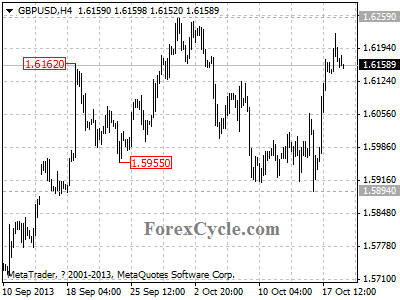
GBPUSD is facing 1.6259 resistance

GBPUSD is facing 1.6259 resistance, a break above this level will indicate that the uptrend from 1.4813 (Jul 9 low) has resumed, then the following upward movement could bring price to 1.6500 zone. Support is at 1.6080, only break below this level will suggest that lengthier consolidation of the uptrend is underway, then sideways movement in a rang between 1.5894 and 1.6259 could be seen.

gbpusd

Provided by ForexCycle.com

Could Google’s Share Price Signal a Real Economic Recovery?

By MoneyMorning.com.au

How do you fancy paying US$1,011 for just one share?

If that’s your bag you may want to think about having a flutter on Google [NASDAQ: GOOG]. It closed at that price on Friday in the US. It was up 13.8% for the day.

Of course, at US$1,011 Google has a long way to go before it catches up with Warren Buffett’s Berkshire Hathaway [NYSE: BRK/A], which ended the day on Friday at US$175,400 per share.

But Google’s whopping share price is only part of the story. The most important part is the reason behind Google’s big price rise on Friday – it could mean the phoney economic recovery is stronger than we think…

Let’s make one thing clear. We’re still copping flak from folks who think we don’t get what’s going on in the big economic picture.

Well, we’ll say it again: we do get it. That’s why we call it a phoney recovery. But we also get it that regardless of what’s happening on the macro-economic and political front, stocks are still going up.

Just look at Google. Just look at the S&P/ASX 200. This year they are up 44.5% and 13.9% respectively.

You’ve got to ask yourself, do you want to sit and gloat and say things are a mess and not make money? Or do you want to acknowledge things are a mess and give yourself a chance to make a lot of cash on stocks?

You know our answer. What’s yours?

What Bad Economy?

One of the most economically sensitive sectors is the advertising sector. When the economy looks as though it may be going downhill, companies tend to cut back on advertising costs.

They do that because they figure if consumers are keeping their hands in their pockets there’s no point spending money on advertising. Now, you can argue the merit of that all you like, but it’s a fact.

Naturally, some businesses will maintain their ad spending. They see it as an opportunity to grab market share from the competition. But even so, for the advertising industry as a whole, a poor outlook means lower revenues and lower profits.

And that’s exactly where the economy is now, right? That’s the thing. If you look at Google’s revenue and profit numbers you’ll see that’s far from being the truth. That’s why the stock gained 13.8% on Friday to US$1,011.41.

In the September 2012 quarter (US companies report results quarterly, unlike Aussie companies who report results half-yearly) Google brought in revenue of US$13.3 billion and profit of US$2.2 billion.

In the just-released September 2013 quarter Google brought in US$14.9 billion in revenue and profit of US$3 billion.

In percentage terms that’s a revenue increase of 12% and a profit increase of 36%. So much for an economic slowdown. If we measure the strength of the economic outlook on the willingness of firms to spend on advertising, then this is a good sign.

Now, we know the September quarter doesn’t include most of the potential negative impact of the US government shutdown. By ‘negative impact’ we mean the possibility that companies were so worried about it that they pulled back on ad campaigns.

We won’t find out that until early next year when Google reports its December quarter numbers.

More Reason to Buy Stocks

But that’s for then. For now, regardless of gripes about the US budget and debt ceiling you can’t ignore the fact that the US S&P 500 is at a record high. The NASDAQ index is at its highest point since it crashed in 2000.

And the Aussie index is on the verge of surging towards our near-term target of 6,000 points by the end of this year.

On top of that, Google’s results confirm we were right to take a punt on economically sensitive stocks.

In November last year we tipped two Aussie media plays. They had both taken a beating during the previous three years. But we bet that most of the worst was over.

If we were wrong then it was a speculative play anyway. Speculators know that they shouldn’t invest more than they can afford to lose. But if it paid off then over time it could result in some pretty big gains.

It’s an idea we’ve stuck with over the past 11 months despite the negativity in the mainstream about the economic outlook. In fact, we believe in the story so much that in the current issue of Australian Small-Cap Investigator we’ve tipped another stock, only this one has a direct involvement in the advertising sector.

If things pan out as we expect then we’re looking at a big triple-digit percentage gain. But as we say, it’s a speculative punt. That’s true with all small-cap stocks. But with Google’s record results showing that advertisers are prepared to spend, we’re confident this is the right time to buy into this economically sensitive industry…

…And we’re equally confident that not only does this spell good news for advertisers, but it should spell good news for the rest of the Aussie stock market too.

If the news keeps going this way, more good news for stocks is on the way.

Cheers,
Kris+

From the Port Phillip Publishing Library

Special Report: UNAVOIDABLE: Australia’s First Recession in 22 Years

Join Money Morning on Google+

Author information

Kris Sayce

Kris Sayce is Editor in Chief of Australia’s biggest circulation daily financial email — Money Morning. (You can subscribe to Money Morning for free here).

Kris is also editor of Australian Small-Cap Investigator, his small-cap stock research service, where he provides detailed analysis on some the brightest, smallest listed companies on the ASX.

If you’re already a subscriber to these publications, or want to follow his financial world view more closely, then we recommend you join Kris on Google+. It’s where he shares investment insight, commentary and ideas that he can’t always fit into his regular Money Morning essays.