USDJPY’s fall extends to 97.15

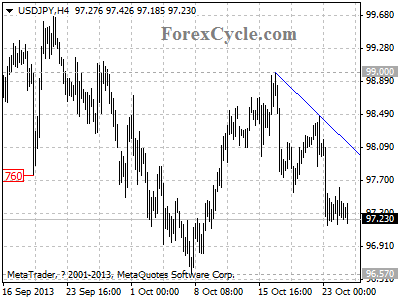
USDJPY’s fall from 99.00 extends to as low as 97.15. Resistance is now located at the downward trend line on 4-hour chart, as long as the trend line resistance holds, the short term downtrend from 99.00 could be expected to continue, and deeper decline to test 96.57 support would likely be seen, a breakdown below this level will signal resumption of the longer term downtrend from 100.60, then the target would be at 94.50 – 95.00 area. However, as long as 96.57 support holds, the fall from 99.00 could be treated as correction of the uptrend from 96.57, one more rise to 100.00 area is still possible.

usdjpy

Provided by ForexCycle.com

CRUDE OIL: Broader Bias Remains Lower.

By fxtechstrategy.com

CRUDE OIL: Despite its Thursday flat close, Crude Oil remains biased to the downside medium term. This leaves the risk of a return to the 95.95 level. A breach of here will turn attention to the 95.00 level followed by the 94.00 level and then the 93.00 level. Its daily RSI is bearish and pointing lower suggesting further downside. Resistance is seen at the 98.29 level where a violation will aim at the 100.00 level followed by the 101.00 level where a breach will aim at the 101.50 level. Further out, resistance comes in at the 102.00 level with a cut through here turning attention to the 103.00 level. All in all, Crude Oil remains biased to the downside in the medium term.


Learn to Spot a Head & Shoulders Pattern in Your Charts (Video)

A Trading Lesson from Elliott Wave International’s Jeffrey Kennedy

By Elliott Wave International

Senior Analyst Jeffrey Kennedy is the editor of our Elliott Wave Junctures trader education service and one of our most popular instructors. Jeffrey’s primary analytical method is the Elliott Wave Principle, but he also uses several other technical tools to supplement his analysis.

You can apply these methods across any market and any timeframe. Enjoy this lesson and then find out how you can get additional trading lessons from Elliott Wave International.


My primary tool as a technical analyst is, of course, the Wave Principle. Even so, I find great value in other forms of technical analysis, such as candlesticks and indicators. With this in mind, let’s review one of my favorite old-school chart patterns — Head-and-Shoulders.

Spotting a Head & Shoulders Pattern

This formation was popularized by Edwards and Magee in their seminal work Technical Analysis of Stock Trends. It is a reversal pattern and consists of a left shoulder, a head and a right shoulder.

A trendline drawn between the price extremes of the left shoulder and head and head and right shoulder is referred to as the neckline. The neckline is important for two reasons — the first being that a parallel of the neckline drawn against the extreme of the left shoulder can identify the extent of the formation of the right shoulder.

The second important aspect of the neckline is that it can provide a high probability target for the subsequent breakout. If prices decisively penetrate the neckline, the distance between that point and the head is often a reliable objective for the ensuing price move. Watch this 4-minute video where I explain more:


Learn How Technical Indicators
Can Give Your Trading The Edge

Get Practical Tips from the Pros That
You Can Apply to Your Trading

In this free report, you will learn some of the most
effective tools of the trade from analysts at Elliott
Wave International. Find out which technical indicators
are best for analyzing chart patterns, which are best
for anticipating price action, even which are best for
spotting high-confidence trade setups — plus how they
all complement Elliott wave analysis.

Get your technical indicators report now >>

This article was syndicated by Elliott Wave International and was originally published under the headline Learn to Spot a Head & Shoulders Pattern in Your Charts (Video). EWI is the world’s largest market forecasting firm. Its staff of full-time analysts led by Chartered Market Technician Robert Prechter provides 24-hour-a-day market analysis to institutional and private investors around the world.

This Biotechnology Platform Could Save Millions of Lives: Patrick Cox

Source: George S. Mack of The Life Sciences Report (10/24/13)

http://www.thelifesciencesreport.com/pub/na/this-biotechnology-platform-could-save-millions-of-lives-patrick-cox

Patrick Cox, editor of the brand-new publication Transformational Technology Alert, is acutely aware of how transformational technology platforms can enable efficiencies and improve scale a la Moore’s Law. A sweeping new synthetic vaccine platform that poses infinite possibilities for researchers and could produce novel preventive and therapeutic drugs is a quintessential example. In this interview with The Life Sciences Report, Cox delivers a single name that holds the potential to save lives on a mass scale, cheaply and efficiently, in both the developed and developing world—and deliver health and wealth to investors’ portfolios as well.

The Life Sciences Report: Congratulations on your new publication, Transformational Technology Alert(TTA). I’ve read the first issue, and I think your readers will find a lot of value there. Why did you start TTA?

PC: The driving force behind this new effort came from readers of former publications who are much better at trading than I am. I was encountering people who read the articles, understood the basic science, understood the markets that the breakthroughs would address and then combined that knowledge with techniques like channel trading.

TLSR: Tell me what you mean by channel trading.

PC: There is a lot of volatility in startup biotechs. That fluctuation is a favorite domain of shorters. I became really impressed that people were able to buy on dips and then sell part of their holdings when the price went up. They were making enormous amounts of money, frankly.

TLSR: These traders seem to know where the resistance and support levels are, is that right?

PC: That’s my impression—in fact, that’s sort of the point behind this new publication. The publisher, Mauldin Economics, has given me a team of excellent analysts who study resistance and are looking very closely at the past behavior of companies to help people predict what the channel or range of prices between support and resistance is going to be, and how to play that channel. I like the idea of holding fewer stocks but having more confidence in them. Not that there’s anything wrong with holding more.

TLSR: It’s hard to find a brand new idea that encompasses a massive market, isn’t it?

PC: Just when I think that there’s no possible way we can find anything else as important or as big as what we’ve already found, something new and exciting comes along. But that’s the nature of these times. We are in a period of accelerating science. I’m constantly surprised and amazed at the new discoveries being made and applied in the field of medicine.

TLSR: Tell me how Gordon Moore’s Law applies to biotechnology. This was a theme in your webinar entitled Science Saves the Future, which you and your colleagues at Mauldin Economics hosted on Oct. 15.

PC: Informational technology (IT) people are inventing and creating new computer systems from scratch, and as these systems become more powerful we see researchers applying those tools to biological systems that are very sophisticated—actually far more sophisticated than the IT systems. If you compare DNA to microcircuits—well, there just is no comparison. The systems of our biology, of our DNA, are vastly more sophisticated and interesting than anything IT experts have made.

However, IT is giving biotechnologists the ability to analyze these systems like they have never done before. Moore’s Law states that the density of data on a circuit will double every 18 months or so for the next 20 years. In the last 10 years, research, which is often computer-intensive, has become so much easier. I am told on a regular basis that we are seeing the rate of discovery increase by several orders of magnitude per decade. Data is processed a thousand times faster, in fact, than it was just 10–15 years ago. We are witness to new fixes for old problems, and we are going to see even more new fixes in the coming years.

TLSR: Can you summarize the Moore’s Law component in this process for me?

PC: We’re talking about improvements in everything from target discovery to in silico synthesis of compounds to reducing times of clinical trials to increasing efficiency associated with drug discovery and development. Moore’s Law is about collapsing timeframes in all areas of technology and development.

TLSR: What about your webinar topic, Science Saves the Future? Tell me the thinking here.

PC: These advances in IT and biotechnology are important because of our economic problems. Right now 36% of the U.S. budget consists of transfer payments (Medicare, Medicaid and Social Security) to older individuals. That’s three times what those payments were when they started, and they have doubled since 1970. This is mostly because we have seen a demographic transition, with people living much longer. Life spans have almost doubled in the last century or so, and birth rates have fallen to half of what they were since 1970, causing the demographic pyramid to flip. The ability of younger people to support older people, who are living longer, is gone.

Instead of resisting that trend, we need to embrace it. We have the ability now to work much longer, and we will do that. This is not a question of policy. This is just practical. Retirees are working past the age of entitlement eligibility already, and most say they expected that to happen.

Biotech breakthroughs are going to extend life spans further, and they are also extending health spans—that portion of a person’s life that is vigorous, robust and strong. That means enhanced productivity, so savings and investment will increase. This trend is going to solve problems like the debt and entitlement crises that the entire Western world is facing right now.

TLSR: Can we talk about investment? You currently have an exciting theme revolving around DNA immunization. Would you briefly give some background?

PC: Inovio Pharmaceuticals Inc. (INO:NYSE.MKT) came out of the work of David Weiner, who is the father of DNA vaccines. He is the chairman of Inovio’s scientific advisory board, and also a professor at the University of Pennsylvania, where he is chairman of the gene therapy and vaccine program at the medical school.

Dr. Weiner discovered how to genetically engineer plasmids, which are circular strings of DNA, to produce any protein that is normally produced by our DNA. We can create artificial DNA with these plasmids to make things like the antigens, which alert the immune system to the presence of disease when it’s normally hidden, and then cause the immune system to ramp up production of specific kinds of T cells that will allow the effective countering of viral diseases or cancers. This is really an astonishing technology, and that’s only the tip of the iceberg.

Inovio is the amalgamation of four or five different companies that started going after DNA vaccines. Over time, after the initial enthusiasm of big pharma waned, these companies ended up coming together as a single company.

TLSR: Briefly, please, how does this work? What is the theory?

PC: Interestingly, because these plasmids are large molecules, they are not readily absorbed into the cell. That would be a problem, except that Inovio owns the key intellectual property around electroporation. This proprietary technology gives Inovio the ability to deliver plasmids across cell membranes. The process uses controlled, millisecond-long, electrical pulsations, after the vaccine injection, to produce momentary pores that open up and allow the cell to absorb the synthetic vaccine material. The vaccine then enters the cytoplasm and eventually moves into the nucleus, where the plasmids begin to express whatever protein the researchers want them to express. The cellular mechanism uses the DNA code that was engineered into the plasmid to synthesize the proteins related to the disease being targeted. These protein antigens trick the immune system into producing a response that will protect against a disease associated with that antigen, or eradicate infected cells or cancer cells.

TLSR: Inovio stock has moved upward dramatically in the last six months. It is getting a lot of respect these days, isn’t it?

PC: When I first started writing about Inovio, it was so new that people were skeptical and were complaining that the company wasn’t making regular gains. In early September the company signed an agreement with Roche Holding AG (RHHBY:OTCQX) for two programs, both of which are preclinical and both of which are therapeutic vaccines, INO-5150 for prostate cancer and INO-1800 for hepatitis B virus. Its stock price is doing significantly better. Moreover, it now has the resources to pursue other applications of DNA vaccines.

TLSR: What about this impressive move upward? Is it hard to sell this as an investment idea with the stock up 260% since May?

PC: I’m not at all bothered about the fact that price has gone up. Inovio still has extraordinary potential, and I’ll tell you why. Here’s one example: Monoclonal antibodies are expensive therapies, and they are difficult to handle, but this technology can actually produce monoclonal antibodies in these little inoculation sites. It puts this code in your body, and you make the antibodies yourself.

The company has a majority-owned subsidiary, VGX Animal Health, that is using Inovio’s technology on animals in Australia. The vaccine technology is causing animals to express growth hormone-releasing hormone (GHRH), which makes them larger and more fertile. Think about that. The baby boom is aging. We see athletes taking growth hormones, but because it’s exogenous, coming from outside the body, it causes all kinds of problems. We know that it’s possible to get effective rejuvenation of many human systems—better skin, better muscle tone, that sort of thing—with GHRH. I think that down the road, after Inovio’s cancer and virus vaccines have begun to pay off and when the company is able to go where it wants to go, we’re going to be looking at monoclonal antibodies, then life-extension technologies, and then other exciting applications.

TLSR: Today Inovio has a market cap of $413 million, still small enough to be an easy acquisition. Do you anticipate this company is going to be acquired before it has a chance to grow into a fully integrated biopharma?

PC: It’s a possibility, but I don’t think Inovio is going to give up all of its technology to a single company. I don’t think it’s necessary. The company has many partnerships. For instance, it has made extraordinary progress on malaria, and the Bill & Melinda Gates Foundation, through its PATH Malaria Vaccine Initiative (MVI), is funding preclinical development of Inovio’s SynCon synthetic malaria vaccine.

I’m hoping that the company is not acquired. I suppose shortsighted investors would be happy about it, but I really want to see Inovio CEO Joseph Kim and Dave Weiner continue to push this technology into the future.

TLSR: Is there any other company you wanted to mention?

PC: One of the people who participated in the Science Saves the Future webinar is Cameron Durrant, who is a remarkable guy. He was a top executive at Johnson & Johnson (JNJ:NYSE), GlaxoSmithKline (GSK:NYSE), Merck & Co. Inc. (MRK:NYSE), and Pharmacia Corp. (acquired by Pfizer Inc. [PFE:NYSE]). He may be best known as the prophet who warned big pharma not to pursue beta amyloid as the cause of Alzheimer’s disease. He was proven correct. He’s just a brilliant scientist. He is also a founding board member of a private company, Bexion Pharmaceuticals, which has a remarkable cancer technology. He talked a little bit about that in the seminar. Retail investors can’t yet own any part of this company. Would you like to hear about the technology?

TLSR: Since it’s not public yet, give me just a brief description. Why is Bexion so interesting?

PC: It has taken two naturally occurring biologics and joined them to create a nanovesicle, which homes in on phosphotidylserines, which are the self-destruct mechanisms built into all of our cells. Our cells ordinarily follow a cycle of replication and apoptosis (natural cell death) to clear out aged cells for new cells. Cancer cells are, in a sense, the zombie cells. They’ve forgotten how to die because apoptotic functions are shut off. Bexion has demonstrated that its BXQ-350 induces apoptosis in certain glioma cell lines.

TLSR: So nice speaking with you today, Patrick. Thank you.

PC: Thank you. I enjoyed it.

Patrick Cox has lived deep inside the world of technology breakthroughs for the past 30 years. He has written more than 200 editorials for USA Today and has appeared in The Wall Street Journal and on CNN’s Crossfire television program. In the late 1980s, he edited and published one of the first industry-insider software magazines, writing about topics like open-source and user-supported software long before those ideas were widely understood. Later, he wrote presentations and speeches for the CEO of Netscape. His consulting work has taken him to Fortune 500 boardrooms and inside the war rooms of national political candidates. His independent research is based solely on his investigations in transformational wealth-building companies and is generated in close consultation with important economists and scientists.

Want to read more Life Sciences Report interviews like this? Sign up for our free e-newsletter, and you’ll learn when new articles have been published. To see a list of recent interviews with industry analysts and commentators, visit our Streetwise Interviews page.

DISCLOSURE:

1) George S. Mack conducted this interview for The Life Sciences Report and provides services to The Life Sciences Report as an independent contractor. He or his family own shares of the following companies mentioned in this interview: None.

2) The following companies mentioned in the interview are sponsors of The Life Sciences Report: Inovio Pharmaceuticals Inc. Streetwise Reports does not accept stock in exchange for its services.

3) Patrick Cox: I or my family own shares of the following companies mentioned in this interview: None. I personally am or my family is paid by the following companies mentioned in this interview: None. My company has a financial relationship with the following companies mentioned in this interview: None. I was not paid by Streetwise Reports for participating in this interview. Comments and opinions expressed are my own comments and opinions. I had the opportunity to review the interview for accuracy as of the date of the interview and am responsible for the content of the interview.

4) Interviews are edited for clarity. Streetwise Reports does not make editorial comments or change experts’ statements without their consent.

5) The interview does not constitute investment advice. Each reader is encouraged to consult with his or her individual financial professional and any action a reader takes as a result of information presented here is his or her own responsibility. By opening this page, each reader accepts and agrees to Streetwise Reports’ terms of use and full legal disclaimer.

6) From time to time, Streetwise Reports LLC and its directors, officers, employees or members of their families, as well as persons interviewed for articles and interviews on the site, may have a long or short position in securities mentioned and may make purchases and/or sales of those securities in the open market or otherwise.

Streetwise – The Life Sciences Report is Copyright © 2013 by Streetwise Reports LLC. All rights are reserved. Streetwise Reports LLC hereby grants an unrestricted license to use or disseminate this copyrighted material (i) only in whole (and always including this disclaimer), but (ii) never in part..

Streetwise Reports LLC does not guarantee the accuracy or thoroughness of the information reported.

Streetwise Reports LLC receives a fee from companies that are listed on the home page in the In This Issue section. Their sponsor pages may be considered advertising for the purposes of 18 U.S.C. 1734.

Participating companies provide the logos used in The Life Sciences Report. These logos are trademarks and are the property of the individual companies.

101 Second St., Suite 110

Petaluma, CA 94952

Tel.: (707) 981-8204

Fax: (707) 981-8998

Email: [email protected]


J. C. Penney, Coach Joining the Losers in the Retail Sector?

By George Leong, B.Comm.

The retail sector is fierce and competitive, and the reality is that in this sector, a bad move or investment strategy could set a company up for continued miscalculations down the road. Of course, Blockbuster is a classic example.

However, my modern-day example of a total screw-up in the retail sector is J. C. Penney Company, Inc. (NYSE/JCP). The company is a perfect case of continued miscalculations and just horrible decision-making that could inevitably bankrupt this century-old American retail icon, sending it in the direction of Blockbuster to settle in the retail graveyard.

The chart of J. C. Penney below shows the horrific damage caused by its poor execution in the retail sector, which makes the events in Congress seem trivial in comparison.

The crossing of the 50-day moving average (MA) below its 200-day MA in December 2012 (as shown by the shaded sideways oval on the chart below) was a good indication that the worst was yet to come, based on my technical analysis.

Just take a look at the subsequent decline following the “death cross” on the chart, especially the major fallout from the $15.00 to the $6.00 level in just a matter of weeks.

Chart courtesy of www.StockCharts.com

Execution in the retail sector tends to be more critical than any other sector.

Take high-end handbag maker Coach, Inc. (NYSE/COH), for instance. The luxury brand stock has been struggling against its high-end rivals in the retail sector, but so far, it’s seen a difficult run.

Chart courtesy of www.StockCharts.com

Coach reported a horrible fiscal first quarter, in which sales fell one percent year-over-year. The key comparable store sales plummeted 6.8% in the North American retail sector. The positive was that Coach was able to continue to expand its sales in China, with comparable store sales growing in the double digits.

Going forward, the sales growth, while positive, pales in comparison to rival Michael Kors Holdings Limited (NYSE/KORS), which I continue to believe is the “Best of Breed” in the luxury apparel and accessories area. The stock is up 35% since I last featured it in these pages. (Read “Why Michael Kors Outdoes Other Luxury Stocks.”)

Coach is estimated to grow its fiscal 2014 sales by 4.4% and its fiscal 2015 sales by 7.2%, according to Thomson Financial. By comparison, Michael Kors is near its 52-week high and sizzling on the charts.

Chart courtesy of www.StockCharts.com

A maker of high-end clothing and accessories, Michael Kors has beaten earnings-per-share (EPS) estimates for the last four straight quarters. Sales in fiscal 2014 are estimated to grow at a whopping 36.9%, followed by 24.3% in fiscal 2015, according to Thomson Financial. These metrics are far superior to Coach’s, and that’s why Michael Kors deserves its higher market valuation in the retail sector.

Coach needs to get its act together in North America, but it’s not going to be easy, with Michael Kors in its path and not letting up on the accelerator.

For investors, your best bet may be to consider sticking with Michael Kors in the retail sector. Only traders or contrarian investors should even consider looking at Coach.


Wall Street Cheers 13.6% Unemployment Rate; S&P 500 Soars!

241013_DL_whitefootby John Paul Whitefoot, BA

Bad news on Main Street is good news for Wall Street. Illogical heads prevailed on Tuesday after the U.S. government announced that the unemployment rate dipped to an ever-so-modest 7.2% in September, from 7.3% in August. The U.S. added just 148,000 new jobs in September—far short of the forecasted gain of 180,000 jobs for the month. (Source: “The Employment Situation – September 2013,” Bureau of Labor Statistics web site, October 22, 2013.)

The number of long-term unemployed (those without a job for at least 27 weeks) remains stubbornly high at 4.1 million, and the underemployment rate is at an eye-watering 13.6%, up a sliver from 13.4% in August.

Weak jobs numbers means the Federal Reserve will continue its $85.0-billion-per-month quantitative easing policy into 2014. Those who do not read these pages were apparently surprised last month when the Federal Reserve did what it said it was going to do—namely, keep its stimulus package intact until the economy improves to a 6.5% unemployment rate and a 2.5% inflation rate.

It clearly hasn’t, isn’t, and won’t for the foreseeable future.

Those bad jobs numbers sent the S&P 500 into record intra-day territory. In the week since Congress ended the U.S. government shutdown, raised the debt ceiling, and reported stubbornly high unemployment, the S&P 500 climbed more than three percent. Year-to-date, the S&P 500 is up more than 22%.

That increase is in sharp contrast to anything approaching reality on Wall Street. During the first quarter of 2013, 78% of S&P 500 companies issued negative earnings-per-share (EPS) guidance, 81% during the second quarter, and a record 83% for the third quarter. (Source: “Earnings Insight,” FactSet web site, October 4, 2013.)

Even after a record number of S&P 500 companies revised their earnings lower, they’re still having trouble meeting their depressed forecasts. Granted, while only one-fifth of the companies in the S&P 500 have reported actual results, the percentage that has reported earnings above estimates is below the four-year average. At the same time, the percentage of companies that have reported revenue above estimates is also below the four-year average.

The fourth quarter is less than a month old, but already, 18 companies in the S&P 500 have issued EPS guidance for the fourth quarter. Of these, 14 have issued negative EPS guidance and four have issued positive EPS guidance—meaning that 78% have issued negative guidance, well above the five-year average of 63%. That number will continue to rise the deeper we get into the fourth quarter. (Source: “Earnings Insight,” FactSet web site, October 18, 2013.)

What all of this disconnect means is that you can’t fight quantitative easing. So long as the U.S. economy remains weak and the easy money is flowing, the S&P 500, Dow Jones Industrial Average, NASDAQ, and NYSE will continue to notch up gains.

It also means that it’s not too late for investors on the sidelines to take advantage of Wall Street’s neurotic optimism and the Federal Reserve’s generosity. Those bullish on the S&P 500 might want to look into the SPDR S&P 500 ETF Trust (NYSEArca/SPY).

Or, knowing that the consumer discretionary sector has reported the highest earnings growth for the quarter, it might not be a bad idea to look at a corresponding exchange-traded fund (ETF) like the PowerShares Dynamic Consumer Disc (NYSEArca/PEZ) or First Trust Consumer Disc AlphaDEX (NYSEArca/FXD).

Everything you learned in school about rational investors making informed decisions based on sound due diligence is an urban legend; investors follow the money. And for now, that trail leads to the Federal Reserve’s overworked printing press.

This article Wall Street Cheers 13.6% Unemployment Rate; S&P 500 Soars! was originally published at Daily Gains Letter


What an 81% Increase in Food Stamp Use Really Means for the U.S. Economy

241013_DL_zulfiqarby Mohammad Zulfiqar, BA

Each day, there’s growing evidence that suggests the American economy isn’t experiencing any economic growth. Unequal job creation is just one of the main topics discussed in the mainstream, but sadly, there are many other facts and figures that show a gruesome image of the U.S. economy as well.

Consider this: since the financial crisis struck in the U.S. economy, the number of people using food stamps has been increasing. In 2007, there were 26.3 million Americans who were using food stamps; fast-forward to July 2013, and that number had enlarged to 47.6 million, an increase of almost 81% at the rate of roughly 13.5% per year. (Source: “Program Data,” United States Department of Agriculture web site, last accessed October 21, 2013.)

Food stamp use in the U.S. economy is a key indicator of economic growth, showing how Americans are relying on the government to help them with even food, the most basic of needs. This is very contradictory to economic growth; if there was growth in the U.S. economy, then we would see this number decline.

Unfortunately, the horror story that is the U.S. economy just doesn’t end there.

Consumers in the U.S. economy aren’t happy. According to the Thomson Reuters/University of Michigan’s consumer sentiment index preliminary results, consumer confidence in the U.S. economy declined to a nine-month low in October. The index, which gauges how consumers feel in the U.S. economy, collapsed to 75.2 in October, from 77.5 in September. (Source: Leong, R., “Washington drives U.S. consumer sentiment to nine-month low,” Reuters web site, October 11, 2013.)

Consumer confidence is another key indicator of economic growth in the U.S. economy. If it declines, it suggests consumers are not happy and, as a result, they will hold back on their spending, which hints that consumer spending will be headed downward.

The U.S. economy has many problems that need to be fixed before any talks of real economic growth can begin. I have said many times in these pages before that for there to be prosperity in the U.S. economy, we have to see the standard of living for Americans increase. What I have just explained above does not support the argument for economic growth.

Considering all this, one must wonder what’s going to happen to the key stock indices that continue to rise in value. Will the companies that sell consumer goods be able to earn revenue at the same pace as they did before?

The conditions in the U.S. economy are suggesting that consumers are struggling. One thing investors have to keep in mind is that when consumers are facing hardships, they tend to pull back on the spending that they don’t necessarily have to incur. For example, a person who has lost a job and has very little savings will shy away from buying a new gadget, car, and/or house.

As a result of all this, companies that are involved in the consumer discretionary sector might face troubles ahead. Those investors who own a significant amount of consumer discretionary companies in their portfolio may want to take some profits and reduce their exposure to the sector.

This article What an 81% Increase in Food Stamp Use Really Means for the U.S. Economy was originally published at Daily Gains Letter


How Old Economy Stocks Like These Can Make Investing Easier

By Mitchell Clark, B.Comm.

Among the many realities in a slow-growth economy, some traditional, old economy businesses continue to impress with their ability to increase revenue and earnings. It’s no small feat to grow sales by double digits these days; but this company is doing it, and it’s about as “old economy” as you can get.

At the beginning of this year, we considered A. O. Smith Corporation (AOS). Based in Milwaukee, this company is in the water heater business. It isn’t fancy, and it won’t ever make front-page news, but this is a good business. It’s proven to be a good moneymaker, and it’s consistent.

According to the company, its third-quarter sales grew to $536.2 million for a gain of 16% over the comparable quarter last year. Management cited improving business conditions in new home construction and some improvement in replacement demand for water heaters as reasons for the growth.

North American sales grew 10% to $370.1 million, while international sales grew 31% to $175.2 million. The company also sells in China, where it saw a $38.0-million gain in sales, totaling $147.6 million during the third quarter.

Earnings came in at $46.2 million, or $0.50 per share, compared to $37.0 million, or $0.40 per share, in the comparable quarter. Both sales and earnings beat Wall Street consensus. The company’s long-term stock chart is featured below:

Chart courtesy of www.StockCharts.com

I really like finding businesses like A. O. Smith; and often, they are old economy. (See “Why These Old Economy Stocks Are Absolutely Crucial.”) They are companies that execute carefully and diligently, not operating with visions of grandeur but to provide consistent and reasonable shareholder returns from a mature industry.

Another company that falls into the category of consistent wealth creation is AAON, Inc. (AAON). This Tulsa, Oklahoma firm sells heating, ventilation, and air conditioning (HVAC) equipment to industrial customers.

Business is holding up pretty well, as the company’s latest earnings report (for the second quarter of 2013) showed record results.

The company said second-quarter sales grew to $91.2 million, up from $83.3 million in the comparable quarter. Earnings were $12.1 million for a gain of 30% over the same quarter last year. The shares recently split three-for-two in July, and the position just hit a split-adjusted all-time record high on the stock market of $28.00 a share.

It’s difficult to imagine solid financial growth from such old economy businesses, but it’s happening, and these two companies boast solid prospects for continued growth through 2014.

In most cases, I find it more useful for equity investors to go with existing winners over employing the buy low/sell high investment strategy. A company’s share price is typically way down for a reason and betting on a business turnaround is difficult in that you also have to bet on whether other investors will be willing to return to the story.

A successful business with a proven track record of operational success and wealth creation on the stock market already has a solid following.


How a Struggling Jobs Market Will Reward Investors in 2014

by George Leong, B.Comm.

241013_IC_leongWow! Considering all of the money spent by the government on stimulus and the quantitative easing by the Federal Reserve, it really is quite discouraging to see the jobs market stuck in neutral.

In September, only 148,000 new jobs were created, according to the U.S. Bureau of Labor Statistics. The result was subpar and well below the consensus estimate of 183,000.

The unemployment rate edged lower to 7.2%. That doesn’t mean the jobs market is improving, though; instead, it indicates that more workers who are unable to find work have pulled out of the workforce.

Folks, there is a lack of jobs out there, and the jobs market is not getting better. Case in point: the economy produced an average of 143,000 monthly jobs in the July-September period, well below the average 182,000 from April to June. The trend in the jobs market is down, and with what we are seeing with the lack of third-quarter earnings season revenue growth, I don’t expect things to improve much in the jobs market.

There are some three million jobs out there, but there are over 21 million workers looking. The official number for those searching is around 11 million, but trust me—this is understated.

In addition, there are many workers with jobs that are way below their experience or skill set. I just watched a documentary on the high unemployment among college graduates and the mismatched low-paying jobs they’re forced into due to a lack of jobs matching their education and skill levels. In restaurants, for example, the majority of the servers were college grads. What’s worse is that these workers also have massive debt loads from their education and are making minimum wage.

According to the U.S. Bureau of Labor Statistics, the number of “involuntary part-time workers” in the jobs market stood at 7.9 million in September. These are the workers who are forced to work fewer hours due to company cutbacks or the inability to find full-time work. Add these workers to the number of unemployed in the jobs market, and I guarantee you the unemployment rate would shoot shockingly higher.

I guess the Federal Reserve will likely refrain from any tapering of its bond buying until at least the December meeting; however, it’s more likely tapering won’t begin until early 2014, when the new Federal Reserve chairman, Janet Yellen, takes over. We know she is also supportive of easy money, so investors are clearly happy.

As an investor, as long as the jobs market continues to struggle, the easy money will likely continue to be pumped into the economic system, rewarding the stock market. Assuming this scenario, you might want to consider keeping your money in stocks and riding the gains into 2014.

This article How a Struggling Jobs Market Will Reward Investors in 2014 was originally published at Investment Contrarians


What’s Really Behind China’s Economic Growth and Why It Won’t Last

by Sasha Cekerevac, BA

241013_IC_cekerevac

When I read some of the headlines by other news organizations, sometimes I can’t help but chuckle at their oversimplification. Other media outlets take a kernel of truth, and ignore the rest of the picture, only to blow that tiny piece of truth out of proportion.

As an example, there was a recent release by the National Bureau of Statistics of China that reported the Chinese economy grew 7.8% year-over-year for the three months of July to September. (Source: National Bureau of Statistics of China, October 18, 2013.)

That headline number for the Chinese economy does look impressive at first glance. Of course, the mainstream media has used that one data point to extrapolate that the economic recovery we are all expecting is close at hand.

However, the Chinese economy is far more complex than simply looking at the headline data point of year-over-year gross domestic product (GDP) growth.

While nothing would make me happier than to finally hear of a real economic recovery occurring somewhere in the world, I’m afraid that the Chinese economy is simply being pushed higher by a government injection of stimulus that will only be temporary.

While America is suffering from a lack of economic recovery, China is also seeing problems. Inflation is pushing a seven-month high and the government is trying to shift the Chinese economy from being export dependent to domestically oriented.

So while the headline number looks nice, if the Chinese economy hits its target of 7.5% for the full year, it will still be the worst growth level in 23 years. Is that the economic recovery we should be celebrating—the worst level in decades?

Most of the media are printing headlines such as “Chinese Economy Accelerates,” which looks great. But the problem is that most of the boost the economy is getting is government-led. Exports are pulling the economy down, so the government is pumping even more money into the Chinese economy to keep it afloat.

Infrastructure spending is rising at a massive pace. Now, I do think that spending on infrastructure can help build a long-term economic recovery if it’s done correctly; this means fixing roads that actually need to be fixed. However, the problem is that the Chinese economy is growing even more dependent on spending in any capacity. We all know about the Chinese cities that were built and are now completely empty. This is taking the old saying about the government hiring people to dig ditches and fill them up again to absurd levels.

Officials know they need to shift the Chinese economy from this dependence onto a more sustainable path. The problem is that this will cause pain not only to the Chinese economy, but the economic recovery around the world.

As an American investor, don’t think you’re immune to what happens in the Chinese economy. Some of our biggest companies conduct a lot of business within the Chinese economy, including Caterpillar Inc. (NYSE/CAT).

Firms like Caterpillar need the global economic recovery to begin accelerating, since their products depend on growth. If the economic recovery falters, what happens to new projects and developments? They get delayed until the economic recovery takes hold, meaning the company’s growth is also put on hold.

The Chinese economy is extremely important for Caterpillar, not only for this quarter, but over the next decade. If the Chinese economy’s growth rate begins to slow, investors need to re-price their estimated revenue and earnings for firms like Caterpillar. Downward revisions are never a positive for a stock.

What I do know is that if we don’t see a global economic recovery begin to emerge over the next few months, stocks that have gone straight up recently will likely come back down to earth, as investors begin to realize that much of the growth was not based on strong fundamentals, but short-term government-led band-aid solutions.

This article What’s Really Behind China’s Economic Growth and Why It Won’t Last was originally published at Investment Contrarinas