Trouble Putting Food on Table for 17.6 Million American Households?

301013_PC_lombardiBy Michael Lombardi, MBA

I harp on about this over and over again: economic growth is when the average consumer is optimistic about their future; they are spending money, they know they will have a job tomorrow, and they are saving. In the U.S., we are seeing the opposite of all this.

In fact, consumer confidence in the U.S. continues to plummet; the Conference Board Consumer Confidence Index, an indicator of consumer spending, plunged more than 11% in October from September. (Source: Conference Board, October 29, 2013.)

But the misery doesn’t just end there for consumers in the U.S. economy. They are struggling to even buy the most basic of needs—food.

According to a recent study by the United States Department of Agriculture (USDA), in 2012, 17.6 million households in the U.S. economy were “food insecure”—they had difficulty bringing food to the table due to a shortage of resources. (Source: United States Department of Agriculture, September 2013.)

And as a result of so many Americans having trouble putting food on the table, it is costing taxpayers significantly. According to the U.S. Senate Budget Committee, over the last five years, the U.S. government has spent $3.7 trillion on 80 different poverty and welfare programs. The amount of money spent on these programs was five-times greater than combined spending on NASA, education, and all federal transportation projects over the time period. (Source: U.S. Senate Budget Committee, October 23, 2013.)

When I look at all these statistics showing how Americans are suffering, talk of economic growth or economic recovery just doesn’t sit well with me. I tend to focus on facts, rather than the noise. The noise says there is “economic growth” in the U.S. economy; while the numbers say the complete opposite.

But have no fear, dear reader. The stock market continues to tell us all is well. Today’s stock market is about the biggest bear trap I’ve ever seen.

Michael’s Personal Notes:

If you are a stock market investor, you’ve probably come to the same realization I have: the stock market is behaving irrationally. These days, the fundamentals don’t really matter. What’s even more frustrating is that when you do talk about the fundamentals behind the market’s continued advance missing, you are ridiculed.

Soft revenues at public companies are just one area of concern. As of October 25, 244 companies on the S&P 500 have reported their third-quarter corporate earnings; only 52% of them registered revenues above the expectation, which means companies are selling less than they expected—not a good sign. Third-quarter corporate earnings growth is now expected to be just 2.3%. A month ago, the same number stood at an even three percent. (Source: FactSet, October 25, 2013.)

We are seeing some of the well-known bears of the stock market turning bullish. “Dr. Doom” is suggesting investing in stocks, and others like David Rosenberg, who has been bearish for years, are turning bullish.

Is this the peak optimism?

As it stands, investors believe the stock market is a safe place to be again. The charts of key stock indices only show an upward trajectory.

Chart courtesy of www.StockCharts.com

What will happen once the euphoria comes crashing down again? After all, irrationality cannot go on forever.

The most recent and best example of a stock market crash we have is from the financial crisis of 2008. We saw key stock indices come down like a rock. That stock market crash wiped out consumer confidence. Those who were retiring and saving each dollar for their golden days (by investing in stocks) saw their retirement dreams disappear.

But it wasn’t just consumers and retirees who got hit hard by the stock market crash of 2008; it also created problems with corporate America as business confidence also plummeted, thus the Great Recession.

I understand I am one of the last standing financial gurus who remain skeptical on the stock market. I am not saying we have reached a top, as it’s very hard to predict when irrationality is exuberant, but we are heading there. There are so many fundamental factors working against the 2013 stock market rise—and they are all being put aside in favor of market exuberance over a Federal Reserve that prints billions of new U.S. dollars each passing month. I feel the best investment strategy is to be cautious and to focus on capital preservation.

This article Trouble Putting Food on Table for 17.6 Million American Households? is originally publish at Profitconfidential



How Investors Can Profit from These Frightful Valuations

311013_PC_leongBy George Leong, B.Comm.

These are some scary times for holders and chasers of some of the high-volume brand-name momentum stocks, especially in the Internet services area. (Just in time for Halloween…)

While I always like to trade and follow the trend, I’m concerned with some of the superlative moves in the stock market and the resulting excessive and non-realistic valuations in the Internet area.

While I don’t want to wreck the celebratory mood on Wall Street, I highly recommend investors take a step back and really look at some of the euphoric buying we have been seeing specifically with the Internet stocks. It reminds me a bit of what happened in late 1999 and early 2000, prior to the market implosion.

We are clearly witnessing some unjustified buying in Internet stocks as overzealous traders seek profits. The problem is that the pro traders generally are a step ahead and know when to exit.

You don’t want to be caught in a massive stampede to the exits. I’m not saying it will materialize, but it’s something you have to keep in mind.

In my previous article, I discussed the upcoming initial public offering (IPO) for Twitter as it begins its road show this week, drumming up business for what will likely be its overpriced IPO and the frenzy to follow. (Read “How Small Investors Can Still Get a Piece of Twitter.”)

The current valuations I’m seeing with numerous Internet stocks in the social media space is outlandish and would make Warren Buffett shake his head. Buffet may admit to not understanding technology and the Internet, but he clearly knows a thing or two about valuations.

Facebook, Inc. (NASDAQ/FB), for instance, has been burning up on the charts since declining to the $18.00 level in November 2012. The momentum traders have driven the stock up 146% over the past 52 weeks versus a comparative 24.62% advance by the S&P 500. Even when you look at the stock’s expected beta of 2.10, the rise in Facebook’s price is unwarranted.

Trading at nearly 50 times (X) its estimated 2014 earnings and 20X trailing sales, the valuation of Facebook is ridiculous. In comparison, Google Inc., (NASDAQ/GOOG) trades at 19.5X earnings and 5.9X trailing sales, respectively. I have always said Facebook was overpriced, but the stock market clearly feels the company will deliver exceptional results in the future.

Also on the high end is Internet service review site Yelp, Inc. (NYSE/YELP), which trades at an astounding 255X its estimated 2014 earnings. What a crazy valuation! To make matters worse, the company’s price-to-earnings-growth (PEG) ratio is negative 34, which means the company is estimated to see lower earnings growth. In my view, negative PEG ratios are red flags.

The bottom line: there are numerous other overvalued Internet social media and tech stocks that are vulnerable to excessive selling, especially if the market bias reverses. The use of put options or aggressive shorts on some of these overpriced stocks could pay off in some circumstances.

This article How Investors Can Profit from These Frightful Valuations is originally publish at Profitconfidential


Top-Line Growth to Keep This Tech Company Ticking Higher

311013_PC_clarkBy Mitchell Clark, B.Comm.

As evidence of the continued growth in three-dimensional (3D) printing machines, 3D Systems Corporation (DDD) out of Rock Hill, South Carolina reported very good financial results in its latest quarter.

Investors went into the quarter with high expectations, and in spite of some difficulty in translating revenue to the bottom line, 3D Systems looks well-positioned for more capital gains on the stock market.

According to 3D Systems, its third-quarter sales grew 50% to a record $135.7 million: 3D printer sales and related products jumped 76% to $59.8 million; print material sales grew 30% to $33.2 million; and services sales grew 38% to $42.7 million. Earnings for the company grew to $17.7 million, or $0.17 per diluted share, compared to $13.5 million, or $0.16 per diluted share.

The company continues to invest heavily in new research and development. Third-quarter shareholders’ equity almost doubled while the company’s cash balance soared on newly issued shares.

According to management, the company’s 3D printer unit demand tripled since last year. The company increased its full-year sales forecast to between $500 and $530 million, but lowered its non-GAAP earnings-per-share guidance to between $0.93 and $1.03, due to increased spending on research and development as well as new marketing initiatives. The company’s previous adjusted earnings-per-share forecast was between $1.05 and $1.20.

Naturally, real economic growth comes at a price. 3D Systems is expensively priced on the stock market and should remain this way as institutional investors continue to accumulate shares. 3D Systems’ five-year stock chart is featured below:

Chart courtesy of www.StockCharts.com

As is often the case, you get what you pay for when investing. While equity valuations for the new batch of 3D printing companies are overdone, the marketplace can keep it that way for a considerable period with such little choice among real growth stocks.

I think every speculative investor should dedicate some effort to following a stock or two related to this new industry. Previously, we looked at The ExOne Company (XONE), which is a new listing with a lot of potential going forward. (See “This New Trend in Printing a Boon for Tech Investors?”)

3D Systems is already trading at its median Wall Street price target. The company’s 2014 forward price-to-earnings ratio is currently around 45.

Quite likely, a growing company like this will come back to the equity market to raise more money for further expansion. Taking a position in a business like this is a high-risk trade; but then again, it’s very difficult these days to find such strong financial metrics.

I like a company that’s investing heavily in research and development and marketing initiatives. New technology doesn’t sell itself.

3D Systems ranked second in Fortune magazine’s 2013 list of fastest-growing companies. The company is making small acquisitions, getting new ideas and talent related to its core business.

In spite of trading right at its record price high on the stock market, this position is likely to keep ticking higher, with continued strong interest from institutional investors.

This article Top-Line Growth to Keep This Tech Company Ticking Higher is originally publish at Profitconfidential


Coming Hyperinflation a Real Threat to the U.S. Economy?

311013_DL_zulfiqarby Mohammad Zulfiqar, BA

One of the questions being asked by investors these days is “where’s the inflation?” After the financial crisis and the fall of Lehman Brothers, the Federal Reserve and the U.S. government stepped in to help the financial system. As a result, they promised to print money, and thus quantitative easing was born. Banks received billions of dollars in bailout money.

With this, there was a significant amount of speculation that the increased money supply in the U.S. economy would lead to a period of out-of-control inflation, or hyperinflation.

Fast-forwarding to now, it’s been more than five years since the collapse of Lehman Brothers, but out-of-control inflation has yet to occur. Were those who said there will be hyperinflation wrong? What’s the inflation situation right now?

In August, the Bureau of Labor Statistics reported that the prices in the U.S. economy increased by 0.1%. From January to August, prices increased in the U.S. economy by only one percent. (Source: “Consumer Price Index – All Urban Consumers,” Bureau of Labor Statistics web site, last accessed October 29, 2013.)

Other indicators of inflation ahead signal it’s going to remain dismal as well. For example, I look at the producer price index (PPI) as one of the key indicators of inflation.

In September, the PPI showed that producers in the U.S. economy experienced a deflation of 0.1%. Since the beginning of the year, the inflation in producer prices has only increased by 1.1%. (Source: “Producer Price Index-Commodities,” Bureau of Labor Statistics web site, last accessed October 29, 2013.)

With all this in mind, I stand little different from those who say there will be hyperinflation in the U.S. economy. My take: I say we will experience high inflation in the U.S. economy, but before that we may experience a period of deflation.

Why will there be deflation?

Inflation occurs where there’s an increased amount of money supply; which the current U.S. economy possesses. The Federal Reserve is printing $85.0 billion a month, with many rounds of quantitative easing having already occurred; the balance sheet of the Federal Reserve is nearing the $4.0-trillion mark.

There’s just one thing missing: the money has to be used. Currently, it seems that it is just sitting in vaults.

Take the velocity of money—the frequency at which one dollar is used. As it stands, the velocity of M2 money stock in the U.S. economy—this is the money in circulation, plus various savings and checking accounts—stands at 1.577. This number stands at the lowest level ever recorded. (Source: “Velocity of M2 Money Stock (M2V),” Federal Reserve Bank of St. Louis web site, last accessed October 29, 2013.)

Once the velocity of the money starts to pick up, then the inflation will march ahead.

When this will occur, only time will tell. If all the pieces of the puzzle come together, then it’s clear that bonds will not be the greatest investments; they will provide investors with losses, because inflation is a bond’s worst enemy. Investors who are heavy on bonds in their portfolio need to consider this phenomenon and act accordingly.

This article Coming Hyperinflation a Real Threat to the U.S. Economy? was originally published at Daily Gains Letter


Why Investors Are Piling into This $3.5-Billion Tech Stock with No Revenue…

311013_IC_cekerevacby Sasha Cekerevac, BA

As someone who’s been involved in this business for many years, one thing that never surprises me is that people make the same mistakes over and over again.

Taking a look at different sectors, it’s quite interesting to see how market sentiment has gotten so poor in one area but is so exuberant in another. The funny part is that corporate earnings appear to have nothing to do with the current level of market sentiment.

Investors who have been in the markets for a while will remember the “dot-com” bubble of the late 90s. During that time period, market sentiment for any stocks that had “.com” in the name was through the roof in optimism. Sure, the stocks had no corporate earnings or real path to generating corporate earnings, but the web sites had plenty of viewers.

It’s too bad that views on a web site don’t translate into corporate earnings or cash.

We all know what happened next: reality eventually hit market sentiment, and these high-tech flyers crashed hard.

Ah, but this time is different, you might say.

It is true that many of the high-tech companies are extremely strong fundamentally, generating high levels of corporate earnings, including firms like Google Inc. (NASDAQ/GOOG). However, it appears we are reaching a level of market sentiment frenzy in technology stocks that I haven’t seen since the late 90s.

The latest example is a report that the company Snapchat, Inc. has just secured an additional round of financing that values the company at $3.6 billion! (Source: “Snapchat Is Mulling Another Huge Round at a $3.5 Billion Valuation,” AllThingsD.com, October 25, 2013.)

You might ask, what’s wrong with a $3.6 billion valuation for a company?

Valuing a private company can be difficult, especially one that is growing revenue and corporate earnings. However, there’s one slight problem with trying to value Snapchat: it has neither revenue nor corporate earnings! (That’s not a misprint.)

While the firm is private and we don’t know for sure, sources say the company essentially has no source of revenue. That’s right; the company with absolutely no revenue and certainly no corporate earnings is being valued at $3.6 billion. Yet companies that actually make products and sell them are seeing market sentiment decline and their stocks languish.

Perhaps I’m a bit old-fashioned, but I like investing in companies that actually generate revenue and even corporate earnings. But my point is not to be negative on Snapchat; I certainly wish the company all the best. I’m simply trying to point out that market sentiment has gotten skewed, as investors have moved away from looking at fundamentally strong companies that actually generate corporate earnings to simply gambling and hoping that the next high-tech company can quickly give them a profit.

Just as we saw over a decade ago, this type of short-term thinking does not work. To see the stock price collapse in companies with no corporate earnings won’t surprise me. However, at some point over the next decade, we will see fundamentals emerge and the focus will once again be on companies with strong corporate earnings. Of that I am certain; timing it is a whole other matter.

With the market at multiyear highs and more firms reporting trouble generating corporate earnings growth, I really don’t believe the answer is to start looking for firms that have no potential for generating real revenue or corporate earnings.

As a long-term investor, these types of stories worry me, as they indicate that market sentiment is beginning to become frothy. Calling a market top is always dangerous, as the market can continue being irrational for some time. Don’t forget, the bubble in the dot-com stocks lasted for several years.

I would look to begin raising cash by getting out of the highflyers that have outperformed this year. I would also look at the market laggards. One sector that has been hammered over the past year has been mining stocks. I think over the next decade, it’s far more likely that mining stocks will still be around as compared to some company that makes an application for teenagers to take pictures of themselves.

This article Why Investors Are Piling into This $3.5-Billion Tech Stock with No Revenue… was originally published at Investment Contrarians


Consumer Confidence Falls to Six-Month Low

311013_IC_leongby George Leong, B.Comm.

Well, it looks like the Federal Reserve has more ammunition for its bond buying program to continue.

Not only is there a lack of jobs across America, as I discussed in my previous article, but now it looks like the confidence level of consumers is fragile.

According to the Conference Board, the Consumer Confidence Index reading fell to a six-month low of 71.2 in October, down from a revised 80.2 in September and short of the Briefing.com estimate of 72.0. This is bad as far as consumer spending as we approach the key Black Friday holiday shopping season, when the retail sector looks to beef up its sales.

The reality is consumer spending is at risk given the economy and jobs market remains fragile. Knowing they can lose their job will make consumers think hard before buying non-essential goods and services (which is why I pointed out in my last article that looking at defensive stocks, such as utilities and consumer staples, makes sense). You may want to avoid retail stocks for now, but the luxury stocks still look good, given the rich continue to get richer and are less affected by what happens in the economy.

The soft consumer confidence reading, along with the weak jobs market and the decline in pending home sales, will help to make sure the Federal Reserve doesn’t start to rein in its bond purchases until sometime in early 2014.

Of course, that’s great if you are investing in stocks, but it is not good for the long-term economic health of the country. The Federal Reserve is to blame.

The Federal Reserve will end up spending more on quantitative easing in 2014 than previously thought. This will add to the debt on the balance sheet of the Federal Reserve, and pump more easy money into the economy that will eventually have to be paid back. This is where the problem lies. The debt levels accumulated during this massive period of quantitative easing by the Federal Reserve will need to be paid, but it will also likely be based on much higher interest rates as the Federal Reserve will eventually have to raise rates.

The end result is the higher interest rates will add to the carrying cost of the debt of consumers, which in turn, eats away at the discretionary income available to spend. This means a potential decline in consumer spending, and this will negatively impact gross domestic product (GDP) growth.

Given this, we could see a pullback in the revenues of U.S. companies, which technically should also result in weakness in the U.S. stock market. As a pre-emptive strike, you should look at cutting your exposure to U.S. stocks and taking the profits.

As many of you know, I have been warning of this build-up in debt. The Federal Reserve needs to pare down its bond buying. In spite of lackluster jobs numbers, there needs to be some tough love given now so that we can avoid shifting the country’s mass financial problems onto the shoulders of future generations.

This article Consumer Confidence Falls to Six-Month Low was originally published at Investment Contrarians


European Shares Declines As Fed Keeps QE Unchanged

By HY Markets Forex Blog

European stocks opened lower on Thursday after the Federal Open Market Committee (FOMC) decided to leave its $85bn-a-month asset-purchasing program unchanged for now.

The Euro Stoxx 50 declined 0.29% lower at 3,031.75 at the time of writing, while the German DAX edged 0.29% lower at 8,983.97 points.

At the same time, the French CAC 40 index lost 0.42%, standing at 4,255.96 and the UK FTSE 100 dropped 0.33% at 6,755.32 points.

Meanwhile, Germany’s Federal Statistical Office (Destatis) posted its economic data showing that Germany’s retail sales advanced 0.2% in September, following the rise of 0.4% in the previous month.

The Statistical Office of the European Union (Eurostat) is expected to report this month’s Consumer Price Index (CPI) later in the day. Eurostat will report the unemployment rate for the Eurozone with forecasts of an unchanged reading in September, compared to the reading in August.

The Italian Statistical Office (Istat) is expected to release the unemployment rate for September, with a forecast of a rise from the previous month’s reading of 12.2% to 12.3%.

European Shares – Tapering Postpone

Following analysts’ predictions, the US Federal Reserve has decided to keep its $85 billion monthly bond-buying program.

“The Committee decided to await more evidence that progress will be sustained before adjusting the pace of its purchases,” Fed policymakers said.

The Federal Open Market Committee (FOMC) decided to keep the federal fund rate unchanged at 0% to 0.25%. The key rate will remain unchanged until the unemployment rate drops to 6.5% and inflation passes the 2.5% mark, the Fed policymakers confirmed.

European Shares – Market Movers

German’s pharmaceutical company, Bayer’s net income surged 42.1% to €733 million from July to September from the previous record of €516 seen in the same quarter last year.

Germany’s airliner Lufthansa posted its worst quarter in the third quarter as it showed the company’s net profit dropped from €697 million to €247 million on a year-on-year basis. While the French banking company BNP Paribas’s net income came in at €9.287 billion in the third quarter, declining by 4.2% compared to the same period last year. 


Interested in trading In the European Market?

Visit www.hymarkets.com and find out how you can start trading today with only $50.

The post European Shares Declines As Fed Keeps QE Unchanged appeared first on | HY Markets Official blog.

Article provided by HY Markets Forex Blog

Facebook Shares Drops Despite Advance In Earnings

By HY Markets Forex Blog

The Finance chief of the social media giants, Facebook revealed the company’s shares declined after a survey revealed a drop in teenage users and the young users prefer Twitter.

Facebook stocks advanced 18% to $57.98 following its upbeat financial reports but later dropped back to $48.44, below the day’s closing price of $49.01.

Investors’ worries over the Finance chief David Ebersman comments, who confirmed the Facebook, noted a drop in its daily use among their teenage users.

“Our best analysis of youth engagement in the US reveals that usage of Facebook among US teens overall was stable,” David said “We did see a decrease in daily users specifically among younger teens,” he added.

The statement came in after the financial firm Piper Jaffray carried an out a survey and revealed the social network rival Twitter had overtaken Facebook.

Facebook Shares Performance

Facebook has been dropped from being young users top social network choice from 44% of young users down to 23%.

Facebook shares saw a huge advance in its third-quarter figures, surpassing analysts’ expectations. The social media company’s revenue climbed by 60% to $2.02 billion, driven by the company’s mobile as market.

Facebook revealed it gained $425m in the third quarter, compared to its loss of $59m seen during the same period in the previous year.

Adjusted earnings were seen at $621m in the last quarter, exceeding analysts’ expectations.

Facebook CEO Mark Zuckerberg said “The strong results we achieved this quarter show that we’re prepared for the next phase of our company, as we work to bring the next five billion people online and into the knowledge economy.”

The advertising revenue for the social media giants came in at $1.8bn, edging 66% higher from a year ago, as facebook mobile ads accounts for 49% of the company’s ad revenue.


Interested in trading In the European Market?

Visit www.hymarkets.com and find out how you can start trading today with only $50.

The post Facebook Shares Drops Despite Advance In Earnings appeared first on | HY Markets Official blog.

Article provided by HY Markets Forex Blog

Bank of Japan maintains asset purchase target

By www.CentralBankNews.info     The Bank of Japan (BOJ) maintained its target for asset purchases with the aim of increasing the monetary base by an annual pace of about 60-70 trillion yen.
    The brief statement by the BOJ did not include any further details.
    In April the BOJ embarked on a new and aggressive monetary easing with the aim of doubling the country’s monetary base – banks reserves and the central bank plus currency in circulation – in order to rid Japan of nearly 15 years of deflation and boost inflation to 2.0 percent in two years.
    Since June, Japan’s consumer price inflation rate has turned positive, following 12 straight months of falling prices. In September Japan’s headline inflation rate rose to 1.1 percent from 0.91 percent in August.
    Japan’s economy has also been strengthening, with the Gross Domestic Product up by an annual rate of 0.9 percent in the second quarter, up from 0.3 percent in the first quarter.
    At its previous meeting, the BOJ repeated that the country’s economy was “recovering moderately” while the increase in consumer prices was likely to rise gradually.
   
    www.CentralBankNews.info

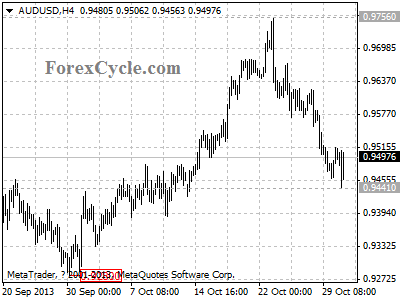
AUDUSD remains in downtrend from 0.9756

AUDUSD remains in downtrend from 0.9756, and the fall extends to as low as 0.9441. Resistance is at 0.9565, as long as this level holds, the downtrend could be expected to continue, and next target would be at 0.9350 area. On the upside, a break above 0.9565 resistance will indicate that the downtrend from 0.9756 had completed at 0.9441 already, then the following upward movement could bring price to 1.0000 zone.

audusd

Provided by ForexCycle.com