This Growth Industry is the Place to Be: The Chinese Car Market

By MoneyMorning.com.au

Every now and again you get a reminder of how stupid and crazy governments are. China and Japan had another spat over the disputed Senkaku/Diaoyu islands in the East China Sea this week. 

Take the Japanese government, in this instance. Japan is into its third ‘lost decade’ since its bubble economy collapsed in 1990. The government has a debt burden of over 200% of GDP in the face of a rapidly ageing population and a declining trade balance with the rest of the world.

The currency has deliberately been debased to drive its value down, hurting the average citizen, whose costs have gone up. And there is still the cost and burden of the aftermath of the tsunami.

One of its few bright spots is its trade surplus with China. And yet the Japanese government seems prepared to jeopardise this for the sake of these rocks.

Perhaps it’s all a ruse to justify the Japanese military build-up. Perhaps it’s the lucrative fishing waters. We don’t know.

But we do think this dispute could alter the trade flows of a major industry and could cost Japan and their major automakers an astonishing amount of money.

But that doesn’t mean investors here have to miss out on ways to play this lucrative market…

Who Will Triumph in This Market?

We’re talking about the Chinese car market. It’s the biggest on the planet. And the news should have been good for Japan this week.

Take this from the Australian:

Japan’s biggest car makers said their production in China surged from a year earlier, when territorial disputes sparked anti-Japan protests…this month, the three [Toyota, Nissan, Honda] posted healthy sales data for September.

That was September. You can imagine a few Japanese auto execs with their head in their hands if the latest showdown causes anti-Japanese sentiment to rise in China again and starts showing up in their sales figures. They’ve spent 12 months and no doubt millions in marketing to win Chinese consumers back over.
 
Japanese carmakers currently have a 15% market share in China. This is still actually down from last year’s 18.5%. The competition from South Korea, Germany and Chinese domestic brands is pretty stiff already.

China’s a profitable place to do business too, by the looks of it. The Australian reports Great Wall Motor, a large Chinese SUV maker, is the most profitable carmaker in the world, with higher operating margins than Ferrari. ‘Great Wall’s Hong Kong shares have rallied 93 per cent this year, even as the Hang Send index has stayed flat.

But the key takeaway is this:

China’s car industry has been a bright spot in an otherwise lagging mainland economy.‘   

With rising incomes, and a staggering amount of money spent upgrading its road infrastructure over the last decade, a car and a ‘road trip’ style holiday is increasingly accessible to millions of Chinese citizens.  A car is an important status symbol in Chinese society too.

It’s a lucrative market. But there’s one problem, and it’s a major one: pollution

China’s Big Problem

According to Tom Miller in his book China’s Urban Billion, ‘Fewer than 20% of China’s cities meet World Health Organization standards for sulphur dioxide and nitrogen dioxide levels, and almost none for particulate matter… China is already the world’s biggest greenhouse gas emitter, and emissions will continue to grow as the country urbanizes.

And the Chinese know it. Miller points out that Chinese cities are willing to spend millions investing in mass transit systems, both subways and above ground to ease congestion and improve air quality. 

If the automakers want to hang on to this market, they need to get the emissions down and their cars as ‘green’ as can be. It’s good news for all of us, actually. Pollution doesn’t stop at the border.

As ever, where you find problems, you find entrepreneurs working on solutions. It can be a happy hunting ground for investors too.

It sounds odd, but this is where it becomes a resource story. There’s more than one way to play this idea too. Our colleague Byron King over in the US thinks the demand for platinum and palladium will soar once China mandates that its millions of diesel engines, which belch out toxic exhaust, be fitted with catalytic converters. 

You might member, too, that we reported a few weeks ago how the editors over at Revolutionary Tech Investor had discovered a company developing a unique material to bring the weight of cars down, and hence the emissions.

But that idea hasn’t made it to the final production line (yet).

But what about right now? This is where it gets intriguing. Over at Australian Small Cap Investigator, Kris Sayce has discovered an innovation in car manufacturing being used as we speak. He reckons it’s going to spur a resurgence for a very specific commodity in Australia. He calls it the ‘Wonder Weld’ and he’ll show you why later this afternoon.

Callum Newman+
Editor, Money Weekend

Special Report: Read This or Retire Poor

Join Money Morning on Google+

How to Identify Turning Points in Your Charts Using Fibonacci

Elliott Wave International

In this trading lesson, Elliott Wave International’s Jeffrey Kennedy shows you how you can use Fibonacci to forecast potential turning points in your charts. You’ll learn the most common Fibonacci retracements and where to expect them in your charts. At the end of the lesson, learn how you can get a 14-page Fibonacci eBook, free!


The primary Fibonacci ratios that I use in identifying wave retracements are .236, .382, .500, .618 and .786. Some of you might say that .500 and .786 are not Fibonacci ratios; well, it’s all in the math. If you divide the second month of Leonardo’s rabbit example by the third month, the answer is .500, 1 divided by 2; .786 is simply the square root of .618. There are many different Fibonacci ratios used to determine retracement levels. The most common are .382 and .618. The accompanying charts also demonstrate the relevance of .236, .382, .500 .618 and .786. It’s worth noting that Fibonacci retracements can be used on any time frame to identify potential reversal points. An important aspect to remember is that a Fibonacci retracement of a previous wave on a weekly chart is more significant than what you would find on a 60-minute chart. With five chances, there are not many things I couldn’t accomplish. Likewise, with five retracement levels, there won’t be many pullbacks that I’ll miss. So how do you use Fibonacci retracements in the real world, when you’re trading? Do you buy or sell a .382 retracement or wait for a test of the .618 level, only to realize that prices reversed at the .500 level?

The Elliott Wave Principle provides us with a framework that allows us to focus on certain levels at certain times. For example, the most common retracements for waves two, B and X are .500 or .618 of the previous wave. Wave four typically ends at or near a .382 retracement of the prior third wave that it is correcting.

In addition to the above guidelines, I have come up with a few of my own over the past 10 years. The first is that the best third waves originate from deep second waves. In the wave two position, I like to see a test of the .618 retracement of wave one or even .786. Chances are that a shallower wave two is actually a B or an X wave. In the fourth-wave position, I find the most common Fibonacci retracements to be .382 or .500. On occasion, you will see wave four retrace .618 of wave three. However, when this occurs, it is often sharp and quickly reversed. My rule of thumb for fourth waves is that whatever is done in price, won’t be done in time. What I mean by this is that if wave four is time-consuming, the relevant Fibonacci retracement is usually shallow, .236 or .382. For example, in a contracting triangle where prices seem to chop around forever, wave e of the pattern will end at or near a .236 or .382 retracement of wave three. When wave four is proportional in time to the first three waves, I find the .500 retracement significant. A fourth wave that consumes less time than wave two will often test the .618 retracement of wave three and suggests that more players are entering the market, as evidenced by the price volatility. And finally, in a fast market, like a “third of a third wave,” you’ll find that retracements are shallow, .236 or .382. In closing, there are two things I would like to mention. First, in each of the accompanying examples, you’ll notice that retracement levels repeat. Within the decline from the high in July Sugar (first chart), each countertrend move was a .618 retracement of the previous wave. The second chart demonstrates the same tendency with the .786 retracement. This event is common and is caused by the fractal nature of the markets. Second, Fibonacci retracements identify high probability targets for the termination of a wave; they do not represent an absolute must-hold level. So when using Fibonacci retracements, don’t be surprised to see prices reverse a few ticks above or below a Fibonacci target. This occurs because other traders are viewing the same levels and trade accordingly. Fibonacci retracements help to focus your attention on a specific price level at a specific time; how prices react at that point determines the significance of the level.


Learn How You Can Use Fibonacci to Improve Your TradingIf you’d like to learn more about Fibonacci and how to apply it to your trading strategy, download the 14-page free eBook, How You Can Use Fibonacci to Improve Your Trading. EWI Senior Tutorial Instructor Wayne Gorman explains:

  • The Golden Spiral, the Golden Ratio, and the Golden Section
  • How to use Fibonacci Ratios/Multiples in forecasting
  • How to identify market targets and turning points in the markets you trade
  • And more!

See how easy it is to use Fibonacci in your trading. Download your free eBook today >>

This article was syndicated by Elliott Wave International and was originally published under the headline How to Identify Turning Points in Your Charts Using Fibonacci. EWI is the world’s largest market forecasting firm. Its staff of full-time analysts led by Chartered Market Technician Robert Prechter provides 24-hour-a-day market analysis to institutional and private investors around the world.

GOLD Elliott Wave Forecast: Are Bears Coming Back?

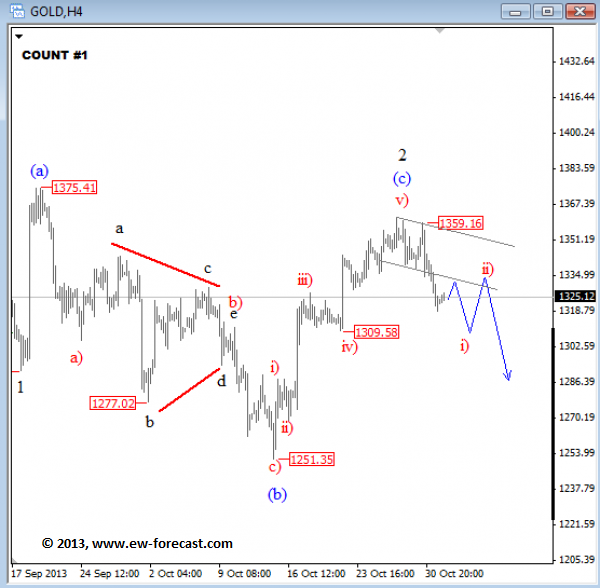
GOLD is reversing lower from 1360 where a five wave move from 1251 may have completed a flat correction in wave 2. Notice that current weakness already extended through the small base channel which usually occurs in impulsive price action. With that said, further weakness is expected as we think that price is in red wave i), so if we are correct then short opportunity could occur in wave ii) maybe next week.

Gold Elliott Wave


Get 2 Month Package For Price Of 1 Month.

2 For 1


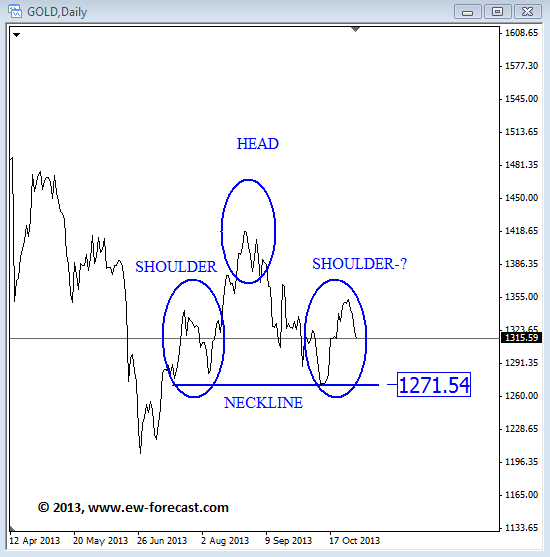
Well on the daily line chart of gold we see a possible Head and Shoulder pattern with price now moving down from the right shoulder. This is a bearish pattern that is pointing towards 1180, but not so soon. Firstly we need a broken neckline placed around 1271.

Gold HNS Pattern

Free Elliott Wave Webinar >>> http://goo.gl/kw2wUh


How to Profit from a Potential Housing Market Downdraft

by George Leong, B.Comm.

The housing market has had a nice run up over the past several years, but the party is beginning to fade.

Home prices continue to edge higher with a 12.8% jump in August, according to the S&P/Case-Shiller 20-City Home Price Index. While this seems positive, you also have to wonder if the housing market is headed for a bubble down the road as mortgage rates rise—and they will.

The chart of the S&P/Case-Shiller 20-City Home Price Index below shows the currency recovery in home prices. The index is still far below the peak in 2006 and 2007, prior to the subprime blow-up. These were unrealistic levels. We saw downward moves in 2009 and 2012, but it has been clear sailing. Yet the problem is that much of the buying in the housing market was driven by institutional buying. Once this begins to fade as home prices rise, we could see a relapse in the housing market.

            Chart courtesy of www.StockCharts.com


We saw a 5.6% decline in pending home sales in September. This metric is not considered as critical as the housing starts and building permits readings, but in my view, it’s a good indicator. In August, pending home sales slid 1.6%. We may be seeing a trend of lower demand for homes, which suggests there could be some issues on the horizon if pending home sales continue to be negative.

Existing home sales were also flat at 5.29 million units in September, down from 5.39 million units in August. Less people are buying homes, and this cannot be good for the homebuilder stocks.

What makes the situation in the housing market worse is that we are failing to see strong job creation. Without confidence and jobs, there will continue to be a tendency among consumers to not want to commit to a major purchase, such as a house.

I would be avoiding the homebuilder stocks at this time. The S&P Homebuilders Index is looking vulnerable, as shown in the chart below, based on my technical analysis.

            Chart courtesy of www.StockCharts.com


What I continue to like is the home building supplies companies. At the top is The Home Depot, Inc. (NYSE/HD), which is the “Best of Breed” in this sector in my opinion.

In the small-cap area, take a look at the suppliers to the housing market. Beacon Roofing Supply, Inc. (NASDAQ/BECN) is a stock that you should keep an eye on. The company supplies builders and roofing companies with roofing supplies.

This article How to Profit from a Potential Housing Market Downdraft was originally published at Investment Contrarians


BlackRock CEO Reports QE Causing Bubbles in Markets

011113_IC_cekerevacby Sasha Cekerevac, BA

As most readers know, I have been calling for a reduction in the Federal Reserve’s quantitative easing (QE) program for some time. My worry has been that the current level of quantitative easing is not doing much to help Main Street, and it is building potentially dangerous risks to our economy over the long term.

I’m worried about the future of this country, and yes, even my investments. I don’t want my hard-earned wealth to disappear due to mistakes made by the Federal Reserve in continuing to pump quantitative easing.

And I’m obviously not alone in this sentiment, as recently the CEO of BlackRock, Inc. (NYSE/BLK), Laurence Fink, stated that the Federal Reserve’s current quantitative easing policy is creating bubbles in various markets. (Source: Bloomberg, October 29, 2013.)

Fink’s opinion that the Federal Reserve should begin tapering quantitative easing immediately comes from the long-term viewpoint of the overall economy and the damage that is being done. Even though money managers like Fink might benefit from quantitative easing over the short term from the boost in asset prices, if bubbles get bigger, the damage over the long term could be extremely serious.

This has been my viewpoint for some time. Sure, it’s great that the market has gone up recently, but if it’s not sustainable, what’s the point?

Much like real estate a decade ago, we all enjoyed the party on the way up, but the hangover has taken years to work off.

Because the Federal Reserve has been so aggressive in its quantitative easing policy, it’s not just the stock market that is going up. Investors who are desperate for yields are piling into even the riskiest of assets, just to try and get some income.

This is where things can get dangerous. It goes beyond just one investor losing their hard-earned wealth. What about pension plans that are now placing your funds into junk bonds for just marginal yields?

The long-term implications of such an aggressive quantitative easing program by the Federal Reserve are unknown, as the central bank has never made such drastic moves in its history. We are in uncharted waters, and that’s a dangerous place to be.

Ultimately, reality will set in whether the Federal Reserve likes it or not. In fact, the Federal Reserve might lose the ability to impact the long-term bond market if foreign investors decide to pull out.

This means that even if the Federal Reserve continued pumping quantitative easing into the U.S. economy and short-term interest rates remained low, if investors in long-term bonds decide to sell, long-term interest rates will rise.

As well as increased interest rates, all of this excess quantitative easing could eventually lead to inflation moving significantly higher. This, too, would result in ever-higher long-term interest rates.

The fact of the matter is that no one knows what will happen, since the Federal Reserve has never taken such unorthodox action.

I think that over the next few years, we will see higher interest rates. One way investors can profit from a drop in bond prices (when bonds drop in price, interest rates move up) is through an inverse exchange-traded fund, such as ProShare Ultrashort 20+ Year Treasury (NYSEArca/TBT).

Of course, another approach is to diversify your investments by including such assets as gold or silver, which obviously can’t be printed at will. Regardless of what foreign investors do with our bonds, we know they can’t get enough gold and silver.

This article BlackRock CEO Reports QE Causing Bubbles in Markets was originally published at Investment Contrarians


Why Consumer Confidence is Falling at an Alarming Rate

by Mohammad Zulfiqar, BA

Consumer spending is very critical to the U.S. economy, as it makes up a significant portion of the gross domestic product (GDP). If consumer spending declines, then U.S. GDP growth becomes very questionable; when it increases, it can provide an idea about where the U.S. economy is heading.

I look at consumer confidence as one of the indicators of consumer spending. The logic behind this is that if consumers are confident, they will most likely spend more, compared to when they are pessimistic.

Sadly, the consumer confidence in the U.S. economy seems to be deteriorating these days. This is definitely not a good sign if we want the U.S. economy to improve going forward.

Look at the Conference Board Consumer Confidence Index, for example; in October, it witnessed a slide of more than 11%, having stood at 71.2 in October from 80.2 in September. The Consumer Expectations Index declined 15.5% in the same period. (Source: “Consumer Confidence Decreases Sharply in October,” The Conference Board web site, October 29, 2013.)

Some will blame the decline in consumer confidence on the U.S. government shutdown. This may not be completely true, however, as we have been seeing continuous deterioration in consumer confidence. Please look at the chart of the University of Michigan Consumer Sentiment Index below.

            Chart courtesy of www.StockCharts.com


The University of Michigan Consumer Sentiment Index stands at the lowest level of 2013 in October. It has been declining since July.

Currently, we are seeing too much attention being paid to the key stock indices making new highs each day, but not to the underlying factors that affect them.

Consumer confidence declining suggests that consumer spending going forward is going to be bleak. We are already seeing some effects of this; for example, companies on key stock indices are showing their sales below expectation.

Consider this: as of October 25, 244 companies on the S&P 500 have reported their third-quarter corporate earnings, and only a little more than half of them were able to beat the estimated revenues. (Source: “Apple continues to be largest drag on S&P 500 technology sector earnings growth,” FactSet web site, October 25, 2013.)

If this trend continues, which I think it will, then it can do a significant amount of damage. For example, if consumer confidence plummeting results in decreasing consumer spending, the retailers will face troubles. And if those retailers are not able to sell product, they will have to reduce staff to stay profitable, and so on.

But that’s not all: consumer spending declining could affect the GDP. The growth rate estimates we hear now may not be the same a few months down the road.

Investors have to be really cautious about what kind of investments they make. If their portfolio consists of companies in the consumer discretionary sector, they should consider taking some profits off the table or reducing their exposure to the sector.

This article Why Consumer Confidence is Falling at an Alarming Rate was originally published at Daily Gains Letter


European Stock Futures Open Slightly Changed

By HY Markets Forex Blog

European stock futures traded little changed on Friday as China’s manufacturing sector improved further in October.

Futures for the pan-European Euro Stoxx 50 edged 0.06% lower at 3,063.30, while the German DAX index declined 0.04% lower to 9,032.00.

At the same time the French CAC 40 climbed 0.06% higher at 4,302.30 while the UK FTSE 100 gained 0.37% at 6,756.30.

Markit Economics are expected to report the UK Purchasing Managers’ Index (PMI) at 9:30am GMT, with forecasts of a drop from previous recorded reading of 56.7 in September to 56.4 in October.

European Stock Futures – China

Meanwhile, the Chinese manufacturing PMI posted a reading of 51.4 for October, compared to the previous month’s reading of 51.1 and surpassing analysts’ forecast of 51.2 in October.

A separate report revealed that HSBC’s PMI climbed 50.9 in October from the previous reading of 50.2 in September, in line the bank’s forecast of 50.9 reported last week, which was based on survey responses.

China’s economy grew by an annualized 7.6% in the third quarter, according to a data released by the government last month.

Asian Trading

Stocks in the Asian region saw a slight boost on Friday, despite the expansion in the Chinese manufacturing sector.

Japanese benchmark Nikkei 225 index lost 0.88% to 14,201.82, while Tokyo’s broader Topix gauge declined 0.94% at 1,183.03.

In China, Hong Kong’s benchmark Hang Seng index gained 0.18% to 23,247.85, while the mainland Chinese benchmark Shanghai Composite edged 0.37% higher to 2,149.56.


Interested in trading In the European Market?

Visit www.hymarkets.com and find out how you can start trading today with only $50.


The post European Stock Futures Open Slightly Changed appeared first on | HY Markets Official blog.

Article provided by HY Markets Forex Blog

Asian Stocks Mixed On Strong Chinese Manufacturing Data

By HY Markets Forex Blog

Asian stocks closed mixed on Friday as the Chinese manufacturing sector showed an improvement. The Japanese stocks dropped lower on a weak corporate data.

Asian Stocks – Japan

The Japanese benchmark Nikkei 225 index edged 0.88% lower at 4,201.57, while Tokyo’s broader gauge, the Topix index declined 0.94% to 1,183.03.Nikkei’s main market mover’s, Sony said it was struggling to maintain the sales of digital cameras and televisions in the competitive market. Sony’s stocks declined more than 11%.While Panasonic shares climbed 6% higher.

The Bank of Japan (BoJ) changed its growth forecast to 1.5% next year, higher than the previous forecast of 1.3%. BoJ also forecasted that its 2% inflation rate target would be achieved by 2015, while its current monetary easing policy remains unchanged.

Asian Stocks – China

Gains were seen in the Chinese trading session, as Hong Kong’s benchmark Hang Seng climbed 0.20% higher to 23,252.87 as of 7:04am GMT, while the mainland Shanghai Composite traded 0.37% higher to 2,149.56 after China’s National Bureau of Statistics revealed that China’s manufacturing sector expanded in October.

The Chinese government manufacturing gauge revealed that the country’s PMI came in at 51.4 in October, compared to the previous reading of 51.1 seen in September and surpassing analysts’ forecast of 51.2.

A separate report released by HSBC showed a comparable result, revealing the manufacturing edged higher at 50.9 in October, from 50.2 in September.

Qu Hongbin, Chief economist in HSBC said China is gradually recovering after the country experienced a fall in growth in the second-quarter.

The South Korean Kospi index climbed 0.46% higher to 2,039.42, after the Korea National Statistical Office confirmed the South Korean consumer price inflation dropped to a negative 0.3%.

Australia

The Australian benchmark S&P/ASX 200 index edged 0.26% lower at the closing bell at 5,411.12, after the Australian Bureau of Statistics confirmed that Australia’s producer price inflation surpassed forecasted made by analysts.


The report also revealed wholesale inflation was at 1.9% in the September quarter, compared to 1.2% seen in the previous quarter, driven by the higher utilities prices.

Australia’s manufacturing gauge showed the sector was slightly recovering and expanding for the second month in October.


Interested in trading Asian Stocks Online?

Visit www.hymarkets.com and start trading today with only $50.

The post Asian Stocks Mixed On Strong Chinese Manufacturing Data appeared first on | HY Markets Official blog.

Article provided by HY Markets Forex Blog

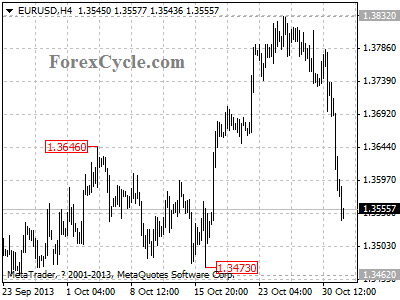
EURUSD’s downward movement extends to 1.3539

EURUSD’s downward movement from 1.3832 extends to as low as 1.3539. Deeper decline to test 1.3462 support is possible, as long as this level holds, the fall could be treated as consolidation of the longer term uptrend from 1.2756 (Jul 9 low), one more rise towards 1.4000 is still possible after consolidation. On the downside, a breakdown below 1.3462 support will indicate that the uptrend from 1.2756 had completed at 1.3832 already, then the following downward movement could bring price to 1.2500 zone.

eurusd

Provided by ForexCycle.com

When to Sell Stocks

By MoneyMorning.com.au

Today is the final day of ‘Retirement Week’.

We hope you’ve got something out of it.

During this week we’ve shown you how to put together the pieces to develop your own retirement plan.

We’ve show you the importance of understanding risk, how to allocate your assets, a simple savings plan to get you started, and an overview of the strategies you can use to help build and preserve your retirement savings.

Today we’ll touch on a subject most pro investment advisors prefer to ignore – how do you know when to sell stocks?

If you don’t think about how to identify selling opportunities then you’re at the complete mercy of the market. And even worse, all the good work you’ve done building your portfolio will count for nothing.

Let’s look at some of the key issues surrounding the undervalued skill of knowing when to sell stocks

The latest issue of Vern Gowdie’s Gowdie Family Wealth investment advisory outlines the importance of knowing when to sell.

He also explains the bizarre attitude many in the mainstream have towards those who warn about the risks in the market.

Vern doesn’t make this comparison, but we will. To many in the mainstream, a rising stock market is akin to a football team. So when someone dares to say stocks could fall, the mainstream sees it as an insult to their ‘team’.

And so they fight back with all sorts of vitriol. But that’s fine. Contrarian investors tend to have thicker skin than most other investors anyway.

That brings us back to Vern’s comments in his latest report.

The Market and Ridicule in Tandem

In his report, Vern details how the mainstream dislikes any talk of over-priced markets and despises even the notion that stock prices could fall. As Vern explains:

Years of being exposed to institutional research and economic opinion left me disillusioned with mainstream thinking; ‘cash for comment’ is my view on institutional commentary. Everything is always an opportunity for the institutions. Major threats (credit bubbles, unbridled money printing, overheated share markets etc.) are not dissected with any real gravitas. If any credence is given to an obvious risk, the institutional worst case scenario is always a ‘soft’ landing followed by a resumption of growth.

If you can find one mainstream Australian economist or investment commentator who warned against the US credit bubble prior to its bursting, please let me know. They are as rare as the dodo…

Bill [Bonner] and a number of independent commentators (many of whom I subscribe to) had been sounding the warning bell on the US debt crisis for a number of years. And therein lies the problem with big picture thinking – you can identify trends early, but it can take years before your analysis is proven correct. In the interim you are easily dismissed as a ‘chicken little’.

In my experience, [the] market and ridicule operate in tandem; as the market goes higher, so too does the volume of ridicule.

We don’t usually like to reprint such long quotes, but everything Vern says in this quote is true and important to understand.

This mainstream attitude all feeds into the mind of investors. It’s the combination of peer pressure, the fear of missing out on further gains, and the potential of people calling you a kook or misfit if you dare say or do anything that’s contrary to mainstream thought.

And yet after the major crash in 2008 the mainstream acted in one of two ways: they said it was obvious the market would crash so don’t give the ‘chicken littles’ too much credit. Or they claim that no one saw it coming because it was so unexpected.

They can’t have it both ways…but they try to.

When to Sell Stocks

Look, we’re not saying it’s easy to know when to sell. It can be one of the hardest things to do.

What if you sell today and the stock price doubles tomorrow?

That’s the thing that worries investors the most, that they’ll miss out on further gains. But as any investor knows, gains can quickly turn into losses. So, when do you sell?

Well, there are several variations on a theme that we follow with our personal share portfolio.

The first and most important part of selling is in the buying – don’t over-expose your portfolio to the stock market. That’s something you should follow regardless of market conditions.

Stocks can fall quickly. As you saw in May and June this year, one week things looked great, the next they didn’t look great as the market fell 10% in just a few days.

But assuming you haven’t piled too much of your cash into stocks, the best technique we’ve found over the years is to ‘bank’ profits when a stock hits a particular level.

As to what level you choose, that’s up to you. One of the most popular techniques (especially with growth stocks) is to sell half your position when the stock price doubles.

That way you’ve effectively taken out your initial stake and you’re leaving the profits to run. It’s a good strategy. It means that even if the stock price goes to zero you haven’t lost any of your initial stake.

Another strategy is similar, but involves taking out your initial stake plus the amount you would normally expect to make from a growth stock during that time.

For instance, if the stock doubles in a year and your investment has gone from $1,000-worth of shares to $2,000-worth of shares, you could sell $1,300-worth which would equal your initial stake plus an extra 30% based on what you would normally expect from a higher-risk growth stock.

That way, even if the stock price goes to zero after you’ve sold, you’ve still banked a 30% gain on your initial investment. Of course, these examples don’t include transaction costs and tax consequences, so bear that in mind too.

Selling Stocks is as Important as Buying

In short, selling should be just as much a part of your investment strategy as buying. And yet it’s the part of investing that most people ignore.

Right now, we believe we’re in the middle of a bull market that could last another two years. But we’re not ignorant. We hear the warnings about the chances of a market crash – we hear them because they’re mostly coming from our colleagues.

That’s why we only recommend a 30-50% exposure to stocks, with at least half of that in dividend stocks. We know the market could turn on a sixpence at any time.

So if we’re wrong and stocks fall, we need to make sure we bank some profits on the way up, and that we can easily sell stocks if the market heads down.

Bottom line: don’t ignore those calling for a market crash; you’ll be grateful for the warning when the crash finally comes.

Cheers,
Kris+

Special Report: Read This or Retire Poor

Join Money Morning on Google+