UK central bank maintains asset purchase target, rate

By www.CentralBankNews.info     The Bank of England (BOE), as widely expected, maintained its bank rate at 0.5 percent and the target for asset purchases at 375 billion pounds, adding in a brief statement that this decision was reached in the context of the monetary policy guidance announced in August.
    The BOE said in August that it would not reduce its purchases of assets, such as bonds issued by the UK government, until the unemployment rate falls to 7.0 percent.
    The BOE’s latest economic will be released on Nov. 13, the BOE added.
    Based on an improving economy and minutes from the BOE’s October meeting, financial markets expect the BOE to update its economic projection to show unemployment falling to 7 percent before the second quarter of 2016, as it projected in the August inflation report.
    The UK unemployment rate was steady at 7.7 percent in August and July, but economists now expect the rate to fall to the BOE’s threshold by the end of 2015 and thus start thinking of raising its policy rate that has been unchanged since March 2009.

    Illustrating the growing belief that the BOE will start to tighten policy sooner than expected, the National Institute of Economic and Social Research (NIESR) this week said the BOE was likely to raise rates in the second half of 2015, before unemployment hits the 7.0 percent threshold.
     The minutes from the October meeting by the BOE’s Monetary Policy Committee showed that the slack in the UK economy was being eroded “a little faster than envisaged” in August and this could lead to unemployment falling faster than expected.
    The minutes also showed that no MPC members saw any reason to tighten policy at this stage.
    The UK’s Gross Domestic Product expanded by an annual 1.5 percent in the third quarter, faster than the second quarter’s pace of 1.3 percent and the first quarter’s 0.2 percent. Inflation was steady at 2.7 percent in September and August.
    Although the BOE in August set out a 7.0 percent unemployment rate as a threshold, it also said that its policy rate would not automatically be raised if the rate falls to that level, nor was it a target for unemployment, describing the 7.0 percent as a “way station” at which it would reassess policy.
    The BOE has held its target for asset purchases – known as quantitative easing – steady since July 2012.
    In its latest forecast, the International Monetary Fund revised upwards its forecast for UK economic growth to 1.4 percent this year from a previous forecast of 0.7 percent, and 1.9 percent in 2014, up from a previous 1.5 percent.

    www.CentralBankNews.info


Serbia cuts rate 50 bps, signals close to neutral stance

By www.CentralBankNews.info     Serbia’s central bank cut its policy rate by 50 basis points to 10.00 percent, its fourth rate cut this year, and signaled that it is now close to a neutral policy stance as inflation has continued to fall and “future monetary policy measures will be geared at keeping it within the target tolerance band.”
    The National Bank of Serbia has now cut rates by 125 basis points since May following rate rises in January and February to push down inflation.
    “As inflationary pressures and inflation expectations continue to subside, the Executive Board expects year-on-year inflation to fall close to the lower end of the target tolerance band in October,” the bank said, adding that fiscal consolidation and positive international financial markets would help inflation remain within the bank’s target range in 2014.
    Serbia’s inflation rate fell further in September to 4.9 percent from 7.3 percent in August, continuing its decline from 12.8 percent in January. The central bank targets inflation of 4.0 percent, plus/minus 1.5 percentage points and raised rates by 150 basis points last year.

    The fall in September inflation was attributed to lower prices of agricultural commodities, low demand and a relatively stabile exchange rate along with the bank’s policy stance.
    The central bank also noted that Serbia’s current account deficit was estimated to have narrowed to 1.4 percent of Gross Domestic Product in the third quarter due to increased economic activity. In 2012 Serbia’s current account deficit rose to 11.5 percent of GDP from 9.9 percent the prior year.
    Serbia’s economy strengthened in the second quarter, with GDP expanding by 0.3 percent from the first quarter for annual growth of 3.2 percent, up from 0.2 percent in the first.

    www.CentralBankNews.info

If Apple Does a Deal with This Company, I’d Buy the Stock

By George Leong, B.Comm.

As I’ve written in these pages before, Apple Inc. (NASDAQ/AAPL) needs to increase its brand in the Chinese economy in order to really entice investors and jumpstart the stock. (Read “Update: Apple’s Attempts to Enter Emerging Markets a Blunder?”)

The reason is simple: China is the biggest mobile phone market in the world with over one billion users, which is more than three times the size of the United States market.

Apple is rumored to have a major distribution deal in place with China Mobile Limited (NYSE/CHL), the largest cell phone operator in the country with a market cap of $210 billion. The company services about 755 million customers as of the end of September, which is huge. (Source: China Mobile Limited web site, last accessed November 5, 2013.)

In my view, Apple could see its business accelerate if a deal is finally announced and, of course, if Apple can execute in the Chinese economy via much cheaper smartphones than the “iPhone 5C.”

For China Mobile, the addition of Apple could also generate new sales and higher margins, so it’s a win-win situation for both companies. The move towards 4G networks will also help to drive growth.

And with the rise in income levels in the cities and rural areas, we could see a major push to buy higher-end smartphones, such as those made by Apple.

China Mobile is the top mobile play in the Chinese economy. The company is bigger than Verizon Communications Inc. (NYSE/VZ) and AT&T Inc. (NYSE/T). China Mobile also owns Luxembourg-based Millicom International Cellular S.A. (OTC/MICCF), a telecom operator with mobile operations in 13 countries and a potential market of about 270 million people. And as I noted earlier, there are 755 million users with China Mobile. Clearly, Apple is anxious to get in.

On the chart, China Mobile has largely been moving in a tight sideways channel, between $50.00 and $56.00, since mid-2012, and it appears to be stuck. We saw attempted breakouts in December 2012 and more recently in September, as shown by the top two shaded circles in the chart below, but in both cases, the move was not sustainable. There’s current weakness, but investors can look for support around $50.00, which could make a decent entry point, or wait for a dip to the $48.00 level, based on my technical analysis.

Chart courtesy of www.StockCharts.com

China Mobile is rated the top brand in BusinessWeek’s “20 Best China Brands.” Investors can expect the company to retain its dominance in the world’s largest consumer market; and with its adaptation of 4G as a catalyst to drive the company going forward, a deal with this mobile powerhouse could be what Apple needs to propel itself into the lucrative Chinese market.

This article If Apple Does a Deal with This Company, I’d Buy the Stock is originally published at Profitconfidential

Should We Invest in Twitter’s IPO ? Future Hit or Disappointment ?

Article by Investazor.com

twitter_ipo_launch

The only reason for which you could not hear about Twitter’s IPO would be that you have been on the Moon for the last couple of months, Twitter will have its debut on the stock market’s stage today and is going to be the most expected initial public offering since Facebook’s rocky debut last year. The company set an initial price range of 17$ to 20$ per share which was raised
this week to 23$ to 25$, settling for 26$ a share on late Wednesday. This latest price makes the micro-blogging company’s IPO worth 1.82 billion dollars, the second biggest debut for an Internet company after Facebook’s.

After the raised price range at the beginning of this week and among the euphoria which surrounded Twitter’s IPO, some investors started to question if we are not witnessing a Facebook deja-vu and to expect a close way below the IPO price at the end of its first trading day. Before giving an answer to the investors’ worries, let’s make a parallel between Facebook and Twitter pre-IPO events. In the week leading up to the initial public offering, Facebook set an IPO price range of high $20s to mid $30s which was turned into $28 to $35 price range and closing the pricing IPO at 38$ per share.

Is this sounding pretty familiar? It sounds like it because it really is a resemblance of the events prior to their trading debut and as I mentioned above Twitter have had a similar path. The micro blogging company settle for a final price of 26 dollars a share after raising its IPO range this week from 17$-20$ to 23$-25$ per share.

Moreover, Topeka Capital put Twitter on a buy rating with a 2014 year-target of 54$ and RBC Capital’s Mark Mahaney gave the stock a pre-IPO rating of outperform, or buy, with a $33 price target, arguing that Twitter has become an Internet utility. Also, like Facebook, Twitter’s IPO is making its appearance amid a wave of social media and Internet IPOs.  The major interest in Twitter’s IPO is largely based, like Facebook’s launch in May 2012, on expectations of a high-growing business potential, especially in the mobile market.

After all, Twitter is walking in Facebook’s shoes and at the moment prior to the IPO is yet to make a profit, reporting for the first nine months of 2013, a lossof $133.9 million, up from $70.7 million in the year-earlier period. On the other hand, the company posted revenues for the first nine months of this year of $422.2 million — up from $204.7 million in the same period last year.
Taking into account all these similarities, the big question is whether Twitter will share the fate of his “older brother” in its trading debut because that high-profile IPO turned into a sore disappointment for the investors when the stock closed with just a fractional gain on its first day of trading. Facebook shares slid below their $38 IPO price, hitting a 17.60$ bottom in September 2012, and stayed below the IPO price until this summer, when its second-quarter report in late July showed strong growth in mobile ads and sparked strong trading that has since pushed the stock above the $50 mark.

Recent history is a very good guide in helping us to get a glimpse into how Twitter’s first trading day could go and as Colin Cieszynski, a market analyst at CMC Markets Canada, says:“Analysis of previous technology and social media IPOs with high public profiles over the last ten years shows that, while shares have tended to get off to a strong start (even Facebook briefly traded above its IPO price on the first day), initial gains are not usually sustainable”.

So, should we expect a similar turn of events today as well? I wouldn’t jump so fast on this bandwagon of negative expectations regarding the performance of Twitter’s stocks in its first day and let me explain you why by starting my analysis from the manner I think the market will discount the stocks’ price in the near short-term.

In my opinion, there are two major factors that will have the greatest influence in the evolution of the shares’ price for now.

The present global economic outlook is the first one. Right now, the American stock market indices, Dow Jones Industrial Average and S&P 500, are at record levels. This situation is taking place after the momentum of investors sentiment shifted towards a more positive one after the US government managed to bring to an end the debt limit issue. So, even though the United States economic
indicators have shown lately a slow-down in economic growth, the investors are confident about the near future. Europe doesn’t look so bad anymore after the economic recovery seemed to have gained some momentum in the last months. European stock market indices as DAX30 or Europe Stoxx 50 are at record levels as well as the American ones.

The second one regards the basis on which investors may price Twitter’s stocks in the IPO day and in the short-term.

investazor_number_of_twitter_mothly_active_users

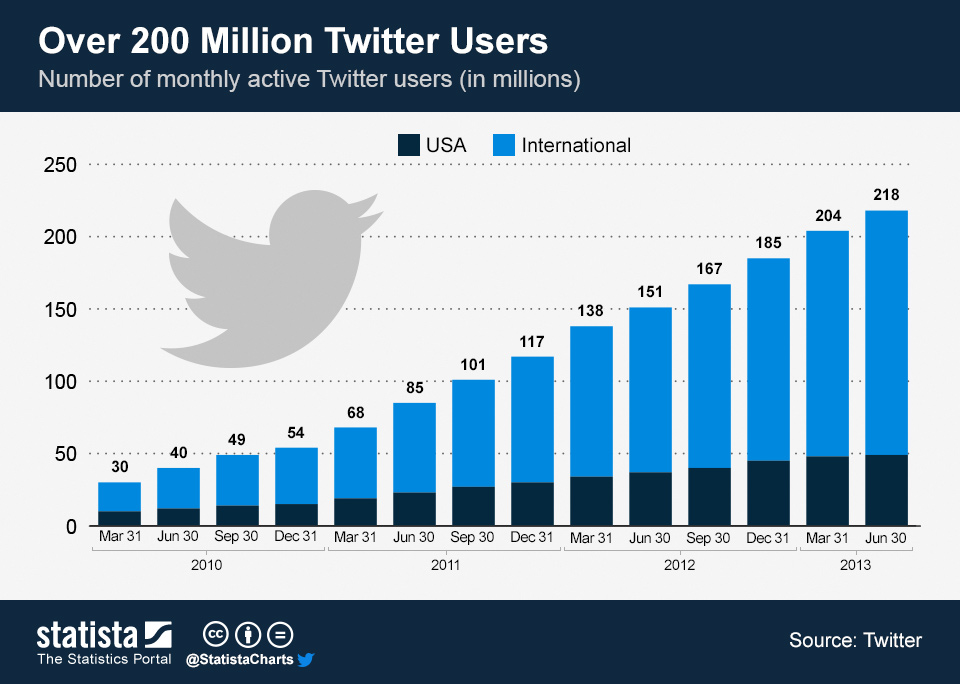
This basis of pricing would consist of fundamental analysis and market sentiment. Regarding the former, October was the busiest month for U.S.-listed IPOs since 2007, and 2013 is on track to be the best year in terms of deals and ollars raised since 2007. Moreover, Twitter’s 232 million monthly active users its growing revenue and its key place in the conversation about many public events brought a more than doubled revenue of $422 million for the nine months ended Sept. 30. Twitter is seen as ahead of rivals on mobile devices, source of more than 70% of its revenue in the third quarter.

It would appear as Twitter has the wind in its sails for its debut, but losses are growing almost as fast as revenue and user growth is slowing. The number of monthly active users grew 6% in the third quarter, compared with the second quarter, down from 7% in the second quarter and 10% in the first quarter.
Nevertheless, after revising the fundamental part I think the big picture points towards a slightly bullish perspective in the short term. However, I do not think the fundamental part is enough to have a clear idea about how the market will price Twitter in its trading debut because the company needs time to prove if it can improve its key metrics and achieve its revenues objectives in the
following period, let’s say next six months.

Consequently, my strong belief is that the market sentiment will have a greater impact on the pricing than the fundamental analysis. The hype created around the IPO was the biggest one after Facebook’s and overall I think there is a positive sentiment towards Twitter’s initial public offering of today and I expect a strong start, marking a high of 32$ as towards the finish line of the day I expect to see a retreat,  closing near the IPO price, around 26$. Furthermore, in the next weeks I see Twitter trading in a price range of 23$-32$, putting it in a moderately bullish perspective.

The post Should We Invest in Twitter’s IPO ? Future Hit or Disappointment ? appeared first on investazor.com.

Three Key Indicators Say U.S. Economy in Trouble

061113_PC_lombardiBy Michael Lombardi, MBA

The mainstream and politicians tell us the “wounds” of the financial crisis are over and the U.S. economy is in recovery mode. This simply isn’t true.

A few of the key indicators I follow to see where an economy stands are personal income, consumer demand, and businesses’ activity. All three of these indicators are telling me the U.S. economy is definitely going in the wrong direction.

First of all, the income gap in the U.S. economy continues to grow. The top earners make more, while the lowest income earners make less. According to the Wage Statistic from Social Security, in 2012, 23 million of the lowest wage earners earned a total of $47.0 billion in the U.S. economy. But those who earned $10.0 million or more annually in the year 2012 earned $64.3 billion! Here comes the kicker: there were only 2,915 wage earners in this category in the U.S. economy last year. (Source: Social Security, November 5, 2013.) Yes, you read that right. Less than 3,000 people cumulatively made more than 23 million people.

The bottom line: while Wall Street and big business has boomed again, the average working American family is struggling under an after-inflation personal income that is lower than it was in 2009—four years ago. In 1999, real median household income (that’s adjusted for inflation) in the U.S. economy was $56,030. By 2012, that number was $51,017. (Source: “Real Median Household Income in the United States,” U.S. Department of Commerce, September 18, 2013.)

Next, American consumers are pulling back on their spending—something that’s not supposed to happen when an economy is recovering.

One indicator of consumer demand I follow is the build-up of wholesale inventories. When business inventories build up, it suggests companies are storing more of the goods they produce because they are selling less to consumers.

In August, wholesale inventories in the U.S. economy reached $503 billion, up 2.5% from August of last year. Inventories of motor vehicles and motor vehicle parts increased 2.4% in just one month! (Source: United States Census Bureau, October 25, 2013.)

Finally, businesses in the U.S. economy are worried.

The CEO of Target Corporation (NYSE/TGT), Gregg Steinhafel, while presenting second-quarter 2013 results, said, “For the balance of this year, our U.S. outlook envisions continued cautious spending by consumers in the face of ongoing household budget pressure…” (Source: “Target Reports Second Quarter 2013 Earnings,” Target Corporation, August 21, 2013.)

Dear reader, what I write each passing day in these pages points to one thing: the U.S. economy is headed towards an economic slowdown, not economic growth. Time will tell if I am right or wrong. As far as I’m concerned, take out massive money printing and massive government spending, and there would be no economy.

Michael’s Personal Notes:

We have seen cities like Detroit and others in California tell their municipal bonds investors, “Sorry, we can’t pay you.” The reason behind this? Their budget deficit was out of control, they reached the breaking point, and they filed for bankruptcy.

But the troubles of municipalities and cities aren’t behind us. In fact, they are marching forward with full force. And it’s not just rural cities and counties that are struggling to fix their budget deficit; major ones are doing the exact same thing. And truth be told, they are failing at it.

Take Fresno, California, for example. In the fiscal year 2014—which began on July 1, 2013 and ends on June 30, 2014—Fresno, one of the largest cities in California, will register a budget deficit of $6.0 million. If the city is unable to reduce its budget deficit in the fiscal year 2014, then its budget deficit can grow to as much as $32.2 million in the next five years. (Source: “FY 2014 Adopted Budget,” City of Fresno, California, May 29, 2013.)

And Fresno has worked very hard to keep its budget deficit under control. In the last four years, the city has decreased its workforce by 1,200 employees (25% of the city’s workforce), reduced or completely eliminated the maintenance and replacement of equipment, and now relies on volunteers for parks maintenance, community centers, and for different functions in the police department. The city has also reduced the number of employees working in public safety. One would assume that after this many cuts, the budget deficit would be controlled; but that’s certainly not the case for Fresno, California.

While this is just one example, the list of cities working to reduce their budget deficit is vast. And I don’t expect them to get out of their misery very quickly. Why? The main source of income for cities is still property taxes…which haven’t recovered.

Many of my readers are not invested in municipal bonds, and I understand that. The purpose of this story is to stress this $3.0-trillion market is under immense pressure. Despite municipalities and cities slashing their costs, they still can’t cover their expenses.

My concern is that struggling cities will ask for government bailouts. We’ve already seen the federal government give money to Detroit. What happens when other cities come calling?

It wasn’t too long ago when the U.S. national debt was $9.0 trillion. Now, our national debt is beyond $17.0 trillion. As the economy slows further, as I’m predicting, the municipal crisis will add considerably more to the national debt we already have.

This article Three Key Indicators Say U.S. Economy in Trouble is originally published at Profitconfidential


GOLD Elliott Wave Analysis: Looks For Lower

GOLD reversed sharply to the downside at the start of September, through the rising trend line of a corrective channel. As we know that’s an important signal for a change in trend, which means that bearish price action is now back in view that could accelerate to the downside in the next few weeks if we consider possibly completed flat correction in wave 2. A fall and daily close beneath 1251 is needed for a wave 3 down back to 1180.

GOLD Daily Elliott Wave Analysis

On the 4h chart below we can see recent reversal down from 1360 where a five wave move from 1251 probably accomplished that flat correction in wave 2 as mentioned and presented on the chart above. Notice that current weakness also extended through the small base channel line (blue circle) which usually occurs in impulsive price action. With that said, further weakness is expected as we think that price is in now moving lower in red wave i) that may find a support around 1280-1290 and then will make a retracement up in red wave ii) which could be a very good position for short opportunity.

GOLD 4h Elliott Wave Analysis

Written by www.ew-forecast.com

Special Offer by ew-forecast.com ::  Get 2 Month Package for Price of 1 >> 50% Saving


Euro Slightly Higher; Draghi’s Press In Spotlight

By HY Markets Forex Blog

The 17-nation euro was seen trading slightly higher against the greenback on Thursday, after the European Central Bank (ECB) decided to keep its borrowing cost unchanged and investors are looking forward to the press conference of ECB’s President Mario Draghi for any further guidance.

The euro advanced 0.06% higher to $1.3522 against the US dollar at the time of writing, before the ECB most likely leaves its interest rate at 0.5% at its meeting later in the day.

Economists are forecasting that the central bank will keep its benchmark interest rate unchanged at 0.5%; however the recent drastic drop in the eurozone inflation may lead the ECB to cut its rate by 0.25%.

“An interest rate cut could also exert some welcome downward pressure on the euro,” an analysts from IHSGlobal Insight said, adding that the bank “may prefer to hold fire until its December meeting when it will have available the new euro zone gross domestic product (GDP) and consumer price inflation forecasts from its staff.”

Draghi’s Press Conference

The President of the European Central Bank (ECB) Mario Draghi is expected to give a speech in a press conference and expected to comment on new tools to help the economy, such as possible changes to the bank’s reserve and long-term refinancing operations (LTRO) and more.

In September, Draghi said that the bank was ready to use any tool to maintain the short-term money market on a level that is warranted by the bank’s assessment of inflation.

The eurozone’s gross domestic product (GDP) is seen contracting by 0.4% this year, the EC forecasted. However next year, the eurozone economic activity forecasted to expand by 1.1% and 1.7% by 2015.

The unemployment rate in the eurozone rose 12.2% higher in September, the latest data confirmed. The eurozone unemployment is expected to be seen at 11.8% in 2015, according to forecasts from the EC.


Interested in trading In the European Market?

Visit www.hymarkets.com and find out how you can start trading today with only $50.

The post Euro Slightly Higher; Draghi’s Press In Spotlight appeared first on | HY Markets Official blog.

Article provided by HY Markets Forex Blog

Crude Oil Futures Fluctuates As US Inventories Rises

By HY Markets Forex Blog

Crude oil futures were seen trading slightly lower on Thursday, after rising the most in five weeks, meeting analysts’ estimates.

West Texas Intermediate crude for December delivery dropped 0.12% to $94.71 per barrel on the New York Mercantile Exchange at 2:15pm Singapore time. The contract rose $1.43 to $94.80 yesterday, rising to its highest level since October 2.

While December settlement for the European benchmark crude Brent lost 36 cents to $104.88 per barrel on the London-based ICE Futures Europe exchange at the time of writing. Brent crude was seen at a premium of $10.17 to WTI.

Crude Oil Futures- US Inventories

The US crude oil stockpiles advanced by 1.577 million barrels last week, while gasoline inventories dropped by 3.755 million barrels, according to a report released by the official Energy Information Administration (EIA).

Last week EIA released a report showing that oil consumption in the world’s largest consumer increased by 4.1 million barrels to 383.9 million in the week ended October 25, rising to its highest level since June.

Meanwhile, a release from the American Petroleum Institute (API) revealed that on Tuesday, the US crude inventories advanced by 870,000 barrels last week and a drop of 4.3 million barrels was seen in gasoline stockpiles.

Crude Oil Futures – US Data

Estimates of the US third-quarter GDP is expected to be released later in the day, with forecasts of a 2.0% increase, down from the previous forecast an expansion of 2.5% recorded during the period between March to June.

October’s labour data is expected to be released on Friday and forecasted to show that the US non-farm payrolls rose by 125,000.


Visit www.hymarkets.com  today and find out more on how you can how you can trade Energy products with only $50.

The post Crude Oil Futures Fluctuates As US Inventories Rises appeared first on | HY Markets Official blog.

Article provided by HY Markets Forex Blog

My Secret to Always Buying Low and Selling High

By WallStreetDaily.com

Watch how easy it is to boil investing down to four words…

Buy low, sell high.

There! I just did it.

If you can repeatedly buy low and sell high, well… it’s impossible to ever lose.

Yet the novice investor always manages to screw this up.

That ends today!

Let me give you my pledge…

For those who have the discipline to follow the principles I put forth today…

Well, you’ll be empowered to buy low and sell high for the rest of your life. No exceptions.

Would I have written this article back in 2008?

Probably not!

Back then, finding bargains took no effort. I mean, dozens of companies actually traded below their cash levels.

Without looking very far, we were picking up dollars for fifty cents and then just waiting. Before long, the market noticed the disconnect and corrected it, and we doubled our money in the process.

Not anymore, though.

We’re in the midst of a historic bull run that keeps getting longer in the tooth with each passing day, which means it’s getting harder to buy low and sell high.

What’s more, the latest leg higher hasn’t been driven primarily by profit growth. Instead, it’s been driven by multiple expansion.

Bargains Are Harder to Come By…

At the beginning of the year, the S&P 500 Index traded for 14.51 times earnings. Now it trades for 16.72 times, representing an expansion of 15%.

The end result? Bargains are scarce. Really scarce. Just ask Warren Buffett.

As I alluded to earlier in the week, his Berkshire Hathaway (BRK.A) is sitting on nearly $40 billion in dry powder. If the bargains were plentiful, he’d be putting that cash to work, not hoarding it.

So what’s an investor to do? In truth, we only have one option.

We still have to buy low and sell high.

It can be no other way.

How are we going to pull off this amazing feat?

Which Mistake Are You Making?

When markets are trading sideways or stocks are a bit out of favor, it’s fairly easy to always buy low.

During rip-roaring bull markets, like we’re experiencing now – not so much. Bargains dry up. And that’s when we’re most likely to commit one of two fatal errors.

Fatal Error #1: Laziness

Most investors remain allergic to hard work. When finding bargains becomes difficult, they take the path of least resistance. They buy stocks that simply appear cheap in relation to the market.

They compromise their standards, change the definition of what qualifies as cheap, and buy “relative” bargains.

The problem?

When the market turns, the true value (i.e., expensiveness) of these stocks gets exposed and share prices often plummet, which leads to losses.

Fatal Error #2: The Value Trap

A small subset of investors recognizes the perils of this “relative” value approach. In turn, they set out to find stocks left behind in the recent rally or hitting new lows and are truly cheap.

While I can’t bemoan the practice, the problem is that these investors often stop there.

They don’t take the time to figure out if the stocks they uncover are value traps (ones that deserve to be cheap indefinitely, thanks to terrible fundamentals).

Instead, they simply buy the beaten-down names under the premise that they’re just too darn cheap not to go up in price eventually. But more often than not, they don’t.

Here’s a word to the wise…

One must commit oneself to strong, value investing principles, which means digging harder and deeper until you find undeniable bargains.

Indeed, when bargains aren’t easy to come by, true value investors do whatever it takes to find a great deal.

They keep digging and digging.

With that in mind, here are my five secrets to ensure that you always buy low and sell high.

They’ve been tailored specifically for the prevailing market.

Secret #1: Chapter 11 Never Felt So Good

Do whatever it takes to find a bargain.

Even if it means scouring companies emerging from the ashes of bankruptcy, like Eastman Kodak Co. (KODK).

Secret #2: Niche Yourself

Don’t be afraid to turn to niches in the market that very few investors understand or follow, as long as it means you can buy low and sell high. I wish there was another way to invest, but there isn’t.

Fortunately, some wonderful niches do exist in this market, like merger arbitrage opportunities and spinoffs.

Secret #3: Cash is King

Most important of all, don’t get too anxious to pull the trigger.

Take a Dramamine if you must, and hold fast to your cash until those relentless efforts I spoke about earlier uncover a true value stock.

Be disciplined. Never compromise on what qualifies as a bargain. And keep digging until you find one. No matter how long it takes.

You have no other choice, really.

Either buy low and sell high, or get slaughtered.

Secret #4: Valuation Metrics Rule

Look, I wish I could pinpoint a single valuation metric to get the job done.

But I’m not a magician.

Neither is Ty Nutt, Portfolio Manager of the Delaware Value Fund (DDVAX).

Before a stock makes it into his portfolio, it must pass a 10-factor screen. The results speak for themselves. His fund of only 30 to 40 companies outclassed the S&P 500 Index over the last three years, returning an average of 18.92% per year.

A few of my personal favorites are Enterprise Value/EBITDA, price-to-sales, price-to-book value, price-to-cash flow and earnings yield.

Secret #5: Live a Contrarian Life

Always buying low and selling high also requires an unwavering commitment to a contrarian philosophy.

As James Roumell, Portfolio Manager of the Roumell Opportunistic Value Fund (RAMVX), says, “There are instances where the herd goes so fiercely negative it builds on itself, and those situations are exploitable,” for a 25% to 30% upside. That is, if you have the courage to step up and defy conventional wisdom to buy.

Fear not!

More help is on the way tomorrow, when we’ll share the single most valuable resource that Wall Street Daily has ever put together.

I don’t recommend anyone miss it!

Ahead of the tape,

Louis Basenese


The post My Secret to Always Buying Low and Selling High appeared first on Wall Street Daily.

Article By WallStreetDaily.com

Original Article: My Secret to Always Buying Low and Selling High

Why Growth Stocks Are the Best Way to Build Wealth

By MoneyMorning.com.au

Beware the fun police.

It doesn’t matter where you turn, there’s always someone determined to put a dampener on your day.

We watched part of the England v Australia test match rugby union the other morning. Towards the end of the game, Australia had a penalty kick from about 40 metres.

In the old days (like, about five years ago) the crowd would whistle and boo to distract the kicker. It rarely worked, but it was fun.

Not anymore. On flashing lights around the Twickenham stands it read, ‘Quiet Please – Respect the Kicker‘.

Where’s the fun in that? Based on the low noise level, it seems most of the chinless wonders in the crowd heeded the message. We always suspected rugby was a game for big softies.

But it’s not just sport where the fun police are out in force. Nowhere are they more rife than in the stock market

If you recall, last year one of the biggest share offerings in a decade came to the market. It was the Facebook [NASDAQ: FB] IPO.

All indications were that the stock would come on the market at about US$25-$30.

But the company (or its advisors…or both) got greedy. They decided to list the stock at a super-pricey US$38.

To make things worse there was a huge stuff-up at the NASDAQ exchange that caused a delay to trading. In short, it was a botched IPO.

Not surprisingly, over the next few months the stock price hit the skids, trading below US$20 per share.

What a disaster. And yet, despite all that it was still the right thing to buy Facebook stock. And despite all the negativity around Twitter, given the opportunity, you should buy that stock too.

Financial Fun Police on Patrol

The point of investing is to make money.

You can make a decent amount of money buying safe and dependable dividend stocks.

We strongly recommend investors do just that. That’s why we’ve banged the drum for you to buy and own dividend stocks. Hopefully you’ve taken that advice.

But in most markets, buying dividend stocks will only get you so far.

While dividend payers have gone great guns over the past year, you shouldn’t expect a repeat of those returns again. That said, you should always keep a lookout for stocks that could pay a dividend for the first time or which could increase their dividend.

That’s something we’ll continue to look out for in Australian Small-Cap Investigator (about one-third of the stocks on our current recommended buy list are dividend paying stocks).

However, looking ahead our money is firmly on growth stocks. We like two types of growth stock right now: resource stocks and technology stocks.

These stocks are generally the polar opposite of the dividend stocks we mentioned above. Growth stocks are high risk. Anything can happen. They’re so risky that your financial advisor (a member of the Fun Police) will probably tell you not to touch them with a 20-foot barge pole.

But growth stocks are also the best way to boost your wealth…provided you can buy into the right stock at the right time…

Is Twitter the New Google?

We’ll agree that the Facebook share price didn’t quite get off to the start we expected. It didn’t help that Facebook revealed that its mobile advertising strategy still needed some work.

But it wasn’t the first IPO to get off to a shaky start, and it won’t be the last. The important thing is to look at the business rather than a mishandled IPO. And in our view Facebook was a no-brainer investment.

Facebook is Google. It’s Apple. It’s Microsoft. It’s Amazon.com.

Facebook is the market leader in its industry. And so is another soon-to-IPO company, Twitter.

Sure, we’ve seen the numbers. It looks expensive. It could come to the market with a market cap of US$13.6 billion. That’s a big price for a company that doesn’t make a profit.

But with potentially game-changing growth stocks you typically have to pay up for future growth. If the market thinks Twitter can grow its business, attract more advertising revenue, and become profitable, then investors will pay a premium.

And if Twitter can exceed the market’s expectations then, despite the negative commentary today, the share price will likely keep going up.

If You Like the Odds, Back It

That’s how it is with growth stocks. The same goes for Aussie resource stocks. It’s all about predicting future potential revenue streams.

If the market valued every resource stock purely on current profitability, then three-quarters of the Aussie market would trade at zero cents…because they aren’t profitable.

But this is all part of the fun of investing (or punting) on growth, especially small-cap growth. You identify what could be a game-changing event for a particular company or industry, you figure out the potential reward and risk, and then if you like the odds, you back it.

That’s what growth investing is all about. In short, don’t let the Fun Police succeed in their attempts to turn investing into a chore, because as an investor if you want any chance of meeting your retirement goals you have to invest in growth.

Cheers,
Kris+

From the Port Phillip Publishing Library

Special Report: Read This or Retire Poor

Join Money Morning on Google+