Time to Rethink Your Gold Investments?

111113_DL_zulfiqarby Mohammad Zulfiqar, BA

Is it time to rethink your gold investments? This question is being asked by those who have held on to their investments as the prices of the precious metal have come down significantly. It wasn’t too long ago when gold bullion prices soared beyond $1,900 an ounce; this year, they are facing scrutiny. Gold bullion prices witnessed plunges in April and June, and now sit close to $1,300—down more than 31% from their peak.

This decline in gold bullion prices has caused concern, and I completely understand why. For example, gold miners’ share prices have collapsed—both senior miners and exploration companies.

With this in mind; I certainly think it’s time to rethink the gold investments that investors hold in their portfolio.

Before going into any details, let me make this very clear: I continue to be bullish on gold bullion prices ahead. I see the most basic principles of economics, supply and demand, are at play; gold bullion is seeing increased buying worldwide, while supply becomes anemic every day that the prices remain stressed.

The reason for rethinking gold investments is due to the basic portfolio management principle that things can change very quickly and investors have to change with them. Investors have to keep in mind that the deeper the losses get, the harder it is to break even. For example, if an investment has come down 50%, it will have to go up 100% just to break even.

Let’s face it: some gold producers have come down significantly and exchange-traded funds (ETFs), which provide leverage to gold bullion prices, have tumbled downward, too.

If investors hold gold producers in their portfolio, they need to study their actions and make sure they are in “survival mode.” Investors have to dig deep and research if the gold producers they own are trying to cut their costs or are spending lavishly. At the same time, they have to see if the producers have made any changes to their production habits. Are they depleting their cheaper deposits to extract reserves? Are they looking to close their expensive operations? And most importantly, is their cash position increasing or decreasing?

Gold producers that are not taking these actions may face more scrutiny as gold bullion prices remain stressed.

Similarly, if investors hold ETFs that provide leverage to gold bullion’s performance, they need to look deep, assess their risk, and ask if it aligns with their long-term goals. These types of funds ultimately magnify the losses; for example, if investors own an ETF that provides twice the leverage on gold bullion prices, then losses in their portfolio can go very deep if the gold prices go down by 10% from their current level.

“When the going gets tough, the tough get going” is easier said that done. The gold bullion market is facing severe pressures and long-term investors have to act accordingly.

This article Time to Rethink Your Gold Investments? was originally published at Daily Gains Letter


NZDUSD Is Looking Bearish Against 0.8415-Elliott Wave Analysis

The USD moved sharply to the upside on Friday after NFP report, but moves were not so significant against some majors. EUR/USD per example is still above 1.3290 low while AUDUSD and some other commodity currencies seems to be much weaker.

Today, we are looking at NZDUSD that seems to be bearish for wave E) to complete a weekly triangle. So if wave E) is going lower, then short term opportunities could be on lower time frames. On the 4h chart per example we see five waves down and three up to 0.9413 where rally looks completed after recent broken trend line that is now pointing for decline to a new low and possible even to 0.8100 in this week. Any taken shorts on this pair should have stops above 0.9400.

NZDUSD weekly


NZDUSD 4h

Elliott Wave Education: Triangle Pattern

A Triangle is a common 5 wave pattern labeled A-B-C-D-E that moves counter-trend and is corrective in nature. Triangles move within two channel lines drawn from waves A to C, and from waves B to D. A Triangle is either contracting or expanding depending on whether the channel lines are converging or expanding. Triangles are overlapping five wave affairs that subdivide 3-3-3-3-3.

Contracting triangle

• Structure is 3-3-3-3-3
• Each subwave of a triangle is ussaly a zig-zag
• Wave E must end in the price territory of wave A
• One subwave of a triangle usually has a much more complex structure than others subwaves
• Appears in wave four in an impulse, wave B in an A-B-C, wave X or wave Y in a double threes, wave X or wave Z in a triple threes

Written by www.ew-forecast.com

Hurry Up! Only a Few Hours Left for 2 for 1 Offer: Register Now & Save 50% >>> http://www.ew-forecast.com/register  [2 for 1:  Get 2 Month Package For Price of 1]


Finally, Someone Else Says Housing Market Rebound Suspicious

081113_DL_zulfiqarby Mohammad Zulfiqar, BA

It’s as bad as expected, or should I say so far so good? I have been critical about the housing market in the U.S. economy for some time now; I don’t buy the blind optimism that is heard in the mainstream these days, which states the housing market will continue to increase at the rate we have seen in 2012. I stand in the camp that says we are not going to see a crash like the one we saw not too long ago, but at the same time, the increase in the U.S. housing market won’t be as exuberant as we witnessed last year—in fact, we might even see a correction going forward.

It’s not just me saying this; Fitch Ratings also agrees with this notion. According to its U.S. RMBS Sustainable Home Price and Economic Risk Factor Report, home prices in the U.S. housing market are overvalued by 17% as per Fitch’s Sustainable Home Prices (SHP) model. The rating agency said that the U.S. housing market has increased 20% year-over-year; this is the highest growth rate in any time in the last 10 years. (Source: “Fitch: Several U.S. Cities Nearing Bubble-Year Home Price Peaks,” Fitch Ratings web site, November 6, 2013.)

Here’s why the housing market looks to be facing hardships going forward.

The U.S. economy is still in trouble, as the financial crisis has left deep wounds that haven’t healed. If someone doesn’t have enough income to pay for their expenses and they’re relying heavily on government assistance, such as food stamps, would they actively look to buy a home? I don’t think it would be their first priority.

In addition to this, the mortgage rates have increased substantially since May of this year. This is all thanks to the quantitative easing taper speculation. What it has done is send those who were thinking of entering the housing market away. When the mortgage rates increase, it makes it more expensive for an individual to own a house. For example, According to the National Association of Realtors, 28% of all existing home sales in the U.S. housing market in September were from first-time home buyers. Compared to last year, this number has declined 12.5% from the same period a year ago. (Source: “Existing-Home Sales Down in September but Prices Rise,” National Association of Realtors web site, October 21, 2013.)

Worst of all, the U.S. housing market saw an influx of investors coming in and buying homes in bulk with cash. We have seen this in the past, when companies like Blackrock, Inc. (NYSE/BLK) purchased a significant amount of residential properties for the sole purpose of renovating and renting them out.

With all this in mind; one must wonder what happens to the homebuilder stocks, since they are closely related to the housing market.

Truth be told, if the housing market in the U.S. economy faces hurdles, the homebuilder stocks will face a precarious future ahead. If investors are heavily invested in them, this may be the time to think and reflect on what’s happening in the U.S. housing market. If they insist on keeping those stocks, then they should consider taking some profits off the table.

This article Finally, Someone Else Says Housing Market Rebound Suspicious was originally published at Daily Gains Letter

Euro Slightly Lower Against Greenback amid ECB Rate Cut

By HY Markets Forex Blog

The 17-nation euro  traded slightly lower against the US dollar on the first day of the trading week, extending last week’s drop  after the European Central Bank revealed its surprising decision to trim its interest rate to a new record-low.

A string of upbeat US macro releases dragged the euro to its lowest level in two month, dropping below the $1.3400 mark.

The euro traded flat, standing at $1.3366 against the US dollar as of 6:40am GMT, while the economic slowdown in the eurozone led the ECB to reduce its borrowing cost to a new record-low.

“While no follow up move is likely in December, ECB officials have been happy to flag that further action could be taken as needed, such as another LTRO, adjusting forward guidance or even a negative deposit rate. Data flow including euro zone Q3 GDP should encourage fresh bearish EUR positioning after IMM speculative accounts built a sizeable long stance from August to late October. Look to sell into any rallies to high 1.34s, with an obvious near term target the 200 daily moving average around 1.3215 but scope for further losses if US data keeps alive ‘taper’ hopes for a little longer,” analysts from Westpac Global Strategy Group wrote in a note on Monday.

Preliminary gross domestic product (GDP) reports  from some of eurozone major economies are expected to be released later this week. The eurozone is expected to rise 0.1% in the third quarter. The economic output for the eurozone is forecasted to come in at 0.3% year-on-year in the third quarter.

ECB cuts rate

The European Central Bank (ECB) revealed its surprising decision after its November meeting on Thursday, when it cut its main interest rate to a new all-time low.

The ECB trimmed its benchmark interest rate by 25 basis points to a new record low of 0.25%, analysts had expected the bank to keep its benchmark rate unchanged.


Visit www.hymarkets.com   to find out more about our products and start trading today with only $50.

The post Euro Slightly Lower Against Greenback amid ECB Rate Cut appeared first on | HY Markets Official blog.

Article provided by HY Markets Forex Blog

Gold Prices Could Extend Losses Incurred After Jobs Report, says Technical Analysis

By HY Markets Forex Blog

The decline that gold prices suffered on Nov. 8 after the U.S. jobs report was released could easily be extended in the near future, market experts stated, citing technical analysis.

This information could be very helpful to those who want to make money trading the precious metal, as being aware of the latest developments – as well as the predictions that have been generated using technical analysis – could enable these individuals to make better, more informed decisions.

Gold plunges in value

December contracts for the metal plunged to as little as $1,280.50 per ounce on the Comex division of the New York Mercantile Exchange, according to Bloomberg News. For a most-active contract, this represented the lowest figure since Oct. 17. The future later recovered and settled at $1,284.60 an ounce. This price represented a loss of 1.8 percent for Nov. 8.

The sharp decline in the price of the precious metal was attributed to a jobs report that provided strong figures and the boost that it provided to hopes that the Federal Reserve will engage in tapering of quantitative easing later this year, the media outlet reported.

Data provided by the U.S. Labor Department revealed that in October, 204,000 positions were added to payrolls, according to the news source. This figure was far higher than the median forecast of 120,000 new jobs, which was provided by economists taking part in a poll.

“To say the October nonfarm payrolls report has exceeded forecasts is an understatement,” Fawad Razaqzada, technical analyst at GFT Markets, wrote in a recent note, MarketWatch reported. “The numbers absolutely blew past expectations. After yesterday’s surprisingly strong U.S. GDP figure, this has strengthened the argument for the Fed to reduce stimulus before the end of this year … And because of that reason, gold prices have plunged today.”


Decline sparks technical analysis

Kitco News reported that after the sharp drop in the price of gold, many market experts started reading charts in an effort to predict when the decline would end. Jim Wyckoff, senior analyst at Kitco Metals, stated that the sentiment surrounding gold was undermined as a result of contracts for the commodity falling below $1,300 per ounce. He said that the contract could easily encounter further support at $1,251 an ounce.

The level of $1,250 per ounce was also identified as being crucial by Sterling Smith, who is a futures specialist, commodity research, at Citibank Institutional Client Group, according to the news source. He stated that reaching this price level is inevitable given the amount of pessimism that surrounds the precious metal.

These two market experts are certainly not the only ones to express negative sentiment surrounding the commodity. Gold entered a bear market in April, having dropped 20 percent from its record high that it attained in 2011. The metal then continued its free fall, declining to less than $1,200 an ounce in June.

Some experts lose faith in gold

Amid the sharp declines that gold has suffered in 2013, some market experts have come out and stated that they no longer think of the precious metal as being the safe-haven asset that it was before, Bloomberg reported. The price of gold is down 23 percent for the year.

As a result of this sharp decline, the precious metal is currently on track to record its first annual loss in 13 years. Gold experienced annual gains between 2000 and 2012, and experienced very robust appreciation during this period.

While the precious metal has frequently been propped up as the ultimate safe haven, this perception has been breaking down in 2012 as gold has experienced lackluster performance. Since many market experts are starting to think of the commodity in a new way, individuals who want to make money trading gold might benefit from being aware of this change in sentiment.


The post Gold Prices Could Extend Losses Incurred After Jobs Report, says Technical Analysis appeared first on | HY Markets Official blog.

Article provided by HY Markets Forex Blog

Why Did Institutions Sell 29 Million Apple Shares?

081113_IC_leongby George Leong, B.Comm.

Apple, Inc. (NASDAQ/AAPL) is maintaining its position as the top seller of smartphones in the U.S., but in the more important global market, Apple is trailing behind its competitors. Unless Apple gains traction in China and the emerging markets, the stock is going nowhere—and that is exactly what institutional money is saying. In the last six months, institutions sold a net 29.14 million shares of Apple, cutting institutional ownership by 5.5%, according to Thomson Financial. The takeaway point in this scenario? When institutions sell, you need to take note and follow the pro money.

Simply put, by looking at where the institutional money is flowing, you can get a better sense of the market. Institutional investors are the money guys who have better access to important information and know when it’s time to jump ship. When a top-ranked analyst says jump, it’s usually wise to jump.

Take a look at the high momentum Internet services stocks. Institutional ownership is declining here, and I’m not surprised, given the massive run-up in prices this year.

Netflix, Inc. (NASDAQ/NFLX) has been the current target of heavy selling by institutions, as the share price surged above $300.00 and the valuation got out of whack at 86 times (X) its estimated 2014 earnings per share (EPS) and a massive price-to-earnings growth ratio at 8.62. Talk about overvalued! Institutions realize this, and over the past six months, 16.13 million shares were dumped, representing a decline of 4.5% in institutional ownership, according to data from Thomson Financial.

Even insiders at Netflix are selling, with 1.06 million shares sold via 26 transactions. On November 4, Neil Hunt, Netflix’s chief product officer, exercised an option to buy 5,000 shares at $54.50 per share and immediately sold at $330.95 per share.

            Chart courtesy of www.StockCharts.com


Online deal provider Groupon, Inc. (NASDAQ/GRPN) also saw heavy selling by institutions after its run-up, with 29.77 million shares sold, representing a 7.55% decline in institutional ownership.

While many of the Dow Jones industrials are seeing institutional selling, there are a few exceptions. These tend to be the companies that are defensive and could handle some stalling in the economy.

Companies that are being purchased include the more defensive and lower-risk plays. For example, consumer products company Johnson & Johnson (NYSE/JNJ) saw a 1.01% rise in institutional ownership, or 19.60 million shares, over the past six months. Johnson & Johnson makes products that people will always need, regardless of the economic climate.

AT&T, Inc. (NYSE/T) saw a massive 285.7 million shares added by institutions, or an 8.01% jump in institutional ownership. The chart below shows the sideways channel and AT&T’s possible upcoming breakout at $37.00.

            Chart courtesy of www.StockCharts.com


As we move forward, I suggest you take some profits on some of the high-momentum stocks. Also take a look at your stock market portfolio and see if the institutions are selling any of the positions you hold; institutional selling can be a good indicator that you should also lighten up on some of your stocks.

This article Why Did Institutions Sell 29 Million Apple Shares? was originally published at Investment Contrarians


Economic “Growth” in Eurozone a Hoax?

081113_IC_cekerevacby Sasha Cekerevac, BA

Most readers, I’m sure, are aware of how weak the eurozone has been over the past few years. That area has had essentially no economic growth at all for quite some time.

But now, eager to find any investment opportunity, some investors are looking at the eurozone as a value play, hoping for a turnaround and a possible acceleration in economic growth. These thoughts of investing in the eurozone, however, are based primarily on hope. As I said, there are no signs of economic growth emerging at all. But you don’t have to take my word for it…

Recently, the European Commission issued its forecasts and, well, the news wasn’t good.

According to the European Commission, real gross domestic product (GDP) growth in the eurozone on an annual basis this year will be -0.4%—meaning contraction. For 2014, estimates are for a mere 1.1% growth, and in 2015, that number only increases to 1.7%. (Source: “Autumn 2013 Economic Forecast,” European Commission, November 5, 2013.)

I’m sure this isn’t breaking news to my readers: another year, another weak level of poor economic growth in the eurozone.

What’s interesting, however, is how the European Commission calculated its estimates. According to the European Commission, economic growth in the region will be a result of “resuming private consumption growth and the rebound in gross fixed capital formation.” (Source: Ibid.)

Capital formation I can understand; money can easily move to areas that offer the best opportunity. However, expecting private consumption to drive growth in this region surprises me.

If you think America is having a tough time with unemployment, you obviously haven’t been to the eurozone lately. The region has massive levels of unemployment and no income growth at all. The report itself forecasts that the eurozone will have an unemployment rate of 11.8% in 2015!

Are we living in a world where unemployment of 11.8% somehow magically becomes a positive driver for economic growth? Call me crazy, but I don’t think that’s a recipe for a burst in consumer spending.

But it doesn’t end there: the report specifically states the forecast is dependent on domestic demand being the main driver of economic growth “against the background of a weakened outlook for EU exports to the rest of the world.” (Source: Ibid.)

The commission is literally saying that it forecasts a lack of economic growth throughout the rest of the world, yet the eurozone will be so strong domestically, that the region can drive economic growth all by itself.

Am I missing something? When I think of economic growth, the eurozone is certainly not on the top of my list.

Below is a chart of the eurozone exchange-traded fund (ETF) the Vanguard European VIPERS (NYSEArca/VGK).

            Chart courtesy of www.StockCharts.com


By looking at this chart, you would think the eurozone is on fire with a huge increase in economic growth. However, the reality is that the eurozone would be lucky to have positive economic growth this year—to even achieve one-percent economic growth in 2014, all its stars would need to align perfectly. And again, unemployment is still well into the double digits.

Let’s face it: looking at this chart, it’s apparent the market has moved up far ahead of the actual data, which are still showing a very weak economic growth level for the region. Clearly, investors have become far too optimistic and are hoping for better conditions.

I understand that as an investor, you would like to get in “ahead” of the crowd. But with no sign of unemployment dropping and a lack of fundamentals to support the seemingly skyrocketing market, the building blocks of a strong, long-term investment are missing.

If you have money in a fund with eurozone investments, now would probably be a good time to take profits.

This article Economic “Growth” in Eurozone a Hoax? was originally published at Investment Contrarians


Monetary Policy Week in Review – Nov 4-8, 2013: 4 central banks cut as countries look to currencies to boost growth

By CentralBankNews.info
    Last week central banks worldwide continued to loosen monetary policy, either by cutting policy rates or by pushing down exchange rates, underscoring the lack of inflationary pressure and sluggish global demand.
    Financial markets were largely caught by surprise by the easing, whether it was rate cuts by the European Central Bank (ECB) and Peru’s central bank, the Czech Republic’s decision to intervene in currency markets or Denmark’s decision to break with tradition and keep rates despite the ECB cut.
    But what is now less of a surprise, and more worrying, is the growing use of exchange rates as a policy tool, either to prevent deflation or to boost exports by making them cheaper.
    This is happening despite the oft-repeated assurances by global policy makers that “we will refrain from competitive devaluations and will not target our exchange rates for competitive purposes,” to quote the Group of 20’s latest declaration from St. Petersburg, Russia.
    A 7 percent rise in the euro against the U.S. dollar from early July to late October undoubtedly caused some concern, albeit so far unspoken, among ECB policy makers. But it was left to Australia to lift the veil and point out the uncomfortable truth that many countries are now pinning their hopes on exports to boost growth as interest rates are already cut to historic lows and growth remains lacklustre.
    The Australian dollar is “uncomfortably high,” bemoaned Glenn Stevens, governor of the Reserve Bank of Australia.
    “A lower level of the exchange rate is likely to be needed to achieve balanced growth in the economy,” he said, continuing his recent campaign to talk down the Aussie and boost exports.
    While ECB President Mario Draghi did not refer to exchange rates – a fall in inflation gave him more than enough reason to cut rates – the reaction of markets to this week’s events was the same, a result that must have pleased many policy makers.
    The euro dropped from 1.35 to the U.S. dollar to 1.34, the Australian dollar dropped from 0.95 U.S. dollar to 0.94, the Czech koruna fell from 25.8 to the euro to 27 and Peru’s sol fell to 2.79 to the U.S. dollar from 2.77.
    At the moment policy makers’ explicit or implicit use of exchange rates is not on the political agenda, but  the obvious danger of a global beggar-thy-neighbor policy will undoubtedly soon surface if the global economy continues to be stuck in a rut.

     A total of 17 central banks decided on their monetary policy stance last week, with four cutting rates (ECB, Peru, Romania and Serbia) while the other 13 banks maintained their rates, accelerating this year’s dominant trend of rate cuts.
    The banks that maintained their rates include Zambia, Uganda, Tunisia, Australia, Kenya, Georgia, Iceland, Poland, the United Kingdom, Denmark, Malaysia, the Czech Republic and Russia.
    The four rate cuts this week raised the total number of rate cuts this year to 102. But the percentage of decisions favouring easier policy was unchanged on the week at 23.2 percent of this year’s 439 policy decisions by the 90 central banks followed by Central Bank News. Compared with end-June, the percentage of rate cuts is still down from 25.3 percent after six months, reflecting the upward shift in rates among some of the major emerging markets.
    There were no rate rises this week, leaving the number of rate increases this year steady at 23 for the second week in a row. The percentage of rate rises was steady at 5.2 of this year’s 439 decisions, up from 4.7 percent at the end of the first six months.

    LAST WEEK’S (WEEK 44) MONETARY POLICY DECISIONS:

COUNTRYMSCI     NEW RATE           OLD RATE         1 YEAR AGO
ZAMBIA9.75%9.75%9.25%
UGANDA12.00%12.00%12.50%
TUNISIAFM4.00%4.00%3.75%
AUSTRALIADM 2.50%2.50%3.25%
ROMANIAFM4.00%4.25%5.25%
KENYAFM8.50%8.50%11.00%
GEORGIA3.75%3.75%5.50%
ICELAND6.00%6.00%6.00%
POLANDEM 2.50%2.50%4.50%
SERBIAFM10.00%10.50%10.95%
UNITED KINGDOMDM0.50%0.50%0.50%
EUROSYSTEMDM0.25%0.50%0.75%
DENMARKDM0.20%0.20%0.20%
MALAYSIAEM 3.00%3.00%3.00%
CZECH REPUBLICEM0.05%0.05%0.05%
PERUEM4.00%4.254.25
RUSSIA (NEW RATE)EM5.50%5.50%8.25%


    This week (week 46) seven central banks are scheduled to hold policy meetings, including Sri Lanka, Latvia, Armenia, Indonesia, Croatia, Mozambique and South Korea.
    The Bank of England will release its highly-anticipated inflation report on Wednesday. The report is expected to show that the UK economy is growing faster than previously expected with the unemployment rate hitting the BOE’s 7.0 percent threshold prior to mid-2016, paving the way for an earlier-than-projected rate rise.
    The past and future of U.S. monetary policy will be scrutinized on Thursday as Janet Yellen, nominated to succeed Federal Reserve Chairman Ben Bernanke, testifies to the Senate Banking Committee.

COUNTRYMSCI             DATE CURRENT  RATE        1 YEAR AGO
SRI LANKAFM11-Nov6.50%7.75%
LATVIA11-Nov2.50%2.50%
ARMENIA12-Nov8.50%8.00%
INDONESIAEM12-Nov7.25%5.75%
CROATIAFM13-Nov6.25%6.25%
MOZAMBIQUE13-Nov8.25%9.59%
SOUTH KOREAEM14-Nov2.50%2.75%

    www.CentralBankNews.info

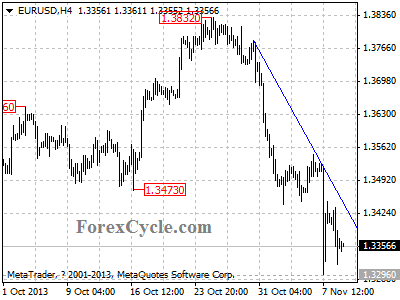
EURUSD stays below a downward trend line

EURUSD stays below a downward trend line on 4-hour chart, and remains in downtrend from 1.3832, the rise from 1.3296 could be treated as consolidation of the downtrend. Key resistance is now at 1.3450, as long as this level holds, the downtrend could be expected to resume, and next target would be at 1.3200 area. On the upside, a clear break above the trend line resistance will indicate that the downtrend from 1.3832 had completed at 1.3296 already, then the following upward movement could bring price to 1.4000 zone.

eurusd

Provided by ForexCycle.com