Japanese Candlesticks Analysis 13.11.2013 (EUR/USD, USD/JPY)

By RoboForex.com

Analysis for November 13th, 2013

EUR/USD

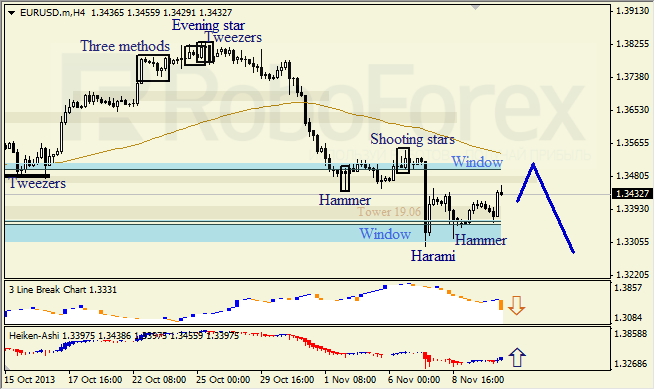
The H4 chart of the EUR/USD currency pair shows correction, which is indicated by Hammer and Harami patterns. Three Line Break chart indicates descending trend; Heiken Ashi candlesticks confirm that correction continues. Upper Window is resistance level.

The H1 chart of the EUR/USD currency pair shows correction within descending trend. Three Line Break chart indicates descending movement; Heiken Ashi candlesticks confirm that correction continues.

USD/JPY

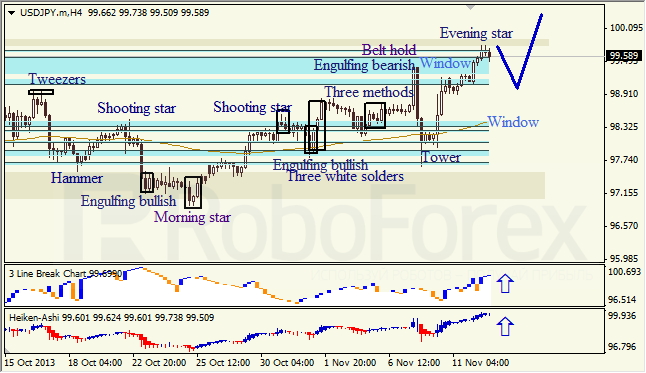
The H4 chart of the USD/JPY currency pair shows bullish tendency. Three Line Break chart and Heiken Ashi candlesticks confirm ascending movement; Evening Star pattern indicates possibility of bearish pullback.

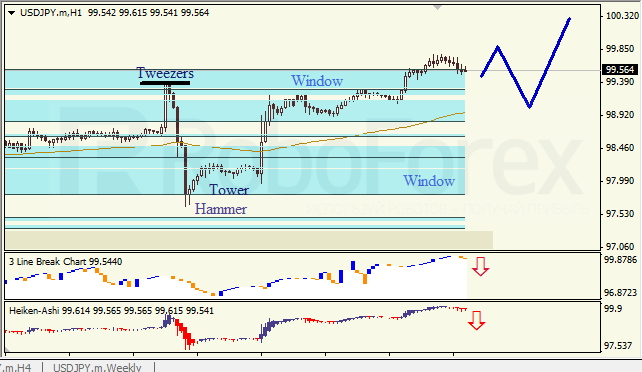
The H1 chart of the USD/JPY currency pair shows correction within ascending trend. Three Line Break chart and Heiken Ashi candlesticks confirm descending movement.

RoboForex Analytical Department


Attention!
Forecasts presented in this section only reflect the author’s private opinion and should not be considered as guidance for trading. RoboForex LP bears no responsibility for trading results based on trading recommendations described in these analytical reviews. 


What the New Record-Low ECB Interest Rate Means for U.S. Investors

121113_IC_cekerevacby Sasha Cekerevac, BA

Of all the central banks around the world, the European Central Bank (ECB) has rarely surprised markets by making monetary policy adjustments without some hints to the market first.

But this is exactly what happened last week when the ECB lowered its benchmark interest rate to a record-low 0.25% in hopes to spur economic growth. (Source: European Central Bank, November 7, 2013.)

This monetary policy change is a much bigger deal than many people realize.

First of all, as I just discussed last week, many investors have been expecting economic growth to finally emerge within the eurozone. This change in monetary policy by the ECB just validates what I’ve been saying for some time: that economic growth is nowhere in sight.

This is not news. How many years has it been since the Great Recession, and where can you find true, fundamentally strong economic growth?

All I see are central banks trying to outdo each other with easier and easier monetary policy (money printing).

With the ECB benchmark interest rate now at 0.25%, how much more ammunition does the bank have left? Does anyone really believe that a quarter-point drop in interest rates will revive economic growth for the region? I certainly don’t.

But this goes beyond just the eurozone. What the ECB is doing with monetary policy is more than simply printing money; it’s trying to lower the euro currency. And while the central bank isn’t explicitly stating that this is its plan, in my opinion, it is still a significant consideration.

Look at what the Japanese central bank has done. Japan has enacted one of the largest monetary policy (money printing) programs ever in an effort to stimulate economic growth. What Japan’s really trying to do, with some effect, is lower its currency to boost exports.

But there’s a problem with that model. Over the long term, no country has ever devalued its way to true economic growth. Sure, over the short term your export industries might get a boost, but the citizens lose their wealth as buying power is eroded.

Even in Japan, exports are benefiting, but citizens are not seeing wages increase and the prices of imports (including energy) are rising.

The entire world can’t simply continue devaluing currencies and printing money forever. For decades, we’ve seen South American nations try the same tactics and ultimately fail.

This monetary policy action by the ECB is yet another shot at trying to boost economic growth by lowering the region’s currency.

So where does this leave the Federal Reserve? Can it really begin reducing its monetary policy program when central banks around the world are printing money like it’s confetti?

If the Federal Reserve does begin to reduce its monetary policy stance, this would (on the margin) drive investors to boost the U.S. dollar versus nations that are more aggressive in their money printing. This action would create pressure on our economy, fragile as it is, by weakening exports.

The situation might then arise where all of the central bankers are looking over their shoulder at each other, waiting for inflation to flare up before reducing their money printing. But it could be too late by then, as bubbles continue to build in many markets globally.

These are difficult times; there’s no question about it. This also means that citizens in nations where monetary policy keeps money printing going at a rapid rate are subject to a loss in purchasing power (wealth).

Central banks are adamant that they want to see higher levels of inflation through monetary policy to support economic growth. The only question is: can they rein in inflation if it gets out of hand? Only time will tell.

Until then, investors should look to hard assets as a store of wealth. As I’ve discussed in this column before, it’s no secret that the wealthy are trading their paper dollars for hard assets, as there is a growing demand for real estate, diamonds, art, and physical precious metals. Having some sort of hedge to any one currency is a prudent move for investors at this point.

This article What the New Record-Low ECB Interest Rate Means for U.S. Investors was originally published at Investment Contrarians

Exclusive: Ex-JP Morgan Lawyer David Andrews Launches Atom8, A New ECN in London

Even in today’s very high technology international environment, London remains synonymous with established, large scale and traditional financial institutions whose history often dates back to the industrial revolution.

As electronic trading made its entry into the financial markets, the major industry participants in London were large and well-capitalized, and quickly encompassed institutional FX client bases, liquidity provision to FX firms and the foundation of dedicated service providers to the FX industry.

It is therefore a point of interest when a new ECN with a different ethos to that of the establishment enters such a market which is populated by giants, today’s launch of Atom8 being a case in point.

Atom8′s official launch today also follows the line of thinking which is emerging among a number of newly established firms, that London is a highly attractive location, despite the high operating costs and immense competition. Last month, a number of retail FX firms also headed to London in order to establish European operations, even after having been granted a CySec license, eschewing the Cypriot bridge to Europe facilitated under MiFID’s passport option immediately in favor of the security of London’s financial district.

Regulated by the Financial Conduct Authority, Atom8 defines itself as a technology-focused ECN FX and spread betting broker which places an emphasis on automation.

Algorithmic Toolkit

As part of the firm’s interest in technological development, Atom8 arrives on the market with its new Atom8 Trader Pro trading platform which is licensed from a software firm, which facilitates FX, CFD and spread betting as is often the case in the UK, however it also provides an algorithmic toolkit allowing institutional and private traders to interact in the same market.

The company has been co-founded by David Andrews who has assumed the position as CEO, and previously served as a commercial lawyer at JP Morgan where he worked within the cross-asset exotic OTC and securitized derivatives legal team.

Andrews_photo

David Andrews, CEO, Atom8

Speaking on the launch of the new ECN, Mr. Andrews confirmed to Forex Magnates that Atom8 will provide spread betting with raw spread, as well as FX/CFD accounts, free automated algorithmic coding services for private clients, as well as customizable multi-currency PAMM facilities, FIX API and an anonymous multi-API-configured ECN access for institutions, with low latency connectivity.

Mr. Andrews considers that the new platform is intended to provide substantial enhancements to traditional liquidity arrangements for both institutional investors and private traders, and allows clients to place orders directly into the ECN pool, essentially acting as a market maker themselves, thus avoiding paying the spread.

Atom8 currently offers up to 50 currency pairs, as well as gold and silver, with spread only or commission only accounts, which can be traded via the desktop, as well as mobile and tablet-based platforms.

Spread Betting – Without The Spread

“Atom8 aims to be the broker that popularises and democratises automated trading in the UK and abroad. Its technological superiority and desire to see its clients succeed in the challenging FX market should make Atom8 a natural choice for serious traders,” Mr. Andrews explained to Forex Magnates today.

“Our ability to create a bespoke client offering based on market-leading execution, liquidity, pricing and FX-focused trading platforms will make our platform the only one clients will want or need.”

“The practical difference for traders is palpable. ECN raw spread spread betting for UK clients and free automated algorithmic coding services are some of the revolutionary services Atom8 already delivers to its UK and international client base,” concluded Mr. Andrews.


Posted by Andrew Saks McLeod


October Job Numbers a Tale of Two Economies

by John Paul Whitefoot, BA

Are the recent U.S. job numbers a tale of two economies? The Labor Department announced last Friday that U.S. employers added 204,000 jobs in October, beating even the most optimistic estimates.

The U.S. unemployment rate, which is based on a separate survey and counted furloughed federal employees as out of work, rose from 7.2% in September to 7.3% in October.

In a world where good news is bad for investors, stocks fell after the opening bell. Why? Because investors are afraid that better job numbers will prompt the Federal Reserve to start tapering its $85.0-billion-per-month quantitative easing (QE) policy sooner than expected.

But that pessimism may be short-lived. The Federal Reserve has been pretty open about what it will take to start raising interest rates: a strong economy, namely a U.S. unemployment rate near 6.5% and inflation at 2.5%.

There’s no arguing that adding more than 200,000 jobs to the U.S. economy is good news; however, a U.S. unemployment rate of 7.3% is nothing to cheer about, regardless of whether the U.S. unemployment numbers were skewed by the U.S. government shutdown or not. The fact of the matter is that U.S. unemployment needs to drop a lot further before the Federal Reserve reins in its easy money policy and congratulates itself.

Mind you, if the Federal Reserve listens to its own economists, any attempts to taper QE could still be a few years away. While the general opinion is a 6.5% U.S. unemployment rate, at least six Federal Reserve economists think a more realistic U.S. unemployment rate goal should be as low as 5.5%.

With a current unemployment rate of 7.3%, that would give Wall Street at least two more years of easy money. That assumes the economic rule of thumb whereby an annual growth rate of three percent will bring the unemployment rate down by one percentage point.

For those who think a 5.5% unemployment rate is still a little too risky, there is another scenario. An even less-aggressive option would see the Federal Reserve start to taper QE in December—but to quell the cries on Wall Street, it would keep interest rates near zero until 2017. Don’t let that date scare you; the Fed economists think interest rates should be kept below normal (two percent) until at least 2020. (Sources: “The Federal Reserve’s Framework for Monetary Policy—Recent Changes and New Questions,” IMF web site, November 7, 2013; “Aggregate Supply in the United States: Recent Developments and Implications for the Conduct of Monetary Policy,” IMF web site, November 7, 2013.)

Ben Bernanke, the current Federal Reserve chairman, could very well begin to taper in December, but it seems unlikely. With a new head of the Federal Reserve coming to the throne in late January, there’s a good chance he’ll keep everything in place, making the transition a smooth one. And who wants to disrupt the economy just before the holidays?

What does all of this mean for investors? Despite the weak economic environment (stagnant wages, high unemployment, high personal debt, bleak consumer sentiment, etc.) the stock market continues to be the best option for those looking to cushion their retirement portfolio—at least until the Federal Reserve starts to taper in earnest and allows the markets to stand on their own two feet.

When it comes to investing in an uncertain market, it’s a good idea to consider big companies that have a history of consistent performance. Companies like Johnson & Johnson (NYSE/JNJ), Medtronic, Inc. (NYSE/MDT), 1st Source Corporation (NASDAQ/SRCE), and Kimberly-Clark Corporation (NYSE/KMB) may not be as exotic as others, but they do provide investors with capital appreciation and dividend growth.

While these companies’ share prices will ebb and flow with overarching changes in the economy, they will also, because of their strong underlying fundamentals, be able to rebound quicker than most.

This article October Job Numbers a Tale of Two Economies was originally published at Daily Gains Letter


Why a Closer Look at October Jobs Numbers Paints Anything but a Rosy Picture

121113_IC_leongby George Leong, B.Comm.

In my previous commentary, I discussed the third-quarter gross domestic product (GDP) growth and how it was really weaker than it appeared. The Federal Reserve should realize the underlying weakness in personal spending, business investment, and export sales.

The nonfarm payrolls reading released on Friday was also suspect. On the surface, the creation of 204,000 new jobs in the jobs market in October seemed spectacular, given the U.S. government shutdown during that period. Apparently, the impasse didn’t impact the October jobs market, according to the U.S. Bureau of Labor Statistics. (Source: “Employment Situation Summary,” Bureau of Labor Statistics, November 8, 2013.)

But then there are other numbers that shed some light on October’s count. Given the Briefing.com estimate of 120,000 new jobs, the October jobs market reading appears to be spectacular. An average of 190,000 new jobs have been created each month over the past 12 months. The stock market appears to be scared by the numbers (fearing a drop in quantitative easing), but the reality is the economy needs to see about 400,000 to 500,000 new jobs created each year to maintain a healthy jobs market. The average jobs growth is supported by the weak revenue growth by corporate America. It’s clearly time to take some money off the table on stocks now.

There also continues to be 11.3 million unemployed in the jobs market, and that figure is likely much higher if you count the workers who have dropped out from the workforce and those who are employed full-time but working at jobs that are well below their experience level and skill set. About 8.1 million were working part-time in the jobs market. These are the workers who cannot find full-time work or saw their hours reduced. Add this in, and you have nearly 20 million workers looking for full-time work in the jobs market.

The problem is there are only about 3.4 million or so full-time jobs available and based on the rate of jobs growth, it will take quite a while before the number rises to a point where the true unemployment rate falls to healthier levels.

There are also the 2.3 million workers the U.S. Department of Labor Statistics groups as “marginally attached.” These workers are not included in the unemployed count or the unemployment rate, because they were not active in the labor market in the four weeks prior to the official count because they’ve given up.

And what makes me question the jobs market continues to be the quality of the jobs created. Many are not highly skilled jobs requiring college education but, of course, many college graduates are working at these jobs because it’s so difficult to find jobs in their field of study.

In October, jobs in the leisure and hospitality area accounted for 26% of all jobs created. The low-skilled food services and drinking area accounted for 14%, while the retail sector generated 22% of all jobs. In all, that means 62% of the 204,000 jobs created in October were from these three low-wage-paying areas. I wouldn’t consider this great news for the jobs market, as America needs to deliver better jobs—and plenty of them—not only to existing workers, but the hoards of college graduates entering the jobs market. Based on how the economy is growing at the two-percent range, improving the quality of jobs created is not going to be easy and could impact the labor market for years to come.

While the Fed may keep buying bonds, the economy and jobs market pictures suggest you should take some profits off the table.

This article Why a Closer Look at October Jobs Numbers Paints Anything but a Rosy Picture was originally published at Investment Contrarians


France to Create More Troubles for the Eurozone?

121113_PC_lombardiBy Michael Lombardi, MBA

My take on the eurozone is that the smaller financially-troubled countries will eventually lead the bigger countries into a further economic slowdown and cause more problems for the eurozone. We can see this right now. While Germany, the biggest economic hub in the eurozone, has kept strong ground, France, the second-largest economy in the eurozone, has become a victim.

According to the National Institute of Statistics and Economic Studies, manufacturing output in France declined 1.1% in the third quarter from the second quarter of 2013, and dropped two percent on a year-over-year basis. Demand in the country is in the slumps; manufacturers of electrical and electronic equipment witnessed a decline of 1.9% in output, and manufacturers of food products and beverages saw their output plummet 2.3% year-over-year. (Source: National Institute of Statistics and Economic Studies, November 8, 2013.)

But the misery for the French economy doesn’t end with those bleak output figures. Standard & Poor’s (S&P), the credit rating agency, recently slashed the credit rating of France one notch lower. The statement from S&P: “We believe the French government’s reforms to taxation, as well as to product, services, and labor markets, will not substantially raise France’s medium-term growth prospects.” (Source: “S&P lowers France credit rating, cites slow reform pace,” Reuters, November 8, 2013.)

The French economy facing a further economic slowdown shouldn’t be overlooked by investors here in the U.S. economy. As I repeatedly say in these pages, the U.S. economy isn’t isolated from what happens elsewhere in the global economy.

Dear reader, the eurozone remaining in an economic slowdown (and it could actually get worse before it’s over) tells me the global economy is vulnerable. When the eurozone crisis was at its peak, we saw the economies in countries like China and Switzerland lag. This scenario can very well play out again, and it can become an obstacle for U.S. growth. American companies with operations in the eurozone will face scrutiny ahead.

As stock market indices here in the U.S. continue their ascent to new highs (in spite of economic fundamentals that do not support the advance), severe economic problems in the eurozone are only one example of the market’s “closed eye” to what’s really going on. Investor, beware!

This article France to Create More Troubles for the Eurozone? is originally publish at Profitconfidential


9.3 Billion Reasons to Buy These Two Cheap, Unloved Stocks

By WallStreetDaily.com

On Monday, the Dow closed at a new all-time high. That’s the 35th time it’s pulled off such a feat this year.

While I’ll take soaring prices over slumping ones any day of the week, it does make finding bargains more difficult.

And that’s a problem, since the secret to investing is truly as simple as always buying low and selling high.

You’re in luck today, though. Because I’ve dug up two cheap investments, one of which is operating in the fastest-growing industry in the world.

On such merits, there’s really only one direction for share prices to head from here.

From Russia With Love

The thought of investing in Russia right now probably makes you cringe. Even the pundits find it hard to muster up any optimism.

“Assuming some ‘optical’ recovery in the fourth quarter, [Russia’s] annual GDP growth is unlikely to come higher than 1.5%,” says Vladimir Kolychev, Chief Economist at VTB Capital in Moscow.

(And we thought U.S. GDP growth prospects were bad!)

Of course, we know that economic growth isn’t a necessary precursor for a meaningful stock market rally. Undeniably cheap equity prices, on the other hand, are of utmost importance.

And just like the United States in early 2009, that’s something Russia definitely possesses right now.

As I shared last week, Russian stocks are the cheapest among all the emerging market countries in the world.

Granted, Russian stocks typically trade at a discount to most emerging markets. But not by this much. A recent study by JP Morgan (JPM) found that Russian stocks trade four standard deviations below the average for emerging markets.

I’m sure the Kremlin isn’t happy about these low valuations. But data never lies!

The Market Vectors Russia Fund (RSX), which I shared before, represents a no-hassle way to capitalize on multiple dirt-cheap Russian stocks with a single investment. But as subscriber, Jeff W., pointed out in an email, “The fund is heavily weighted to oil and, in case you haven’t noticed, oil isn’t performing too well.”

He’s right. Roughly 42% of the fund’s investments are in energy companies, which is to be expected. After all, Russia is the world’s largest energy exporter.

I’m guessing that subscribers like Jeff are more interested in a cheap Russian investment, operating in a sector with the most robust growth forecasts.

Look no further than VimpelCom (VIP).

Go Mobile or Go Home

Forget difficult, it’s impossible to find a more compelling growth opportunity in the world than the exploding use of mobile devices.

Every time new data is released, it becomes more and more obvious how big of an opportunity we’re talking about here.

Case in point: The latest figures from Ericsson AB indicate that there will be 9.3 billion mobile phone users worldwide by 2019, up from “only” 6.3 billion at the end of 2012.

Now, VimpelCom stands to benefit from this growth because it’s one of the largest mobile companies in the world. Its operations span 18 countries, home to almost 800 million people.

And Russia happens to be the company’s biggest market. That’s a good thing for VimpelCom, given that AC&M Consulting reports that Russia’s mobile sales climbed 9% last year, while mobile data revenue surged 33%.

Sealing the Deal on Future Growth

A few weeks ago, VimpelCom reached a new agreement with Apple (AAPL). As of October 25, it’s officially selling the latest iPhones – the 5S and 5C – in Russia.

That’s bound to boost VimpelCom’s overall sales in the coming quarters. Especially since “Apple has a huge army of fans in Russia,” according to Evgeny Golosnoy, analyst at IFC Metropol in Moscow.

Last month, VimpelCom also moved its listing from the NYSE to the Nasdaq exchange and joined the Nasdaq-100 Index. The transition all but guarantees that more and more investors will start paying attention to the stock.

To top it off, it’s trading for just 9.3 times forward earnings. That works out to a 42% discount to the average U.S. stock. Plus, it sports a dividend yield north of 6%.

How many U.S. stocks do you know that can go head-to-head with those fundamentals? Not many.

Bottom line: As Luis Saenz at BCS Financial Group says, “VimpelCom has been an overlooked orphan in the market and that is changing now. Many more eyes will be on the stock now.”

Indeed! But that also means the bargain won’t last long. So don’t delay…

Ahead of the tape,

Louis Basenese

The post 9.3 Billion Reasons to Buy These Two Cheap, Unloved Stocks appeared first on Wall Street Daily.

Article By WallStreetDaily.com

Original Article: 9.3 Billion Reasons to Buy These Two Cheap, Unloved Stocks

3D Printing, the Real Technology Story

By MoneyMorning.com.au

The trouble with being an active investor is that you tend to look at the market every day. That’s a big problem when the market action is as boring as this.

So today, we’ll take a break from the hum-drum and look at the exciting.

For instance, in recent weeks all the big stock market talk has been about technology stocks such as Twitter [NASDAQ: TWTR] and Facebook [NASDAQ: FB].

Those are interesting stories.

And our bet is over the next five to 10 years investors will do well from both those stocks – whatever some people say about them today.

But as exciting as these stocks are, let’s be honest, their future revenue and profit growth is almost entirely predictable.

So while we like them, when it comes to technology stocks, we prefer something even more exciting. We like unpredictable and revolutionary technology stocks

As we say, Facebook and Twitter are predictable businesses.

If you think their business is about staying in touch with old friends, you’re wrong.

Both businesses are just a way to generate ad revenue.

And that’s fine. There’s nothing wrong with that. In fact, last month we wrote a full research report in Australian Small-Cap Investigator tipping a home grown Aussie that’s directly involved in the ad market.

But when it comes to revolutionary ideas, nothing comes close to this game-changing industry…

Simple, Yet Game-Changing

One of the hottest parts of the technology sector is 3D printing.

We’ve followed the sector since launching the premium technology investment advisory service Revolutionary Tech Investor in June.

If you’re not familiar with 3D printing it’s a simple yet game-changing concept. Most manufacturing involves tooling up a big manufacturing plant.

It can be expensive to set up these facilities. A manufacturer will usually demand a minimum order run that could number in the thousands in order to manufacture a product.

For that reason, companies that only needed a small product run looked for other methods. Most of these involved making products by hand. We’re thinking about architectural models or model prototypes made from wood, plaster or some other easy-to-form material.

But it’s time-consuming. That’s where 3D printing enters the frame.

3D Printing: The End of Globalisation

In simple terms, 3D printing involves heating a strip of plastic that feeds from a spool through a heated nozzle.

The nozzle guides the hot plastic onto a plate layer by layer. The plastic cools almost straight away, allowing it to set.

This happens layer by layer until the product is finished.

It’s a simple yet amazing invention. We even bought a 3D printer to check it out for ourselves. Of course, while it may be cool, no business will make much out of just printing a few prototypes or models.

That’s where we see much bigger things for 3D printing.

For a start we see this as the beginning of the end of globalised manufacturing. The ability to print components and complete products locally on demand will mean local firms can compete with cheap Chinese products.

Not only that, but as the price of 3D printers falls, it means every household will soon have their own 3D printer. We’re not kidding.

Right now a basic 3D printer costs less than $1,000. While that may still seem expensive, remember that 3D printing still hasn’t hit the mainstream. By the time it does our bet is you’ll pick up a cheap 3D printer for the same price as a cheap document printer; $99.

But again, while this sounds great, why would anyone need one at home? For the same reason that you may have a document printer at home: the convenience of printing something for yourself rather than getting someone else to do it for you.

What would you print? It could be anything…anything that’s small and plastic. A spare part for something. Something for the kids’ bedroom. Something for the kitchen, garden or garage.

But this goes one step further than that…

Just Because You Don’t Like it, Doesn’t Make it a Bad Investment

One 3D printing firm in the US has just released an affordable 3D scanner that will sell for less than US$400.

The great thing about this is that it’s building on the foundations of social media and mobile technology.

This new 3D scanner lets users scan objects 3m x 3m and then print the scanned image as a scaled-down 3D printed model. As we wrote to Revolutionary Tech Investor readers yesterday, you could print scale models of yourself, your family and even a small car!

Now, you may think that’s pointless and self-indulgent. But that’s the nature of being a consumer. Consumerism is about buying things that satisfy a want or need.

The 3D printing industry looks set to be part of that consumerism. You may not agree with it, approve of it, or like it. But that shouldn’t matter when it comes to investing.

Successful speculative investing is about identifying trends, weighing up their chance of success and then investing in them as early as possible.

3D printing stocks have done well already this year, but if we’re right about this being the beginning of a new trend, there are more good times to come.

Cheers,
Kris+

From the Port Phillip Publishing Library

Special Report: Read This or Retire Poor

Join Money Morning on Google+

Join Money Morning on Google+

When $750,000 Isn’t Enough for your Retirement Income

By MoneyMorning.com.au

The service was lousy. The food was great. The wine was OK. The topic was disturbing.

Here’s the scene: four baby boomer couples out for dinner. The three other males are longtime friends of mine…we’ve been mates since we started grade five together in 1969.

The four men are at one end of the table discussing politics, sports, business and work. The four ladies at the other, chatting about what the children are up to, travel plans and whatever else ladies talk about while the men are ‘solving the problems of the world’.

Occasionally our conversations crossed over. One such time was when I was asked, ‘Vern, I read a column recently from a highly respected financial planner that your retirement capital needs to be 15 times your retirement income. Is that correct?

This question caught the attention of everyone at the table, for the simple reason six of the eight are turning 55 or older next year. Retirement, or at least the prospect of it, is occupying more conscious thought amongst our peer group.

After some not so quick (shiraz assisted) mental arithmetic, my response was, ‘You will need at least 25 times.

Why You Need More Than One Million to Retire

This was not the response my mate was looking for. He wanted to be told yes, 15 times is the magic figure. I suspect this is because he has done his ‘back of the envelope’ calculations on when this 15 times figure and his age will meet.

For those whose strength is not math, please allow me to demonstrate why my friends’ visions for retirement began to evaporate.

A $500,000 shortfall in your retirement capital is more than just a rounding error. Considering it has taken all your working life to accumulate $750,000, how many more years of servitude need to be endured to bridge the gap?

My friend took aim at the messenger (being me) and said, ‘That’s rubbish. You’re telling me I won’t be able to earn $50,000 on $750,000?

My response of, ‘Maybe, maybe not,’ didn’t help clarify matters.

Before I could expand on my vague response, my friend said, ‘I can earn 8%. On $750k this equates to $60k, so $50,000 is easily achievable.

Rather than explain my previous vague response, I asked him incredulously, ‘Where can you get 8% on your money?

To which he replied, ‘From the share market. It has averaged 8% going back several decades.

My friend is well read. He has two degrees. Holds a senior executive position. And is one of the nicest people I know. So it took all of my willpower to stop myself from shaking him.

In the interest of not ruining a fun night and getting bogged down by facts and figures, it was better to let the conversation drift back to topics of far more importance – like, would Australia beat England in the rugby league World Cup opener?

However had I persisted and gone on to earn the title of the most boring dinner guest of all time, this is the line the conversation would have taken…

I would have referred to Ed Easterling’s (Crestmont Research) report titled: ‘Destitute at 80: Retiring in Secular Cycles’.

This is the opening paragraph of the report (emphasis mine):

‘There has never been a thirty-year period for the stock market when investors have lost money; yet there have been quite a few thirty-year periods that have bankrupted senior citizens who were relying upon their stock portfolios for retirement income.’

My friend is correct; the share market has averaged over 8% per annum over the long, long term. However, an average consists of high, medium and low data points.

Don’t Bank on Recent History Repeating

For instance, retirees investing in shares in 1982 managed to ride the most extraordinary share market boom in history. The All Ords index expanded from 450 points in 1982 to over 6800 points in 2007. After twenty-five years the fortunate retiree experienced a fifteen-fold increase in capital value PLUS dividends.

The 1982 to 2007 period was a high point in the compilation of market data.
But can it be relied upon to repeat itself for baby-boomer retirees? History says no.

The 8% per annum average return my friend mentioned is comprised of 4% income + 4% growth. The only probable constant in this equation is the 4% income (and that could vary depending upon the business cycle). The 4% growth may or may not eventuate – the Australian share market is still 20+% lower than where it was six years ago. 

The 4% probable income return is why I selected 25 times retirement income as the capital value; $1.25 million x 4% = $50,000.

Personally I think the multiple on retirement income should be much higher, as the Great Credit Contraction (leading to an unprecedented bout of deflation) could shrink income returns even lower – however this little piece of ‘good’ news would have really killed the mood of the evening.

In addition to the prospect of lower income returns, there is the very real prospect of the boomer generation living well into their nineties and beyond.

So a strategy based on squeezing every bit of ‘hoped for’ return from your capital in the early years of retirement is a recipe for financial disaster – in my humble opinion.

Ed Easterling’s report was far more scientific and mathematically based than my back of the napkin doodling.

His report ran the numbers on a retiree with $1 million wanting a $50,000 income (5% return) over a thirty-year period.

He then calculated their odds of success based on if they had invested when the market (as valued by Price/Earnings or P/E – ratio) was overvalued, fair value or undervalued.

Here is the background of the research in his words:

A number of advocates and studies provide for 5% withdrawal rates: “I only want $50,000 from my million dollars” and have it last for 30 years. The calculated success rate for that rate of withdrawal is 73%. Pretty good odds…except when we consider the impact of valuation.’

Here are the results based on 130 years of data on Secular Markets:

A retiree who invested when the market P/E was greater than 18.5x (the top quartile) had less than a 50% chance of their capital surviving 30 years. The average outcome for investors in this quartile was a LOSS of $850k.

The best outcome was for those who invested in the bottom quartile, when the starting P/E was less than 11.2x. This group of investors had a 95% chance of success and on average turned their $1 million into $7.6 million.

So Which Quartile is the Market in Today?

According to the Shiller P/E 10, the US market is well and truly in the top quartile – signals should be flashing ‘WARNING, WARNING TOXIC INVESTMENT AHEAD’.

Conversely when the P/E dips below 10x (the bottom quartile) there is a clear signal markets stage a long and strong recovery. However for a market to have reached this depressed level, it has created such carnage, very few people are remotely interested in investing – we are indeed strange creatures…buy high and sell low…go figure.

Instead of ringing the alarm bells, the investment industry is quite happy to perpetuate the myth that in the long term shares always go up. The reality is the long term is your life expectancies. If the market decides to repeat the rhythmic pattern of high to low P/E during your retirement years, then ‘in the long term’ (together with your capital) will mean precious little to you.

To be fair Easterling’s report is based on a portfolio invested 100% in shares. Very few retirees commit to this asset allocation.

However the average balanced fund does have a high percentage (60-80%) allocated to ‘growth’ assets – Australian shares, international shares and property.

Therefore the lesson in Easterling’s report is still relevant. Growth assets do not always grow.

My message to our friends is to err on the side of caution. Better to stay another few years in the workforce and accumulate a healthy capital buffer than to spend the last decade or more of your life living hand to mouth.

Perhaps the really lousy service we experienced during last Saturday night’s dinner was fate’s way of signaling how frustrating it would be to become dependent on someone else providing for your needs.

Vern Gowdie+
Chairman, Gowdie Family Wealth

Join Money Morning on Google+

Armenia cuts rate 50 bps, sees lower inflation

By CentralBankNews.info
    Armenia’s central cut its benchmark refinancing rate by 50 basis points to 8.0 percent, reversing a rate rise in August, saying the easier policy reflected the inflationary environment.
    The Central Bank of Armenia (CBA) raised its rate by 50 basis points in August due to accelerating inflation but then said in September that it expected inflation to start to decline in coming months and this would allow the bank to loosen monetary conditions.
    Armenia’s headline inflation rate fell to 7.1 percent in October from 8.19 percent in September and 9.245 percent in August, a high for this year. The CBA targets inflation of 4.0 percent within a 1.5 percentage point band.
    “The board (of the CBA) believes that 12-month inflation will continue to decline in coming months and inflation expectations are anchored,” the bank said, adding that it expects inflation to remain within the tolerance band in 2014.
    Armenia’s Gross Domestic Product expanded by an annual 0.6 percent in the second quarter, down from 7.5 percent in the first quarter, but growth should improve due to an expansionary fiscal policy in the fourth quarter and next year, the CBA said.

    www.CentralBankNews.info