Institutional Investors’ Risk of “Having to Be in Stocks” High

By Mitchell Clark, B.Comm.

It’s an amazing performance that few people predicted at the beginning of the year—this stock market might just keep on climbing right into the New Year.

Just recently we looked at Automatic Data Processing, Inc. (ADP) as it broke a new all-time record high of $77.00 a share. Now, the position has surpassed $80.00 a share, still boasting a 2.4% dividend yield. It was $60.00 a share in January.

The stock market should have experienced a major correction this year, but it consolidated during the summer and reaccelerated instead.

The huge price movements of so many large and mature enterprises are not unusual in the historical performance of the stock market. In the middle of 1998, ADP was $30.00 a share (split adjusted). Two years later, the position hit a new, all-time record-high around $60.00 before correcting with technology stocks.

ADP and so many other positions illustrate the power that monetary policy has on the stock market’s business cycle. Clearly, equities today are overbought, but institutional investors have to be buyers, because investors don’t pay fees to have money sitting in cash.

While I feel that the stock market can close this year out strongly, generally speaking, I am not enthusiastic about investors buying this market. The fundamentals are slowly coming together to support the case for rising equity prices, but all the good news in terms of balance sheets and earnings outlooks are already priced into this market. Anything can happen going forward, but expectations for investment returns have to be extremely low if one is buying a stock market that’s already gone up.

A profound and prolonged correction would be an ideal development in my view. It’s not that I’m rooting for losses; in fact, it’s quite the opposite. Speculative fervor, especially among initial public offerings (IPOs), seems to be at a peak and investors with money to be put to work need more value than is currently being offered. While there are all kinds of reasons why an investor would buy stocks at their all-time highs, investment risk is not reasonable considering potential returns at this time.

Institutional investors, for the most part, can’t really keep their funds in cash, but individual investors can do so. I think the stock market remains a hold, but new money can sit on the sidelines in anticipation of what I hope will be a significant correction.

If the catalyst for such a correction next year is a change in monetary policy, it would likely be an attractive buying opportunity.

I’m of the view that the stock market’s recent strong performance is representative of a breakout from its previous long-run cycle (2000 to 2012), and what’s transpired is the beginning of a secular bull market and a new business cycle.

As I wrote in April, if this is the beginning of a secular bull market, there will be spectacular declines within it. (See “Unbelievable Stock Market Now Destined for Greatness?”) As the stock market has shown so well historically, price inflation is what keeps the system going, but it is that same price inflation that is responsible for the bubbles and collapses.

This article Institutional Investors’ Risk of “Having to Be in Stocks” High is originally posted at Profitconfidential


Thoughts from the Frontline: Game of Thrones-European Style

By John Mauldin

In 2009-10 it seemed like this letter was all Europe all the time. There was a never-ending crisis from one corner of the Continent to the other. That time seems to have slowly faded from our collective consciousness, but the Eurozone crisis is not over, and it will not end quickly or soon. Even if it seems to unfold in slow motion – like the slow build-up in a Game of Thrones storyline to violent internecine clashes followed by more slow plot developments but never any real resolution, the Eurozone debacle has never really gone away. The structural imbalances have still not been fixed; politicians and central bankers have still not agreed to solve major fiscal problems; the overall economy still disintegrates; unemployment is staggeringly high in some countries and still rising; and the people are growing restless.

Just as in the Game of Thrones, the Eurozone drama seems to drag on interminably. It seems to take forever to get to the next installment. I think GRR Martin (the wickedly brilliant creator of the series) should be confined to his Santa Fe villa until he finishes his epic – one of the few lapses in my personal belief that we should be allowed the freedom to control our own time. I read the first of the books in 1996 and the fifth when it came out in 2011, and he will need to finish at least two more. You can do the math, but it is clearly taking longer and longer between books – just as Europe seems to be taking longer and longer between successive peaks of its crisis. Perhaps we should confine the leaders of Europe to a far-northern Scandinavian hotel with hard beds and minimal amenities until they resolve their problems.

In the latest installment of the Eurozone crisis, deflation is back and winter is coming. This week we’ll look at what is shaping up to be a very interesting year in Europe. I am going to visit a number of themes and offer links to readers who want to delve more deeply, as to develop each one would take several months’ worth of letters. Next year it probably shall.

Winter Is Coming

One of the continuing themes in the Game of Thrones is that a winter of epic proportions looms in the immediate future, and the world is not prepared for it. “Winter is coming” is whispered by worried wise men who urge various leaders to prepare, yet they put off the necessary in the face of the urgent. Signs that a European winter, too, is coming have lately been cropping up.

Key measures of inflation are decelerating across the Eurozone, and the region is as close as it has ever been to a deflationary bust. It’s troubling enough that Eurozone headline CPI collapsed from 1.1% in August to 0.7% in September and that core CPI fell from 1.0% to 0.8% over the same period; but measures of Eurozone money supply (M1, M2, & M3) are also decelerating rapidly, suggesting that the deflationary trend will most likely continue without decisive action from the ECB, which has been strangely absent from the current rush by central bankers to print mountains of money. And the ECB could actually make a case for such action!

Even worse, this new round of borderline deflationary data is coming not just from a small number of lost causes like Greece or Cyprus. Ten out of the seventeen Eurozone countries experienced rapidly decelerating inflation rates over the past few months, including Italy and France. Spain officially fell into deflation for the first time since February 2010. In many ways, the situation is even worse than the CPI numbers suggest. Note that Italy, France, and Germany all hover barely above 1% inflation. And their numbers are falling.

There are two major problems associated with an extended period of ultra-low inflation or deflation in the Eurozone. First, peripheral countries will have a much harder time servicing and retiring their debts without the extra boost to nominal GDP that positive inflation provides. Even if you are working on lowering the absolute amount of your debt, it is impossible to improve your debt-to-GDP ratio when GDP is falling and your debts are growing. Moreover, outright deflation works to crush debtors (and debtor nations) by increasing the real weight of the debt and triggering the destructive debt-deflation cycle described in Irving Fisher’s Debt Deflation Theory of Great Depressions (1933).

The second major problem is that currency appreciation always accompanies deflation – all else being constant – so that affected economies also become less competitive in terms of exports at the very moment that a positive trade balance is most important.

These are problems that I have written about for years. The effects of a common currency and monetary policy are spread around very unevenly in Europe, creating a boom in certain countries (chiefly Germany) and a sad bust in others. This disparity is the very predictable result of a currency union sans fiscal union. And trying to fix the Eurozone fiscal structure after the fact is akin to fixing the engine of an airplane while flying at 30,000 feet.

The rapidly weakening inflation we are seeing in Europe is a very big deal, because deflation can become a chronic, crushing condition, making it even harder to deal with excessive debt, undercapitalized banks, and runaway fiscal deficits in major countries like Spain, Italy, and France. Over time the masses begin to expect falling rather than rising prices, and these expectations can be very difficult to reverse without credible, decisive, and powerful action from the central bank.

Up to this point, the ECB has been almost completely unwilling to squarely confront the issues at hand. The ECB balance sheet has been inexplicably shrinking for the past year (more on that in a moment). That is why ultra-low inflation readings should not come as a surprise. Not only has the ECB not been easing, it has actually tightened its balance sheet considerably over the past year. To many observers, this trend clearly demonstrates German dominance within the ECB.

“This is just like Japan,” says Lars Christensen of Danske Bank. “The central bank thought money was easy when in fact it was much too tight. But effects could be much worse in Europe because unemployment is so much higher.” In addition to a central bank seriously behind the curve, structural problems are holding back economies across the periphery, including Spain, Italy, and, yes, even France.

“Like Japan, necessary structural reforms prior to the crisis were delayed and now these will have to be implemented in an environment that is both economically and politically more fragile,” said Takeo Hoshi & Anil Kashyap in a recent report for the IMF. Germany looks like an exception precisely because it undertook structural reforms well before the crisis, which is part of the reason that Germany is doing so well and much of the rest of Europe is not.

You can see the disastrous difference between German industrial production and Italian industrial production in this chart from my friends at GaveKal. This chart would look much the same whether it was France, Italy, Greece, Ireland, or any of the peripheral countries contrasted with Germany. Structural reform of labor policies requires massive social disruption in the best of times. I think we can all agree that for southern Europe this is not the best of times.

True, the risk of government funding crises has receded since Mario Draghi’s July 2012 commitment to “do whatever it takes” to preserve the Euro; but debtor countries like Greece, Cypress, Spain, Ireland, Portugal, Italy, and France have been forced to bear most of the economic cost. Like Japan, the Eurozone has failed to adequately recapitalize its banking system, and troubled economies have failed to address structural problems through reforms.

Ambrose Evans-Pritchard recently noted, “While the risk of a Eurozone bond crisis has greatly receded since the ECB agreed to act as a lender of last resort in July 2012, this has been replaced by slow economic attrition.”

Outright Monetary Transactions (or OMTs) by the ECB are limited by the size of its balance sheet, and the German Constitutional Court may further limit the ECB’s capabilities when it rules on OMT in early 2014. No one really seems to be talking about this fact, but the ECB is losing firepower each and every month as its balance sheet contracts. This trend is going to require Germany to change its stance in the face of the next crisis, but the question is, what will Germany demand in return? Germany always seems to have a price for action. While the market was willing to give Draghi the benefit of the doubt in the last crisis without his really having to fire a shot, it is entirely possible that it will question the limits of his ability to find the funds necessary to solve multiple crises at once. And if France is one of those countries that needs aid? Mon Dieu, c’est une catastrophe!


To continue reading this article from Thoughts from the Frontline – a free weekly publication by John Mauldin, renowned financial expert, best-selling author, and Chairman of Mauldin Economics – please click here.


© 2013 Mauldin Economics. All Rights Reserved.

Thoughts from the Frontline is a free weekly economic e-letter by best-selling author and renowned financial expert, John Mauldin. You can learn more and get your free subscription by visiting www.MauldinEconomics.com.

Please write to [email protected] to inform us of any reproductions, including when and where copy will be reproduced. You must keep the letter intact, from introduction to disclaimers. If you would like to quote brief portions only, please reference www.MauldinEconomics.com.

To subscribe to John Mauldin’s e-letter, please click here: www.mauldineconomics.com/subscribe

To change your email address, please click here: http://www.mauldineconomics.com/change-address

Thoughts From the Frontline and MauldinEconomics.com is not an offering for any investment. It represents only the opinions of John Mauldin and those that he interviews. Any views expressed are provided for information purposes only and should not be construed in any way as an offer, an endorsement, or inducement to invest and is not in any way a testimony of, or associated with, Mauldin’s other firms. John Mauldin is the Chairman of Mauldin Economics, LLC. He also is the President and registered representative of Millennium Wave Advisors, LLC (MWA) which is an investment advisory firm registered with multiple states, President and registered representative of Millennium Wave Securities, LLC, (MWS) member FINRA and SIPC, through which securities may be offered. MWS is also a Commodity Pool Operator (CPO) and a Commodity Trading Advisor (CTA) registered with the CFTC, as well as an Introducing Broker (IB) and NFA Member. Millennium Wave Investments is a dba of MWA LLC and MWS LLC. This message may contain information that is confidential or privileged and is intended only for the individual or entity named above and does not constitute an offer for or advice about any alternative investment product. Such advice can only be made when accompanied by a prospectus or similar offering document. Past performance is not indicative of future performance. Please make sure to review important disclosures at the end of each article. Mauldin companies may have a marketing relationship with products and services mentioned in this letter for a fee.

Note: Joining The Mauldin Circle is not an offering for any investment. It represents only the opinions of John Mauldin and Millennium Wave Investments. It is intended solely for investors who have registered with Millennium Wave Investments and its partners at http://www.MauldinCircle.com (formerly AccreditedInvestor.ws) or directly related websites. The Mauldin Circle may send out material that is provided on a confidential basis, and subscribers to the Mauldin Circle are not to send this letter to anyone other than their professional investment counselors. Investors should discuss any investment with their personal investment counsel. John Mauldin is the President of Millennium Wave Advisors, LLC (MWA), which is an investment advisory firm registered with multiple states. John Mauldin is a registered representative of Millennium Wave Securities, LLC, (MWS), an FINRA registered broker-dealer. MWS is also a Commodity Pool Operator (CPO) and a Commodity Trading Advisor (CTA) registered with the CFTC, as well as an Introducing Broker (IB). Millennium Wave Investments is a dba of MWA LLC and MWS LLC. Millennium Wave Investments cooperates in the consulting on and marketing of private and non-private investment offerings with other independent firms such as Altegris Investments; Capital Management Group; Absolute Return Partners, LLP; Fynn Capital; Nicola Wealth Management; and Plexus Asset Management. Investment offerings recommended by Mauldin may pay a portion of their fees to these independent firms, who will share 1/3 of those fees with MWS and thus with Mauldin. Any views expressed herein are provided for information purposes only and should not be construed in any way as an offer, an endorsement, or inducement to invest with any CTA, fund, or program mentioned here or elsewhere. Before seeking any advisor’s services or making an investment in a fund, investors must read and examine thoroughly the respective disclosure document or offering memorandum. Since these firms and Mauldin receive fees from the funds they recommend/market, they only recommend/market products with which they have been able to negotiate fee arrangements.

PAST RESULTS ARE NOT INDICATIVE OF FUTURE RESULTS. THERE IS RISK OF LOSS AS WELL AS THE OPPORTUNITY FOR GAIN WHEN INVESTING IN MANAGED FUNDS. WHEN CONSIDERING ALTERNATIVE INVESTMENTS, INCLUDING HEDGE FUNDS, YOU SHOULD CONSIDER VARIOUS RISKS INCLUDING THE FACT THAT SOME PRODUCTS: OFTEN ENGAGE IN LEVERAGING AND OTHER SPECULATIVE INVESTMENT PRACTICES THAT MAY INCREASE THE RISK OF INVESTMENT LOSS, CAN BE ILLIQUID, ARE NOT REQUIRED TO PROVIDE PERIODIC PRICING OR VALUATION INFORMATION TO INVESTORS, MAY INVOLVE COMPLEX TAX STRUCTURES AND DELAYS IN DISTRIBUTING IMPORTANT TAX INFORMATION, ARE NOT SUBJECT TO THE SAME REGULATORY REQUIREMENTS AS MUTUAL FUNDS, OFTEN CHARGE HIGH FEES, AND IN MANY CASES THE UNDERLYING INVESTMENTS ARE NOT TRANSPARENT AND ARE KNOWN ONLY TO THE INVESTMENT MANAGER. Alternative investment performance can be volatile. An investor could lose all or a substantial amount of his or her investment. Often, alternative investment fund and account managers have total trading authority over their funds or accounts; the use of a single advisor applying generally similar trading programs could mean lack of diversification and, consequently, higher risk. There is often no secondary market for an investor’s interest in alternative investments, and none is expected to develop. You are advised to discuss with your financial advisers your investment options and whether any investment is suitable for your specific needs prior to making any investments.

All material presented herein is believed to be reliable but we cannot attest to its accuracy. Opinions expressed in these reports may change without prior notice. John Mauldin and/or the staffs may or may not have investments in any funds cited above as well as economic interest. John Mauldin can be reached at 800-829-7273.



Janet Yellen Is Close to Making History in Two Ways

Psychology appears near a major turn

By Elliott Wave International

Janet Yellen just moved closer to her place in history when the Senate Banking Committee approved her nomination to lead the Federal Reserve. The full Senate is expected to confirm. If so, she will be the first chairwoman in the central bank’s 100 year history.

But when her term concludes, gender may be secondary to the narrative about her time at the helm. The larger focus could be that Yellen was at the helm of economic disaster.

Here’s what Robert Prechter said in the October Elliott Wave Theorist:

Economists and journalists are taking Janet Yellen’s approaching stint as Chairman of the Fed at face value and opining what she will bring about for the economy. Our socionomic point of view prompts a different tack and makes us ask what social mood will bring about for her.


…Social mood is a powerful regulator of public perception. Consider this contrast: Nixon lied to protect his buddies, and his career and reputation were ruined. Clinton lied to a grand jury and the nation to protect his own hide, but he makes six figures a speech. What made the difference? The answer is that social mood was deeply into a negative trend in August 1974, when Nixon finally resigned and entered retirement in disgrace; whereas it was soaring in a positive trend in 1999, when Clinton survived impeachment and went on to become perceived as an elder statesman. The stock market had been falling for over eight years in Nixon’s case, and it had been rising for over eleven years in Clinton’s case. This is why society condemned Nixon but forgave Clinton.


The coming negative trend in social mood will cause Yellen to fail at her job. When bond investors become more cautious — as they will in a negative-mood trend — the image of central-bank potency will begin to dissolve. That will neuter the Fed’s presumed jawboning power. As for its ability to force inflation, the bond market, not the Fed, is ultimately in charge of interest rates. Investors’ demands for higher rates will negate the Fed’s inflationary activity. As rates on Treasury bonds move up, the values of existing bonds will fall, lowering the total value of money+credit, thus neutering the Fed’s inflationary policy. Finally, when bond buyers begin demanding 4%, then 6%, then 10%, then 20% interest for assuming the risk of owning a Treasury obligation, both the government and the Fed will face ruin. …


Indeed, 10-year Treasury note yields stand near a two-month high.

Moreover, bond yield spreads have widened:

The difference between the yields on two- and 10-year notes widened to 2.54 percentage points, the most since August 2011 as investors demand more to own longer-term securities … A report showed producer prices fell last month, suggesting inflation is tamed. The Treasury sold $13 billion of 10-year inflation-protected securities at the highest yield since July 2011.

— Bloomberg, Nov. 21

Worried bond investors may well demand even higher yields down the road.

Bond yields skyrocketed during the Great Depression; the October Theorist also said that the Yellen era will likely have a parallel with former Fed chair Eugene Meyer, who presided over the central bank during the Great Depression.

For a limited time, you can read Robert Prechter’s 6-page report to prepare for what EWI sees ahead. In this report you’ll learn why the risk of deflation is mounting and how you can see it coming in the prices of gold, gas, real estate, crude oil and other markets. See below for full details.


What Do the Prices of Gold, Gas, Real Estate and Crude Oil Tell Us About the Economy?
Read this new FREE report from Robert PrechterRobert Prechter of Elliott Wave International gives you a clear sense of what really drives the markets and the U.S. economy. In this FREE report, you will read about real estate, crude oil, gold, and other markets (with the support of 16 charts!) to see why these markets point to deflation rather than inflation – exactly the opposite of what the Fed wants. But never mind what the Fed wants: What you want and what you will get is a new perspective on the financial markets to help you invest prudently.

Download your FREE report by Robert Prechter now – for a limited time >>


This article was syndicated by Elliott Wave International and was originally published under the headline Janet Yellen Is Close to Making History in Two Ways. EWI is the world’s largest market forecasting firm. Its staff of full-time analysts led by Chartered Market Technician Robert Prechter provides 24-hour-a-day market analysis to institutional and private investors around the world.


Wave Analysis 27.11.2013 (DJIA Index, Crude Oil)

Article By RoboForex.com

Analysis for November 27th, 2013

DJIA Index

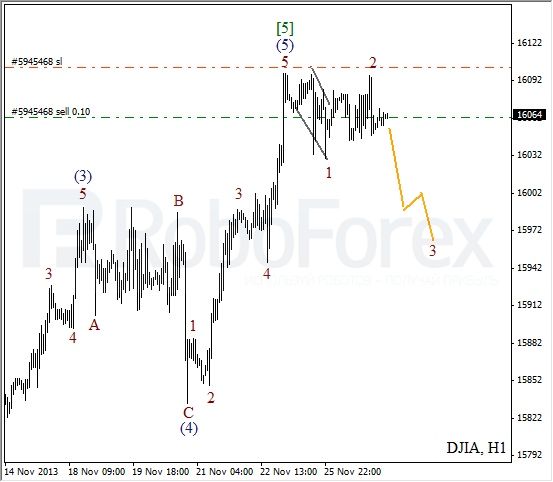
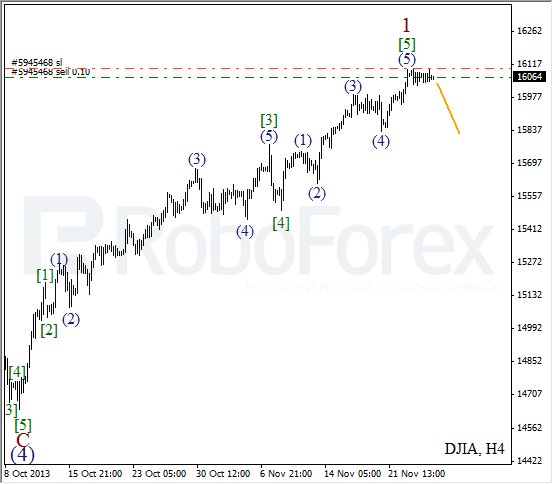
Current chart structure implies that Index completed bullish impulse inside wave 1. It looks like on minor wave level price finished wave [2] and right now is starting to reverse. Probably, bears may return to the market during the day.

As we can see at the H1 chart, price formed descending wedge pattern inside wave 1. Possibly, instrument also formed zigzag pattern inside wave 2 and is about to start falling down inside the third one. During local correction, I opened sell order with stop placed a bit above maximum.

Crude Oil

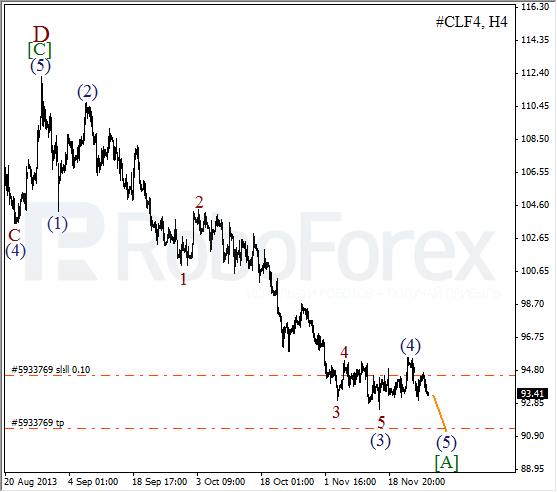
Oil is still moving downwards; I’ve already moved stop on my sell order into the black. Earlier, after completing long extension inside the third wave, instrument finished wave (4). Price may break minimum during the day.

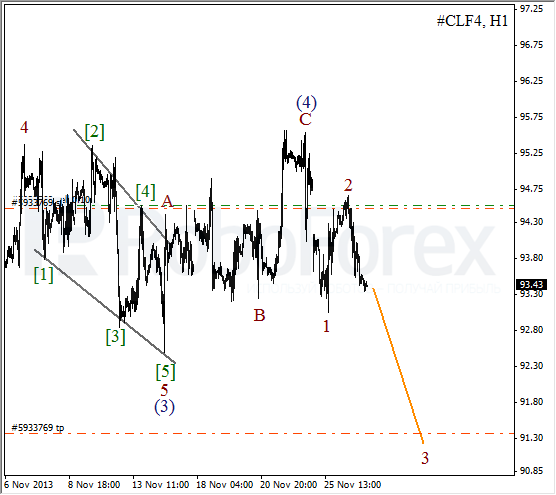
More detailed new wave structure is shown on H1 chart. Wave (4) took the form of zigzag pattern and then price completed initial impulse inside wave 1. While forming wave 2, instrument has eliminated the gap occurred during the market opening on Monday. In the near term, I expect price to continue falling down inside wave 3 of (5).

RoboForex Analytical Department

Article By RoboForex.com

Attention!
Forecasts presented in this section only reflect the author’s private opinion and should not be considered as guidance for trading. RoboForex LP bears no responsibility for trading results based on trading recommendations described in these analytical reviews.


Gold Prices Advanced on China Strong Demand

By HY Markets Forex Blog

Prices of gold were seen rising during Asian trading session on Wednesday, following reports from China which showed the demand for gold was stronger in October and during the whole year.

Yellow metal futures advanced 0.37% higher, trading at $1,246.10 per troy ounce at the time of writing, while the silver futures gained 0.34%, standing at $19.960 per ounce at the same time.

Holdings in the world’s largest gold-backed exchange-traded fund, SPDR Gold Trust, came in at 848.91 tones on Tuesday, dropped to its lowest level since February 2009.

The US dollar index, which measures the strength of the US dollar against a basket of six of its major peers, dropped 0.05% to 80.569 points.

Gold Prices – China Strong Demand

According to recent data, China imported 129.9 metric tons of gold in October, the highest in seven months, up from 109.4 tons recorded in the previous month. Demand increased to 955.9 tons in the first ten months of the year, doubling last year’s amount.

According to forecasts from the World Gold Council, China is expected to overtake India as the biggest gold consumer as its demand is expected to reach 1,000 tons by this year end.

Gold Prices – US Data

The consumer Confidence Index for November dropped to 70.4, from last month’s reading of 71.2 and below analysts’ forecast of 72.4.

Meanwhile, home-builders in the US took out 1.034 million in October, higher than analysts’ forecasts of 940,000. In September, 974,000 issued permits and 926,000 in August, according to reports from the US Department of Commerce.


Visit www.hymarkets.com   to find out more about our products and start trading today with only $50 using the latest trading technology today.

The post Gold Prices Advanced on China Strong Demand appeared first on | HY Markets Official blog.

Article provided by HY Markets Forex Blog

Crude Oil Prices Drops Amid Turmoil in Libya

By HY Markets Forex Blog

Crude oil prices declined on Wednesday after the recent data showed a rise in crude stockpiles in the US, the world’s largest oil consumer.

West Texas Intermediate for December delivery dropped 0.24% lower to $93.46 a barrel on the New York’s Nymex at the time of writing, while the European benchmark Brent rose 0.03% at $110.93 a barrel at the same time.

Crude Oil – US Inventories

Crude Inventories in the US, the world’s largest oil consumer; rose by 6.92 million barrels for the week ended November 22, according to reports from the American Petroleum Institute. The report also showed that gasoline supplies added 201,000 barrels in the week.

The Energy Information Administration (EIA) is expected to release additional data, as it is forecasted to show a rise in oil supplies by 423,000 barrels in the week ending November 23.

Crude Oil – Iran Deal in Focus

Five permanent Security Council members, Britain, France, US, China, Russia and Germany concluded an agreement with Iran over the weekend to ease the extensive nuclear program in the country in return of an estimated $7 billion-worth of sanctions on Iran’s exports for the coming six months. As part of the six-month agreement, Iran will get access to $4.2 billion in foreign exchange, a Western diplomat confirmed to the press.

The Persian Gulf nation shipped 715,000 barrels a day in October, down from 1.26 million in September, the International Energy Agency confirmed in its monthly report.

The country holds the world’s fourth-largest oil reserves and second-largest natural gas reserves, according to data from the US Energy Information Administration (EIA).

Crude Oil – Libya

Civil servants and the private sector staffs in Libya went on strike on Tuesday, reacting to the conflict between the army and Islamists. The country’s oil output dropped from 1.45 million bpd recorded last year to 450,000 bpd in October.

US Data

Investors are expecting more US macroeconomic data later in the day for hints as to when the Federal Reserve may begin to scale-back on its monthly asset-purchasing program.

In the jobs sector, the jobless claims report for the week ending November 23 is forecasted to show a rise to 330,000, up from 323,000 in the previous week.


Visit www.hymarkets.com  today and find out more on how you can how you can trade Energy products with only $50.

The post Crude Oil Prices Drops Amid Turmoil in Libya appeared first on | HY Markets Official blog.

Article provided by HY Markets Forex Blog

Say “Hello” to the Next Big Technology Breakout

By WallStreetDaily.com

I’ve spent much of last week highlighting the bubble-like qualities of investment-grade scotch, farmland, Bitcoins, real estate in the United Kingdom – and, most recently, 3-D printing stocks.

If you’re like me, the exercise proved frustrating, even if there were no easy ways to invest in most of the assets. Why? Because outside 3D Systems (DDD), it underscored the fact that those huge run-ups are over.

Sure, if you could just turn back time, a la Cher in the late 1980s, you’d be sitting on a ton of profits. Unfortunately, that’s just not possible.

So instead of whining and complaining about the past, let’s look to where the next explosive profits reside.

Fair warning, though…

This opportunity is a bit counterintuitive.

In fact, it’s hiding inside of an asset bubble.

Confused? Don’t be. Because I’m about to explain everything and reveal the one stock that I’m convinced will be a top performer in 2014. So let’s get to it…

The Best 3-D Opportunity

Yesterday, I pointed out that 3-D printing is perched right atop the “Peak of Inflated Expectations” in Gartner’s latest Hype Cycle Report for Emerging Technologies.

From an investment standpoint, that puts it squarely in the “Danger Zone” I identified in January.

But that’s not the case with another emerging technology in the space – 3-D scanning.

Last year, Gartner identified it as a “tipping point technology” and placed it in the “Technology Trigger” phase. Fast forward to this year, and 3-D scanning is officially ready for primetime.

I say that because it’s just entering the “Peak of Inflated Expectations” phase, which is precisely the point at which 3-D printing stock prices really took off.

Here’s why I’m convinced that 3-D scanning stocks are about to do the same thing…

The Perfect Marriage

The easiest way to think of the 3-D scanning process is 3-D printing in reverse.

Whereas 3-D printing takes a digital file and “prints” a tangible model in the real world, 3-D scanning captures detailed images of the geometry of a tangible object and converts it into a digital file.

Yet this lucrative niche space is like a modern-day Bermuda Triangle for Wall Street analysts. It’s not even a blip on their radar.

It should be…

Because without 3-D scanning, not a single airplane could be built today. Same goes for many automobiles.

3-D scanning is also used by the entertainment industry to create 3-D models of various real world places. For instance, Electronic Arts (EA) scans every Division I football stadium and every PGA course to use in its games.

All told, we’re talking about a $3-billion to $5-billion industry that’s about to kick into hypergrowth mode.

You see, the next legitimate catalyst for the 3-D printing boom promises to be 3-D scanners. After all, before you can print an object, you need to create an accurate three-dimensional model.

The analysts at Gartner concur: “Whether in an enterprise or an educational institution, 3-D scanners should be used in conjunction with design and creative programs that employ 3-D printers to produce physical output from CAD software and other similar software.”

Of course, everyday investors haven’t connected the dots yet. And that’s the good news.

Once they do, they’re bound to bid up leading 3-D scanning company, FARO Technologies (FARO), to stratospheric levels. Especially when they realize that the company is growing profits even faster than 3D Systems.

Now, if we assume the same amount of hype overtakes 3-D scanning stocks – and we use 3D Systems’ forward price-to-earnings (P/E) ratio as a proxy – FARO could rally to almost $92 per share. That works out to an upside of more than 70% to current prices.

Need I say more? Probably not. But I will.

It’s All About the Patents

As I’ve said before, patents are the only tangible proof of a company’s technological leadership. And when it comes to 3-D scanning, no company comes close to matching FARO’s portfolio of U.S. patents.

FARO has amassed 129 patents, with an average age of 8.04 years, according to MDB Capital Group’s PatentVest database.

The company’s sheer quantity of patents isn’t what interests me most, however. It’s the recent surge in patent applications.

Over the last three years, the company has increased its filings at a compound annual growth rate of 45%. All told, FARO is waiting for approval on 78 patent applications.

What’s the big deal? It’s simple, really.

You can’t sell a product without a patent, can you? Not if you plan to maintain any semblance of a competitive advantage. So, in terms of timing disruptive technology investments, the best time to buy is right after a spike in patent filings, as it signals that a new wave of products is about to launch.

Apple (AAPL) serves as the poster boy for this reality.

The naysayers are bound to point out that not every patent is valuable, and that many companies file junk patents that never get approved. But that’s not the case here.

How can I be so sure? Because FARO’s patent application conversion rate – the percentage of patent applications that result in actual patent grants – stands at 86%.

In comparison, conversion rates for the standard-bearers of innovation – Apple, Google (GOOG) and IBM (IBM) – check in at about 65%.

Long story short, almost every patent filed by FARO represents a novel invention with the potential to dramatically increase sales, profits and – in turn – share prices.

Full disclosure: I originally recommended FARO to WSD Insiders back in February. Since then, the stock has rallied 50%. (It obviously pays to upgrade to insider status. To learn more about WSD Insider, just click here.)

But there’s still plenty more room for shares to run. So much so, that I’m convinced the stock will be one of the top performers in the technology sector in 2014.

So don’t miss out. Otherwise you won’t ever get Cher’s “If I Could Turn Back Time” out of your head.

Ahead of the tape,

Louis Basenese

The post Say “Hello” to the Next Big Technology Breakout appeared first on Wall Street Daily.

Article By WallStreetDaily.com

Original Article: Say “Hello” to the Next Big Technology Breakout

Ichimoku Cloud Analysis 27.11.2013 (GBP/USD, GOLD)

Article By RoboForex.com

Analysis for November 27th, 2013

GBP/USD

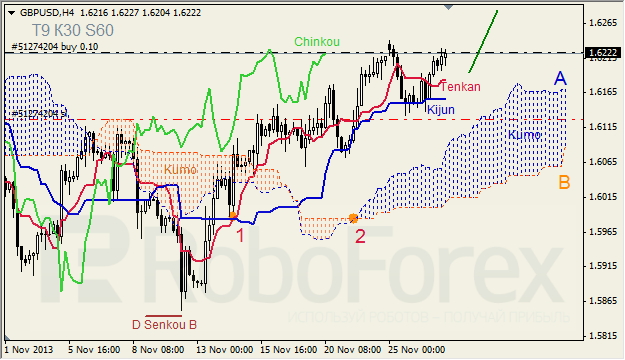
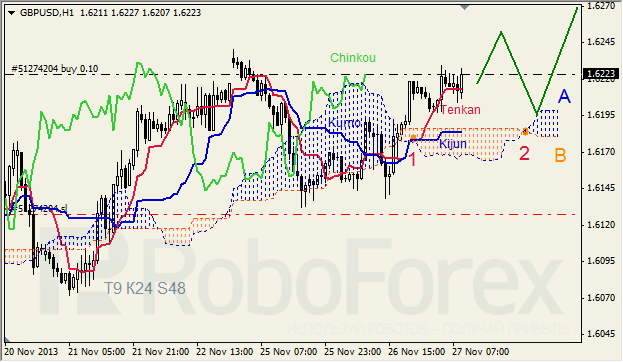
GBPUSD, Time Frame H4 – Indicator signals: Tenkan-Sen and Kijun-Sen are still influenced by “Golden Cross” (1); Senkou Span B is directed upwards, other lines are horizontal. Ichimoku Cloud is going up (2), Chinkou Lagging Span is above the chart, and the price is above the lines. Short‑term forecast: we can expect support from Tenkan-Sen and price to grow up.

GBPUSD, Time Frame H1 – Indicator signals: Tenkan-Sen and Kijun-Sen intersected inside Kumo Cloud and formed “Golden Cross” (1); all lines are horizontal. Ichimoku Cloud is going up (2); Chinkou Lagging Span is above the chart, and the price is on Tenkan-Sen. Short‑term forecast: we can expect support from Tenkan-Sen and growth of price.

GOLD

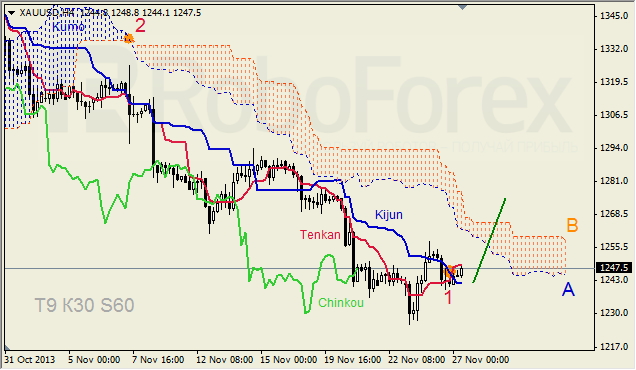
XAUUSD, Time Frame H4 – Indicator signals: Tenkan-Sen and Kijun-Sen intersected below Kumo Cloud and formed “Golden Cross” (1); Senkou Span B is directed downwards, other lines are horizontal. Ichimoku Cloud is going down (2), Chinkou Lagging Span is on the chart, and the price is inside Tenkan-Sen – Kijun‑Sen channel.  Short‑term forecast: we can expect support from Kijun-Sen and attempts of price to stay above Kumo.

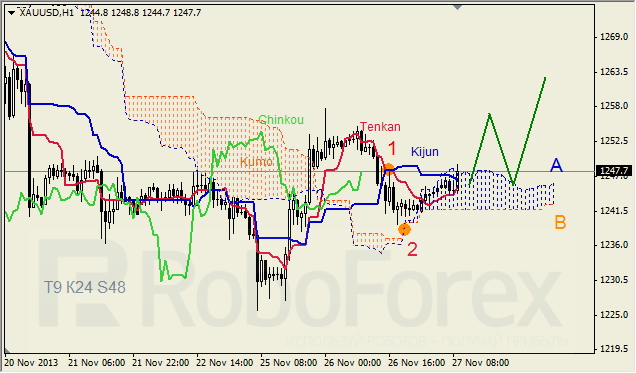
XAUUSD, Time Frame H1 – Indicator signals: Tenkan-Sen and Kijun-Sen are influenced by “Dead Cross” (1), they are very close to each other inside Kumo Cloud again; Tenkan-Sen and Senkou Span A are directed upwards, Kijun-Sen is moving downwards, Senkou Span B is horizontal. Ichimoku Cloud is going up (2), Chinkou Lagging Span is below the chart, and the price is on Senkou Span A. Short‑term forecast: we can expect attempts of price to stay above Kumo.

RoboForex Analytical Department

Article By RoboForex.com

Attention!
Forecasts presented in this section only reflect the author’s private opinion and should not be considered as guidance for trading. RoboForex LP bears no responsibility for trading results based on trading recommendations described in these analytical reviews.


Thailand surprises by cutting rate 25 bps on low inflation

By CentralBankNews.info
    Thailand’s central bank cut its policy rate by 25 basis points to 2.25 percent, saying “given the benign inflation outlook and moderating household credit growth, there is room for monetary policy to mitigate downside risks to the economy.”
    The Bank of Thailand (BOT) has now cut rates twice this year for a total cut of 50 basis points.
    Most economists had expected the central bank to maintain rates due to concern over high household debt and fears that an expected reduction in asset purchases by the U.S. Federal Reserve in coming months could lead to outflow of capital and downward pressure on the Thai baht.
    “The committee judges the the Thai economy is expanding at a lower pace than previously assessed, with greater downside risks compared with the last meeting,” the BOT said after a meeting of its monetary policy committee.
    The committee voted by 6 members to 1 to cut the rate, with one member judging the current rate to be sufficiently accommodative and voting to maintain the rate.
    At its previous meeting in October, the BOT had said the Thai economy was stabilizing and should gradually recover with the current accommodative stance supporting economic recovery.

    But following that meeting, the BOT revised downward its growth forecasts for this year and 2014 in its quarterly policy report due to slower-than-expected growth.
    The BOT’s forecast for Thailand’s Gross Domestic Product was revised down to growth of 3.7 percent this year from a previous forecast of 4.2 percent and 2014 growth was revised down to 4.8 percent from 5.0 percent.
    In the third quarter of this year, Thailand’s GDP expanded by 1.3 percent from the second quarter for annual growth of 2.7 percent, down from 2.9 percent in the second quarter.
    Recently, the Thai state’s planning agency has cut its 2013 growth forecast to 3.0 percent from a previous 3.8-4.3 percent.
    The BOT said that growth in the third quarter was weaker than expected from both the private and public spending and a recovery in exports had not gained traction.
    “Looking ahead, there are higher downside risks to growth stemming from a delay in government investment and fragile private confidence, which could be compounded by the ongoing political situation,” the BOT said.
    Although the central bank said the global economy was continuing to recover, it said that exports might not fully benefit from this recovery and high uncertainty over the outlook for monetary and fiscal policies in the United States continued to weigh on financial markets.
    Thailand’s headline inflation rate rose marginally to 1.46 percent in October from 1.42 percent in September and the BOT last month revised downward its inflation forecast for this year to 2.2 percent from a previous 2.3 percent and the 2014 forecast to 2.4 percent from 2.6 percent.
    The BOT targets core inflation of 0.5 to 3.0 percent and said that inflationary pressures remained subdued while private credit decelerated in line with the economy.
    The BOT did not make any references to the baht, which has weakened in the last month and fell by 0.4 percent to 32.16 baht to the U.S. dollar following the rate cut.
    From the beginning of the year to late April, the bath rose by almost 6 percent to a high of 28.6 baht by late April. But it then started to depreciate after Thai authorities voiced their concern over the impact of the rise on exports, a rate cut in May and a general decline in most emerging market currencies following expectations that the Federal Reserve would start tapering its asset purchases.
    Compared with the the end of last year, the Thai bath is down by 4.8 percent.

    www.CentralBankNews.info

Movements in GBP/USD indicate key role of Britain’s economy

By HY Markets Forex Blog

The movements that the pound sterling made relative to the U.S. dollar on Nov. 26 illustrated the key role that the strength of the U.K. economy plays in the exchange rate for this pair.

Individuals who want to make money by trading current pairs such as the GBP/USD might benefit from knowing about this potentially helpful information.

GBP/USD nears one-month high amid strong data
The release of strong economic data for the United Kingdom coincided with the exchange rate for these two currencies rising to $1.6190, according to Reuters. As a result, the GBP/USD came close to the one-month high of $1.6241 that was reached on Nov. 25.

This key measure was pushed higher when market participants responded to a survey which indicated that hiring in the European nation has surged recently, and that British employers are planning to step up these staffing initiatives, the media outlet reported. The poll, which was released overnight, indicated that the pace of hiring enjoyed by service firms in the United Kingdom recently surged to its highest in six years.

Later in the day, the GBP/USD pair dipped slightly after Bank of England Governor Mark Carney indicated that interest rates will not automatically be pushed higher if the nation's jobless rate reaches 7 percent, according to Investing.com. He indicated that while this level will have to be reached for these borrowing costs to rise, hitting this particular measure may not result in a rate hike.

"The exact timing of when that 7 [percent] threshold will be achieved is subject to uncertainty. We do our best to give our estimates of that uncertainty … One month's unemployment figures does not have a material change on those likelihoods," Carney stated in testimony before the Treasury committee on the parliament, the media outlet reported.

Carney optimistic about British economy
The BOE official indicated his optimism surrounding the nation's economy, stating that "all the elements" were present so that it could improve, according to the news source. He noted that the recent decline in the nation's jobless rate to 7.6 percent represented a positive development.

Amid all these developments, one market expert in particular indicated that the British Pound looks strong according to technical analysis, Reuters reported.

"If you look at the major currencies, sterling is the most reliable," Nawaz Ali, market analyst at Western Union Business Solutions, told the news source. "It is running into technical resistance … But right now you can't short sterling."

Individuals who want to make money by trading the GBP/USD might benefit from knowing about this analysis, as well as the impact that the latest economic news has had on the currency pair.

The post Movements in GBP/USD indicate key role of Britain’s economy appeared first on | HY Markets Official blog.

Article provided by HY Markets Forex Blog