Oil Prices to Reach $80/Barrel?

By for Investment Contrarians

Oil PricesOil prices are heading higher on the chart with the cash West Texas Intermediate (WTI) crude rallying back toward the $100.00 level after threatening to test $90.00.

Steady economic signs in the United States, China, and Japan—the three largest economies in the world—along with some muted growth in the eurozone and Europe are adding some spark to the oil futures… But hold on; doesn’t the buying seem somewhat premature?

I’d say so, as I believe oil prices may have limited upside unless something dramatic surfaces in the Middle East that impacts OPEC oil.

The Organization of the Petroleum Exporting Countries (OPEC) has also come out and said it would maintain its current daily production quota and not cut supply in order to add support to oil prices.

I doubt we will see $130.00-per-barrel oil prices anytime soon—unless, of course, tensions escalate in the Middle East and a war breaks out across a wider region that would impact the flow of OPEC oil. The current nuclear agreement in Iran has also added some stability to the region.

And the futures market for oil supports my view, too. A look at the oil futures actually shows expectations for oil prices should decline back towards $92.00 by the end of 2014, drop below $90.00 in 2015, and continue downward to $80.00 by 2018. The December 2022 futures contract points to $78.00-per-barrel oil.

The chart of WTI oil below shows the downward channel and recent breakout, which I doubt will have much holding power as it nears the $100.00 level.

Light Crude Oil Chart

Chart courtesy of www.StockCharts.com

Now while the prospects over the next eight years don’t look great, the actual movement of oil prices will obviously be dependent on other variables that will come into play, such as demand, industrial growth, geopolitical tensions, and the production of domestic oil via fracking.

It’s the rising production of domestic oil through fracking that could inevitably drive a downward push in oil prices of both WTI and Brent crude.

I believe that there’s a real possibility America could cut its buying of OPEC oil in the future as fracking oil production rises. Of course, the country could also supplement OPEC oil with extra oil from the Alberta tar sands, which continues to be a major issue in the country.

If this scenario plays out, we could cut the volatility of oil prices that has played a big role in the past but has now lessened with the reduced buying of OPEC oil.

Oil and gas magnate T. Boone Pickens is surely enjoying what he is seeing, as he has always been extremely vocal about cutting the country’s dependence on OPEC oil.

For the consumer, this may mean lower gasoline prices, and for businesses, it may mean lower energy prices.

The big winners will likely continue to be the oil companies that are undertaking fracking, such as Continental Resources, Inc. (NYSE/CLR) and Whiting Petroleum Corporation (NYSE/WLL). I also like Schlumberger Limited (NYSE/SLB) and Halliburton Company (NYSE/HAL).


Source: http://www.investmentcontrarians.com/stock-market/oil-prices-to-reach-80barrel/3423/


“Flat, Cautious” Action in Gold After Surge as Asian Premiums Fall

London Gold Market Report

from Adrian Ash

BullionVault

Weds 11 Dec 08:35 EST

ASIAN and London dealing was quiet in gold Wednesday morning, with prices holding $10 per below yesterday’s sudden rise to 3-week highs above $1267.

 Silver also slipped but held onto more of Tuesday’s 3.2% gain to $20.45 per ounce.

 Asian stock markets fell more than 1% meantime, but European shares ticked higher with commodities as major government bonds held flat.

 After “gold prices soared on Tuesday,” said one brokers’ note overnight, “we [saw] gold trading relatively flat.”

 “We suspect that given the better-looking chart patterns,” says INTL FCStone, noting yesterday’s 2% surge, “the current rally in gold will likely continue until $1290.”

 Tuesday’s volumes in US Comex futures were double the 7-week low hit Monday, one of the 5 lowest daily turnovers of 2013 according to Reuters’ data.

 But rising only to 154,000 lots, Comex futures trading still lagged the recent 30-day average of 182,000 gold contracts.

 Junior gold mining stocks meantime had their best day since late October, with those making up the Market Vectors Junior Gold Miners ETF (GDXJ) rising more than 4%.

 That only took the junior miner stocks to 1-week highs however, some 61% down from the start of the year.

 “Looking forward,” says ANZ Bank in Australia, “prices may find it hard to maintain yesterday’s momentum with Asian demand likely to taper off tomorrow.”

 “Trading is bound to be increasingly cautious,” agrees a note from Swiss bank and London market-maker UBS, “with investors becoming more and more defensive” ahead of the Christmas shutdown.

 “Given diminishing liquidity conditions heading into year-end, choppy price action should remain a feature for the remainder of 2013.”

 The volume of trading on China’s officially-approved Shanghai Gold Exchange rose today from Tuesday, but lagged Monday’s two-week high by value.

 Although prices rose, Shanghai’s premium to London quotes fell further, edging below $6 per ounce as the Yuan rose to fresh record highs against the US Dollar.

 Gold premiums in India meantime fell back to $120 per ounce according to local dealers, after there was “some delivery” from futures market the Multi Commodity Exchange.

 “That has put pressure on premiums,” Reuters quotes Bachhraj Bamalwa of the All India Gems & Jewellery Trade Federation.

 India’s imports of gold and silver bullion sank over 80% by value last month compared to November 2012, dropping to barely $1.0 billion as the government’s anti-gold import rules continued to bite.


Adrian Ash

BullionVault

Gold price chart, no delay | Buy gold online


Adrian Ash is head of research at BullionVault, the secure, low-cost gold and silver market for private investors online, where you can fully allocated bullion already vaulted in your choice of London, New York, Singapore, Toronto or Zurich for just 0.5% commission.


(c) BullionVault 2013

Please Note: This article is to inform your thinking, not lead it. Only you can decide the best place for your money, and any decision you make will put your money at risk. Information or data included here may have already been overtaken by events – and must be verified elsewhere – should you choose to act on it.


EURUSD Short Term Technical Perspective

Article by Investazor.com

The worldwide perspective about investing in risky assets seems to have changed. We observed that in December the European single currency has gained 2.0% in favor of the US dollar. It didn’t matter for the investors that good economic data were published for the United States and Fed could use them as an argument to taper the Quantitative Easing program. From this results that we are back to risk aversion and risk appetite.

The United States is the world largest economy. If good economic data is published for the country, investors will think that the world economy will follow. If bad economic data is released for the US then investors will take refuge in American assets because, the world largest economy cannot default.

So how do you think that such logic will influence the EURUSD? If the US economic indicators will be published above expectation then investors would like to put their money in riskier assets, like the EUR, thus this currency will gain. If bad economic data will be released then investors would like to get their money back into a safe heaven, which is the US dollar, so it will go up.

eurusd-reistance-area-resize-11.12.2013

From the technical point of view, on a one month time period, the EURUSD trend is up. The price even broke the rejection of the channel and rallied all the way back to 1.3800. Around this level it has encounter a very important resistance area, which we talked about in our past analysis. It is a very interesting confluence zone which rejected the price back in late October.

At this point would be pretty hard to decide whether it will continue its rally or it will have another bounce. There are some bearish signals given by the overbought RSI (14 periods) but they aren’t enough to take a position, especially because it signals a counter trend move. From our opinion the bearish signal would be confirmed by a drop back under 1.3750 and the target for the drop would be around 1.3650.

A break above 1.3830, the latest high, would signal that the buyers still have the power to move prices even higher and we would look to buy the dips. Between 1.3750 and 1.3830 it is a gray area in which the price might play for a while before deciding its direction.

Keep your eyes also on the economic calendar. Today the sky it is clear, but tomorrow it might get a little bit clouded with the speech of Mario Draghi and the US Core Retail/Retail Sales and Unemployment Claims.

The post EURUSD Short Term Technical Perspective appeared first on investazor.com.

Iceland holds rate, tightens warning of rate rises

By CentralBankNews.info
    Iceland’s central bank held its policy rates steady but warned that interest rates would be raised as the economy’s spare capacity disappears and “the degree to which such tightening takes place through changes in nominal Central Bank rates will depend on future inflation developments, which in turn will depend on wage developments and exchange rate movements.”
    The Central Bank of Iceland, which has held its benchmark seven-day lending rate steady this year at 6.0 percent after raising it by 125 basis points in 2012, also said the country’s economy expanded by 3.1 percent in the first three quarters of this year, “considerably above the Central Bank’s November forecast and is consistent with previous indications of a strong labour market recovery.”
    The central bank has maintained a policy tightening bias for months but appeared to ratchet up its warning about rate rises in light of a government proposal to reduce household debt.
    The central bank said debt reduction would stimulate domestic demand and because spare capacity is disappearing, increased demand will raise inflation unless there is a change in the monetary stance.
    Stronger demand will also tend to stimulate imports and narrow the current account surplus, which will contribute to a weaker krona. This would tend to raise inflation.

    “A stronger economic recovery and the above-mentioned government measures will require more rapid monetary tightening than previously expected, other things being equal,” the bank warned.

    Last month Iceland’s prime minister accused the central bank governor of playing “politics” after he expressed doubt over plans to offer homeowners debt relief.
    Prime Minister Sigmundur David Gunnlaugsson’s Progressive Party won elections in April and promised homeowners to reduce their debt. In addition to asking foreign creditors to write of some $3.6 billion of $6 billion debt that is owed to creditors of Iceland’s failed banks, the government is considering setting up a fund financed by the central bank to help provide debt relief to home owners.
    Central Bank Governor Mar Gudmundsson has criticized such an idea, telling a parliamentary committee that this would be “tantamount to printing money.”
    Last month the central bank raised its 2013 growth forecast to 2.3 percent but cut its 2014 forecast to 2.6 percent. For 2015 the bank forecast growth of 2.8 percent.
    In the third quarter Iceland’s Gross Domestic Product grew by 6.1 percent from the second quarter for year-on-year growth of 4.9 percent, up from 3.8 percent.
    Iceland’s inflation rate rose to 3.7 percent in November from 3.6 percent while the krona’s exchange rate was “somewhat higher” than in November, but broadly as expected by the central bank.
    Last month the central bank said it expected inflation to subside to its 2.5 percent target by end-2015 and to average 2.0 percent over its forecast horizon.
    As in previous months, the central bank warned that the outcome of wage negotiations “will have a decisive effect on the inflation outlook and therefore on near-term interest rates developments” and rates are likely to rise if wage rises exceed the inflation target.
    Iceland’s unemployment rate fell further to 5.7 percent in October from 6.2 percent in September and the bank expects the rate to fall to about 4 percent in the fourth quarter of 2014.
   
    www.CentralBankNews.info

European Stocks in Red amid Fed-Tapering Fear

By HY Markets Forex Blog

European stocks opened the market lower on Wednesday as traders focus on the Federal Reserve’s (Fed) upcoming meeting scheduled for December 17-18, with speculation that the Central bank would begin to taper its stimulus program. Meanwhile in the US, policymakers concluded a deal to reduce automatic budget cuts to avoid another government shutdown.

The pan-European Euro Stoxx 50 opened 0.21% lower at 2,959.50, while the German DAX edged 0.23% lower to 9,093.80 at the time of writing. At the same time, the British FTSE 100 declined 0.17 to 6,512.30, while the French CAC 40 rose 0.03% higher to 4,092.30.

Germany’s consumer prices climbed 0.2% higher in November, meeting in line with estimates, compared to the 0.2% drop recorded in the previous month; the final reports from the Federal Statistical Office confirmed.

Meanwhile in France, the non-farm payrolls showed a drop of 0.1% in the third quarter, meeting flash estimates, reports from the National Institute for Statistics and Economic confirmed.

The government of Italy will auction Treasury bills maturing in 12 months, with a maximum target of 5.5 billion euros.

Greece unemployment report for September is expected to show that the country’s unemployment rate remains the highest among the rest of the eurozone nations.

The Managing Director of the International Monetary Fund, Christine Lagarde said the high rate of youth unemployment could   lengthen the eurozone’s economic crises.

“Can a crisis really be over when 12% of the labor force is without a job? When unemployment among the youth is in very high double digits, reaching more than 50% in Greece and Spain? And when there is no sign that it is becoming easier for people to pay down their debts?” Lagarde stated.

European Stocks – US Budget Agreement

In the US, budget policymakers concluded a deal to reduce automatic budget cuts and set spending levels for the next two years.

“While modest in scale, this agreement represents a positive step forward by replacing one-time spending cuts with permanent reforms to mandatory spending programs that will produce real, lasting savings,” House Speaker John Boehner said.


Get $100 FREE Funded into your MT4 Account as well as many more amazing benefits! Register with HY Markets today…

http://www.hymarkets.com/english/reg/reg.hyml …

The post European Stocks in Red amid Fed-Tapering Fear appeared first on | HY Markets Official blog.

Article provided by HY Markets Forex Blog

Oil Prices Climbs Close to Six-Week High as US Crude Supplies Drops

By HY Markets Forex Blog

Oil prices traded near its highest level since October after the industry data revealed a drop in crude inventories for a second week in the US, the world’s biggest oil consumer.

The US crude stockpiles declined by 7.5 million barrels last week, data from the American Petroleum Institute confirmed. The government data which is expected to be released today is forecasted to show a drop in supplies by 3 million. Meanwhile in Libya, the three eastern ports are expected to reopen by December 15, the head of Libya’s energy protection force confirmed.

“The run of inventory increases had the market rattled, but it now appears to be reversing and the focus is coming back to global growth numbers,” said Michael McCarthy, chief strategist at CMC Markets in Sydney. “The outlook is for a test of higher levels for crude.”

West Texas Intermediate for January delivery came in at $98.49 per barrel on the New York Mercantile Exchange as of 2:30pm in Singapore; it climbed $1.17 to $98.51 yesterday; reaching its highest close since October 28.

The European benchmark Brent for January settlement climbed up by 5 cents at $109.43 per barrel on the ICE Futures Europe exchange. Brent crude was at a premium of $10.94 to WTI.

Oil Prices – US Stockpiles

Last week, WTI rose 5.3% higher, the highest in five months, while the US crude inventories booked its first drop in 11 weeks and TransCanada Corp announced its plans to begin some of its Keystone pipelines to the Gulf Coast from Cushing, the delivery spot for Nymex futures.

US gasoline stockpiles added 6.27 million barrels in the seven days through December 6, reports from the American Petroleum Institute confirmed. A report from the Energy Information Administration is forecasted to show a gain of 2 million, according to analysts.

Distillate supplies, including diesel and heating oil, added 1.8 million barrels, API reports confirmed.

Oil Prices – Libya

Brent crude rose for a second month in November as the turmoil in Libya reduced production. Libya is a member of the Organization of Petroleum Exporting Countries (OPEC) and the holder of the largest oil reserves in Africa.

The eastern ports, Es Sider, Ras Lanuf and Zueitina are expected to reopen this month, the head of the Petroleum Facilities Guard, Idris Bukhamada confirmed over the phone from Ajdabiya yesterday.


Win a luxurious trip to the Maldives & up to $30,000 cash for trading with us!

Visit for details http://alturl.com/2kysk 

The post Oil Prices Climbs Close to Six-Week High as US Crude Supplies Drops appeared first on | HY Markets Official blog.

Article provided by HY Markets Forex Blog

Apple Finally Takes Step That Will Bring the Company to the Next Level

By George Leong, B.Comm.

Just last Thursday, Apple Inc. (NASDAQ/AAPL) revealed its long-awaited and worst-kept secret when the maker of the “iPhone” and “iPad” reported it would align with China Mobile Limited (NYSE/CHL) to push its products into China, a very lucrative market for the smartphone giant.

The deal, while somewhat newsworthy, was not a bug surprise to the markets, as evidenced by the stock slightly edging upward by a little more than three percent on the news.

Now, you may be wondering why the stock market simply shrugged at the news, given that China Mobile is the biggest mobile deliverer in the world, with about 730 million subscribers.

Obviously, that’s a huge number of potential buyers and added revenue channels for Apple. But the deal really doesn’t mean Apple will be going back to its previous high above $700.00, reached in September 2012. The reality is that Apple needs to be able to find Chinese buyers for its somewhat expensive (or overpriced) smartphones and tablets.

The target market is there, and it’s probably closer to about 300 million people or so, based on the number of middle-class consumers in China. The reason I see its potential market base being much smaller than China Mobile’s subscriber base is simply due to the company’s product pricing. I really don’t think some shopkeeper or farmer in rural China is going to dole out a major portion of their annual wages to snap up a snazzy “iPhone 5C” or “5S.” This will be the main dilemma Apple will face in this market.

The problem at the very root of this dilemma is that Apple will need to shift its margins to address the prohibitive cost of its phones when considering the mass of Chinese consumers earning average wages.

China Mobile may decide to subsidize the iPhones for buyers, as we have seen here with the zero-cost 5C with the signing of a contract in more recent weeks. With the cost to make an iPhone 5C at around $190.00, it’s really not a big deal for China Mobile to subsidize its phones, given that the majority of the company’s revenues are made through its monthly mobile fees anyway.

So for Apple to really push into China and increase its market share from its current five percent or so, the company’s success will lie squarely on the price point of its phones.

Apple has traditionally made money from selling its phones, so if the company were to make these major price cuts in China, it would be a divergence from its normal policy. But if the company wants to be the next Samsung Electronics Co. Ltd., LG Corporation, HTC Corporation, or Nokia Corporation (NYSE/NOK) in China and the emerging markets, aggressive pricing will be required for Apple to succeed and reward investors.

Of course, there is more than one way that investors interested in the mobile market can get in on the action without having to invest directly in phone makers like Apple. Read “How to Profit from the Mobile Market Without Investing in Phone Makers” for more.

This article Apple Finally Takes Step That Will Bring the Company to the Next Level is originally publish at Profitconfidential


The Most Difficult, But Profitable, Investment Puzzle in the World

By WallStreetDaily.com

“Pad kid poured curd pulled cod.”

Scientists at MIT say it’s the toughest tongue twister ever created.

“If anyone can say this 10 times quickly,” declares MIT psychologist, Stefanie Shattuck, “They get a prize.” Or perhaps notoriety in the Guinness Book of World Records.

It’s that difficult. Go ahead and try. Before long, you’ll be scurrying back to the safe and easy tongue twisters to redeem your self-confidence. Like “Sally sold seashells by the seashore,” or “Peter Piper picked a peck of pickled peppers.”

And that’s my point today – to prove that shunning difficult tasks is in our nature. Especially when it comes to investing.

Heck, even the greatest investors are guilty…

Charles Munger, the unsung hero behind the success at Berkshire Hathaway (BRK.A), once summed up the firm’s investment approach by saying, “At Berkshire we have three buckets: yes, no and too hard. We just throw some decisions into the ‘too hard’ file and go on to the others.”

Now, I might not have nearly as many zeros behind my net worth as Mr. Munger, but I gotta say… he’s making a colossal mistake. And here’s why…

Buffett’s Biggest Blunder?

I only took a few physics classes in college. So do you think I was always familiar with nanometer-sized semiconductor components and the magnetic force created by spinning electrons? No way!

Yet back in 2009, if I simply tossed the technology into the “too hard” hopper, I would’ve missed out on the six-month, 125% run-up in shares of the spintronics industry pioneer, NVE Corp. (NVEC). WSD Insider subscribers would’ve missed the boat, too.

Same goes for my knowledge of rare earth metals, additive manufacturing and the budding body of work in alternative metal mesh sensors for use in touchscreens.

I was as green as you could get when I first met with Uni-Pixel’s (UNXL) CEO, Reed Killion, way back in May 2011.

But if I simply ignored him and dismissed the company’s potentially disruptive technology as “too hard” to understand, my MicroCap Tech Trader subscribers would’ve missed out on the stock’s meteoric rise – from a lowly $7.50 per share to more than $41.

What about the overlap between rules-based application development, scan-based trading, supply-chain optimization and the Food Safety Modernization Act (FSMA) signed into law in early 2011?

Sorry, but I never took a single Six Sigma course during my MBA program. And the closest I ever got to being truly on the “inside” in Washington, D.C. was when I attended the Texas-Wyoming Ball for President Bush’s second inauguration.

However, if I simply declined to meet with Park City Group’s (PCYG) CEO, Randy Fields, and spend almost a year getting up to speed on the technology, MicroCap Tech Trader subscribers wouldn’t have been able to enjoy the stock’s run-up from our entry price of $4.05 in April to over $11 in October.

(In case you missed it, here’s why I’m convinced the stage is set for an even more impressive run-up for the stock.)

The Only Way to Invest

The list of “too hard” opportunities I’ve come across and pursued (instead of discarded) goes on…

From 3-D bioprinting, femtocells and emerging markets currencies – to biometric authentication, digital watermarking and haptic sensors.

Truth be told, the “too hard” opportunities I come across end up being the most profitable ones – without fail. Why is that?

It’s simple, really.

While everyone else passes, including the Warren Buffetts and Charlie Mungers of the world, I dig in.

Sure, it takes time and dedication. But you know what? That time breeds understanding.

It gives me an unparalleled informational advantage over the throngs of investors who simply pass on an opportunity – or, worse yet, wait for the technologies to grace the pages of The Wall Street Journal before considering an investment. (At that point, all the big gains are often already realized.)

Bottom line: Peter Lynch’s famous investment principle, “Invest in what you know,” isn’t an excuse to be lazy, or to overlook complex investments.

Not to me, at least.

It’s a call to action to figure out what we don’t know – and then invest the time required until we do.

That way, we gain a serious edge that we can consistently exploit for triple-digit profits. (I think that’s much better than a mention in the Guinness Book of World Records for mastering the toughest tongue twister in the land.)

So next time you come across the hardest investment you’ve ever tried to understand, dive in! Don’t run away. My experience proves it could be the most profitable investment you ever make.

If you’re too lazy, of course, you can piggyback off my tireless efforts.

I just finished up my research on a technology that can dramatically reduce air pollution by harnessing the power of a force that’s several billion times stronger than gravity. For all the details on the technology – and the tiny micro-cap company behind it – go here.

Ahead of the tape,

Louis Basenese

The post The Most Difficult, But Profitable, Investment Puzzle in the World appeared first on Wall Street Daily.

Article By WallStreetDaily.com

Original Article: The Most Difficult, But Profitable, Investment Puzzle in the World

Murray Math Lines 11.12.2013 (AUD/USD, EUR/GBP, SILVER)

Article By RoboForex.com

Analysis for December 11th, 2013

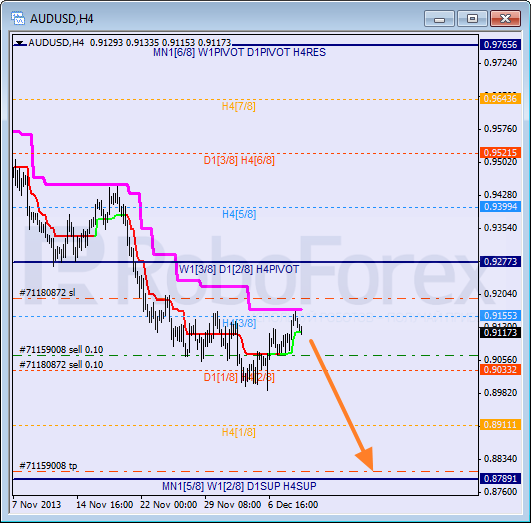
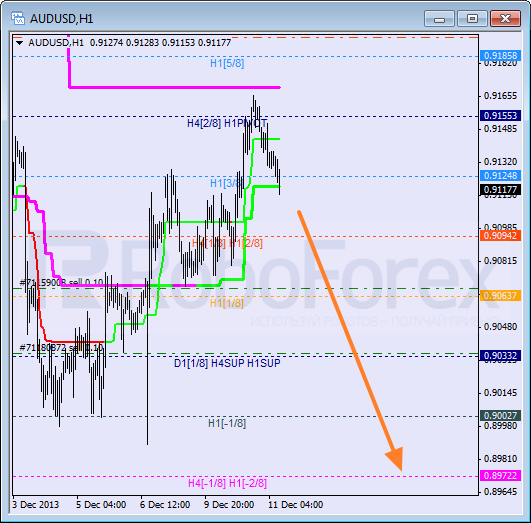
AUD/USD

Possibly, price is about to complete this correction quite soon. Australian Dollar rebounded from daily Super Trend and the 3/8 level. Main target for bears is still at the 0/8 level.

At H1 chart, correction faced resistance from the 4/8 level. Right now, market is trying to keep price below Super Trends. Pair may enter “oversold zone” during the next several hours.

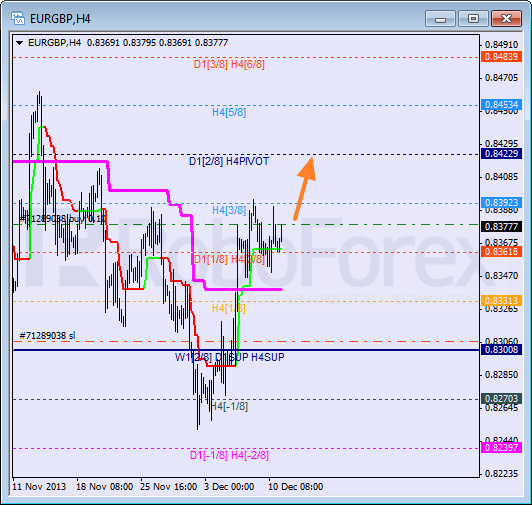
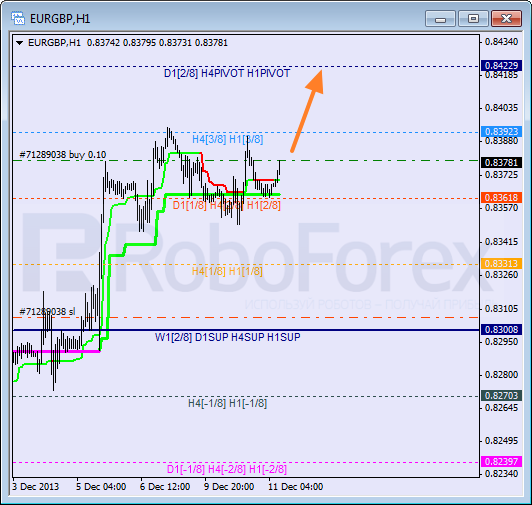
EUR/GBP

It looks like EUR/GBP is starting new trend; Super Trends formed “bullish cross”. In the near term, price may grow up towards the 4/8 level, break it, and then continue moving upwards.

Levels at H4 and H1 charts are completely the same; local correction is supported by Super Trends. I’ve got only one buy order so far. After market breaks maximum, I’ll move stop closer to local minimum.

SILVER

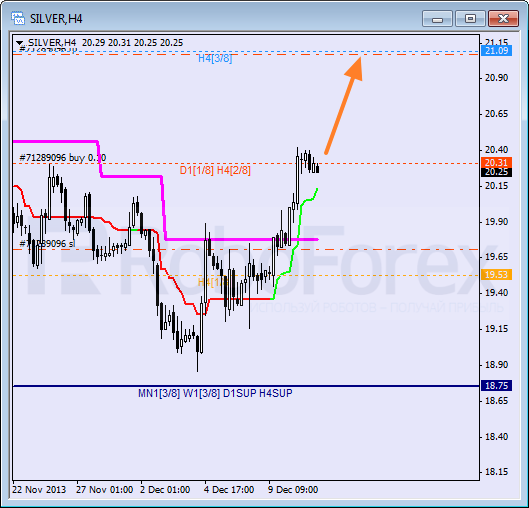
Silver reached its target at the 2/8 level and Take Profit on my buy order worked. Super Trends formed “bullish cross”. Considering that price didn’t rebound from the 2/8 level and is consolidating right now, I opened new buy order with target at the 3/8 level.

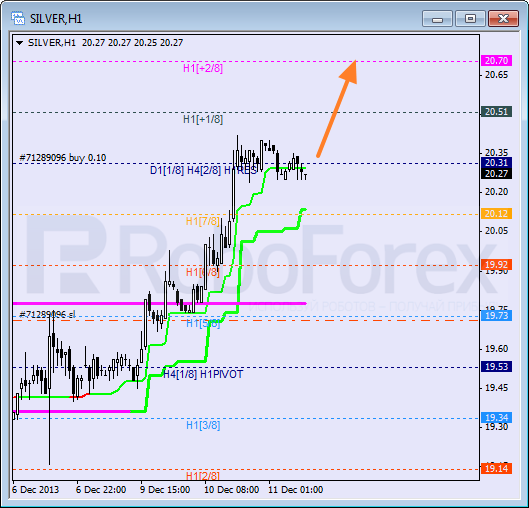
At H1 chart, price is about to enter “overbought zone”; current ascending movement is supported by Super Trends. If later price breaks the +2/8 level, lines at the chart will be redrawn.

RoboForex Analytical Department

Article By RoboForex.com

Attention!
Forecasts presented in this section only reflect the author’s private opinion and should not be considered as guidance for trading. RoboForex LP bears no responsibility for trading results based on trading recommendations described in these analytical reviews.


Japanese Candlesticks Analysis 11.12.2013 (EUR/USD, USD/JPY)

Article By RoboForex.com

Analysis for December 11th, 2013

EUR/USD

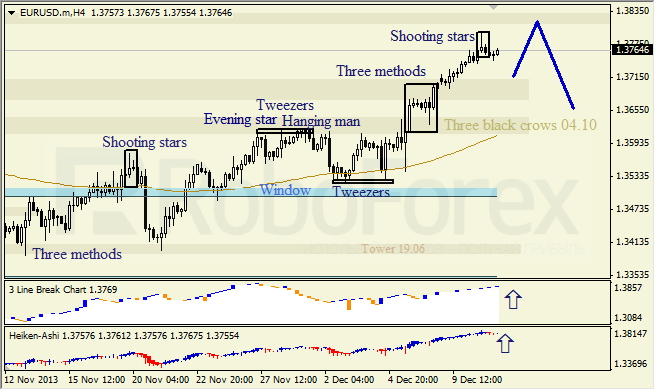
H4 chart of EUR/USD shows bullish tendency within ascending trend. Shooting Star pattern indicates possible correction up to support area; Three Line Break chart and Heiken Ashi candlesticks confirm ascending movement towards resistance area.

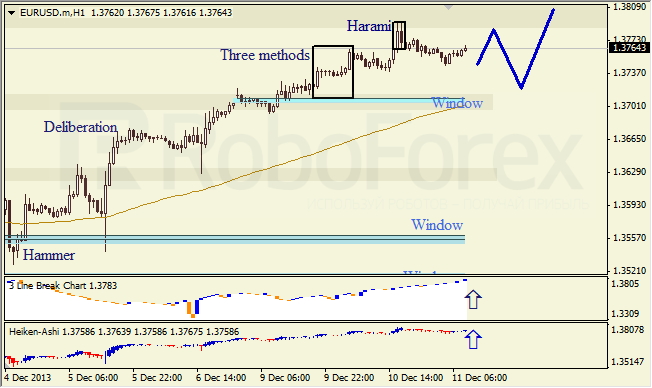
H1 chart of EUR/USD shows correction, which is indicated by Harami pattern inside resistance area. Closest Window is support level. Three Line Break chart and Heiken Ashi candlesticks confirm ascending movement.

USD/JPY

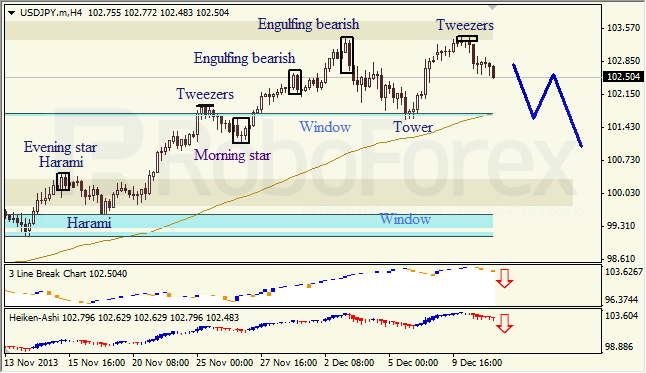
H4 chart of USD/JPY shows correction, which is indicated by Engulfing Bearish and Tweezers patterns inside resistance area. Three Line Break chart and Heiken Ashi candlesticks confirm descending movement.

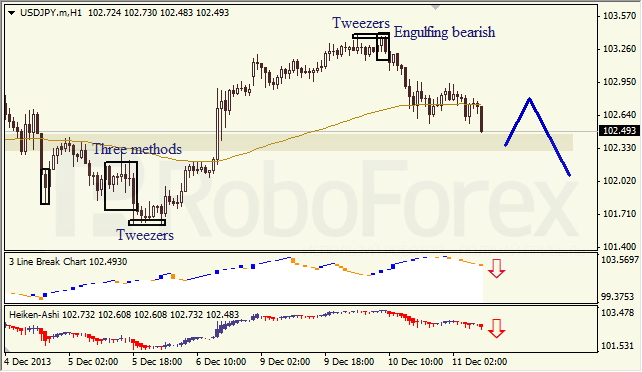
H1 chart of USD/JPY shows correction, which is indicated by Engulfing Bearish and Tweezers patterns. Price may form several bullish patterns inside support area. Three Line Break chart and Heiken Ashi candlesticks confirm descending movement.

RoboForex Analytical Department

Article By RoboForex.com

Attention!
Forecasts presented in this section only reflect the author’s private opinion and should not be considered as guidance for trading. RoboForex LP bears no responsibility for trading results based on trading recommendations described in these analytical reviews.