Three Indicators to Turn Your Trust Back to Precious Metals

By for Daily Gains Letter

Trust Back to Precious MetalsDespite the wintry Arctic chill, the economic recovery is in full bloom. Or is it? Wages are stagnant, unemployment remains stubbornly high at seven percent, and consumer confidence remains tepid at best. The average American investor clearly isn’t enjoying the Wall Street perpetual momentum machine.

Are stocks fairly valued (i.e. cheap), and is the current momentum sustainable? If you consider the charts, it looks like well-heeled investors think the market is inexpensive; how else can you explain the current bull market marathon? This is after an increasingly larger number of companies on the S&P 500 warned about revenues and earnings.

In the third quarter, a record 83% of all S&P 500 companies revised their third-quarter earnings guidance lower. So far, 92 of the S&P 500 companies, or 89%, have already issued negative earnings guidance for the fourth quarter. In spite of the warnings, the markets continue to tread higher.

I’m not the first person to say you can’t beat the Fed; but this market proves it every day. Thanks to the Federal Reserve’s $85.0-billion-per-month easy money policy, the markets just go higher and higher.

So, are the markets fairly valued? Not if you think S&P 500 revenues and earnings are important. Over the last few years, companies have been doing a good job at cutting costs; in fact, corporate profits are at an all-time record high at 70% of GDP. (Source: “Corporate Profits Are At An All-Time Record Peak At 70% Of GDP,” Forbes web site, November 30, 2013.)

S&P 500 earnings are also being artificially inflated due to low corporate tax rates. While the top corporate tax rate is 35%, few companies pay that once deductions, credits, and loopholes are factored in. Thanks to a growing deficit, Washington will be looking for ways to generate cash, meaning the tax rate will most likely climb higher, which also means corporate profits will dip. (Source: “Corporate Taxpayers & Corporate Tax Dodgers 2008-2010,” Citizen for Tax Justice web site, November 2011.)

The near-record-low interest rate environment is also helping S&P 500 companies report deceptively solid numbers. According to one report, the low-interest-rate environment has helped boost corporate profits in the U.S. and U.K. by five percent in 2012 alone. At the same time, households in the U.S. and U.K. lost a combined $630 billion in net interest income. (Source: “QE and ultra-low interest rates: Distributional effects and risks,” McKinsey & Company web site, November 2013.)

Low interest rates mean companies can issue low-cost debt and use the proceeds to repurchase shares. By reducing the share count, organizations can inflate their earnings. More than 80%of the S&P 500 companies are currently employing this strategy, and at the fastest pace since the 1990s. (Source: Perlberg, S., “GOLDMAN: Here Are The 23 Best Stocks For Fat Dividends And Huge Buybacks,” Business Insider web site, October 10, 2013.)

As long as interest rates are artificially low, companies will continue to borrow and buy, especially when you consider that more than 40% of the yearly gain in earnings-per-share (EPS) growth by S&P 500 companies has come from share repurchase programs. (Source: Condon, B., “Narcissist’s rally led by giant stock buybacks,” USA Today web site, May 18, 2013.)

With stocks going up irrationally, now might be the time to consider those precious metals that have been unfairly punished in step. When it comes to standing on its own, I trust gold and silver more than I do financially engineered stocks.


Source: http://www.dailygainsletter.com/stock-market/three-indicators-to-turn-your-trust-back-to-precious-metals/2200/


Six Traits of Successful Retirees

Guest Post By Dennis Miller – Six Traits of Successful Retirees

When I coached baseball many years ago, a young ballplayer came to me asking for advice. I offered my opinion: he needed to get his act together. Then, like many young men might do, he griped about me to one of the other coaches. Our paths crossed again when he was 28 years old, at which point he said, “Now that I have a family of my own, I’ve thought back on your ‘lectures’ and realized you were just answering my questions honestly. Thank you.”

Not surprisingly, my lectures as a coach weren’t so different from those I’d received from a WWII colonel turned coach and teacher at my high school. The only difference: I never asked for his opinion—it was offered as he held my shirt collar. Still, when I came home on leave from the Marine Corps a few years later, I showed up at my old high school, walked onto the practice field, and thanked him. He was a solid mentor when I needed one but was too young to know it.

Years later, as a retirement mentor, I’ve spent countless hours analyzing the habits shared by successful retirees. Six stand out, and I urge all of our readers to take these steps sooner rather than later. I’m not going to grab you by the shirt collar like my coach did, but I’m confident you’ll find this “lecture” worth reading.

  1. Cut the financial cord with your children. All parents have one basic responsibility: to equip their children to survive on their own, both emotionally and financially.Retirees are often the wealthier members of an extended family—or they are perceived as such. But having money does not make you a bank. If a family member needs money, let him or her borrow it elsewhere. The wealth you’ve accumulated has to last you the rest of your life. The best way to remind your family and yourself of this simple fact is to simply say “no.”

    Of course, some accidents and disabilities cannot be prevented, and there are times to rally behind family members truly unable to put a roof over their heads or food in their bellies. But for every truly unavoidable catastrophe, there are dozens more instances of parents enabling a freeloader.

    You’ve worked too hard to sacrifice your financial independence and give up your golden years. Even if you have enough to support two generations indefinitely, being the “Bank of Parents” won’t help anyone in the long run.

  2. Be your own “pension fund” manager. Independence is the real goal of retirement. That means listening to experts, but also learning to make savvy financial decisions for yourself.Today, pensions are virtually nonexistent in the private sector. Soon they won’t exist in the public sector either. So all of your retirement—including saving, investing, debt reduction, tax planning, estate planning—is up to you.

    There’s a lot to learn, but the information is there for the taking. I’ve known too many people who retired with a large chunk of change only to panic because they had no clue how to manage it. These folks were afraid, rightly so, because their lack of financial know-how made them vulnerable.

    Give yourself a financial education while you’re accumulating wealth so you can enjoy that wealth once you retire. Otherwise, you might leave a high-stress job for a high-stress retirement.

  3. Maximize your tax-preferred retirement savings. Only 10% of those eligible for employer-sponsored 401(k) programs maximize their contributions. There are real financial benefits to contributing to your 401(k), and it’s a mistake to turn down that free money, especially if your employer will match all or part of your contributions.In that same vein, tapping into retirement accounts to pay off bills is almost always a mistake. Unless you absolutely need the money for basic survival, you’re much better off leaving your retirement money alone. Like many things in life, once you tap those funds, it gets easier and easier to do it again.

    Before Congress passed the first Social Security Act in 1935, retirement was for a wealthy few. Since then, Social Security has fostered the illusion that we need not worry about money and that retirement doesn’t require a large personal nest egg. Reality is far harsher.

    I know people who’ve tried to live on their Social Security alone; now they are all back at work. A happy retirement rarely comes for people who choose to worry about retirement later.

  4. Get out of debt. Many retirees are drowning in debt. It’s a topic we touched on in The Reverse Mortgage Guide when discussing why seniors are turning to reverse mortgages at an increasingly younger age.Independence is pretty hard when you don’t have any money. And don’t fool yourself: if you have a million dollars in your brokerage account and a million-dollar mortgage, you’re broke. Forget all the fancy formulas. When you stop paying people to rent their money, that’s when real wealth building can start.
  5. Get some professional help. Even if you have a small nest egg, I strongly recommend going to a professional certified financial planner (CFP) for a regular checkup. I don’t mean pay someone to manage your money, although that is an option. Much like an annual physical, however, we can all benefit from an independent, qualified professional assessing where we are and how to stay (or get) on course.The checkup might cost a few hundred dollars, but it’s money well spent. Retirees cannot afford to be penny wise and pound foolish.
  6. Get in synch with your spouse sooner rather than later. During your working years, you trade time and expertise for money. For most folks, the goal is to save enough so that they don’t have to work full time to survive. Then, during retirement you trade money for time to pursue other interests. Sad to say, many people struggle to pinpoint what those interests are once they get there. One spouse might want to travel while the other is a homebody, etc.Retirement is no fun if only one spouse is living their dream. Happier couples talk and plan how they want to spend their time long before retirement day.

As someone in or approaching retirement age, you’ve lived long enough to be a mentor in some area of life. So you already know that mentoring is about telling people what they need to hear—whether it’s on the baseball field, in the boardroom, or at the kitchen table (where most life lessons are learned).

I urge you to pass your own “secrets to success” on to the next generation; they will thank you for it… eventually.

In addition to our regular weekly and premium monthly issues, we’ve been hard at work producing a series of special reports on need-to-know retirement topics: financial advisorsreverse mortgagesincome-producing stocks and low-fee ETFs, to name a few. You can download each of these timely special reports individually; or, if you really want to kick-start your financial education, you can begin your Money Forever premium subscription now and receive access to all of our special reports, our current issue, and the Money Forever archives.


Four Profitable Ways to Play the Retail Sector

By for Daily Gains Letter

Retail SectorWell, unlike many retailers, it looks like Starbucks Corporation (NASDAQ/SBUX) knows how to boost sales—at least momentarily. The company managed to sell 1,000 limited edition metal gift cards at $450.00 a pop via Gilt.com in a matter of seconds. Apparently, this high level of demand and consumers’ reactions to the rare gift card were a repeat of last year, when the company offered a similar product.

Now, this gimmicky kind of sales strategy, while working for Starbucks, likely won’t work for many other companies in the retail sector. Instead, I think these companies could face a margin squeeze over the final weeks of the year, which have proved critical for the retail sector in the past.

The problem is that the retail sector didn’t report strong results on Black Friday and the subsequent key shopping days, despite retailers’ attempts to attract consumers by pulling out all the stops, including longer shopping hours (earlier store openings, later closings), heavy advertising, and steep discounts.

Of course, the operators in the retail sector will soon need to clear out their winter merchandise, and that means great discounts for consumers ahead but pressure on sales margins for the retailers. The end result will likely be sales and earnings coming in lower than expected. And this means we could see more retailers hurting when they present their fourth-quarter results.

For the retail sector, the next few weeks will be a battle between the retailers for consumers’ limited spending dollars. This means that heavier discounting to clear inventory will likely take place.

As an investor, I would be hesitant to buy retail stocks at this time. Yes, there will be some strong performers in the discount and high-end luxury stocks, but many of the retailers will be competing for the same customer’s dollar. In the discount area, I like Dollar General Corporation (NYSE/DG) and Family Dollar Stores, Inc. (NYSE/FDO). A good small-cap contrarian pick in the discount area that investors may want to take a closer look at is Stage Stores, Inc. (NYSE/SSI).

Stage Stores Chart

Chart courtesy of www.StockCharts.com

In the luxury end, my top pick is Michael Kors Holdings Limited (NASDAQ/KORS). I also like Tiffany & Co. (NYSE/TIF).

Michael Kors Holdings Chart

Chart courtesy of www.StockCharts.com

But for playing the broader retail sector, which could show weakness, I would suggest investors look at exchange-traded funds (ETFs) that play the short side of the retail sector. You could consider buying put options on the SPDR S&P Retail ETF (NYSEArca/XRT) to play a possible downside move.

Alternatively, for the more aggressive investor, you can simply buy the Direxion Daily Retail Bear 3X Shares (NYSEArca/RETS) ETF, which is an aggressive short play on the retail sector.


Source: http://www.dailygainsletter.com/investment-strategy/four-profitable-ways-to-play-the-retail-sector/2193/


Just Follow the Easy Money and Forget Everything Else?

By George Leong, B.Comm.

This has clearly been the year of the bull, as the bears enter their fifth year of hibernation during what has been a spectacular bull market run. For those who have constantly called for the stock market to burn up, it hasn’t happened.

The stock market clearly has its eyes on higher ground as we move into the final few weeks of the year. The advance has been much stronger than what I had initially expected back in January.

At that time, I thought the stock market would move higher, driven by the technology and financial stocks. My assessment was correct, but the size of the upside moves have been much bigger than I had imagined. The biggest surprise has been the ability of the stock market to hold and avoid any major correction. Bulls have fended off the majority of the bear uprising this year, with the biggest stock market correction being about six percent in the S&P 500.

Chart courtesy of www.StockCharts.com

Now, as the S&P 500 and DOW move back toward their record highs, my view is that the stock market will likely move higher, driven by jobs creation and decent confidence levels.

Of course, with the jobs creation will come tapering by the Federal Reserve; but as long as the economy strengthens and jobs are created, investors should be happy.

Investors are also continuing to hold onto their bullish sentiment. In the weekly AAII Investor Sentiment Survey for the week ended December 4, 42.6% of individual investors surveyed were bullish on the stock market for the next six months, down 4.7% from the previous week. (Source: American Association of Individual Investors web site, last accessed December 10, 2013.) In the survey, 27.5% were bearish and 29.8% were neutral, which was a 5.4% rise from the previous week.

I’m not at all surprised with the findings, as investors generally don’t want to miss out on any additional gains in the stock market as we move into 2014, which will likely be another good year for stocks; albeit, I doubt it will surpass the advance we will see this year.

While I will be offering my view towards 2014 early in the New Year, I feel the investment climate of easy money, economic renewal, and jobs growth will help support stocks heading into 2014. So feel free to ride the current stock market gains; but at the same time, you should make sure you take some profits off the table and have some capital available for buying, just in case the stock market shows some temporary weakness, which could be a buying opportunity.

This article Just Follow the Easy Money and Forget Everything Else? is posted at Profitconfidential


Another Flashing Red Light: Investments in Stocks by Households and Nonprofits Reach Record High

By Michael Lombardi, MBA

The general consensus among stock advisors is that the key stock indices will continue to go higher. Each day, I hear about another “bear” throwing in the towel and turning bullish on key stock indices.

“Don’t fight the fed or the tape; just buy stocks, and you’ll do fine” has become the norm again. Sadly, this worries me a lot because the fundamentals that drive the key stock indices higher are becoming weaker with each passing day.

As an example, for the third quarter, the corporate earnings growth rate for the S&P 500 companies was only 2.9%. To some, this might sound great, but look at these three facts: 1) corporate earnings were up 2.9% in the third quarter, but the stock market is up about 13% from the beginning of the third quarter; 2) corporate earnings growth so far in 2013 is running at its slowest pace since 2009; and 3) only 52% of the S&P 500 companies were able to beat revenue estimates for the third quarter. (Source: FactSet, December 6, 2013.) This suggests corporate earnings aren’t really coming from companies selling more, but rather from stock buyback programs and cost-cutting.

Troubles for corporate earnings don’t just end there. Corporate earnings are expected to be weaker in the fourth quarter. So far, of the 103 companies in the S&P 500 that have issued corporate earnings guidance, 89% of them have issued negative guidance!

And aside from corporate earnings, there is another problem brewing for key stock indices…

The chart below shows the dollar amount of stocks owned by households and nonprofit organizations. At the end of the third quarter, this number reached its all-time high!

What does this mean?

At the core, we see people running to key stock indices just at the point when the fundamentals are getting weaker. History has clearly shown that when the great majority of investors are bullish on key stock indices, when people are buying stocks via the “herd mentality,” that’s when key stock indices usually go the opposite direction and move downward.

Yes, I know I’m the last “bear” standing. And my skepticism towards key stock indices continues to grow as they post new record highs. I was also one of the rare bears who called the October 2007 peak in stock prices and who screamed, “Get out of real estate!” in 2006, when the great majority of economists were against me. Time will be the judge if I’m right this time about the stock market being severely overbought. But I wouldn’t bet against proven historical indicators that say this stock market is out of control.

Michael’s Personal Notes:

Detroit, the “Motor City,” has been approved for bankruptcy. In making the ruling, Judge Steven W. Rhodes, who sits in the United States Bankruptcy Court for the Eastern District of Michigan, said, “This once proud and prosperous city can’t pay its debts.” He added, “It’s insolvent. It’s eligible for bankruptcy. But it also has an opportunity for a fresh start.” (Source: “Detroit Ruling on Bankruptcy Lifts Pension Protections,” New York Times, December 3, 2013.)

In his ruling, the judge also made it very clear that the pensions of city employees might be at stake. He said, “Pension benefits are a contractual right and are not entitled to any heightened protection in a municipal bankruptcy.” (Source: Ibid.)

Looking at what happened to Detroit, I question if we are going to see a spree of municipal bankruptcies in the U.S. economy.

You see, Detroit was a prime example of a city registering budget deficit after budget deficit, year after year. It borrowed to pay for its expenses. It came to a point where it had to tell its municipal bonds holders, “Sorry, we can’t pay you,” and its pensioners, “Sorry, your pensions are non-existent.”

After the housing bubble burst in 2007, cities across the U.S. economy started to register budget deficits as they continued to spend at the same pace despite the decline in property tax revenue.

As it stands, across the U.S. economy, there are a significant number of cities that are struggling to control their budget deficits. Mind you, it’s not just smaller counties that are struggling with this problem. Major cities in the U.S. economy, like Chicago, Los Angeles, and Philadelphia, are stuck with budget deficits and pension deficit issues, as well.

At the very core, the ruling that let Detroit enter into bankruptcy has given cities who are struggling with budget deficits, pension deficits, and massive debt loads an easy way out. They can simply follow in Detroit’s footsteps.

I am very worried about this situation, having written about it many times in these pages before. If we do see an influx of cities filing for bankruptcies due to massive budget deficits, there will be a pension crisis in America and a faster-rising national debt, as the U.S. government gives in to the voter pressure of bailing out cities, municipalities, and counties.

This article Another Flashing Red Light: Investments in Stocks by Households and Nonprofits Reach Record High is originally publish at Profitconfidential


Aussie Extends Losses as Unemployment Rate Rises

By HY Markets Forex Blog

The Aussie  extended its losses against the US dollar on Thursday after a domestic report from the nation showed the unemployment rate rose to the highest since August 2009, as traders continue to speculate about the Federal Reserve (Fed) tapering. The New Zealand dollar advanced after the central bank signaled it would increase interest rates if needed.

The Australian dollar dropped 0.26% lower to $0.9024 against the US dollar as of the time of writing, extending a loss of 1.1% from the previous session. At the same time; it declined 0.32% to a$1.5279 against the euro and stood at 0.16% to ¥92.57.

Australia’s jobless rate rose 5.8% higher in November, from 5.7% recorded in the previous month, according to the statistics bureau reports from Sydney. The number of unemployed people rose by 3,400 to 712,500 in November. Businesses in Australia added 21,000 jobs, doubling analysts’ forecasts.

The US dollar is buoyed by speculations that the Federal Reserve (Fed) will begin to scale-back on its bond buying program at one of its two meetings scheduled for December 17-18.

New Zealand Kiwi

The New Zealand dollar extended gains against the US dollar, rising 0.32% higher to $0.8283 as of the time of writing and a five-year high versus the Australian dollar at 0.42% up to NZ$1.0913.

The kiwi’s advance came after the Reserve Bank of New Zealand (RBNZ) hinted it would increase key interest rates to stay with the inflation target of 1% to 3%.

“Annual CPI inflation increased to 1.4% in the September quarter and inflation pressures are projected to increase,” Reserve Bank of New Zealand Governor Graeme Wheeler said, warning that inflation pressures are starting to emerge. “The extent and timing of such pressures will depend largely on movements in the exchange rate, changes in commodity prices, and the degree to which momentum in the housing market and construction activity spills over into broader cost and price pressures,” he added.


Win a luxurious trip to the Maldives & up to $30,000 cash for trading with us!

Visit for details http://alturl.com/2kysk 


The post Aussie Extends Losses as Unemployment Rate Rises appeared first on | HY Markets Official blog.

Article provided by HY Markets Forex Blog

Gold Futures Declines with Fed Meeting In Spotlight

By HY Markets Forex Blog

Gold futures extended losses on Thursday, dragged by speculation that the Federal Reserve (Fed) might begin to taper on its monthly asset-purchasing program at its next meeting scheduled for December 17-18. Bullion found support at $1,250 an ounce.

Yellow metal futures dropped 0.37% lower, trading at $1,252.60 per ounce as of 6:42am GMT, up 2% this week with a weekly high of $1,267.50 from Tuesday, its highest price since November 20. Meanwhile, silver futures edged 0.55% lower at $20.245 per ounce at the same time.

Holdings in the world’s largest gold-backed exchange-traded fund, SPDR Gold Trust, dropped more than 2 tones on Wednesday to 833.60 tones.

With the prices of gold is being directly connected to the developments from the US labour market, data on the US jobless figures is expected to be released later today and could shed more light on the valuation of the yellow metal after the Federal Reserve’s meeting.

Gold Futures – Federal Reserve Meeting

According to analysts, the recent US budget deal could bring the Federal Reserve closer to tapering its bond-buying program, while some analysts are still predicting tapering could begin March next year.

“The gold market will probably mark time until next week’s FOMC meeting,” Howard Wen, an analyst at HSBC Securities, stated in a note. “Bullion market’s focus may shift to the upcoming release of retail sales data and initial jobless claims data. Political compromise on the budget issue removes some uncertainty and reduces risk premiums in the markets and is therefore a negative for gold.”


Get $100 FREE Funded into your MT4 Account as well as many more amazing benefits! Register with HY Markets today.

http://www.hymarkets.com/english/reg/reg.hyml …


The post Gold Futures Declines with Fed Meeting In Spotlight appeared first on | HY Markets Official blog.

Article provided by HY Markets Forex Blog

Fibonacci Retracements Analysis 12.12.2013 (EUR/USD, USD/CHF)

Article By RoboForex.com

Analysis for December 12th, 2013

EUR/USD

Eurodollar continues moving upwards; stop on my buy order is already in the black. Most likely, market will reach new maximum during Thursday. Target for bulls is several fibo-levels in upper area, near level of 1.3850.

At H1 chart, price is being corrected. In the nearest future, pair may enter temporary fibo-zone and reach predicted target levels. If later price rebounds from them, pair may start new correction.

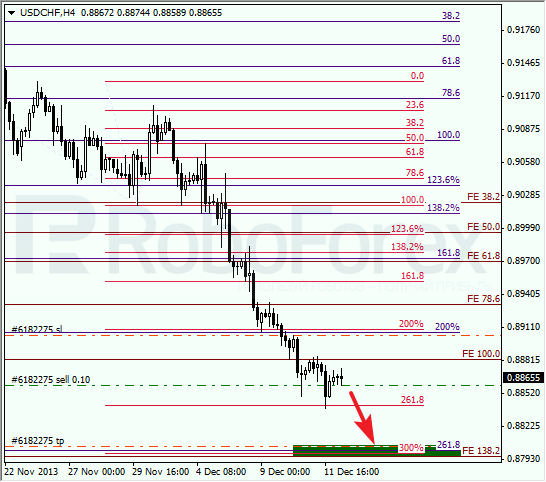
USD/CHF

Franc also may yet move downwards for a while. During local correction, I opened short-term sell order. In the future, price is expected to continue falling down towards lower fibo-levels at 0.8800.

At H1 chart, we can see one more fibo-level, 161.8%, inside target area. According to analysis of temporary fibo-zones, lower levels may be reached during the day. I’ll move stop into the black right after pair starts moving downwards.

RoboForex Analytical Department

Article By RoboForex.com

Attention!
Forecasts presented in this section only reflect the author’s private opinion and should not be considered as guidance for trading. RoboForex LP bears no responsibility for trading results based on trading recommendations described in these analytical reviews.


Bill Williams’ Indicators Analysis 12.12.2013 (USD/CAD, NZD/USD)

Article By RoboForex.com

Analysis for December 12th, 2013

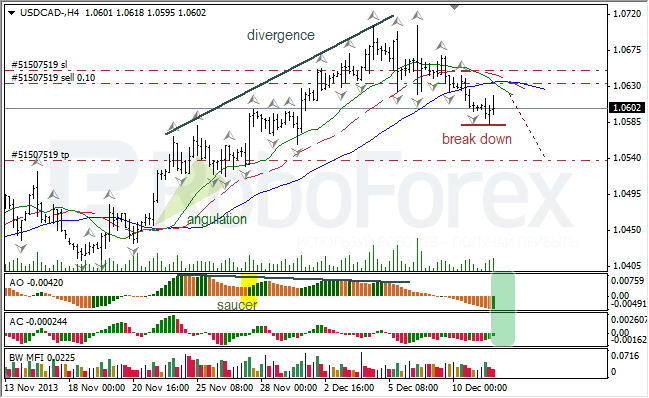
USD/CAD

At H4 chart of USD/CAD, Alligator reversed downwards. Indicators are in green zone; there are no Squat bars on the MFI. I expect breakout of fractals to the downside.

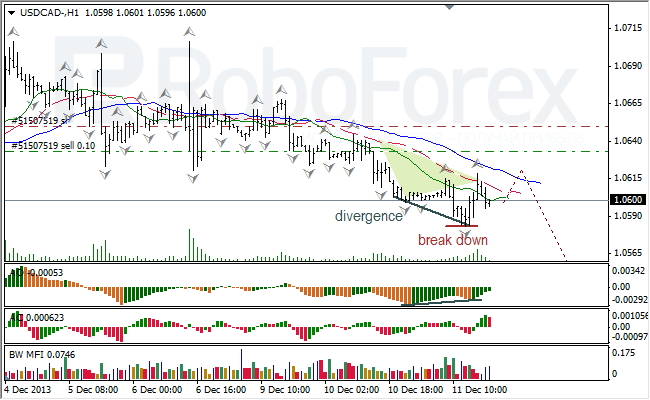
At H1 chart of USD/CAD, Alligator is moving southwards. AO and AC are in grey zone; there is Squat bar on the MFI. Bullish fractal may reach Alligator’s jaw (blue line) and then I expect breakout of fractals to the downside.

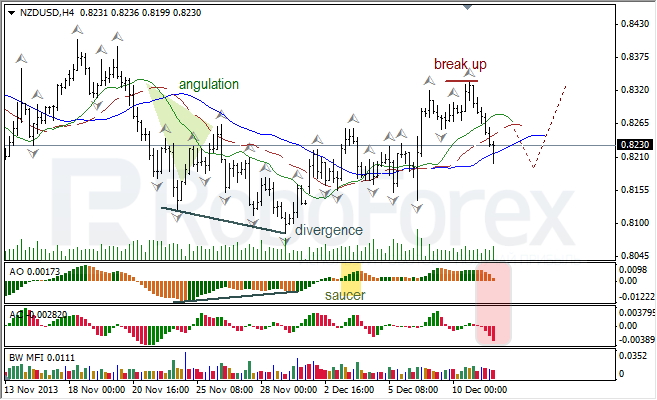
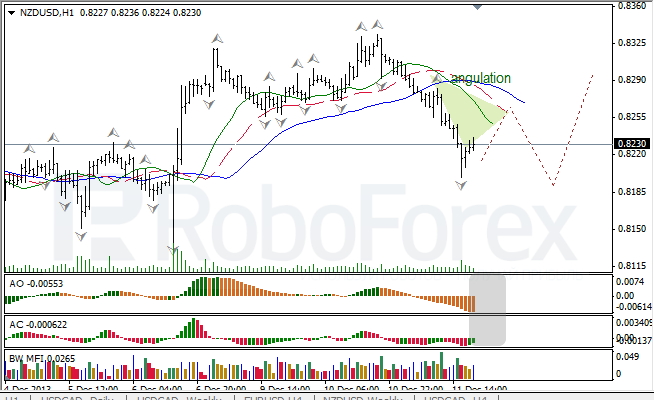
NZD/USD

At H4 chart of NZD/USD, Alligator is opening its mouth. Price is finishing bearish fractal; AO and AC are in red zone; there is Squat bar on the MFI. After completing bearish fractal, price is expected to grow up.

At H1 chart of NZD/USD, Alligator is moving downwards. AO and AC are in grey zone; there are no Squat bars on the MFI. I expect sideways correction.

RoboForex Analytical Department

Article By RoboForex.com

Attention!
Forecasts presented in this section only reflect the author’s private opinion and should not be considered as guidance for trading. RoboForex LP bears no responsibility for trading results based on trading recommendations described in these analytical reviews.


The Two Smartest Ways to Play the Coming Takeover Boom (Part 1)

By WallStreetDaily.com

Forget shopping for the latest holiday gift item. Let’s go shopping for an entire company!

Based on the latest survey of 1,000 merger and acquisition (M&A) professionals, that’s apparently the mindset in boardrooms across the country.

“We’ve seen a shift in the marketplace,” says Dan Tiemann, KPMG’s Transactions and Restructuring Lead for the Americas.

I’ll say!

Nearly 75% of the C-level executives polled by KPMG expect to complete an acquisition in 2014. That’s up from about 50% in last year’s survey.

Forget trying to offload deadweight to survive the economic downturn. Clearly, companies now want to thrive by purchasing growth.

The profound change in sentiment underscores a tremendous investment opportunity. There’s a way for the most aggressive and conservative investors to play it, too. Here’s how…

Bring on the Deals and Hefty Profits

As investors, we know that nothing – and I mean nothing – jolts a stock higher than an unsolicited takeover offer.

Just ask shareholders of Rochester Medical Corporation (ROCM), which was an active WSD Insider recommendation.

Back in August, the stock rocketed 52% higher on news of a $20-per-share takeover offer from C. R. Bard, Inc. (BCR).

Anyone here going to complain about a single-day return of 50% (or more)? I didn’t think so.

It’s also worth noting that Rochester Medical is one of three takeover deals recently announced among the companies in our WSD Insider portfolios. So we’re witnessing a legitimate resurgence.

That means it’s high time to identify even more companies that would make for attractive acquisitions.

Of course, by no means am I suggesting that this is an easy task. But it’s not impossible. Especially since M&A insiders have tipped their hands, so to speak.

More specifically, insiders singled out the two sectors they expect to have the most M&A activity in 2014: technology (44%) and healthcare (41%). Since they’re the ones who will be negotiating the deals, they’re not blindly guessing, either.

We’d be well served, then, to find companies with compelling products and technologies, trading at lower levels, with minimal to no debt. We should be on the lookout for small caps, too, as they traditionally fetch the highest takeover premiums.

Two such candidates in the technology sector, which I’ve previously singled out, are Fusion-io, Inc. (FIO) and Crossroads Systems, Inc. (CRDS).

As for the healthcare space, BioScrip Inc. (BIOS) represents a timely opportunity. Especially in the wake of CVS’ (CVS) $2.1-billion deal for the Coram division of Apria Healthcare, a peer of BioScrip.

No doubt, with a little elbow grease, we can turn up other suitable and compelling options. In fact, we’ve just uncovered a new opportunity that we’re revealing to WSD Insider subscribers this week. If you haven’t upgraded your subscription to insider status yet, go here now.

Of course, many investors believe there’s just too much guesswork involved – or too much time required – to sleuth out companies with irresistible takeover appeal like we do. Fair enough. Everyone’s entitled to his or her opinion (or to be lazy).

If you fall into that category, I have good news for you. There’s an easy and safe way that you can still tap into the dozens of deals I expect next year. Stay tuned tomorrow to find out how.

Ahead of the tape,

Louis Basenese

The post The Two Smartest Ways to Play the Coming Takeover Boom (Part 1) appeared first on Wall Street Daily.

Article By WallStreetDaily.com

Original Article: The Two Smartest Ways to Play the Coming Takeover Boom (Part 1)