Fibonacci Retracements Analysis 20.01.2014 (EUR/USD, USD/CHF)

Article By RoboForex.com

Analysis for January 20th, 2014

EUR/USD

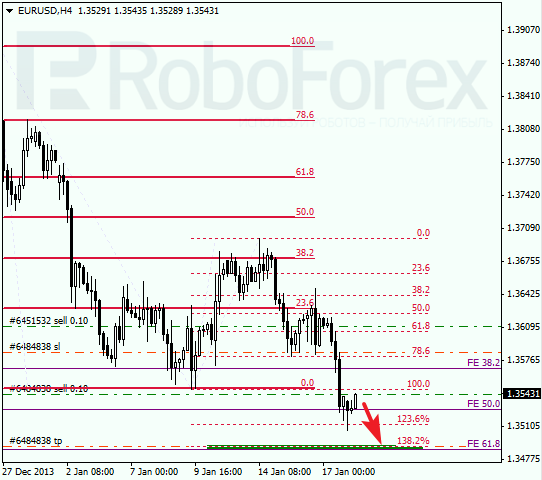
Euro is still moving downwards; target levels are very close. During correction, I opened another sell order; stop on both trades is placed at local maximum. If later price rebounds from lower levels, pair may start new and deeper correction.

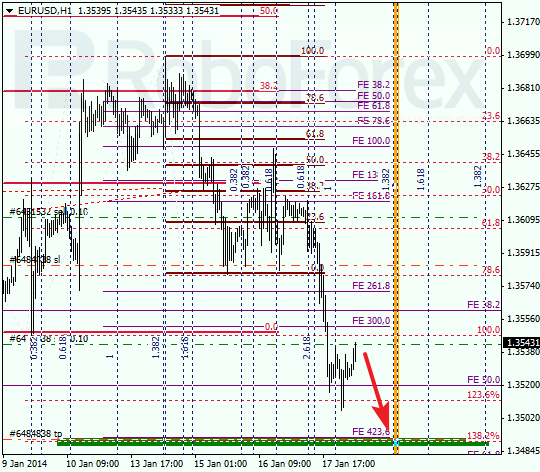
As we can see at H1 chart, after rebounding from correctional level of 50%, pair started falling down. According to analysis of temporary fibo-zones, predicted targets may be reached during Monday. If later price breaks lower levels, I’m planning to start selling again during pullback.

USD/CHF

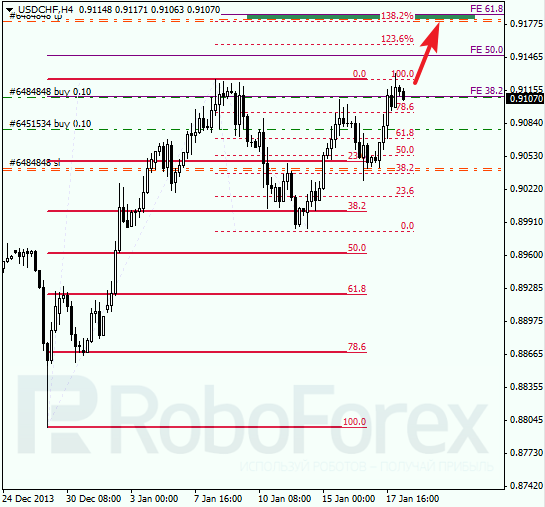
After reaching new maximum, Franc started correction, during which I opened my second buy order. Target for both trades is the same; it’s close to upper fibo-levels at 0.9180. Stops for both orders are placed at local minimum, but later I’m planning to move them higher.

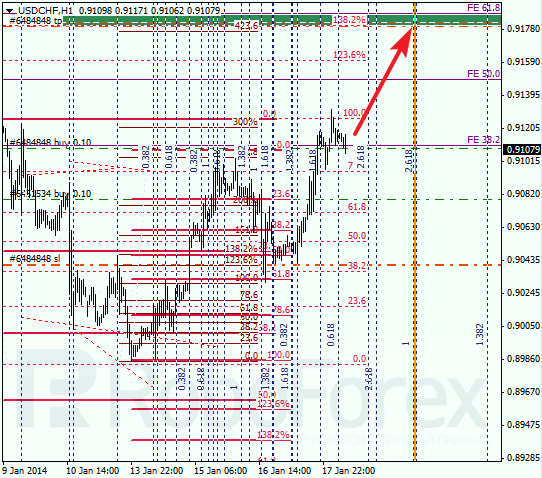
As we can see at H1 chart, after rebounding from local level of 61.8%, price started growing up again. However, current correction is unlikely to be very deep, that’s why upper target levels may be reached quite soon.

RoboForex Analytical Department

Article By RoboForex.com

Attention!
Forecasts presented in this section only reflect the author’s private opinion and should not be considered as guidance for trading. RoboForex LP bears no responsibility for trading results based on trading recommendations described in these analytical reviews.


Penny Stock Accidentally Blasts 1,900% Higher

By WallStreetDaily.com Penny Stock Accidentally Blasts 1,900% Higher

On January 13, Google (GOOG) made a big splash into the home automation market by scooping up privately held Nest Labs for $3.2 billion.

The very next day, Nestor Inc. (NEST) – a Rhode Island-based company that traded over-the-counter for less than one penny – watched its stock soar 1,900%.

What gives? Investors confused the two companies, of course.

Not just a few investors, either. For two days in a row, close to two million shares of Nestor traded hands.

(And we wonder why Wall Street calls us the “dumb money!”)

It’s not even the only case of mistaken identity that we’ve seen recently.

Back in October 2013 – when social media darling, Twitter (TWTR), announced its highly anticipated IPO filing – investors bid up Tweeter Home Electronics Group (THEGQ) by 1,800%. (Its ticker symbol at the time was TWTRQ.)

Naturally, both penny stocks have since come crashing back down to Earth, handing thousands of investors big losses and a big dollop of embarrassment.

Forget the mix-ups, though. I’m not here to belabor the point that you should look twice before you hit the “Buy” button. That goes without saying.

Instead, I want to drive home how extremely sensitive penny stocks are to news – and, more importantly, why that’s a reality we can exploit for serious short-term profits…

Ever See a Stock Double Overnight?

Despite the misconception that all penny stocks are frauds, there are real companies – with actual businesses, sales and profits – that trade as penny stocks. Thousands of them, in fact.

Of the almost 19,000 stocks traded on all U.S. exchanges, roughly 6,000 are penny stocks, trading for less than $1 per share. And among those penny stocks, more than 2,000 are profitable, which is as real as it gets.

So what do you think happens when one of those penny stocks announces legitimate news? Well, shares often double (or more) overnight. And they don’t come crashing back down, either.

Want proof? Look no further than cloud-based videogame provider, TransGaming (TNG.V), which happens to be an active recommendation in our premium newsletter, WSD Insider.

On January 6, the company was trading for $0.19 per share, at a market cap roughly equal to its annual sales.

Then, on January 7, management announced its GameTree TV platform would be offered on smart televisions made by the $170-billion market cap Samsung, the world’s largest consumer electronics company.

Sure enough, the stock rocketed 105% higher on the news… in a single day.

Lest you think I’m merely cherry-picking an example, think again. Price doubles for penny stocks occur with incredible regularity.

During any given month, there are upwards of 890 overnight doubles, which works out to an average of about 30 per day.

In fact, based on our analysis, it’s not uncommon for the number of overnight doubles to average as high as 40 per day – like they did in 2012.

Of course, with over 6,000 penny stocks trading on U.S. exchanges, the trick becomes distinguishing the good penny stocks from the mediocre (or the downright rotten).

It can be done, though. Our experience with TransGaming serves as the latest proof. Be sure to tune in tomorrow to find out how. That’s when I plan to share my 10 Golden Rules for Investing in Penny Stocks.

Ahead of the tape,

Louis Basenese

The post Penny Stock Accidentally Blasts 1,900% Higher appeared first on Wall Street Daily.

Article By WallStreetDaily.com

Original Article: Penny Stock Accidentally Blasts 1,900% Higher

Ichimoku Cloud Analysis 20.01.2014 (GBP/USD, GOLD)

Article By RoboForex.com

Analysis for January 20th, 2014

GBP/USD

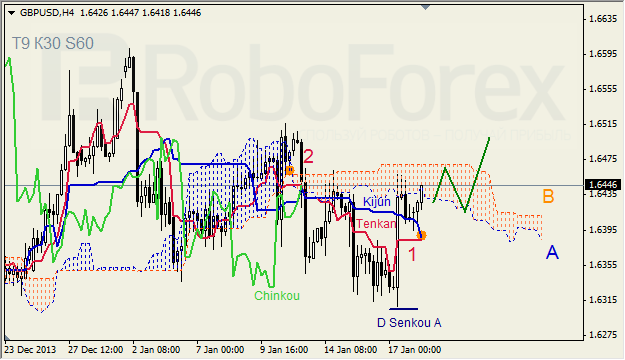
GBPUSD, Time Frame H4. Tenkan-Sen and Kijun-Sen are close to each other below Kumo Cloud, they may intersect and form “Golden Cross” (1). Ichimoku Cloud is going down (2), and the price is trying to stay inside Kumo. Short‑term forecast: we can expect resistance from Senkou Span B and support from Senkou Span A.

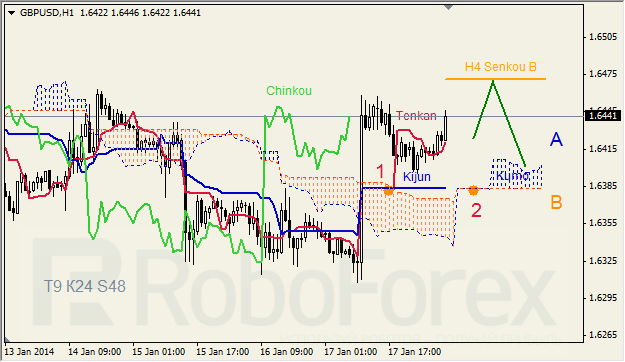
GBPUSD, Time Frame H1. Tenkan-Sen and Kijun-Sen intersected and formed “Golden Cross” (1); Tenkan-Sen is directed upwards. Ichimoku Cloud is going up (2), Chinkou Lagging Span is close to the chart, and the price is above the lines. Short‑term forecast: we can expect resistance from H4 Senkou Span B.

GOLD

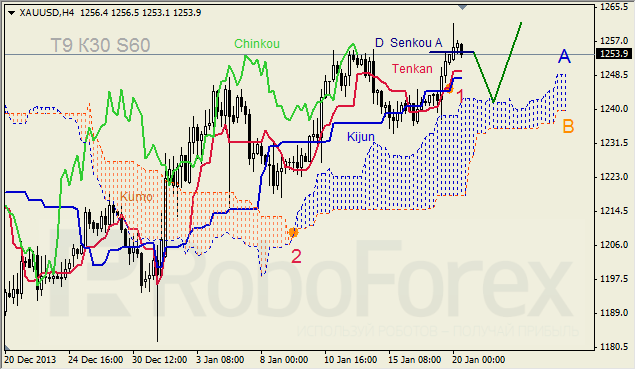
XAUUSD, Time Frame H4. Tenkan-Sen and Kijun-Sen intersected again above Kumo Cloud and formed “Golden Cross” (1). Ichimoku Cloud is going up (2); Chinkou Lagging Span is on the chart, and the price is above the lines. Short-term forecast: we can expect support from Senkou Span A.

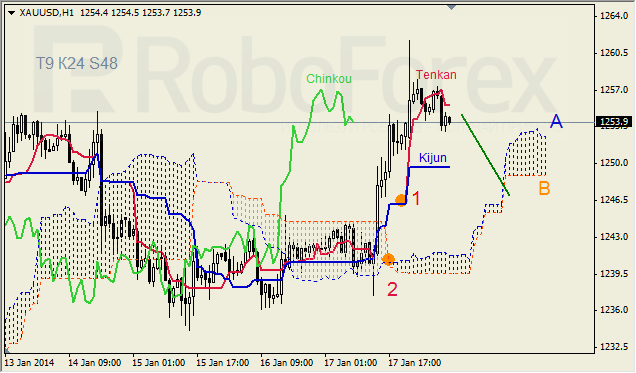
XAUUSD, Time Frame H1. Tenkan-Sen and Kijun-Sen intersected and formed “Golden Cross” (1). Ichimoku Cloud is going up (2), Chinkou Lagging Span is above the chart, and the price is inside Tenkan-Sen – Kijun‑Sen channel. Short‑term forecast: we can expect resistance from Tenkan-Sen, and decline of the price.

RoboForex Analytical Department

Article By RoboForex.com

Attention!
Forecasts presented in this section only reflect the author’s private opinion and should not be considered as guidance for trading. RoboForex LP bears no responsibility for trading results based on trading recommendations described in these analytical reviews.


USDJPY failed to break above 105.44 resistance

USDJPY failed to break above 105.44 resistance and pulled back from 104.92, indicating that lengthier sideways movement in a range between 102.85 and 105.44 is underway. Resistance is now at 104.92, a break above this level could signal resumption of the uptrend from 96.57 (Oct 8, 2013 low), then the target would be at 110.00. On the downside, a breakdown below 102.85 support will indicate that that the uptrend from 96.57 had completed at 105.44 already, then the following downward movement could bring price back to 95.00 zone.

usdjpy

Daily Forex Analysis

Binary Options trading explained

Binary options trading is an exciting new type of investing. Instead of purchasing an asset itself, investors (i.e. traders) can speculate on the direction in which the rate of the asset will move.

What Is Binary Options Trading

When the trader has bought a certain asset as a binary option, the trader has created a contract which gives the him/her the right to buy this underlying asset at the fixed price, within the specified time frame, from the binary options trading brokers. Whatever the binary options are called: digital options, fixed return options, exotic options, each name means the 0-1 nature of the options. Because there are only two possible outcomes in binary options. Both of the outcomes are understood by the trader before making the purchase of an options. A trade on the binary options trading system may look like this: A trader purchases a GOOGLE binary option for $100, with the option that at the end of the day the GOOGLE shares will be higher than they currently stand.. If the prediction is correct, then the trader’s position ended in the money and the profit will be cashed out. Profits range from 85% for standard binary options to 1250% with the GOptions Ladder Options tool. So, if the trader was right, he/she will be paid the $100 + 85% = $185 If the trader was wrong, he/she will get $0. But there are always possibilities such as the round-up, double up, stop-loss and more safeties in binary options trading.

Binary Options Trading vs. Regular Options Trading

There are three major differences between binary options trading and regular options trading (vanilla options). The figure below will explain the differences. binary options trading versus traditional options These differences have several consequences:

  1. The short-term investments have multiple expiry times and are therefore more flexible than the regular options.
  2. In binary options both the amount and the expiry time are set from the start. In vanilla options the trader pays per contract and will only profit or lose the amount depending on the number of point difference between the expiry level and the strike price.
  3. Binary options trading means that the trader must keep the option upon expiring. Care must be taken when opening a position.However, a lot of binary options trading brokers nowadays are offering the stop-loss function to sell the option back to broker before expiring. GOptions and 24Option offer this.

Binary options trading is a novel and interesting method of investing in the financial markets. Despite being more flexible than traditional (vanilla) options, planning ahead is an important part of succeeding. Another brand new feature with binary options trading are the risk free trades. These are offered to customers of GOptions and the amount of free trades depends on the deposit you make. Read our extended review of GOptions who we believe are the best binary options trading broker at this very moment!

About 

Jan de Wit is your forex and binary options blogger, bringing the best free tips, tools, ebook and more to his subscribers at his site.


Why I’d Rather Pick Bubbles Than Stock Market Crashes

By MoneyMorning.com.au

If you want to make a name for yourself in the financial markets, pick a crash.

If you want to build lasting and long-term wealth, pick a bull market and invest in stocks to take advantage of it as it rises.

OK, it’s not that simple or clear cut.

Many people have built a fortune from predicting a stock market bust – Jim Rogers, Dr Marc Faber, John Paulson…er, there are probably a few more.

While that’s an impressive (but short) list, there are two simple reasons why the list isn’t longer. It’s hard to predict a stock market crash, and it’s less lucrative.

That’s why we prefer to invest on the long side. Historically, stocks tend to rise more than they fall, and more importantly, you can make more money from buying stocks than short-selling them…

If you look at the market over the past 40 years it’s easy to come to a simple conclusion: over the long term stock markets go up. We can show you a chart to ‘prove’ it.

This is a chart of the US S&P 500 since 1974:


Source: Google Finance
Click to enlarge

Case proven, right? Not quite. For a start, 40 years doesn’t cover the complete history of stock markets. And second, 1974 roughly coincides with the beginning of the greatest asset bubble in living memory – the end of the Gold Standard and the start of the ‘paper money’ experiment.

So, those are legitimate reasons for caution. There’s no guarantee that this enormous rally will go on forever. But what if the greatest asset bubble in living memory has barely begun? What if this asset bubble plays out for another 10, 20 or 50 years?

It seems unthinkable. And yet, it’s entirely possible…

It’s Hard to Pick These Violent Market Moves

But before we explain why this asset bubble could last many more years, we’ll quickly go over what we mean about predicting crashes and why they’re less lucrative than betting on a bull market.

Predicting a crash is a great way to get people to notice you. Getting it right is an even better way to get people to notice you. There’s no argument that the big names who predict a market crash get more fame than those who predict a bull market.

Why is that?

First of all, it’s hard to predict a crash. An overvalued market can easily become more overvalued. Valuations can keep rising as investors believe earnings will catch up with prices. This can keep going until the valuations become so stretched they become impossible to sustain.

The second reason is that crashes happen quickly and violently. You can see that on the chart above. A crash from beginning to end may only last a few weeks or perhaps a few months.

If you can predict that move and tell everyone about it, it’s fresh in their mind as it’s happening. On the other side, a bull market for stocks can take years, sometimes more than a decade to play out. By the time it’s proven that they’re right everyone has forgotten about it.

There’s something ironic about that, because as rich as you can become from short-selling the market and profiting from a crash, short-selling actually involves investors taking on big risks in order to make finite returns.

From a risk/reward perspective it’s something we’ve always found hard to justify as a long-term investment strategy. Here’s why…

Weigh Up the Risk and Reward

When you short sell a stock the most you can make is a 100% return on your money (assuming you don’t use any leverage). If you short sell $1,000-worth of stock and the share price goes to zero, your maximum profit is $1,000.

Assuming you didn’t use leverage on the trade, you would have deposited $1,000 in your brokerage account as ‘margin’ for the trade. That means you would have made a $1,000 profit on your $1,000 stake – a 100% gain.

If you want to increase the percentage returns, then you can leverage the position. But the maximum dollar gain is still the same.

On the other hand, if the share price goes up rather than down, you potentially face unlimited losses. You could lose two, three or four times your initial investment. That’s a big risk.

That’s why we prefer the long side. To begin with, there are no limits to your gains. If you back the right stock at the right time you can make unleveraged gains of two, three, five, 10 or more times your initial stake.

Now, those gains won’t necessarily happen overnight. As we mentioned before, stock market gains can take years, or even a decade or more to compound into big profits.

But on a risk/reward basis the numbers certainly stack up better than being short.

Don’t Sit Around Losing Money

That’s not to say we object to short selling or think that you shouldn’t do it. If you’re after short-term gains then short selling should be part of your investing toolkit. After all, on any given day there’s a 50/50 chance of a stock rising or falling.

If you’re not short-selling you’re missing out on half the market action. The problem with many short sellers is that they tend to sit around doing nothing or losing money when the market is going up.

So we don’t see betting on falling markets as a way to build long-term wealth. Just look at the Bloomberg Billionaires list. How many of the top 100 wealthiest people have built a fortune by short-selling stocks or businesses?

We can’t see a single name on the Billionaires list of someone who has built wealth that way. That’s not to say no-one has ever done it. But if you’re playing the numbers game, the odds suggest that if you want to get rich (or just build a decent nest egg) your best bet is to invest in good companies and watch your wealth grow as those companies grow revenues and profits.

We won’t pretend it’s without risk, because there are plenty of things that can go wrong. But if we’re right…if stocks continue to benefit from cheap money, and if the cheap money and low interest rate era has further to go, then now remains a great time to buy stocks.

Cheers,
Kris

Special Report: Five Fatal Stocks

Join Money Morning on Google+


By MoneyMorning.com.au
Data Roaming: The Technology Trend That’s NOT Your Friend…Yet

By MoneyMorning.com.au

Casey Snook’s parents were mad – and understandably so.

The 14-year-old Briton was on a five-day vacation in New York with her mom this summer, snapping pictures of the Big Apple to share with her friends on Facebook. None of that is particularly remarkable, though. The trouble came later, when Casey’s dad got the cellphone bill…

The teenager had racked up $6,000 in data roaming charges, a pretty hefty price tag just for posting some pictures to Facebook.

Casey’s story isn’t an anomaly.

Last year, an 11-year-old Canadian boy rang the register for $22,000 after three days of video streaming on his dad’s cellphone during a family vacation to Mexico. And in 2011, T-Mobile billed a Florida woman $201,000 after her brothers went to town with data usage on a two-week trip to Canada.

These stories seem unthinkable in today’s superconnected world. But the reality is that getting an internet connection while travelling is still the Wild West of the telecom world. That’s why tiny wireless carriers looking to change that could potentially make you a fortune in the process.

Why is the wireless business such a slam-dunk?

We have become ravenous consumers of digital information. For the five-year span between 2012-17, mobile data traffic is estimated to increase 13 times, to more than 11.2 exabytes per month. That’s enough bandwidth to transfer a copy of all the content in every academic research library in the United States…2,000 times.

But it’s not just that data consumption is through the roof – people also expect to be able to access that data from anywhere, anytime. That’s why wireless carriers are seeing such a surge in the data volumes that pass through their networks.

The Big Opportunity

There are some real problems with wireless data roaming. For starters, it’s incredibly expensive; while technological advances have lowered costs for most of the technological services we consume, wireless data costs have actually gone up, not down.

Major carriers like AT&T and Verizon have locked down their unlimited data plans, instead charging subscribers for limited amounts of bandwidth per month. If you go over, you pay more.

Cellular data coverage can also be spotty. While the latest LTE towers can now match the broadband download speeds you get from a fixed line, buildings can block signals or make them unusable.

Device availability is another big problem. Select few laptops come with built-in cellular antennas, and even most tablets today aren’t cellular-enabled. At last count, around 90% of all iPads sold are Wi-Fi only.

For travelers – particularly business travelers – those factors present a big problem. When you’re away from the office, especially overseas, turning your email off isn’t always an option.

Wi-Fi solves some of the problem. It’s far cheaper to connect your laptop or smartphone to a hotel’s Wi-Fi network than to connect to cellular data. But Wi-Fi has plenty of detractors of its own – the biggest is that there’s no unified Wi-Fi carrier. Instead, users have to connect to a patchwork of free or paid wireless networks, each with varying degrees of security, speed and availability. It’s not as simple as turning on your phone and hitting the Web.

What we need is a solution that combines the simplicity of an always-on cellular network with the cost and connection strength of Wi-Fi.

Keep your eye on this space!

Regards,
Jonas Elmerraji,
Contributing Editor, Money Morning

Ed Note: The Tech Trend That’s NOT Your Friend…Yet was originally published in The Daily Reckoning America.

Join Money Morning on Google+


By MoneyMorning.com.au
Commodity Technical Outlook on GOLD

GOLD: While our immediate bias on GOLD remains higher on correction, the commodity will have to take out the 1,267.75 level, its Dec 10’2013 high to convince the market of price extension. However, as long as the mentioned level continues to hold as resistance the risk remains lower despite the mentioned recovery. On the upside, resistance resides at the 1,267.75 level, its Dec 10 2013 high. A cut through here will create scope for a move higher towards the 1,300.00 level where a violation if seen will turn focus to the 1,350.00 level. Conversely, support stands at the 1,218.35 level, representing its Jan 08’2014 low. This level must hold to prevent a return to the 1,182.33 level, its Dec 31’2013 low from occurring. However, if this is violated it will aim at the 1,150.00 level followed by the 1,100.00 level with a turn below the latter shifting attention to the 1,050 level.. All in all, GOLD remains biased to the downside in the medium term.

Article by fxtechstrategy.com


NZD/USD Forecast January 20-24

Article by Investazor.com

The kiwi struggled and managed to gain during the first two days of this week. The price of NZDUSD hit a high at 0.8431 but this gain was quickly erased until the ending of 14th of January. Even though the NZIER Business Confidence rose to 52, all the way from 38, it wasn’t enough to maintain a higher NZD. Next week’s main important release would be the CPI. Continue reading to see what is expected for the inflation in New Zealand, what are the other economic releases and what are the technical perspective.

Economic Calendar

REINZ HPI m/m – Monday (no hour scheduled). This is the indicator that shows the changes in the selling price of all homes. In November it rose with 1.6% and in December rose with 1.2%.

CPI q/q – Monday (21:45 GMT). In October the quarterly inflation rate was up with 0.9%, with 0.1% above analysts estimations. After the last quarter it is expected to be unchanged (0.0%). A bigger number could trigger attention for the investors the kiwi could gain back some terrain.

Business NZ Manufacturing Index – Wednesday (21:30 GMT). This is the level of a diffusion based on surveyed manufacturers. The December value was 56.7. This is usually a medium impact indicator.

Technical View

NZDUD, Daily

nzdusd-daily-forecast-january-resize-20-24-19.01.2014

Support: 0.8235, 0.8100;

Resistance: 0.8400, 0.8543.

On the daily chart we can see that the downside move, started on 15th of this month, was actually signaled by the Shooting Star that made a false breakout above the 0.8400 resistance line. Currently the price got to a daily support level at 0.8235. A close on this time frame under this level could trigger a fall to the next Daily Key Support at 0.8100.

NZDUSD, H1

nzdusd-h1-forecast-january-20-24-resize-19.01.2014

Support: 0.8235, 0.8200;

Resistance: 0.8300, 0.8310.

On the H1 interval it is pretty clear that the NZDUSD is in a downtrend. The last move down has the 14 periods RSI in the oversold area. This could be a bullish signal for the beginning of next week. A break through 0.8260 would confirm a short term reversal that could target the 0.8300 area. The drop could continue but is important to be careful not to be caught in a throw back.

Bullish or Bearish

nzdusd-weekly-forecast-january-resize-20-24-19.01.2014

The investors’ sentiment and the US economic releases could be of help in deciding whether   bullish or bearish than the economic releases for the New Zealand. But if we stick to the technical analysis after a retrace I would look for strong bearish signals to enter short. This direction is sustained also by the huge Shooting Star drawn on the weekly chart of NZDUSD, as you can see in the image on the right.

The post NZD/USD Forecast January 20-24 appeared first on investazor.com.

EUR/USD Forecast January 20-24

Article by Investazor.com

The European single currency struggled to gain terrain last week in front of the US dollar. It managed to hit the high of the week on Tuesday, when the Industrial Production for the Euro Area was posted 1.8%, 0.2% above analysts’ estimation. It was actually the only economic data posted above the forecasts. The rest of the releases were in line or under the forecasts. The CPI was 0.8%, in line with the estimates, but well under the ECB’s target of 2%. The Core CPI rose with only 0.7%. These will, for sure, put pressure on the ECB.

The US dollar was aggressively bought on Friday even though the economic data released for the United States was under estimates. The EUR/USD currency lost almost 1.0% and confirmed the downtrend on the short term time interval. Continue reading this article to see what are the economic expectations for this week and what does the technical analysis says for the short and medium term.

Latest EURUSD posts on Fundamental Analysis:

15 January Wrap Up – Why Did The Market Rally?

EUR/USD – 14 January Morning Overview

Economic Calendar

German PPI – Monday (7:00 GMT). Although expected to rise with 0.1% in November, the actual post was a drop of 0.2%. In December it wasn’t expected any change, but it actually dropped with 0.1%. This month the German Producer Price Index is expected to rise with 0.2%. Another disappointing release might discourage investors in buying the Euro.

German Buba Monthly Report – Monday (11:00 GMT). It would be very interesting to read especially if the report reveals viewpoints which crash with the ECB’s stance.

German Constitutional Court Ruling – Tuesday (doesn’t have a specific hour). The German Federal Constitutional Court is due to announce a ruling regarding the constitutionality of the ECB’s Outright Monetary Transactions policy (OMT), in Karlsruhe.

German ZEW Economic Sentiment – Tuesday (10:00 GMT).  From August 2013 the German Zew has surprised the market with better than expected releases. In November the actual was in line with the 54.6 estimates. This even did not repeat itself in December when the actual release was of 62.0, with 4.7 points above the analysts’ forecast. On Tuesday it is expected to be around 63.4. If the actual release will be in line or above this forecast, the Euro might get some fundamental support. On the other hand, a drop in this indicator could mean another hit for the Euro Area, especially for Germany.

ZEW Economic Sentiment – Tuesday (10:00 GMT). The Euro Area ZEW didn’t have a smooth road like the German ZEW. In October the indicator was in line with the estimates, disappointed in November, but In December was with 7.4 points above the forecast. This month is estimated to rise at 70.2

Flash Manufacturing PMI – On Thursday at 08:00 GMT will be published the French PMI. From August last year each release was under the analysts’ estimates. December’s release was of 47.1, which was under the 49.1 estimated, revised this month to 47.0. This month it is expected to be 47.6, but it will not be any surprise for us if it will disappoint again. At 08.30 GMT the German Flash Manufacturing will be released. After it had October and November in line with the estimates, last month surprised with a 1.1 points higher value, at 54.2. For this week it is expected to be somewhere around 54.7. The Euro Area Flash Manufacturing it is expected to be published at 09:00 GMT. This one had a similar evolution like the German one. It was in line with the forecasts in October and November and exceeded them in December. This month it is expected around 53.2.

Flash Services PMIs – They are noted to have a less impact on the market, but if the differences between the forecasts and the actual releases are big, then they could raise the volatility of the EURUSD pretty fast. The French Services PMI is expected to be released Thursday at 08:00 GMT around the 48.2 value. The German Services PMI was lower than estimates in December, with a 54.0 release. This month was revised at 53.5 and the forecast is of 54.1. The Euro Area Services PMI is programmed at 09:00 and is expected to be around 51.5.

Current Account – Thursday (09:00 GMT). The Euro Area Current Account it is expected to be this month around 19.2B after in December was recorded a value of 21.8B.

These are the most important releases for the Euro Zone next month. We would like to highlight the German ZEW Economic Sentiment and the Flash PMIs to be more important. But as we look at the EURUSD pair and not the Euro alone, we should see what economic releases are scheduled for the United States.

On Monday it will be a Bank Holiday for the United States, on Tuesday, Wednesday and Friday it seems that nothing important is scheduled. Thursday will be the most crowded day as for the Economic releases for the United States and the USD: Unemployment Claims – Exp. 331K; Flash Manufacturing PMI – Exp. 55.2; HPI – Exp. 0.4%; Existing Home Sales – Exp. 4.99M.

Technical View

EURUSD, Daily

eurusd-daily-forecast-january-resize-20-24-19.01.2014

Support: 1.3400, 1.3150;

Resistance: 13800, 1.4000;

The price has continued the down move after the Euro tried to comeback in the beginning of this week. The pressure coming from the US buyers was too big to handle. EURUSD dropped around 1% and seem to have drawn a Falling Wedge. This pattern in the current conditions is bullish as long as the lower line will not be broken in the upcoming week. Of course traders will also need a strong bullish confirmation to get in long positions.

EURUSD, H1

eurusd-h1-forecast-january-20-24-resize-19.01.2014

Support: 1.3515, 1.3500, 1.3450;

Resistance: 1.3580, 1.3640.

On the lower, H1, time frame we can see that the rally of the US dollar from Friday triggered a bullish signal. The 24 periods RSI went in the oversold area and came back after the price has broken the rejection line of the down trend channel. In this case we could expect a retrace back in the 1.3560/80 area. If the price will break 1.3500 this week then we can expect for the downtrend to continue to 1.3450 or why not, even lower.

Latest EURUSD posts on Technical Analysis:

EURUSD – Short Term Rectangle Pattern

 Bullish or Bearish

My stance would be bullish for the US dollar on the medium term. Even though there will be more economic releases for the Euro Area this week, the tendency could remain bearish. As long as no clear bearish signals will appear it would be pretty hard to change this view.

The post EUR/USD Forecast January 20-24 appeared first on investazor.com.