Fibonacci Retracements Analysis 21.01.2014 (EUR/USD, USD/CHF)

Article By RoboForex.com

Analysis for January 21st, 2014

EUR/USD

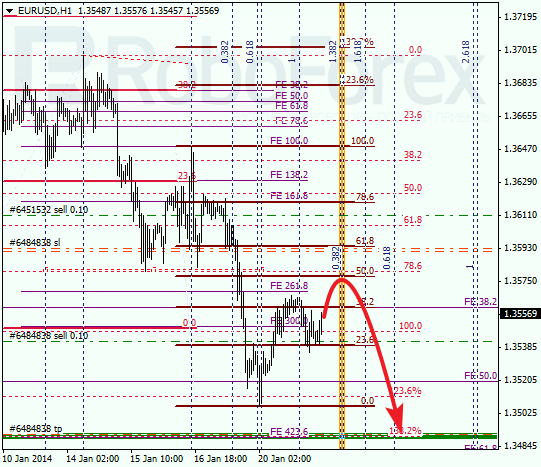
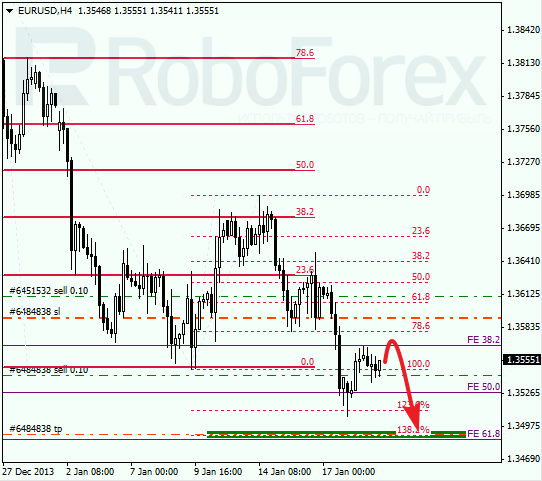
Euro is still being corrected. Possibly, during the day, bulls may break latest maximum, but after that price may continue falling down towards lower fibo-levels at 1.3490. If later price rebounds from these levels, pair may start new and deeper correction.

As we can see at H1 chart, target of current correction is at local level of 50%. According to analysis of temporary fibo-zones, this level may be reached during Tuesday. If later price rebounds from it, I’m planning to increase my short position.

USD/CHF

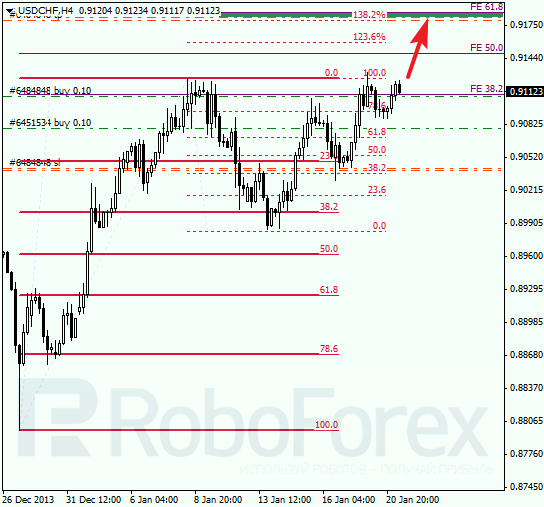
Franc is moving very close to its latest maximums. During the next several days, price may continue growing up towards upper fibo-levels. If later Franc rebounds from this target area, bears may steal the initiative and start new and deeper correction.

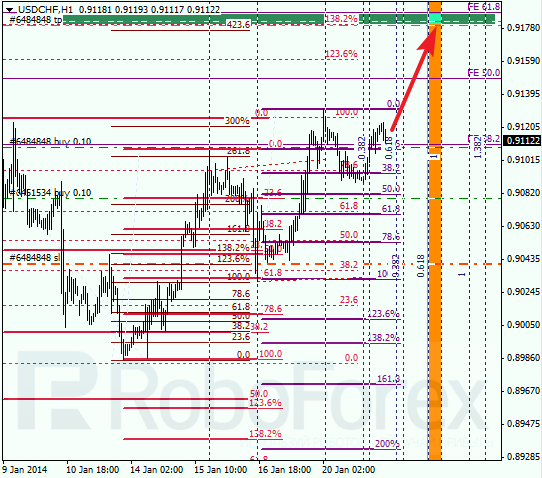
As we can see at H1 chart, after rebounding from local level of 38.2%, price started growing up again. I’ll move stops below latest maximum as soon as pair breaks maximum. According to analysis of temporary fibo-zones, main target may be reached by Wednesday.

RoboForex Analytical Department

Article By RoboForex.com

Attention!
Forecasts presented in this section only reflect the author’s private opinion and should not be considered as guidance for trading. RoboForex LP bears no responsibility for trading results based on trading recommendations described in these analytical reviews.


Lehman Brothers Exacts Revenge, Rigs Market With Booby Trap

By WallStreetDaily.com Lehman Brothers Exacts Revenge, Rigs Market With Booby Trap

Avoid penny stocks at all costs!

At least, that’s what blue-blooded Wall Street types swear we should do.

By their definition, any stock trading for $5 technically falls into this classification.

When I talk about penny stocks, though, I’m referring to stocks that trade for less than $1 per share. By my tally, there are currently more than 5,000 such stocks in existence.

Granted, not all of these stocks are destined to be winners.

Indeed, I admit that the penny stock market is full of landmines. For instance, we shouldn’t invest in Lehman Brothers (LEHMQ) just because it’s a penny stock! But this market is also home to goldmines – stocks capable of quickly rallying 200%, 500%, even 1,000%.

And if we know how to sidestep the dangers, there’s truly a fortune to be minted trading penny stocks.

As I promised yesterday, I want to help you do just that by sharing my 10 rules for investing in penny stocks. So let’s get to it…

Penny Stock Rule #1: Administer the Scam Tests

After getting a “hot” tip about a penny stock, many investors commonly wonder if it’s a scam.

Anybody home? Think, McFly. Think!

If we have to ask that question, there’s usually a reason for it. Do yourself a favor and move on to a stock that doesn’t raise any such doubts.

Now, if you simply refuse to believe nothing is ever too good to be true – or you’re incapable of rational thinking when presented with a seemingly can’t-lose penny stock – apply this secondary scam test…

Verify that the company is fully reporting. By that I mean, make sure the company files audited financials and quarterly results with the SEC.

If a company can’t meet those simple requirements, the likelihood of it being a worthy investment is pretty much zero. Don’t take the chance.

Penny Stock Rule #2: Show Me the Revenue!

A cheap stock price is no reason to abandon sound financial analysis. Be picky when investing in penny stocks and insist on finding companies with solid and improving fundamentals.

With that in mind, we should be willing to take a bet on a young, innovative company – even if it doesn’t have any profits. But we should never compromise on sales.

Revenue is the only sure sign that real demand exists for its products. So if a company can’t show you the revenue, show it to the curb. It’s not worth your time or hard-earned investment capital.

Penny Stock Rule #3: Size Matters

There may be riches in niches, but not for penny stock investors.

We need market opportunities big enough to meaningfully increase sales and share prices, as well as attract mainstream attention in the form of a takeover offer. With that in mind, stick to penny stock companies with products or services that address a market worth at least $1 billion. That’s more than enough to do the trick.

Penny Stock Rule #4: Stick to “Smart Money” Magnets

Almost every company gets its start in the private market. And it stands to reason that the companies attracting the most private funds from leading venture capitalists and private equity firms hold the most promise.

By tracking these money flows, we can ensure that we’re one of the first to know about the next wave of visionary companies.

With that in mind, be on the lookout for penny stocks receiving fresh capital from the “smart money,” which includes insiders.

As we recently witnessed with Crossroads Systems (CRDS), it can be a surefire sign that good times are on the horizon. The stock hit a low of $0.69 on October 10, 2013. Shortly thereafter, a prominent insider and value investor started buying shares. Sure enough, less than four months later, the stock is up 315%.

Penny Stock Rule #5: Catalyst Required

An impending event can send a tiny stock through the roof.

Imagine owning a small pharmaceutical stock ahead of FDA drug approval – or a little software company before a major takeover. Such events can make us ridiculously wealthy, overnight.

When hunting for compelling penny stocks, we need to focus on companies with strong catalysts on the horizon with the potential to propel shares dramatically higher. If none exist, the stock will likely be worth a penny indefinitely, which makes it unworthy of our time or investment.

Penny Stock Rule #6: Be Old School… Pick Up the Phone

The information age has produced a generation of lazy investors. Their due diligence goes no further than a few mouse clicks and internet searches.

But I’m here to tell you that the internet is not efficient.

All publicly available information about a particular company cannot be unearthed on our computers. The surest way to verify an opportunity and find out more specifics about it is to pick up the phone! Yes, reach out and call someone.

While CEOs of multi-national, mega-billion-dollar-market-cap companies won’t give you the time of day, executives at micro-cap companies are much more likely to answer your call.

Penny Stock Rule #7: Bet Small to Win Big

By making small bets on penny stocks, we can limit our downside risk and ensure that a total loss won’t torpedo our entire portfolio. As a general rule of thumb, I never invest more than 1% of my total equity portfolio in a penny stock.

If you want to wager slightly more, that’s up to you. But don’t wager too much more, or else you’ll undermine any efforts to reduce risk.

Penny Stock Rule #8: Know Your Limits

Most penny stocks sport lower-than-average trading volumes. If we use market orders, we’ll end up paying more, which ultimately cuts into our profit potential.

Instead, use limit orders to buy penny stocks. And be patient. Penny stocks are notoriously volatile, which means we should never have to chase prices. Eventually, a dip in prices will materialize.

Penny Stock Rule #9: There’s No Crying in Baseball

When investing in such a speculative area of the market, we’re bound to invest in a few duds. It happens. So expect it.

As long as we’re only investing money we can afford to lose, and we limit our bets to small amounts (see Rule #7), there’s no reason to shed a tear.

Penny Stock Rule #10: Don’t Be a Miner

For whatever reason, investors love to go prospecting for penny stock riches by investing in developmental stage mining stocks. Particularly in Canada, where 68% of the companies on the Canadian TSXV exchange are in the mining and energy sectors.

Unless you’re a geologist with a big travel budget – and that’s not any of us – we’re no more qualified to make an investment decision in these types of penny stocks than a newbie prospector with a divining rod.

So don’t do it!

Bottom line: Follow these 10 straightforward rules, and your winners should far outshine your losers – thereby making hunting profits in penny stocks a worthwhile endeavor. Don’t believe me? Give it a try!

Ahead of the tape,

Louis Basenese

The post Lehman Brothers Exacts Revenge, Rigs Market With Booby Trap appeared first on Wall Street Daily.

Article By WallStreetDaily.com

Original Article: Lehman Brothers Exacts Revenge, Rigs Market With Booby Trap

Japanese Candlesticks Analysis 21.01.2014 (EUR/USD, USD/JPY)

Article By RoboForex.com

Analysis for January 21st, 2014

EUR/USD

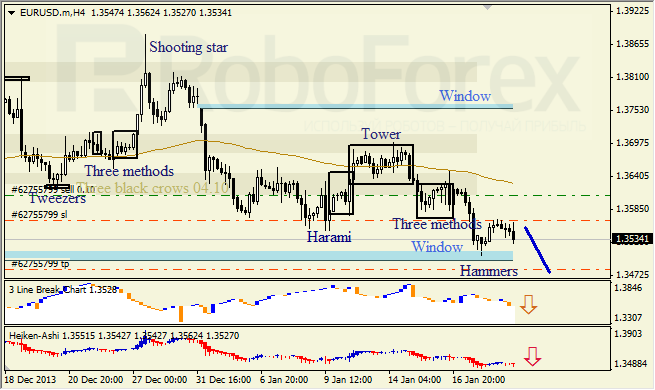
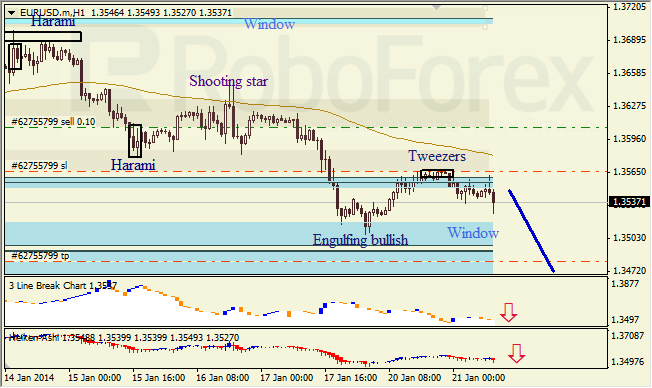
H4 chart of EUR/USD shows bearish tendency; closest Window is support level. Three Line Break chart and Heiken Ashi candlesticks confirm descending movement.

H1 chart of EUR/USD shows sideways correction within descending trend; closest Window is resistance level. Tweezers pattern, Three Line Break chart, and Heiken Ashi candlesticks confirm descending movement.

USD/JPY

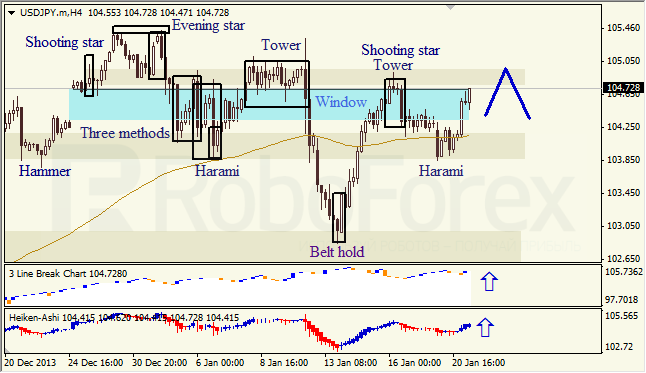
H4 chart of USD/JPY shows resistance from closest Window. Harami pattern, Three Line Break chart, and Heiken Ashi candlesticks confirm ascending movement.

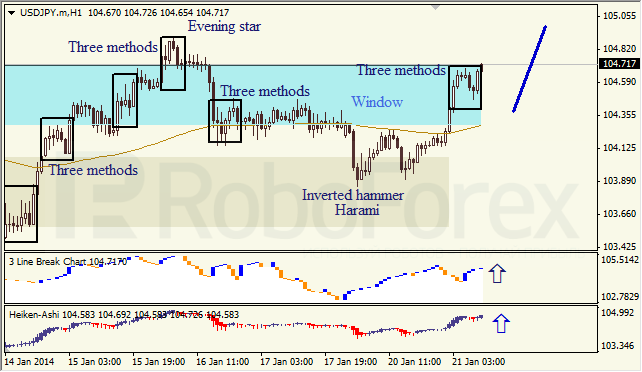
H1 chart of USD/JPY shows that correction finished after Inverted Hammer pattern. Bullish Three Methods pattern, Three Line Break chart, and Heiken Ashi candlesticks confirm ascending movement.

RoboForex Analytical Department

Article By RoboForex.com

Attention!
Forecasts presented in this section only reflect the author’s private opinion and should not be considered as guidance for trading. RoboForex LP bears no responsibility for trading results based on trading recommendations described in these analytical reviews.


EURUSD Daily Forecast 21 January

Article by Investazor.com

The Euro has moved up, testing the 1.3565 resistance. After it hit this high on Monday the EURUSD started to drop, consolidating itself between 1.3536 and 1.3558. A breakout above the resistance could trigger a rally to 1.3581, while a false breakout might send the price back to the local support or even lower to the next key support.


The post EURUSD Daily Forecast 21 January appeared first on investazor.com.

Why It’s Too Soon to Burst the Stock Price Bubble

By MoneyMorning.com.au

What was yesterday’s big news? China’s economic growth.

The market expected bad news.

That’s why the S&P/ASX 200 index fell as much as 43 points during the day.

So, what happened?

It turns out the news was better than the market had expected.

After that came out the market turned course and went up. It ended the day down just 10.9 points.

So much for the idea that the market is living in cloud cuckoo land with too-high expectations. In fact, is it possible that investors are being unduly pessimistic and undervaluing stocks?

As always, you can never know for certain if stocks are undervalued, fairly valued or overvalued until after the event.

What seems expensive today may turn out to be cheap tomorrow if stock prices continue to rise and if company earnings follow suit.

That’s a key point. We’ll come back to that in a moment.

You’ve doubtless heard talk everywhere claiming that stocks are currently in a bubble. But what’s the rationale for that reasoning? That stock prices in the US have gained 170% since the 2009 low.

Likewise, many say Australian stocks are overvalued because the index is up 68% since the 2009 low. Let’s put things in perspective; as far as stocks are concerned there’s no way that anyone can reasonably call the current gains a bubble.

Not All Price Rises are Bubbles

Look, we’re not saying that stocks aren’t heading towards bubble territory. If you’ve read Money Morning at any point over the past five years you’ll know we’ve long warned about this gradually building bubble caused by low interest rates and money printing.

But it’s not there yet.

If you’re looking for a real bubble, look at the dot-com bubble. The NASDAQ index climbed 1,071% from March 1990 to March 2000. If Mick Dundee were comparing the two he’d probably say, ‘That’s not a bubble. THAT’S a bubble.’

We will point out one thing. Just because stocks go up – sometimes a lot – it doesn’t necessarily mean it’s a price bubble. It’s possible for prices to rise and for it to be entirely justified.

Diggers and Drillers resource analyst Jason Stevenson sent your editor a note in response to yesterday’s Money Morning. It was a quote in the Wall Street Journal from Jason Hsu, chief investment officer at Research Affiliates:

When everyone starts to use “bubble” anytime prices go up, it’s probably not one. The time to worry is when people are using all kinds of rationalizations as to why it’s not a bubble.

Hmmm. Does that mean it is a bubble because we’re claiming it isn’t yet the top of the bubble? Are we using ‘all kinds of rationalizations‘ to justify our position?

Well, that’s up to you to decide. We just give you the financial advice to buy stocks to take advantage of a rising stock market. As a self-directed investor it’s then up to you to decide if our argument makes sense…or whether we’re talking junk.

Current Valuations ‘Cheap’ Compared to Bubble Valuations

Of course, we should make something else clear. Just because stock prices haven’t yet reached bubble proportions, doesn’t mean prices can’t fall.

Stocks rise and fall all the time. The issue is whether the price rise far exceeds anything that could possibly be justified by future earnings growth.

Even if stock valuations are high relative to historical levels, you have to decide whether they are so high that it’s fair to say the market is at the peak of a bubble.

The following chart details the average price to earnings (PE) ratio of the S&P 500 from 1871 to the present day:

The following  chart details the average price to earnings (PE) ratio of the S&P 500 from  1871 to the present day
Source: www.multpl.com
Click to enlarge

(Note: The data prior to 1957 is estimated data. The S&P 500 didn’t exist until 1957.)

We’ll agree that the PE ratio is towards the top of the average range. But as you can see, for a comparison to the dot-com boom and sub-prime boom, it’s plain to see current valuations are well below those bubble valuations.

Again, we’re not saying stock prices can’t or won’t fall. But the current market appears to be far from bubble territory…for now.

It All Depends on Investor Confidence

Finally, we’ll make one last point. It’s something we referred to at the top of this letter.

It’s the idea that what may look like an expensive stock valuation today may not look so expensive a year or two from now. In fact, by then today’s stock prices could look cheap.

That can happen in one of two ways. Either companies announce better-than-expected profits, or investors become more positive about future company profits.

Look at the chart of PE ratios again. You can see how that’s played out in the past. If investors gain more confidence they’ll pay more for a stock in the belief that profits and prices will go higher.

Look, let’s get something straight. The whole period from 2009 is part of a major asset bubble. We get that, and we’ve openly warned you about it.

But just because we or others are supposedly smart enough to spot a bubble, doesn’t mean asset prices won’t go even higher. Price bubbles through history have a funny habit of going much further than most expect.

And right now, while the US market in particular may have clocked up good returns since 2009, we don’t think it’s anywhere near reaching a bursting point.

In fact, it may still be many years before the bubble reaches that point. In the meantime, it’s important you don’t miss out on the potential gains if this market continues to rise.

Cheers,
Kris
+


By MoneyMorning.com.au

Finding Gold’s True Value (Part One)

By MoneyMorning.com.au

An interview with Paul van Eeden, founder of Cranberry Capital

Ed Note: The following is part one of an interview with Paul van Eeden, president of private holding and investment company Cranberry Capital Inc., and is well known for his work on the relationship between the price of gold and currency markets. Tune in tomorrow for part two.

The Daily Reckoning: Let’s dive right into the price of gold. Gold had a rough year in 2013 – hitting a low $1,178. Are you surprised by gold’s recent performance?

Paul van Eeden: No, I’m not surprised at all. I think even at $1,230 gold is still expensive. And it wouldn’t surprise me in the least to see gold go down another few hundred dollars. But I have to be very careful because I don’t try to predict what the price of gold is going to do in the next six months or a year. I pay attention to what I think gold is worth, because if the price’s higher than what I think its worth, then I have very little interest in buying gold specifically. If it trades for less than what I think it’s worth, then I’m more inclined to buy it – without paying attention to the timing. I don’t mind buying assets if they’re trading below intrinsic value and holding onto them; I don’t mind buying more if they continue to decline. But I try not to buy assets when they’re trading for more than what I think they’re worth, regardless of what I think is going to happen in the next three-six months.

The Daily Reckoning: Building on that, how, exactly, do you figure out what gold’s intrinsic value is?

Paul van Eeden: The basic premise is the fact I think gold is money. And I analyse it as if it’s money. Whenever you talk about the price of something, whether it’s gold, or a Mercedes-Benz, or a widget – it doesn’t matter what you’re talking about – the minute that you denote something as a price, then you’re making a comparison between two different things. You’re comparing a Mercedes against a bunch of US dollars. The minute that you express something as a price, you’re analysing two things.

To make it very clear, if I tell you I think the value of a Mercedes-Benz is going to go up in the next four years, I might mean that I think Mercedes are becoming scarce, and therefore its value is going to go up. Or I might mean I think the value of the US dollar’s going to go down, and therefore the Mercedes-Benz is going to retain value better than the dollar. Both have the same effect, but they mean very different things.

The minute you start talking about the gold price, it means you also have to understand what you’re pricing it in. In this case, most people price it in US dollars. So you cannot start an analysis of gold without first analysing the US dollar. So I’ve spent a lot of time and effort trying to figure out how the dollar’s intrinsic value changes over time.

My own view is that a currency’s intrinsic value declines proportional to its inflation rate. We have to be very careful here because a lot of people, when you talk about inflation, think about price changes – or price inflation. When I talk about inflation, I’m talking about monetary inflation, changes in the money supply. So my belief is that a currency’s intrinsic value declines in proportion to an increase in the money supply.

If that’s the case, then whenever I want to think about the changes in value of gold relative to the US dollar, I have to take into account the change in the intrinsic value of the US dollar as a result of US monetary inflation, the increase in US money supply. But I also have to take into account the change in the intrinsic value of gold as a result of the change in the gold supply.
If gold is money, then its intrinsic value will decline as the supply of gold increases. So you have to know what the US money supply is and how does it change from year to year. You also need to know what is the gold supply, and how does that change from year to year. So by looking at the change in the US money supply and the change in the gold supply over the last 100 years, I’ve come up with a chart that gives me the change in the intrinsic value of gold vis-a-vis the US dollar over the last 100 years, purely and simply as a result of the relative inflation rates of the two currencies.

And based on that, I think gold’s probably worth about $1,000 an ounce right now in US dollars.

It was worth about $913 last year, and it should be about 5% higher this year. Call it $960 – could be a little bit higher – but it’s close to $1,000 an ounce. That’s accurate enough for most purposes.

The Daily Reckoning: Do you think that gold will, in fact, decline to that level?

Paul van Eeden: This is where I always find people misinterpret what I’m trying to say. I’m saying that in my opinion, I think gold is worth $1,000 an ounce. I’m not saying that gold is going to decline in price to $1,000 an ounce. I have no idea what the gold price is going to do. The gold price might decline to $700 an ounce. It might turn around and go back up to $1,800 an ounce. I have absolutely no idea.

What I do know is if I think it’s worth $1,000, I’m not going to buy it when it’s $1,200 an ounce. If the gold price declines below $1,000 an ounce, I’ll be inclined to buy some – not because I think it’s going to go up, but because I think it is underpriced. If gold continues to decline, I’ll buy more, again without any consideration for when the price of gold is going to go up, merely as a function of the fact I think the value of gold vis-a-vis the dollar goes up steadily from year to year.

And let’s say in theory, hypothetically, it goes up by, say, 4-6% a year. Let’s average that out and say every year it goes up about 5%. Well, if I can buy gold at a 10% discount to its value and it increases at 5% a year, and I keep holding it, eventually I’m going to be doing OK. But if I buy it at a premium to what I think it’s worth, even if it continues to appreciate in value against the dollar, I might actually lose money, depending on how large that premium is.

The Daily Reckoning: That’s an important distinction. Finally, to wrap up…would you explain what measure of the money supply you use for our readers? You call it the ‘Actual Money Supply’, correct?

Paul van Eeden: Yes, my measure of money supply is very simple. It’s the actual amount of money that’s in the economy and available to the economy. So in other words, it’s notes and coins. We all use notes and coins, all the money supply measures use notes and coins. It includes all of your bank account deposits – your checking account, your savings account, your term deposit account. I’ve never met anybody who believes the money they have in their savings account isn’t money or isn’t theirs or they cannot spend it. Similarly with term deposits. So I count all those things. But I don’t count anything else. I don’t count money market mutual funds, I don’t count other financial instruments, because they’re not money, they’re assets. And most other measures of money supply include items that are not money, but are assets.

The Daily Reckoning: Thanks very much, Paul. That’s a good place to stop today. Tomorrow, we’ll continue with Part Two of our interview and get your opinion on why the ‘gold to the moon’ scenario hasn’t played out over the past five years.

Paul van Eeden is president of private holding and investment company Cranberry Capital Inc., and is well known for his work on the relationship between the price of gold and currency markets. Originally from South Africa, and having been intimately involved in the financing and evaluation of resource companies, he has an insider’s understanding of mineral exploration. Van Eeden is a frequent speaker at investment conferences and a regular guest on radio and television.

Ed Note: The above article was originally published in The Daily Reckoning America. Tune in tomorrow for part two.


By MoneyMorning.com.au

Central Bank News Link List – Jan 21, 2014: Japan out of deflation, no guarantee it won’t return: economy minister

By CentralBankNews.info

Here’s today’s Central Bank News’ link list, click through if you missed the previous link list. The list comprises news about central banks that is not covered by Central Bank News. The list is updated during the day with the latest developments so readers don’t miss any important news.

Central Bank News Link List – Jan 20, 2014: Crunch time for Turkey’s central bank as rate hike pressure mounts

By CentralBankNews.info

Here’s today’s Central Bank News’ link list, click through if you missed the previous link list. The list comprises news about central banks that is not covered by Central Bank News. The list is updated during the day with the latest developments so readers don’t miss any important news.

The Longwave Winter of Ian Gordon’s Discontent

Source: Brian Sylvester of The Gold Report  (1/20/14)

http://www.theaureport.com/pub/na/the-longwave-winter-of-ian-gordons-discontent

As the Fed runs low on ammunition to further suppress the gold price, Ian Gordon, founder and chairman of the Longwave Group, is extremely bullish on gold. In this interview with The Gold Report, he recounts his history of the manipulation of the gold price and its implications for the global economy. He also expands on research showing that juniors are more effective and cost efficient at making discoveries.

The Gold Report: Gold was among the worst performing assets in 2013. How have its trading patterns and performance over the last two years informed your predictions for 2014?

Ian Gordon: I’m extremely bullish for the gold price in 2014. Part of that bullishness is related to my work on cycles. Indeed, I am confident that 2014 will see the beginning of the 4th long-term cycle for precious metals and precious metals stocks and the bullish phase of this cycle should last about three years.

The prices of precious metals and precious metals stocks have been badly bruised following their price peaks in 2011, due in part to what I consider to be manipulation in the COMEX. There is a long history of gold price manipulation: In the 1960s, the London Gold Pool was formed to try to hold the price at $35/ounce ($35/oz)—the price the U.S. dollar was pegged to—because gold was leaving the U.S. The London Gold Pool lasted for six years, at which point it became impossible to maintain the $35/oz price and that effectively forced the U.S. off gold in 1971. In the 1970s, the gold price rose, eventually reaching $800/oz in 1980. In an attempt to contain the rising gold price, the International Monetary Fund and the U.S. sold gold during the late 1970s. In 1999, the price of gold bottomed at $250/oz, then started to bubble up.

As the price of gold started to rise, the U.S. inveigled countries like Canada, the United Kingdom and several others to sell their physical gold, in an effort to contain the price. When those overt gold sales failed to stop the price from rising, Western central banks moved to gold leasing. That was done so funds that were borrowing the gold could sell it to suppress the price. That came to an end when there was no more gold to lease, perhaps evidenced by the fact that U.S. cannot return just 300 tons of gold to Germany.

The final battlefield for the U.S. war on gold is being waged in the COMEX. Gold was down $480/oz during 2013, and on two days in April, it was down $246/oz, which is more than half the total drop in the gold price for all of 2013. The ratio on the COMEX of paper gold to physical gold is now effectively 100:1.

It seems to me the U.S. is running out of ammunition to suppress the price of gold, to convince people that the paper dollar is better than gold. All the physical gold has been moving to Asia. The war will end in 2014. The manipulation will be exposed for what it is. When that happens, the gold price will rise dramatically.

TGR: Is there any evidence that gold’s previous price performance can be used to forecast its future performance, or are we in uncharted territory?

IG: Whenever we have manipulation in markets it becomes much more difficult to make forecasts. For example, the stock market is being driven higher through massive monetary stimulus on the part of the central banks, particularly the Federal Reserve.

Our research demonstrates that cycles of secular bull and bear markets occur within what we call the longwave cycle seasons. We are now in the winter of the longwave cycle, when debt is effectively taken out of the economy. The central banks are resisting that process and have been since 2000. During the winter of the longwave season, gold is in a secular bull market and stocks should be in a secular bear market.

We’ve been in a secular bull market for gold and the gold stocks effectively since 2000. The HUI Gold BUGS Index bottomed at $35.50 in 2000; today it’s just above $200. The gold price bottomed at $251/oz and today is above $1,225/oz. Within these secular cycles there are long-term and intermediate cycles. Long-term cycles last between four and five years and there are four and a half of these long-term cycles in each secular cycle. I have written about how these cycles fit together; this can be seen on mywebsite.

We should be in a price bottom of the 3rd long-term cycle and beginning the bullish phase of the 4th long-term cycle for precious metals and precious metals stocks. In my cycle work I have estimated that this bullish phase should take the price of gold to $3,300/oz and the HUI Index to $990 sometime early in 2017. It won’t be straight up; there will be intermediate corrections along the way.

TGR: Is 2014 the year that the financial system crumbles?

IG: I’m absolutely convinced that will happen this year. According to our cycle work, we’re in a currency crisis very much akin to the crisis of the last longwave winter during the 1931–1933 global currency crisis. I believe we will see world currencies fail this year. The euro and the dollar are going to be in jeopardy.

Out of that, a new world monetary system will evolve, much as it did at Bretton Woods in 1944. This will be a very difficult process as people lose faith in fiat paper currencies and turn to gold and silver.

TGR: Some people argue that this apocalyptic gold narrative does nothing to help gold stocks and gold investors. How do you respond to that?

IG: I think that is ridiculous. The world is facing an unprecedented fiat paper money currency crisis that can only end very badly. I know that gold goes up in the longwave winter as it did after 1929, and before that, after 1873. The price of gold rises because people no longer trust paper money.

The paper money fiasco is getting out of hand. France and Italy are teetering. When they collapse, it will be very difficult to keep the euro functioning as a currency.

I’m confident that the gold bull market is nowhere near over because in times of crisis gold becomes the money of choice. As I have already said, we are facing a mammoth crisis.

TGR: In a December 2013 issue of That Was the Week That Was, you noted some points made by Richard Schodde of MineEx Consulting when he compared the performance of juniors and seniors in mineral exploration in Canada and elsewhere since 1960. What were some of his findings?

IG: I think the most important thing we can take from his analysis is the importance of the junior companies in the exploration field. Between 1960 and 2012, 46% of the largest discoveries were made by junior companies. The juniors also were much more efficient than their senior counterparts in making those discoveries. It cost the juniors far fewer dollars to make discoveries similar to those made by the seniors.

TGR: If gold stays at around $1,200/oz, Schodde expects about $1.3 billion ($1.3B) to be spent annually on exploration in Canada. You help exploration companies arrange financing. How did 2013 compare with 2012 in that regard?

IG: Both were difficult years. Many junior mining companies are fighting just to survive. Toronto, the principle financial hub for the mining sector, was to a large extent put out of the financing game because the gold funds were experiencing significant redemptions and had to sell positions to make those payments. There was no money for financing.

I’ve noticed that Europeans and Americans along the eastern seaboard remain pretty active in financing the juniors. Europeans understand gold and they understand that paper currencies are in serious trouble.

I suppose my biggest contribution to financing last year was helping Barkerville Gold Mines Ltd. (BGM:TSX.V) raise a $15 million ($15M) gold loan through Eric Sprott.

TGR: Barkerville had issues crop up in 2012 that carried through 2013. Have they been resolved?

IG: Yes. The British Columbia Securities Commission lifted the cease-trade order on the company in 2013.

There were 14 months when the company could not raise capital, but continued to spend money. Snowden Mining Industry Consultants was brought in to do a new NI 43-101. That took time, but the numbers are not hugely different from the numbers that Peter George and Geoex originally came up with. The capped resource is 5 million ounces (5 Moz) and the potential is much larger than that.

I’m extremely bullish on Barkerville Gold Mines. I have visited the property several times and believe Barkerville could become one of the world’s biggest gold deposits at a really good grade of something like 3 grams/ton from surface.

TGR: Is Barkerville drilling now?

IG: First, the company is following Snowden’s recommendation to use metallic screening to redo assays because the deposit is nuggety. As a result, we expect a possible 20% bump in the resource.

Second, a lot of the drill holes done through visual inspection were determined to be barren, and were not submitted for assay. Now, Barkerville is assaying those drill holes. That could produce another bump in the resource. In addition, a lot of the Inferred will probably be moved into Indicated and some of the Indicated could even be moved into Measured.

TGR: What’s on tap for some of the junior miners you mentioned in your last interview with The Gold Report?

IG: I really like Terraco Gold Corp. (TEN:TSX.V). It has an excellent management team—a particularly important component for a junior miner. The company has 1 Moz in Idaho, and a property that abuts the Barrick Gold Corp. (ABX:TSX; ABX:NYSE) and Midway Gold Corp. (MDW:TSX.V; MDW:NYSE.MKT) joint venture at Spring Valley. Terraco’s management acquired some royalties on that Barrick/Midway property, which I think could have a value of $50M and that is considerably greater than Terraco’s tiny market cap.


TGR: Terraco has the right to exercise an option on a 3% net smelter royalty on the Barrick/Midway Spring Valley joint venture. Terraco has to act on that $15.1M option before December 2016. Do you think that’s likely?


IG: Barrick will be very interested in appropriating that royalty for itself. Royalties are so costly to production that no company likes to give out big royalties. I think that before the time is up someone will buy out that royalty. That would give Terraco lots of cash.


TGR: What about other companies you discussed?


IG: Temex Resources Corp. (TME:TSX.V; TQ1:FSE) has close to 5 Moz and an NI 43-101 on its Juby and Whitney properties. Whitney abuts Timmins and is situated on the old Hallnor mine, one of the highest-value producing gold mines on that belt.


TGR: Temex has been working on those assets for a long time and finally has something fairly substantial. Once the market turns, could this be one of the better assets out there?


IG: Yes. Temex is trading at $0.09/share and has 5 Moz gold. When the gold price starts bubbling and attention turns back to the junior gold mining companies, it’s not a stretch to see a stock like this doubling and tripling from that position in very short order.


TGR: Does Temex have what it needs to survive until the market turns?


IG: The company really slowed down its cash spending on exploration. It has about $3M in cash and could easily go another year on that amount.


I don’t think cash will be an issue for Temex or Terraco.


TGR: Are there any other companies you would like to talk about?


IG: Two that spring to mind have only recently come to my attention. Brazil Resources Inc. (BRI:TSX.V; BRIZF:OTCQX) has a resource in Brazil. The company has a very competent management team led by Amir Adnani, who ran Uranium Energy Corp. (UEC:NYSE.MKT) and did extremely well for shareholders.


One of the company’s projects in Brazil has about 1.4 Moz gold. It just raised $6.4M, a sign that investors are attracted to the company. According to Amir, the company will use some of that money to buy up cheap assets and add to its portfolio. I like that kind of thinking.


Integra Gold Corp. (ICG:TSX.V) has a similar perspective. It owns the Lamaque project in Québec’s Val-d’Or. That project is an NI 43-101 resource just under 1 Moz, but the company has recently raised $5M. President Steve de Jong sees this downside in gold as an opportunity to acquire cheap good assets and build on the Lamaque project.


TGR: Can you offer a couple of investable themes as 2014 begins?


IG: I’m extremely bullish on the gold price. The gold price will explode to the upside once it becomes apparent that the emperor has no clothes and no gold, and the war on the gold price ends. That means junior mining companies with good assets and good management will do likewise.


On the other hand I’m extremely bearish on the stock market simply because of my cycle work. Since 2000, we’ve been in a 2, 5, 2, 5 sequence: two years down, five years up, two years down and five years up. These are Fibonacci numbers and in cycles such numbers are very important. It suggests to me that the end is nigh for the stock market in 2014.


When that happens, the Federal Reserve will be out of ammunition to keep stock prices higher. Interest rates in the U.S. are essentially at zero and we’re pushing money at the rate of $75B a month into the major U.S. banks. When the market caves in, the Fed will be unable to bring it back because it has no room to cut interest rates. If the Fed keeps printing money at the current rate or increases it, the dollar will be under tremendous pressure. The Fed is caught between a rock and a hard place.


TGR: So, even if quantitative easing (QE) comes back, it won’t suffice.


IG: Increasing QE to induce money back into the stock market through the banks will destroy the dollar. Once that begins, interest rates have to rise and that will be the quandary facing the Fed.


TGR: Ian, thank you for your time and your insights as we head into 2014.


A globally renowned economic forecaster, author and speaker, Ian Gordon is founder and chairman of the Longwave Group, which comprises two companies—Longwave Analytics and Longwave Strategies. The former specializes in Gordon’s ongoing study and analysis of the Longwave Principle originally expounded by Nikolai Kondratiev. With Longwave Strategies, Gordon assists select precious metal companies in financings. Educated in England, Gordon graduated from the Royal Military Academy, Sandhurst. After a few years serving as a platoon commander in a Scottish regiment, he moved to Canada in 1967 and entered the University of Manitoba’s History Department. Taking that step has had a profound impact because, during this period, he began to study the historical trends that ultimately provided the foundation for his Long Wave theory. Gordon has been publishing his Long Wave Analyst website since 1998. Eric Sprott, chairman, CEO and portfolio manager at Sprott Asset Management, describes Gordon as “a rare breed in the investment-adviser arena.” He notes that Gordon’s forecasts “have taken on a life force of their own and if you care to listen, Gordon will tell you how it will all end.”


Read what other experts are saying about:

Want to read more Gold Report interviews like this? Sign up for our free e-newsletter, and you’ll learn when new articles have been published. To see a list of recent interviews with industry analysts and commentators, visit our Streetwise Interviews page.


DISCLOSURE:
1) Brian Sylvester conducted this interview for The Gold Report and provides services to The Gold Report as an independent contractor. He or his family own shares of the following companies mentioned in this interview: None.
2) The following companies mentioned in the interview are sponsors of The Gold Report: Terraco Gold Corp., Brazil Resources Inc. and Integra Gold Corp. Streetwise Reports does not accept stock in exchange for its services or as sponsorship payment.
3) Ian Gordon: I or my family own shares of the following companies mentioned in this interview: Barkerville Gold Mines Ltd., Terraco Gold Corp. and Temex Resources Corp. I personally am or my family is paid by the following companies mentioned in this interview: None. My company has a financial relationship with the following companies mentioned in this interview: Barkerville Gold Mines Ltd., Terraco Gold Corp. and Temex Resources Corp. I was not paid by Streetwise Reports for participating in this interview. Comments and opinions expressed are my own comments and opinions. I had the opportunity to review the interview for accuracy as of the date of the interview and am responsible for the content of the interview.
4) Interviews are edited for clarity. Streetwise Reports does not make editorial comments or change experts’ statements without their consent.
5) The interview does not constitute investment advice. Each reader is encouraged to consult with his or her individual financial professional and any action a reader takes as a result of information presented here is his or her own responsibility. By opening this page, each reader accepts and agrees to Streetwise Reports’ terms of use and full legal disclaimer.
6) From time to time, Streetwise Reports LLC and its directors, officers, employees or members of their families, as well as persons interviewed for articles and interviews on the site, may have a long or short position in securities mentioned and may make purchases and/or sales of those securities in the open market or otherwise.


Streetwise – The Gold Report is Copyright © 2014 by Streetwise Reports LLC. All rights are reserved. Streetwise Reports LLC hereby grants an unrestricted license to use or disseminate this copyrighted material (i) only in whole (and always including this disclaimer), but (ii) never in part.


Streetwise Reports LLC does not guarantee the accuracy or thoroughness of the information reported.


Streetwise Reports LLC receives a fee from companies that are listed on the home page in the In This Issue section. Their sponsor pages may be considered advertising for the purposes of 18 U.S.C. 1734.


Participating companies provide the logos used in The Gold Report. These logos are trademarks and are the property of the individual companies.


101 Second St., Suite 110
Petaluma, CA 94952

Tel.: (707) 981-8999
Fax: (707) 981-8998
Email: [email protected]


Can IBM gain 5% in two days?

Article by Investazor.com

The quarterly earnings report season is back and promises a hell of surprising moves in the markets. These days the banking sector was in the center of the attention with Bank of America, Goldman Sachs, Morgan Stanley and Citigroup reporting on duty. The first three did pretty well and managed to beat Wall Street’s expectations while the latter was last week’s biggest disappointment in the sector, missing top- and bottom-line expectations.

Today we have in full focus one of the tech giants, International Business Machines, which have been rallying in recent weeks, mirroring the broader market advance. One of the hottest recent news about IBM is its announcement of a $1.2 billion effort to significantly grow its cloud footprint from 40 data centers worldwide in 15 countries and five continents globally, meaning that IBM reasserts its iconic technological leadership one more time in an ever increasing competitive marketplace.

The consensus EPS forecast for the quarter is $6.01 and I think that any EPS which is even slightly better than the consensus can be a catalyst for hitting the $200 mark, technical analysis being the reasoning behind this hypothesis. On a daily chart, the price has made a Double Bottom, broke the resistance line from $186, retested it and now is heading towards the first target at $195, the whole price target of the reversal pattern being the $200 level. So, if the price closes Tuesday above the $195 level on a daily time frame, there are very high chances that by Wednesday, the $200 mark to be hit.

ibm-200-in-two-days-resize-20.01.2014

The post Can IBM gain 5% in two days? appeared first on investazor.com.