Bangladesh holds rate, aims to reduce inflation to 7 pct

By CentralBankNews.info
    Bangladesh’s central bank kept its policy rate steady at 7.75 percent and aims to bring inflation down to 7.0 percent “while ensuring that credit growth is sufficient to stimulate inclusive economic growth.”
    The Bangladesh Bank (BB) said in its monetary policy statement for the second half of the current 2014 fiscal year that it would use both monetary and financial sector policy instruments to reach its inflation goal and specifically contain reserve money growth to 16.2 percent and broad money growth to 17.0 percent by the end of June 2014.
    “The persisting inflationary pressures over the past few months with the risks ahead related to the inflation outlook imply that achieving the FY14 target will be challenging,” BB said.
    In its previous policy statement from July 2013, the BB aimed to limit reserve money growth to 15.5 percent and broad money growth to 17.2 percent by December 2013. Bangladesh’s financial year begins on July 1.
    BB also said it expects a further build-up of foreign reserves in the current fiscal year though at a more moderate pace than last year when international reserves rose to US$18.1 billion by the end of December from $15.3 billion end of June 2013, sufficient for about 5-1/2 months of imports.
    “BB will continue to support a market-based exchange rate while seeking to avoid excessive
foreign exchange rate volatility,” the central bank said.

    During the July-December period, the central bank intervened in the foreign exchange market by purchasing $2.35 billion of foreign currencies to protect the international competitiveness of Bangladesh. The surplus in the country’s current account balance rose to $1.384 billion in the July-November period compared to a surplus of $433 million in the same period last year.
    After rising in the last month of 2012 and through the first half of 2013, the taka has only risen slightly in the last seven months, trading at 77.30 to the US dollar today compared with 79.68 end-2012, a gain of almost 3 percent.
    The central bank said inflation had continued to rise due to higher food prices, with the average rate rising to 7.53 percent in December from 6.06 percent in January 2013. Non-food inflation, however, has declined steadily from a peak of 11.28 percent in October 2012 to 4.88 percent in December due to slower economic activity and lower consumer demand. The central bank attributed the rise in food prices to higher distribution costs from frequent strikes and that Indian food inflation had also risen.
    “Reducing average inflation from its current 7.5% level may prove challenging especially as aggregate demand is likely to pick up in FY14 and the recent rise in Indian inflation is also a risk for Bangladesh,” the BB said.
     The central bank expects slightly slower economic growth in fiscal 2014 from fiscal 2013’s estimated 6.2 percent due to sluggish growth in the services and construction sector along with an 8.4 percent decline in remittances in the first half of the current fiscal year from the first half of fiscal 2013.
     The central bank said it was currently forecasting that growth will be pick up in the second half of the current fiscal year with growth for fiscal 2014 now forecast at 5.8 percent to 6.1 percent, slightly up from its forecast of 5.7-6.1 percent in December 2013. If there are no major disruptions to the economy, output growth would be close to 6.0 percent, BB said.

    http://ift.tt/1iP0FNb


Fourth-Quarter Earnings Season Another Dud

by George Leong, B. Comm.

You can tell from the activity and the lack of direction in the stock market that the much-anticipated fourth-quarter earnings season has, yet again, been another letdown.

Now I’m not saying the early results this earnings season have been that bad; it’s just that the numbers from corporate America have not been that great.

And with just four days remaining in January, the NASDAQ and Russell 2000 are slightly positive, while the Dow Jones Industrial Average and the S&P 500 are in the red. This creates some anxiety.

As many of you know, I have discussed my views on earning and, more particularly, the revenue side. I don’t really care that companies beat earnings-per-share (EPS) estimates as many of these so-called sell side estimates from Wall Street have been adjusted downwards to meet the lower expectations over the past few years.

It’s akin to analysts doing whatever they can to make sure companies can meet lower targets instead of demanding that companies deliver.

So far, the early numbers this earnings season suggest it’s more of the same—and perhaps slightly worse.

Of the 53 S&P 500 companies that have reported so far this earnings season, a mere 57% have managed to beat the mean average based on research from FactSet. (Source: “Earnings Insight,” FactSet, January 17, 2014.) And of the 101 companies that have offered guidance, a staggering 96 companies offered negative EPS guidance, while just 15 companies were positive in their assessment.

Folks, this is not good, considering that Wall Street has already been manipulating estimates. Plus, only 58% of these companies have beaten the mean sales estimates. Again, not good.

General Electric Company (NYSE/GE) met on revenues and earnings; albeit, the revenue growth of 3.1% is average at best.

Banks continue to beat in this earnings season.

McDonalds Corporation (NYSE/MCD) continues to fight lower sales and flat earnings this earnings season.

International Business Machines Corporation (NYSE/IBM) fell short on revenues due to weakness in China, while Texas Instruments was in line on earnings, but flat on revenues. Moreover, to cut costs, Texas Instruments announced it would slash about 1,100 jobs and save about $140 million this year. Again, cutting costs in response to lower revenues.

In the retail sector, luxury bag maker Coach, Inc. (NYSE/COH) fell short on its EPS, along with a six percent decline in quarterly revenues. Weak demand in North America was blamed. (Read “These Retail ‘Screw-ups’ Could Turn Things Around This Year.”)

The FactSet report said the blended revenue growth rate is only 0.3% in the fourth-quarter earnings season. This downright stinks. Information technology and health care were tops. Financials offered the lowest revenue growth.

Therefore, if the pattern remains the same for the other 447 S&P 500 companies yet to report this earnings season, I would be looking for the stock market to trade lower and the upside to be limited.

This article Fourth-Quarter Earnings Season Another Dud was originally posted at Profit Confidential


GBPUSD Elliott Wave Forecast: Looks Lower

GBPUSD reversed strongly to the downside on Friday from 1.6667 high where pair is showing signs of a top, even if just temporary. A decline from the high is strong and sharp that has extended through the lower side of a recent upward channel. This bearish reversal suggests that pair is heading even lower, ideally back to 1.6300 in this week.

GBPUSD 4h Elliott Wave Analysis

On GBPUSD intraday chart we see five waves down from 1.6665 which suggests more GBP weakness after a corrective retracement that is expected to stop at 1.6565/1.6590 resistance zone. Move back beneath 1.6500 will put new low in play.

GBPUSD 1h Elliott Wave Analysis

Written by www.ew-forecast.com

14 days trial just for €1 >> www.ew-forecast.com/register


WTI Crude Begins the Week Slightly Higher

By HY Markets Forex Blog

West Texas Intermediate (WTI) traded slightly higher at the start of the trading week during the Asian trading session, as the freezing weather in the US increased the demand for heating oil.

The North American crude oil for March Delivery was up 0.07% at $96.71 per barrel, on the New York Mercantile Exchange at the time of writing. At the same time, Brent crude for March settlement dropped 0.26% lower at $107.60 per barrel on the ICE Futures Europe exchange. The European benchmark was at a $10.80 premium to WTI, from $11.24 seen on January 24.

WTI – US Inventories

The US stockpiles of distillate fuels, which includes heating oil, declined by 3.2 million barrels to 120.7 million barrels in the week ended January 17, declining for a second week, according to reports from the US Energy Information Administration (EIA).

US Northeast distillate inventories were at 33.4 million barrels in the week ended Jan 17, the lowest reading for the same period since 1990, according to EIA, the Energy Department’s statistical arm.

Meanwhile, natural gas rose 3.6% higher to $5.370 per million British thermal units, rising for a fifth day.

In New York, futures for the ultra-low sulfur diesel advanced by 1.5% to $3.1835 per gallon, the highest since August 30.

Other news

The Keystone XL pipeline project which connects the US with the Canada and US Gulf Coast is in use and predicted to reach a capacity of 700,000 barrels per day by the end of the year.


Visit www.hymarkets.com   to find out more about our products and start trading today with only $50 using the latest trading technology today.

The post WTI Crude Begins the Week Slightly Higher appeared first on | HY Markets Official blog.

Article provided by HY Markets Forex Blog

Yen Declines from Recent Gains on Japan Trade Deficit

By HY Markets Forex Blog

The Japanese yen dropped from its two-day gain against the greenback and Europe’s common currency on Monday after reports from the Japanese government revealed that the nation’s trade deficit increased to a record last year.

The yen dropped from a seven-week high against  the US dollar as Treasury yields in the US  advanced, while investors focus on the Federal Reserve’s two day meeting which is scheduled to begin January 28-19.

The Japanese yen dropped 0.3% lower to 102.66 per dollar, bouncing back from 101.75 seen earlier, the highest since December and weakened 0.3% to 140.45 against the 18-block euro.

Japan’s Ministry of Finance said the nation’s trade deficit widened in 2013 to a record 11.5 trillion yen , doubling the previous year’s trade shortfall.

Federal Reserve

Market analysts are predicting members of the Federal Open Market Committee will reduce its monthly bond purchases by $10 billion at every meeting to end the stimulus program by December year. The Federal Open Market Committee (FOMC) next policy meeting is scheduled for January 28-29.

The figures for people in the US receiving unemployment benefits unexpectedly increased to 3.06 million in the period ended January 11, the most since July, reports from the Department of Labour confirmed yesterday. Analysts forecasted a decline of 2.9 million after the Labour Department data revealed the economy added 74,000 jobs in December 2014.

The yield on the US ten-year Treasury bonds climbed by 0.01 percentage point to 2.73%, while in Germany; the Ifo Institute’s business climate index is forecasted to show a rise for a third month to 110 in January.


Visit www.hymarkets.com   to find out more about our product offerings and start trading today with only $50 using the latest trading technology today.

The post Yen Declines from Recent Gains on Japan Trade Deficit appeared first on | HY Markets Official blog.

Article provided by HY Markets Forex Blog

Short-Term Market Softness Abounds

by Mitchell Clark, B. Comm.

Along with railroad stocks, trucking enterprises are good benchmark indicators. When it comes to forming a stock market view, the Dow Jones Transportation Average is still very much an important index.

One of the major components of this index is J.B. Hunt Transport Services, Inc. (JBHT), which just reported revenues in line with estimates, but missed on earnings per share. But even with the earnings miss, the company still reported a solid fourth quarter, and while Wall Street expectations are important, so is real double-digit economic growth from a mature enterprise.

The company said its total operating revenues in the fourth quarter of 2013 grew to a record $1.47 billion, up from $1.34 billion comparatively.

Fourth-quarter earnings also achieved a record $92.0 million, or $0.77 per diluted share, compared to $84.0 million, or $0.70 per diluted share, for a gain of 10%.

Full-year 2013 operating revenues grew 10% to $5.6 billion, while total earnings per share grew 11% to $2.87 per diluted share.

J.B. Hunt’s been an outstanding wealth creator since its March low of 2009 (up four-fold on the stock market). For a $9.0-billion company, 10% top- and bottom-line growth is very respectable. If the company missed earnings consensus by two pennies, then it did. The stock’s been due for a sell-off; this was the catalyst.

Noteworthy in the company’s numbers was a 17% gain in intermodal shipments within eastern networks. Transcontinental loads grew 11% during the fourth quarter, and operating income grew 17% within this important segment (almost two-thirds of total sales).

Another component company of the Dow Jones Transportation Average, Alaska Air Group, Inc. (ALK) reported excellent fourth-quarter numbers.

The company’s sales were in line with consensus estimates, growing seven percent to $1.2 billion. The big news with Alaska Air was its earnings growth; net income grew 77% to a record $78.0 million (excluding special items), or $1.11 per diluted share.

This is another stock selling off on earnings results. and deservedly so. (See “Earnings Finally Catching Up to Stocks This Reporting Season?”)

The numbers are mostly mediocre, so far, although large-cap companies are generally meeting either earnings or revenue metrics from Wall Street. This has been a continuing trend for the last several quarters, and it is representative of some volume expansion, pricing gains, and extreme cost control. It does seem like there’s plenty of cash available for new share buyback programs.

With the strong share price performance last year, a significant consolidation, even for the entire first half of this year, would not be unreasonable. I think equity investors should be prepared for little to no gains near-term with the exception of dividend payments.

This fourth-quarter earnings season is all about justifying current share price valuations. If a company beats consensus on revenues and earnings, then it should pop higher; but this is very much a market in which new buying is on the backburner. Valuations now have to be justified by current outlooks.

So far, most large-caps haven’t increased their guidance for 2014. This is the conservative play and not unusual. With financial reports coming in modest, more near-term softness is likely.

This article Short-Term Market Softness Abounds was originally posted at Profit Confidential


The “Big Thing” for Companies This Year

by Michael Lombardi, MBA

Last year, the “big thing” with companies was buying back their shares to boost per-share corporate earnings. In 2013, share buybacks hit their pre-financial crisis high. If big public companies didn’t buy back so much of their own stock in 2013, per-share corporate earnings just wouldn’t be that great.

This year, I expect share buybacks to continue at the pace we saw in 2013. Another “big thing” companies will do this year will be labor force reductions (cost-cutting) to make corporate earnings look better in light of generally weaker sales.

Companies have already started to lay out their plans for employee cuts…

Intel Corporation (NASDAQ/INTC) said it will be reducing its workforce by 5,000 this year. Here’s what the company spokesman, Chris Kraeuter, had to say: “This is part of aligning our human resources to meet business needs.” (Source: Randewich, N., “Intel to reduce global workforce by five percent in 2014,” Reuters, January 17, 2014.) Intel had flat fourth-quarter 2013 corporate earnings.

Hewlett-Packard Company (NYSE/HPQ), another major company in the key stock indices, is taking a similar approach. In 2014, it is expected to cut its workforce. According to its long-term restructuring plan, 34,000 jobs, or 11% of the total workforce, will disappear.

And job cuts aren’t just happening at companies in the personal computer (PC) industry…

We see this phenomenon occurring across the board. Companies in the retail sector are struggling as well. Macy’s Inc (NYSE/M) said it will be reducing its labor force to reduce costs. As part of the company’s cost-cutting program to boost corporate earnings, it will be eliminating about 2,500 jobs in 2014. (Source: Timberlake, C., “Macy’s Forecasts Profit That Tops Estimates Amid Job Cuts,” Bloomberg, January 9, 2014.) Sales are soft for the retailers, and foot traffic is down.

And manufacturers could be looking at jobs cuts, too. Over the past few quarters, we have seen massive amounts of inventory build up in the U.S. economy. If this continues, businesses will eventually come to the realization that they need to stop production to get rid of bloated inventory. This will force them to reduce their operations and eventually cut jobs.

How long can companies in the key stock indices continue to use “financial engineering” to make their corporate earnings look better? With 2014 starting out as a terrible year for the stock market, big public companies will pull out all the tricks they can to make corporate earnings look better this year to relieve pressure on stock prices. But how many jobs can a company cut before service to customers starts to be affected?

With corporate earnings weakening, interest rates rising, and the underlying economy still very soft, stock prices, which have gotten far too ahead of themselves, will come under immense pressure in 2014.


This article The “Big Thing” for Companies This Year

was originally published at Profit Confidential


Wave Analysis 27.01.2014 (DJIA Index, Crude Oil)

Article By RoboForex.com

Analysis for January 27th, 2014

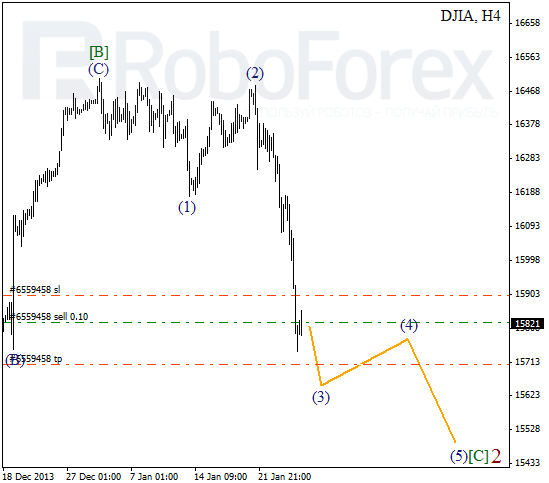
DJIA Index

Index continues falling down. Probably, wave 2 is taking the form of flat pattern with bearish impulse [C] inside it. In the nearest future, instrument is expected to fall down a little bit inside wave (3), that’s why I opened sell order during correction.

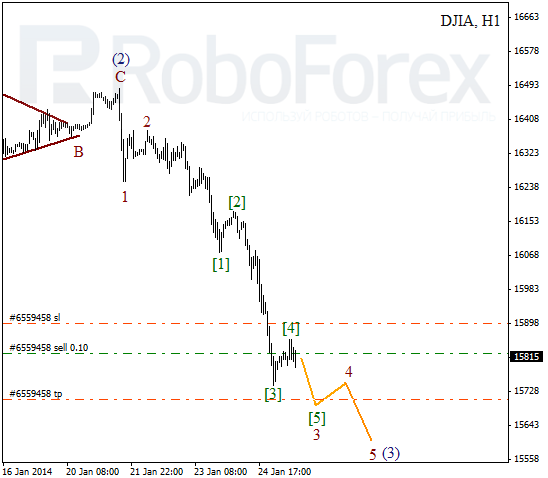
More detailed wave structure is shown on H1 chart. Probably, Index is forming extension inside wave 3. On minor wave level, price is finishing the fourth wave. Most likely, in the nearest future instrument may break minimum of wave [3].

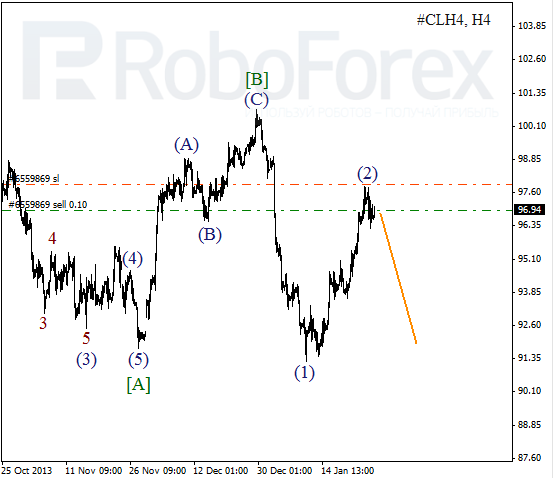
Crude Oil

It looks like Oil completed wave (2). Earlier, after completing zigzag pattern inside wave [B], price formed bearish impulse inside wave (1). Right now, I’m selling very carefully, but after instrument forms initial descending impulse I’ll increase my short position.

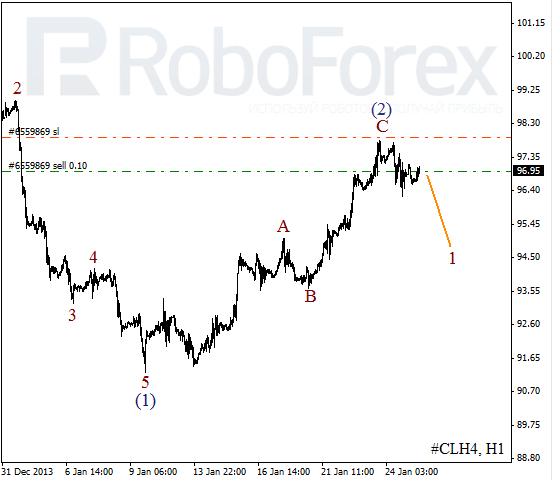
As we can see at the H1 chart, wave (2) took the form of zigzag pattern. On minor wave level, price formed wedge pattern inside wave 1. In the future, instrument is expected to continue falling down.

RoboForex Analytical Department

Article By RoboForex.com

Attention!
Forecasts presented in this section only reflect the author’s private opinion and should not be considered as guidance for trading. RoboForex LP bears no responsibility for trading results based on trading recommendations described in these analytical reviews.


Forex Technical Analysis 27.01.2014 (EUR/USD, GBP/USD, USD/CHF, USD/JPY, AUD/USD, GOLD)

Article By RoboForex.com

Analysis for January 27th, 2014

EUR/USD

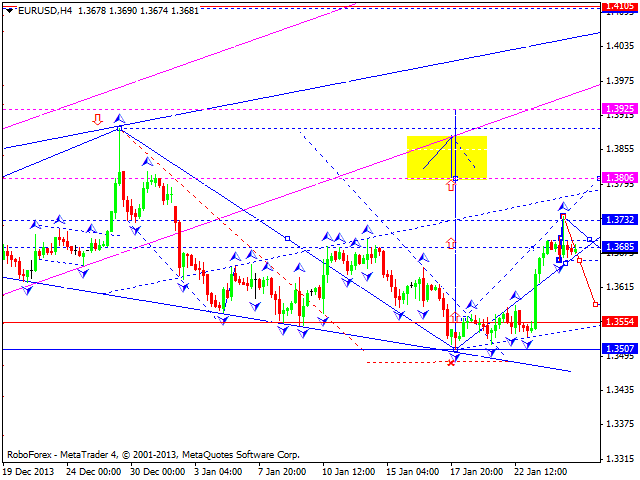
Euro continues forming ascending structure inside the fifth wave with target at 1.4100. We think, today price may consolidate for a while at current levels and form continuation pattern to reach level of 1.3800. Later, in our opinion, pair may consolidate again for some time and continue growing upwards.

GBP/USD

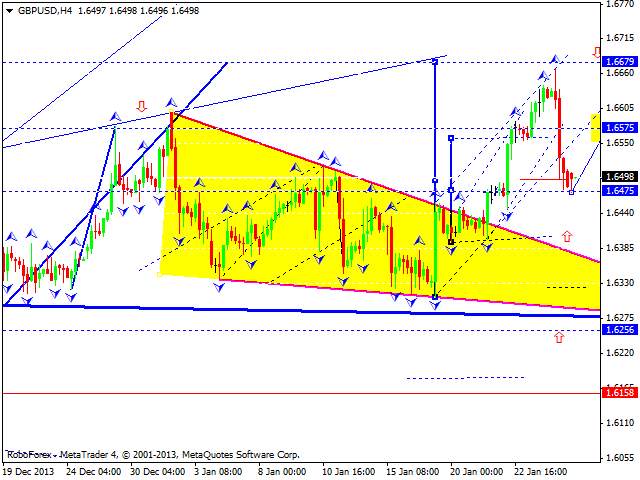
Pound is still moving inside another ascending wave with target at 1.6670; market returned to level of 1.6475 to test it from above. We think, today price may continue moving upwards to reach above-mentioned target.

USD/CHF

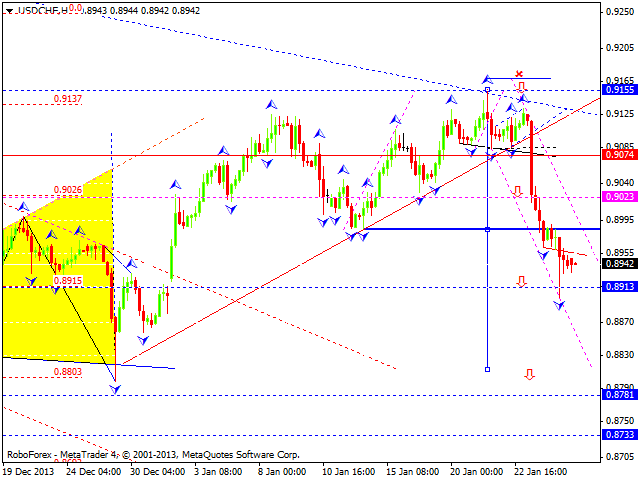
Franc is still falling down. We should note that this pair continues moving inside descending trend towards level of 0.8300. This descending movement is expected to be quite fast and without any serious corrections. We shouldn’t expect the market to form proper five-wave structure during this descending movement until price reaches its main target.

USD/JPY

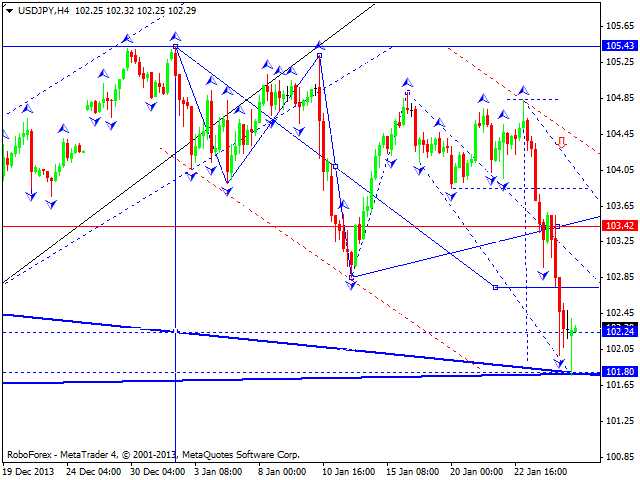
Yen reached target of its descending structure; right now market is forming continuation pattern. If price is able to break current minimum, pair may extend this structure up to level of 100.00. Alternative scenario implies that pair may form new correction and return to level of 104.00.

AUD/USD

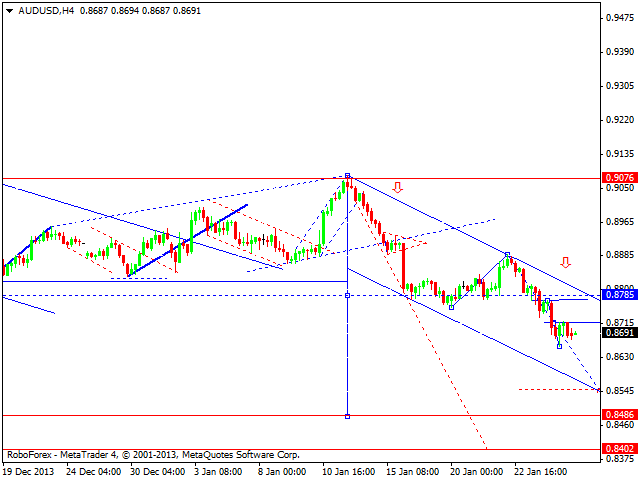
Australian Dollar is still falling down towards target at 0.8400. However, we shouldn’t expect the market to form proper five-wave structure during this descending movement until price reaches its main target.

GOLD

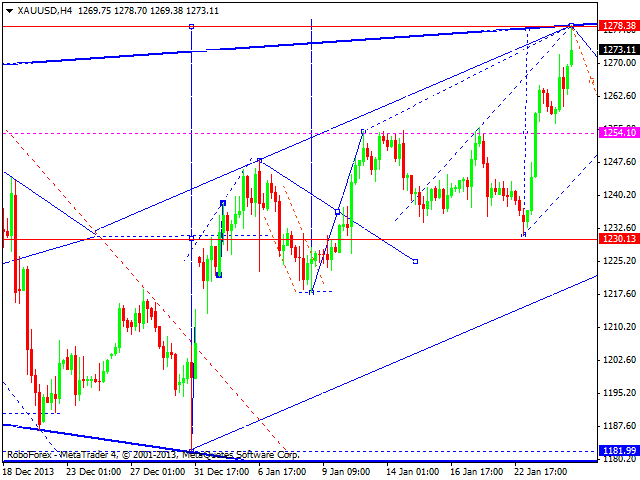
Gold reached target of its first ascending wave. We think, today price may form correctional structure to fall down towards level of 1230. This movement is considered as the right shoulder of head & shoulders reversal pattern and may reach target at 1360.

RoboForex Analytical Department

Article By RoboForex.com

Attention!
Forecasts presented in this section only reflect the author’s private opinion and should not be considered as guidance for trading. RoboForex LP bears no responsibility for trading results based on trading recommendations described in these analytical reviews.