By CentralBankNews.info
Colombia’s central bank maintained its benchmark interest rate at 3.25 percent, as expected, saying interest rates remain at a level that stimulates spending and should contribute to improve the productive capacity of the economy as inflation continues to converge toward the bank’s 3.0 percent target.
The Central Bank of Colombia, which has held rates steady since last April after slashing rates by 100 basis points in the first three months of the year, said Colombia’s fourth quarter economic growth likely was 4.5 percent as household consumption was growing at average rates while investment was rising and exports accelerating though less dynamically than imports.
The central bank estimated 2013 growth between 3.7 and 4.3 percent and growth in 2014 was projected at 4.3 percent. In 2012 the economy expanded by 4.0 percent.
Colombia’s finance minister, Mauricio Cardenas, last week suggested that 2013 growth was between 4.3 and 4.5 percent, slightly below the government’s official forecast of 4.5 percent, and forecast 4.7 percent growth in 2014, above the central bank’s forecast today.
Colombia’s Gross Domestic Product rose by 1.1 percent in the third quarter from the second quarter for annual growth of 5.1 percent, the fastest rate in six quarters, and up from 3.9 percent in the second quarter.
An improved outlook for growth in the United States has led the Federal Reserve to reduce its asset purchases and the central bank said that “to the extent that liquidity levels remain less expansive, the cost of international funding may increase.”
However, it also sees continued global economic recovery with growth in Colombia’s trading partners above 2013.
The bank noted that the Colombia peso had depreciated against the U.S. dollar as part of the impact of the changes in the Fed’s policy but made no further comment on exchange rates.
Colombia’s peso has weakened by 4.7 percent this year, trading at 2,025 to the U.S. dollar earlier today after falling by 8.4 percent in 2013, helped by the central bank that has been intervening in foreign exchange markets for more than two years to hold back an appreciation of the peso.
In December the central bank extended its currency intervention program by as much as $1 billion through the end of March, but Cardenas, who sits on the bank’s board, has hinted that the intervention program could be halted.
Colombia’s inflation rate rose to 1.94 percent in December, up from November’s 1.76 percent, but still below the central bank’s range of 2.0 to 4.0 percent.
The central bank said the average measure of core inflation in December was 2.5 percent and inflation expectations are close to 3.0 percent.
GOLD: Vulnerable Below Falling Trendline Resistance.
GOLD: Vulnerable Below Falling Trendline Resistance.
GOLD: Outlook for GOLD remains lower while holding and trading below its declining trendline currently seen at 1,274.25 level. This leaves it targeting its minimum support located at the 1,231.48 level, its Jan 23’2014 low. On a turn below that level, more weakness should occur follow towards the 1,200 level, representing its psycho level. This level must hold to prevent the commodity from weakening further. However, if that level is violated it will turn attention to the 1,182.33 level, its Dec 31’2013 low where a breach will target the 1,150.00 level followed by the 1,100.00 level, its psycho level. Conversely, a return above the 1.279.08 level and its declining trendline resistance is required to annul its present bear pressure and trigger further upside towards the 1,300.00 level. Further out, resistance resides at the 1,350.00 level and next the 1,400.00 level, its psycho level. All in all, GOLD remains biased to the downside in the medium term.
Article by www.fxtechstrategy.com
Mexico holds rate, but keeps eye on inflationary pressures
By CentralBankNews.info
Mexico’s central bank held its policy rate steady at 3.50 percent, as expected, but cautioned that it was keeping a close eye on any signs of higher inflationary pressures or expectations in light of the recent rise in inflation and the risks to the peso’ exchange rate from volatile international financial markets.
Crude Prices Drops Amid Chinese Oil Demand Concerns
Crude oil prices were seen trading lower on the last day of the trading week while oil traders express their worries over oil demand from China as reports revealed a contraction in China’s manufacturing sector.
The North American West Texas Intermediate delivery slid 0.55% lower, trading at $97.70 per barrel on the New York Mercantile Exchange as of the time of writing, at the same time Brent crude oil for March settlement fell 0.34% lower to $107.59 per barrel on the London-based ICE Futures Europe exchange. The European benchmark was at a premium of $10.01 to WTI.
The Dollar index, which monitors the strength of the greenback against a basket of six major currencies, came in 0.02% higher to 81.100 points.
Crude – Chinese Manufacturing Sector
For the first time in six months, China’s manufacturing sector contracted, highlight the government’s vow to keep the nation’s economy steady.
HSBC’s final PMI for January weakened, standing at 49.5, dropping from the previous reading of 49.6 seen last week. Any reading above 50 indicated the rise in manufacturing activity, while any reading below 50 points a contraction.
The PMI manufacturing report by China Federation of Logistics and Purchasing, which will be released on Saturday, is expected to show that manufacturing activity dropped to 50.5 points in January; compared to the previous reading of 51 points seen in December.
Crude – US GDP
The world’s largest economy expanded by 3.2% at annualize pace, meeting in line with estimates , driven by the housing sector and higher trade receipts, which both rose to its highest in nearly three years.
Visit www.hymarkets.com to find out more about our products offering and start trading today with only $50 using the latest trading technology today.
The post Crude Prices Drops Amid Chinese Oil Demand Concerns appeared first on | HY Markets Official blog.
Article provided by HY Markets Forex Blog
Greenback to Strengthen to Best Amid US Recovery Signs
Economist are forecasting the greenback to strengthen to its best since 2010 against its peers, as investors are expecting reports to show the world’s largest economy increased its spending for an eighth month.
Meanwhile, the Japanese yen added monthly gains against a basket of its major peers while stocks for the country declined and reports revealed inflation increased. The 18-block euro was seen hovering for its biggest monthly decline since March before the Central Bank policy meeting scheduled for February 6.
The dollar index, which monitors the strength of the greenback against a basket of 10 major currencies, came in at 1.030.62. The US dollar traded at $1.3536 per euro from $1.3555. The Japanese yen rose 0.2% higher to 102.49 per dollar, heading for a 2.7% monthly gain.
US Economy Recovery
While the market awaits reports from the Commerce Department report later in the day, analysts forecast to see a rise in the US consumer spending by 0.2% in December, compared to the 0.5% advance seen in November.
Figures from the Commerce department revealed the world’s largest economy expanded by 3.2% in the fourth quarter, meeting analysts’ estimates.
Following the Federal Reserve’s two day policy meeting, Fed policymakers concluded the meeting by deciding to reduce the central bank’s stimulus further by $10 billion to $65 billion, showing signs that the world’s largest economy is expanding.
The US data surprise index for Westpac Banking climbed to its highest this month since June. “The recent improvement in U.S. growth sentiment is living on borrowed time,” New-York based chief currency strategist Richard Franulovish wrote in a note.
“We would expect the trend in growth differentials to continue to shift in the USD’s favor over the medium term,” he wrote. “However, there will be setbacks and if anything we could be on the cusp of one.”
Visit www.hymarkets.com to find out more about our products and start trading today with only $50 using the latest trading technology today.
The post Greenback to Strengthen to Best Amid US Recovery Signs appeared first on | HY Markets Official blog.
Article provided by HY Markets Forex Blog
Forex Technical Analysis 31.01.2014 (EUR/USD, GBP/USD, USD/CHF, USD/JPY, AUD/USD, GOLD)
Article By RoboForex.com
Analysis for January 31st, 2014
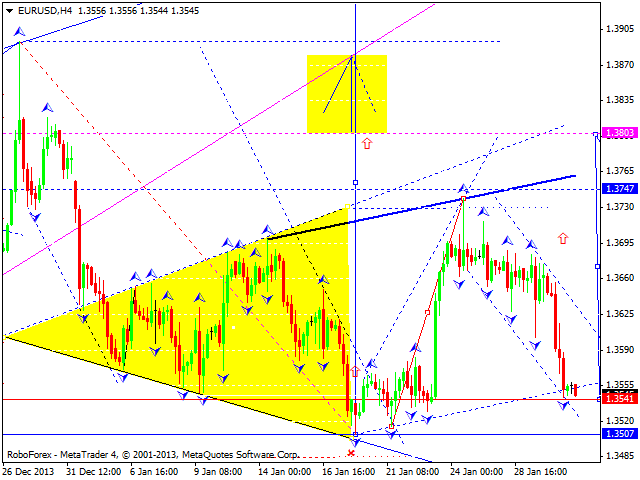
EUR/USD
Euro is still moving inside descending correction. We think, today price may form reversal structure to break this correctional channel and then continue moving upwards to reach level of 1.3800.
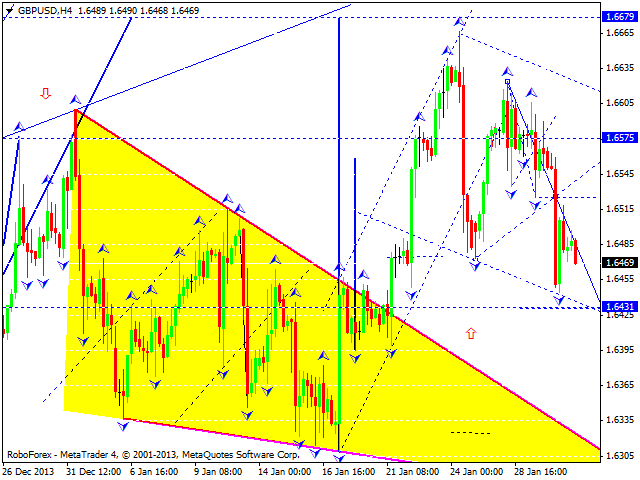
GBP/USD
Pound formed another descending structure. We think, today price may reach level of 1.6431 and then return to level of 1.6575. Later, in our opinion, market may continue moving upwards to reach level of 1.6680.
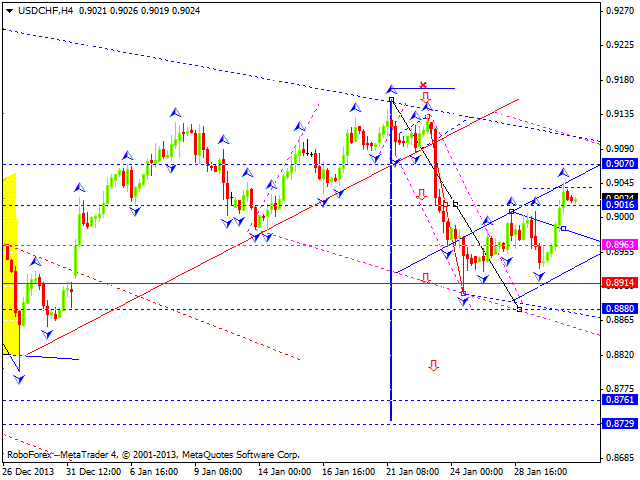
USD/CHF
Franc formed another ascending structure, the same at the previous one; as a result, we have three-wave correction. We think, today price may fall down towards level of 0.8963 and try to form the fifth wave with target at 0.9070. Later, in our opinion, market may continue moving inside descending trend to reach main target at 0.8300.
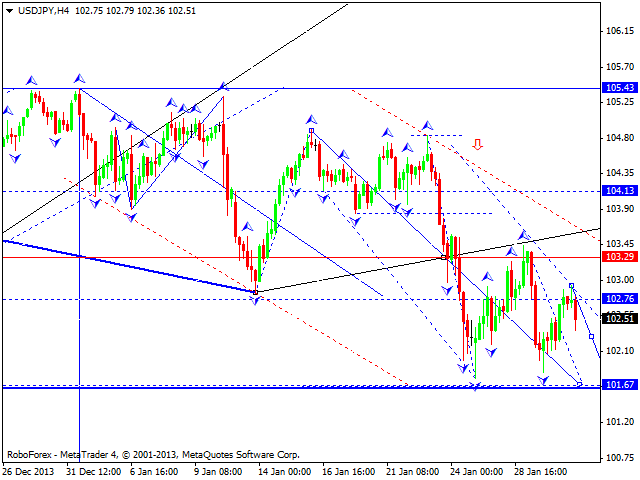
USD/JPY
Yen is still consolidating. We think, today price may expand this consolidation channel, first – downwards, to reach target level of 101.70, and then upwards, towards level of 103.80. Later, in our opinion, market may continue growing up towards level of 104.00 and then start new descending movement to reach level of 100.00.
AUD/USD
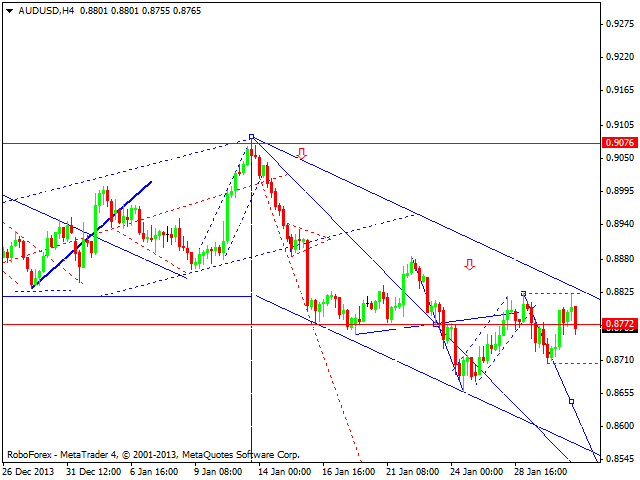
Australian Dollar tried to start new ascending movement, but faced resistance from level of 0.8820. We think, today price may continue moving inside descending trend. Main target at level of 0.8400.
GOLD
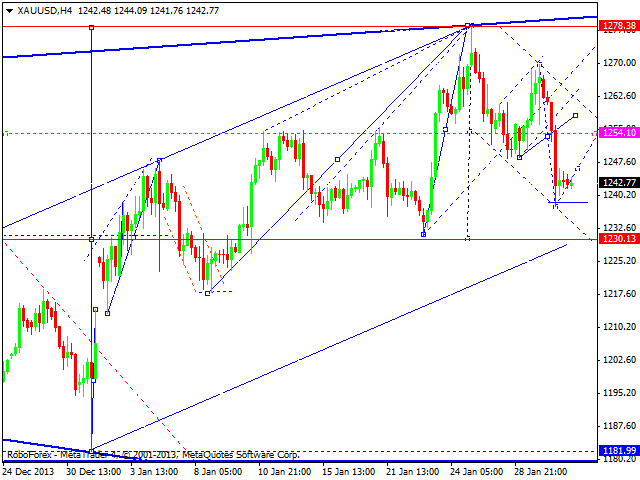
Gold completed the third descending structure of its correction. We think, today price may return to level of 1254 (at least) and then complete this correction by forming the fifth structure towards level of 1230. Later, in our opinion, market may start new ascending movement to reach level of at 1360.
RoboForex Analytical Department
Article By RoboForex.com
Attention!
Forecasts presented in this section only reflect the author’s private opinion and should not be considered as guidance for trading. RoboForex LP bears no responsibility for trading results based on trading recommendations described in these analytical reviews.
Fibonacci Retracements Analysis 31.01.2014 (EUR/USD, USD/CHF)
Article By RoboForex.com
Analysis for January 31st, 2014
EUR/USD
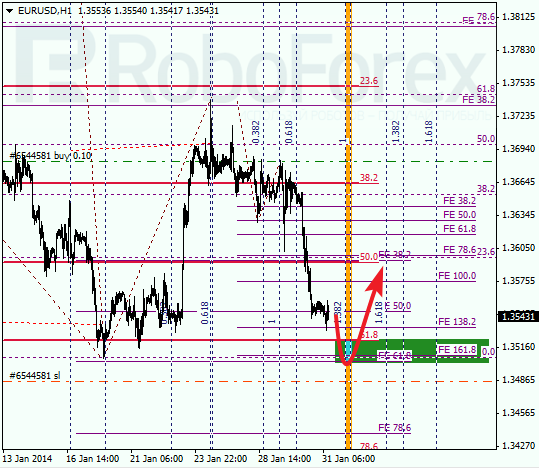
Euro is still being corrected. Earlier price rebounded from level of 61.8% and right now is testing it again. If pair rebounds from this level again, market may start growing up. Otherwise, it will move towards level of 78.6%.

At H1 chart we can see, that there are two additional fibo-levels below level of 61.8%. According to analysis of temporary fibo-zones, price may rebound from these levels during Friday.
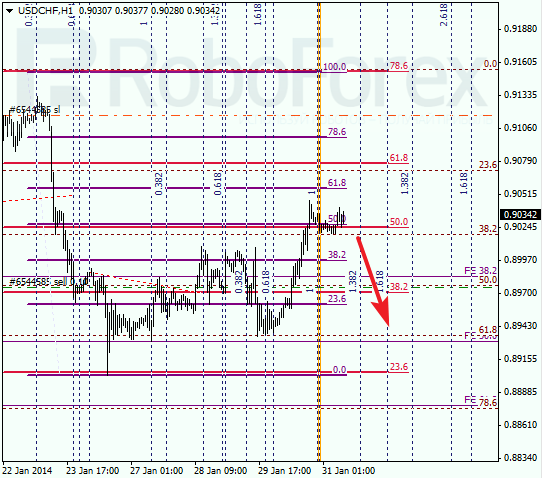
USD/CHF
Despite current correction, main target for Franc is still near several lower fibo-levels. This is the reason why I expect price to break local minimum in the beginning of the next week. I’m planning to open additional sell order right after market starts moving downwards.
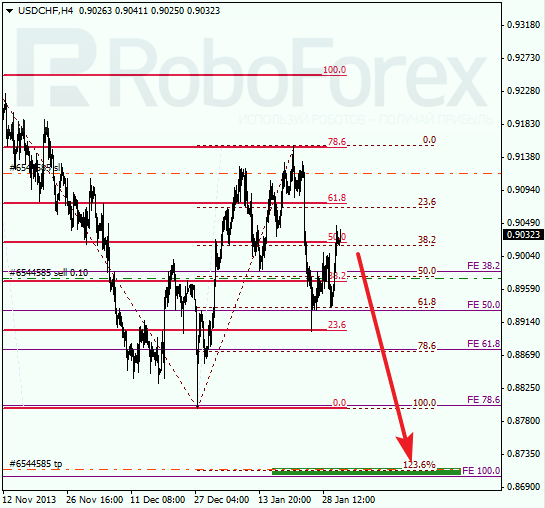
As we can see at H1 chart, price is moving at level of 50%. Pair has already reached one of temporary fibo-zones, that’s why it may rebound from the above-mentioned level in the nearest future. Later, instrument is expected to move towards several fibo-levels close to 0.8930.
RoboForex Analytical Department
Article By RoboForex.com
Attention!
Forecasts presented in this section only reflect the author’s private opinion and should not be considered as guidance for trading. RoboForex LP bears no responsibility for trading results based on trading recommendations described in these analytical reviews.
375 Companies Prepare for the Guillotine
It’s Friday in the Wall Street Daily Nation!
That means the longwinded analysis is out. And instead, some carefully selected charts are in. After all, a picture is supposed to be worth a thousand words, right?
Without further ado, check out these snapshots on the annual disappearing act by S&P 500 companies, why Sunday’s big game really isn’t about the game and, lastly, how the White House could be to blame for the current stock market selloff.
Is “Buy and Hold” Dead?
When we hear the term “creative destruction,” we most often think about a new innovation coming along that destroys an existing technology.
After today, though, I want you to think about it in terms of actual companies.
By analyzing 100 years’ worth of stock market data, Innosight’s Director, Richard N. Foster, found that the average company in the S&P 500 Index in 1958 remained there for 61 years. By 1980, the average tenure plummeted to 25 years. Today, a company’s lifespan rests below 20 years.
Bottom line: At the current churn rate, 75% of companies in the S&P 500 will be replaced by 2027. Here’s hoping we’re not caught holding onto any of these stocks when they’re “creatively” destroyed.
Or as Foster concluded, “You must embrace creative destruction rather than wait to become a victim of this unstoppable force.” Indeed!
A Super Bowl for Advertising
Peyton Manning is in the Super Bowl this year. Ironically, he’ll be squaring off in his little brother Eli’s house.
As a New York Giants fan, you can probably guess that I couldn’t care less which team wins. But it’s not really about the game, anyway. It’s all about the advertising – increasingly so, too.
Here’s the graphic proof…
Bottom line: Forget trying to bet correctly on the winner to score some extra spending cash from your office mate. Prepare your mind to defend against the onslaught of advertisements so you don’t inadvertently spend your cash on something you definitely don’t need.
The Two-Year Curse
To say the stock market stumbled out of the gates in 2014 would be an understatement. As I write, the S&P 500 is down 4% for the year, with most of the losses coming in the last week.
Many people want to blame it on emerging markets, the Fed, even Leonardo DiCaprio.
Turns out, it’s all the presidents’ fault. (Notice I said, “presidents” – as in, not just Obama.)
As LPL Financial’s Chief Market Strategist, Jeffrey Kleintop, shared on Twitter (TWTR) recently, the S&P 500 typically struggles in year two of the election cycle.
Specifically, stocks drop to start the year, rally briefly, stumble again for most of the year, and then finish strong. And, so far, we’re following the pattern like clockwork.
Obviously, the past is no guarantee of the future. But it’s the best thing we have to evaluate.
Bottom line: Election cycle curse or not, it appears that we’re in store for a volatile year for stocks. So load up on Tums and get ready to do battle with us in the trenches.
Whether the market heads up, down, or sideways, we’re committed to uncovering the best ways to protect and increase your net worth.
That’s it for today. Before you go, though, let us know what you think of this weekly column – or any of our recent work at Wall Street Daily – by going here.
Ahead of the tape,
Louis Basenese
The post 375 Companies Prepare for the Guillotine appeared first on Wall Street Daily.
Article By WallStreetDaily.com
Original Article: 375 Companies Prepare for the Guillotine
GBPUSD’s downward movement extended to 1.6445
GBPUSD’s downward movement from 1.6668 extended to as low as 1.6445. Deeper decline to test the support of the lower line of the price channel on 4-hour chart is possible. As long as the channel support holds, the fall from 1.6668 could be treated as consolidation of the longer term uptrend from 1.5854 (Nov 12, 2013 low), one more rise towards 1.7000 could be expected after consolidation. On the downside, a clear break below the channel support will indicate that the uptrend from 1.5854 had completed at 1.6668 already, then the pair will find support around 1.6000.

Angola holds rate but cuts reserve requirement to 12.5%
By CentralBankNews.info
Angola’s central bank maintained its policy rate at 9.25 percent but cut the reserve requirement ratio for local currency deposits to 12.5 percent from 15.0 percent to “increase the financial resources available for lending to the economy, as well as continue to influence the reduction of the costs of financial intermediation.”
The National Bank of Angola, which cut rates by 100 basis points in 2013, kept the reserve requirement for foreign currency deposits unchanged at 15.0 percent.
The central bank’s monetary policy committee, which met on Jan. 27, said the latest estimates indicate real Gross Domestic Product growth of around 7.4 percent for the country’s economy in 2013, up from 5.2 percent in 2012, with an emphasis on the continued growth in the non-oil sector.
Angola’s inflation rate eased to 7.69 percent in December from 7.94 percent in November and 9.02 percent in December 2012, as inflation continues to drop since hitting a recent high of 16.08 percent in October 2010.
The central bank also said Angola’s international reserves fell by 5.73 percent to US$ 33.17 billion in December from November. It did not give any reason for the decline.
