Crude Oil Prices Bounces Back From Losses

By HY Markets Forex Blog

Crude oil prices bounced back from its lowest closing level in almost a month on Tuesday, driven by the downbeat Chinese and US data, signaling signs that demand may drop in the future.

The North American West Texas Intermediate (WTI) climbed 0.18% higher to $96.90 per barrel on the New York Mercantile Exchange. At the same time the European benchmark Brent crude for March settlement slipped by 0.39% lower, trading at $106.01 a barrel on the ICE Futures Europe exchange.

Crude – Chinese Manufacturing Sector

China’s Manufacturing Purchasing Managers’ Index (PMI) declined to a six-month low of 50.5 in January, compared to the previously reading of 51.0 seen in December.

For the first time in six months, China’s manufacturing sector contracted, highlight the government’s vow to keep the nation’s economy steady.

HSBC’s final PMI for January weakened, standing at 49.5, dropping from the previous reading of 49.6 seen last week. Any reading above 50 indicated the rise in manufacturing activity, while any reading below 50 points a contraction.

Crude- US Data

In the US, the manufacturing sector expanded in January at its slowest pace in eight months, coming in at 51.3, missing estimates and down from the previous reading of 56.5 seen in December; according to reports complied by the institute for Supply Management (ISM) manufacturing PMI.

US Supplies

Crude Stockpiles reports are expected to be released by the Energy Information Administration on Wednesday, with a forecast of a rise of 2.25 million barrels in the previous week, according to analysts.

While reports for gasoline stockpiles is expected to show a rise by 1.35 million barrels in the week ended Jan 31, according to market analysts forecasts.


Visit www.hymarkets.com   to find out more about our products offering and start trading today with only $50 using the latest trading technology today.

The post Crude Oil Prices Bounces Back From Losses appeared first on | HY Markets Official blog.

Article provided by HY Markets Forex Blog

Australian Dollar Climbs as RBA Maintains Cash-Rate

By HY Markets Forex Blog

The Australian dollar climbed against the US dollar on Tuesday after the Reserve Bank of Australia (RBA) kept its cash-rate target at 2.5%, indicating stronger economic growth. Investors digested the statement released by the bank, which showed that the Australia’s central bank signaled the end to its easing cycle and approving the exchange rate decline.

The Reserve Bank of Australia is changing stance as home prices climbs and inflation accelerates.

“The exchange rate has declined further, which, if sustained, will assist in achieving balanced growth in the economy,” Governor Glenn Stevens said in a policy statement released on Tuesday, “the most prudent course is likely to be a period of stability in interest rates,” he added.

The aussie was trading 1.65% higher at $0.8898 at the time of trading, after dropping to a low $0.8729 before the RBA decision on Tuesday.

The country’s central bank maintained its benchmark rate at 2.5%, meeting in line with analysts’ forecasts after inflation for the final quarter of 2013 came in higher than expected at 2.7%, compared to the previous reading of 2.3%.

“Inflation in the December quarter was higher than expected,” Stevens said on Tuesday. “This may be explained in part by faster-than-anticipated pass-through of the lower exchange rate, though domestic prices also continued to rise at a solid pace, despite slower growth in labor costs. If domestic costs remain contained, some moderation in the growth of prices for non-traded goods could be expected over time.”

Australian Dollar – Forecasted Lowered

The implied yield on June interbank futures climbed to its highest since November, rising to 2 basis points to 2.46%, as market analysts lower their forecast on further RBA reduction.

The Reserve Bank of Australia is trying to stimulate housing construction to pick up some of the strain in the labour sector.

Demand Rises

Adding to the signs of the economy’s growth stabilizing is the recent data released which supported lowering the exchange rate on business sentiment with the National Australia Bank (NAB) Business Conditions Index climbing by 7 points in December from -3 to 4 in the previous reading; the highest in two and a half years.

Domestic demand indicators came in higher than expected, as well as retail sales which climbed 0.7% higher in November, compared to a consensus forecast of a rise of 0.4%. Building approvals in December came in below analysts’ forecast, showing a 21.8% year-on-year growth.


Visit www.hymarkets.com   to find out more about our products offering and start trading today with only $50 using the latest trading technology today.

The post Australian Dollar Climbs as RBA Maintains Cash-Rate appeared first on | HY Markets Official blog.

Article provided by HY Markets Forex Blog

Thoughts from the Frontline: Central Banker Throwdown

By John Mauldin – Thoughts from the Frontline: Central Banker Throwdown

Those of us who have attained a certain age can remember being bombarded by commercials in which we were asked “Is it live or is it Memorex?” The thrust of the ad was that it didn’t make any difference, that the tape recording was just as good as being there to watch that TV show live. Video recording technology was in its infancy, and the ability to play a movie whenever you wanted was really cool. Imagine being able to set a video recorder to record a TV show while you were away! … As long as you had somebody in the house young enough to be able to program the recorder to do it, it was great technology.

Today investors are asking themselves a similar question: “Is the meltdown in the stock market the result of Fed tapering, or is there something else going on?” We’ll address that question today and take a deep plunge into the emerging markets. We have a good old-fashioned central banker throwdown in progress, and if the results didn’t have such an impact on our investment portfolios, it could actually be quite fun to watch. What happens in the emerging markets will unfortunately not stay in the emerging markets. It’s all connected. There is more happening here than a simple correction. Let’s put our thinking caps on and try to connect some dots.

The current emerging-market meltdown is what Jonathan Tepper and I discussed in our book Endgame and specifically predicted in our latest book, Code Red. Let’s rewind the Memorex tape and see what we said:

This unprecedented global monetary experiment has only just begun, and every central bank is trying to get in on the act. It is a monetary arms race, and no one wants to be left behind. The Bank of England has devalued the pound to improve exports by allowing creeping inflation and keeping interest rates at zero. The Federal Reserve has tried to weaken the dollar in order to boost manufacturing and exports. The Bank of Japan, not to be outdone, is now trying to radically depreciate the yen. By weakening their currencies, these central banks hope to boost their countries’ exports and get a leg up on their competitors. In the race to debase currencies, no one wins. But lots of people lose.

Emerging-market countries like Brazil, Russia, Malaysia, and Indonesia will not sit idly by while the developed central banks of the world weaken their currencies. They too are fighting to keep their currencies from appreciating. They are imposing taxes on investments and savings in their currencies. All countries are inherently protectionist if pushed too far. The battles have only begun in what promises to be an enormous, ugly currency war. If the currency wars of the 1930s and 1970s are any guide, we will see knife fights ahead. Governments will fight dirty, they will impose tariffs and restrictions and capital controls. It is already happening, and we will see a lot more of it….

We are already seeing the unintended consequences of this Great Monetary Experiment. Many emerging-market stock markets have skyrocketed. Only to fall back to earth at the mere hint of any end to Code Red policies.

Emerging-market countries have to fend for themselves. Bernanke, Kuroda, and other developed-country central bankers accept no responsibility. If other countries don’t like a weaker dollar or yen, too bad. Bernanke places the blame, not on the United States for weakening the dollar, but on emerging countries for not revaluing their currencies or imposing capital controls. As U.S. Treasury Secretary John Connally said to foreign finance ministers in 1971, “The dollar is our currency, but it’s your problem.” Indeed.

Let’s stop there for a moment, as this is an extremely important point. There have been numerous speeches by developed-world central bankers explicitly explaining that they are responsible for their own markets and that the central bankers of developing economies have to adjust on their own. Just as there have been many emerging-market central bankers complaining about quantitative easing in the developed world creating problems in their markets. In a few pages, we are going to look at a very important interview on Bloomberg with Raghuram Rajan, the brilliant head of the Reserve Bank of India, but now, back to Code Red:

Whenever the Fed hikes rates, bad things happen somewhere. It’s that simple. In 1994 the quick rise in rates killed a lot of leveraged investors in the bond market. Orange County had interest-rate derivatives that blew up in its face. It was the largest municipal bankruptcy in history. Emerging-market stocks and bonds were hammered, and Mexico was even forced to devalue its currency in a major financial market crisis. If (when) the Fed hikes rates today, we’ll see lots of bankruptcies like Orange County’s and blow-ups like the Mexican Tequila Crisis. The very low rates globally in a Code Red world mean that now there are probably hundreds or thousands of investors like Orange County. You can bet on that. And that is why the market gets so nervous about suggestions that the Fed might start tapering its quantitative easing. If QE is finally ended, can rising rates be far behind? [Or at least that’s the thinking!]

Recently, much of QE’s effects have been felt in emerging-market countries. This is a response not just from the U.S. Fed but from the BOJ, ECB, and BoE. Unlike the sick, indebted developed world, many emerging-market countries are growing and doing well. [Let me remind you that we wrote this in August 2013!] We have not seen a lot of borrowing in the developed markets. Instead, growth of credit and lending to private borrowers is happening in emerging markets. Emerging markets have been a popular target of excess capital for a number of reasons: their overall ability to take on debt remains strong, and their balance sheets are still relatively healthy; and more importantly, investment yields have been high relative to sovereign competitors. This two-speed world presents enormous problems. Code Red-type policies in the developed world are leading savers and investors to flee very low rates of return at home in favor of putting money into Turkey, Brazil, Indonesia or anywhere that offers higher rates of return.

Code Red-type monetary policies are designed to produce investment and growth, and they are! Just not in the countries that central banks intended to help. This is a major headache for governments in these countries. For them it is like having loads of visitors drop by all of a sudden. It is flattering that they like your house; but after a while, you’d rather they didn’t show up unexpectedly. Hot money flows are like drunken guests. They create a very big party, they leave unexpectedly, and they leave a god-awful mess behind. Large hot money flows have been behind most major emerging-market booms and busts.

Whenever major, developed-world central banks keep rates at very low levels and weaken their currencies, they cause bubbles. Let’s look at two recent bubbles and crashes that Code Red policies helped cause.

After the Japanese bubble burst in 1989, the bank of Japan cut interest rates close to zero. By 1995 the dollar/yen exchange rate weakened, and the yen lost almost half of its value. The Japanese took money out of Japan and put it into Indonesia, Korea, Malaysia, Philippines, and Thailand. Investors in other countries borrowed money either directly in yen or through synthetic instruments. It was called the yen carry trade, and it was designed to take advantage of easy Japanese money to invest elsewhere. Everyone assumed that the yen would continue to go down, making the terms of repayment easier.

Asia attracted nearly half of the total capital inflow to emerging markets, and the stock markets of South Korea, Malaysia, Singapore, Thailand, and Indonesia were soaring. The party didn’t last forever. When the Thai currency came under pressure in June 1997, almost all Asian countries faced stock market crashes, capital flight, currency depreciations, and banking busts. The entire Asian episode perfectly fit the five stages of a bubble, but it was certainly much greater than it otherwise would have been, given the policies of the Bank of Japan….

The idea that ultra-low interest rates cause booms and busts is not new. Economists of the Austrian school, led by von Mises and Hayek, warned that credit-fueled expansions lead to the misallocation of real resources that end in crisis. In the Austrian theory of the business cycle, the central cause of a credit boom is the fall of the market rate of interest below the natural rate of interest. Investments that would not be profitable at higher rates become possible. The bigger the deviation of interest rates from the natural rate, the bigger the potential credit boom and the bigger the bust.

Like all bubbles, rapid price increases can rapidly reverse when interest rates return to normal levels. The greatest danger will then be to leveraged investors who bought farmland, corporate bonds, some emerging markets, and other bubbles with borrowed money.

Narrative or Reality?

The US Federal Reserve has begun to taper by $10 billion a meeting. That means they are still putting $65 billion a month into the world economy. Let’s do a thought experiment. If the Fed had originally announced they were going to do $65 billion per month in QE rather than the $85 billion they did announce, would it have made any difference in the overall outcomes? I would suggest there is not a great deal of actual difference between $85 billion and $65 billion. Yet now the markets are acting as if there is some massive difference.

I would submit to you that the difference is actually in the narrative. The Federal Reserve is signaling that it is going to end quantitative easing at some point in the future; therefore, investors are trying to find the exits before the end actually comes. But does it make any real difference to your portfolio whether it’s the reality or the narrative that is driving the volatility in the markets?

Sidebar: the US just printed 3.2% (annualized) GDP growth for the fourth quarter – a quarter in which the government was a significant drag. Without that drag, growth might have been 4%. In such an environment it is going to be difficult if not impossible for the Federal Reserve to discontinue the tapering of QE. If there is a surprise – and with continued growth there might be – it will be to increase the amount of easing each meeting. Just saying…

What’s Driving Emerging Markets?

The trouble in emerging markets is just beginning.

Hot money has been chasing a growth story across the emerging markets since early 2009. Trouble is, the real driver of economic growth in emerging markets is not the explosive force of eager, low-skilled workers as they climb into the middle class. That’s just the story you hear from mutual fund salesmen. That’s like saying the economy grows over time because we all get raises and spend the new income on plasma screen TVs.

Emerging-market consumption is a RESULT of growing incomes, not the CAUSE. The real driver of long-term global growth has been the great spurts of innovation enabled by the last two industrial revolutions.

Longtime readers know I disagree with Professor Robert Gordon on his long-term forecasts for productivity growth. He specializes in economic history and is one of the finest productivity economists in the world, while I am just an amateur futurist with a wild imagination, but…

Dr. Gordon was absolutely right to proclaim the end of the Second Industrial Age. It began to pass away in the 1970s, and except for the boost from the 1980s through the early 2000s due to the advent of personal computers, the world economy has essentially been running on the fumes of a dying growth model, an unprecedented but now-deflating credit bubble, and the last high-spending years of wealthy but aging populations in the developed world.

As he attempts to peer beyond the chaos of debt, deleveraging, bankrupt governments, and desperate central banks that will ensue for the next five to ten years, Dr. Gordon’s dark and dire predictions about long-term growth hinge around the fact that he can’t see the rapidly accelerating technological transformation that promises to drive another century of explosive innovation. He doesn’t think it can happen again.

Can you blame him?

Identifying the next set of world-changing technologies before it “crosses the chasm” is infinitely harder than calling a market peak or a rare turn in the long-term credit cycle. In all of human history, we have seen only TWO sets of world-changing technologies that enabled centuries of follow-on innovation, inspired dynamic new industries, and revved up the faltering growth engines of ages past.

You would have to be extremely close to potentially world-changing technology to notice when it first leaps across the chasm, goes parabolic, and begins to drive a fresh explosion of innovation, productivity, and then – and only then – income.

But as you already know, the constant doubling of computing power since the late 1950s (known as Moore’s Law) has reached a point where our technological capabilities are taking exponentially larger leaps every year. And that constantly accelerating computing power is already enabling a massive round of follow-up innovation so disruptive that it looks and feels like magic.

That is great news for the human experiment and great news for the privileged minority in developing countries … but it could be terrible news for the vast majority of people in emerging markets who do not have the skills to participate in this new economy.

Contrary to popular belief, the real drivers of economic growth in most emerging markets are still investment and/or trade demand from the developed world. And those growth models – (A) attracting investment from the rich world to encourage development, (B) producing the things consumers in rich countries want, and/or (C) supplying the things manufacturing economies need to produce the things rich consumers want – are either running out of steam or becoming a lot more hazardous.

Let’s look at the longer-term challenge for export-oriented growth models first and then shift our attention to the sharp, Fed-induced reversal in capital flows that could devastate emerging economies in the coming months.

To continue reading this article from Thoughts from the Frontline – a free weekly publication by John Mauldin, renowned financial expert, best-selling author, and Chairman of Mauldin Economics – please click here.

© 2013 Mauldin Economics. All Rights Reserved.
Thoughts from the Frontline is a free weekly economic e-letter by best-selling author and renowned financial expert, John Mauldin. You can learn more and get your free subscription by visiting www.MauldinEconomics.com.

Please write to [email protected] to inform us of any reproductions, including when and where copy will be reproduced. You must keep the letter intact, from introduction to disclaimers. If you would like to quote brief portions only, please reference www.MauldinEconomics.com.

To subscribe to John Mauldin’s e-letter, please click here: www.mauldineconomics.com/subscribe
To change your email address, please click here: http://www.mauldineconomics.com/change-address

Thoughts From the Frontline and MauldinEconomics.com is not an offering for any investment. It represents only the opinions of John Mauldin and those that he interviews. Any views expressed are provided for information purposes only and should not be construed in any way as an offer, an endorsement, or inducement to invest and is not in any way a testimony of, or associated with, Mauldin’s other firms. John Mauldin is the Chairman of Mauldin Economics, LLC. He also is the President and registered representative of Millennium Wave Advisors, LLC (MWA) which is an investment advisory firm registered with multiple states, President and registered representative of Millennium Wave Securities, LLC, (MWS) member FINRA and SIPC, through which securities may be offered. MWS is also a Commodity Pool Operator (CPO) and a Commodity Trading Advisor (CTA) registered with the CFTC, as well as an Introducing Broker (IB) and NFA Member. Millennium Wave Investments is a dba of MWA LLC and MWS LLC. This message may contain information that is confidential or privileged and is intended only for the individual or entity named above and does not constitute an offer for or advice about any alternative investment product. Such advice can only be made when accompanied by a prospectus or similar offering document. Past performance is not indicative of future performance. Please make sure to review important disclosures at the end of each article. Mauldin companies may have a marketing relationship with products and services mentioned in this letter for a fee.

Note: Joining The Mauldin Circle is not an offering for any investment. It represents only the opinions of John Mauldin and Millennium Wave Investments. It is intended solely for investors who have registered with Millennium Wave Investments and its partners at http://www.MauldinCircle.com (formerly AccreditedInvestor.ws) or directly related websites. The Mauldin Circle may send out material that is provided on a confidential basis, and subscribers to the Mauldin Circle are not to send this letter to anyone other than their professional investment counselors. Investors should discuss any investment with their personal investment counsel. John Mauldin is the President of Millennium Wave Advisors, LLC (MWA), which is an investment advisory firm registered with multiple states. John Mauldin is a registered representative of Millennium Wave Securities, LLC, (MWS), an FINRA registered broker-dealer. MWS is also a Commodity Pool Operator (CPO) and a Commodity Trading Advisor (CTA) registered with the CFTC, as well as an Introducing Broker (IB). Millennium Wave Investments is a dba of MWA LLC and MWS LLC. Millennium Wave Investments cooperates in the consulting on and marketing of private and non-private investment offerings with other independent firms such as Altegris Investments; Capital Management Group; Absolute Return Partners, LLP; Fynn Capital; Nicola Wealth Management; and Plexus Asset Management. Investment offerings recommended by Mauldin may pay a portion of their fees to these independent firms, who will share 1/3 of those fees with MWS and thus with Mauldin. Any views expressed herein are provided for information purposes only and should not be construed in any way as an offer, an endorsement, or inducement to invest with any CTA, fund, or program mentioned here or elsewhere. Before seeking any advisor’s services or making an investment in a fund, investors must read and examine thoroughly the respective disclosure document or offering memorandum. Since these firms and Mauldin receive fees from the funds they recommend/market, they only recommend/market products with which they have been able to negotiate fee arrangements.

PAST RESULTS ARE NOT INDICATIVE OF FUTURE RESULTS. THERE IS RISK OF LOSS AS WELL AS THE OPPORTUNITY FOR GAIN WHEN INVESTING IN MANAGED FUNDS. WHEN CONSIDERING ALTERNATIVE INVESTMENTS, INCLUDING HEDGE FUNDS, YOU SHOULD CONSIDER VARIOUS RISKS INCLUDING THE FACT THAT SOME PRODUCTS: OFTEN ENGAGE IN LEVERAGING AND OTHER SPECULATIVE INVESTMENT PRACTICES THAT MAY INCREASE THE RISK OF INVESTMENT LOSS, CAN BE ILLIQUID, ARE NOT REQUIRED TO PROVIDE PERIODIC PRICING OR VALUATION INFORMATION TO INVESTORS, MAY INVOLVE COMPLEX TAX STRUCTURES AND DELAYS IN DISTRIBUTING IMPORTANT TAX INFORMATION, ARE NOT SUBJECT TO THE SAME REGULATORY REQUIREMENTS AS MUTUAL FUNDS, OFTEN CHARGE HIGH FEES, AND IN MANY CASES THE UNDERLYING INVESTMENTS ARE NOT TRANSPARENT AND ARE KNOWN ONLY TO THE INVESTMENT MANAGER. Alternative investment performance can be volatile. An investor could lose all or a substantial amount of his or her investment. Often, alternative investment fund and account managers have total trading authority over their funds or accounts; the use of a single advisor applying generally similar trading programs could mean lack of diversification and, consequently, higher risk. There is often no secondary market for an investor’s interest in alternative investments, and none is expected to develop. You are advised to discuss with your financial advisers your investment options and whether any investment is suitable for your specific needs prior to making any investments.

All material presented herein is believed to be reliable but we cannot attest to its accuracy. Opinions expressed in these reports may change without prior notice. John Mauldin and/or the staffs may or may not have investments in any funds cited above as well as economic interest. John Mauldin can be reached at 800-829-7273.


Fibonacci Retracements Analysis 04.02.2014 (EUR/USD, USD/CHF)

Article By RoboForex.com

Analysis for February 4th, 2014

EUR USD, “Euro vs US Dollar”

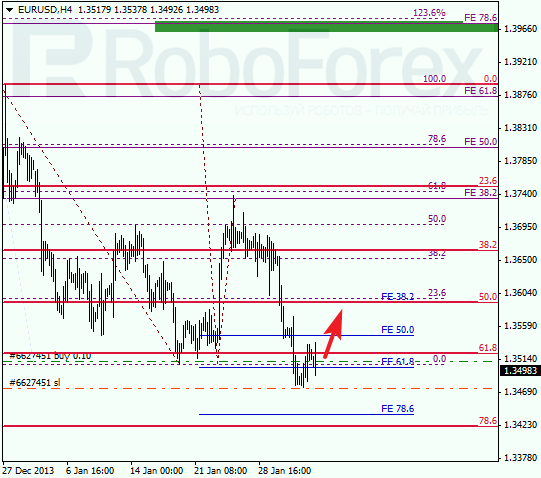
Euro is moving close level of 61.8%. If later price is able to stay above this level, pair may start new ascending movement towards upper fibo-levels. Otherwise, current correction may continue towards level of 78.6%.

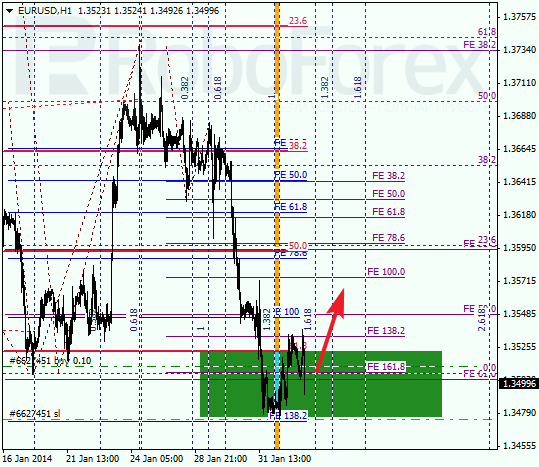
At H1 chart we can see, that market is still moving inside lower target area; price rebounded from its lower border right inside temporary fibo-zone. I’ll move stop on my order into the black right after pair reaches new local maximum.

USD CHF, “US Dollar vs Swiss Franc”

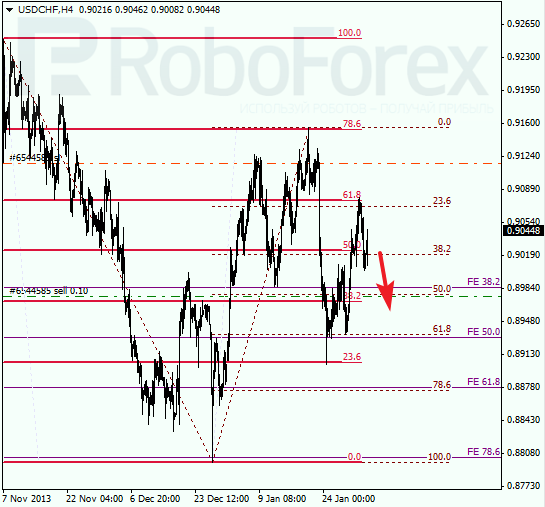
Franc rebounded from level of 61.8%, which means that market may start new descending movement. I’m keeping my sell order so far, although right now I’m in a drawdown. Main target is still below previous minimum.

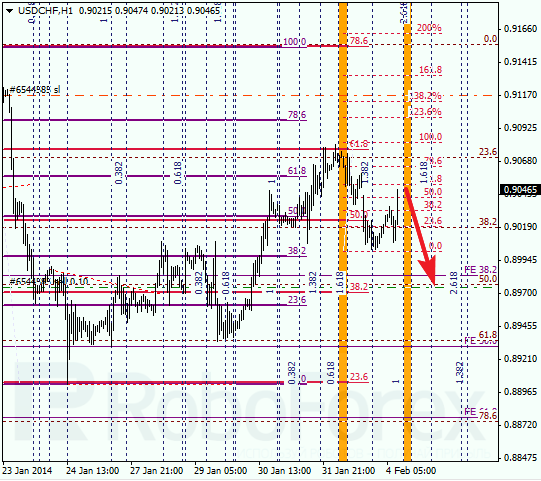
As we can see at H1 chart, local correction reached level of 61.8%. Right now, market is entering temporary fibo-zone, which means that price may reverse downwards.

RoboForex Analytical Department

Article By RoboForex.com

Attention!
Forecasts presented in this section only reflect the author’s private opinion and should not be considered as guidance for trading. RoboForex LP bears no responsibility for trading results based on trading recommendations described in these analytical reviews.


Cosmos Chiu: Assessing Gold Mines in Far Flung Places

Source: Brian Sylvester of The Gold Report  (2/3/14)

http://www.theaureport.com/pub/na/cosmos-chiu-assessing-gold-mines-in-far-flung-places

Cosmos Chiu, executive director of precious metals equity research at CIBC World Markets, doesn’t just stick to mining companies in North America. About one-third of gold comes from Africa, Chiu says in this interview with The Gold Report, so he likes to dedicate a similar amount of coverage to companies there. But knowing what to look for in intriguing districts around the world is what sets Chiu apart—that and his decidedly bullish forecast for the gold price.

The Gold Report: Cosmos, with U.S. economic data putting pressure on gold and silver prices, Moody’s is forecasting an average of $1,100/ounce ($1,100/oz) for gold in 2014 with almost identical all-in gold production costs. Bank of America Merrill Lynch is forecasting an average of $1,150/oz. What’s your view?

Cosmos Chiu: The U.S. economic data is nothing new. Last year certainly wasn’t the best for gold. However, the bad news has already been priced in. We’ve seen some pretty robust U.S. data come out first thing in 2014 and gold prices have held up at the $1,200/oz level.

CIBC has an average gold price for 2014 of $1,350/oz, which is predicated on robust Asian demand for physical gold. An all-in gold production cost of $1,100/oz is pretty realistic from our perspective.

We have wide-ranging coverage at CIBC from gold mining companies to royalty companies. Yes, there will be some companies in trouble. Investors have to be pretty picky about where they invest. They need to focus on the companies that have strong balance sheets and the flexibility to cut costs and focus on the cash cost.

TGR: Most people would say that $1,350/oz is quite bullish.

CC: It’s not conservative. Is it overly bullish? I think it’s doable.

TGR: We will soon see Q4/13 earnings reports from gold producers. Will those reports show investors that gold producers can still perform with gold hovering around $1,225/oz?

CC: We’ve seen glimpses of what Q4/13 could look like through production reports. It’s becoming a market where there are good producers and there are bad producers. The difference is especially visible right now. For the better producers, some will continue to see cash costs come down. We saw that in Q3 versus Q2. I would expect that to happen again. The better producers will continue to make money even at today’s gold price.

TGR: What are some names that could surprise?

CC: Q4/13 is going to be a lot cleaner than what we saw earlier this year with the write-downs. It might even be a little bit boring which, to be honest, is a good thing. Companies will be able to prove that they can make money. It won’t be one of those noisy, messy quarters that we saw earlier last year.

Looking into 2014, I like Franco-Nevada Corp. (FNV:TSX; FNV:NYSE)Osisko Mining Corp. (OSK:TSX)and Eldorado Gold Corp. (ELD:TSX; EGO:NYSE). These three companies exhibit the ability to excel, even at today’s gold price.

On the lower end of the cost curve, I like Franco-Nevada; it doesn’t really have operating costs at all. It has quite a few accretive acquisition opportunities in the current environment for gold producers.

Osisko fits into a theme of seeking a stronger balance sheet. Things are stabilizing and even optimizing at the Canadian Malartic mine. It’s generating positive free cash flow and there’s optionality. If the gold price environment is supportive once again, and it will be, then there will be a lot of organic growth opportunities within that portfolio. That gives investors that upside potential, as seen by Goldcorp Inc.’s (G:TSX; GG:NYSE) bid.

Eldorado has always been one of the lowest-cost producers no matter how you dice it. It’s got one of the better growth profiles and has a very strong balance sheet.

TGR: Osisko is based in Canada and Mexico. Eldorado is mostly Turkey, Greece, China and South America. Franco-Nevada is everywhere. This is a still a risk-adverse market where most precious metals analysts are sticking to safe mining jurisdictions like Canada, the U.S. and Mexico.

About 30% of your coverage, however, includes names that primarily or exclusively operate in Africa. Why do you lean heavily on equities with key assets in Africa?

CC: I try to give broad coverage to the different areas in the world where gold is produced. Looking at the world, about one-quarter to one-third of the gold production is coming from Africa. A lot of Africa’s production is coming from South Africa. I try to pick out the better or more prospective parts for future growth. Mainly, that’s coming from West Africa.

TGR: Can you tell us about some of the companies that you cover?

CC: Teranga Gold Corp. (TGZ:TSX; TGZ:ASX) recently signed an agreement to sell a gold production stream to royalty titan Franco-Nevada for $135 million ($135M). Teranga management said it would use the cash to purchase the remaining interest in the Oromin Joint Venture Group. I upgraded Teranga’s shares from sector performer to sector outperformer on the back of that news.

This is a story that I’ve followed for a long time. There are a lot of synergies to be realized. The Oromin Joint Venture partnership no longer has to build a second mill. Despite Teranga now selling some of the upside off to Franco-Nevada, my net asset value still increased by about 40%.

TGR: It also consolidates the exploration potential of that area, which is a 60-kilometer strike.

CC: It just makes sense to have the two companies together.

TGR: On the other side of that deal is Franco-Nevada. It recently had a market cap of $6.5 billion. Does the deal impact Franco-Nevada’s bottom-line in any tangible way?

CC: It adds good cash flow in the near term. Franco-Nevada is getting in from day one. There’s a lot of potential for future production increases. Teranga could grow into a cornerstone royalty. Franco-Nevada offers a diversified portfolio. It’s everywhere. It’s a less risky way to get involved in the gold space, but at the same time get that upside when gold prices go higher.

TGR: Franco-Nevada’s purchase price per ounce is set at 20% of the spot price. Doesn’t that really speak to the management at Franco-Nevada and its shrewd negotiating tactics?

CC: It’s the first time I’ve seen a structure at 20%. Most royalty deals are set at $400/oz or $500/oz. The financials on this deal are a little bit more favorable to Franco-Nevada. However, I don’t believe that Teranga would have gotten a deal done with OJVG if not for Franco-Nevada. That’s how it works out to be a win-win situation.

TGR: What are the most likely performers among the other companies that you cover that operate in Africa?

CC: I have two sector outperformers in my West African universe: Teranga and SEMAFO Inc. (SMF:TSX; SMF:OMX) in Burkina Faso. SEMAFO’s flagship mine is Mana. What’s most exciting about SEMAFO these days is that it made the Siou discovery, which is scheduled to be in production midway through 2014. It’s going to be a satellite deposit, which means there won’t be a lot of capital expenditure (capex) involved.

The great thing about Siou is that the grade is about twice as high, at 4+ grams/ton (4+ g/t), as the Wona-Kona pit, which has been in production for several years. There’s not a lot of capex. It’s feeding higher-grade material through the mill, so we expect costs to come down and production to increase.

TGR: You also cover a number of companies operating in Canada. In a recent research report you praised Osisko Mining for its Q3/13 performance, which met most of the Street’s expectations. Not far away at another low-grade, high-tonnage open-pit mine, Detour Gold Corp. (DGC:TSX) shut down its mill in December as it attempted to work out the kinks in production. What’s your prognosis for Detour? Will it get this thing on track?

CC: I would consider the problems with Detour to be teething issues. It’s good that you brought up Osisko. It has had its share of issues in the past as well. Given the size of these operations—Detour included—it takes time. I firmly believe that as Detour opens up the pit and continues to work out the teething issues at the mill, it should meet what it has set out to do when it first engineered the mine. It’s certainly got a lot of people worried about the financial position of the company. It doesn’t help that there’s been a changeover in management. However, all in all, it’s just a timing thing. Detour should work out.

TGR: Detour has published production guidance of 457,000 oz in 2014 at cash costs of $945/oz. Is that realistic?

CC: I think it is realistic because those are my numbers. If we annualize what happened in Q4/13, even with the two-week shutdown in December, Detour would work out to something that’s close to that. There were signs in Q4/13 that point to its ability to meet that guidance in 2014.

TGR: There’s a technical report that’s scheduled to be out this quarter on Detour Lake. What are you expecting from that?

CC: I’m expecting a fine-tuning of 2014 numbers. Detour had difficulty meeting 2013 guidance. It learned quite a bit about mining rates, which should be factored into the new mine plan. If I recall correctly, based on an old technical report, 2014 grades were expected to increase to 0.98 g/t. My expectation for 2014 would be less than that. Based on this new knowledge, the company will likely put out a fine-tuned number.

TGR: You recently rerated Lake Shore Gold Corp. (LSG:TSX) from a sector underperform to a sector perform. Is that based on its record production in 2014?

CC: I’ve followed this story for a long time and things are finally turning the corner. We saw its cash balance increase from $15M to $34M between Q3/13 and Q4/13. Lake Shore increased the grade profile for three consecutive quarters. It set targets that are reachable for 2014 that would represent another 20% increase in production between 2013 and 2014. It’s no longer a sector underperformer; things are looking much better.

TGR: If you could, please leave our readers with an investable theme or two to chew on.

CC: Focus on the companies that have a stronger balance sheet, stable operations and growth potential.

TGR: Thanks, Cosmos.

Cosmos Chiu, director of Precious Metals Equity Research, CIBC World Markets, joined CIBC in June 2006 to provide coverage of development and production-stage companies in the gold sector, as well as royalty companies. Chiu has a specific focus on mining assets in North America, Europe and Africa, covering companies with market capitalizations ranging from $200 million to $10 billion. He was ranked fifth overall best stock picker by Starmine in 2010. He is consistently ranked in the top 10 in the Brendon Wood International survey for the Precious Metals—Small/Mid Cap sector.

Want to read more Gold Report interviews like this? Sign up for our free e-newsletter, and you’ll learn when new articles have been published. To see a list of recent interviews with industry analysts and commentators, visit our Streetwise Interviews page.

DISCLOSURE:
1) Brian Sylvester conducted this interview for The Gold Report and provides services to The Gold Report as an independent contractor. He or his family own shares of the following companies mentioned in this interview: None.
2) The following companies mentioned in the interview are sponsors of The Gold Report: Teranga Gold Corp. Goldcorp Inc. and Franco-Nevada Corp. are not affiliated with The Gold Report. Streetwise Reports does not accept stock in exchange for its services or as sponsorship payment.
3) Cosmos Chin: I or my family own shares of the following companies mentioned in this interview: None. I personally am or my family is paid by the following companies mentioned in this interview: None. My company has a financial relationship with the following companies mentioned in this interview: All. I was not paid by Streetwise Reports for participating in this interview. Comments and opinions expressed are my own comments and opinions. I had the opportunity to review the interview for accuracy as of the date of the interview and am responsible for the content of the interview.
4) Interviews are edited for clarity. Streetwise Reports does not make editorial comments or change experts’ statements without their consent.
5) The interview does not constitute investment advice. Each reader is encouraged to consult with his or her individual financial professional and any action a reader takes as a result of information presented here is his or her own responsibility. By opening this page, each reader accepts and agrees to Streetwise Reports’ terms of use and full legal disclaimer.
6) From time to time, Streetwise Reports LLC and its directors, officers, employees or members of their families, as well as persons interviewed for articles and interviews on the site, may have a long or short position in securities mentioned and may make purchases and/or sales of those securities in the open market or otherwise.


Streetwise – The Gold Report is Copyright © 2014 by Streetwise Reports LLC. All rights are reserved. Streetwise Reports LLC hereby grants an unrestricted license to use or disseminate this copyrighted material (i) only in whole (and always including this disclaimer), but (ii) never in part.


Streetwise Reports LLC does not guarantee the accuracy or thoroughness of the information reported.


Streetwise Reports LLC receives a fee from companies that are listed on the home page in the In This Issue section. Their sponsor pages may be considered advertising for the purposes of 18 U.S.C. 1734.


Participating companies provide the logos used in The Gold Report. These logos are trademarks and are the property of the individual companies.


101 Second St., Suite 110
Petaluma, CA 94952

Tel.: (707) 981-8999
Fax: (707) 981-8998
Email: [email protected]


Scary Mathematical Certainty Hits Market on Thursday

By WallStreetDaily.com Scary Mathematical Certainty Hits Market on Thursday

Blame China’s slowing growth. Blame the Fed. Blame the currency crisis in Argentina. It doesn’t matter.

Investors are kicking off the New Year by panicking – sending stocks down for three consecutive weeks. A mere month into 2014, and the S&P 500 Index is already down almost 4%.

At this point, you might be considering joining in the stampede for the exits. But don’t even think about it!

Ever the contrarian, you know that I pay close attention to investor sentiment – and look to do the opposite.

If you think that’s a stupid mentality, take it up with Mr. Buffett. He’s the one who hardwired my brain to get greedy when others are fearful and fearful when others are greedy.

And as you’ll see in a moment, we could be on the cusp of an unmistakable call to action…

There’s No Wisdom in Crowds

The masses are “fair weather” investors, in the words of Bespoke Investment Group. “When the market rallies, they have been slow to embrace the advance. At even a hint of trouble, however, they rush for the exits.”

And that’s exactly what’s happening right now…

For four straight weeks, the American Association of Individual Investors’ (AAII) bullish sentiment reading has been plummeting (faster than the temperature in most parts of the country).

Last week, the AAII bullish sentiment reading fell to 32.18%. That’s nearly 23 points below the December peak of 55.06%.

What’s more, for the first time since August 2013, bearish sentiment rose above bullish sentiment to 32.76%.

Clearly, attitudes towards stocks are changing for the worse. Ironically, that’s good news for us.

As I’ve shared before, whenever bullish sentiment drops below 25%, stocks (almost) always rally.


Over the ensuing three months, they climb 6% higher on average. Then over the next six months, the gains reach almost 16% on average.

I can’t think of a more obvious and reliable “Buy” signal over the last five years. If you can, let me know here.

For those of you who want to discount the data because it only takes into account the current bull market, chew on this:

Since 1987, when bullish sentiment dropped below 19%, which is equal to a full two standard deviations below the long-term average, stocks rallied over the next six months – 100% of the time.

In other words, the short-term and long-term data justifies our contrarian approach to investor sentiment readings.

Turning Back Time on Valuations

As it stands now, we’re a mere 7.18 points away from the critical 25% threshold being triggered.

Now, it’s not uncommon for sentiment readings to change by double digits in a single week. So come Thursday, when the next reading is released, we could get all the confirmation we need to start getting greedy. (Based on past examples, you could almost call it a mathematical certainty that stocks will blast higher if sentiment drops enough.)

Plus, it’s important to keep in mind that stocks represent much more of a bargain than they did six weeks ago.


After peaking near 17.5 times trailing earnings in December 2013, the S&P 500 Index is now trading for 16.5 times earnings. That’s almost 6% lower.

What’s more, it’s uncommon for bull markets to end at such reasonable valuations.

Bottom line: Everyone likes to call himself or herself a contrarian. However, it’s statistically impossible for everyone to claim the title.

As early as this week, you could get an opportunity to prove your true colors. Don’t chicken out!

Ahead of the tape,

Louis Basenese

v\:* {behavior:url(#default#VML);}
o\:* {behavior:url(#default#VML);}
w\:* {behavior:url(#default#VML);}
.shape {behavior:url(#default#VML);}

Normal
0

false
false
false

EN-US
X-NONE
X-NONE

MicrosoftInternetExplorer4


<w:LatentStyles DefLockedState="false" DefUnhideWhenUsed="true"
DefSemiHidden=”true” DefQFormat=”false” DefPriority=”99″
LatentStyleCount=”267″>
<w:LsdException Locked="false" Priority="0" SemiHidden="false"
UnhideWhenUsed=”false” QFormat=”true” Name=”Normal”/>
<w:LsdException Locked="false" Priority="9" SemiHidden="false"
UnhideWhenUsed=”false” QFormat=”true” Name=”heading 1″/>

<w:LsdException Locked="false" Priority="10" SemiHidden="false"
UnhideWhenUsed=”false” QFormat=”true” Name=”Title”/>

<w:LsdException Locked="false" Priority="11" SemiHidden="false"
UnhideWhenUsed=”false” QFormat=”true” Name=”Subtitle”/>
<w:LsdException Locked="false" Priority="22" SemiHidden="false"
UnhideWhenUsed=”false” QFormat=”true” Name=”Strong”/>
<w:LsdException Locked="false" Priority="20" SemiHidden="false"
UnhideWhenUsed=”false” QFormat=”true” Name=”Emphasis”/>
<w:LsdException Locked="false" Priority="59" SemiHidden="false"
UnhideWhenUsed=”false” Name=”Table Grid”/>

<w:LsdException Locked="false" Priority="1" SemiHidden="false"
UnhideWhenUsed=”false” QFormat=”true” Name=”No Spacing”/>
<w:LsdException Locked="false" Priority="60" SemiHidden="false"
UnhideWhenUsed=”false” Name=”Light Shading”/>
<w:LsdException Locked="false" Priority="61" SemiHidden="false"
UnhideWhenUsed=”false” Name=”Light List”/>
<w:LsdException Locked="false" Priority="62" SemiHidden="false"
UnhideWhenUsed=”false” Name=”Light Grid”/>
<w:LsdException Locked="false" Priority="63" SemiHidden="false"
UnhideWhenUsed=”false” Name=”Medium Shading 1″/>
<w:LsdException Locked="false" Priority="64" SemiHidden="false"
UnhideWhenUsed=”false” Name=”Medium Shading 2″/>
<w:LsdException Locked="false" Priority="65" SemiHidden="false"
UnhideWhenUsed=”false” Name=”Medium List 1″/>
<w:LsdException Locked="false" Priority="66" SemiHidden="false"
UnhideWhenUsed=”false” Name=”Medium List 2″/>
<w:LsdException Locked="false" Priority="67" SemiHidden="false"
UnhideWhenUsed=”false” Name=”Medium Grid 1″/>
<w:LsdException Locked="false" Priority="68" SemiHidden="false"
UnhideWhenUsed=”false” Name=”Medium Grid 2″/>
<w:LsdException Locked="false" Priority="69" SemiHidden="false"
UnhideWhenUsed=”false” Name=”Medium Grid 3″/>
<w:LsdException Locked="false" Priority="70" SemiHidden="false"
UnhideWhenUsed=”false” Name=”Dark List”/>
<w:LsdException Locked="false" Priority="71" SemiHidden="false"
UnhideWhenUsed=”false” Name=”Colorful Shading”/>
<w:LsdException Locked="false" Priority="72" SemiHidden="false"
UnhideWhenUsed=”false” Name=”Colorful List”/>
<w:LsdException Locked="false" Priority="73" SemiHidden="false"
UnhideWhenUsed=”false” Name=”Colorful Grid”/>
<w:LsdException Locked="false" Priority="60" SemiHidden="false"
UnhideWhenUsed=”false” Name=”Light Shading Accent 1″/>
<w:LsdException Locked="false" Priority="61" SemiHidden="false"
UnhideWhenUsed=”false” Name=”Light List Accent 1″/>
<w:LsdException Locked="false" Priority="62" SemiHidden="false"
UnhideWhenUsed=”false” Name=”Light Grid Accent 1″/>
<w:LsdException Locked="false" Priority="63" SemiHidden="false"
UnhideWhenUsed=”false” Name=”Medium Shading 1 Accent 1″/>
<w:LsdException Locked="false" Priority="64" SemiHidden="false"
UnhideWhenUsed=”false” Name=”Medium Shading 2 Accent 1″/>
<w:LsdException Locked="false" Priority="65" SemiHidden="false"
UnhideWhenUsed=”false” Name=”Medium List 1 Accent 1″/>

<w:LsdException Locked="false" Priority="34" SemiHidden="false"
UnhideWhenUsed=”false” QFormat=”true” Name=”List Paragraph”/>
<w:LsdException Locked="false" Priority="29" SemiHidden="false"
UnhideWhenUsed=”false” QFormat=”true” Name=”Quote”/>
<w:LsdException Locked="false" Priority="30" SemiHidden="false"
UnhideWhenUsed=”false” QFormat=”true” Name=”Intense Quote”/>
<w:LsdException Locked="false" Priority="66" SemiHidden="false"
UnhideWhenUsed=”false” Name=”Medium List 2 Accent 1″/>
<w:LsdException Locked="false" Priority="67" SemiHidden="false"
UnhideWhenUsed=”false” Name=”Medium Grid 1 Accent 1″/>
<w:LsdException Locked="false" Priority="68" SemiHidden="false"
UnhideWhenUsed=”false” Name=”Medium Grid 2 Accent 1″/>
<w:LsdException Locked="false" Priority="69" SemiHidden="false"
UnhideWhenUsed=”false” Name=”Medium Grid 3 Accent 1″/>
<w:LsdException Locked="false" Priority="70" SemiHidden="false"
UnhideWhenUsed=”false” Name=”Dark List Accent 1″/>
<w:LsdException Locked="false" Priority="71" SemiHidden="false"
UnhideWhenUsed=”false” Name=”Colorful Shading Accent 1″/>
<w:LsdException Locked="false" Priority="72" SemiHidden="false"
UnhideWhenUsed=”false” Name=”Colorful List Accent 1″/>
<w:LsdException Locked="false" Priority="73" SemiHidden="false"
UnhideWhenUsed=”false” Name=”Colorful Grid Accent 1″/>
<w:LsdException Locked="false" Priority="60" SemiHidden="false"
UnhideWhenUsed=”false” Name=”Light Shading Accent 2″/>
<w:LsdException Locked="false" Priority="61" SemiHidden="false"
UnhideWhenUsed=”false” Name=”Light List Accent 2″/>
<w:LsdException Locked="false" Priority="62" SemiHidden="false"
UnhideWhenUsed=”false” Name=”Light Grid Accent 2″/>
<w:LsdException Locked="false" Priority="63" SemiHidden="false"
UnhideWhenUsed=”false” Name=”Medium Shading 1 Accent 2″/>
<w:LsdException Locked="false" Priority="64" SemiHidden="false"
UnhideWhenUsed=”false” Name=”Medium Shading 2 Accent 2″/>
<w:LsdException Locked="false" Priority="65" SemiHidden="false"
UnhideWhenUsed=”false” Name=”Medium List 1 Accent 2″/>
<w:LsdException Locked="false" Priority="66" SemiHidden="false"
UnhideWhenUsed=”false” Name=”Medium List 2 Accent 2″/>
<w:LsdException Locked="false" Priority="67" SemiHidden="false"
UnhideWhenUsed=”false” Name=”Medium Grid 1 Accent 2″/>
<w:LsdException Locked="false" Priority="68" SemiHidden="false"
UnhideWhenUsed=”false” Name=”Medium Grid 2 Accent 2″/>
<w:LsdException Locked="false" Priority="69" SemiHidden="false"
UnhideWhenUsed=”false” Name=”Medium Grid 3 Accent 2″/>
<w:LsdException Locked="false" Priority="70" SemiHidden="false"
UnhideWhenUsed=”false” Name=”Dark List Accent 2″/>
<w:LsdException Locked="false" Priority="71" SemiHidden="false"
UnhideWhenUsed=”false” Name=”Colorful Shading Accent 2″/>
<w:LsdException Locked="false" Priority="72" SemiHidden="false"
UnhideWhenUsed=”false” Name=”Colorful List Accent 2″/>
<w:LsdException Locked="false" Priority="73" SemiHidden="false"
UnhideWhenUsed=”false” Name=”Colorful Grid Accent 2″/>
<w:LsdException Locked="false" Priority="60" SemiHidden="false"
UnhideWhenUsed=”false” Name=”Light Shading Accent 3″/>
<w:LsdException Locked="false" Priority="61" SemiHidden="false"
UnhideWhenUsed=”false” Name=”Light List Accent 3″/>
<w:LsdException Locked="false" Priority="62" SemiHidden="false"
UnhideWhenUsed=”false” Name=”Light Grid Accent 3″/>
<w:LsdException Locked="false" Priority="63" SemiHidden="false"
UnhideWhenUsed=”false” Name=”Medium Shading 1 Accent 3″/>
<w:LsdException Locked="false" Priority="64" SemiHidden="false"
UnhideWhenUsed=”false” Name=”Medium Shading 2 Accent 3″/>
<w:LsdException Locked="false" Priority="65" SemiHidden="false"
UnhideWhenUsed=”false” Name=”Medium List 1 Accent 3″/>
<w:LsdException Locked="false" Priority="66" SemiHidden="false"
UnhideWhenUsed=”false” Name=”Medium List 2 Accent 3″/>
<w:LsdException Locked="false" Priority="67" SemiHidden="false"
UnhideWhenUsed=”false” Name=”Medium Grid 1 Accent 3″/>
<w:LsdException Locked="false" Priority="68" SemiHidden="false"
UnhideWhenUsed=”false” Name=”Medium Grid 2 Accent 3″/>
<w:LsdException Locked="false" Priority="69" SemiHidden="false"
UnhideWhenUsed=”false” Name=”Medium Grid 3 Accent 3″/>
<w:LsdException Locked="false" Priority="70" SemiHidden="false"
UnhideWhenUsed=”false” Name=”Dark List Accent 3″/>
<w:LsdException Locked="false" Priority="71" SemiHidden="false"
UnhideWhenUsed=”false” Name=”Colorful Shading Accent 3″/>
<w:LsdException Locked="false" Priority="72" SemiHidden="false"
UnhideWhenUsed=”false” Name=”Colorful List Accent 3″/>
<w:LsdException Locked="false" Priority="73" SemiHidden="false"
UnhideWhenUsed=”false” Name=”Colorful Grid Accent 3″/>
<w:LsdException Locked="false" Priority="60" SemiHidden="false"
UnhideWhenUsed=”false” Name=”Light Shading Accent 4″/>
<w:LsdException Locked="false" Priority="61" SemiHidden="false"
UnhideWhenUsed=”false” Name=”Light List Accent 4″/>
<w:LsdException Locked="false" Priority="62" SemiHidden="false"
UnhideWhenUsed=”false” Name=”Light Grid Accent 4″/>
<w:LsdException Locked="false" Priority="63" SemiHidden="false"
UnhideWhenUsed=”false” Name=”Medium Shading 1 Accent 4″/>
<w:LsdException Locked="false" Priority="64" SemiHidden="false"
UnhideWhenUsed=”false” Name=”Medium Shading 2 Accent 4″/>
<w:LsdException Locked="false" Priority="65" SemiHidden="false"
UnhideWhenUsed=”false” Name=”Medium List 1 Accent 4″/>
<w:LsdException Locked="false" Priority="66" SemiHidden="false"
UnhideWhenUsed=”false” Name=”Medium List 2 Accent 4″/>
<w:LsdException Locked="false" Priority="67" SemiHidden="false"
UnhideWhenUsed=”false” Name=”Medium Grid 1 Accent 4″/>
<w:LsdException Locked="false" Priority="68" SemiHidden="false"
UnhideWhenUsed=”false” Name=”Medium Grid 2 Accent 4″/>
<w:LsdException Locked="false" Priority="69" SemiHidden="false"
UnhideWhenUsed=”false” Name=”Medium Grid 3 Accent 4″/>
<w:LsdException Locked="false" Priority="70" SemiHidden="false"
UnhideWhenUsed=”false” Name=”Dark List Accent 4″/>
<w:LsdException Locked="false" Priority="71" SemiHidden="false"
UnhideWhenUsed=”false” Name=”Colorful Shading Accent 4″/>
<w:LsdException Locked="false" Priority="72" SemiHidden="false"
UnhideWhenUsed=”false” Name=”Colorful List Accent 4″/>
<w:LsdException Locked="false" Priority="73" SemiHidden="false"
UnhideWhenUsed=”false” Name=”Colorful Grid Accent 4″/>
<w:LsdException Locked="false" Priority="60" SemiHidden="false"
UnhideWhenUsed=”false” Name=”Light Shading Accent 5″/>
<w:LsdException Locked="false" Priority="61" SemiHidden="false"
UnhideWhenUsed=”false” Name=”Light List Accent 5″/>
<w:LsdException Locked="false" Priority="62" SemiHidden="false"
UnhideWhenUsed=”false” Name=”Light Grid Accent 5″/>
<w:LsdException Locked="false" Priority="63" SemiHidden="false"
UnhideWhenUsed=”false” Name=”Medium Shading 1 Accent 5″/>
<w:LsdException Locked="false" Priority="64" SemiHidden="false"
UnhideWhenUsed=”false” Name=”Medium Shading 2 Accent 5″/>
<w:LsdException Locked="false" Priority="65" SemiHidden="false"
UnhideWhenUsed=”false” Name=”Medium List 1 Accent 5″/>
<w:LsdException Locked="false" Priority="66" SemiHidden="false"
UnhideWhenUsed=”false” Name=”Medium List 2 Accent 5″/>
<w:LsdException Locked="false" Priority="67" SemiHidden="false"
UnhideWhenUsed=”false” Name=”Medium Grid 1 Accent 5″/>
<w:LsdException Locked="false" Priority="68" SemiHidden="false"
UnhideWhenUsed=”false” Name=”Medium Grid 2 Accent 5″/>
<w:LsdException Locked="false" Priority="69" SemiHidden="false"
UnhideWhenUsed=”false” Name=”Medium Grid 3 Accent 5″/>
<w:LsdException Locked="false" Priority="70" SemiHidden="false"
UnhideWhenUsed=”false” Name=”Dark List Accent 5″/>
<w:LsdException Locked="false" Priority="71" SemiHidden="false"
UnhideWhenUsed=”false” Name=”Colorful Shading Accent 5″/>
<w:LsdException Locked="false" Priority="72" SemiHidden="false"
UnhideWhenUsed=”false” Name=”Colorful List Accent 5″/>
<w:LsdException Locked="false" Priority="73" SemiHidden="false"
UnhideWhenUsed=”false” Name=”Colorful Grid Accent 5″/>
<w:LsdException Locked="false" Priority="60" SemiHidden="false"
UnhideWhenUsed=”false” Name=”Light Shading Accent 6″/>
<w:LsdException Locked="false" Priority="61" SemiHidden="false"
UnhideWhenUsed=”false” Name=”Light List Accent 6″/>
<w:LsdException Locked="false" Priority="62" SemiHidden="false"
UnhideWhenUsed=”false” Name=”Light Grid Accent 6″/>
<w:LsdException Locked="false" Priority="63" SemiHidden="false"
UnhideWhenUsed=”false” Name=”Medium Shading 1 Accent 6″/>
<w:LsdException Locked="false" Priority="64" SemiHidden="false"
UnhideWhenUsed=”false” Name=”Medium Shading 2 Accent 6″/>
<w:LsdException Locked="false" Priority="65" SemiHidden="false"
UnhideWhenUsed=”false” Name=”Medium List 1 Accent 6″/>
<w:LsdException Locked="false" Priority="66" SemiHidden="false"
UnhideWhenUsed=”false” Name=”Medium List 2 Accent 6″/>
<w:LsdException Locked="false" Priority="67" SemiHidden="false"
UnhideWhenUsed=”false” Name=”Medium Grid 1 Accent 6″/>
<w:LsdException Locked="false" Priority="68" SemiHidden="false"
UnhideWhenUsed=”false” Name=”Medium Grid 2 Accent 6″/>
<w:LsdException Locked="false" Priority="69" SemiHidden="false"
UnhideWhenUsed=”false” Name=”Medium Grid 3 Accent 6″/>
<w:LsdException Locked="false" Priority="70" SemiHidden="false"
UnhideWhenUsed=”false” Name=”Dark List Accent 6″/>
<w:LsdException Locked="false" Priority="71" SemiHidden="false"
UnhideWhenUsed=”false” Name=”Colorful Shading Accent 6″/>
<w:LsdException Locked="false" Priority="72" SemiHidden="false"
UnhideWhenUsed=”false” Name=”Colorful List Accent 6″/>
<w:LsdException Locked="false" Priority="73" SemiHidden="false"
UnhideWhenUsed=”false” Name=”Colorful Grid Accent 6″/>
<w:LsdException Locked="false" Priority="19" SemiHidden="false"
UnhideWhenUsed=”false” QFormat=”true” Name=”Subtle Emphasis”/>
<w:LsdException Locked="false" Priority="21" SemiHidden="false"
UnhideWhenUsed=”false” QFormat=”true” Name=”Intense Emphasis”/>
<w:LsdException Locked="false" Priority="31" SemiHidden="false"
UnhideWhenUsed=”false” QFormat=”true” Name=”Subtle Reference”/>
<w:LsdException Locked="false" Priority="32" SemiHidden="false"
UnhideWhenUsed=”false” QFormat=”true” Name=”Intense Reference”/>
<w:LsdException Locked="false" Priority="33" SemiHidden="false"
UnhideWhenUsed=”false” QFormat=”true” Name=”Book Title”/>

/* Style Definitions */
table.MsoNormalTable
{mso-style-name:”Table Normal”;
mso-tstyle-rowband-size:0;
mso-tstyle-colband-size:0;
mso-style-noshow:yes;
mso-style-priority:99;
mso-style-parent:””;
mso-padding-alt:0in 5.4pt 0in 5.4pt;
mso-para-margin:0in;
mso-para-margin-bottom:.0001pt;
mso-pagination:widow-orphan;
font-size:10.0pt;
font-family:”Times New Roman”,”serif”;}

The post Scary Mathematical Certainty Hits Market on Thursday appeared first on Wall Street Daily.

Article By WallStreetDaily.com

Original Article: Scary Mathematical Certainty Hits Market on Thursday

Japanese Candlesticks Analysis 04.02.2014 (EUR/USD, USD/JPY)

Article By RoboForex.com

Analysis for February 4th, 2014

EUR USD, “Euro vs US Dollar”

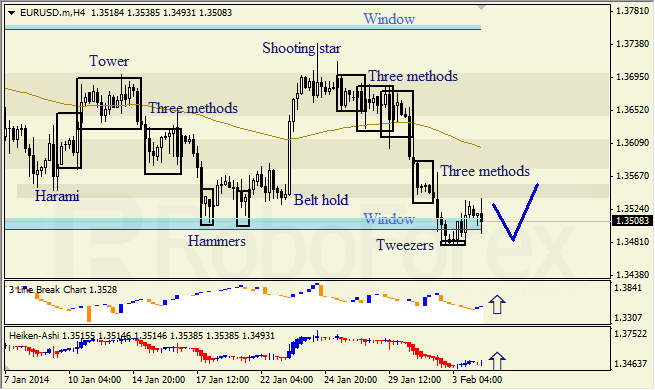
H4 chart of EUR USD shows correction at closest Window. Tweezers pattern, Three Line Break chart, and Heiken Ashi candlesticks confirm ascending movement.

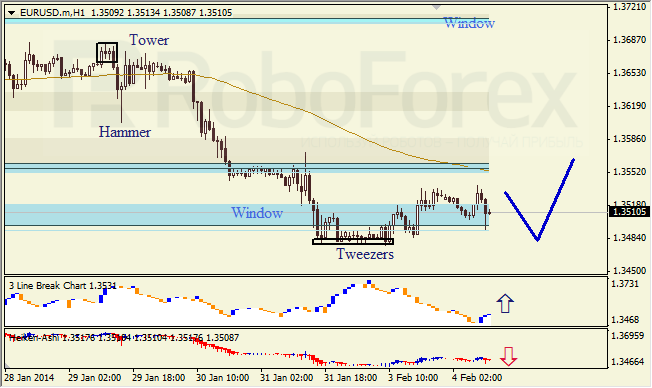
H1 chart of EUR USD shows sideways correction at closest Window. Tweezers pattern and Three Line Break chart confirm that correction continues; Heiken Ashi candlesticks indicate bearish pullback.

USD JPY, “US Dollar vs Japanese Yen”

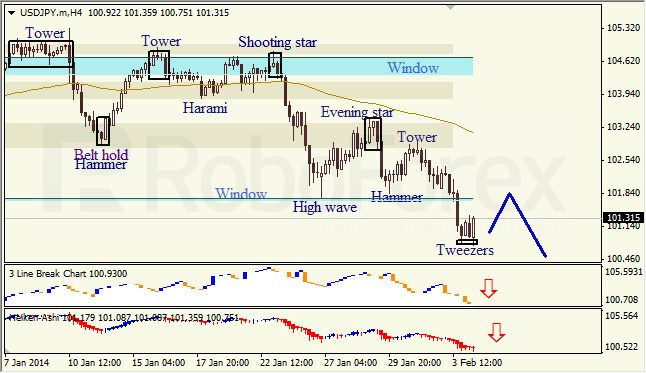
H4 chart of USD JPY shows bearish tendency. Closest Window is broken; now it’s resistance level. Three Line Break chart and Heiken Ashi candlesticks confirm descending movement; Tweezers pattern indicates ascending correction

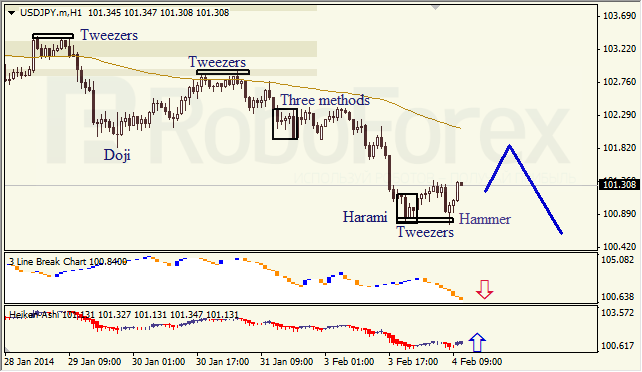
H1 chart of USD JPY shows correction within descending trend. Three Line Break chart indicates current trend; Harami, Tweezers, and Hammer patterns, along with Heiken Ashi candlesticks confirm that correction continues.

RoboForex Analytical Department

Article By RoboForex.com

Attention!
Forecasts presented in this section only reflect the author’s private opinion and should not be considered as guidance for trading. RoboForex LP bears no responsibility for trading results based on trading recommendations described in these analytical reviews.


EURUSD remains in downtrend from 1.3739

EURUSD remains in downtrend from 1.3739, the rise from 1.3477 could be treated as consolidation of the downtrend. Resistance is at 1.3570, as long as this level holds, the downtrend could be expected to continue, and next target would be at 1.3400 area. Only break above 1.3570 resistance will indicate that lengthier consolidation of the longer term downtrend from 1.3892 is underway, then further rise to 1.3700 area could be seen.

eurusd

Provided by ForexCycle.com

What Could be Next for the Australian Stock Market

By MoneyMorning.com.au

Every investor makes this mistake when investing.

It’s almost impossible not to make the mistake.

We’ve made it many times in the past.

We’re sure you have too…as has every analyst you care to mention.

And even though we like to think we’d never make the mistake again, we can’t promise that.

The good news is that even if you consistently make this mistake, you can still make big investing returns.

So, what is this common investing mistake?

It’s the idea that an outcome in one market will exactly mirror the outcome in another market.

To give you an example, from 2008 to 2010 we saw the aftermath of the US and UK housing bubble and concluded that the Australia market would suffer a similar fate.

We suggested Aussie housing could fall across the board by 40%. That didn’t happen. In fact Aussie house prices didn’t fall by anywhere near that amount.

But we didn’t get it 100% wrong. Some markets in Queensland and Western Australia did fall by this amount, and many individual house prices fell even further.

And now, the same mistake we made in the housing market is the mistake most of the mainstream is making with the Australian stock market.

Our dire warning never came to pass

It doesn’t matter where you look or what you read, the message is the same — the Aussie economy and stock market are on the ropes. And the advice behind those messages is that investors should ditch stocks before a major market crash.

To prove it they’ll point towards the US and Japanese markets. They’ll say the big rally in those markets in 2013 means those markets are set to crash. And by crash, we mean more than the 2.5% drop overnight.

They then argue that when those markets crash, the Aussie market will crumble, wiping billions of dollars of value from retirement accounts.

And they may be right. On the other hand, they may not be right.

We’ve learned the lesson from our dire (in more ways than one) house price prediction. The performance of one market doesn’t guarantee a carbon copy performance in another market.

We’ve also learned that lesson from the performance of the Aussie market in 2013. While small-cap growth and income stocks did well, we thought they could have done a lot better. Why? You guessed it, because US and European markets had done so well.

But we won’t be picky. If you backed individual stocks in 2013 rather than following an index-tracking strategy you should have come out of the year well ahead. In fact, stocks in pretty much every sector apart from the resource sector had a good year — tech related stocks especially.

Even so, compared to global markets, the Aussie market lagged. The Aussie market gained 15%, while some US and European markets gained more than double that.

Japan’s index gained 62%. So it’s perhaps not surprising that the Nikkei 225 index is now officially in ‘correction’ territory since the start of this year. That means it has fallen by more than 10%.

So, should you really be fearful about an Aussie market crash? Not in our view…

This isn’t a mirage

Any way you measure the market, Aussie stocks have done much worse compared to other Western markets.

The simple reason for that is foreign investors still see the Aussie market through a single lens — that is, as a commodities-based market.

That was great when the market took off between 2003 and 2007. It was equally great when the market rebounded between 2009 and 2011. But it wasn’t so great when commodities and resource stocks fell in a heap between 2011 and 2013.

But what about now? Well, we’re not sure that even the grumpiest bear could claim that Aussie resource stocks are overvalued.

Those who do must think it’s an illusion that Newcrest [ASX:NCM] has fallen 75.9% in just under three years. Maybe they think it’s a mirage that the S&P/ASX 300 Metals & Mining index is down 39.5% over the same timeframe.

The reason the bears think the Aussie market is primed to fall is because they’re looking at the US, European and Japanese markets, which have soared over the past year or so.

The same isn’t true for the Aussie market. In fact, as analysis from analyst Jason Stevenson points out, there are a whole bunch of stocks ready to bounce back after hitting multi-year lows.

We’re not saying these stocks are about to head up in a straight line. And we’re not saying the stock market won’t have days when prices fall. But we are saying that anyone who claims these stocks haven’t already crashed clearly hasn’t paid attention.

If you’re a genuine investor and you’re looking for genuine opportunities to buy low and sell high, we can’t think of another sector right now that gives you a better opportunity to do that than this beaten down sector.

Cheers,
Kris

Special Report: The Last Time This Stock Bottomed Out…

Join Money Morning on Google+


By MoneyMorning.com.au

iRobot: The Day of the Last Warrior Part One

By MoneyMorning.com.au

‘When it comes to changing the face of warfare,’ proclaims our ex-Navy officer turned newsletter editor, Byron King, ‘this one tops them all’.

‘Scientists and engineers,’ he says ‘are taking us closer to the day of the last warrior.’

‘I’m talking about an America that no longer sends significant numbers of troops overseas.’

At some point in the future, in other words, your children or grandchildren may be spared the horrors of the battlefield that have been a necessary evil since history can remember.

Let it be known: Byron is no utopian. He knows that for now, armed forces are needed.

Last year alone he says, ‘The US narrowly avoided another Mideast entanglement in Syria.’

‘Meanwhile, we learned that US troops will remain in Afghanistan beyond next year.’

‘Plus,’ he goes on, ‘it looks like that tenuous ‘peace’ between Israel and Iran is shakier than ever as Western powers loosen restrictions on Tehran’s nuclear ambitions. And then there’s that new issue of Asian airspace, with China’s new assertiveness.’

Yikes.

Good thing then that in the future, the US won’t send troops overseas. They’ll send things with names like ‘Warrior’, ‘Big Dog’ and ‘Gladiator’… and ‘PackBot’, a much less fearsome but equally important scout robot — and what must be Pixar’s WALL-E doppelganger.

‘That ‘world peace’ thing is just too good to be true, but this,’ Byron says of this mil-tech in question, ‘could be the next best thing.’ And what’s better, it’s investable.

Here we go…

Player No. 1: From Battlefields to Bathrooms

More than 20 years ago in the cradle of MIT, a trio of young scientists got to work on real-world applications for artificial intelligence (AI). After university, they became entrepreneurs, founded the company iRobot Corp. (NASDAQ: IRBT), and before the end of the decade were offered a contract to assist the US military through DARPA (the Defense Advanced Research Projects Agency). The first result was PackBot, a SUGV (Small Unmanned Ground Vehicle), pictured below:

This ‘little robot that could’ scouts ahead at speeds
past 8 mph, climbing stairs and outfitting its
multi-section arm with various attachments

Two wars were raging in the Middle East when PackBot was approved and deployed by the US Army and Marine Corp. And by the end of 2004, IED’s or Improvised Explosive Devices became the norm. That’s where PackBots became soldiers’ little helper, saving untold American lives. These rovers enabled US soldiers and Marines to check out suspected bomb sites remotely, sending the robot to inspect and — if necessary — detonate explosives riddled throughout the terrain. Soldiers — and civilians — meanwhile, could be kept a safe distance from the ‘kill zone’. By 2010, iRobot delivered its 3,000th PackBot; at the height of US involvement in Afghanistan and Iraq, there were 2,000 of these robots in theatre…mainly performing Explosive Ordnance Disposal (EOD) missions.

But that’s the past. The future for iRobot is autonomy. iRobot recently announced that its robots can come equipped with a ‘User Assist Package’ or UAP, imbuing these AI with a limited degree of self-awareness and self-direction. Some PackBots can now provide situational awareness to SWAT teams in urban warfare by locating enemy snipers with high-tech acoustics.

These same machines were critical in 2011 when the Japanese government scrambled to contain the world’s worst nuclear disaster at the Fukushima power plant. It was too hot inside the reactors — any human being would have received a fatal radiation dose after 20 minutes. The Japanese have been world leaders in industrial robotics since the 1970s, but when it really mattered, they turned to iRobot. ‘Packbot was ready like Cup Noodles’ said The Japan Times — an allusion to Japan’s national microwavable soup — ‘PackBots were the obvious choice to explore the No. 1 plant’s shattered, radiation-saturated reactor units.’

PackBot’s successor will be the ’710 Warrior’ — but that’s another story for another time.

iRobot is a great example of a company that’s bringing about ‘the day of the last warrior’. However, most of iRobot’s revenue comes from its sale of common household appliances. Just this morning, I saw a magazine outside my neighbour’s front door. On the front-page it featured the Roomba robotic vacuum cleaner that has been sold to a mind-boggling 10 million customers.

Company No. 2: The King of Search

Readers may remember when iRobot’s share price spiked after Google bought Boston Dynamics, a company with similar origins. It was the tail-end of an eight company acquisition binge. ‘Given the innovative horsepower of [Google’s] eight acquisitions,’ we said at the time, ‘it would probably take Google under a month to come up with a better vacuum cleaner that sells for less than iRobot’s Roomba.’

‘It’s worth saying that iRobot makes other robotics, including mobile hospital delivery platforms, but its bread and butter is consumer items like a $300 gutter cleaner that still requires you to climb a ladder and place the thing in the gutter. The companies Google bought are highly innovative. I think iRobot is both unlikely to be bought by Google and able to compete with anything Google decides to focus on since the king of search started buying robotics firms.’

Hmm, you don’t say?

Tomorrow we’ll see what Google’s been up to…

Josh Grasmick,
Contributing Editor, Money Morning

Ed Note: The above article was originally published in Tomorrow in Review.

Join Money Morning on Google+


By MoneyMorning.com.au