WTI Crude Prices Climbs Amid Freezing Weather

By HY Markets Forex Blog

West Texas Intermediate (WTI) climbed during the Asian trading session on Wednesday amid the cold weather in the US, the world’s biggest oil consumer.

Futures for the North American WTI crude for March delivery added 0.60% higher to $97.88 per barrel on the New York Mercantile Exchange at the time of writing, while the Brent crude for March settlement rose 0.35% higher at $106.09 per barrel on the London-based ICE Futures Europe exchange at the same time.

The European benchmark crude was at a premium of $8.39 to WTI.

WTI – US Crude Stockpiles

On Tuesday, reports from the American Petroleum Institute (API) revealed a rise in crude stockpiles by 384,000 barrels last week, compared to forecast of a gain of 2.55 million; while distillate fell by 1.5 million barrels.  A drop of 1.8 million barrels was seen in US gasoline inventories in the previous week ending Jan 31.

Data from the Energy Information Administration is expected to show a rise in stockpiles by 2.27 million barrels last week, compared to 113.7 million barrels seen last week.

WTI -US Macro data

In the US, the manufacturing sector expanded in January at its slowest pace in eight months, coming in at 51.3, missing estimates and down from the previous reading of 56.5 seen in December; according to reports complied by the institute for Supply Management (ISM) manufacturing PMI.

Freezing Weather

The cold weather in the central US is expected to be followed by cold rain today, according to Tom Kline, a meteorologist at AccuWeather Inc.

A strong freezing storm will breeze through east with heavy snow from central Kansas to the Northeast, according to the National Weather Service.


Visit www.hymarkets.com   to find out more about our products offering and start trading today with only $50 using the latest trading technology today.

The post WTI Crude Prices Climbs Amid Freezing Weather appeared first on | HY Markets Official blog.

Article provided by HY Markets Forex Blog

Eurozone Services Sector Expands in January

By HY Markets Forex Blog

The services sector for the 18-bloc eurozone expanded in January, showing an improvement for the sixth month in a row, data from Markit Economics confirmed on Wednesday.

Eurozone’s final Purchasing Managers’ Index (PMI) for the services sector expanded by 51.6 points in January, slightly higher than the reading of 51 seen in the previous month and compared with analysts forecast of 51.9 points, the reports from Markit Economics confirmed.

The Eurozone’s final PMI Composite came in at 52.9 points in January, picking up from the previous month’s figures of 52.1 points.

“The final reading of the eurozone PMI was down slightly on the earlier flash reading but nevertheless signals a very encouraging start to the year. Companies are reporting the strongest growth of business activity for two-and-a-half years, putting the economy on course to grow by 0.5% in the first quarter if this pace is sustained,” Chris Williamson, chief economist at Markit said.

Earlier in the week, reports revealed that activity on the eurozone’s manufacturing sector came in at 54 points in January, compared to December’s figures of 52.7.

Germany

The figures for Germany’s services sector revealed the euro area’s strongest economy continued to expand in January for the eighth consecutive month, but came in below the previous month’s reading, marking the lowest in two month. Germany’s services PMI came in at 53.1 in January, compared to 53.5 seen in the previous month.

France

The French services PMI slightly picked up to 48.9 from December reading of 47.8 and above estimates.

Italy

Italy’s services sector showed an improvement in January, but still failed to climb to expansion territory. The country’s services PMI rose 49.44 points higher from 47.9 recorded in December and higher than analysts forecast of 48.9 points.

Spain

The Spanish services sector climbed in January, as the respective reading remained in the expansion territory for the third month in a row. The country’s services PMI came in at 54.9 points, compared to the reading of 54.2 seen in December.


Visit www.hymarkets.com   to find out more about our products offering and start trading today with only $50 using the latest trading technology today.

The post Eurozone Services Sector Expands in January appeared first on | HY Markets Official blog.

Article provided by HY Markets Forex Blog

Fibonacci Retracements Analysis 05.02.2014 (EUR/USD, USD/CHF)

Article By RoboForex.com

Analysis for February 5th, 2014

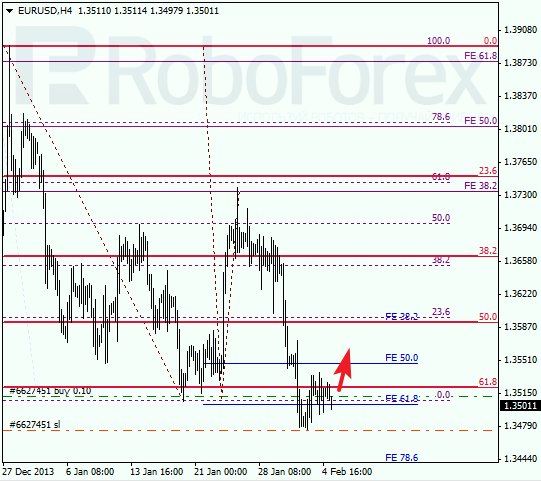
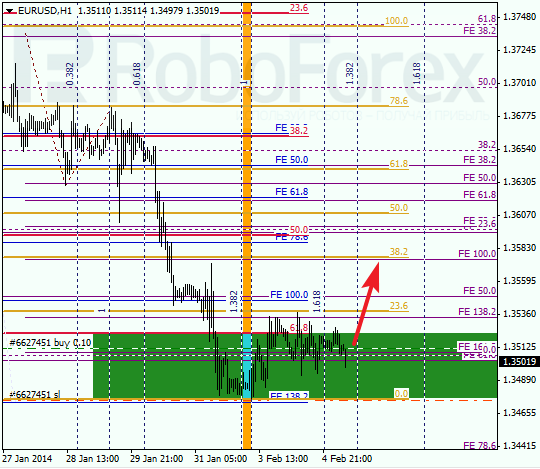
EUR USD, “Euro vs US Dollar”

Euro is still moving between levels of 61.8%. Probably, pair may form slight correction in the nearest future. However, if price rebounds from current levels, market will start new ascending movements. Otherwise, current correction may continue.

At H1 chart we can see, that price rebounded from lower border of its target area right inside temporary fibo-zone. Closest target for bulls is at local correctional level of 38.2%. If market breaks it, pair will continue growing up.

USD CHF, “US Dollar vs Swiss Franc”

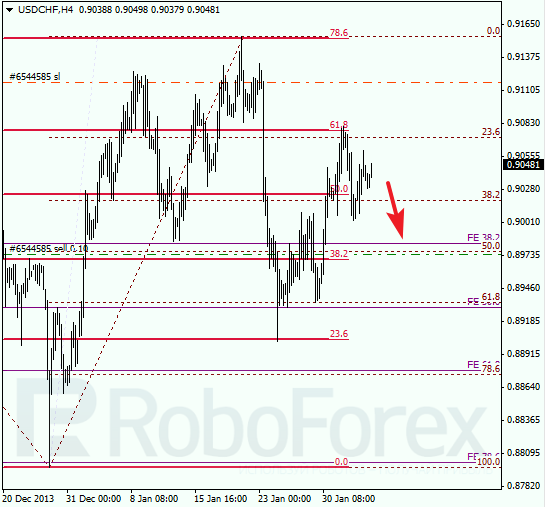
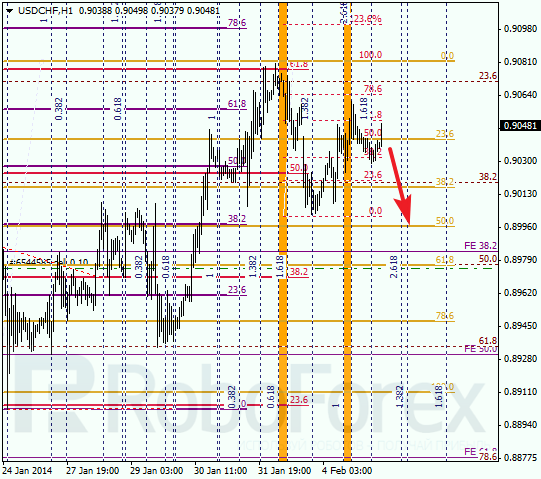
At H4 chart, Franc rebounded from level of 61.8%. Later, after completing current correction, market may start new descending movement. I’m still a bit in a drawdown, that’s why I don’t open any new orders.

Market was just several pips shy to reach local correctional level of 38.2%. Two of the latest temporary fibo-zones indicated the exact points of reverse. Possibly, pair may reach new minimum during the day.

RoboForex Analytical Department

Article By RoboForex.com

Attention!
Forecasts presented in this section only reflect the author’s private opinion and should not be considered as guidance for trading. RoboForex LP bears no responsibility for trading results based on trading recommendations described in these analytical reviews.


USDCAD: Vulnerable, Continues To Face Bear Threats

USDCAD: Vulnerable, Continues To Face Bear Threats

USDCAD: With its corrective weakness triggered off the 1.1223 level yet to be over, further decline is the likely scenario. USDCAD may be retaining its long term uptrend but its immediate outlook remains to the downside. Nearby support comes in at the 1.1040 level where a violation will aim at the 1.1000 level. Further down, support stands at the 1.0950 level and then the 1.0900 level, its psycho level. Its daily RSI is bearish and pointing lower supporting this view. On the other hand, resistance comes in at the 1.1137 level where a violation will aim at the 1.1223 level, its Jan 31 2014 high. A turn above here will activate additional strength towards the 1.1300 level where a breach if seen will trigger further gain towards the 1.1350 level. All in all, USDCAD continues to face further upside threats in the long term.

Article by www.fxtechstrategy.com


Ichimoku Cloud Analysis 05.02.2014 (GBP/USD, GOLD)

Article By RoboForex.com

Analysis for February 5th, 2014

GBP USD, “Great Britain Pound vs US Dollar”

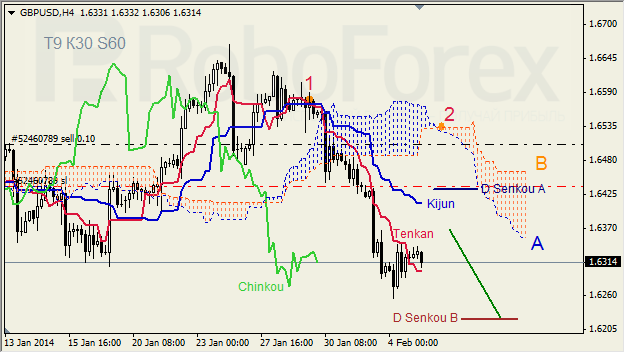
GBP USD, Time Frame H4. Tenkan-Sen and Kijun-Sen are influenced by “Dead Cross” (1). Ichimoku Cloud is going down (2), Chinkou Lagging Span is below the chart, and the price is inside Tenkan-Sen – Kijun-Sen channel. Short‑term forecast: we can expect resistance from Kijun-Sen, and decline of the price.

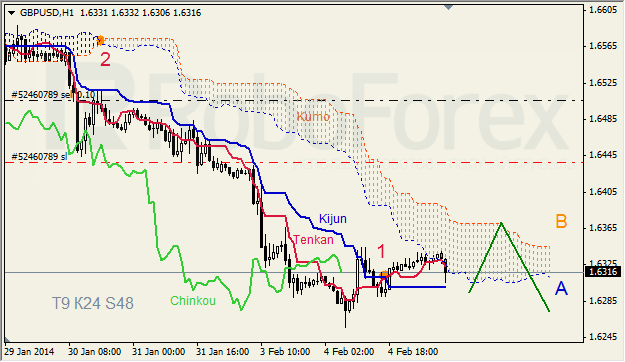
GBP USD, Time Frame H1. Tenkan-Sen and Kijun-Sen intersected below Kumo Cloud and formed “Golden Cross” (1); Tenkan-Sen and Senkou Span A are directed downwards. Ichimoku Cloud is going down (2). Short‑term forecast: we can expect resistance from Senkou Span B, and decline of the price.

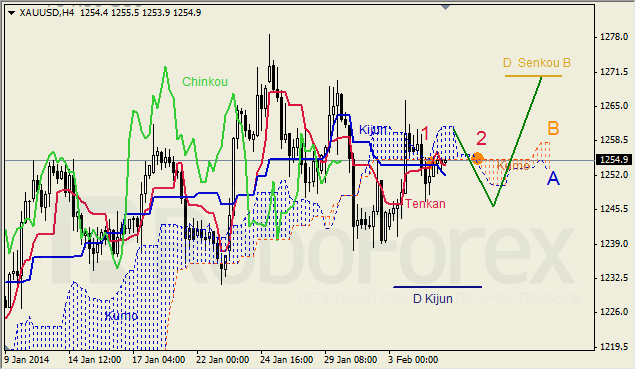
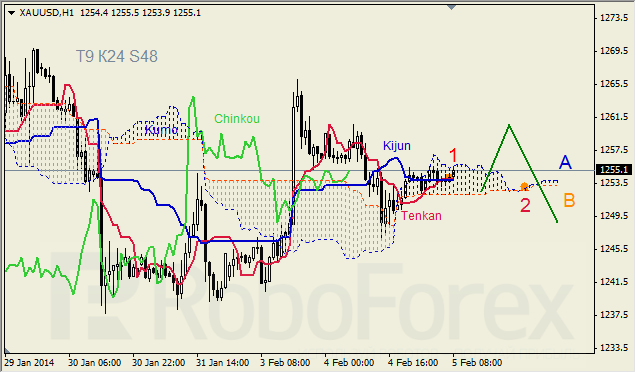
XAU USD, “Gold vs US Dollar”

XAU USD, Time Frame H4. Tenkan-Sen and Kijun-Sen intersected below Kumo Cloud and formed “Golden Cross” (1); both lines are directed downwards. Ichimoku Cloud is going down (2); Chinkou Lagging Span is below the chart. Short-term forecast: we can expect resistance from Senkou Span A.

XAU USD, Time Frame H1. Tenkan-Sen and Kijun-Sen are close to each other inside Kumo Cloud (1). Ichimoku Cloud is going up (2), Chinkou Lagging Span is below the chart, and the price is on Tenkan-Sen – Kijun-Sen. Short‑term forecast: we can expect support from Senkou Span B, and growth of the price.

RoboForex Analytical Department

Article By RoboForex.com

Attention!
Forecasts presented in this section only reflect the author’s private opinion and should not be considered as guidance for trading. RoboForex LP bears no responsibility for trading results based on trading recommendations described in these analytical reviews.


AUDUSD broke above 0.8887 resistance

AUDUSD broke above 0.8887 resistance, suggesting that he downward movement from 0.9085 had completed at 0.8660 already. Further rally could be expected, and next target would be at 0.9000 area. Key resistance is at 0.9085, as long as this level holds, the price action from 0.8820 (Dec 18, 2013 low) could be treated as consolidation of the downtrend from 0.9756 (Oct 23, 2013 high), one more fall towards 0.8500 is still possible after consolidation. Only break above 0.9085 resistance could signal completion of the downtrend.

audusd

Provided by ForexCycle.com

Are Central Banks Losing Relevance?

By MoneyMorning.com.au

‘At the same time, with resources sector investment spending set to decline significantly, considerable structural change occurring and lingering uncertainty in some areas of the business community, near-term prospects for business investment remain subdued.’

Monetary Policy Decision, Reserve Bank of Australia

After nearly six years of central banks dominating the business pages, and terms such as ‘the Fed’, ‘the RBA’, and ‘Bernanke’ getting more than their fair share of use, we can only look back on yesterday with fondness.

You may think that’s an odd reaction, seeing as the S&P/ASX 200 fell 90 points. That was the index’s biggest drop since June last year.

So what was it that brought a smile to our face even while stocks fell?

It was the possibility — however slim — that maybe things are returning to normal…

Last year we set a target for the main Aussie stock index to hit 7,000 points. Our prediction was that the index would get to that mark in early 2015 (say around January or February).

Part of our rationale was that the continued money printing from central banks and record low interest rates would provide a ‘money torrent’ of fresh cash helping to push up stock prices.

We weren’t the only one to hold that view. Dr Marc Faber, keynote speaker at our upcoming World War D conference in March, calls the US Federal Reserve’s latest round of money printing ‘QE Infinity’.

That was a reference to the fact that the plan didn’t have a fixed duration or end date.

But maybe now it’s time to change that view. That doesn’t mean we’ve ditched our 7,000 point target for the ASX — far from it. But maybe now the driving force behind the stock market’s rise is no longer the central banks.

Cashed-up Miners

At the top of this letter we printed a quote from the latest Reserve Bank of Australia monetary policy decision statement.

We’ve printed it for two reasons.

First, it supports an argument made by analyst Jason Stevenson. He’s made it pretty clear where he stands on where the mining sector is going this year.

His view is that the mining sector is moving from an investment phase into a production phase. If you read the RBA statement it sounds like that’s a bad thing. But it’s not. In fact, it’s the opposite of bad.

A shift from the investment phase to a production phase means there are a whole lot of beaten down mining stocks that will soon have stacks of cash flooding into their bottom line as explorers become producers.

This will give investors the clearest indication they’ll have gotten in 10 years on whether a company’s management is all talk and no action. One of our biggest criticisms of the mining sector is that a company’s breakthrough project always seems to be ’18 months from production’.

Just as tomorrow never comes, for many mining companies production never comes either. But if investors become fussier about where they’ll put their cash (and by investors I mean the institutions providing direct funding on projects) it likely means investment dollars will migrate towards the most viable and potentially profitable projects.

That’s actually good news for retail resource investors, and flies in the face of the mainstream rubbish about the end of the resources boom.

And that’s why Jason is focusing most of his attention on the companies that have the greatest chance of turning exploration projects into production projects.

But that’s not the only reason to be positive about the markets…

If Bad News is Bad News, Then Good News Should be Good News

As we said, there is another reason to be positive. In fact, this is what cheered us the most. It wasn’t until 2.20pm yesterday afternoon, 10 minutes before the Reserve Bank of Australia was due to release its statement, that we remembered the RBA board was meeting.

(Incidentally, the RBA decided not to change the current Cash Rate.)

How different that was to even a year ago? Back then it seemed as though everyone was waiting for the RBA decision with bated breath. We even remember a few years ago when Sky Business channel had a countdown clock as a gimmick leading up to the RBA decision.

We haven’t watched Sky Business channel in years, so maybe they still do the countdown thing. It’s a pretty sad state of affairs when the only thing driving the market is the actions and comments of the grey suits in Martin Place.

Maybe it’s just your editor who had this feeling. But if you add this to the previous day’s action on Wall Street, where bad economic news actually translated into bad stock market news, perhaps investors should see this as a positive sign.

It’s always dangerous to use one or two events in order to formulate an entire investment strategy. But you’ve got to start from somewhere. For over a year we’ve based our entire theory of a soaring stock market on the belief that central banks will keep printing money.

There is of course an alternative: rather than central banks boosting stocks to 7,000 points, what if the boost comes from investors pouring money back into the market in the belief that a genuine recovery is underway?

It’s a crazy idea. But do you know what? It might just happen…and if it does, we’re betting on mining stocks to be some of the best performing stocks on the Aussie market.

Cheers,
Kris

Special Report: The Last Time This Stock Bottomed Out…

Join Money Morning on Google+


By MoneyMorning.com.au

Robotics: The Day of the Last Warrior Part Two

By MoneyMorning.com.au

Yesterday, we told you about ‘the Day of the Last Warrior’, a time when military forces use robotics and AI makes the American warfighter obsolete.

Specifically, we covered iRobot and Google.

Today, we pick up where we left off…at the king of search…

Player No. 2: Google (NASDAQ:GOOG)

As you know, Google is powering future generations of robots. As we said yesterday, they’ve been on an acquisition binge.

Here’s what they acquired last year alone:

  • Boston Dynamics has provided Google with fearsome-appearing robotic creations for contracts with the US Defense Department
  • Bot & Dolly Have you seen the movie Gravity? If so, you’re familiar with this company’s work; they developed software and safety features for the robotic arms used
  • Holomni sell themselves on their website as an expert in ‘high-tech wheels and omnidirectional motion,’ with applications for wheeled robots and driverless cars
  • Meka Robotics, as anyone could guess, designs robots and the software they use to work in everyday environments
  • Redwood Robotics PC Magazine says Redwood Robotics is pretty specialised and focuses on robotic arms for personal service robots
  • Industrial Perception claims that it’s ‘providing robots with the skills they’ll need to succeed in the economy of tomorrow,’ manufacturing robots for consumer electronics, assembly or warehouse duties
  • Schaft Inc. is a Japanese startup that spawned the 209-pound robot creation that won Google recognition at a DARPA disaster relief competition. The acquisition gave Google access their two-legged robots. Watch out, PackBot!

In 2014, they’ve acquired Nest Labs, a home automation success story (and maker of the popular Nest Learning Thermostat. Their team of talented engineers includes former Apple VP and iPod visionary Tony Fadell.

But the most recent, most secretive and perhaps most important acquisition took place last weekend…and it could justify buying Google’s expensive shares: a private company called DeepMind.

DeepMind specialises in something called ‘deep learning’. Shocker, I know.

The thing is…major tech companies are highly competitive for talent in this space.

‘IBM’s Watson supercomputer,’ according to TechCrunch ‘is now working on deep learning.’

Likewise, ‘Yahoo recently acquired photo analysis startup LookFlow to lead its new deep learning group.’

And recently, Facebook hired celebrity scientist Yann LeCun to lead its new AI lab. He’s the guy who invented the optical character recognition tech that banks used throughout the late 1990s and early 2000s that made a scan whenever you wrote a check. Soon enough, Facebook’s facial recognition tech may recognise people in not just photos but also the videos you post… Kind of scary, eh?

But Google outdid Facebook. According to what The Information reported back in December, Google and Facebook vied to purchase DeepMind. Last weekend, Google CEO Larry Page led the deal himself to acquire the three-year-old company for $400 million, considered by some to be ‘the last large independent company with a strong focus on artificial intelligence.’

Talk about competing for talent… DeepMind’s founder Demis Hassabis is a rare seed, indeed. As a child prodigy, chess master, shogi and poker player, he won the World Games Championships at the Mind Sports Olympiad a record five times. Now retired, the latter hailed him as ‘probably the best games player in history’.

Multiple sources said the company has been applying their tech to various potential products such as recommendation system for e-commerce. In light of the high-caliber acquisitions for robotics and AI, Google — despite its priciness — is a great stock.

Google and its subsidiaries are a force to be reckoned with and could be the biggest player bringing about ‘the Day of the Last Warrior,’ despite the fact that they started in search.

As promised, I have one final company to tell you about, a UAV specialist bringing about ‘the Day of the Last Warrior’ that you should know about…

Player No. 3: From Tuna Fishing to Terrorist Nabbing

Ever since the US Air Force armed spy drone, the MQ-1 Predator, was armed with guided missiles in the early ’00s, drones have been the source of a lot of fear — and rightly so.

The military space operates differently than the civilian, in that people are more willing to take an area where there’s already a problem — the cost of human life, whether it be from an exploding bomb or through computer code — and replace it with nonliving machinations.

If you’ve ever seen Captain Phillips with Tom Hanks, a movie based on a true story about the rescue of a hostage in an attack on a cargo ship by Somalian pirates, you might recognise this:

ScanEagle

The drone is ScanEagle, made by Insitu Inc., a name inspired by the Latin term for ‘in position’ — readiness, in other words. Compared with its big brothers such as the Predator, ScanEagle is tiny.

Its wingspan is 10 feet, and it weighs less than 50 pounds, including payload. The Predator, on the other hand, has a wingspan of nearly 50 feet and weighs in at more than a ton fully loaded. So where Predator requires an airfield to operate, ScanEagle can be launched from a small towed trailer. In theory, a horse could pull this thing (useful in parts of Afghanistan to this day).

But Insitu didn’t start as a big, bad drone maker. In fact, it started pretty small. In 1994, it was a little startup in Washington state, composed of a group of engineers who enjoyed windsurfing together. They set out to improve offshore weather tracking and then got to work improving deep-sea tuna fishing. Yawn.

But when they turned their hot new tech toward the problems facing the troops in Iraq after 2003, they caught the attention of the big three-letter agencies (CIA, FBI, NSA…if you catch my drift). Soon, the old ‘tuna hunter’ was reincarnated as ScanEagle, and things really blew up. In fact, by 2010, revenues reached $400 million, and sales of the ScanEagle platform passed 1,000 orders.

The DoD’s acceptance of their signature drone put Insitu on the map. Now everything from police agencies to oil and gas corporations want a piece of the action.

There’s just one catch. Insitu never went public. In 2008, just five years after their drone tech made them a mil-tech darling, Insitu was bought out by Boeing (BA: NYSE).

But they got the ScanEagle program up and running in the first place through technology sharing and collaboration. Boeing’s bigger initiative to supply the needs of a burgeoning defence sector with mil-tech production lines going far beyond drones like ScanEagle.

‘If there’s only one thing you should remember about this bad boy,’ says our mil-tech guru Byron King, ‘it should be this: American Special Forces operators probably got their first up-close-and-personal look at Osama bin Laden’s secret compound in Abbottabad, Pakistan, using one of these.

‘Of course,’ he concedes, ‘I can’t prove that.’ Although he’s rubbed elbows with Donald Rumsfeld, ‘The only people that know for sure,’ he says, ‘have been sworn to secrecy, and rightly so. The details of Operation Neptune Spear are going to remain ‘need to know’ for a long time.’

Josh Grasmick,
Contributing Editor, Money Morning

Ed Note: The above is an edited version of an article originally published in Tomorrow in Review. For your chance to see Tomorrow in Review’s military technology guru Byron King in person and hear him speak about the future of technology and money at Port Phillip Publishing’s World War D conference, click here.

Join Money Morning on Google+


By MoneyMorning.com.au

We Love You, Mr. President!

By Marin Katusa, Chief Energy Investment Strategist, Casey Research

With Valentine’s Day coming up fast and furious, I wanted to take a moment to give heartfelt thanks to one of my personal heroes this year—the man who single-handedly destroyed US national security and will give smart uranium investors a lot to be grateful for in the coming months. This letter is addressed to him.

Dear President Obama (may I call you Barry?),

I’m writing this letter to you in sincere appreciation and heartfelt gratitude for your achievements regarding national security and the uranium sector.

Perhaps you wonder what on earth national security could have to do with uranium (unless it is used in those pesky nuclear weapons that you keep taking away from the mullahs).

In fact, I bet you do wonder, because apparently it never occurred to you that one could depend on a ready supply of the other.

But let’s take this one step at a time.

I know you’re used to receiving information on the state of the union from your slew of sycophantic advisors in the form of tidbits and sound bites, so I’ll try not to overwhelm your fragile cerebrum.

Please take a look at the facts listed below, and maybe, just maybe, it’ll begin to dawn on you…

7 Facts You Should Know About Uranium in America

Amount of electricity in the United States generated by nuclear power: 20%.

Number of homes in President Obama’s America that are powered by the Russians: 1 in 10.

Number of homes in President Kennedy’s America that were powered by the Russians: 0.

Percentage of imported uranium in President Obama’s America: over 90%.

Percentage of imported uranium in President Kennedy’s America: 0%.

In 1962, the US was the largest producer of uranium in the world.

In 2013, the US ranked #8 in uranium production, right after China.

But let’s not stop there. To fully understand in what way national security and uranium might be linked (except that they both share some of the same vowels and consonants), I need to insert a brief…

History of the DOE

Believe it or not, but it was good old Albert Einstein who was the catalyst for the creation of what’s known as the US Department of Energy (DOE) today. In 1939, seeing that the Germans had an alarming head start in the nuclear race, Einstein wrote a letter to your predecessor Franklin D. Roosevelt, alerting him to that fact.

We know the rest from the textbooks: In 1939, Germany invaded Poland… in 1941, Japan bombed Pearl Harbor… and within two months, in 1942, Roosevelt instructed the Army Corps of Engineers to build a nuclear bomb—the start of the Manhattan Project. The US dropped two nuclear bombs on Japan, and in August of 1945, Japan surrendered.

The beginning of the Cold War led to the creation of the DOE.

In 1946, the US presented a plan for international control of nuclear research at the United Nations summit. The Soviet Union completely rejected the American proposal, launching the race for the nuclear bomb between the two superpowers.

After World War II, the Manhattan Project was turned over to the Atomic Energy Commission, which by the late 1940s had invested hundreds of billions of dollars into expanding the weapons complex.

By 1973, OPEC caused chaos at the pumps for Americans, and President Nixon announced an energy plan of independence for the US by 1980 (the first of many announced by subsequent presidents; I wonder why they never worked out).

Nixon created the Federal Energy Administration, and in 1974, his successor, Gerald Ford, signed the Federal Energy Reorganization Act. Like most political promises, the program failed to deliver, and by the late 1970s, Jimmy Carter was facing high oil prices and low approval ratings.

President Carter created the Department of Energy, and nine days before Elvis Presley died of a heart attack, James Schlesinger was sworn in as the first secretary of energy.

I know, Barry, you’ve been impatiently shifting around in your seat, waiting for the punchline. Okay, now this is where you come in…

President Obama Makes Changes to the DOE

Perhaps you know that since its inception, the Department of Energy has been the largest holder of uranium in the world. The DOE’s mandate for uranium was a strategic one, and the essential goal—as an issue of national security—was for the US and its citizens to never become dependent on another nation for uranium.

All the DOE had to do was follow two simple rules for sales to the US utilities that required uranium to power American households. Here they are:

  1. Never sell more than 10% of domestic demand into the market per year.
  1. Never sell uranium at such a low price that it would sabotage domestic uranium production.

Enter you, Mr. President, Barack Obama. You rode your campaign horse to victory on slogans like “Yes we can” and “It’s about time. It’s about change.”

Unfortunately, you forgot to mention that rather than change American politics, you were about to short-change the American people.

Why, oh why couldn’t you just leave well enough alone? Every US president before you had obeyed those two rules I mentioned above—Republican or Democrat, from Truman to Kennedy to even George W. Bush.

In mid-2013, you, Barry, apparently not understanding the importance of national energy security, changed the law and dropped the two rules. (We’ve been writing about this for a while now, so thanks for providing us with editorial material too.)

Since your advisors obviously did such a dismal job explaining it to you, maybe we can help.

How You Destroyed the US Uranium Sector—and US National Security

You see, the DOE built up its strategic stockpile of uranium from domestic production to make sure that the nuclear power generation that is so vital for the United States’ supply of electricity was never at risk. (The US is the world’s largest consumer of uranium and makes up about 25% of the global demand.)

All the presidents before you, Barry, followed the two sacred rules because the Russians, due to their Soviet legacy assets, can produce uranium at much lower prices than the Americans. Therefore, it is crucial to keep domestic production economic and competitive.

However, your recent job numbers didn’t look so good, did they—so you decided to milk the nuclear sector in order to create jobs and raise $250 million for the reclamation of old nuclear sites.

(You never openly stated this, but we found out anyway. It was easy, you see—to figure out your agenda, all we had to do was work backwards through the nuclear chain and look at the companies the DOE approved for the clean-up jobs, because these companies have announced their work programs for the next few years. Nice try there, Mr. President.)

So to get your $250 million—do we still count in millions, by the way? I thought everything under a billion was viewed as chump change these days—you made the DOE sell significantly more uranium into the market than ever before in the history of the United States.

And of course your timing couldn’t have been worse. Namely, you decided to do this right after the Japanese started selling record amounts of uranium after the Fukushima incident, and the wave of uranium hitting the market dropped the spot price from over US$72/lb to US$34/lb… a more than 50% drop within 24 months.

Well, you got what you wanted: with the spot price slashed in half, 95% of all US uranium production is now uneconomic. That means the miners are losing money and the higher-cost producers will soon go bankrupt.

Thanks to your tireless efforts, the former “Land of the Free” is now a junkie dependent on Russian uranium supplies for its next fix. And the nice Mr. Putin, whose country was America’s sworn enemy not too long ago (remember that?), now essentially controls 10% of the entire US electricity matrix.

Which proves again that with friends like you, Barry, one can make do quite easily without enemies.

So why exactly am I writing you a thank-you letter?

Well, as a community organizer, you wouldn’t know such things, but you see, the cure for low prices is low prices.

Less uranium production = less supply = higher price. So thanks to you, the shares of first-class uranium explorers and producers now really have nowhere to go but up. Well done!

You may have endangered the welfare of your entire nation for the foreseeable future, but from an investor’s viewpoint, you deserve a ton of chocolate truffles. Because you have single-handedly created—oh, just the…

Greatest Investment Opportunity in Uranium EVER

So, thank you, dear Mr. President, because your loss is my gain.

Oh, come on now, no need to hide your face in shame. After all, this is not the first time government stupidity has set up an incredible opportunity to make a fortune—you’re in very good company.

Thanks to your stunning incompetence, I wouldn’t be surprised if you handed me and my Casey Energy Report subscribers a double or triple on our investments.

So I close my letter with the warmest wishes for the rest of your presidency. May you never change.

Yours in deep gratitude,

Marin Katusa

Now to you, dear readers: If you want to find out the true extent of the windfall my dearest friend, Mr. Obama, has so kindly provided for us, you should give the Casey Energy Report a try today.

The current issue is all about the latest and greatest opportunities in uranium investing, and in our article “Making the Grade,” we’ll take you to the richest uranium deposit in the world and tell you all about the company that’s in the best position to be successful there.

There’s no risk in giving it a try: Test my newsletter for the next 3 months, and if you don’t like it or don’t make any money, just cancel within that time for a full refund, no questions asked. Click here to get started.


CRUDE OIL: Halts Weakness, Looks To Retake The 98.58 Level.

CRUDE OIL: With Crude Oil halting its two-day weakness and recovering higher on Tuesday, the risk is for a retake of the 98.58 level, its Jan 30 2014 high to occur. Further out, resistance comes in the 99.38 level, representing its Dec 31 2013 high. A turn above here will set the stage for more recovery towards the 100.00 level with a breach of there turning focus to the 100.74.00 level, its Dec 27 2013 high. On the downside, support comes in at the 96.26 level, its Feb 03 2014 low with a break targeting the 95.67 level. A cut through here will turn attention to the 95.00 level with a breach of here shifting focus to the 94.00 level, its psycho level. All in all, Crude Oil remains biased to the upside in the medium term.

Article by www.fxtechstrategy.com