Crude Prices Advances as Distillate Supply Declines

By HY Markets Forex Blog

Crude prices climbed on Thursday after the report from the US which revealed the demand for distillates dropped due to the freezing weather.

Futures for the WTI for March delivery rose 0.31% higher to $97.69 per barrel on the New York Mercantile Exchange at the time of writing. At the same futures for the Brent crude for the March settlement came in 0.14% higher at $106.40 per barrel on the ICE Futures Europe exchange. The European benchmark crude was at a premium of $8.80 to WTI on the ICE exchange.

Reports from the US Energy Information Administration (EIA) revealed that the US stockpiles climbed at a slower pace last week. Stockpiles rose by 440,000 barrels, compared to the previous figures of 2.27 million barrels in the previous week.  Gasoline inventories added 505,000 barrels, compared to the gain of 1.48 million barrels forecasted by analysts.

Crude – Distillates Demand

Meanwhile, the US distillate supplies including heating oil and diesel fell by 2.36 million barrels to 113.8 million. The demand in distillates dropped due to the freezing weather and snow in the Northern eastern region of the US.  The US is the world’s biggest oil consumer.

Report from the Institute for Supply Management (ISM)  revealed the US services sector expanded to 54.0 in January, rising from the previous reading of 53.0 seen in December and compared to analysts forecast of 53.7.


Visit www.hymarkets.com   to find out more about our products offering and start trading today with only $50 using the latest trading technology today.

The post Crude Prices Advances as Distillate Supply Declines appeared first on | HY Markets Official blog.

Article provided by HY Markets Forex Blog

Asian Stocks Mixed Ahead of US Jobs Report

By HY Markets Forex Blog

Shares in the Asian region advanced for a second day on Thursday as Australia reported an upbeat trade surplus on exports to China and comments from the deputy governor of the Bank of Japan (BoJ).

Market participants are looking forward to the release of the US unemployment and payroll reports tomorrow and the European Central Bank (ECB) decision on the monetary policy.

The Japanese Nikkei 225 index climbed 0.18% higher at 14,155.12 points, while Tokyo’s Topix index declined 0.02% lower, closing at 1,162.37 points.  Hong Kong’s Hang Seng index climbed 0.60% to 21,395.19 points at the time of writing, while the Shanghai Stock Exchange closed for the Chinese New Year holiday. Korea’s benchmark Kospi index advanced 0.88% higher, closing at 1,907.89 points.

Stocks – BoJ, ECB

Kikuo Iwata, Deputy Governor of the Bank of Japan (BoJ) commented on the bank’s monetary easing, saying the bank would continue its monetary easing until the inflation rate reaches the bank’s 2% target.

Meanwhile, European Central Bank policymakers are expected to meet to discuss the bank’s interest rate after inflation slowed to a four-year low last month. Analysts are expecting officials to maintain rates.

Stocks – Australia Upbeat Data

Stocks in Australia climbed on a string of positive macroeconomic data on Thursday. The country’s benchmark S&P/ASX index closed 1.20% lower at 5,131.40, while Australia’s trade balance came in higher in December as exports came in 4% higher from the November.

Australia reported a trade surplus of A$468 million in December, according t o the Australian Bureau of Statistics. Trade data with China, Australia’s biggest trading partner hit a record.

Australia’s retail sales came in 0.5% higher month-on-month in December, compared to the previous figures of 0.7% seen in November.

Stocks – US Payroll & Jobless Claims Report

With reports for the US payrolls and unemployment reports expected to be released on Friday, analysts are expected to see the US unemployment figures come in at 6.7% in January. US companies increased payrolls by 175,000 in January, according to reports from the ADP Research Institute.


Visit www.hymarkets.com   to find out more about our products offering and start trading today with only $50 using the latest trading technology today.

The post Asian Stocks Mixed Ahead of US Jobs Report appeared first on | HY Markets Official blog.

Article provided by HY Markets Forex Blog

Forex Trading Results in Spike in AUD/USD

By HY Markets Forex Blog

Forex trading resulted in the AUD/USD pair rising by more than 2 percent on Feb. 4, as global market participants were impacted by the latest information provided by the Reserve Bank of Australia.

The currency pair gained 2.2 percent during the day, according to Reuters. This happened after lackluster economic conditions and the policies of the central bank of the Asian Pacific nation resulted in the Aussie plunging by almost 20 percent over the last year.

Forex trading prompted by RBA statements

The increase in the AUD/USD happened after Glenn Stevens, governor of the RBA, indicated that the financial institution would not change its benchmark interest rate, leaving it steady at 2.5 percent. The RBA stated that for the time being, it would likely maintain its borrowing costs. Stevens asserted that the organization was likely on track to achieve its goals for inflation and demand with the existing monetary policy.

The central bank noted that its current use of monetary stimulus levers leans toward stimulating further growth. In addition, the government official indicated his shifting stance on the Aussie, according to Bloomberg.

Central bank notes new view of Aussie

While Stevens had said previously that the value of the emerging-market currency was “uncomfortably high,” he stated that the recent depreciation in the Australian dollar would help facilitate economic growth, the media outlet reported.

“They’ve shifted very firmly to a neutral bias,” Su-Lin Ong, who works for Royal Bank of Canada in Sydney as head of Australian economic and fixed-income strategy, told the news source. “The fact they’ve taken out the reference to the uncomfortably high Australian dollar also tells you that they’re clearly pleased with what the currency’s done over the past couple of months.”

The market expert is correct in that the statements about the RBA being comfortable with the currency value of the Aussie could have substantial implications for forex trading and the AUD/USD. The fact that the financial institution is satisfied with the current strength of the currency means that the organization will be less likely to take further action aimed at devaluation.

“Together, these statements suggest that the exchange rate is approaching levels at which the RBA is more comfortable and that policymakers are removing the threat of using their most powerful tool to drive it lower,” Citibank analysts wrote in a note that was written for European clients, Reuters reported. “This will be viewed as the market as an all-clear signal on the currency and is likely to invite a further reversal of short positions among leveraged investors.”

Importance of Fed stimulus

Another factor that is considered by many market experts to play a crucial role in the AUD/USD is the actions that the Federal Reserve takes to stimulate the U.S. economy.

The Federal Open Market Committee announced at the end of its most recent meeting that starting in February, it would purchase $65 billion worth of bonds per month. The central bank could easily push this amount lower at subsequent meetings, depending on the strength of economic data in the nation.

Many market experts are currently waiting to see the results of the latest U.S. Department of Labor report, which is scheduled to released on Friday, Feb. 7.

This government agency will probably end up showing that in January, the jobless rate declined to 6.6 percent and payrolls rose by 190,000, according to economists who took part in a recent MarketWatch poll. Another key piece of information came in the form of a report released by the Institute for Supply Management, which indicated that in January, its manufacturing index fell short of the predictions of market experts, the media outlet reported.

The lackluster activity was blamed by many industry participants on challenging weather. One market expert said that attributing poor economic conditions to the cold will not work for much longer.

“I think the market is frustrated with that argument,” Brad Bechtel, managing director at Faros Trading, told the news source. “After the ISM data, it needs to see some better data otherwise it’s going to get worried.”

If the jobs report is also disappointing, this information could put pressure on the FOMC to refrain from dialing down its existing regimen of bond purchases quickly. Many market participants have been speculating about the schedule that the Fed will use to gradually reduce these transactions.

Many believe that if the data that is released shows strength in the U.S. economy, then the central bank will have the justification it needs to continue lowering its bond purchases. Such a development would reduce the pace at which the U.S. money supply is growing, and provide some tailwinds to the value of the greenback.

Any factors that serve to push this currency higher could have a substantial impact on forex trading and the value of the AUD/USD.

The post Forex Trading Results in Spike in AUD/USD appeared first on | HY Markets Official blog.

Article provided by HY Markets Forex Blog

Philippines holds rates, says inflation is manageable

By CentralBankNews.info
    The Philippines’ central bank held its policy rates steady, as widely expected, describing inflation as “manageable” and forecast to remain within the central bank’s target ranges this year and 2015.
    The Central Bank of the Philippines (BSP), which has maintained its overnight borrowing rate at 3.50 percent since October 2012, acknowledged that the balance of risks to the inflation outlook remains “slightly weighted towards the upside” given the pending petitions for higher utility rates and the possible rise in food prices.
    Inflation in the Philippines has been accelerating the last five months, hitting 4.2 percent in January, the highest since November 2011 mainly due to higher food prices from adverse weather. The central bank targets inflation at a midpoint of 4.0 percent in 2014, plus/minus 1 percentage points, while in 2015 the inflation target is 3.0 percent, plus/minus 1 percentage point.
    The decision by the BSP’s monetary board was expected following a text message sent by the governor, Amando Tetangco, to reporters on Wednesday in which he said the bank still had room to keep rates steady but that room may be narrowing due to the risks to the inflation outlook.
    In addition to the impact on food prices from Typoon Haiyan, import prices are also likely to be under pressure from the decline in the Philippine peso.
    The peso lost 7.5 percent against the U.S. dollar in 2013 and has lost a further 1.7 percent so far this year, trading at 45.18 to the dollar today.
    The BSP said the global economy had become more challenging due to heightened financial market uncertainty following the adjustment of monetary policy in the United States and concern over the sustainability of growth in emerging market economies.
    But the BSP said domestic activity is likely to stay firm, with buoyant demand, strong fiscal and external positions, as well as favorable consumer and business sentiment supporting the economy.
    The Philippines’ Gross Domestic Product expanded by 1.5 percent in the fourth quarter of last year from the third quarter for annual growth of 6.5 percent, down from 6.9 percent.

    http://ift.tt/1iP0FNb

Fibonacci Retracements Analysis 06.02.2014 (EUR/USD, USD/CHF)

Article By RoboForex.com

Analysis for February 6th, 2014

EUR USD, “Euro vs US Dollar”

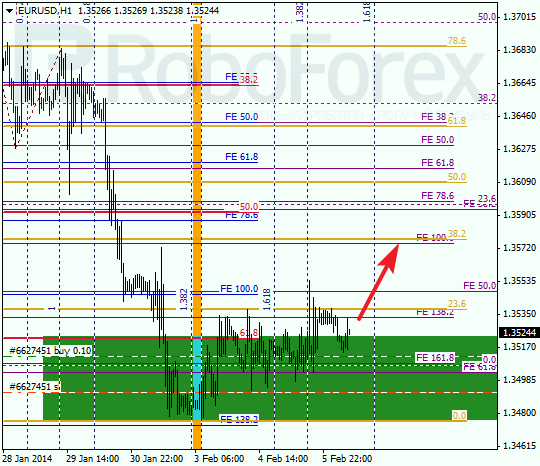
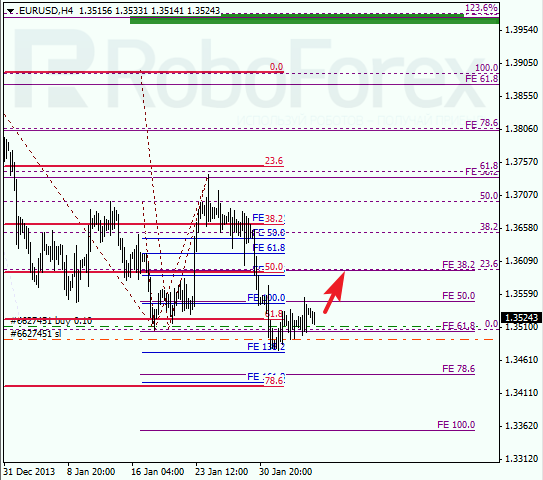
Bulls are trying to keep price above level of 61.8%. If they succeed, pair will continue growing up towards a group of upper fibo-levels. I’ll move stop on my buy order into the black as soon as market reaches new maximum.

At H1 chart we can see, earlier this week price rebounded from lower border of its target area, it happened right inside temporary fibo-zone. The first target for bulls is at local level of 38.2%. If market breaks it, pair will continue growing up.

USD CHF, “US Dollar vs Swiss Franc”

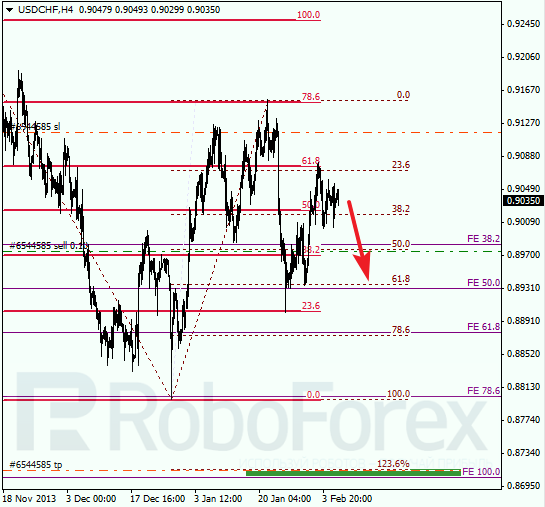
At H4 chart, Franc rebounded from levels of 78.6% and then 61.8%. I’m keeping my sell order, although I’m still a bit in a drawdown. In the near term, market may start new descending movement.

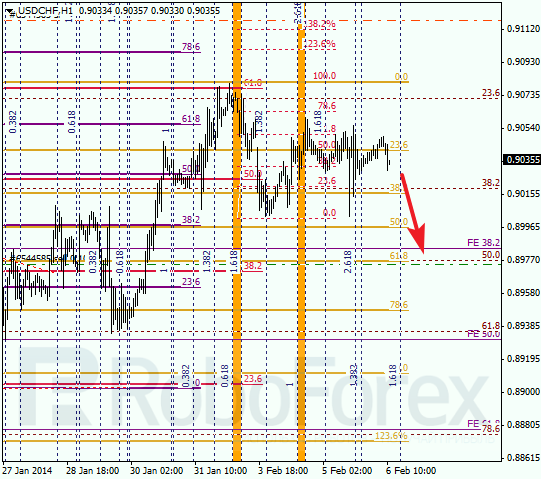
At H1 chart, market rebounded from local level of 78.6%. Most likely, in the nearest future pair will continue falling down towards level of 61.8%. If price breaks it, bears will continue pushing pair downwards.

RoboForex Analytical Department

Article By RoboForex.com

Attention!
Forecasts presented in this section only reflect the author’s private opinion and should not be considered as guidance for trading. RoboForex LP bears no responsibility for trading results based on trading recommendations described in these analytical reviews.


The Ghost of Benjamin Graham Takes Revenge

By WallStreetDaily.com The Ghost of Benjamin Graham Takes Revenge

You can bet that the father of value investing, Benjamin Graham, is haunting the stock market at this very moment.

For one simple reason…

The market that made him so rich is seriously out of whack right now.

You see, stock prices ultimately follow earnings. But even though the latest earnings data points to strength, the S&P 500 Index is nursing a year-to-date loss of nearly 4%.

Let’s dig into the data for answers – and, more importantly, to find out what it means for our investments over the coming weeks and months. I’ll also reveal Graham’s warning that he continues to shout from the grave…

A Weekly Addiction

Every Friday during earnings season, I devour the Earnings Insight report from FactSet. I recommend you do the same, as it contains invaluable information about the latest earnings trends.

While reading the latest report, one anomaly jumped out at me right away…

In one week’s time, the expected earnings growth rate for the S&P 500 rose to 7.9% from 6.4%.

Let me assure you, after monitoring these reports for years, this qualifies as a significant increase in such a short period of time.

The catalyst? Way better-than-expected earnings reports, particularly from companies in the financial sector. (Believe it or not, banks are finally on the mend.)

All told, 74% of companies in the S&P 500 have topped earnings expectations so far.

While it’s common knowledge that companies underpromise so they can overdeliver, this much overdelivering is uncharacteristic.

Or as FactSet’s John Butters says, “The percentage of companies reporting [earnings per share (EPS)] above the mean EPS estimate is above the one-year (71%) average and the four-year (73%) average.”

Usually, such a strong surprise to the upside would lead to a similar trend in the market, too. But that’s not happening.

Sure, individual stocks are up an average of 0.39% on their earnings report day, according to Bespoke Investment Group. However, the overall market is trending lower.

In fact, after a horrible January, the S&P 500 kicked off February with its second-worst opening-day decline – ever!

What gives?

It’s simple, really. Market conditions are anything but normal right now…

An Emerging Contagion?

Investors can’t seem to shake off the fears of a spillover effect from the taper-inspired rout going on in emerging markets.

In an upcoming issue, I’ll dig into the data to reveal whether or not such fears are misplaced. Right now, I want to focus on the fact that the S&P 500 is acting oblivious to the strong earnings data.

For today, here’s the important takeaway: It won’t last!

As Benjamin Graham famously observed, “In the short term, the stock market behaves like a voting machine, but in the long term it acts like a weighing machine.”

Think his wisdom is outdated? Then chew on a sound bite tweeted this week by a modern-day guru, Chuck Royce of The Royce Funds: “Macro noise can at times be a distraction, but our attention never strays from our long-term view.”

Amen!

Bottom line: The stock market can act quite irrational in the short term. However, it’s only a matter of time before it regains its senses and starts trading based on the merits of the only long-term determinant of prices – earnings.

So should we just sit and wait for the transition to materialize? Not a chance!

Given the erratic behavior in relation to earnings and the precipitous drop in bullish sentiment, we should be on the hunt for attractive buying opportunities to prepare for a bounce.

If I were you, I’d start by scouring the consumer discretionary, consumer staples and energy sectors. They’re the most oversold right now – trading more than three standard deviations below their 50-day moving averages, according to Bespoke.

Happy hunting!

Ahead of the tape,

Louis Basenese

The post The Ghost of Benjamin Graham Takes Revenge appeared first on Wall Street Daily.

Article By WallStreetDaily.com

Original Article: The Ghost of Benjamin Graham Takes Revenge
Japanese Candlesticks Analysis 06.02.2014 (EUR/USD, USD/JPY)

Article By RoboForex.com

Analysis for February 6th, 2014

EUR USD, “Euro vs US Dollar”

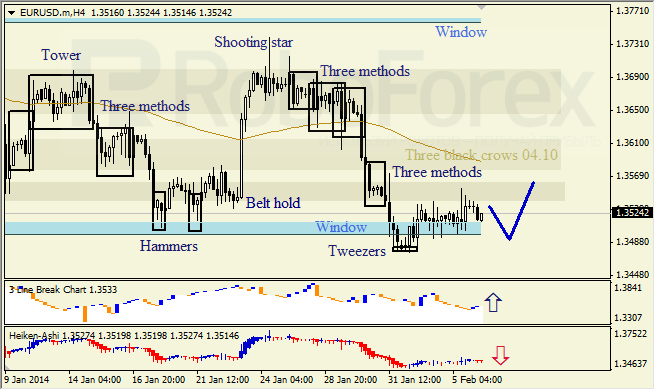
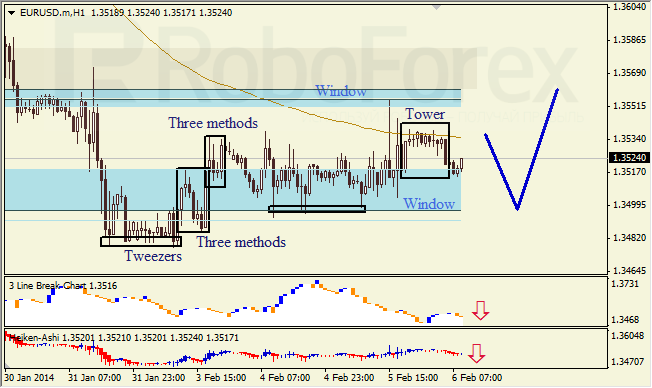
H4 chart of EUR USD shows correction at closest Window. Tweezers pattern and Three Line Break chart confirm ascending movement; Heiken Ashi candlesticks indicate bearish pullback.

H1 chart of EUR USD shows support from closest Window. Tower pattern, Three Line Break chart, and Heiken Ashi candlesticks indicate bearish pullback.

USD JPY, “US Dollar vs Japanese Yen”

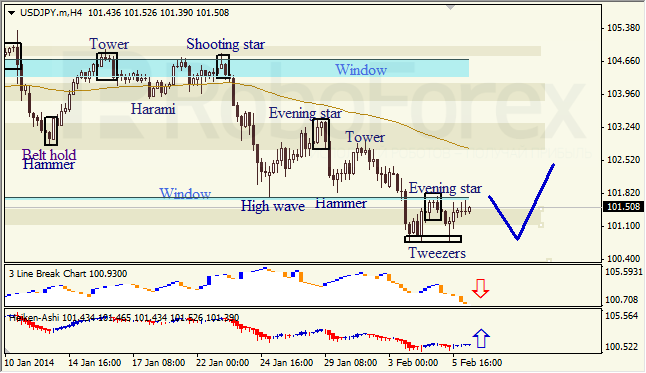
H4 chart of USD JPY shows descending trend. Closest Window is resistance level. Evening Star pattern and Three Line Break chart confirm descending movement; Tweezers pattern and Heiken Ashi candlesticks indicate that correction may continue.

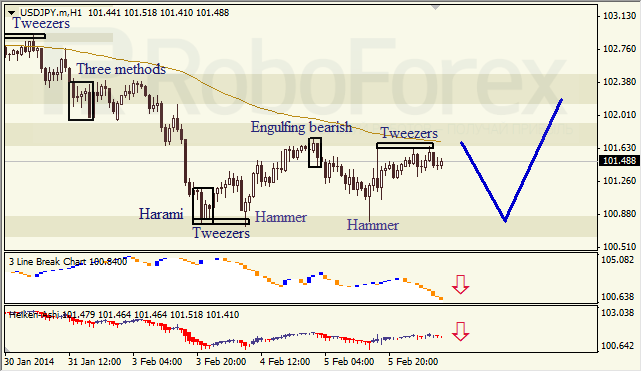
H1 chart of USD JPY shows sideways correction within descending trend. Engulfing Bearish and Tweezers patterns, along with Three Line Break chart and Heiken Ashi candlesticks confirm descending movement; Hammer and bullish Tweezers patterns indicate ascending correction.

RoboForex Analytical Department

Article By RoboForex.com

Attention!
Forecasts presented in this section only reflect the author’s private opinion and should not be considered as guidance for trading. RoboForex LP bears no responsibility for trading results based on trading recommendations described in these analytical reviews.


Forex Trading Pushing EUR/USD Lower Shows Key Importance of Economic Data

By HY Markets Forex Blog

Forex trading has resulted in the EUR/USD pair showing continued weakness recently, and the price fluctuations of this exchange rate have largely been attributed to economic data by market experts.

The currency pair dropped to its lowest value in more than two months on Friday, Jan. 31, Bloomberg reported. On this day, the EUR/USD declined to the least since Nov. 22. This movement happened as global market participants responded to key data that was provided for both the European Union and the U.S.

Key importance of EU inflation data

Figures supplied by the Luxembourg-based statistics office of the EU revealed that in January, consumer prices in the 28-nation consortium experienced a gain that fell short of the predictions of market experts, according to the news source. While economists taking part in a Bloomberg New survey gave a median forecast that this key measure of inflation would rise by 0.9 percent during the month, it increased by 0.7 percent.

The EUR/USD dropped to 1.34765 on Monday, Feb. 3, Reuters reported. This represented the lowest exchange rate for the two since late in November. The currency pair encountered downward pressure, as global market participants were affected by speculation that in order to compensate with the lackluster inflation that has been happening in the region, the European Central Bank could potentially leverage robust stimulus.

Deflation threat could force ECB bond purchases

One market expert noted that if the price level in the area starts declining, such a development could be rather troubling, according to the news source. Further bond purchases conducted by the ECB could potentially be necessitated as a result of such a situation.

“What really matters is deflation,” Hans Redeker, who works for Morgan Stanley as head of global currency strategy, told the media outlet. “The euro is going to find it very difficult to hold its value … I think that with a … fall in inflation and the development of deflation expectations the only credible instrument is outright QE (quantitative easing). It’s not the best tool, but there’s no other tool available.”

These concerns about a lack of adequate inflation in the EU helped push the EUR/USD to 1.3494 on Tuesday, Feb. 4, according to Investing.com. It was noted at the time that the concerns about the price level in the region have been persistent, as January was the fourth month in a row where inflation failed to reach 1 percent.

Economic data in the U.S.

While the figures being provided for Europe helped fuel speculation that the region’s central bank will engage in further stimulus in an effort to jumpstart business conditions there, the economic data that will soon be supplied for the U.S. created different expectations for how the Federal Reserve might act, Reuters reported.

The Fed might be able to announce further reductions in its existing quantitative easing in the event that data provided for both the U.S. jobs market and factories is strong, according to the news source.

Many market participants have been waiting for the outcome of the monthly report that was scheduled to be released by the U.S. Labor Department on Friday, Feb. 7. Such information could have a key impact on the actions of the country’s central bank, as the figures provided for December were lackluster.

Ben Bernanke, former chairman of the Fed, testified before Washington lawmakers that economic indicators such as the jobless rate would need to be at a certain level before the central bank opted to lower its stimulus.

Strong figures could accelerate tapering

The prospects for the greenback were bolstered after Commerce Department data released on Jan. 31 indicated that during the month, a key measure of consumer spending for the nation experienced an increase that surpassed the expectations of market experts, according to Bloomberg.

While median forecast of economists taking part in a poll conducted by the media outlet called for a 0.2 percent gain in household purchases, the measure rose by 0.4 percent during the month. In addition, this gauge of transactions gained 0.6 percent in December.

“The risks to the dollar are skewed to the upside,” Eimear Daly, who works in London for Monex Europe Ltd. as head of market analysis, told the news source before the figures were released. “It seems the Fed wants to get rid of its quantitative easing at this stage and there is little that will put them off their course of $10 billion of tapering each month.”

After several months of indicating that it might reduce its bond purchases in the near future, the Fed finally announced in December 2013 that starting in January 2014, it would begin buying $75 billion worth of the debt-based securities every month, compared to the prior pace of $85 billion.

Any further lowering of the stimulus used by the Fed could prompt those who take part in forex trading to put more downward pressure on the EUR/USD.

The post Forex Trading Pushing EUR/USD Lower Shows Key Importance of Economic Data appeared first on | HY Markets Official blog.

Article provided by HY Markets Forex Blog