Murray Math Lines 10.02.2014 (AUD/USD, CAD/CHF, SILVER)

Article By RoboForex.com

Analysis for February 10th, 2014

AUD USD, “Australian Dollar vs US Dollar”

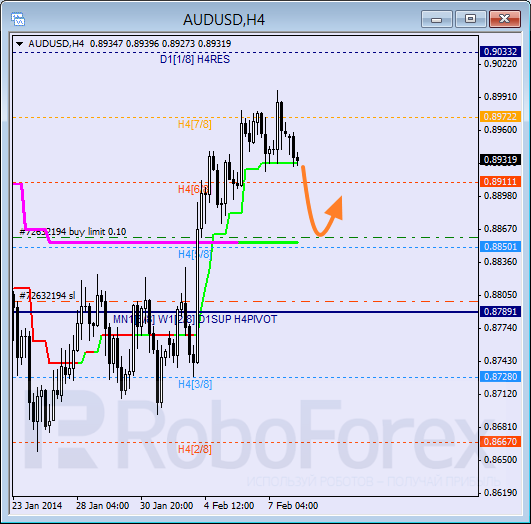
Australian Dollar rebounded from the 7/8 level twice, which means that price may start new correction. If pair breaks H4 Super Trend, market may continue falling down towards daily Super Trend, where I placed limit buy order.

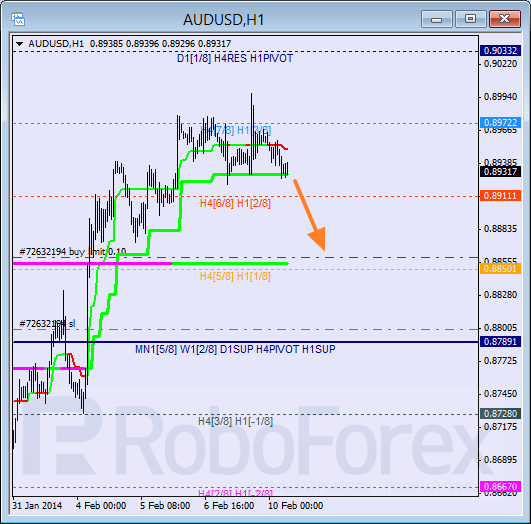
At H1 chart, market is trying to rebound from the 3/8 level. Possibly, Super Trends may form “bearish cross” in the nearest future. Correction may face resistance from the 1/8 level: if price rebounds from it, pair will start growing up again.

CAD CHF, “Canadian Dollar vs Swiss Franc”

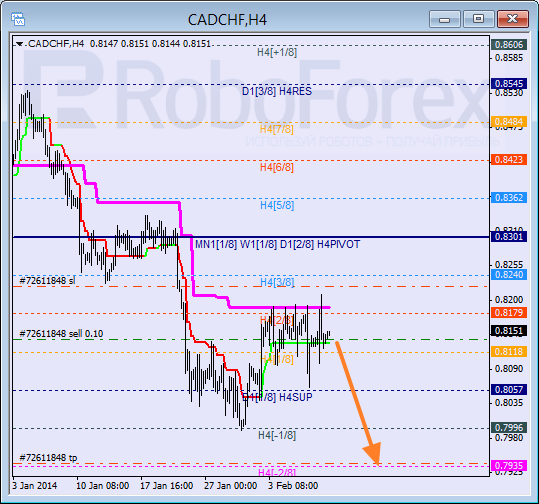
Last Friday, pair rebounded from daily Super Trend once more, that’s why I’m keeping my sell order. Closest target is at the -2/8 level: if pair breaks it, lines at the chart will be redrawn.

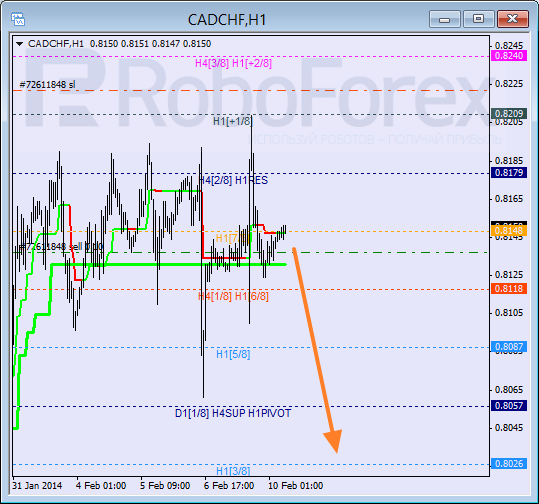
At H1 chart we ca see, that bulls still hasn’t been able to break the 8/8 level. Probably, Super Trends may form “bearish cross” on Monday. I’ll move stop into the black right after market starts falling down.

XAG USD, “Silver vs US Dollar”

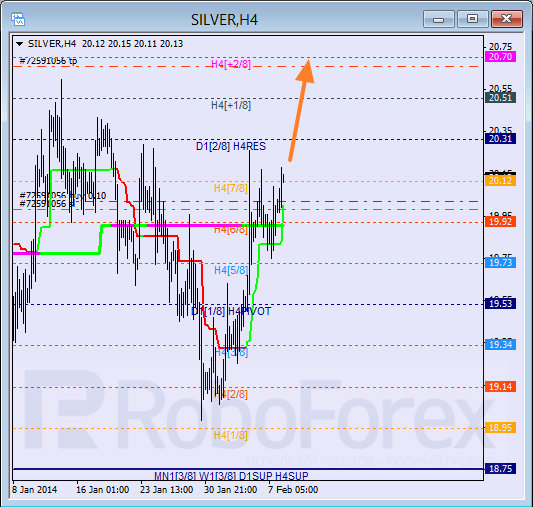
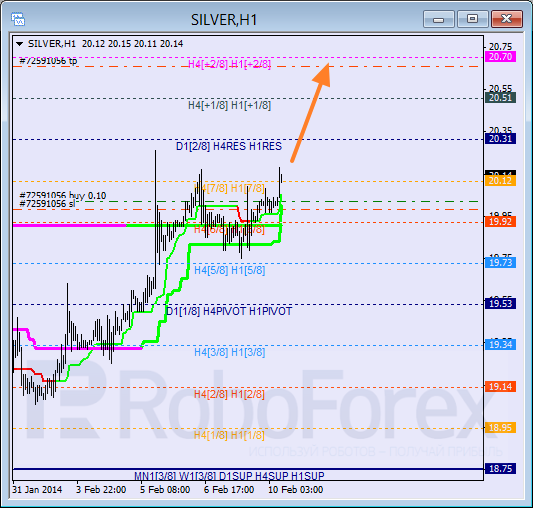
Silver rebounded from Super Trends, which formed “bullish cross”. Probably, in the nearest future price may break the 8/8 level and enter “overbought zone”.

The lines at the H4 and H1 charts are completely the same. I’ve moved stop on my buy order to local minimum and plan to move it into the black after price breaks latest maximum. If instrument breaks the +2/8 level, lines at the chart will be redrawn.

RoboForex Analytical Department

Article By RoboForex.com

Attention!
Forecasts presented in this section only reflect the author’s private opinion and should not be considered as guidance for trading. RoboForex LP bears no responsibility for trading results based on trading recommendations described in these analytical reviews.


Crude Oil Trading Pushes Futures to 1-Month High

By HY Markets Forex Blog

Crude oil trading resulted in futures for the commodity rising to their highest value in one month on Feb. 6.

Brent crude contracts on the ICE Futures exchange rose 0.9 percent to reach $107.19 a barrel, according to The Wall Street Journal. Futures for light, sweet crude gained 0.5 percent to rise to $97.84 per barrel on the New York Mercantile Exchange.

Strong economic data pushes oil higher

The gains in both of these contracts were attributed to data pointing to improvement in the U.S. economy, the media outlet reported. Government data indicated that during the fourth quarter of last year, non-farm labor productivity enjoyed a 3.2 percent increase.

In addition, those who engage in crude oil trading were supplied with data indicating that during the week that ended on Feb. 1, the number of initial applications for jobless benefits fell short of the predictions of economists participating in a Bloomberg poll. The market experts who took part in this survey provided a median forecast of 335,000 of these claims being made, and 331,000 of these applications were submitted.

Labor market shows signs of improvement
Scott Brown, who works for Raymond James & Associates Inc. as chief economist, told the news source that this decline in claims was caused by employers adding more workers. If this trend continues, it could provide support to consumer spending, which is a crucial component of gross domestic product.

“When you look at the labor market, job destruction has been very, very low,” Brown told the news source. He had predicted that during the latest week, 330,00 of these applications would be made. “It’s really been an issue of new hiring. That hiring, we think, is gradually picking up.”

The job market showed some signs of improvement when the U.S. Department of Labor released its monthly report on Feb. 7. The data released by the government agency revealed that in January, there was an increase in net positions of 113,000. This figure fell short of the 189,000 gain predicted by economists taking part in a poll conducted by The Wall Street Journal.

Fed stimulus key

It is important to note that these figures could easily have an impact on the Federal Open Market Committee and the schedule that it uses for tapering. The policymakers of the Fed have cut the pace of monthly bond purchases to $65 billion this month.

This stimulus could be reduced further still in the event that the current economic data supports such a move. Any changes that are made to the existing policies of the Fed could easily have an impact on crude oil trading.

The key impact that this central bank stimulus could have on such activity was noted by Carl Larry, analyst for Oil Outlooks & Opinions, the media outlet reported. He noted that both the policies of the Fed, and also the state of economic conditions in the U.S., “all play into the demand picture for oil.”

The next policy meeting of the central bank is not going to happen until about halfway through March. It will be impossible to tell how such decision making is impacted by the economic data that is released.

Larry told the news source that “It’s going to be an unsure six weeks.”

Another factor that could potentially make the state of the economy even less clear is the impact of the cold weather, according to Bloomberg. Warnings about winter storms were issued after the Eastern region of the U.S. was affected by a wave of polar air.

The persistent cold weather is another factor that could potentially have an influence on crude oil trading.

The post Crude Oil Trading Pushes Futures to 1-Month High appeared first on | HY Markets Official blog.

Article provided by HY Markets Forex Blog

Ichimoku Cloud Analysis 10.02.2014 (GBP/USD, GOLD)

Article By RoboForex.com

Analysis for February 10th, 2014

GBP USD, “Great Britain Pound vs US Dollar”

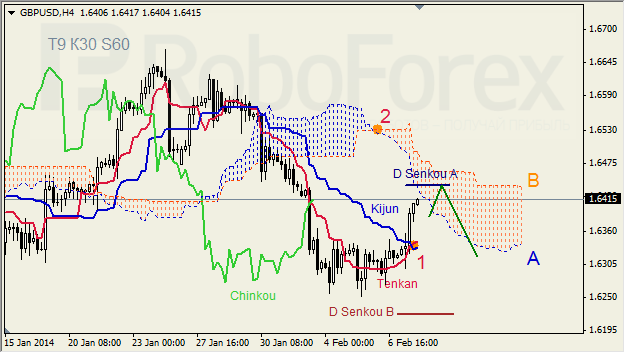
GBP USD, Time Frame H4. Tenkan-Sen and Kijun-Sen are forming “Golden Cross” (1) below Kumo Cloud; Tenkan-Sen and Senkou Span A are directed upwards. Ichimoku Cloud is going down (2), Chinkou Lagging Span is on the chart. Short‑term forecast: we can expect growth of the price up to D Senkou Span A.

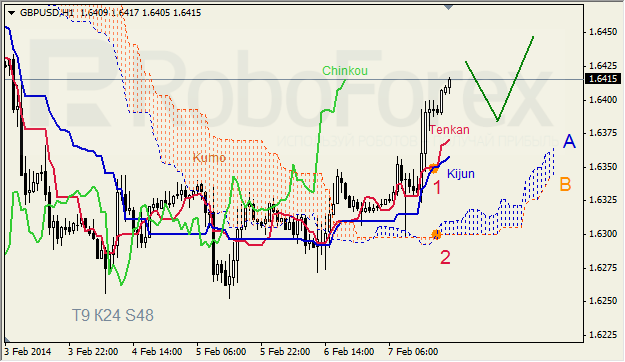
GBP USD, Time Frame H1. Tenkan-Sen and Kijun-Sen intersected below Kumo Cloud and formed “Golden Cross” (1). Ichimoku Cloud is going up (2), Chinkou Lagging Span is far above the chart. Short‑term forecast: we can expect support from Tenkan-Sen, and growth of the price.

XAU USD, “Gold vs US Dollar”

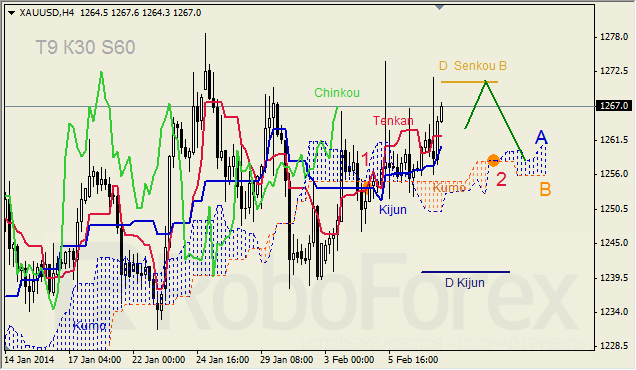
XAU USD, Time Frame H4. Tenkan-Sen and Kijun-Sen are influenced by “Golden Cross” (1). Ichimoku Cloud is going up (2); Chinkou Lagging Span is above the chart. Short-term forecast: we can expect support from Tenkan-Sen, and growth of the price up to D Senkou Span B.

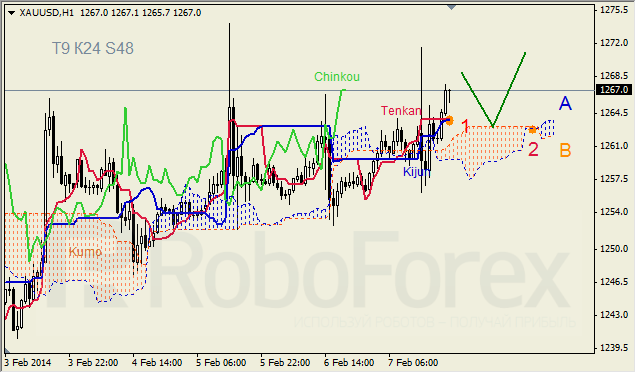
XAU USD, Time Frame H1. Tenkan-Sen and Kijun-Sen are close to each other above Kumo Cloud (1). Ichimoku Cloud is going up (2), Chinkou Lagging Span is above the chart, and the price is above the lines. Short‑term forecast: we can expect support from Tenkan-Sen – Kijun-Sen – Senkou Spans A and B.

RoboForex Analytical Department

Article By RoboForex.com

Attention!
Forecasts presented in this section only reflect the author’s private opinion and should not be considered as guidance for trading. RoboForex LP bears no responsibility for trading results based on trading recommendations described in these analytical reviews.


EURUSD’s rise extended to 1.3642

EURUSD’s rise from 1.3477 extended to as high as 1.3642. The uptrend could be expected to continue, and the target would be at the upper line of the price channel on 4-hour chart. However, the rise would possibly be consolidation of the downtrend from 1.3892 (Dec 27, 2013 high), as long as the channel resistance holds, one more fall to 1.3400 area is still possible. Support is at 1.3550, a breakdown below this level could signal resumption of the downtrend.

eurusd

Provided by ForexCycle.com

Could These Be The Best Two Markets For 2014?

By MoneyMorning.com.au

Whether it’s a government program or a private development, there is no doubt that the march of science is unstoppable.

Bloomberg News reports:

The Pentagon is exploring the development of implantable probes that may one day help reverse some memory loss caused by brain injury.

The goal of the project, still in early stages, is to treat some of the more than 280,000 troops who have suffered brain injuries since 2000, including in combat in Iraq and Afghanistan.

Of course, the easiest way to eliminate combat injuries is for governments to stop sending young men and women off to fight pointless wars. But where’s the glory in that?

But this continual march of science goes some way to vindicate our decision to launch a technology-focused investment advisory last year. Not only that, but we put our money where our mouth is by hiring a dedicated technology analyst and futurist to scope out the best and most investable technologies on the planet.

But not every aspect of technology is about investing – not directly anyway. That’s why technology analyst Sam Volkering is launching a new free daily eletter to introduce you to the broad technology trends shaping the future…

One of those trends is the future of money. It’s the theme of our 2014 investment conference, World War D.

It was also the subject of the August 2013 issue of Revolutionary Tech Investor. In that issue we presented a vision of the future that had no need for paper money or coins – everything will be electronic. We followed up on that theme in the January issue of Revolutionary Tech Investor with a second stock pick.

The issue of digital money was also the subject of the October 2013 issue of Revolutionary Tech Investor, in which Sam introduced readers to the surprisingly exciting world of cyber security and cyber terrorism. If the world’s economies do head towards a purely digital currency, then security of that data will be paramount.

Of the four stocks, the first is currently down 7.4%, the second is breakeven, while the other two are up 13.9% and 75.1% respectively. Not a bad start for a long-term story.

A New ‘Breeding Ground’ For Ideas

But the truth is, right now only a fraction of the new technologies that Sam investigates are investable right now. A lot of these technologies are still at the development stage. The research is still in universities and private labs.

Sam’s new free eletter – Tech Insider – will give Sam the flexibility of talking about new trends without the need to find an investable opportunity straight away. In a way that will mean Tech Insider will serve a similar function to Money Morning.

That’s the important thing to remember about investing, it’s all about ideas. We’ve lost count of the number of times we’ve come up with an idea in these letters and then developed it further into an investing idea for Australian Small-Cap Investigator.

Sam will use Tech Insider in the same way, as the ‘breeding ground’ for new ideas. So, how can you get your name on the list for Sam’s new free eletter? That’s easy. This week we’ll send you an email with simple instructions on how to register.

Look out for it.

Until then, stocks are back on the up. See, we told you not to sell…

US Unemployment Down Again

As the Financial Times notes:

In New York, the S&P 500 equity index jumped 1.3 per cent to 1,797, giving it a gain of 0.8 per cent for the week…

Friday’s stock market gains came even as a disappointing US employment report added to concerns that momentum in the world’s biggest economy was slowing – which could affect the Federal Reserve’s plans to scale down its stimulus measures.

Ah, do we have a return of the ‘bad news is good news’ mentality?

Maybe not. One view is that heavy snow storms in the US impacted the non-farm payroll number, which recorded a lower number than analysts predicted.

On the plus side, the US unemployment rate now sits (officially) at 6.6%. That’s only marginally worse than Australia’s 5.8% unemployment rate. Unofficially, some analysts claim the real rate is much higher, somewhere in the double digits.

That may be true. In fact it probably is. Governments always do what they can to fudge official statistics.

The question is whether enough investors believe the statistics to a large enough degree to give them more confidence to make investments.

That’s something bulls in a bear market and bears in a bull market tend to forget. While they try to pick the top or bottom of the market, they forget that their individual opinion doesn’t matter.

Bull Markets Take Time to Form

What really matters is the opinion of the market – the consensus view.

So far this year the view has switched quickly from bullish to bearish and back again. Investors are looking for any reason to either give them the confidence to buy stocks or to make them cautious to stay away from stocks.

The way we see it is that investors are still looking for reasons to buy. Remember, market crashes are relatively rare events. That’s why investors usually refer to a crash as a single year event – the 1987 crash, the 2001 crash, or the 2008 crash.

Crashes happen quickly and violently.

By contrast, recoveries and bull markets tend to take a long time to mature. They can last for many years – three, four or five years…sometimes even longer.

During that time investors become more confident that stocks will continue to rise. Eventually they become so convinced that stocks will rise that they become afraid of missing out. That’s when you tend to see stock prices really take off.

You could argue that happened in 2013 in the US market and in Japan’s market. But whichever way you look at it, no one can make the same claim about the two most important markets for Aussie investors – the Aussie and Chinese markets.

Over the past year the Aussie market is up a paltry 3.9% and China’s market is down 20.2%.

So for all the talk about overvalued and bubble markets, we simply say, what bubble? The last we checked a bubble was a market where stock prices had skyrocketed to an unrealistically high level.

A 3.9% one-year gain? That doesn’t sound unrealistically high to us.

We’ll challenge anyone who claims the Aussie market is in bubble territory, because the reality is the exact opposite. In fact, as we see it, the best time for Aussie stocks is yet to come.

Cheers,
Kris

Special Report: Never Worry about a Financial Crisis Again

Join Money Morning on Google+


By MoneyMorning.com.au
2014: The Year of the Drone

By MoneyMorning.com.au

There are plenty of uses for persistent, low-cost, self-guided drones in the sky. The potential uses for these friendly flying machines for individuals, businesses and governments are vast, and we’ll see them applied in ways we won’t necessarily see coming. We’re already using them, such as to remotely check pipelines and nuclear power plants, as Japan did after the earthquake and tsunami.

Another recent example is the use of drones for protecting populations of endangered animals. In Africa, drones are watching for poachers looking to illegally take endangered elephants, rhinos and other big game. In agriculture, unmanned aerial vehicles (UAVs) will be used to monitor fields and herds. And really dangerous jobs like crop dusting will eventually be taken over by drones, something that’s already happened in places like Japan.

Meteorologists will keep a better eye on dangerous weather systems, something people who live in the path of hurricanes and tornadoes will appreciate. We’ll also be able to detect the outbreak of forest fires earlier, improving our odds of stopping them before they grow too large.

The private nondefense market has received some regulatory clearance for testing drones in US airspace. The FAA has released the following six sites where commercial drones will be tested next year and into 2015.

Once potential UAV operators know how they will be allowed to use the flying robots, I expect there will be a rush to fly them. Within a few years, there will be thousands in the air. The FAA expects 7,500 by 2018, but really, it’s anybody’s guess at this point. The number could be far larger.

We’re already seeing some early signs of this technology metaphorically taking off. Amazon recently unveiled its own idea about how to use drones. The company is exploring the use of drones to deliver small packages to addresses a short distance from its warehouses. It even has flying prototypes – and Amazon CEO Jeff Bezos thinks this could be a reality in five years. Order an item and it’s flown to your door in less than an hour by a small helicopter. Amazon is probably thinking near-instant gratification will be good for sales.

Amazon’s announcement caused quite a stir in the news. I think the timing was a crafty way for Bezos to raise his company’s profile just in time to coincide with the holiday shopping season, but Amazon already deploys an advanced, automated environment in its distribution centres. They’re very comfortable using the latest in technology and pushing the envelope.

Flying robots taking care of the last link in the chain – customer delivery – is a logical next step for Amazon, but they aren’t the only company thinking along these lines. UPS and FedEx are also working on UAV delivery ideas. A delivery truck could pull into your neighbourhood and open up and a swarm of flying delivery robots fly out to every address with a package. One stop, multiple packages.

This market is going to be big. One group of analysts believes that spending on UAVs will fly to $400 billion in the next few years. Other analysts have different estimates, but the consensus is clear: This is going to be a big deal. UAVs are a tech trend investors shouldn’t ignore.

Ray Blanco,
Contributing Editor, Money Morning

Ed note: The above story was originally published in Tomorrow in Review.

Join Money Morning on Google+


By MoneyMorning.com.au
EUR/USD Forecast February 10-14

Article by Investazor.com

Euro gained back more than 1% last week. In the first part of the week Euro recovered some of the lost ground from two weeks ago, even though the economic data released for the Euro Area wasn’t that good. The services PMIs were mostly under expectations, the Spanish unemployment was higher and German factory orders dropped with 0.5%.

The trigger of the rally was actually the fact that the ECB maintained the interest rate. The upside move continued during the press conference when Mario Draghi, the ECB’s president, was pretty optimist in what concerns the economy’s recovery.

The US Non-Farm Payrolls was for a second month under expectations. But the unemployment rate dropped to 6.6%, which could be an important argument for the Fed to continue the QE tapering during next months.  Continue reading this article to see what the most important events are and what our forecast for this currency pair is, on short and medium term.

Economic Calendar

French Industrial Production – Monday  (07:45 GMT).  From September 2013 to the end of the year the French industrial production has disappointed investors because of the low readings. None of the last four months, of last year, exceeded analysts’ expectations. In January it was forecasted a 0.6% growth, but it actually gained 1.3%. This month it is expected to drop with 0.1%.

Italian Industrial Production – Monday (09:00 GMT).  This indicator didn’t surprise the market in the first month of 2014. It gained only 0.3% even though the expectations were of 0.6%.  Tomorrow it is expected to remain unchanged. Even though it isn’t a big impact indicator it could trigger some volatility if the surprise will be big.

Sentix Investos Confidence – Monday (09:30 GMT). This is an indicator which shows the level of diffusion index based on surveyed investors and analysts. In January it exceeded expectations by 2.2 points. Next week it is expected to be 10.3.

European Industrial Production – Wednesday (10:00 GMT). In December the European Industrial Production dropped by 1.1%. On month later, in January 2014, it gained 1.8%, with 0.2% better than analysts expected. On Wednesday the change in the total inflation-adjusted value of output produced by manufacturers, mines and utilities is expected to be -0.2%.

Mario Draghi Speaks – Wednesday (15:30 GMT). The ECB president is due to speak at the European Monetary Institute’s “Progress through Crisis” Conference organized by the European Central Bank and National Bank of Belgium, in Brussels.

ECB Monthly Bulletin – Thursday (09:00 GMT). It is released monthly, 7 days after the Minimum Bid Rate release and it reveals the statistical data that the ECB Governing Board evaluated when making the latest interest rate decision.

German Prelim GDP q/q – Friday (07:00 GMT). In August last year the German GDP has risen with 0.7% and in November with 0.3%. This month it is expected another 0.3% growth. A positive surprise could trigger another rally for the euro.

European Flash GDP q/q – Friday (10:00 GMT). Last year 3 out of 4 release were below estimates. In November the European GDP rose with 0.1% and for this week it is forecast to gain 0.2%. In the last ECB press conference Mario Draghi said that the GDP gave some good signals. We will not be that surprised to see a better than expected release.

For the upcoming week the most important economic indicators for the Euro Zone are the GDP and the Industrial production. Good publishing could keep the single currency on the uptrend. As we learned until now, a good forecast cannot be done only by looking at the Euro Area economic data. Important inputs come also from the United States so let’s take a look at the economic calendar for it.

Tuesday: FOMC Member Plosser Speaks; Fed Chair Yellen Testifies; JOLTS Job Opening – Exp.  4.04;

Wednesday: 10-y Bond Auction; Federal Budget Balance – Exp. 28.2B;

Thursday: Core/Retail Sales; Unemployment Claims – Exp. 331k; Fed Chair Yellen Testifies; Business Inventories m/m – Exp. 0.4%;

Friday: Import Prices – Exp. -0.1%; Capacity Utilization Rate – Exp. 79.4%; Industrial Production – Exp. 0.2%; Prelim UoM Consumer Sentiment – Exp. 80.6.

Technical View

EURUSD, Daily

Support: 1.3500, 1.3400;

Resistance: 1.3700; 1.3800;

eurusd-daily-forecast-february-10-14-resize-09.02.2014

The price of the EUR/USD was rejected from 1.3475. Now the price got back at the down trend line where it could find some resistance, especially from 1.3650. A break above the trend line, drawn with orange, could mean that investors are trying to push Euro higher, targeting the resistance from 1.3700 or 1.3800.

EURUSD, H1

Support: 1.3581, 1.3506, 1.3477;

Resistance: 1.3639, 1.3700, 1.2730;

eurusd-h1-forecast-february-10-14-resize-09.02.2014

On a lower time frame we can see pretty clear how the Euro rallied last week. After a new weekly high touched on Thursday during the ECB press conference, another rally took place on Friday after the NFP release. The price hit a good local resistance at 1.3639, which was a level mentioned in our past analysis. We can assume that the uptrend could continue if the earlier mentioned resistance will be broken. Next target are 1.3700 and 1.3730.

Bullish or Bearish

Taking into consideration the new price action I would say that my view on the medium changed from bullish USD to a range move. On a lower time frame I believe that 1.3600 could be retested before another important rally. On short term I also change my view to longs, since the interest rate remained unchanged and the confidence has risen towards the Euro Area.

The post EUR/USD Forecast February 10-14 appeared first on investazor.com.

Monetary Policy Week in Review – Feb 3-7, 2014: Australia central bank changes tack, Romania cuts, Ghana raises

By CentralBankNews.info
    Last week in global monetary policy Romania cut its rate for the second time this year, but then called a halt to further cuts, while Ghana raised its rate to boost the yield on its assets and counter the fall in its currency and thus dampen inflation.
    But the main change to the outlook for global monetary policy came from the Reserve Bank of Australia (RBA), which shifted into a neutral policy stance and eased up on three months of concerted efforts to verbally push down the exchange rate of the Australia dollar.
    The U.S. Federal Reserve’s modest start to to its long-awaited tapering of asset purchases in January is having a dramatic effect on financial conditions worldwide as capital – much of it highly leveraged – drains away from emerging markets and heads back toward advanced economies.
    In the case of Australia, a rate cut in May 2013 triggered a decline in the Australian dollar – known as the Aussie – that was further fueled by weaker external demand for its raw materials and the Fed’s signal on May 22 that it was getting ready to change course after five years of pumping money into the global economy.
    The Aussie dropped 15 percent from a 2013-high of 94.8 cents per U.S. dollar in early April to 1.122 end-December and the pass-through of this decline is now feeding into Australia’s inflation rate, which hit a two-year high of 2.7 percent in the fourth quarter.
    In addition to saying that “the most prudent course is likely to be a period of stability in interest rates,” in last week’s policy statement, the RBA toned down its efforts to talk down the Aussie.
   Starting last November, the RBA began describing the Aussie as “uncomfortably high” and its governor, Glenn Stevens, even held out the prospect of intervention in foreign exchange markets as the central bank started a campaign of using exchange rates instead of interest rate cuts to ease financial conditions and spur economic growth.
    But the RBA has now changed tack.
    Last week it merely said that if the recent decline in the exchange rate is sustained, it would asset in rebalancing the economy, signaling that it is comfortable with the current level of the Aussie.
    The combination of a shift to a neutral policy stance and the change in tone about the exchange rate immediately pushed up the Aussie by 2 percent, with the currency ending the week at 1.12 to the U.S. dollar, or 89.6 U.S. cents, slightly higher than the level of 85 cents that Stevens had mentioned in December.
   
    Through the first six weeks of this year, five central banks have raised rates while rates have been cut six times, or 11.3 percent of this year’s 54 policy decisions.
    Four of this year’s rate rises have come from major emerging market central banks (South Africa, Turkey, India and Brazil) with Ghana the fifth to raise rates.
    Only one of this year’s rate six rate cuts have come from an emerging market central bank (Hungary), while three from frontier market central banks (two cuts by Romania and once by Jordan) while the other two have been carried out by central banks from other markets (Tajikistan and Uzbekistan).

LIST OF LAST WEEK’S CENTRAL BANK DECISIONS: 

OTHER STORIES LAST WEEK:

TABLE WITH LAST WEEK’S MONETARY POLICY DECISIONS:

COUNTRYMSCI     NEW RATE           OLD RATE        1 YEAR AGO
DOMINICAN REPUBL.6.25%6.25%5.00%
GAMBIA20.00%20.00%12.00%
MAURITIUSFM4.65%4.65%4.90%
AUSTRALIADM2.50%2.50%3.00%
ROMANIAFM3.50%3.75%5.25%
UGANDA11.50%11.50%12.00%
POLANDEM2.50%2.50%3.75%
GHANA18.00%16.00%15.00%
PHILIPPINESEM3.50%3.50%3.50%
UNITED KINGDOMDM0.50%0.50%0.50%
EUROSYSTEMDM0.25%0.25%0.75%
CZECH REPUBLICEM0.05%0.05%0.05%
BOTSWANA7.50%7.50%9.50%
 This week (Week 7) nine central banks will be deciding on monetary policy, including Armenia, Iceland, Georgia, Indonesia, Sweden, Serbia, Korea, Peru and Russia.

COUNTRYMSCI             DATE CURRENT  RATE        1 YEAR AGO
ARMENIA11-Feb7.75%8.00%
ICELAND12-Feb6.00%6.00%
GEORGIA12-Feb3.75%4.75%
INDONESIAEM13-Feb7.50%5.75%
SWEDENDM13-Feb0.75%1.00%
SERBIA FM13-Feb9.50%11.75%
KOREAEM13-Feb2.50%2.75%
PERUEM13-Feb4.00%4.25%
RUSSIAEM14-Feb5.50%8.25%


Many Are Betting on a Calm Market. We’re Not.

Here’s one good reason why: a historic market sentiment extreme

By Elliott Wave International

The DJIA, S&P and NASDAQ are struggling to bounce. Yet the bullish convictions remain high. Says a February 5 Investor’s Business Daily headline:

“Why Mutual Fund Investors Need Not Panic After January Sell-Off”

When is the best time to get out of the stock market? When everyone else is invested and extremely optimistic. When is the best time to buy, then? Exactly: when you see the opposite sentiment.

Market sentiment is one indicator you don’t hear much about on financial networks. Yet we’ve seen sentiment extremes repeat at every recent market top and bottom. What’s more, as Robert Prechter, the president of Elliott Wave International, puts it, “the greater the degree of the advance that is ending, the greater the optimism at its peak.”

This contrarian view of the market can be a financial lifesaver.

Below is an excerpt from Prechter’s recent Elliott Wave Theorist, a monthly newsletter he has published since 1978. It shows you one way how Bob finds bearish and bullish extremes in the market.

Conviction Among the Bulls
(Robert Prechter, The Elliott Wave Theorist, December 2013)

The Daily Sentiment Index (trade-futures.com) reported 93% bulls twice, on November 15 and 22. Two readings this high are a rarity.

The weekly Investors Intelligence poll on December 11 and 18 showed over 80% bulls among committed advisors (i.e. bulls/(bulls+bears), omitting those expecting a correction), the highest reading since 1987.

Such extreme readings in conjunction are even rarer.

The Rydex family-of-funds data afford good sentiment indicators. Recent figures show a record low investment in conservative money-market funds, meaning nearly everyone is invested in stocks and bonds.

At the same time, the ratio of money in bullish stock funds vs. bearish stock funds is over 5:1, and per sentimenTrader.com the ratio of money in leveraged bull vs. bear funds (see Figure 2) is 10:1!

This reading leaves past extremes in the dust. If you study Figure 2, you will notice that the biggest rush has come in the past six months, which is precisely the time that stocks’ ascent has been slowing!

In other words, optimism is soaring while upside momentum is waning.

Once this epic complacency melts, I doubt we will see such a ratio again in our lifetimes.


Bad Start for Stocks in 2014: Buying opportunity or more pain to come?

You can benefit greatly from looking at charts that take a historical look at what’s going on in the financial markets. Robert Prechter has just released an issue of his Elliott Wave Theorist publication that includes 15 charts of the S&P 500, NASDAQ, gold, and mutual funds — along with his analysis.With this information, his Elliott Wave Theorist subscribers are now prepared for 2014. And you can be, too, because you can get the full 10-page issue, FREE.

Download your free 10-page report now >>

This article was syndicated by Elliott Wave International and was originally published under the headline Many Are Betting on a Calm Market. We’re Not.. EWI is the world’s largest market forecasting firm. Its staff of full-time analysts led by Chartered Market Technician Robert Prechter provides 24-hour-a-day market analysis to institutional and private investors around the world.


GOLD: Pressure Builds On The 1,279.08 Level.

GOLD: Risk is now building up on the 1,279.08 level, its Jan 27 2014 high. This is coming on the back of its past week gains. A decisive break and hold above the mentioned resistance will pave the way for a run at the 1,300.00 level, its big psycho level. A clearance of here if seen will turn focus to the 1,350.00 level. Further out, resistance stands at the 1,400.00 level, its psycho level. Conversely, the risk to this analysis will be a continued hold below the 1,279.08 level and an eventual return to the downside towards the 1,231.48 level. Further down, support resides at the 1,218.35 level, representing its Jan 08’2014 low. This level must hold to prevent the commodity from returning to the 1,182.33 level, its Dec 31’2013 low. However, if that level is violated it will turn attention to the 1,150.00 level followed by the 1,100.00 level. All in all, GOLD remains biased to the upside short term.

Article by www.fxtechstrategy.com