The U.S. Dollar Decreasing Again

The EURUSD Trading With a Positive Sentiment

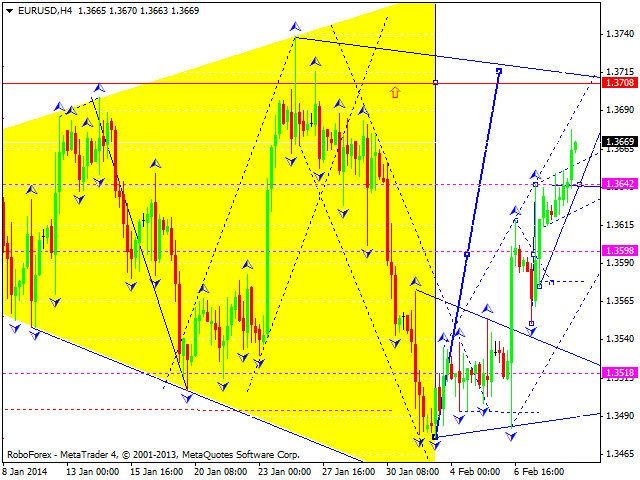
Yesterday’s trading day was boring, dull and uninteresting. The EURUSD was trading sluggishly above the support at 1.3618, while it was not risen above 1.3652. The pair increased by 1.3678 in the Asian trading session, then it rebounded to 1.3656. Apparently, this increase was associated with an increase in the Australian dollar against the U.S. currency, but not with suddenly appeared interest in buying euro from Asian players. Nevertheless, the euro bears were certainly disappointed by dynamics of the pair, which could grow up to the 37th figure, where they could once again begin to sell the pair. In the short term, the dips to 1.3618 should attract buying interest, a loss of the 36th figure will delight the bears.

eur


The GBPUSD Stick in a Tight Range

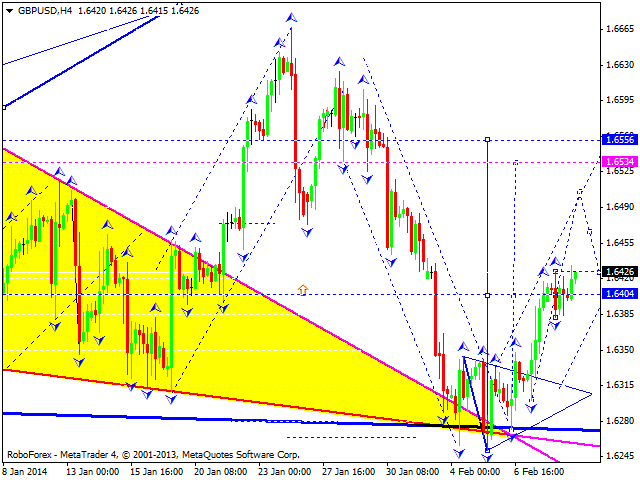
The GBPUSD was drifting in a tight range, hesitating in sense of the pair existence. The pound is still under pressure as well as in cross rate with the euro. Nevertheless, so far the British pound manages not to fall below the support around the 1.6382 level, thereby keeping the bulls` hope to continue growing of the pair. If this support is lost, it will extinguish the smoldering flame of hope and lead to a drop in the pair to the 63rd figure. In turn, rising above 1.6433-1.6454 will inflate the flame of hope and lead to testing the 65th figure.

gbp


The USDCHF Is Aimed At 0.8900

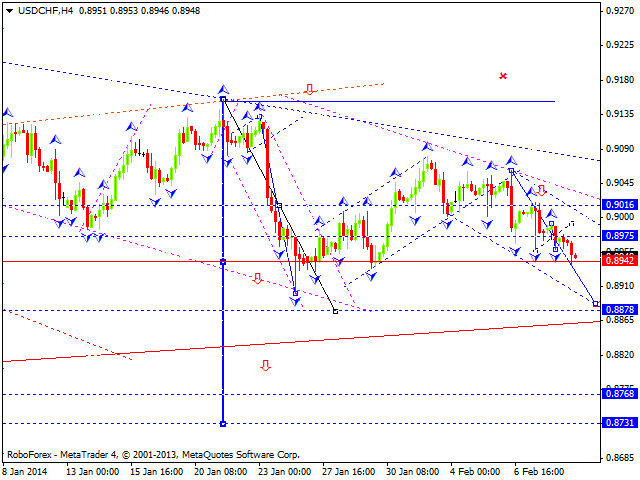
The U.S. dollar is losing its confidence in itself in pair with the Swiss franc. Yesterday, its rate dropped to 0.8959, then the dollar retreated and was sluggishly trading above this markup. In the Asian session, it dropped to 0.8938. It seems that the bears are aimed at the support at 0.8900, its breakout would open the way to the 88th figure. The bulls still need to return the pair above 0.9118 to make its prospects constructive.

chf


The USDJPY Holding Above 102.00

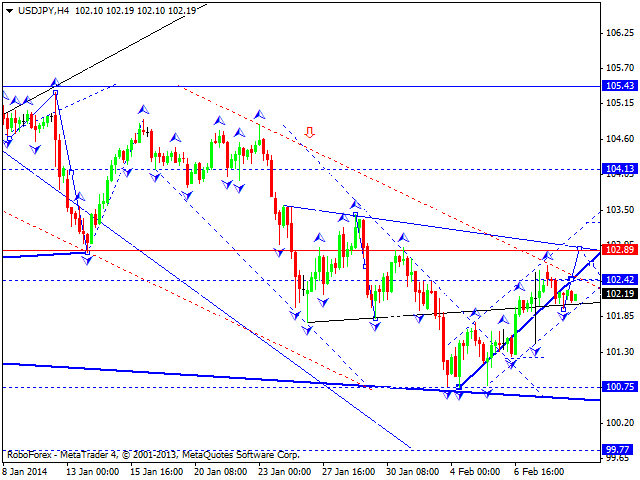
Yesterday, the USDJPY was under pressure and decreased to the support around the level of 101.99. Here the pair is being bought, though it is hardly possible to mention any fluctuations. The ability to consolidate above the 102th figure is a positive factor for the dollar and it can rise to 103.00 in the short term. A loss of 102.00-101.80 will testify to resume a downward correction.

jpy1


provided by IAFT


WTI Trades Near Six-Week High Ahead Yellen’s Testimony

By HY Markets Forex Blog

Crude Prices were seen trading higher on Tuesday, with the West Texas Intermediate (WTI) trading towards a six-week high. While market participants focus on the Fed’s chairwoman Janet Yellen’s first testimony on the monetary policy before the Congress later today.

Analysts are also expecting the US stockpiles data from the Energy Information Administration on Wednesday, with forecasts of a decline in distillate inventories, including heating oil and diesel by 2.13 million barrels in previous week.

According to the US National Weather Service, a cold winter storm is expected to spread snow across the southern region of the country.

The WTI crude oil for March delivery added 0.29% to $100.36 a barrel on the New York Mercantile Exchange at the time of writing, while the Brent crude for March settlement climbed 0.33% to $108.99 a barrel on the London-based ICE Futures Europe exchange.

The European benchmark Brent crude was at a premium of $8.62 to WTI.

WTI – Janet Yellen Speech In Spotlight

The Federal Reserve’s (Fed) new Governor Janet Yellen is expected to give her speech and deliver her first semi-annual monetary policy testimony before the House Financial Services Committee later in the day and the Senate Banking Committee on Thursday. Market analysts are expecting a dovish testimony from Janet Yellen which could benefit the oil market.

“We see no reasons why Chairman Yellen will front-run the FOMC in March, especially while waiting for the outcome of one more jobs report for additional clarity on the underlying trend in labour markets,” JP Morgan analysts wrote in a note.

WTI – US Stockpiles Data

Oil traders also keeping an eye on the American Petroleum (API) report which is due later in the day and the additional government report s on Wednesday which is forecasted to show a rise in crude inventories by 2.6 million in the week ended February 7.

However distillate stockpiles are predicted to have dropped for a fifth week by 2.3 million barrels. Gasoline supplies are expected to have declined by 250,000 barrels.

The continuous four-week gain in the North American crude was primarily driven by the extreme cold weather in the US, increasing the demand for energy.


Visit www.hymarkets.com   to find out more about our products and start trading today with only $50 using the latest trading technology today.

The post WTI Trades Near Six-Week High Ahead Yellen’s Testimony appeared first on | HY Markets Official blog.

Article provided by HY Markets Forex Blog

Australian Dollar Climbs to Four-Week High on Home Prices

By HY Markets Forex Blog

The Australian dollar climbed above the $0.90 threshold on Tuesday, it’s highest in four weeks; driven by the optimistic business confidence and house prices which advanced at the fastest pace since 2010. Meanwhile, the Federal Reserve’s (Fed) new Governor Janet Yellen is expected to give her speech and deliver her first semi-annual monetary policy testimony later in the day.

The aussie climbed to $0.9014, its highest since January 14, the Australian dollar is currently trading 0.67% higher at $0.9008.

Australian Dollar – Upbeat Business Confidence & House Prices

The National Australia Bank (NAB) Monthly Business posted an index reading of 8 last month, compared to the previous reading of 6 seen in December.

Meanwhile houses prices in Australia climbed 3.4% higher in the final quarter of 2013, rising from the previous reading of 1.9% seen in the previous quarter.

“Conditions look to have turned around a little faster than we had expected just a few months ago,” NAB said on Tuesday, “with low interest rates and depreciating AUD gaining surprisingly good traction in some non-mining sectors of the economy.”

The NAB survey also revealed employment conditions were still weak and expects the Reserve Bank of Australia (RBA) to cut its benchmark rate further later in the year.

Janet Yellen Upcoming Speech

The Federal Reserve’s (Fed) new Governor Janet Yellen is expected to give her speech and deliver her first semi-annual monetary policy testimony later in the day. Market analysts are expecting a dovish testimony from Janet Yellen which could weaken the US dollar.

“We see no reasons why Chairman Yellen will front-run the FOMC in March, especially while waiting for the outcome of one more jobs report for additional clarity on the underlying trend in labour markets,” JP Morgan analysts wrote in a note.


Visit www.hymarkets.com   to find out more about our products and start trading today with only $50 using the latest trading technology today.

The post Australian Dollar Climbs to Four-Week High on Home Prices appeared first on | HY Markets Official blog.

Article provided by HY Markets Forex Blog

Forex Technical Analysis 11.02.2014 (EUR/USD, GBP/USD, USD/CHF, USD/JPY, AUD/USD, GOLD)

Article By RoboForex.com

Analysis for February 11th, 2014

EUR USD, “Euro vs US Dollar”

Euro is still forming ascending structure with target at level of 1.3700. We think, today price may reach this target and then start falling down towards level of 1.3640, at least. Later, in our opinion, instrument may continue moving upwards to break level of 1.3700. Next target of the growth is at 1.3900.

GBP USD, “Great Britain Pound vs US Dollar”

Pound is also still moving inside ascending structure. We think, today price may reach level of 1.6500, fall down towards 1.6420, and then and then form another ascending structure to reach level of 1.6530.

USD CHF, “US Dollar vs Swiss Franc”

Franc is moving downwards; market is forming continuation structure near level of 0.8975. We think, today pair fall down to reach level of 0.8880. Later, in our opinion, instrument may return to level of 0.8940 and then move downwards to reach level of 0.8878.

USD JPY, “US Dollar vs Japanese Yen”

Yen is still growing up and forming continuation pattern. We think, today price may form ascending structure to break descending channel and start reach level of 102.90. Later, in our opinion, instrument may fall down to break level of 102.40 and start new ascending movement towards level of 104.00.

AUD USD, “Australian Dollar vs US Dollar”

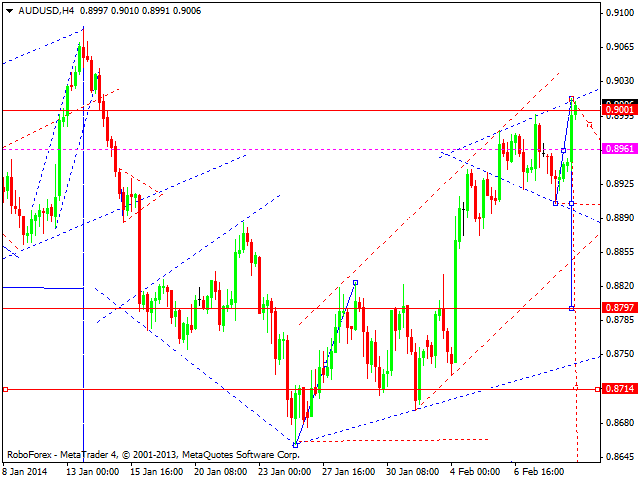
Australian Dollar is forming divergent triangle pattern at the top of another ascending wave. We think, today price may fall down towards lower border of this trading range. This pattern may be considered as reversal pattern. Later, in our opinion, instrument may continue moving inside descending trend to reach level of 0.8800.

XAU USD, “Gold vs US Dollar”

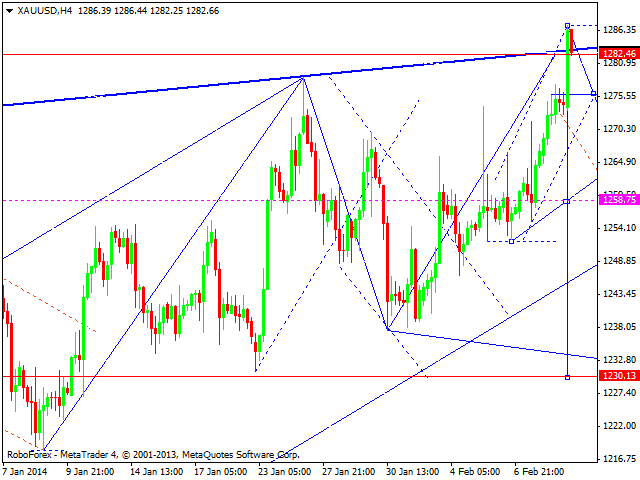
Gold reached another target of its ascending movement. We think, today price may start correction towards level of 1230. This correction is expected to be five-wave structure in the form of bullish flag pattern. First target is at level of 1265.

RoboForex Analytical Department

Article By RoboForex.com

Attention!
Forecasts presented in this section only reflect the author’s private opinion and should not be considered as guidance for trading. RoboForex LP bears no responsibility for trading results based on trading recommendations described in these analytical reviews.


Fibonacci Retracements Analysis 11.02.2014 (EUR/USD, USD/CHF)

Article By RoboForex.com

Analysis for February 11th, 2014

EUR USD, “Euro vs US Dollar”

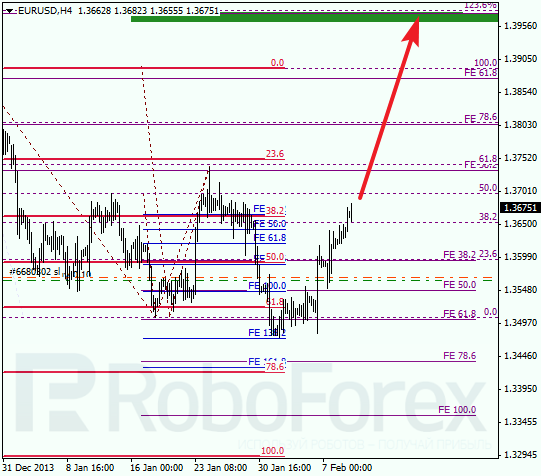
After rebounding from level of 61.8%, Euro started growing up. At H4 chart we can see, that bulls have several intermediate fibo-levels in front of them, where price may start local corrections. Main target is near several upper fibo-levels at 1.3970.

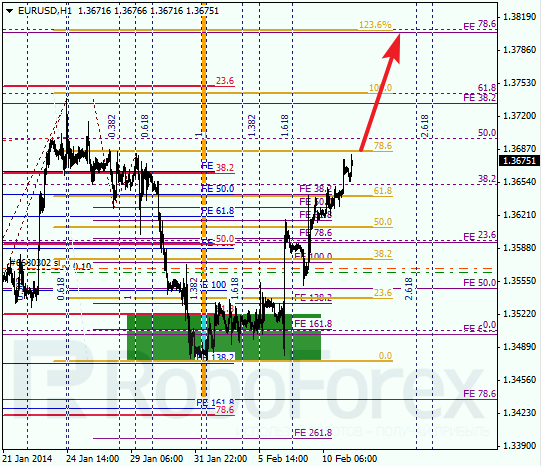
Market moved very close to level of 78.6%. Possibly, price may break this level during the day and then continue growing up. Closest target for bulls is near several fibo-levels at 1.3740.

USD CHF, “US Dollar vs Swiss Franc”

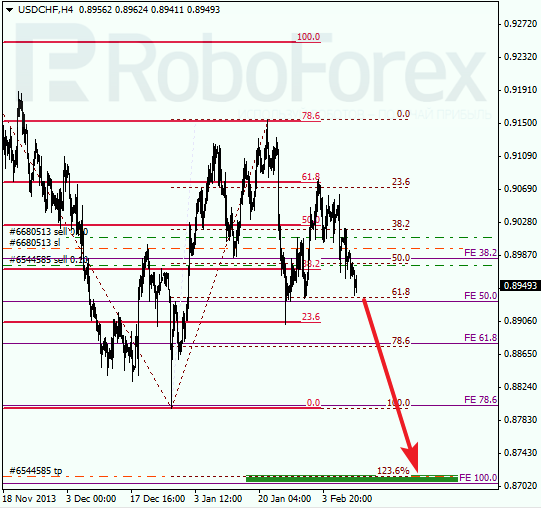
Franc continues moving downwards, so I’ve decided to move stop on my sell orders into the black. Right now, market got very close to level of 61.8%. If bears break it, pair will continue falling down towards level of 78.6%.

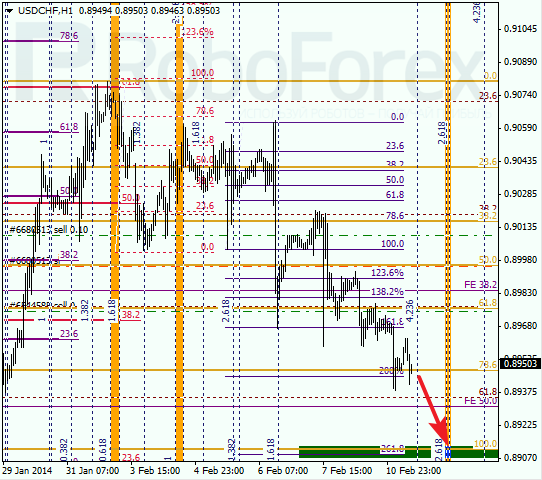
At H1 chart, closest target is at level of 0.8910, which may later become a starting point of new short-term correction. According to analysis of temporary fibo-zones, price may reach its target levels during Tuesday.

RoboForex Analytical Department

Article By RoboForex.com

Attention!
Forecasts presented in this section only reflect the author’s private opinion and should not be considered as guidance for trading. RoboForex LP bears no responsibility for trading results based on trading recommendations described in these analytical reviews.


EURUSD: Bullish, Set To Recapture Key Resistance.

EURUSD: With the pair extending its past week gains on Monday and today, further strength is likely. This development now leaves the pair aiming at the 1.3700 level where a breach will target further upside towards the 1.3739 level followed by the 1.3800 level, its psycho level. This view is consistent with its long term uptrend which is on hold due to corrective price action. Conversely to annul its past week gains it will have to return to the 1.3476 level. Further down, support comes in at the 1.3400 level, representing its psycho level where a breach will aim at its weekly 200 ema at the 1.3346 level. Additionally, support stands at the 1.3300 level where a break will target the 1.3250 level and possibly lower towards the 1.3200 level. All in all, EUR remains biased to the downside below its broken trendline.

Article by www.fxtechstrategy.com


Is Russia Back? Where Sochi and Forex Meet

Sochi OlympicsWith the world focused on the Olympic Games in Sochi Russia we can now take a step back and look at Russia’s current position in the world. Like it or not Russia has established itself again as a dominant player on the world stage. Russia has paid off its debts and despite what most people feel is more politically stable then any other time since before the fall of the Soviet Union.

The Russian middle-class is experiencing the greatest levels of prosperity in the history of the nation. Russia has also seen a dramatic rise in its more affluent call as well.

Looking at the world of Forex it is quite obvious that to see the signs where Russian individuals and Russian companies have left  their mark. Companies like InstaForex and Alpari which all started in Russia have grown exponentially and have made a dramatic on the Forex market.

The Russian company in the Forex world that can claim the greatest success is of course Metaquotes. It can be argued that no other company has ever achieved such a market dominance with their product that Metaquotes has and their role in the Forex market.

It will be fascinating to see what the future brings for both Russia and for Russia and the Forex market.

To learn more please visit www.clmforex.com

Disclaimer: Trading of foreign exchange contracts, contracts for difference, derivatives and other investment products which are leveraged, can carry a high level of risk. These products may not be suitable for all investors. It is possible to lose more than your initial investment. All funds committed should be risk capital. Past performance is not necessarily indicative of future results. A Product Disclosure Statement (PDS) is available from the company website. Please read and consider the PDS before making any decision to trade Core Liquidity Markets’ products. The risks must be understood prior to trading. Core Liquidity Markets refers to Core Liquidity Markets Pty Ltd. Core Liquidity Markets is an Australian company which is registered with ASIC, ACN 164 994 049. Core Liquidity Markets is an authorized representative of Direct FX Trading Pty Ltd (AFSL) Number 305539, which is the authorizing Licensee and Principal


The Biggest Emerging Market Of Them All: China.

By MoneyMorning.com.au

After the impending disaster that was otherwise known as an ‘emerging markets crisis’, what do you know?

The Australian market has recovered about half its losses since the start of the year.

Another crisis appears and disappears quicker than it came. In its wake it leaves…that’s right, a raft of investing opportunities.

Sounds great. Trouble is, where do you start…?

As a contrarian investor we go where other investors fear to go.

During the depths of the global financial meltdown in 2008 and 2009 we told investors to pile in to some of the market’s most hated stocks – small-cap stocks.

In late 2012 and 2013, when most investors were too afraid to look at their own shadow let alone buy shares, we advised increasing your exposure to dividend-paying stocks.

Then for most of the past year we’ve suggested that investors take more interest in resource stocks. That culminated in us hiring a dedicated resource analyst to find, research and recommend the best resource stocks on the Aussie market.

And although we can’t claim to have backed tech stocks since the market turned around in 2008, the timing of the launch early last year of Revolutionary Tech Investor coincided with the most recent gains for the NASDAQ index.

We won’t claim to have picked the bottom of these markets. That’s not our aim. We’re simply looking for developing trends and then we try to back them early before others rush in.

That leads us to the next trend investors should follow closely – emerging markets.

Phone Box Convention

To be honest, we’re not completely alone in the view that emerging markets are worth a punt. Although it’s also fair to say that if you held a convention in a phone box (remember those?) for emerging markets enthusiasts, you’d struggle to sell the place out.

But we’d have one companion. David Bloom, head of global currency strategy at HSBC in London told Bloomberg News:

When others are crying, you should be buying. This is not the time to be bearish. The time to be bearish was a year ago. If you missed that, you’ve missed the boat.

Bloom is referring specifically to emerging markets currencies. On the question of currencies we’ll leave that to Bloom. We figured long ago (just after passing our foreign exchange exam) that the currency market was way too difficult for your editor to understand.

So we stick to what we know – stocks.

And when it comes to emerging markets stocks, we take the same view as HSBC’s David Bloom. This is the time to buy the market, not sell it.

But what’s this? Things are getting cosier in the phone box. Bloomberg News reports on another emerging markets bull. This time it’s Gary Dugan, chief investment officer in Asia for the Queen’s bankers Coutts. He says:

If you look at the balance of trade that our clients are doing, they’re buying. There’s been an appetite for Asia and for Russia after the sell-off. There’s no crisis, it’s just talk.

But the guys at HSBC and Coutts really are in the minority. Most investors are doing as you’d expect; they’re trading the last ‘crisis’ rather than buying the next opportunity.

When We Say Emerging Markets, We Really Mean China

We like Dugan’s call, and his guts. But we’re not sure about buying Russia.

We may be a contrarian and a risk taker, but we’re not lunatics.

Coutts can take the Russia trade, we’ll take the rest.

It’s understandable that investors fret and fuss about the markets. It’s understandable that they panic and sell at the wrong time.

But what they’ve clearly forgotten is that this is how markets tend to behave. Prices rise and prices fall all the time. The important thing is to figure out if anything has fundamentally changed.

As far as we can tell, the simple answer to that question is no.

But let’s be more specific. When we’re talking about emerging markets, what we’re really talking about is the biggest emerging market of all, China.

Regardless of what anyone thinks about China’s growth rate, is it reasonable to think China’s economy will stop dead in its tracks? Even if China’s growth rate drops from the current stratospheric 7.7% to just 6%, these people do realise that the Chinese economy will double in size in less than 12 years don’t they?

So sure, there could be ongoing problems with some of the other emerging markets – Brazil, India, Russia, Indonesia, and so on – but as long as the biggest emerging market of them all stays on track to double in size within the next 9-12 years, we’ll stay firmly on the side of the small group of analysts rating China and the emerging markets as a buy.

It’s a risky trade right now. But if experience has taught us one thing, it’s that when the markets appear as risky as this, more often than not we’re right to follow our instincts (and the fundamentals) to buy the market.

Cheers,
Kris

From the Port Phillip Publishing Library

Special Report: Three Bounce-Back Mining Belters to Buy Now

Join Money Morning on Google+


By MoneyMorning.com.au

Machines are Coming for Our Jobs

By MoneyMorning.com.au

When he wasn’t explaining mass unemployment, negotiating the Versailles Treaty, making a fortune trading stocks from his bed or inventing modern probability theory, John Maynard Keynes had a few ideas about the future of work.

Writing in the 1930s, Keynes predicted that automation and rising productivity would lead to a world of ease and plenty. In the future people would work for fifteen hours per week, he said, which would give us more than enough income to satisfy our needs.

This idea was still in vogue when I was being taught economics in the 1970s. The early spread of computers and increasing automation made Keynes’ dream seem achievable in our lifetimes.

But today, it’s clear that Keynes got it wrong. Instead we live in a time where junior investment bankers are keen to do basic repetitive tasks for ninety hours per week. And where the government allows you to opt-out of the EU working time directive, if 48 hours a week just isn’t enough to satisfy you!

Despite our eagerness to toil all the hours God sends, the share of national income taken by labour has been falling in recent years. Average wages are stagnating. They used to grow a little faster than inflation. Now they are lagging.

So the big political issue at the moment isn’t unemployment, which most economists (wrongly) expected to be a lot higher after the crash in 2008. The big issue is this squeeze on real wages (that is, wages adjusted for inflation).

Are we Stuck With Low Wages?

I would normally blame the economic cycle for this. And if the economic cycle is to blame, the problem will resolve itself as the economy improves and the labour market strengthens.

Our labour market is a lot more flexible than it used to be, back when the unions ruled. So workers might well be pricing themselves into jobs by not demanding inflation-busting pay rises. It’s reasonable to expect their bargaining power will improve as unemployment falls.

But something tells me that this might not happen. In fact, there are a couple of reasons that I suspect this squeeze could be permanent.

First, there is globalisation. At first, the West lost basic manufacturing jobs as millions of workers in emerging markets entered the global workforce. Then we saw white collar jobs in call centres, and basic legal, financial and IT tasks being ‘offshored’. Cheap communications and IT meant that previously ‘safe’ service sector jobs could be carried out almost anywhere.

The latest big trend which is hurting workers is automation. Voice recognition technology means that you no longer have to choose between Mumbai and Middlesbrough for your call centre. Instead you can locate it in the cloud, and let the computers do the work.

Computers Are Getting Smarter

Computers are getting a lot better at reading text, too. They can use smart algorithms and huge processing power to ‘understand’ human language. So rather than put-upon junior lawyers or bankers ploughing through legal texts and contracts, the machines will be able to take over.

I wrote recently about Arria NLG, which makes software which is able to write technical reports in everyday language. Once the machine has been taught the industry specifics, it can generate useful reports far quicker than a technically qualified human could.

Machines are getting better at ‘working with’ humans. Another example is Google’s driverless cars. They’ve already clocked up half a million accident-free miles in the US. Driving in normal traffic was something that most of us would have thought needed a human. But the end of the taxi driver could be closer than we thought. There’s already a trial planned for Milton Keynes next year.

How to Invest in This Trend

So what ‘safe’ jobs should I try to direct my children into? It’s not at all obvious which jobs will be unaffected by the relentless progress of machines. A lot of technology stocks employ very few people relative to their market value. A few well-paid technicians develop valuable services and software, while the support tasks are either outsourced or just don’t exist anymore.

This seems to tie in with the view that the labour market is splitting in two – that a small number will enjoy great success by working with computers, but most will struggle.

Workers and parents might find this future unsettling. But as investors, we can choose to be on the right side of this trend. That means looking out for companies that are exploiting growth in computer power. Because as scary as this vision of the future might be…we could be stuck with it!

David Thornton,
Contributing Editor, Money Morning

Ed note: The above story was originally published in MoneyWeek.

Join Money Morning on Google+


By MoneyMorning.com.au