Stocks in Europe Little Changed; GDP Reports In Focus

By HY Markets Forex Blog

Stocks in the European market were seen little changed on Friday as market participants awaits gross domestic product (GDP) reports from Germany, France, Italy and the rest of the countries in the eurozone.

The European Euro Stoxx 50 dropped 0.01% lower at 3,098.50, while the French CAC 40 declined 0.07% to 4,310.80. The German DAX edged 0.03% higher at 9,600.30, at the same time the UK benchmark FTSE 100 lost 0.08% at 6,654.30.

Stocks – Germany’s Growth

Germany’s gross domestic product (GDP) climbed 0.4% higher in the fourth quarter, the Federal Statistics Office in Wiesbaden confirmed, after a growth off 0.3% in the previous quarter. Year over year the German economy grew by 1.3% in the final quarter after a rise of 1.1% in the previous three months.

Stocks- France

The French economy expanded by 0.8% in the fourth quarter last year, compared to analysts’ predictions of a 0.6% rise, reports from the National Institute of Statistics and Economic Studies (INSEE) revealed on Friday.

Italy

Italy stands as the third largest economy in the Eurozone, however shows a slow growth as the economy declined in the fourth quarter. Analysts’ are forecasting to see a drop of 0.8% and compared to 1.8% recorded in the previous quarter.

The eurozone is predicted to show a rise of 0.4% in the fourth quarter.

Other news

The German company, ThyssenKrupp climbed 3.2% higher, after recording a loss of 69 million euros in the first quarter of fiscal year 2014.

While the British mining company Anglo American, the biggest platinum producer in the world climbed 1.5% higher, as it posted its underlying profit for 2013 which increased by 6% to $6.62 billion and compared with $6.253 billion recorded in 2012.

Schindler dropped 2.9% lower to 129.50 Swiss francs after the company’s profits in 2013 declined to 463 million francs from 730 million francs from the previous year.


Visit www.hymarkets.com   to find out more about our products and start trading today with only $50 using the latest trading technology today.

The post Stocks in Europe Little Changed; GDP Reports In Focus appeared first on | HY Markets Official blog.

Article provided by HY Markets Forex Blog

Crude Prices Drops on Weak US Retails Sales Reports

By HY Markets Forex Blog

Crude prices were seen dropping lower as futures for the West Texas Intermediate (WTI) dropped on the last day of the trading week, dragged lower by the downbeat US retails sales in January and weekly jobless claims.

WTI for March delivery dropped 0.41% trading at $99.94 per barrel on the New York Mercantile Exchange at the time of writing. While Futures for the European benchmark Brent crude eased 0.23% to $108.54 per barrel on the ICE Futures Europe exchange at the same time.

Crude – US Oil Inventories

Crude inventories from the developing countries declined by 1.5 million barrels per day in the last quarter of 2013, according to reports from the International Energy Agency (IEA).

In a separate report released on Wednesday from the Energy Information Administration (EIA) showed that US crude stockpiles climbed higher than expected.

The reports from the EIA also revealed crude inventories climbed by 3.27 million to 361.35 million barrels in the week ended February 2, exceeding analysts’ forecast of a rise of 2.63 million barrels.

Distillate stockpiles declined by 731,000 barrels to 113.1 million in the week ending February 7, reports from the EIA confirmed.

Libya

In Libya, oil production from the country dropped by more than 100,000 barrels per day, due to the shutdown of two pipelines by protesters, Ibrahim Al Awami, an oil Ministry official confirmed. Libya’s crude output fell to 460,000 barrels per day on Thursday, dropping from 567,000 barrels per day recorded on Tuesday.

Crude – US Downbeat Reports

The US retail sales dropped lower than expected in January, declining 0.4% lower in January, compared to the revised reading of a 0.1% decrease in December and the sharpest drop since June 2012.

Meanwhile, the initial US jobless claims for the week ending February 8 climbed to 339,000, compared to the previous reading of 331,000 seen in the previous month, according to reports from the Labour Department.


Visit www.hymarkets.com   to find out more about our products and start trading today with only $50 using the latest trading technology today.

The post Crude Prices Drops on Weak US Retails Sales Reports appeared first on | HY Markets Official blog.

Article provided by HY Markets Forex Blog

Fibonacci Retracements Analysis 14.02.2014 (EUR/USD, USD/CHF)

Article By RoboForex.com

Analysis for February 14th, 2014

EUR USD, “Euro vs US Dollar”

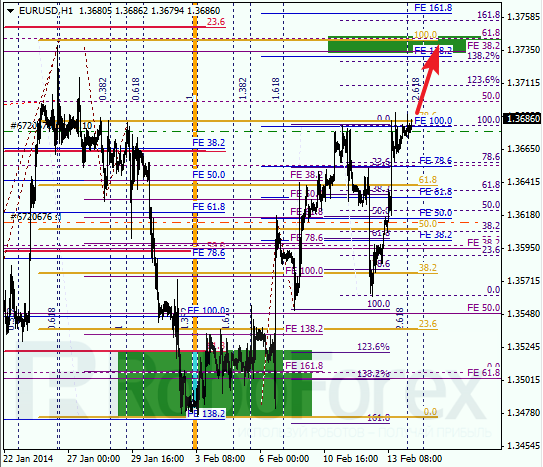
Euro is being corrected near local level of 78.6. Possibly, price may break this level during the next several hours. Main targets are still the same: upper fibo-levels near 1.3810.

As we can see at H1 chart, market is moving close to latest maximums. Closest target is near several fibo-levels at 1.3740. After reaching it, pair may start new correction.

USD CHF, “US Dollar vs Swiss Franc”

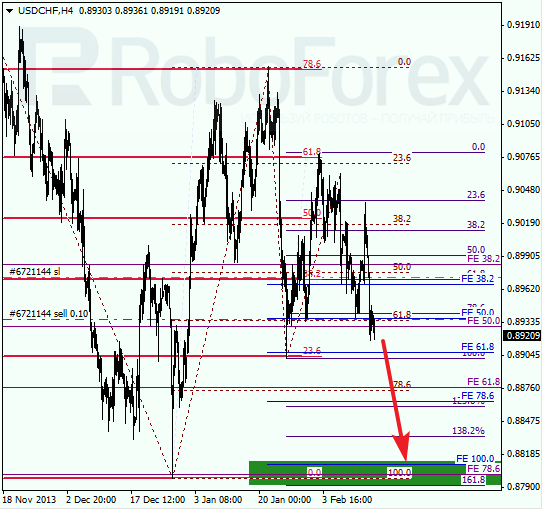
Franc is falling down. Most likely, market will break minimum in the nearest future. During the next several days, pair is expected to continue falling down towards several lower fibo-levels near 0.8800.

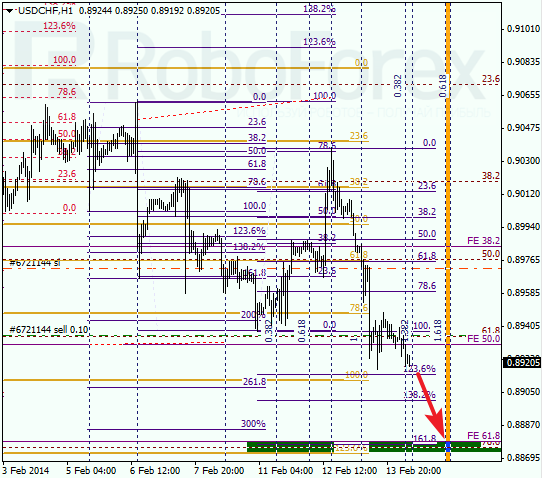
At H1 chart, we can see one of the closest intermediate targets, near level of 0.8875. According to analysis of temporary fibo-zones, price may reach this level during the day, in other words until the end of this trading week.

RoboForex Analytical Department

Article By RoboForex.com

Attention!
Forecasts presented in this section only reflect the author’s private opinion and should not be considered as guidance for trading. RoboForex LP bears no responsibility for trading results based on trading recommendations described in these analytical reviews.


Forex Technical Analysis 14.02.2014 (EUR/USD, GBP/USD, USD/CHF, USD/JPY, AUD/USD, GOLD)

Article By RoboForex.com

Analysis for February 14th, 2014

EUR USD, “Euro vs US Dollar”

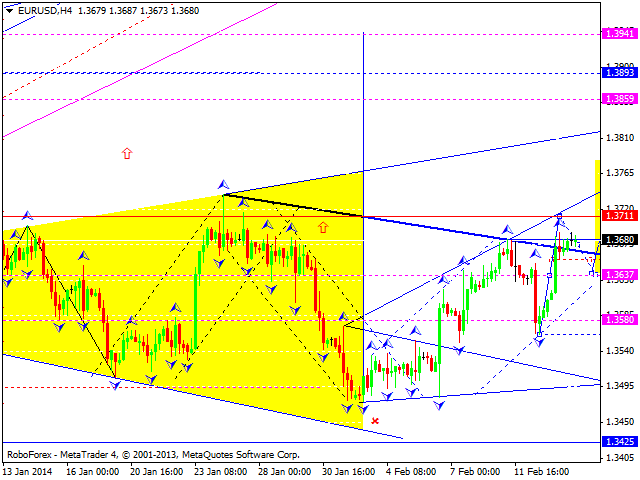
Euro formed ascending wave. We think, today price may form consolidation channel near the top of this wave and then continue growing up towards level of 1.3700. Later, in our opinion, instrument may form another consolidation channel and then continue moving upwards again to reach next target at level of 1.3900.

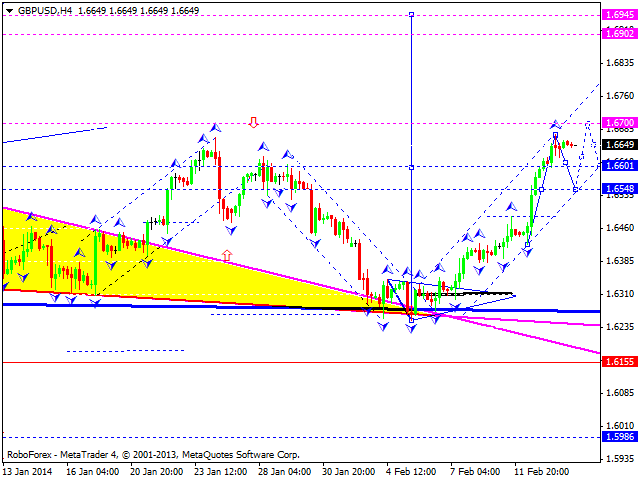
GBP USD, “Great Britain Pound vs US Dollar”

Pound is still consolidating near the top of this ascending wave; right now market is moving inside ascending structure with target at 1.6900. We think, today price may form consolidation channel and then leave it upwards. Alternative scenario implies that instrument may start slight correction and then continue growing up.

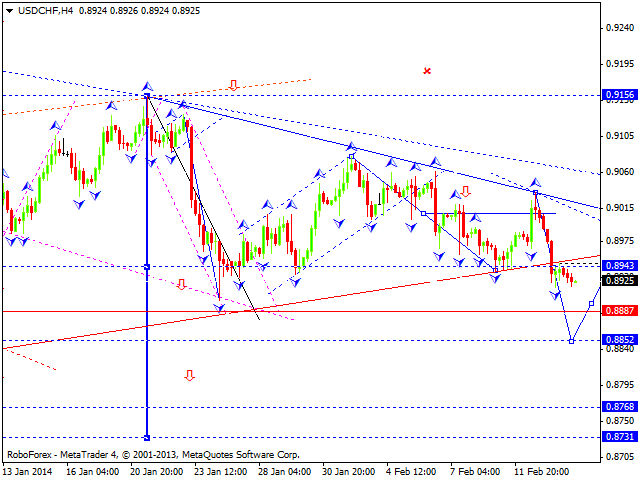
USD CHF, “US Dollar vs Swiss Franc”

Franc completed another descending wave and right now is consolidating near its top. We think, today pair may continue fall down to reach level of 0.8300. The closest intermediate target is at level of 0.8730.

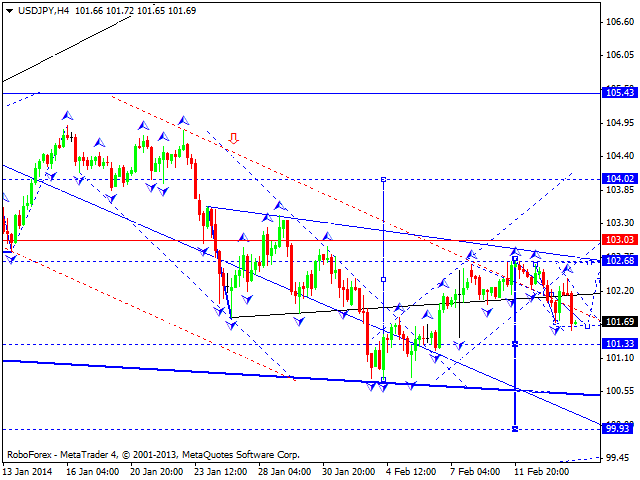
USD JPY, “US Dollar vs Japanese Yen”

Yen is still falling down; market formed five-wave structure, which may be considered as correction towards previous ascending movement. We think, today price may form new ascending structure to reach level of 104.00. Alternative scenario implies that instrument may fall down towards level of 100.00.

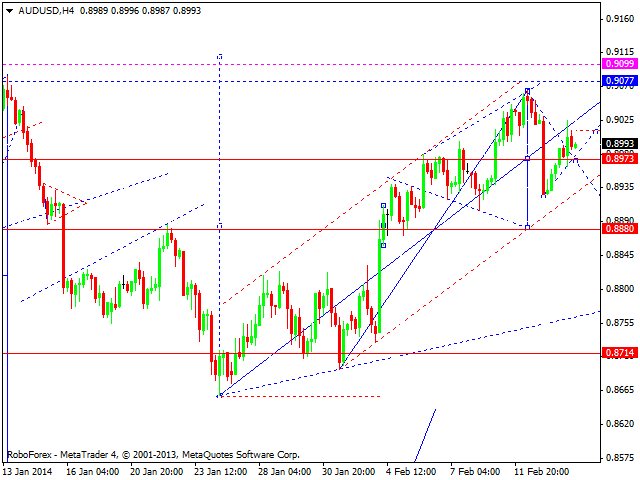
AUD USD, “Australian Dollar vs US Dollar”

Australian Dollar is forming ascending structure towards level of 0.9100. Later, in our opinion, instrument may form new descending structure towards level of 0.8880, consolidate for a while, and then continue moving inside descending trend to reach level of 0.8400.

XAU USD, “Gold vs US Dollar”

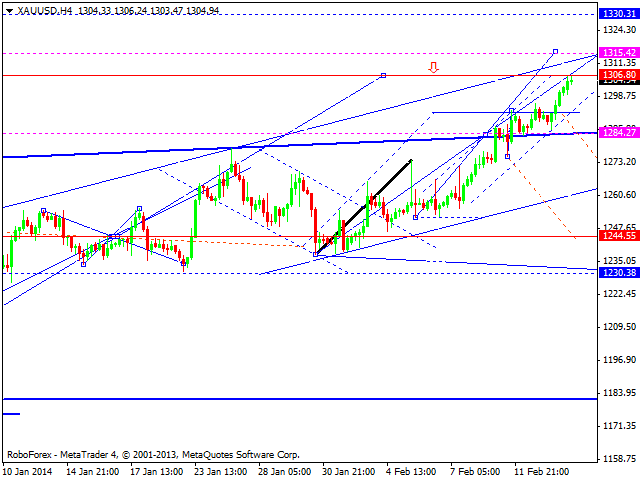
Gold is still moving upwards and forming ascending wave with target at level of 1315. We think, today price may form descending structure towards level of 1285 and then start new ascending movement to reach level of 1330.

RoboForex Analytical Department

Article By RoboForex.com

Attention!
Forecasts presented in this section only reflect the author’s private opinion and should not be considered as guidance for trading. RoboForex LP bears no responsibility for trading results based on trading recommendations described in these analytical reviews.


Nightmarish Problem Found Hiding Inside Employees’ Paychecks

By WallStreetDaily.com Nightmarish Problem Found Hiding Inside Employees' Paychecks

If you’re a newbie to the Wall Street Daily Nation, you’re in for a treat.

Each Friday, I try my darndest to zip my lips and let some carefully selected graphics do the talking for me.

This week, I’m dishing on 1) the oddest, yet most instructive chart on wage growth, 2) one trend the polar vortex can’t disrupt, and 3) another ticking time bomb in the credit markets.

Pictorial enlightenment begins in three, two, one…

Show Me the Money!

We all know corporate incomes keep climbing, but what about personal incomes? Not so much.

Monthly wage growth checked in at an all-time low of 1.28% in October 2012.

Granted, it’s been trending higher ever since. (The latest reading came in at 2.21%.)

However, if we also take into account the year-over-year growth rate (shown on the y-axis), forget a clear trend. We essentially get a scatter plot that more closely resembles a preschooler’s art project.


I hate to be the bearer of such nightmarish news. But even though the labor market is on the mend, the gains aren’t showing up where they matter most – in workers’ paychecks.

Until that happens, the U.S. economy won’t truly be on solid footing, which means the Fed might be providing “support” for much longer than anyone anticipates.

Airfares Grounded

Yet another historic winter storm is wreaking havoc across the country, making air travel impossible.

So far, more than 10,000 flights have been cancelled.

While it might be hard to look on the bright side of things if you’re one of those stranded travelers, a silver lining definitely exists…

It’s never been cheaper to fly.


On a per-mile basis, air travel is about 50% cheaper than it was three decades ago. So the next time someone starts griping about how expensive it’s gotten to travel, set him or her straight.

Big Problem in Little China

Earlier this week, I alluded to a potential credit crisis in China. And today, I’m sharing a single chart to help put the threat into perspective, courtesy of Jim Grant of Grant’s Interest Rate Observer.

From the end of 2008 through the third quarter of 2013, China’s banks took on $15.1 trillion in new debt.

As a percentage of global GDP, that’s an epic credit frenzy, the likes of which the world has never seen.


Forget the United States (and Japan). If the world is going to endure another financial collapse, it’s going to be China’s fault. And now you know why everyone is keeping such a close eye on what’s going on in the country.

That’s it for today. Before you go, though, let us know what you think of this weekly column – or any of our recent work at Wall Street Daily – by going here.

Ahead of the tape,

Louis Basenese

The post Nightmarish Problem Found Hiding Inside Employees’ Paychecks appeared first on Wall Street Daily.

Article By WallStreetDaily.com

Original Article: Nightmarish Problem Found Hiding Inside Employees’ Paychecks

Central Bank Statements Cause GBP/USD to Surge Most in 3 Months

By HY Markets Forex Blog

Forex trading resulted in the GBP/USD pair experiencing its largest increase in three months on Feb. 12, as global market participants were impacted by the recent statements made by officials representing the central banks of both the U.S. and also the U.K.

The GBP/USD rose to as much as 1.6581 during the day in London, according to Bloomberg. This represented an 0.8 percent increase, which was the largest single-session gain since Nov. 13. One major factor that was cited as helping to push the value of this currency pair higher was speculation that as the U.K. economic recovery picks up steam, Mark Carney, governor for the Bank of England, might have a hard time keeping benchmark borrowing rates at their current low levels.

Carney has pledged to keep interest rates low

The BOE governor has stated previously that interest rates will experience slight increases at most, the media outlet reported. While Carney has promised that borrowing costs will not rise significantly, the U.K. central bank indicated on Feb. 12 that in 2015, interest rates could climb higher, according to Reuters. At the same time, the financial institution upgraded its predictions for the economic growth of the European nation.

Individuals were motivated to take part in forex trading and purchase the sterling as a result of anticipation that in the last six months of next year, the BOE could increase its borrowing costs, the media outlet reported. One market expert noted that the skepticism of Carney’s pledge to keep interest rates low was reflected in the actions of market participants who trade currencies, according to Bloomberg.

Expert notes skepticism of Carney’s promise

“The market at the moment is just not willing to trust Carney when he says rates will stay low,” Kathleen Brooks, who works in London at Forex.com as European research director, told the news source. “The market may challenge the Bank of England to just be more specific and not just expect us to believe they are not going to hike interest rates.”

Speculation that these borrowing costs will push higher as the European nation’s economy continues to improve has contributed to the Sterling appreciating relative to many currencies in the last 12 months, the media outlet reported. Data contained in the Bloomberg Correlation-Weighted Indexes has revealed that during this period, the British pound has had the best performance of any of the 10 currencies contained in this measure.

Impact of Fed speculation

Another factor that has played a key role in forex trading and the value of the GBP/USD is the speculation that surrounds the future policies of the Federal Reserve. The decisions of the Federal Open Market Committee have generated substantial visibility recently, as many market participants have been scrutinizing the statements of the officials working for this financial institution in an attempt to gain better insight into the timeline that will be used for lowering quantitative easing.

Janet Yellen, who recently became the chair of the Fed, testified before Washington lawmakers on Feb. 11, providing a view of the U.S. economy that seemed optimistic, Bloomberg reported. She said that the nation’s economic expansion is not in jeopardy as a result of the volatility that the global financial system has suffered lately.

The government official said that she will need more data before making any judgments about the labor market, and predicted that inflation will probably increase, according to the news source. One market expert forecasted that since the FOMC has started lowering its bond purchases, this tapering will probably not slow down without there being a good reason.

“It seemed like it was a long, hard decision to start tapering, and I think they’re loath to stop it unless they have a good reason,” Dana Saporta, who works for Credit Suisse Securities in New York as director of U.S. economic research, told the media outlet. “Unless we have a longer period of disappointing data or greater market turbulence, the Fed is still on track to taper” bond purchases by roughly $10 billion at every meeting.

The central bank recently made two reductions to its regimen of bond purchases. The Fed started buying $65 billion worth of debt-based securities starting this month. In January, it lowered its pace of asset purchases to $75 billion billion per month. Until the start of 2014, the central bank had been buying $85 billion worth of these financial instruments every month since 2012.

Yellen indicated that she planned to reduce these bond purchases at a moderate pace going forward, stating in her testimony that she would lower these transactions in “measured steps,” Bloomberg reported. This plan could combine with the inevitable raising of interest rates by the BOE to have an impact on forex trading, and motivate those who take part in such activities to push the GBP/USD higher still.

The post Central Bank Statements Cause GBP/USD to Surge Most in 3 Months appeared first on | HY Markets Official blog.

Article provided by HY Markets Forex Blog

Peru holds rate, cuts reserve requirements again

By CentralBankNews.info
    Peru’s central bank maintained its monetary policy reference rate at 4.0 percent but again lowered the reserve requirements on the domestic soles currency by 100 basis points to 13 percent and said that it would “implement additional measures to ease its monetary policy instruments” if necessary.
    The Central Bank of Peru (BCRP), which cuts it rate by 25 basis points in November as a preventative move, also said the economy slowed down until the third quarter of last year but indicators and surveys about expectations “show a recovery of economic activity in the first quarter of this year.”
    Peru’s Gross Domestic Product rose by 0.8 percent in the third quarter of last year from the second quarter for annual growth of 4.4 percent, down from the second quarter’s 5.6 percent.
    Economic growth remains below the country’s potential while inflation expectations remain anchored within the central bank’s target range of 1.0 to 3.0 percent with a 2.0 percent midpoint.
    Peru’s inflation rate rose to 3.07 percent in January from December’s 2.86 percent and an average 2013 rate of 2.86 percent. The bank said the current reference rate of 4.0 percent was compatible with an inflation forecast of 2 percent in the 2014-2015 horizon.

    http://ift.tt/1iP0FNb

Big Pharma Will Find Good Hunting Among Early-Stage Biotechs: Dhesh Govender

Source: Tracy Salcedo-Chourré of The Life Sciences Report  (2/13/14)

http://www.thelifesciencesreport.com/pub/na/big-pharma-will-find-good-hunting-among-early-stage-biotechs-dhesh-govender

Dhesh Govender, manager of the life sciences portfolio for Cedar Lane Enterprises Inc., has the inside track when it comes to identifying the hottest biotech trends. In this interview with The Life Sciences Report, Govender explains why he thinks plenty of upside remains in the life sciences sector, and reveals trade secrets that every investor should consider when building a successful investment strategy.

The Life Sciences Report: Dhesh, you attended the JPMorgan Healthcare Conference and the Biotech Showcase 2014 in San Francisco in mid-January. What takeaway advice do you have for investors looking into the life sciences sector?

Dhesh Govender: This was the 12th JPMorgan Healthcare Conference that I have been privileged to attend. Attendance was up significantly from previous years. Pharma investors were flocking around the reps of early-stage companies, discussing new product launches and partnership possibilities. Conference chatter revolved mostly around mergers and acquisitions (M&A). The takeaway message is that the valuations of early-stage biotech companies are poised to increase significantly, in tandem with a widely expected surge in M&A activity during 2014.

TLSR: Are the great returns that we saw in 2013 going to continue?

DG: In the early-stage small-cap space, there is significant upside to be realized. However, the upside for many large-cap biopharmas will be capped, especially for firms with product launches. We shall closely monitor the new product trajectories, but companies that enjoyed prelaunch valuation bump-ups will be looking to grow their markets. These firms will continue to concentrate on developing preclinical, phase 1-type assets, as well as on building revolutionary tools to help with clinical trials and patient assessment. On the diagnostic side, for example, companies will employ innovative theranostic (integrated therapeutic and diagnostic) methods to identify the right patients for a drug. I anticipate a small-cap rally to occur early on in the year, with activity leveling off in Q3/14. Then small caps will rally again in Q4/14.

TLSR: In San Francisco, you predicted that 18–20 major life science deals are coming down the pike. What is the catalyst for the life sciences rush?

DG: The books are closed for 2013 and investors have to deploy fresh capital. I know of several large funds that are launching as we speak, and these funds are dedicating more than $500 million ($500M) to the life sciences. Interest in the biotech sector is currently similar to that given to information sector technologies in 2001–2002, when there was an absolute flurry of amazing deals. Last year alone, more than $10 billion ($10B) was raised for life science companies. I expect that number to be surpassed in 2014. The challenge for investors, naturally, is to find well-managed companies with great technology coupled to valuations poised for maximum return.

TLSR: At the San Francisco showcase, presenters talked about different kinds of therapy areas and new technologies, including regenerative medicine. What technologies drew your attention as an investor?

DG: New technologies in the oncology and neurology spaces are especially ready to generate premium pricing power in the marketplace. One reason for the expected windfall is that the regulatory agencies are increasingly amenable to authorizing shorter time horizons for oncologic and neurologic product approvals.

The barometer is the U.S. Food and Drug Administration (FDA), as well as federal funding for the National Institutes of Health and National Cancer Institute. Even though funding levels have diminished, changes in how the FDA regulates the approval of new drugs are giving these biotech spaces a boost. With its new leadership going great guns, the FDA is now very amenable to working with the needs of new technology companies. We expect that to continue.

In fact, the oncology and neurology sectors contain a goodly number of undervalued companies with upcoming catalysts that have not yet appeared on the status quo radars. I expect to see an influx of initial public offerings for new companies in regenerative medicine and with cell-based therapies for oncology, neurology, and immunology. These in-the-wings product ripenings bode well for good hunting by big pharma.

TLSR: Can you talk about any of the companies you are following in these arenas?

DG: In 2013, Novartis AG (NVS:NYSE) made a very lucrative deal with the University of Pennsylvania to support Carl Junes’ work on CD19 for chronic lymphocytic leukemia (CLL). That is a template for the future.Bristol-Myers Squibb Co. (BMY:NYSE) and Merck & Co. Inc. (MRK:NYSE) are taking advantage of the excellent data presented on their PD-1 and PD-L1 antibodies at the American Society for Clinical Oncology in June. Investors in the checkpoint inhibition space will be very well positioned for developments during 2014, I must say.

TLSR: During 2014, will the trend for small life science companies be about solidifying partnerships with big pharma or about positioning for acquisitions?

DG: The opportunities for smaller companies to partner and to make deals is ripe, because big pharma has to enter early to realize substantial value. Smart companies were represented by top management at the Biotech Showcase in San Francisco. Investors want to talk directly to the CEOs and scientists at early-stage companies. I had dinner with a Roche Holding AG (RHHBY:OTCQX) executive during the conference. Roche sent about 150 of its upper-level people to the conference to look at smaller companies and their innovative technologies, and to talk turkey.

TLSR: Is there competition between the juniors for access to the deep pockets of big pharma? What strategies are used to garner such attention?

DG: Data is the currency for early-stage companies. They can demonstrate value as a partner for a large pharma if they have certain proprietary tools and, more important, if they have a target or a product candidate that fits nicely into the large biopharma’s existing pipeline—or that can flow in combination with an already approved drug. For example, new vaccines that can be combined with current therapy are hot.

Remember too that pharma is a global marketplace. U.S.-domiciled firms with attractive intellectual properties are focusing on the global market, and non-U.S. firms are looking toward the U.S. markets.

TLSR: Let’s talk about the pace of innovation, particularly in genomic sequencing, which is accelerating. Is that going to bring down the cost of development for smaller biotech companies and open up access to banking and investment capital?

DG: Innovation in the cost of genomic sequencing is leveling the playing field. For example, the cost of running a trial using the whole genome sequencing services offered by Illumina Inc. (ILMN:NASDAQ) is now less than $1,000. That means smaller biotechs can compete with large pharma in product development and testing. Traditionally, sequencing costs were tens of thousands of dollars per test.

We all know Moore’s law, from the technology sector. That trend will continue; paying even less than $1,000 for genomic sequencing is a sweet spot that can be touched. Lowering these costs means more people will be able to pay for access to these new technologies. That will force large pharma to increasingly collaborate with smaller firms at the edge of innovation.

TLSR: Can you provide specific examples of companies poised to take advantage of M&A, partnerships, or new innovations? Are you adjusting your portfolio to take advantage of these trends?

DG: Without getting into trouble with the compliance department at my firm, Cedar Lane Enterprises, I can suggest that checkpoint inhibition is a very hot topic in mergers and acquisitions. We are a hedge fund, and we are constantly looking at strategies and catalysts on the derivative side, as well as the long-short side, to maximize returns. Traditionally, we have observed that pending deals that have not been done by the end of the year are usually done toward the beginning of the new year. We expect a lot more news flow in this sector in terms of M&A, and we will position our portfolio to take advantage of that, especially on the derivative side, during April, May and, possibly, June.

TLSR: Are there any companies with interesting technologies or catalysts that you’d like to talk about?

DG: Sorrento Therapeutics Inc. (SRNE:NASDAQ) has an antibody drug conjugate platform that is blossoming into a full-fledged pipeline project. The driver of Sorrento’s lead program is a nanoformulated paclitaxel (Taxol). The company will commence its pivotal first patient trials with this therapy in the U.S. any day now.

With a $213M market cap and a potential launch in two years, Sorrento is tremendously undervalued. Sorrento was started up by the team that launched and developed Abraxane, also a nanoformulated paclitaxel, which was acquired by Celgene Corp. (CELG:NASDAQ). At the JPMorgan conference we heard from Celgene’s CEO; Abraxane guided $2B in peak sales in 2013 and should add another $1B in sales this year. Success breeds success!

TLSR: Thanks for your time, Dhesh.

DG: Cheers.

Dhesh S.K. Govender is a portfolio manager for healthcare and life sciences with the Cedar Lane Fund, a division of New York-based Cedar Lane Enterprises.

Want to read more Life Sciences Report interviews like this? Sign up for our free e-newsletter, and you’ll learn when new articles have been published. To see a list of recent interviews with industry analysts and commentators, visit our Streetwise Interviews page.


DISCLOSURE:
1) Tracy Salcedo-Chourré conducted this interview for The Life Sciences Report and provides services toThe Life Sciences Report as an employee. She or her family own shares of the following companies mentioned in this interview: None.
2) The following companies mentioned in the interview are sponsors of The Life Sciences Report: None. Streetwise Reports does not accept stock in exchange for its services or as sponsorship payment.
3) Dhesh Govender: I or my family own shares of the following companies mentioned in this interview: Sorrento Therapeutics Inc. I personally am or my family is paid by the following companies mentioned in this interview: None. My company has a financial relationship with the following companies mentioned in this interview: Sorrento Therapeutics Inc. I was not paid by Streetwise Reports for participating in this interview. Comments and opinions expressed are my own comments and opinions. I had the opportunity to review the interview for accuracy as of the date of the interview and am responsible for the content of the interview.
4) Interviews are edited for clarity. Streetwise Reports does not make editorial comments or change experts’ statements without their consent.
5) The interview does not constitute investment advice. Each reader is encouraged to consult with his or her individual financial professional and any action a reader takes as a result of information presented here is his or her own responsibility. By opening this page, each reader accepts and agrees to Streetwise Reports’ terms of use and full legal disclaimer.
6) From time to time, Streetwise Reports LLC and its directors, officers, employees or members of their families, as well as persons interviewed for articles and interviews on the site, may have a long or short position in securities mentioned and may make purchases and/or sales of those securities in the open market or otherwise.


Streetwise – The Life Sciences Report is Copyright © 2014 by Streetwise Reports LLC. All rights are reserved. Streetwise Reports LLC hereby grants an unrestricted license to use or disseminate this copyrighted material (i) only in whole (and always including this disclaimer), but (ii) never in part..


Streetwise Reports LLC does not guarantee the accuracy or thoroughness of the information reported.


Streetwise Reports LLC receives a fee from companies that are listed on the home page in the In This Issue section. Their sponsor pages may be considered advertising for the purposes of 18 U.S.C. 1734.


Participating companies provide the logos used in The Life Sciences Report. These logos are trademarks and are the property of the individual companies.


101 Second St., Suite 110
Petaluma, CA 94952

Tel.: (707) 981-8204
Fax: (707) 981-8998
Email: [email protected]


USDJPY stays in a downward price channel

USDJPY stays in a downward price channel on 4-hour chart, and remains in downtrend from 105.44, the rise from 100.75 could be treated as consolidation of the downtrend. As long as the channel resistance holds, the downtrend could be expected to resume, and another fall towards 95.00 is still possible. On the upside, a clear break above the channel resistance will indicate that the downtrend from 105.44 had completed at 100.75 already, then the following upward movement could bring price to 110.00 zone.

usdjpy

Daily Forex Forecast

It Pays to Invest in What Scares You

By MoneyMorning.com.au

Picture this. It’s 3am.

You’re in bed and you should be fast asleep. But you’re staring at the ceiling.

What’s playing on your mind?

Is it the mortgage?

Is it that black spider that crawled behind your dresser?

Or is it stocks in your portfolio that keep you up at night?

If that last part sounds familiar, don’t worry. You’re in good company.

I know I’ve suffered the odd sleepless night thanks to the stock market.

But that might not be such a bad thing.

In fact, it could mean your portfolio is primed for success…

One article caught my eye this week as I scanned through the press.

It was a piece written by American finance pundit Chuck Jaffe. Chuck’s note leads with the headline ‘Always Invest In What Scares You‘.

Smart advice, I thought. But once I read Chuck’s article, I realised that he and I don’t see eye to eye.

You see, although that headline immediately drove me to a certain conclusion, Chuck used it to make a different point.

We can summarise Chuck’s argument with this quote from Dan Dorval of Dorval & Chorne Financial Advisors in Maple Grove, Minnesota:

A well-diversified portfolio is almost always going to own something that is currently out of favour.

Chuck and Dan point out that it’s important to diversify your investments. They’re saying a long term investor shouldn’t react emotionally to a 5% swing in a market or single stock.

The most recent example of that being January’s emerging market storm in a teacup.

These are both valid points.

But for these guys in the mainstream press, ‘scary’ means ‘any asset that underperformed in the last reporting period’.

I don’t call that scary. I call that boring. What’s more, I call it lazy.

Let me explain…

Most people wait for everything to seem perfect before they buy a stock. They wait until a technology is commercialised, until sales contracts are locked in, or in a broader sense, until the market has risen 10% or 20%.

These people will then sit back and wait for the stock to go up.

That doesn’t work.

For the best rewards, you have to buy into companies that face risks…as long as you can foresee a day when those risks go away.

Take for example Slater & Gordon Ltd [ASX: SGH].

Over the course of 2012, the Australian ‘no-win-no-fee’ litigator’s stock price gained a respectable 23%, plus 3-4% in dividends.

This time last year, Slater’s stock price looked to have hit a ceiling, limited by the risk and uncertainty around the company’s tentative expansion to the United Kingdom.

The UK consumer law market is four to five times larger than that of Australia. It’s ferociously competitive.

But then again, it’s had a few more centuries to develop. And that’s led to a fragmented market.

It’s safe to say entering the UK was a risky strategy for this Aussie law firm.

Well, in 2013, Slater & Gordon went on to outperform every other company in the S&P/ASX 200. Including dividends, the stock returned a massive 118%.

That’s what happens when a firm takes a risk and a daring expansion pays off with greater market share, revenue and profit.

An Investment Rule of Thumb

Sometimes you have to be willing to look stupid in the short term when you own emerging stocks.

But companies and ideas that took over the world usually started out looking stupid.

It just takes patience and time for these stories to move from the fringe of what seems sensible into the mainstream of the investment world.

That’s always an exciting journey. And the best part is that it usually involves a stock price growing in leaps and bounds.

In short, you have to invest in what seems scary today to reap the strongest long term gains.

That’s the message I get from the headline ‘Always Invest In What Scares You‘.

Here’s an investment rule of thumb. Large blue-chip companies lack the gumption that’s needed to pursue truly revolutionary ideas.

These companies can suffer from risk-averse management or even just too many layers of management. They might suffer from a shareholder base that actively dissuades investment in challenging ideas.

Either way, there’s a lack of daring that puts the handbrake on idea generation.

There’s a much smarter way to capture that entrepreneurial spirit and cash in when ideas move from the fringe to the mainstream.

It’s by investing in carefully chosen small-cap companies, like the ones we research and recommend in Australian Small-Cap Investigator.

Look, I won’t pretend that buying stocks at this end of the market is a low-risk strategy.

You should only invest money in speculative stocks that you can afford to lose.

But in the context of an Australian economy that’s ‘just going’, you’ll never bank outsized profits by investing in stories that everyone agrees look soothing and sensible.

You’ve got to leave your comfort zone if you want to fatten up your share portfolio. Don’t bother looking for perfection in your investments.

If you find perfection, you’ll know you’ve already missed the biggest gains.

Instead, look for the risks that a company faces…and try to determine what the company would be worth if those risks went away.

Embrace the risks – yes, some may keep you up at night, but they’re allowing you to get a good price!

There’s every chance you’ll make more money in that mindset than if you shy away from ‘scary’ investments…it could help keep your mind off that black spider that crawled behind your dresser, too.

Cheers,
Tim Dohrmann
Small-Cap Analyst, Australian Small-Cap Investigator

Ed note: By the way, I hope you’ll join me at World War D, our mega event coming up in March. If you don’t know anything about our 2014 show, click here. There are a handful of tickets left.

Join Money Morning on Google+


By MoneyMorning.com.au