Euro Trades Lower; Germany Final PMI Drops

By HY Markets Forex Blog

The 18-bloc euro remained lower against the US dollar on Monday. The currency bloc released a set of manufacturing data for February as the largest economy in region, Germany; released its final manufacturing data for February, showing that activity in the country contracted compared to the previous month.

Germany’s final manufacturing Purchasing Managers’ Index (PMI) dropped to 54.8 in February, compared to the previous reading of 56.5 seen in January and  slightly lower than analysts forecast of 54.7.

The euro traded 0.15% lower to $1.3778 against the greenback at the time of writing after rising to its highest level since Dec 27 in the previous session. The euro was dragged lower by the turmoil between Ukraine and Russia.

Market analysts are focusing on the upcoming European Central Bank meeting scheduled for Thursday, where policymakers of the central bank will assemble. The ongoing crises in Ukraine is expected to weigh on the market through the week.

Euro – Final PMIs

In France, the manufacturing activity came in slightly higher in February, climbing to 49.7 points, compared to the previous reading of 49.3 recorded in January.

While Spain’s manufacturing sector grew higher than expected in February, staying in the expansion territory for the third consecutive month. The PMI climbed to 52.5 points in February, slightly picking up from the previous reading of 52.2 seen in January and higher than analysts forecast of 52.0 points.

In Italy, the country’s manufacturing sector dropped beyond expectation in February, with the final PMI declining to 52.3 points, compared to the previous reading of 53.1 points recorded in January.

As for Germany, eurozone’s strongest economy; slowed down their activity in February, compared to the previous month but remained in expansion territory for the eighth month in a row. Germany’s final PMI came in at 54.8 points in February, compared to 56.5 recorded in the previous month.

The eurozone’s final manufacturing PMI declined beyond expectation, dropping to 53.2 points in February, down from 54.0 seen in January.


Visit www.hymarkets.com   to find out more about our products and start trading today with only $50 using the latest trading technology today

The post Euro Trades Lower; Germany Final PMI Drops appeared first on | HY Markets Official blog.

Article provided by HY Markets Forex Blog

Stocks In Europe Begins The Week Lower on Ukraine

By HY Markets Forex Blog

Stocks in Europe were trading lower on the first day of the trading week as the ongoing turmoil in Ukraine weighs on market sentiment. Meanwhile, market participants are focusing on the release of a string of Final Purchasing Managers’ Indices (PMI) for February from European countries, later in the day.

Futures for the European Euro Stoxx 50 dropped 0.99% lower at 3,100.50, while the German DAX futures declined 1.33% to 9,523.50. At the same time futures from France’s CAC 40 lost 1.03% to 4,344.30 and UK’s benchmark FTSE 100 fell 1.08% to 6,707.50.

The ongoing crises between Ukraine and Russia, stocks were seen dropping in Asia, with equities in Japan closing the session lower.

Stocks- Ukraine Turmoil

Ukraine is preparing for war after the Russian President Vladimir Putin sent more than 6,000 troops to the tense Crimean Peninsula over the weekend.

“This is not a threat: this is actually the declaration of war to my country,” said Ukrainian Prime Minister Arseny Yatseniuk. However, the Russian President Vladimir Putin said he had the right to raid his neighbor country, to protect Russian interests in Ukraine.

The US President Barack Obama threatened to cut off Russia economically, which may also include the removal from the G8. The next summit of industrialized nations, scheduled in the Russian city of Sochi in June has been cancelled by the G7.

An emergency meeting on Ukraine by the European Union foreign ministers will be held later in the day, while US Secretary of State John Kerry is expected to visit the country.

Stocks – Expected Final PMIs

Final PMI’s for February are expected to be released later in the day, analysts are forecasting to see little or no impact on the markets from the ongoing turmoil in Ukraine.


Visit www.hymarkets.com   to find out more about our products and start trading today with only $50 using the latest trading technology today

The post Stocks In Europe Begins The Week Lower on Ukraine appeared first on | HY Markets Official blog.

Article provided by HY Markets Forex Blog

Fibonacci Retracements Analysis 03.03.2014 (EUR/USD, USD/CHF)

Article By RoboForex.com

Analysis for March 3rd, 2014

EUR USD, “Euro vs US Dollar”

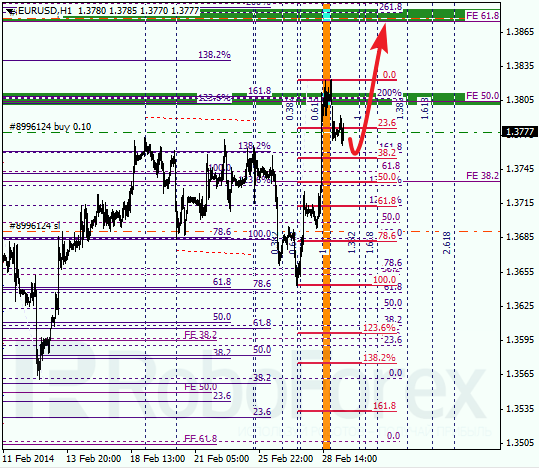
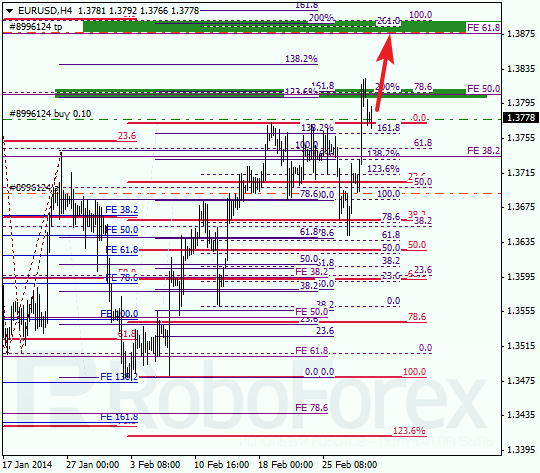
Last Friday, Eurodollar reached its first bullish target and Take Profits on my buy orders worked. During correction, I opened another buy order; next target is at level of 1.3875. I’ll move stops into the black as soon as price breaks maximum.

As we can see at H1 chart, pair reached its target at level of 1.38 right inside temporary fibo-zone. Right now, pair is being corrected and may test local level of 38.2% in the nearest future. It is rebounds from this level, price may start new ascending movement.

USD CHF, “US Dollar vs Swiss Franc”

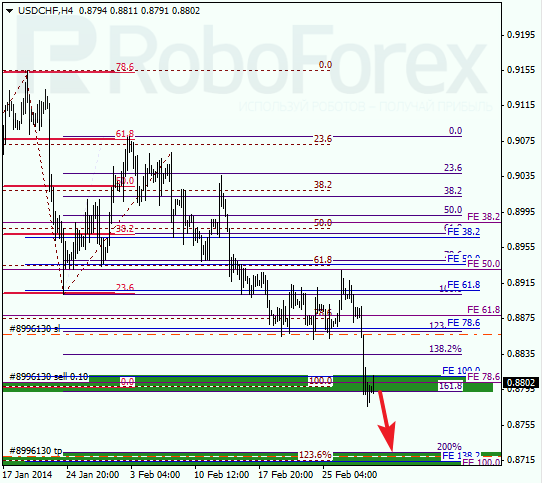
Franc also reached its first target. However, in the future bears may continue pushing price downwards to reach their next target, which is near several fibo-levels at 0.8715. Possibly, after reaching it, price may start new and more serious correction.

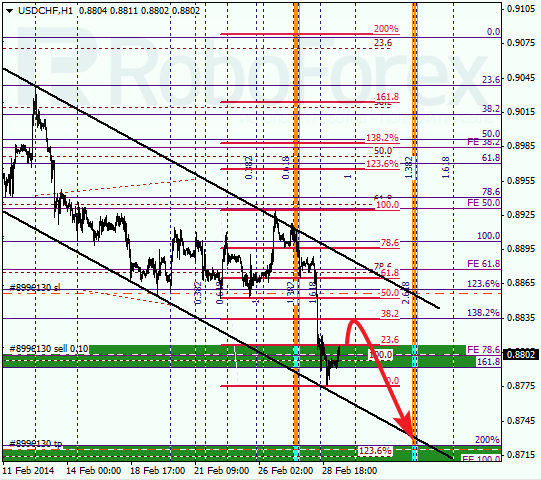
At H1 chart we can see, that price reached channel’s lower border and started new correction, which is already 23.6%. Probably, pair may finally reach local level of 38.2%, rebound from it, and start new descending movement.

RoboForex Analytical Department

Article By RoboForex.com

Attention!
Forecasts presented in this section only reflect the author’s private opinion and should not be considered as guidance for trading. RoboForex LP bears no responsibility for trading results based on trading recommendations described in these analytical reviews.


GBPUSD: Retains Broader Upside Bias Despite Hesitation.

GBPUSD: Though seen hesitating, we still look for the pair to resume its bullish strength triggered off the 1.6583 level. Note that the fact that it has reversed most of intra day losses suggests that its broader upside bias remains intact and trend resumption is imminent. Immediate resistance resides at the 1.6768 level, its Feb 28 2014 high where a break will turn focus to the 1.6822 level and then the 1.6850 level, its psycho level. Further out, resistance stands at the 1.6900 level. Its daily RSI is bullish and pointing higher suggesting further upside. Conversely, support lies at the 1.6675 level, its Feb 28 2014 low where a cut through here will pave the way for a run at the 1.6600 level. Further down, support comes in at 1.6550 level where a break will aim at the 1.6500 level. Further down, support lies at the 1.6450 level and possibly lower towards the 1.6400 level. On the whole, GBP continues to retain its medium term upside.

Article by www.fxtechstrategy.com


Ichimoku Cloud Analysis 03.03.2014 (GBP/USD, GOLD)

Article By RoboForex.com

Analysis for March 3rd, 2014

GBP USD, “Great Britain Pound vs US Dollar”

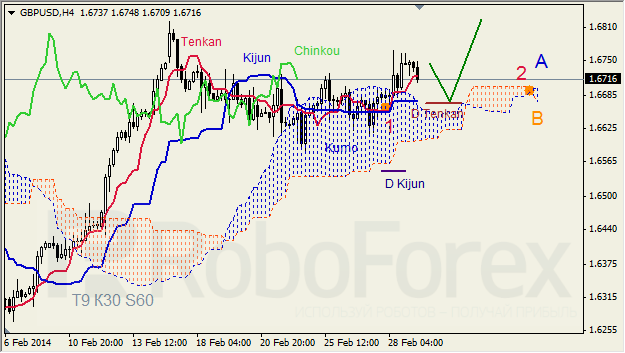
GBP USD, Time Frame H4. Tenkan-Sen and Kijun-Sen are influenced by “Golden Cross” (1); Tenkan-Sen is directed upwards. Ichimoku Cloud is going up (2), and Chinkou Lagging Span is above the chart. Short‑term forecast: we can expect support from Kijun-Sen – D Tenkan-Sen, and growth of the price.

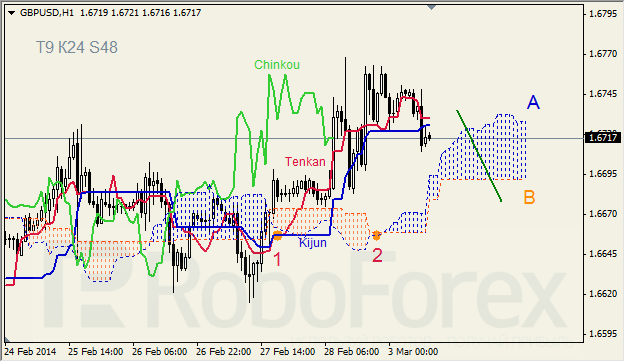
GBP USD, Time Frame H1. Tenkan-Sen and influenced by “Golden Cross” (1); the lines are very close to each other. Ichimoku Cloud is going up (2), and Chinkou Lagging Span is on the chart. Short‑term forecast: we can expect resistance from Tenkan-Sen – Kijun-Sen, and decline of the price.

XAU USD, “Gold vs US Dollar”

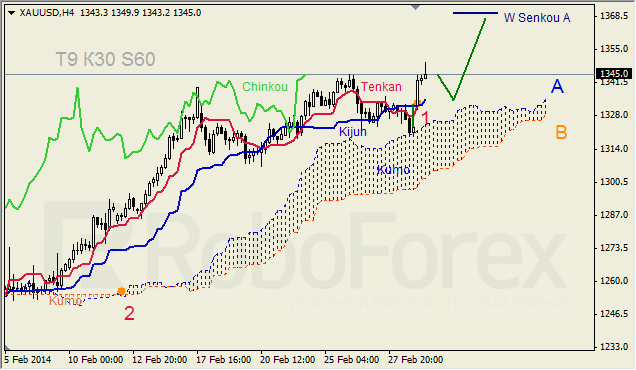
XAU USD, Time Frame H4. Tenkan-Sen and Kijun-Sen are close to each other above Kumo Cloud (1); all lines are directed upwards. Ichimoku Cloud is very narrow and going up (2), and Chinkou Lagging Span is above the chart. Short-term forecast: we can expect support from Tenkan-Sen – Kijun-Sen, and growth of the price.

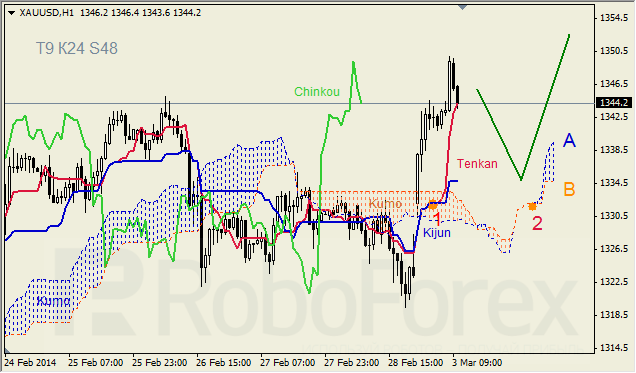
XAU USD, Time Frame H1. Tenkan-Sen and Kijun-Sen intersected inside Kumo and formed “Golden Cross” (1); Tenkan-Sen and Senkou Span A are directed upwards. Ichimoku Cloud is going up (2), Chinkou Lagging Span is above the chart, and the price is on Tenkan-Sen. Short‑term forecast: we can expect decline of the price towards support from Kijun-Sen.

RoboForex Analytical Department

Article By RoboForex.com

Attention!
Forecasts presented in this section only reflect the author’s private opinion and should not be considered as guidance for trading. RoboForex LP bears no responsibility for trading results based on trading recommendations described in these analytical reviews.


Powerful Insider Issues Warning to Growth Investors

By WallStreetDaily.com Powerful Insider Issues Warning to Growth Investors

“Go where there’s growth.”

It’s a mantra so simple that even novice investors immediately understand it.

Why? Because it makes perfect sense that companies operating in growing markets and increasing sales and profits can’t help but see their share prices rise.

I mean, why else does a company go into business? To grow, grow and grow some more!

So where’s the growth today? The answer might surprise you. But don’t let that keep you from scooping up the profits…

No One Will Believe It…

We’ve been told time and time again that emerging markets are home to the fastest growth rates in the world.

What people say doesn’t always jive with reality, however.

“Although it might be hard to believe, the U.S. and the developed markets are where the growth is,” according to Richard Bernstein of Richard Bernstein Advisors.

Sure enough, if we dig into the data, long-term earnings growth projections for Japanese stocks and U.S. small caps top the list.

Shocking, I know. But it’s nonetheless true.


Even if we evaluate growth prospects over the short run (i.e., the next 12 months), Japan and U.S. small caps still come in first and second place, respectively.

Now you understand why we’ve been banging the drum for so long on Japan and U.S. small caps.

Along the way, we’ve shared numerous specific investment opportunities.

In Japan, for instance, we offered up the WisdomTree Japan Hedged Equity Fund (DXJ). You’ll recall, it provides a hedge against currency valuations, while investing in some of the largest dividend-paying Japanese stocks. It’s up 20% over the last year and remains an attractive, low-cost and safe way to bet on a resurgent Japan.

My favorite play in Japan, however, remains the Japan Smaller Capitalization Fund (JOF). The closed-end fund invests in 146 small-cap Japanese companies. They represent the cheapest stocks in the country, as well as the ones with the most growth potential. Best of all, the fund currently trades at a 10% discount to NAV, which makes it an even more compelling bargain.

On the Domestic Front

When it comes to U.S. small-cap opportunities, a bevy of factors contribute to the rosy expectations. Like lower energy costs, increasing productivity, superior quality control and political stability, according to Bernstein.

He’s particularly fond of U.S. small-cap banks, thanks to much stronger balance sheets than their larger-cap brethren. While I don’t disagree with his assessment, I’m most optimistic about technology stocks. (For a quick refresher explaining why, go here.)

With that in mind, in November I brought 3-D scanning leader, FARO Technologies, Inc. (FARO), to your attention. And the company definitely fits the “growth” bill.

Sales and new order bookings increased 11% and 20%, respectively, in the most recent quarter. That figure is more than double the sector’s average growth rate of 4.9% – and it stands head and shoulders above the S&P 500 Index average sales growth of 0.8%.

Not long ago, I also shared a compelling small-cap, cyber-security play with you – The KEYW Holding Corporation (KEYW).

It’s up a solid 12% since then, on heavier than average volume, too.

Could a takeover be in the works, like I predicted? Time will tell. Regardless, the stock possesses significant growth opportunities – and, most importantly, it remains grossly undervalued.

Of course, our WSD Insider portfolios are chock-full of other, equally compelling, small-cap opportunities. I’m getting ready to add another fast grower to this exclusive list, which is levered to one of the hottest trends in the market right now.

And it’s completely off Wall Street’s radar, which sets the stage for dramatic gains. If you’re already a WSD Insider, stay tuned. The issue should hit your inbox early next week.

If you’re not a subscriber yet, what are you waiting for? You can sign up for a risk-free trial here, and you’ll be among the first to find out the company’s identity.

Ahead of the tape,

Louis Basenese

The post Powerful Insider Issues Warning to Growth Investors appeared first on Wall Street Daily.

Article By WallStreetDaily.com

Original Article: Powerful Insider Issues Warning to Growth Investors

Monetary Policy Week in Review – Feb 24-28, 2014: Israel 1st advanced economy to cut rate in ’14 as Brazil raises

By CentralBankNews.info
    Last week in global monetary policy Israel and Albania cut their rates as Israel became the first advanced economy to ease in 2014, illustrating the sluggish state of the global economy despite its gradual healing from the global financial crises.
    With weak global demand keeping worldwide inflation at bay, currency depreciation is boosting import prices and thus inflation in pockets around the world, including in Brazil and Zambia, with both banks raising rates last week as they continue their tightening cycles started in early 2013.
    Eight rate increases through the first 9 weeks of this year compared with 11 rate cuts by the 90 central banks followed by Central Bank News shows that the trend in global monetary policy is shifting toward tightening though rates are likely to remain very low for years to come.
   Viewed in percentage terms, rates have already been raised 10 percent of this year’s 79 monetary policy decisions compared with only 5.3 percent through the 52 weeks of 2013.
    Central banks in advanced economies cut rates 9 times in 2013 as the Bank of Israel cut three times,  the European Central Bank and the Reserve Bank of Australia cut twice and Sweden cut once. Denmark managed to both raise and cut its rate last year. But Denmark’s central bank is an anomaly among advanced economies as its monetary policy is purely aimed at defending the krone’s exchange rate to the euro so in most cases it shadows the ECB.
 
    The global shift toward higher rates is being driven by the U.S. Federal Reserve’s gradual wind-down of quantitative easing, underpinned by an improving U.S. economy.
    Apart from the distortion that ultra-low rates are having on financial assets and investors’ behavior, low rates also means that major central banks have little ammunition with which they can respond to an economic shock, an unsettling prospect that has been raised by Russia’s aggressive behavior in the Crimean peninsula.
    While much of the current debate around monetary policy in the U.S. and the UK is focused on the timing of rate rises, the issue of the future level of rates is increasingly being discussed.
    Mark Carney, governor of the Bank of England (BOE), has on several occasions, including his Feb. 12 presentation of the Bank’s new forward guidance, said that rates in the medium term will be “materially lower than before the crises” due to the headwinds of public and private deleveraging, strains in the financial system, weak global demand and a high sterling exchange rate.
    Last week Dennis Lockhart, president of the Atlanta Federal Reserve, echoed this sentiment, saying he expects the U.S. to be “in this low interest rate environment for quite a while.”
    David Miles, an external member of the Bank of England’s Monetary Policy Committee, added fresh perspective to this debate in a speech last week on “The transition to a new normal in monetary policy.”
    While Miles acknowledged the above-mentioned headwinds to demand, he believes that the financial crises has also led to a much more fundamental and longer-lasting change in investors’ risk perception.
    “I suspect the memory of the crises and the effect it has had on the risk perceptions will last longer than the impact on spending and taxes of the need to rebuild balance sheets,” Miles said on Thursday in London.
       To help examine investors’ perception of risk, Miles looked to economic models developed by the American economist Robert Barro, senior fellow at Stanford University’s Hoover Institution and well-known critic of government stimulus programs.
    The events surrounding the global financial crises were largely considered inconceivable by most economists and investors during the so-called Great Moderation from the mid-1980s to 2007.
    But now, investors are considering such crises as rare, but not inconceivable. The implication is that assets that are low in risk, such as indexed bonds issued by governments with a small risk a default, are viewed as much more attractive with a corresponding decline in their yields.
    This new post-crises perception risk will tend to increase the difference between the returns on safe assets, which are closely linked with rates set by central banks, with the returns on riskier assets that are more closely linked to an economy’s performance, such as corporate debt.
    “A rise in that spread between safe rates and rates on riskier assets is likely to mean that the rate set by a central bank should be lower,” said Miles, professor at London’s Imperial College.
    Interestingly, Miles finds that BOE’s Bank Rate historically has been around 5.0 percent. Not only was this the average rate from 1997, when the BOE was granted independence, to the end of 2007, but also the average rate in the 320-year-history of the Bank of England, from its creation in 1694 to 2014.
    Underlying this 5.0 percent Bank Rate was an average inflation rate of 2.0 percent so historically, the risk-free real UK interest rate has been around 3 percent, Miles said.
    “Indeed there are reasons to think that for some time to come the level of Bank Rate that will keep demand and supply consistently in balance and keep inflation at the target rate is likely to be below
(maybe well below) the 5% figure,” he said.
    Spreads between lending rates and Bank Rate may come down in coming years once banks have built up their capital to more adequate levels and if competition in the banking sector picks up. But spreads on risky lending, whether by banks or by capital markets, are unlikely to fall to where they were before the crisis, partly because those pre-crises spreads unsustainable.
    Miles shows how the spread of corporate bond rates over 5-year government bond rates fell to an average of 0.9 percent in the period from 1997-2007 from 1.6 percent during 1938-1996. The spreads then jumped to 3.5 percent from 2008-2013 and has now narrowed to 2.0 percent in January 2014.
    A parallel example is how mortgage rates fell to unprecedented lows in the decade before the crises. The spread of mortgage rates over the BOE’s Bank Rate averaged 1.2 percent from 1938 through 1996 but then narrowed to only 0.5 percent from 1997 through 2007. From 2008 through 2013 it then widened to 2.7 percent as banks’ perception of risks changed dramatically. Since then it has narrowed to 1.9 percent in January.
    Financial liberalisation may be one factor behind lower spreads during 1997-07 compared to 1938-96. But another likely reason for Miles is that in the years before the crisis, lenders and borrowers underestimated the risk that debt would not be repaid. Those risks are now perceived to be significantly higher and are likely to stay higher for many years.
    Another perspective on the future evolution of monetary policy came from bitcoin when Tokyo-based Mt. Gox, one of bitcoin’s biggest exchanges, went dark under mysterious circumstances, casting doubts on the future viability of the virtual currency.
    The collapse of Mt. Gox, including a reported 744,000 missing bitcoins – worth over $400 million – has showcased the complete lack of regulation and legal status of the bitcoin system.
    Nevertheless, Federal Reserve Chair Janet Yellen, in her Thursday testimony to a Senate committee, said Congress should consider ways to regulate virtual currencies as the Fed currently has no jurisdiction.
    On the same day, Japanese Vice Finance Minster Jiro Aichi said that legally bitcoin was not a currency as it was not issued by the Bank of Japan. However, Aichi also said that any regulation of bitcoin should involve international cooperation to avoid loopholes.
    These two comments show that central bankers and policy makers believe digital currencies are likely to play a growing role and they are now starting to consider how to regulate them in the future.

    LIST OF LAST WEEK’S CENTRAL BANK DECISIONS:

    TABLE WITH LAST WEEK’S MONETARY POLICY DECISIONS:

COUNTRYMSCI     NEW RATE           OLD RATE        1 YEAR AGO
ISRAELDM0.75%1.00%1.75%
ALBANIA2.75%3.00%3.75%
BRAZILEM10.75%10.50%7.25%
FIJI0.50%0.50%0.50%
MOLDOVA3.50%3.50%4.50%
EGYPTEM8.25%8.25%9.25%
ANGOLA9.25%9.25%10.00%
ZAMBIA10.25%9.75%9.25%
COLOMBIA EM3.25%3.25%3.75%

    This week (Week 10) eight central banks will be deciding on monetary policy, including Australia, Uganda, Canada, Poland, Malaysia, the European Central Bank, the United Kingdom and Serbia.

COUNTRYMSCI             DATE CURRENT  RATE        1 YEAR AGO
AUSTRALIADM4-Mar2.50%3.00%
UGANDA4-Mar11.50%12.00%
CANADADM5-Mar1.00%1.00%
POLANDEM5-Mar2.50%3.25%
MALAYSIAEM6-Mar3.00%3.00%
EURO AREADM6-Mar0.25%0.75%
UNITED KINGDOMDM6-Mar0.50%0.50%
SERBIAFM6-Mar9.50%11.75%

 
  http://ift.tt/1iP0FNb

Investors ignored Game-Changing Deal; WhatsApp

By MoneyMorning.com.au

In January 2009, Jan Koum bought a new smartphone.

A top-of-the-range iPhone 3G.

As soon as Jan booted up his new device, something exciting dawned on the young infrastructure engineer.

He realised that the Apple App Store – then just seven months old – was about to spawn a whole new software industry.

That gave Jan an idea…

Jan worked on the idea day and night for the next several months until he’d perfected it.

Jan’s idea would eventually make him an incredibly rich man. But when he released his idea to the world, investors wouldn’t even give him the time of day.

If you’d been browsing the online forum ASmallWorld on the 4th of May 2009, you might have come across this post…


Source: The Reformed Broker
Click to enlarge

We’re told the post above received no replies. Zero.

Five years and $19 billion later…

Unless you’ve been under a rock for the past week, you’ll have seen that Facebook Inc [NASDAQ:FB] has just agreed to buy WhatsApp, a four-year old text messaging company with 55 employees and $20 million in annual revenue, for $19 billion.

At face value, that’s a staggeringly large sum of money.

And yes, this deal dwarfs most high-profile tech acquisitions. It’s more than the combined total Microsoft [NASDAQ:MSFT] shelled out for Nokia’s mobile phone business and for Skype…and it’s much more than Google [NASDAQ: GOOG] paid for YouTube.

But large doesn’t necessarily mean expensive. And it’s important to realise what Facebook has really bought here. There’s an important lesson in it for investors…

Price is What You Pay – Value is What You Get

Facebook has just bought a company that processes 50 billion free messages a day. WhatsApp has grown to more than 450 million users, and 70% of those users log into the app every day. That level of engagement is valuable because the more users interact with a service, the more ads or other products can be sold to them.

Brian Blau, an analyst at research and advisory firm Gartner Inc [NYSE:IT], put it best when he said:

If you’re a technology player today, and you’re in the communications business, then you need a way to capture people and bring them into your ecosystem. Virtually anybody in the technology space that has a pillar product around conversations and connecting people together could be a potential buyer.

Facebook paid $42 per WhatsApp user…a great proportion of them are highly active. In fact, the average WhatsApp user sends more than 1,000 messages every month!

But compare $42 per user to the price commanded by the other major social networks. $42 is a fairly cheap price for a pair of eyeballs…as you can see in the chart below, which compares WhatsApp to its social network peers.


Source: Statista
Click to enlarge

You’ll note certain words missing from that chart: ‘sales’, ‘cashflow’, and – god forbid – ‘earnings’.

And that’s fine.

Mark and friends will figure out a way to monetise those users. In the long run, it’s not hard to see WhatsApp getting anywhere from $1 to $10 per user annually. That would make it a lucrative business in its own right.

And that’s before you consider the less tangible benefits that come from extending Facebook’s reach.

According to mobile research firm Jana, 55% of people surveyed in India said WhatsApp was their most-used messaging service. That response rose to 63% in Brazil and 78% in Mexico.

Those kind of penetration rates – and the swathes of personal data that come with them – will be a godsend to Facebook as it pushes into emerging markets.

But WhatsApp isn’t the only communication software start-up that’s been snaffled this month for big dollars…

Lost In The Noise

If it’s possible for an international takeover worth close to a billion US dollars to get drowned out in market noise, well, that’s what happened two weeks ago.

That’s when Japanese e-commerce giant Rakuten Inc [TYO:4755] announced its purchase of voice-call app-maker Viber for $900 million.

On any valuation metric, the price that Viber’s owners achieved for their business looks pretty shabby compared to WhatsApp’s $19 billion price tag.

Should Viber’s founder, Israeli entrepreneur Talmon Marco, feel hard-done-by to have only gotten $900 million for his app?

I’d imagine Talmon has spent a few sleepless nights this week wondering what might have been if the WhatsApp deal had been announced before he’d agreed to sell. It’s clear that tech industry heavyweights are now placing a much higher price on strategically important assets.

You may not have noticed, but stories like the WhatsApp acquisition are constantly playing out in the Australian stock market.

The only difference is that you don’t have to be a secretive fund manager like Sequoia Capital to win this game. That’s the venture capital firm that backed WhatsApp five years ago in exchange for a share in the business. As Kris Sayce told you last week…with the Facebook takeover, Sequoia made a 35,525% return on their initial stake in WhatsApp.

While that sort of gain doesn’t happen often, opportunities for big triple-digit or quadruple-digit percentage gains do happen relatively often. All you need is the courage to take on some calculated risks in exchange for the potential to make huge gains.

I’m talking about investing in the opportunities we find amongst the speculative small-cap companies listed on the ASX.

Not just smaller Aussie companies with revenue, profit and an established business plan…but tiny firms with little more than some start-up capital and a bright idea.

The potential to make huge gains

These small-cap companies typically ask you to invest in their business before they have an idea of how they’re going to make any money.

Many of these companies will fail to reach their full potential. But some will…and if you get along for the ride, the returns will be breathtaking.

Here’s a tip on how to find the next Aussie WhatsApp…an investment that’ll go on to pay you as much as 35,525% more than your initial outlay.

Look for a small company with three things: a unique asset, barriers to entry and smart operators at the helm.

If you find a company that ticks those boxes at the right time, the rest will look after itself.

You don’t get $19 billion small-cap takeovers every day, but the huge deals we’ve seen in the past two weeks show you what can be possible.

The trick is in finding these companies before everybody else does. That’s not always easy.

My recent research has unveiled tiny Aussie companies building unique businesses in high technology, alternative finance and online retail.

Will these be the next Aussie WhatsApp? Maybe. Maybe not.

But either way, these are exciting stocks with a great future. They may not return investors a 35,525% gain…but if my analysis is right, high triple-digit percentage gains are a realistic possibility.

It’s an exciting time to be an investor, especially a small-cap investor.

Cheers,
Tim Dohrmann+
Analyst, Australian Small-Cap Investigator

Join Money Morning on Google+


By MoneyMorning.com.au
Warren Buffet’s Latest Investment Tips Are Must-Reads

By MoneyMorning.com.au

I can be awfully cynical about Warren Buffett sometimes.

There’s something about that folksy, down-home, man-of-the-people persona, and the gushiness of his fan base.

It doesn’t sit well with the reality of being the man that even Goldman Sachs, the ‘vampire squid’ of legend, comes running to when it gets into trouble.

But at the end of the day, that’s all showbiz. What matters is that Buffett is a brilliant investor, and better yet, he writes extremely well on the topic.

His latest letter contains two key lessons that will definitely change your investing for the better if you haven’t already learned them…

Lessons From Warren Buffett’s Property Investments

The latest excerpt from Warren Buffett’s annual letter to Berkshire Hathaway shareholders, published in Fortune magazine, tells the tale of two property investments he made.

You can – and should – read the whole piece. But here’s what it boils down to. Buffett bought a farm on the cheap after one recession. Then he bought some retail property in New York after another one.

With the help of some trusted experts, he looked at the business case for both. He saw that the returns looked good, even on a conservative estimate. So he bought them, made loads of money, and still owns them decades later.

Good for him, you’re thinking. But what can I learn from Buffett’s good fortune? I’d say there are two main takeaways – both critical to being a better investor.

Firstly, he points out that he ignored the broader economic backdrop. He didn’t think: ‘property prices are bound to go up, I’ll buy now.’ Instead he looked at the earnings these properties were likely to generate in the future. On that basis, they looked cheap, so he bought in.

This is important. It’s the way you should look at any investment, from shares to bonds. It’s not about asking: ‘What will the price be tomorrow?’ It’s about asking: ‘Does this represent good value, given the returns I can realistically expect from it?’

This seems simple. Yet, as Buffett points out, with share prices being barked at you from the TV every other minute, it’s easy to get caught up in the sense that you are missing opportunities, or that your hard-earned wealth might be at risk.

In short, invest in businesses because they’re good value, not because the price is going up.

The Financial Industry Wants you to Trade Like a Maniac

Secondly, Buffett flags up the importance of keeping ‘your costs minimal’.

As he puts it, if farm owners ‘frenetically bought and sold farmland to one another, neither the yields nor the prices of their crops would be increased. The only consequence would be decreases in the overall earnings realised by the farm-owning population because of the substantial costs it would incur as it sought advice and switched properties.

The financial industry wants you to trade like a maniac. It gets a bite of your money every time you do. But if you take the time to make a sensible, considered investment decision in the first place, you won’t be panicked into doing anything rash.

Successful Investing for People who aren’t Warren Buffett

This is all very well. But what if you’re a normal human being, and not someone like Buffett, who actively loves the process of analysing businesses?

As far as he’s concerned, there’s a simple solution. Invest in a cross-section of American businesses by sticking your money in a cheap S&P 500 tracker. If you invest regularly, then you don’t have to worry about market timing. Any short-term losses made by buying near the highs will be compensated for by gains made by buying in near the lows.

There’s a lot to be said for this. The truth is that for many people, simply even establishing a monthly, low-cost savings plan would greatly improve their long-term financial outlook. And if you have a long period of time to save over – a decade or more – then saving regularly in shares has historically produced better returns than cash.

But I think you can do better than that, even as a non-specialist. Buffett is right to focus on cheap tracker funds. But he ignores one great benefit of such funds – you can use them to buy into a very wide range of assets, not just US or British stocks.

It’s really easy to build a diversified portfolio that has exposure to shares across the globe, and also to property, bonds, and gold. All without paying a fortune in fees, or even having to spend a lot of time setting the thing up.

That reduces the risks of having all your money in one very over-valued asset class at any given moment. Which in turn should make it even easier to sleep at night while your money steadily accumulates.

I do think this point about diversification is particularly important right now. There’s a lot of frankly nutty-looking stuff going on in the investment world at the moment.

Stupidly expensive deals are being done in the tech sector. Valuations are being put together on the basis of rosy future scenarios – one investment bank analyst even used the word ‘utopia’ in his valuation model of Tesla the other day. (Interestingly enough, Tesla’s looking to raise funds, and said investment bank is in the running to get the business.)

Meanwhile, China’s financial system is looking ever more rickety. And markets can’t seem to make up their mind about whether the ‘taper’ is really happening or not, and what it means if it does.

In short, conditions look ripe for a ‘slip-up’ of some sort. Maybe nothing will happen. But it’s worth being prepared for if it does.

John Stepek,
Contributing Editor, Money Morning

Ed note: The above article was originally published in MoneyWeek.

Join Money Morning on Google+


By MoneyMorning.com.au