New Zealand 1st developed nation to hike rate since Jul ’11

By CentralBankNews.info

    The Reserve Bank of New Zealand (RBNZ) has become the first central bank in the world’s advanced economies to raise its benchmark interest rate in 31 months.
    The last year central banks in developed markets raised policy rates was in 2011 when the global economy seemed to recovering from the 2007-2009 financial crises, boosted by extraordinary easy monetary policy and government stimulus.
     A monetary tightening cycle got under way in mid-2010 when the Bank of Israel (BOI), Norway’s Norges Bank, Sweden’s Riksbank and the RBNZ raised rates in the second half of that year.
    The BOI continued the tightening cycle in 2011, raising its rate in January, followed by the Riksbank in February, the European Central Bank (ECB), Denmark’s Nationalbank and the Riksbank in April.
     Norway then raised rates in May and July, with the Riksbank and the ECB finishing off the monetary tightening cycle in developed economies in July 2011, 31 months prior to the RBNZ’s 25 basis point rate rise today.
     But the global economy had already run out of steam by mid-2011, hit by a cascade of negative events, ranging from the Japanese tsunami, political and social unrest in the Middle East, Europe’s sovereign debt crises and political indecision in the United States.
    Central banks quickly reversed course, with the BOI again leading the charge by cutting its rate in September 2011, followed by the Reserve Bank of Australia  (RBA), the ECB and Denmark in November, and then Norges Bank and the Riksbank in December.
    Since July 2011, only central banks in emerging and frontier markets, along with central banks in smaller economies, have raised rates, most often in response to inflationary pressures but also more recently to cushion currencies from depreciation that raises import prices and thus inflation.
    Meanwhile, central banks in advanced economies have undertaken waves of stimulus, ranging from the U.S. Federal Reserve and Bank of England’s (BOE) asset purchases, aggressive easing by the Bank of Japan (BOJ) and rate cuts by the ECB.
    But this period of extraordinary stimulus is coming to an end, with the Fed starting to reduce its asset purchases from January and the BOE expected to raise rates in early 2015.    

New Zealand raises rate 25 bps to 2.75%

By CentralBankNews.info

    New Zealand’s central bank raised its benchmark Official Cash Rate (OCR) by 25 basis points to 2.75 percent following months of warnings that it would have to tighten monetary policy to keep inflation from rising above the bank’s target.
    The Reserve Bank of New Zealand (RBNZ) started warning investors and financial markets in July 2013 that would have to start to remove its stimulus and in January it it said interest rates had to return to normal levels and this adjustment was expected to start “soon.”
    

Trading the USD on Upcoming Reports

On Thursday, March 13th and Friday March 14th, several key releases will be made available. Among these are the initial jobless claims report, preliminary US consumer confidence report, retail sales, and business inventory data. Analysts expect US retail sales to rise by 0.2% as well as an increase in unemployment to 330,000. Business inventories are set to decrease to 0.4% and consumer confidence is forecast to come in at 81.9 points compared to 81.6 in the previous month.

There will be an interesting result for the USD as well its major crosses such as EUR/USD, USD/CNY, and AUD/USD because those nations will also see vital data coming out around the same time.  For the EUR/USD, buying or selling on the breakout would be a wise move. For AUD/USD, selling around 0.9070 would also be a wise move as the pair is likely to see rough resistance around 0.9056, which is the 38.2 Fibonacci level.

aud/usd

Written by Daniel Elo, www.EconomicCalendar.com


Trade strategies for China’s February industrial production, retails sales reports

Thursday will see the release of important data from China. As China is the largest consumer of platinum, palladium, copper and many other commodities, a decrease in industrial production will see commodity prices decrease. Analysts forecast a bullish figure for industrial production. In January, production grew at 9.% compared to 9.7% the same January of the previous year. For retail sales, the median projection is a slight increase from the year before to approximately 13.5%. Buying around 6.0700 should prove to be a solid strategy with stops placed at 6.0500 with a target at 6.1540. A deep correction may also be likely in the near future, thus showing the double bottom support.

usdcny chart
Written by Daniel Elo, analyst for www.EconomicCalendar.com


Major Currency Pairs Stick In Tight Ranges

The EURUSD Consolidating After Last Week’s Rise

The EURUSD continues to be in a sluggish state. After a last week’s rise it entered a consolidation phase, trading in a tight range. Yesterday it was limited by the 1.3833 and 1.3876 levels. Thus, the overall picture remains unchanged. Inability to grow above 1.3900 will trigger profit taking as well as falling below the support level of 1.3833, so this will open the way to 1.3782—1.3720.

eur


The GBPUSD Testing Support

Yesterday, the GBPUSD was under pressure, but falling was limited by the support at 1.6596. After testing the pound returned to the resistance around 1.6647. On the whole, the pair looks able to continue declining as well as to break through the current lows at the 1.6583 level that will lead to falling at least to 1.6500—1.6480. Growth attempts to the 67th figure should be considered as the opportunity to open short positions at the best price. A rise above will put the 1.6800 resistance at risk.

gbp


The USDCHF Can Form Base

Yesterday, the USDCHF made an attempt to increase, but it failed to rise above 0.8804. Having been here under pressure, the pair fell to the support at 0.8765, which continues to cope succesfully with its task. Thus, the probability of forming a base at current levels with the subsequent development of an ascending correction increases. In this case, in the short term, the dollar bulls may test the resistance at 0.8900, its breakout will significantly improve the prospects of the pair. Loss of the 0.8765/55 support will lead to a fall to 0.8568.

chf


The USDJPY Testing 102.83

The USDJPY failed to continue increasing as well as to rise above the previous week’s highs at the 103.76 level. This, as expected, led to some profit taking, against this background the bears are testing the previously broken 102.83 level, acting as support. Its loss will open the way to the 101.59 level. If the 102.83 level can hold onslaught of the bears, then the bulls will be able to test 103.76 again.

jpy


provided by IAFT


Keys to Investor Success – Elliott Wave Theory

By Chris Vermeulen, Technical Traders

Elliott Wave Theory – Plenty of people will freely offer you advice on how to spend or invest your money. “Buy low and sell high,” they’ll tell you, “that’s really all there is to it!” And while there is a core truth to the statement, the real secret is in knowing how to spot the highs and lows, and thus, when to do your buying and selling. Sadly, that’s the part of the equation that most of the advice givers you’ll run across are content to leave you in the dark about.

The reality is that no matter how many times you are told differently, there is no ‘magic bullet.’ There is no plan, no series of steps you can follow that will, with absolute certainty, bring you wealth. If you happen across anyone who says otherwise, you can rely on the fact that he or she has an agenda, and that at least part of that agenda involves convincing you to open your wallet.

In the place of a surefire way to make profits, what is there? Where can you turn, and what kinds of things should you be looking for?

The answers to those questions aren’t as glamorous sounding as the promises made by those who just want to take your money, but they are much more effective. Things like careful, meticulous research. Market trend analysis. Paying close attention to extrinsic factors that could impact whatever industry you’re planning to invest in, and of course, Elliott wave theory. If you’ve never heard of the Elliott wave, you owe it to yourself to learn more about it.

Postulated by Ralph Nelson Elliott in the late 1930’s, it is essentially a psychological approach to investing that identifies specific stimuli that large groups tend to respond to in the same way. By identifying these stimuli, it then becomes possible to predict which direction the market will likely move, and as he outlined in his book “The Wave Principle,” market prices tend to unfold in specific patterns or ‘waves.’
The fact that many of the most successful Wall Street investors and portfolio managers use this type of trend analysis in their own decision making process should be compelling evidence that you should consider doing the same. No, it’s not perfect, and it is certainly not a guarantee, but it provides a strong framework of probability that, when combined with other research and analysis, can lead to consistently good decisions, and at the end of the day, that’s what investing is all about. Consistently good decision making.

We use Elliott Wave Theory in real time by looking at the larger patterns of the SP 500 index for example. We deploy Fibonacci math analysis to prior up and down legs in the markets to determine where we are in an Elliott Wave pattern.  This helps us decide if to be aggressive when the markets correct, go short the market, or to do nothing for example.  It also prevents us from making panic type decisions, whether that be in chasing a hot stock too higher or selling something too low before a reversal.  We also can use Elliott Wave Theory to help us determine when to be aggressive in selling or buying, on either side of a trade.

For many, its not practical to employ Elliott Wave analysis with individual stocks and trading, but it can be done with experience.  We instead use a combination of big picture views like weekly charts, Wave patterns within those weekly views, and then zoom in to shorter term technical to determine ultimate timing for entry and exit.  This type of big picture view coupled with micro analysis of the charts gives us more clarity and better results.

One of our favorite patterns for example is the “ABC” pattern.  Partially taken from Elliott Wave Theory, we mix in a few of our own ingredients to help with timing entries and exits.  This is where you have an initial massive rally or the “A” wave pattern. Say a stock like TSLA goes from $30 to $180 per share, which it did.  The B wave is what you wait for and using Fibonacci analysis and Elliott Wave Theory we can calculate a good entry point on the B wave correction.  TSLA dropped from $180 to about $ 120, retracing roughly 38% (Fibonacci retracement) of the rally $30 to $180.  The B wave bottomed out as everyone was negative on the stock and sentiment was bearish. That is when you get long for the “C” wave.  The C wave is when the stock regains momentum, good news starts to unfold, and sentiment turns bullish.  We can often calculate the B wave as it relates often to the A wave amplitude.  Example is the TSLA “A” wave was 150 points, so the C wave will be about the same or more.

When TSLA recently ran up to about $270 per share, we were in uber bullish “C” wave mode, and we had run up $150 (Same as the A wave) from $120 to $270.  That is when you know it’s a good time to start peeling off shares. Often though, the C wave will be 150-161% of the  A wave, so TSLA may not have completed it’s run just yet.

Elliott Wave Theory

Knowing when to enter and exit a position whether your time frame is short, intermediate, or longer… can often be identified with good Elliott Wave Theory practices.  Your results and your portfolio will appreciate it, just look at our ATP track record from April 1 2013 to March 3rd 2014 inclusive of all closed out swing positions.  We incorporated Elliott Wave Theory into our stock picking starting last April and you can see the results:

ATP Elliott Wave Trading

Join Us Today And Start Making Real Money Trading – Click Here

Sincerely,

Chris Vermeulen
Founder of Technical Traders Ltd


USDJPY: Bearish On Corrective Pullbacks.

USDJPY: The pair has triggered a correction and looks to extend it further in the days ahead. On the downside, support comes in at the 102.26 level, its Feb 26’2014 high. Further down, support stands at 101.50 level and then the 101.00 level with a turn below here switching focus to the 100.75 level, its Feb 04 2014 low. It daily RSI is bearish and pointing lower suggesting further weakness. On the other hand, resistance is initially seen at the 103.09 level where a break will target the 103.75 level. A cut through here will pave the way for a run at the 104.50 level and then the 105.00 level. Its daily RSI is bullish and pointing higher suggesting further strength. On the whole, USDJPY remains exposed to the downside on correction.

Article by www.fxtechstrategy.com


Thailand cuts rate on higher risks to growth from unrest

By CentralBankNews.info
    Thailand’s central bank cut its policy rate by 25 basis points to 2.0 percent, saying “downside risks to growth have risen in the wake of the prolonged political situation” and that “monetary policy has some scope to ease, in order to lend more support to the economy and ensure continuous financial accommodation.”
    But it was a close decision with the Bank of Thailand’s (BOT) Monetary Policy Committee voting by 4 to 3 to reduce the rate, with the minority doubting that a rate cut would help boost growth as the weak economy is due to political unrest that has unnerved consumers and kept tourists away.
   The three members of the committee that voted to maintain rates were quoted as saying the bank’s policy was already accommodative and the main headwinds to growth were not financial in nature.
    “Monetary policy should be used when it is effective in supporting the economic recovery,” the bank said, a sign of how intense the committee’s debate had been.
    The BOT cut its rate by 50 basis points in 2013 and at its last meeting in January it voted by 4 to 3 to maintain rates, with three voting for a rate cut. At that time it also said political unrest was weighing on the growth outlook and cut the 2014 growth forecast to 3 percent from a previous forecast of 4 percent.
     A narrow majority of economists had expected the BOT to cut rates today, with those expecting the central bank to maintain rates citing stable inflation.

    Thailand’s headline inflation rate rose slightly to 1.96 in February from 1.93 percent in January with the Thai baht strengthening slightly in the last month after falling sharply in 2013 as political unrest added to the general negative international sentiment toward emerging market currencies.
    The BOT noted that core inflation had edged up but remained subdued. Core inflation rose to 1.22 percent in February from 1.04 percent the previous month. The BOT targets core inflation of 0.5 percent to 3.0 percent.
    “Growth of the Thai economy slowed through the final quarter of 2013 and January 2014 from domestic demand amid lower private confidence,” the BOT said, adding that tourism has felt more of an import from the political situation.
    Thailand’s Gross Domestic Product rose by only 0.6 percent in the fourth quarter of 2013 from the third quarter for annual growth of 0.6 percent, sharply down from a rate of 2.7 percent in the third quarter.  
    “Prolonged political uncertainties would continue to impede the recovery of private consumption and investment,” the bank said.
    But economic growth should be supported by a gradual recovery of exports, the BOT said, adding that the global economic had continued to recover in the last two months, led by the major economies.
    Thailand’s exports eased further in January to US$ 17.907 billion, the fifth month in a row with declining exports.
    Along with many other emerging market currencies, the Thai baht fell from late April 2013, hitting a low of 33.075 to the U.S. dollar on Jan. 7, 2014, a drop of 13.5 percent. But since then the baht has recovered somewhat, trading at 32.44 to the dollar today, down 0.7 percent since the start of 2014.
    Protestesters accused the former prime ministers, Yingluck Shinawatra, of corruption and are still occupying parts of the capital of Bangkok. A general election in February was disrupted by the protesters, leaving Yingluck with a caretaker government with limited powers to act.

    http://ift.tt/1iP0FNb


Wave Analysis 12.03.2014 (DJIA Index, Crude Oil)

Article By RoboForex.com

Analysis for March 12th, 2014

DJIA Index

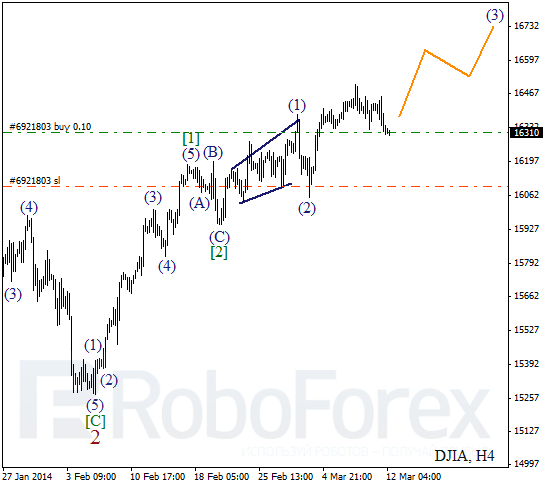
In case of Index, main trend is still bullish despite slight correction. Possibly, in the nearest future may continue forming extension inside the third wave. Critical level here is minimum of wave (2).

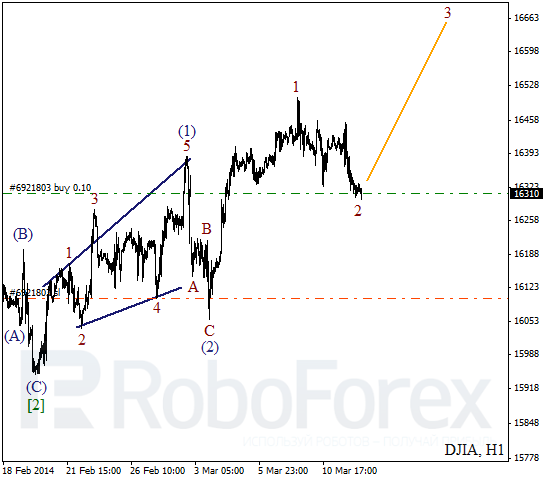
As we can see at the H1 chart, after completing zigzag pattern inside wave (2), Index formed initial impulse inside the first wave on minor wave level. Current chart structure implies that pair may have already finished local correction. I’ll increase my long position as soon as price starts new ascending movement.

Crude Oil

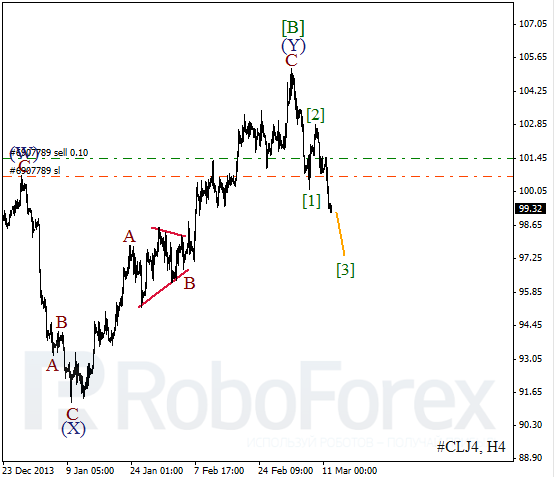
Oil is falling down; bears have already broken minimum of the first wave. It looks like right now price is forming the third wave. Stop on my buy order is already in the black; I’m planning to increase my position during correction.

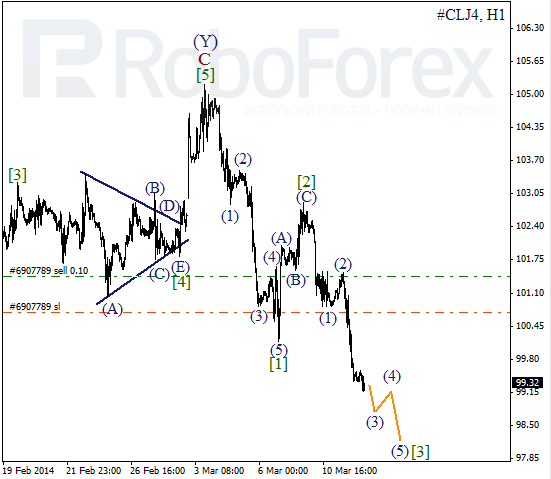
More detailed wave structure is shown on H1 chart. After completing short impulse inside wave (C) of [2], Oil started falling down inside the third one. In the nearest future, price is expected to finish wave (3) and start local correction.

RoboForex Analytical Department

Article By RoboForex.com

Attention!
Forecasts presented in this section only reflect the author’s private opinion and should not be considered as guidance for trading. RoboForex LP bears no responsibility for trading results based on trading recommendations described in these analytical reviews.


Crude Prices Trades Lower as US Crude Supplies Climbs

By HY Markets Forex Blog

Crude prices extended losses, falling for a third day, the longest losing streak in two month following the release of the latest API stockpiles report which revealed demand growth concerns in the world’s largest oil consuming country.

The North American WTI crude for April delivery dropped 0.83% to $99.19 per barrel on the New York Mercantile Exchange at the time of writing. While Brent crude for April settlement slid 0.37% lower at $108.16 per barrel on the ICE Futures Europe exchange at the same time.

The European benchmark crude was at a premium of $8.88 to WTI.

Crude – Ukraine

The ongoing tension between Russia and Ukraine over the Crimean region continues as the Ukrainian government appealed to the Western nations for help on Tuesday to help fight against Russia’s aggression in Crimea, which is still preparing for a referendum on joining Russia on March 16.

US Crude Supplies

On Wednesday, the American Petroleum Institute (API) released reports which revealed crude stockpiles at Cushing, the delivery point for WTI contracts, dropped by 1.31 million barrels in the week ending March 7.

According to the API report, crude inventories added 2.6 million barrels to 367 million, in the week ending March 7, compared to analysts forecast of an increase of 2.2 million barrels.

Distillate inventories, including heating oil and diesel, declined by 839,000 barrels, the industry group in Washington confirmed.

A separate report from the Energy Information Administration (EIA) is expected to be released later in the day.

According to the monthly Short-Term Energy Outlook released on Tuesday, the North American West Texas Intermediate could possibly average $95.33 per barrel this year.


Visit www.hymarkets.com   to find out more about our products and start trading today with only $50 using the latest trading technology today

The post Crude Prices Trades Lower as US Crude Supplies Climbs appeared first on | HY Markets Official blog.

Article provided by HY Markets Forex Blog