Skip to content

InvestMacro Forex News

  • Home
  • News
  • COT
  • Opinions
  • Calendar

Month: March 2014

Posted on March 6, 2014

Stocks in Europe Climbs; ECB and BoE In Spotlight

By HY Markets Forex Blog

Stocks in Europe traded higher on Thursday as the market are focusing on the ECB meeting and BoE’s rate decision, with both meeting taking place later in the day.

Futures for the European Euro Stoxx 50 traded 0.08% higher at 3,138.50, while Germany’s DAX futures rose 0.08% higher at 9,556.80.

At the same time the French CAC 40 futures edged 0.10% higher to 4,400.30, while futures for the UK’s benchmark FTSE 100 added 0.13% to 6,766.00.

Stocks – European Central Bank (ECB) Meeting

Market analysts are mixed on the outcome of the anticipating ECB meeting as to whether the bank would implement further monetary policy action.

The bank’s current rate is at 0.25% after the bank decided to keep its benchmark rate and keep the deposit facility rate unchanged at 0%.

On Monday, the ECB President Mario Draghi said that the current rate of inflation of 0.8% was below the bank’s target and added that “we know that the longer inflation stays at the current level, the higher the risk.”

Stocks – Bank of England (BoE) In Focus

Analysts are forecasting there will be no change in the Bank’s monetary policies in March. The most recent speeches from the Monetary Policy Committee members have indicated they feel at ease with the market’s predictions of the first rate climb could be in the first half of 2015.

“Today’s BoE rate meeting will be a non event from a policy point of view. It goes without saying that rates and asset purchases will remain on hold at 0.5% and £375 billion respectively. That said, coming into today’s meeting the pound strengthened slightly following yesterday’s strong Services PMI data release which caps off an impressive week as far as UK PMIs go,” analysts from Commerzbank Corporates and Markets commented.


Visit www.hymarkets.com   to find out more about our products and start trading today with only $50 using the latest trading technology today

The post Stocks in Europe Climbs; ECB and BoE In Spotlight appeared first on | HY Markets Official blog.

Article provided by HY Markets Forex Blog

Posted on March 6, 2014

Malaysia holds rate, to keep eye on financial imbalances

By CentralBankNews.info
    Malaysia’s central bank maintained its Overnight Policy Rate (OPR) at 3.0 percent, as expected, and said inflation is expected to be affected by higher domestic costs and it would “continue to monitor for signs of destabilizing risk of financial imbalances.”
    Bank Negara Malaysia’s (BNM) mention of the risk of financial imbalances signals its concern over inflation from an expanding economy and the impact of disruptions in supply from adverse weather and higher domestic costs from the government’s cut in fuel subsidies in September, higher utility tariffs in January and coming changes in taxes in April.
    BNM has held its benchmark OPR rate steady since May 2011 but economists are expecting the central bank to start tightening later this year to stem inflation which rose to a higher-than-expectd 3.4 percent in January, continuing the acceleration seen since December 2012 when it was 1.2 percent.
    The central bank has acknowledged the rise in inflation and expects it this year to top 2013’s average rate of 2.1 percent and has said it may exceed the long-term inflation average of 3.2 percent. However, subdued external price pressures and moderate domestic demand will also contain the impact of some of these cost pressures on inflation.

    “For the Malaysian economy, latest indicators point to further improvement in exports and continued expansion in private sector investment spending. Going forward, this trend is expected to continue,” the central bank said.
    Malaysia’s Gross Domestic Product rose by 2.1 percent in the fourth quarter from the third quarter for annual growth of 5.1 percent, up from 5.0 percent. Average growth in 2013 was 4.7 percent, down from 2012’s 5.6 percent, but the government expects growth this year of 5.0 percent to 5.5 percent.
    Exports are expected to continue to benefit from the recovery in advanced economies and from regional demand while investment activity should remain robust on the back of private sector investment in manufacturing and services.
    Domestic demand, however, is expected to moderate due to the consolidation of the public sector and the return of private consumption to its long-term average, the central bank said.
   The central bank described the global economic expansion as “moderate” and while advanced economies are improving, it was still modest and uneven. Growth in Asia is also supported by a better external sector while domestic demand is moderating in some economies.
    “Conditions in the international financial markets continue to be volatile as markets adjust to policy shifts in a number of major economies and to geopolitical developments,” BNM said.

    http://ift.tt/1iP0FNb


Posted on March 6, 2014

Wave Analysis 06.03.2014 (DJIA Index, Crude Oil)

Article By RoboForex.com

Analysis for March 6th, 2014

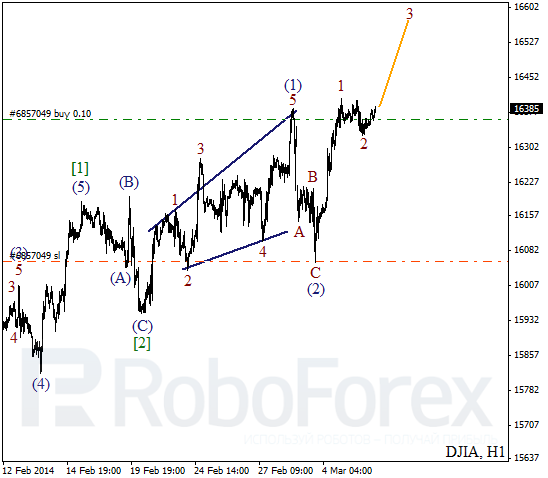
DJIA Index

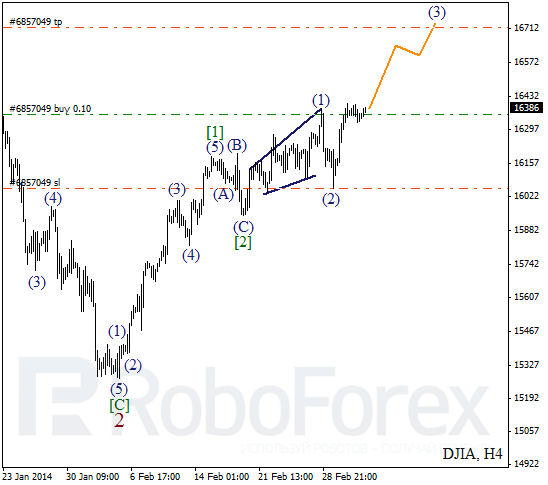
Index is still being corrected. Earlier, price completed bullish wedge pattern inside the first wave. Probably, right now Index is extending wave (3). Instrument may start new ascending movement during Thursday.

More detailed wave structure is shown on H1 chart. After completing zigzag pattern inside wave (2), Index formed bullish impulse inside wave 1. It looks like instrument is about to finish the second wave and may reach new maximums while forming the third one.

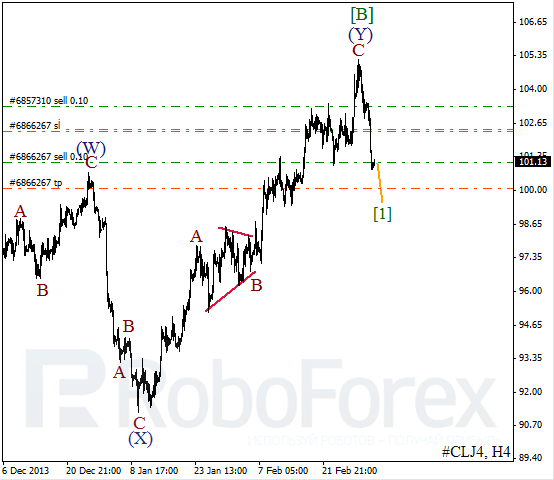
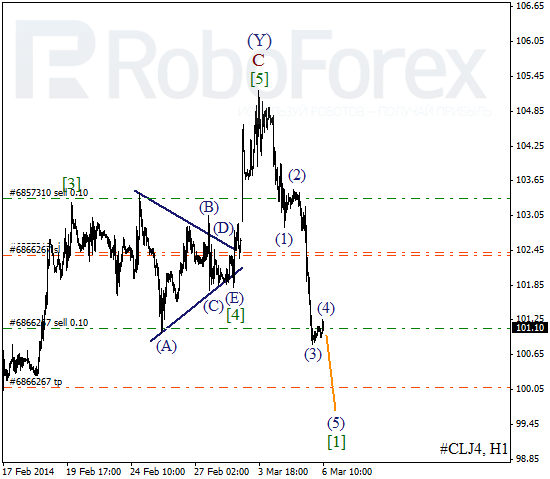
Crude Oil

Oil started forming initial impulse inside wave [1], that’s why my yesterdays’ sell order was opened just in time. Most likely, after short pause, price will continue falling down.

As we can see at the H1 chart, wave [5] of C turned out to be quite short. On minor wave level, right now price is finishing the fourth wave inside impulse [1]. During correction, I opened another sell order. Instrument is expected to start moving downwards in the nearest future.

RoboForex Analytical Department

Article By RoboForex.com

Attention!
Forecasts presented in this section only reflect the author’s private opinion and should not be considered as guidance for trading. RoboForex LP bears no responsibility for trading results based on trading recommendations described in these analytical reviews.


Posted on March 6, 2014

Fibonacci Retracements Analysis 06.03.2014 (EUR/USD, USD/CHF)

Article By RoboForex.com

Analysis for March 6th, 2014

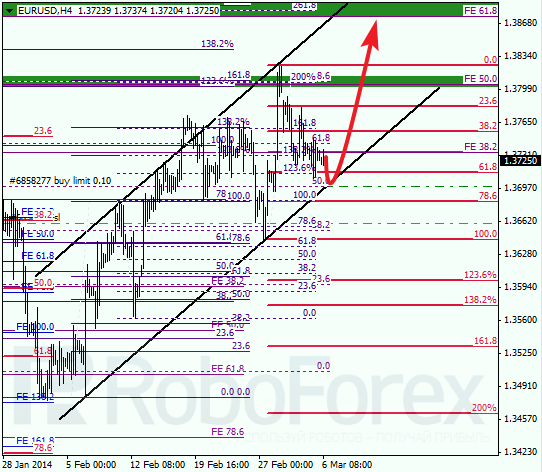
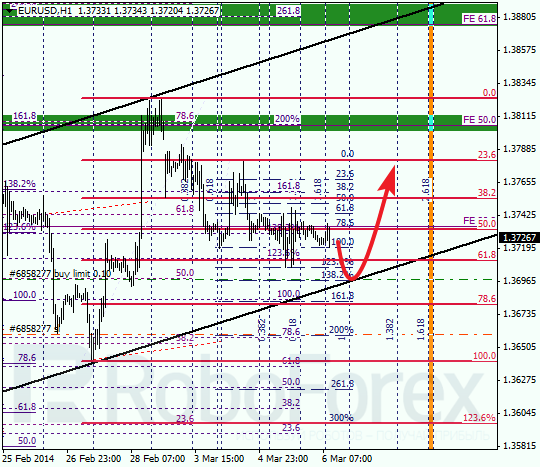
EUR USD, “Euro vs US Dollar”

Yesterday Eurodollar tried to rebound from level of 61.8%. Pair didn’t make any significant ascending movement, that’s why it may test this level once again. I’m planning to enter the market using limit order. However, if price rebounds from the channel, I’ll open several more orders.

As we can see at H1 chart, pair is moving inside flat pattern. Probably, price may start new ascending movement until the end of this week and reach its upper targets in the beginning of the next one. We should note that if price breaks the channel downwards and stays below it, I’ll close my limit buy order placed earlier.

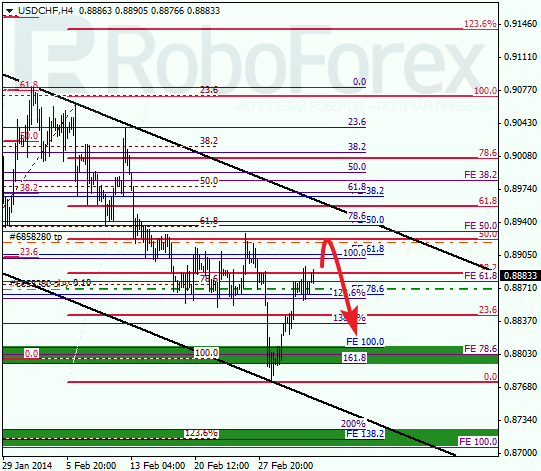
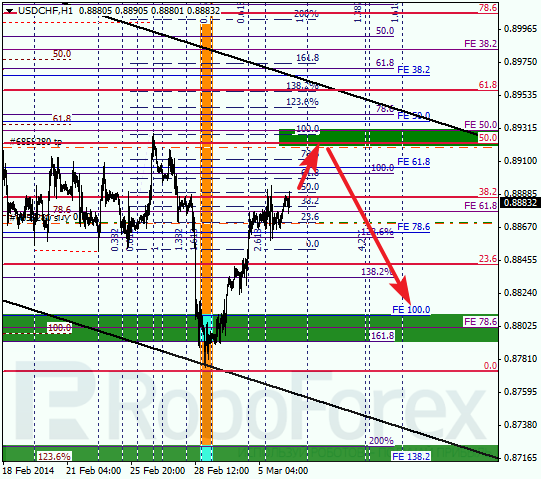
USD CHF, “US Dollar vs Swiss Franc”

After rebounding from is first target, Franc started new correction, which seems to be quite fast. I opened short-term buy order with target at level of 50%. If later pair rebounds from this level, I’ll start selling with target at latest minimum.

Franc has grown a little bit over the last 24 hours, and I’ve decided to move stop into the black. Earlier pair rebounded from the channel right inside temporary fibo-zone. Possibly, price may reach local level of 50% during the day.

RoboForex Analytical Department

Article By RoboForex.com

Attention!
Forecasts presented in this section only reflect the author’s private opinion and should not be considered as guidance for trading. RoboForex LP bears no responsibility for trading results based on trading recommendations described in these analytical reviews.


Posted on March 6, 2014

Too Late to Become a Polar Vortex Millionaire?

By WallStreetDaily.com Too Late to Become a Polar Vortex Millionaire?

From beaten down and ignored, to becoming the King of the Commodity Hill…

That pretty much sums up the transformation that natural gas has experienced over the last two years.

In April 2012, prices hit a nearly 15-year low of $1.92 per thousand British thermal units.

Fast forward to today, and – thanks to supply shortages caused by the polar vortex – prices recently topped $6.10. That’s a staggering 220% rise!

And I’m convinced prices will stay above $5 over the next three years.

After all, we’ve discovered vast domestic supplies. And demand is steadily on the rise for power generation, as well as various transportation and consumer applications.

Now, for an immediate course of action, I encourage you to check out the archives at Oil & Energy Daily. My colleague, Karim Rahemtulla, has provided continuous coverage of the natural gas sector. And he’s shown subscribers several ways to profit from the momentum in the industry.

Plus, I’ve just uncovered a unique, under-the-radar and low-risk opportunity that’s about to take off in a big way…

Drill, Baby, Drill!

In the wake of the recent price rally, interest is understandably percolating for all types of natural gas investments.

Amazingly, though, few investors have discovered this company. It’s been publicly traded since 1979, yet no traditional Wall Street analysts even cover the stock.

But they should.

It’s sitting on over 150 billion cubic feet equivalent of proven reserves. And it boasts one of the lowest cost profiles in the country.

Not to mention that it carries negligible debt. Cash flows from operations fund most, if not all, of its working interest and mineral acreage acquisition costs. The company has never diluted shareholders. And it’s paid a dividend for 50 years (and counting).

To top it off, the company sports solid insider ownership (15%), and it constantly invests in future growth.

Impressive, yes. But what’s even more compelling is the company’s unconventional business model.

Now, I just released my full research report on the stock yesterday in the March issue of WSD Insider. And it would be unfair to our subscribers if I went into any more detail at this time.

If you’re a WSD Insider, be sure to check your inbox.

If you’re not a WSD Insider, and you’d like more information about the company – including the ticker symbol of the stock – simply click here now.

Ahead of the tape,

Louis Basenese

The post Too Late to Become a Polar Vortex Millionaire? appeared first on Wall Street Daily.

Article By WallStreetDaily.com

Original Article: Too Late to Become a Polar Vortex Millionaire?

Posted on March 6, 2014March 6, 2014

Tensions in Ukraine Impacting Oil Prices

By HY Markets Forex Blog

With violence across the eastern region of Ukraine, Russia mobilized troops to the Crimea peninsula. Despite the fact that Russian President Vladimir Putin said he would use force as a “last resort,” the move has impacted many markets, including oil.

People who partake in crude oil trading should pay close attention to the situation in Ukraine, as prices are on the rise out of fears over disruption, according to the Wall Street Journal. The physical oil supply hasn’t been impacted yet, but both Nymex and Brent crude prices increased in response to Russia’s movement to Crimea.

With Russia being one of the world’s largest oil and gas producers, tensions in Ukraine escalating could have serious implications for the world’s oil market.

“For now oil prices have gained slightly but after London markets open it is possible that oil prices go up further,” Ken Hasegawa, commodities sales manager in Japan, told the news source. “The price of West Texas Intermediate oil may touch $105 in the short term.”

Putin Eased Ukraine Concerns

With Putin announcing Russia would take every action necessary to avoid the use of military force in Ukraine, worries eased, which led to a drop in oil prices in the second week of Russia’s movement in Crimea.

Following Putin’s comments, crude oil decreased nearly 2 percent, from the five-month high previously reached, as Russian troops engaged in military exercises near the Ukraine border were ordered back to the base, according to Reuters.

“The receding fears of a disruption of the Russian crude oil supply and the easing geopolitical concerns are weighing on crude,” Dwayne Pliska, senior trading consultant for HighGround trading in Chicago, Ill., told the news source.

The best possible scenario in Ukraine would be a peaceful resolution. Not only would it prevent military action, but the economy could benefit as well. If Russia is subjected to economic sanctions by the U.S. and other nations, the oil supply could be disrupted, which may put a tremendous amount of pressure of crude oil prices.

Investors should keep a close eye on the situation, because if Putin reneges on his words and continues with the military presence in Crimea, there could be some consequences for oil markets across the world.

The post Tensions in Ukraine Impacting Oil Prices appeared first on | HY Markets Official blog.

Article provided by HY Markets Forex Blog

Posted on March 5, 2014

How Much Will a 15% Hair Cut Cost Your ETF Portfolio?

By Chris Vermeulen – www.TheGoldAndOilGuy.com
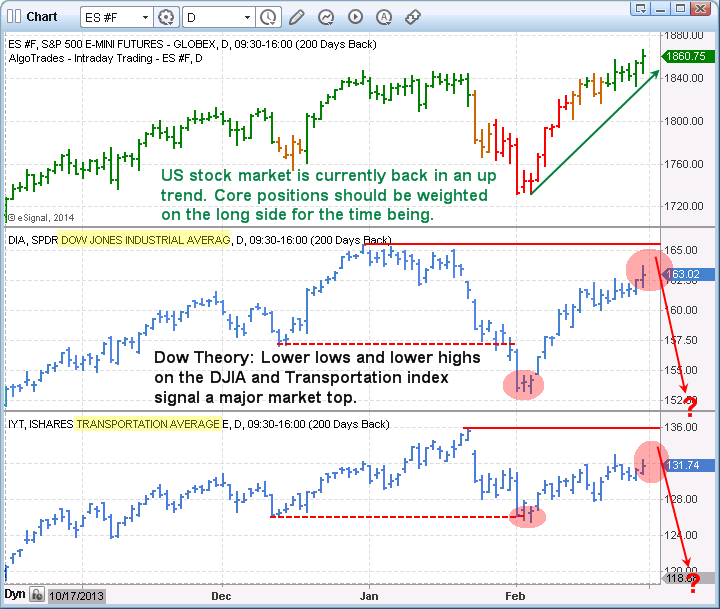
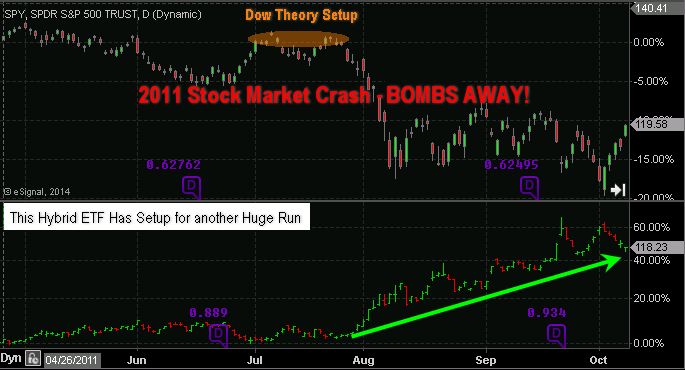
Model ETF Portfolio TradingOver the past few weeks I have been watching the DOW and Transportation index closely because it looks and feels like the Dow Theory may play out this year and the stock market could take a 15% haircut.

But what if you skipped on the haircut and opted for a 40% refund?  What? Keep reading to find out how.

Keeping this post short and sweet, I think the US stock market is setting up for a sharp selloff. And it will look a lot like the July 2011 correction. If my calculations are correct this will happen in the next 3-9 weeks and we will see a 15% drop from our current levels. Only time will tell, but I have a way to hedge against this with very little downside risk to you ETF portfolio.


The Dow Theory Live Example for ETF Portfolio

The daily chart of the SP500 index below shows our current trend analysis with green bars signaling an uptrend, orange being neutral, and red signaling bearish price action. Currently the bars are green and we can expect prices to have an upward bias.

The Dow Theory could be  in play. When both the Transports (IYT) and the Dow Jones Industrial Average (DIA) cannot make higher highs and start making lower lows, according to the Dow Theory the broad stock market is topping.

We are watching the market closely because they have both made lower highs and lows.  This rally could stall in the next couple weeks and if so we expect a 15% correction.


Model ETF Portfolio


Take a look at the 2011 Stock Market Crash

Model ETF Portfolio Trading

The chart above shows how fearful traders have a delayed reaction to moving money from stocks to a mix of risk-off assets.

The choppy market condition during August and September clearly helped in frustrating investors and created more uncertainty. This helped prices of this ETF portfolio fund rally long after the initial selloff took place. This is something I feel will take place again in the near future and subscribers of my ETF newsletter will benefit from this move.

Because we have a Dow Theory setup, our risk levels are clearly defined as to when to exit the trade if it does not play out in our favor. But with the potential to make 40% and the downside risk only being 4%, it’s the perfect setup for a large portion of our ETF portfolio. And just so you know this is not a precious metals trade as we are already long that sector and up 10% in that position already.

Get My Daily Video Forecasts & ETF Trades Today – Get Off The Fence Make Your ETF Portfolio Perform

Chris Vermeulen
www.TheGoldAndOilGuy.com


Posted on March 5, 2014

Ron Struthers: The Juniors Are Forging the Path Forward

Source: Kevin Michael Grace of The Gold Report  (3/5/14)

http://www.theaureport.com/pub/na/ron-struthers-the-juniors-are-forging-the-path-forward

Is the bear market in mining equities finally over? It looks that way, says Ron Struthers, publisher and editor of Struthers’ Resource Stock Report. In this interview with The Gold Report, Struthers explains what distinguishes this recovery from past ones: TSX Venture Exchange stocks, not the majors, are leading the way. But which juniors should investors favor? Struthers names several with proven management, ample funding and good share structures.   

The Gold Report: Back in July, you said that the bullion banks’ fractional reserve system was coming under stress. Do the big gains in gold and silver bullion this year suggest that this system is breaking down?

Ron Struthers: I believe the fractional reserve gold system has seen more stress and was probably in good part responsible for cementing the bottom in gold around $1,200/ounce ($1,200/oz). We know Germany has not even been able to repatriate the modest amounts it asked for. The gold is simply not there. The physical gold was leased or sold years ago.

We see that the gold inventories at COMEX and the bullion banks have been steadily declining for the past year. There are not too many places to turn to, if any, for physical supply. It is no secret that record amounts of physical gold have been moving into China, and India continues as a major buyer despite higher import taxes. I think that a change in the market sentiment, a belief that the bottom is in, and the large short position on the COMEX are the reasons for the recent rises in price.

TGR: Do you put any credence in the claims by the Gold Anti-Trust Action Committee (GATA) that there is an organized conspiracy by central banks and the gold and silver bullion banks to lower the prices of gold and silver?

RS: There has always been a lot of intervention in the markets by the central banks in currencies, of which gold is one. It wouldn’t surprise me if there is front running by bullion banks as well that are privy to any such action.

TGR: Do you think that we could see a divorce between physical and paper gold?

RS: I think we’ve already seen some of that. For instance, the SPDR Gold Shares (GLD) has been at about a 4% discount to the metal for the last couple of years. We’re seeing some very high premiums in Asia on the spot physical price compared to the COMEX paper price—as much as $70/oz.

TGR: The historical appeal of physical gold is that it is a real asset that cannot be duplicated endlessly, as fiat currencies can. That being the case, what is the appeal of paper gold?

RS: It depends where you are. Asians don’t think of paper gold at all. To them, it’s all physical. They buy it, keep it as savings and pass it from generation to generation. But North Americans like to trade things, to buy and sell for short-term profit, so they are more apt to buy paper gold products like futures and exchange-traded funds.

TGR: You’ve argued that quantitative easing (QE) is a ploy by the Federal Reserve to make the U.S. economy seem stronger than it really is. Does the tapering of QE indicate genuine confidence in the future, or is this another ploy?

RS: Actually, that is backward. I believe the Fed strives to make the U.S. economy look stronger than it is so it can try to reduce QE and increase confidence in the U.S. debt. If confidence existed, we wouldn’t need QE. We have QE because the Fed is the lender of last resort. There is not enough confidence from U.S. or foreign investors to fund U.S. federal government debt and real estate mortgage debt. In 2013 the Fed bought 150% more treasury debt than all foreign investors combined. Nor is there the will to reduce this debt. This lack of will is another reason for the lack of confidence.

The Fed has long been on record saying that its low interest rate policy will repair the U.S. economy, so it needs QE to maintain these low rates. And it must do all it can to demonstrate that this policy is actually helping the economy. The Fed is walking a tightrope. It knows it cannot keep QE going forever. It wants to make the U.S. economy look as good as possible to increase market confidence and to manage the debt problem and, eventually, resolve it.

TGR: David Stockman, President Reagan’s budget director, has argued that the hubris of the Fed and the U.S. Government has resulted in a situation whereby “gold could explode at any moment.” Do you agree?

RS: Yes. The whole world financial system is walking a tightrope. Structural problems and large debt loads have not been resolved, only Band-Aids applied. The longer you walk a tightrope, the greater chance of a fall, in this case, a financial fall or collapse. This would result in a big vote of confidence in certain fiat currencies and a huge flight to gold. But so much physical gold has gone to Asia, and it’s not coming back. So when investors come looking for it, there’s going to be a shortage of supply.

TGR: What is gold’s next resistance level?

RS: I’m looking at $1,360–1,370/oz.

TGR: If gold burst through $1,370/oz in the next couple weeks, would this signal a rather rapid acceleration?

RS: Yes, it could. The next level would be $1,450–1,500/oz; that could offer resistance.

TGR: Given the recent rises in gold and silver equities, is the bear market that began in April 2011 finally over?

RS: I believe it is over, but the equities have given little sign yet of a bottom or new uptrend. Gold just went above the 200-day moving average. I would say it’s probably one of the strangest markets I’ve ever seen. We’re really in unprecedented times with all the market interventions, record debt, currency wars, distortion of economic and market data, computer trading and alternate trading platforms on markets.

Looking at the NYSE Arca Gold BUGS Index (HUI) on the gold stocks, we’ve not seen much of a move yet. It looks as if my downtrend line might be broken, but we have not seen a higher high in the index since the last low.

TGR: What do the shorts tell us?

RS: I have not seen short covering in the gold stocks yet. As of Feb. 15, there were seven gold stocks in the TSX Top 20 short positions, which is pretty significant given that they have much higher short positions compared to other stocks that have a much higher number of shares outstanding. We’ve seen covering only in Osisko Mining Corp. (OSK:TSX), which is subject to a hostile takeover bid by Goldcorp Inc. (G:TSX; GG:NYSE).

Another strange thing is the S&P/TSX Venture Composite Index, which is a good measure of the junior mining explorers. Typically, the juniors follow the seniors or producers: the trickle-down effect. Once the bigger stocks do well, the little guys start to follow. In the past 12 months, however, the TSX Venture Index is down about 10%, while the NYSE Arca Gold BUGS Index is down more than 30%.

This time around, the TSX Venture is leading the way up. It broke through the 200-day moving average in early January. It tested that in early February, and now it has broken clearly to the upside, a second higher high above 1,000. The 200-day moving average has started to turn up as well.

TGR: Do you think that all the bad press that the majors have gotten for bad decisions, inefficiency, bloated projects, etc., has caused this anomaly?

RS: Somewhat. The producers’ margins were hit pretty hard by the gold price decline. For junior explorers, however, $1,200–1,300/oz gold is still pretty good if an explorer makes a discovery. On the other hand, while the producers have struggled with rising costs, this bear market has cut the cost of exploration probably almost in half because of falling demand for related goods and services.

TGR: What qualities do you look for in junior explorers?

RS: I’m sticking with companies that have proven management, ample funding and/or good share structures, so they can still raise funds. Diversification is a good approach for investors.

TGR: After the gold price collapse last year, there was a renewed emphasis on the importance of high grade. How crucial is this?

RS: Grade is always important but becomes more so as the price of gold falls.

TGR: What are some companies leading the way in high grade?

RS: Roxgold Inc.’s (ROG:TSX.V) recent preliminary economic assessment at its Yaramoko project in Burkina Faso is projecting a metal grade of 11.9 grams per ton (11.9 g/t) in the first five years. That results in a low cash cost of just $455/oz, a high 47.7% internal rate of return and only a 1.4-year payback on initial capital. So you can see the big effect there.

TGR: Yaramoko’s initial capital expenditure is only $93.8 million ($93.8M). Isn’t that quite low?

RS: Yes.

Eastmain Resources Inc.’s (ER:TSX) Eau Claire deposit in Canada has at least 1.5–3 million ounces (1.5–3 Moz) and a grade higher than 3 g/t. The open-pit resource is 635,000 ounces (635 Koz) at 4.67 g/t, and the underground is 145 Koz Measured and Indicated at 6.3 g/t. These are attractive numbers. Goldcorp already owns almost 9% of Eastmain.

Richmont Mines Inc. (RIC:TSX; RIC:NYSE.MKT) produces good grades but has seen a temporary rise in production costs because its grade declined from about 5.5 g/t to 4.5 g/t. That had quite an effect on its earnings. But I think these numbers will soon reverse, which should make for a good turnaround there. The company is driving down a ramp to produce from its Island Gold Deep deposit in Canada. In late January, it updated that resource to 169 Koz Indicated at 11.5 g/t, with almost 1 Moz in the Inferred at 9.29 g/t. Again, very good grades.

TGR: Of the companies looking to improve grade, which stand out?

RS: A couple. We picked up Mandalay Resources Corp. (MND:TSX) at a good price in November because I like its Costerfield mine in Australia. It has gold grades: more than 9 g/t with 4% antimony on top. Its other mine, Challacollo, in Chile, has a very good silver grade.

TGR: Challacollo was a recent purchase, correct?

RS: Yes. It has a very good silver grade of 209 g/t with 2.28 g/t gold along with it. The company is very profitable, reporting net income of $29M for 2013. That’s $0.09/share, and it is paying a good dividend, too.

SilverCrest Mines Inc. (SVL:TSX; SVLC:NYSE.MKT) has been a great growth story with its Santa Elena mine in Mexico. It has been very profitable even at lower silver prices, and it put its profits into growth and expansion. The company’s 3,000 ton per day (3,000 tpd) mill is almost complete, and it will soon start producing underground reserves.

TGR: How will this affect grade?

RS: The gold grade should remain about 1.6 g/t, but the silver grade should double, to well over 100 g/t. The company’s future is brightened by two other advanced projects. It looks to duplicate Santa Elena’s success at its La Joya project, again using a starter open pit. Its Cruz de Mayo project is just 35 kilometers (35km) from Santa Elena. With 2.3 Moz Indicated and more than 12 Moz Inferred, it could heap leach there and possibly ship the high grade to the Santa Elena mill.

TGR: Let’s talk about companies that have gained greatly in price recently but, in your opinion, still have room to grow.

RS: One that stands out is Avino Silver & Gold Mines Ltd. (ASM:TSX.V; ASM:NYSE.MKT; GV6:FSE). It rose from a bottom of $0.75/share in July to more than $3/share recently. It continues to expand production at its historic Avino project in Mexico, which was relaunched last year. Around year-end 2014, it will add a third circuit to production from the historic Avino mine. That will increase the mill run rate from 500 tpd to 1,500 tpd. Currently, most of production is from the nearby San Gonzalo mine. Its grade is high, recently processing gold at 1.98 g/t and silver at 358 g/t. That results in a low cash cost of under $7/oz silver equivalent.

TGR: With the recent tax-regime changes, there has been a lot of negativity about Mexico of late. What’s your view?

RS: I think the concern is somewhat overrated. Governments always want a bigger piece of the pie. Mexico retains a stable mining regime, a good labor force and infrastructure, and relatively low costs. I think the mining companies can live with the new tax regime.

TGR: Moving on to Nevada, now that Rye Patch Gold Corp. (RPM:TSX.V; RPMGF:OTCQX) has gotten $10M in its settlement with Coeur Mining Inc. (CDM:TSX; CDE:NYSE), does this gives it what it needs to find high grade there?

RS: It was a nice deal. Rye Patch also has a net smelter royalty (NSR) from Coeur, which will generate about $8M annually for the next three years. This should enable Rye Patch to explore actively. I think the bigger story is that the company already has a 1+ Moz resource it can expand on. Its properties are located very close to producing mines.

I’m not so concerned about grade there, as Nevada remains one of the lowest-cost gold jurisdictions. It’s all about the heap leach and good infrastructure. If Rye Patch could deal one or two projects to next-door majors, that could reward shareholders very nicely.

TGR: Is Rye Patch a possible takeout target?

RS: If it were able to grow one of these deposits substantially, I would say so. I think the company would more likely deal one of its projects with either a coproduction agreement or another NSR royalty.

TGR: Which explorers do you like in Nevada?

RS: Asher Resources Corp. (ACN:TSX.V) is fully funded for 2014. There were high expectations for its first drill program at its King property. It did not hit the big hole on the first round, but a lot was learned. It ended up drilling a halo of porphyry, so the real target is likely off to the left of the high induced polarization (IP). It appears it drilled under the gold structure on another target there, despite some good hits in two holes. Before a second round at King, it is drilling three holes on its Lavington gold project in British Columbia.

TGR: Which Canadian explorers do you like?

RS: TerraX Minerals Inc. (TXR:TSX.V). In the past six months it acquired the advanced-stage Northbelt gold property in the Northwest Territories. That had seen previous drilling of 463 holes, with about 25 gold zones, many with some pretty good high-grade numbers. The company has been reassaying previous drill holes and compiling the historic data ahead of a drill program planned for this summer. It has raised ample funding.

Zonte Metals Inc. (ZON:TSX.V), which has a unique group of projects in Newfoundland. It is also focusing on Colombia, and I expect acquisitions could be announced any time. It has a good share structure and strong insider backing. I don’t think it will have any trouble funding a new acquisition.

TGR: What else stands out in Colombia?

RS: Colombian Mines Corp. (CMJ:TSX.V) is well funded with about $4M. Its El Dovio project saw good drill results last year, with 16.8 g/t over 6.85 meters (6.85m). It has a number of other projects in Colombia, including Yarumalito, a joint venture with Teck Resources Ltd. (TCK:TSX; TCK:NYSE) that Teck is funding. Colombia remains one of the best jurisdictions for exploration. It has the oldest, most stable democracy in South America. It remains underexplored, even though it was once the world’s leading gold producer.

TGR: How about Mexico?

RS: Mammoth Resources Corp. (MTH:TSX.V) is funded for 2014 on its Tenoriba project. This shows high-grade gold and silver on surface and good drill results from a 2008 program that included 45 g/t over 1.9m. It is planning some IP and magnetic surveys over four main targets and some road development that could cut zones ahead of a drill program.

Another I’ve looked at lately is Tosca Mining Corp. (TSQ:TSX.V). Its Carol copper-gold project is just 5km from the Piedras Verdes copper mine, the third largest in Mexico, which produces 70 million pounds annually. Invecture Group got this from Frontera Copper, which it bought and took private.

Invecture bought out Kimber Resources Inc. late last year, as well as Vista Gold Corp.’s (VGZ:TSX; VGZ:NYSE.MKT) Los Cardones project. I think Tosca is probably its next target. Invecture has staked all the available ground around Tosca’s project. Carol has seen excellent trench results, including 1.9% copper, 19% zinc, 0.93% lead, 36 g/t silver and 0.59 g/t gold over 10m. Its upcoming drill program should prove quite interesting.

TGR: Any other gold explorers you could mention?

RS: Garibaldi Resources Corp. (GGI:TSX.V) has done much better than many juniors. It was funded throughout the downturn by a big block of Paramount Gold and Silver Corp. (PZG:TSX; PZG:NYSE.MKT) shares it held. It has advanced a number of its projects: La Patilla, Tonichi, Iris and Rodadero in Mexico and Grizzly in Canada. The company is awaiting drill results from La Patilla and has pretty high expectations for good numbers based on previous exploration.

TGR: And there is a uranium junior you’re sweet on, correct?

RS: Yes. Zadar Ventures Ltd. (ZAD:TSX.V) is well funded by two recent financings. It has an advanced portfolio of projects in the prolific Athabasca Basin. Its management has a proven record of uranium discovery in the basin. Its geologist, Kieran Downes, is the former vice president of exploration with Cameco Corp. (CCO:TSX; CCJ:NYSE). And its PNE project is adjacent on trend to the recent significant Patterson Lake discovery.

TGR: Given how depressed the junior sector has been since 2011, seeing the TSX Venture leading the way, as you put it, has to be pretty encouraging, no?

RS: I agree. We’ve had a brutal downturn and washout. For almost two years, the market had little access to capital. This resulted in share consolidations, mergers and many companies disappearing. Now we’re seeing some momentum. This could be the start of quite a turnaround.

TGR: Ron, thank you for your time and your insights.

Ron Struthers founded Struthers’ Resource Stock Report 20 years ago. The report covers senior and junior companies with ample trading liquidity.

Want to read more Gold Report interviews like this? Sign up for our free e-newsletter, and you’ll learn when new articles have been published. To see a list of recent interviews with industry analysts and commentators, visit our Streetwise Interviews page.


DISCLOSURE:
1) Kevin Michael Grace conducted this interview for The Gold Report and provides services to The Gold Report as an independent contractor. He or his family own shares of the following companies mentioned in this interview: None.
2) The following companies mentioned in the interview are sponsors of The Gold Report: Mandalay Resources Corp., Roxgold Inc., Richmont Mines Inc. SilverCrest Mines Inc. and Rye Patch Gold Corp. Goldcorp Inc. is not affiliated with The Gold Report. Streetwise Reports does not accept stock in exchange for its services or as sponsorship payment.
3) Ron Struthers: I or my family own shares of the following companies mentioned in this interview: Asher Resources Corp., Avino Silver & Gold Mines Ltd., Colombian Mines Corp., Eastmain Resources Inc., Mammoth Resources Corp., Richmont Mines Inc., TerraX Minerals Inc., Tosca Mining Corp., Zadar Ventures Ltd. and Zonte Metals Inc. I personally am or my family is paid by the following companies mentioned in this interview: None. My company has a financial relationship with the following companies mentioned in this interview: None. I was not paid by Streetwise Reports for participating in this interview. Comments and opinions expressed are my own comments and opinions. I had the opportunity to review the interview for accuracy as of the date of the interview and am responsible for the content of the interview.
4) Interviews are edited for clarity. Streetwise Reports does not make editorial comments or change experts’ statements without their consent.
5) The interview does not constitute investment advice. Each reader is encouraged to consult with his or her individual financial professional and any action a reader takes as a result of information presented here is his or her own responsibility. By opening this page, each reader accepts and agrees to Streetwise Reports’ terms of use and full legal disclaimer.
6) From time to time, Streetwise Reports LLC and its directors, officers, employees or members of their families, as well as persons interviewed for articles and interviews on the site, may have a long or short position in securities mentioned and may make purchases and/or sales of those securities in the open market or otherwise.


Streetwise – The Gold Report is Copyright © 2014 by Streetwise Reports LLC. All rights are reserved. Streetwise Reports LLC hereby grants an unrestricted license to use or disseminate this copyrighted material (i) only in whole (and always including this disclaimer), but (ii) never in part.


Streetwise Reports LLC does not guarantee the accuracy or thoroughness of the information reported.


Streetwise Reports LLC receives a fee from companies that are listed on the home page in the In This Issue section. Their sponsor pages may be considered advertising for the purposes of 18 U.S.C. 1734.


Participating companies provide the logos used in The Gold Report. These logos are trademarks and are the property of the individual companies.


101 Second St., Suite 110
Petaluma, CA 94952

Tel.: (707) 981-8999
Fax: (707) 981-8998
Email: [email protected]


Posted on March 5, 2014

The Best Investment Opportunity of Your Lifetime: China

By MoneyMorning.com.au

In your lifetime you’ll have many chances to make money.

That’s why we advise investors not to make rash decisions.

It’s why we say that if you miss a stock rally, don’t panic, just wait for the next one.

However, while stocks rise and fall on a daily basis, there are some opportunities you can’t afford to miss. Because depending on your age, some opportunities will never appear again in your lifetime.

One of those opportunities is here right now. And it’s so rare that it’s fair to call it the Halley’s Comet of investment opportunities…

If you know anything about astronomy, you’ll know that Halley’s Comet passes through the solar system past the Earth roughly every 75 years.

The last time it showed up was in 1986.

It’s not due to reappear until 2061. A child born today will be middle-aged by the time Halley’s Comet next arrives.

And the investment opportunity before you today is similarly a rare event.

The Dot-com Boom Was a Blip Compared to This

When we’re talking about the Halley’s Comet type investment opportunities, we’re talking about the big investing megatrends.

Those are investing themes that can last for an entire generation. By that we mean for perhaps 20, 30 or 40 years. We’re not talking about something as brief as the dot-com boom.

And we’re not talking about the brief two year trend that was the dividend stock rally.

This is something much bigger. This megatrend started around 2003. It has had what will turn out to be a brief setback that has lasted off and on from 2011 through to today. But this megatrend is set to resume its extraordinary growth path.

By now you’ve probably figured it out. It’s China.

Take this report from the BBC yesterday:

‘China announced a growth target of 7.5% and revealed plans to raise its defence budget by 12.2%, as it opened its annual parliament session in Beijing.‘

That one sentence says it all.

Whatever your view on China, there’s no denying that 7.5% annual growth is huge. As we’ve mentioned before, at that rate China’s economy will double in size within the next nine years.

It’s one thing for a small underdeveloped economy to double in size in nine years. It’s something else for the world’s second biggest economy to do the same thing.

To put that into context, based on the current growth rate of 2.8% it will take the Aussie economy more than 25 years to double in size. It’s a mind-boggling comparison.

Perhaps now you can grasp the scale and importance of this megatrend.

Your Chance to Invest in the ‘new America’

That’s why investors need to understand the China story today. The fact that the growth rate is so amazing underlies the rare nature of this opportunity.

If developing nations of this size doubled their economy at the same rate all the time then it wouldn’t be such a big deal.

But it doesn’t happen all the time. The best way of putting this into perspective is to say that investing in China today is like having the foresight to invest in Japan in the 1950s, the US in the 1880s, or Britain in the 1740s.

And because these events are so rare it means you have to make the most of them when they appear. You need to make sure that you don’t end up looking back on today and regretting a huge missed opportunity.

The best thing about this is that it won’t just be a resource boom. If it was, that would be good enough. After all, the demand for Aussie resources over the next nine years will dwarf anything seen so far. After a long drought resource investors will get a reward for their patience.

But it will be more than that.

It will be a technology boom. A services boom. A manufacturing boom. And perhaps most interestingly, a military boom.

It’s the last of which that we’re keen to discuss with military technology expert Byron King. He’s in town from the US at the end of this month to present at the World War D conference in Melbourne.

The Biggest Boom The World Has Ever Seen

Doubtless as China’s economy grows the central government will seek to increase the size and power of its military.

Wealthy nations always do that. China will seek to increase its influence overseas, and maintain control at home.

So from an investing angle the next stage of China’s boom years will be about so much more than just iron ore, copper, oil and natural gas. It will be about consumer electronics, high tech weapons systems, telecommunications, healthcare, and transport.

It would be easy to look at China and say that China already has all these things – skyscrapers, bullet trains, mobile phones, and millions of new cars sold every year.

But remember – and make sure this sinks in – China’s economy is set to double within nine years. If it does the country will need to create in nine years the same size economy that until today has taken over one thousand years.

That will be a huge achievement.

But it’s also an example of the impact that new technology is having on the world’s economies.

In a way, talking about China like this may come across as a bit of a cliché. But anyone who thinks the China boom has ended is missing out on the chance to buy into a booming market.

We won’t say that the boom has only just begun (that would be a cliché), but we will say that the biggest and most spectacular phase of the boom hasn’t even started. When it does it will result in the biggest investment megatrend this generation of investors has ever seen and likely ever will see.

In the weeks and months ahead we’ll fill you in on our plans to help you profit from this boom as it happens. Stay tuned.

Cheers,
Kris+

Special Report: Three Aussie Miners Set to Lead the Resource Sector’s Epic Comeback

Join Money Morning on Google+


By MoneyMorning.com.au

Posted on March 5, 2014

‘Doctor EROEI’ Was Wrong

By MoneyMorning.com.au

‘For some years now,‘ Tim Morgan writes in Life After Growth, ‘global average EROEIs have been falling, as energy resources have become both smaller and more difficult (meaning energy-costly) to extract.‘

You may have heard of this concept called energy return on energy invested (EROEI). It looks at how much energy we expend in relation to how much energy we extract. Some, like Morgan, think this is very important.

Consequently, falling EROEIs have become the basis of a variety of dire forecasts…

In these scenarios, we spend more and more energy just getting energy, and we have less and less for other discretionary items. As Morgan writes, ‘If EROEI falls materially, our consumerist way of life is over.‘

I’m writing to you today to slay this flawed EROEI concept.

I have to say I used to be taken in by this argument. I wrote a C&C issue a couple of years back with the headline ‘Crack This Code: EROEI – Why It Matters Now and What to Do About It.‘ I included a list of approximate EROEI ratios for various energy sources:

  • 1970s oil and gas discoveries: 30-to-1
  • Current conventional oil and gas discoveries: 20-to-1
  • Oil sands: 5-to-1
  • Nuclear: 4-to-1
  • Photovoltaic: 4-to-1
  • Biofuel: 2-to-1.

I noted that such ratios were falling and concluded that a lower mix of EROEI sources means higher prices for many commodities, because it will take more energy to produce them.

It means nothing of the kind.

I would like to right my old error and convince you why EROEI is fatally flawed, so you don’t fall for it. I’ll use Morgan as the foil, because he is an articulate and strong proponent of the idea in his new book.

Morgan’s crucial assumption appears on page five: ‘The economy is not primarily a matter of money at all. Rather, our economic system is fundamentally a function of surplus energy.‘

This is the key to the whole EROEI argument. Morgan repeats it often. And it is completely wrong.

You can’t take money out of the equation! Money is what it’s all about. It is the essence of the economic life. It’s at the centre of decision making. As economist Hyman Minsky said, ‘Money isn’t everything. It is the only thing.‘

Be sceptical of anything that seeks to analyse our economy by taking money out. Households and firms make decisions based on money. They certainly don’t use EROEI, nor should they.

When a firm decides to drill a well or not, it does so on the basis of estimated costs and profits. It makes a decision based on some expected return — as measured in money. They are not the same. High-EROEI projects can be losers. Low-EROEI projects can be winners — as measured in profits and return on investment in money terms.

According to Morgan’s logic, you wouldn’t bother generating electricity…

Here is Robin Mills, currently with Manaar Energy (and once a petroleum manager for the Emirates national oil company in Dubai):

‘Generating electricity, usually at a thermal conversion efficiency of less than 50% plus transmission losses, has an EROEI of much less than 1, but is still rational and economic because electricity is such a useful form of energy.‘

Put another way, the money costs of the inputs are less than the money prices of the outputs. It works because…it’s profitable! People value electricity more than they value the inputs. Looked at through an EROEI lens, though, it doesn’t make sense.

You can build any scary resource scenario you want if you exclude money prices. If, say, falling ore grades were predictive of prices, then we would see continually rising prices for copper and other resources. Clearly, this isn’t the case. But this does not prevent people (usually geologists) from taking these moneyless concepts to make economic forecasts of higher prices.

A general rule of thumb: If it doesn’t take into account money prices, then it isn’t about the real-world economy as it exists today.

That’s my biggest objection to EROEI. But I’m not making a comprehensive case against EROEI here. That would take too long. I won’t get into how EROEI is calculated: there is no agreement and when you think about it, maybe it’s impossible to know with any accuracy worth relying on.

In the end, I think Morgan doesn’t really get modern money. He repeats an old myth about its origins. He doesn’t seem to know why fiat currency has value. (He says money is a ‘claim on real goods and services,‘ which only begs the question: Why do people accept dollars in exchange for real goods?) He doesn’t seem to understand the primacy of making a monetary profit in a market economy.

Contrary to Morgan, you can’t take money out and hope to understand the modern economy. You have to study money. And in markets, you have to make a money surplus (a profit) — or you are out of the game before long. I can’t say the same is true for EROEI, which is perhaps the best I can say against it.

You can ignore EROEI, but you can’t ignore money.

Chris Mayer,
Contributing Editor, Money Morning

Ed note: The above article was originally published in Daily Resource Hunter.

Join Money Morning on Google+


By MoneyMorning.com.au

Posts pagination

Previous page Page 1 … Page 39 Page 40 Page 41 … Page 46 Next page

Archives

  • June 2018
  • June 2014
  • May 2014
  • April 2014
  • March 2014
  • February 2014
  • January 2014
  • December 2013
  • November 2013
  • October 2013
  • September 2013
  • August 2013
  • July 2013
  • June 2013
  • May 2013
  • April 2013
  • March 2013
  • February 2013
  • January 2013
  • December 2012
  • November 2012
  • October 2012
  • September 2012
  • August 2012
  • July 2012
  • June 2012
  • May 2012
  • April 2012
  • March 2012
  • October 2011
  • January 2010
  • August 2008
All Rights Reserved Copyright CountingPips.com

Risk Disclosure - Blog Disclosure - Terms of Use - Privacy Policy
Risk Disclosure: Foreign Currency trading and trading on margin carries a high level of risk and can result in loss of part or all of your investment. Due to the level of risk and market volatility, Foreign Currency trading may not be suitable for all investors and you should not invest money you cannot afford to lose. Before deciding to invest in the foreign currency exchange market you should carefully consider your investment objectives, level of experience, and risk appetite. You should be aware of all the risks associated with foreign currency exchange trading, and seek advice from an independent financial advisor should you have any doubts. All information and opinions on this website are for general informational purposes only and do not constitute investment advice.
Proudly powered by WordPress
We use cookies to ensure that we give you the best experience on our website. Use of our website is governed by our Privacy Policy & Terms of Use.